1975 Roosevelt Dime Coin Value: How Much Is It Worth?
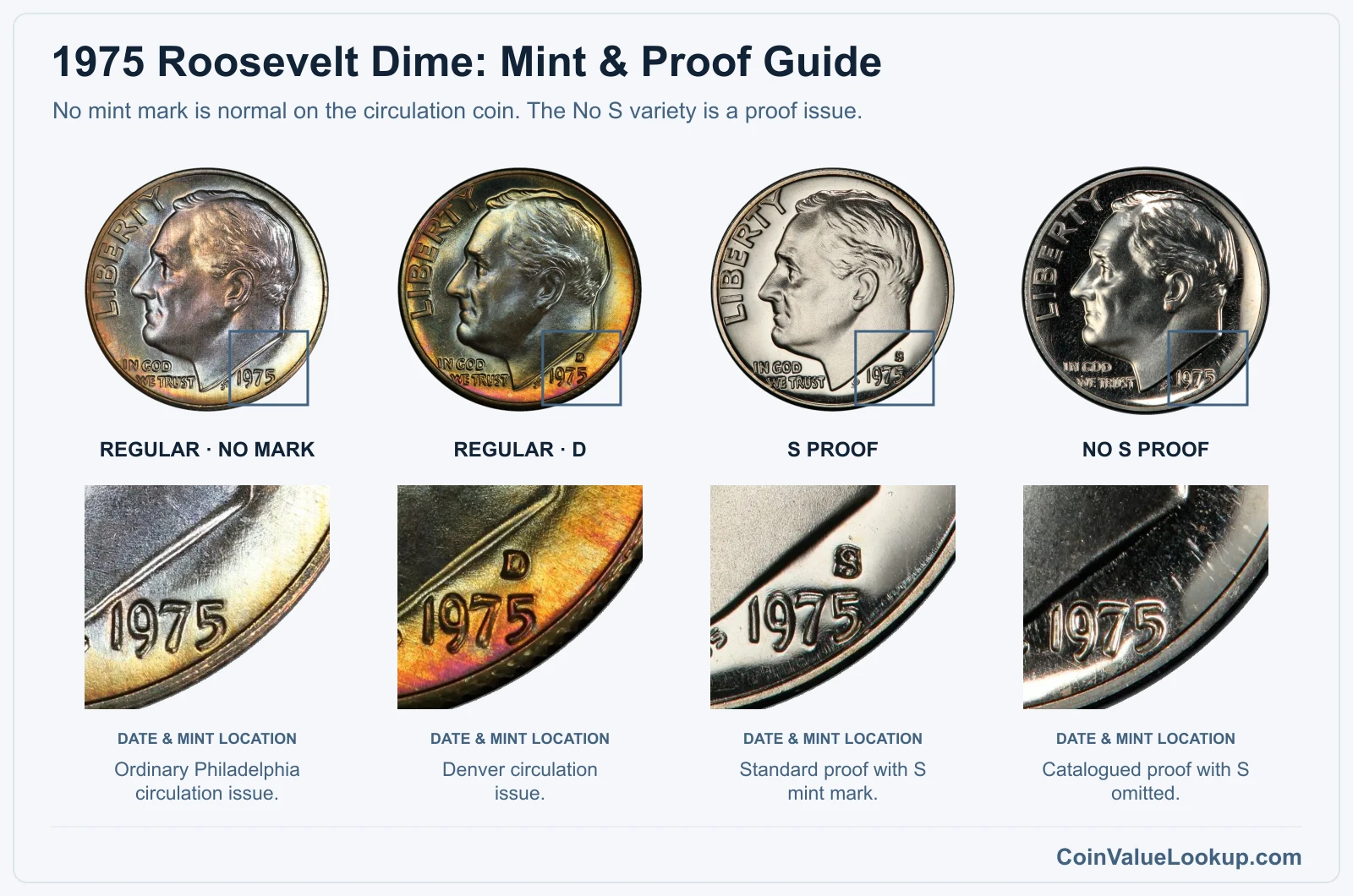
Most 1975 Roosevelt dimes you find in pocket change are worth face value — ten cents, no more. In uncirculated condition around MS 65, a USA Coin Book guide lists both the no-mintmark and Denver issues at about $2.79.
Standard S proofs sit near $3.08 at PR 65. The real action is in a handful of scarce varieties and authenticated errors, where a single confirmed specimen has sold for six figures.
Fast Way to Identify Your 1975 Roosevelt Dime
Snap clear photos of the front and back of your 1975 dime and upload them to our identifier for a preliminary look. This helps narrow down the mintmark, finish and any visible oddities.
It is not a substitute for professional authentication or grading, but it is a solid first step before you decide whether to send your coin in for certification.
1975 Roosevelt Dime Value
Upload both sides of your 1975 Roosevelt Dime.
Front Obverse
Upload photo
Back Reverse
Upload photo
Which 1975 Roosevelt Dime Versions Are Worth Money?
- The 1975 No S Proof is spectacularly rare — only two are reported known, and one sold for $506,250 at PR 67 CAC in October 2024.
- Uncirculated business strikes with strong, fully separated torch bands can carry a premium over flat-band examples at the same grade.
- S proofs with clean, undisturbed mirror fields and genuine cameo contrast are worth examining closely for quality.
- A 1975-D struck on a copper planchet brought $1,920 in October 2022 at MS 62 — an authenticated wrong-planchet error.
- Double curved clip errors on no-mintmark strikes have sold modestly but confirm the date is collected for mint mistakes.
- A 1975-S/S repunched mintmark variety has been reported and is worth checking under magnification.
Step 1: Identify Your 1975 Roosevelt Dime Mint Mark and Version
Start by confirming the 1975 date on the obverse, Roosevelt's portrait facing left, and the torch-and-branches reverse. That is your Roosevelt dime.
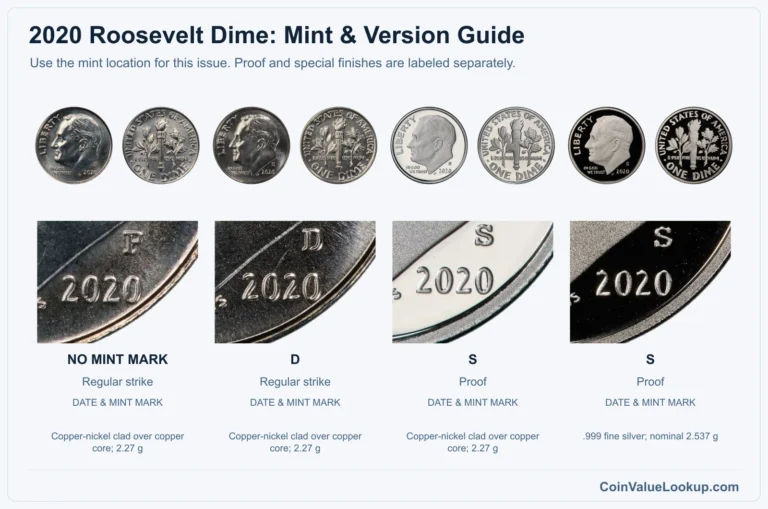
Next, check for a mintmark. Look on the obverse near the date.
A "D" means Denver. An "S" means a San Francisco proof.
No mintmark at all means a regular business strike — but here is where it gets tricky.
San Francisco also helped produce no-mintmark circulation dimes in 1975, so you cannot tell which facility made a particular no-mark coin just by looking at it. The material on all normal 1975 dimes is copper-nickel clad over a copper core, weighing about 2.27 grams and measuring roughly 17.9 mm across.
There is no standard silver version for this year.
The critical distinction is between an ordinary no-mintmark business strike and the extremely rare No S proof. A proof coin has mirror-like fields and sharp, squared-off rims from a special striking process.
If your coin simply lacks a mintmark and shows normal circulation wear, it is a regular business strike, not the valuable proof variety.
Step 2: Check Your 1975 Roosevelt Dime Grade
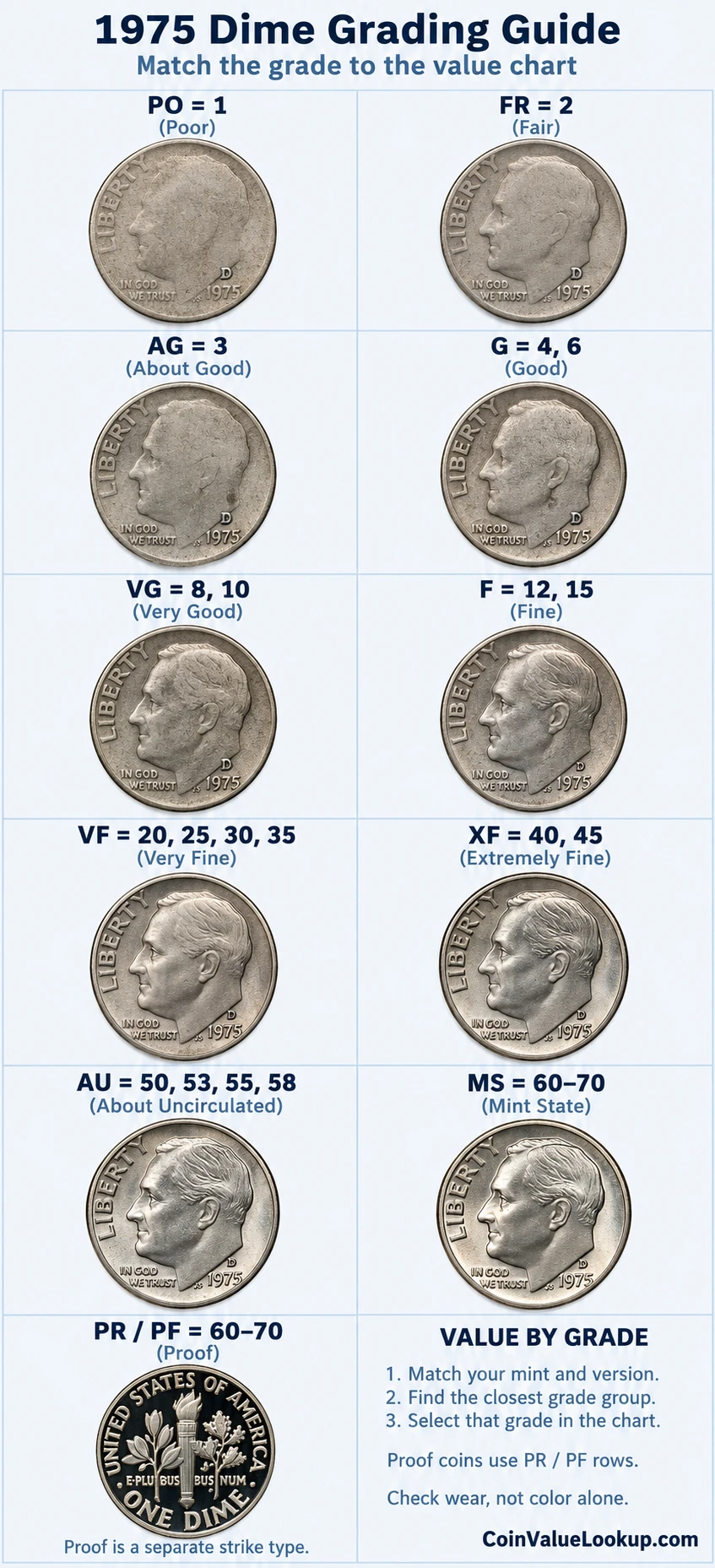
Focus first on Roosevelt's cheek and jawline — these are the highest points and show wear earliest. Then check the hair detail above the ear, which softens quickly in circulation.
On the reverse, examine the horizontal bands on the torch. When both pairs of bands show full, clean separation, the coin may qualify for a Full Bands designation, which is a strike characteristic rather than an error.
The leaves flanking the torch also lose detail as the coin wears.
Use the comparison image to gauge where your coin falls. A coin with complete original luster and no contact marks is heading toward Mint State territory.
One with slight rub on the cheek but otherwise sharp detail is likely About Uncirculated.
Do not confuse a weak strike with actual wear. A weakly struck coin may lack band separation even in high grade.
Also watch for cleaning, scratches and corrosion — these hurt value regardless of how little wear is present. Proof coins get their own scale; judge them by the quality of the mirrored fields and any hairlines or haze, not by the same wear checkpoints used for business strikes.
Step 3: Check 1975 Roosevelt Dime Value by Mint and Version
1975 Roosevelt Dime — No Mintmark Business Strike
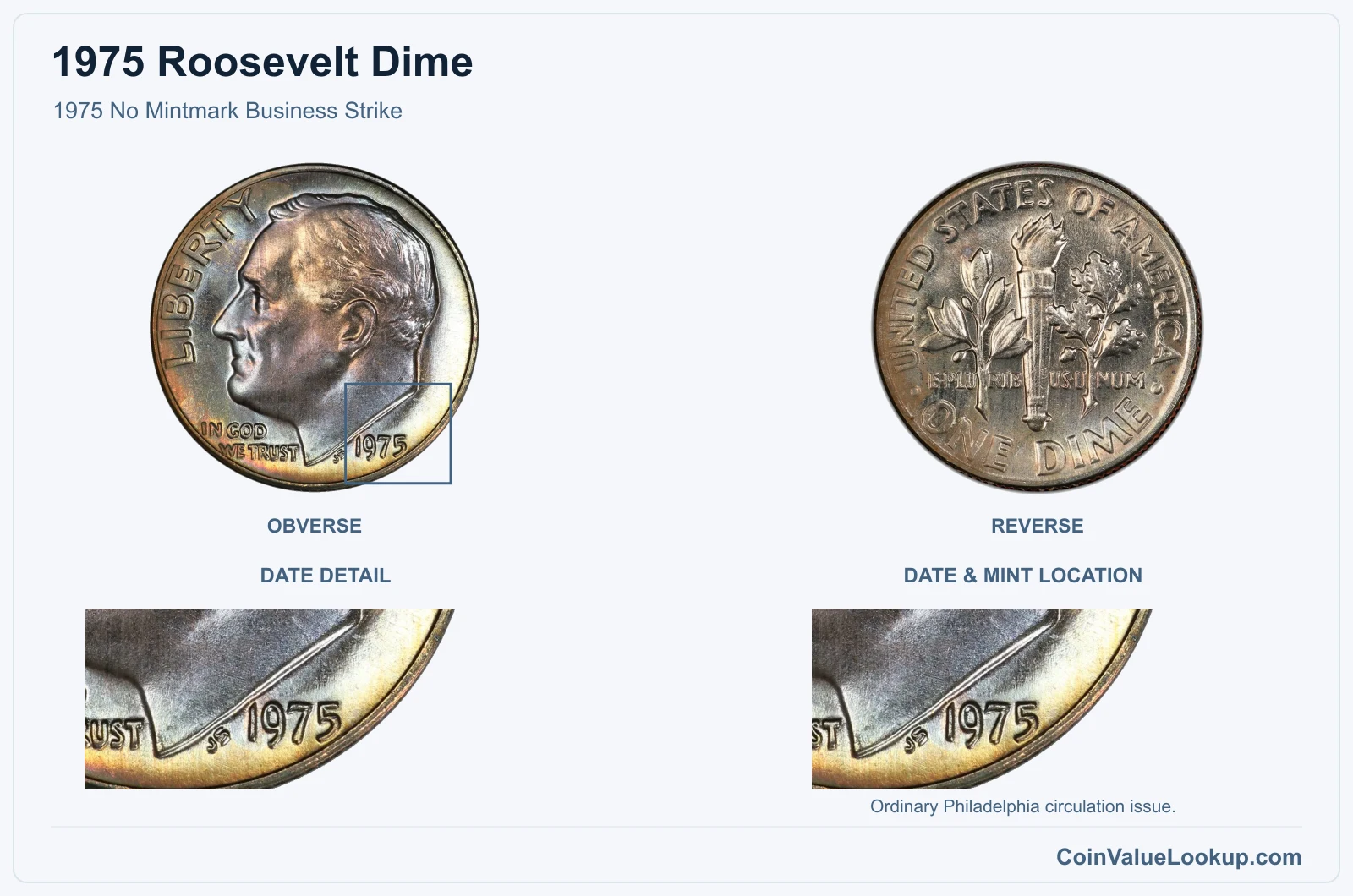
The 1975 no-mintmark Roosevelt dime is the most common version you will encounter. It is copper-nickel clad over a copper core, struck for general circulation.
At MS 65, the USA Coin Book guide lists it around $2.79. In worn condition, it is a spender.
San Francisco helped produce no-mintmark business dimes this year alongside Philadelphia, so the absence of a mintmark tells you nothing about which facility struck your coin. Do not confuse this ordinary issue with the No S proof — that is a completely different animal with proof surfaces and squared rims.
A normal business strike pulled from circulation is not rare.
Range Grade
Price Auction Records Appraisal PO PO 1
—
Coin Identifier FR FR 2
—
Coin Identifier AG AG 3
—
Coin Identifier G G 4
—
Coin Identifier
G 6
—
Coin Identifier VG VG 8
—
Coin Identifier
VG 10
—
Coin Identifier F F 12
—
Coin Identifier
F 15
—
Coin Identifier VF VF 20
—
Coin Identifier
VF 25
—
Coin Identifier
VF 30
—
Coin Identifier
VF 35
—
Coin Identifier XF XF 40
—
Coin Identifier
XF 45
—
Coin Identifier AU AU 50
—
Coin Identifier
AU 53
—
Coin Identifier
AU 55
—
Coin Identifier
AU 58
Coin Identifier MS MS 60
—
Coin Identifier
MS 61
—
Coin Identifier
MS 62
Coin Identifier
MS 63
Coin Identifier
MS 64
Coin Identifier
MS 65
Coin Identifier
MS 66
Coin Identifier
MS 67
Coin Identifier
MS 68
—
—
—
MS 69
—
—
—
MS 70
—
—
—
1975 Roosevelt Dime — D Business Strike
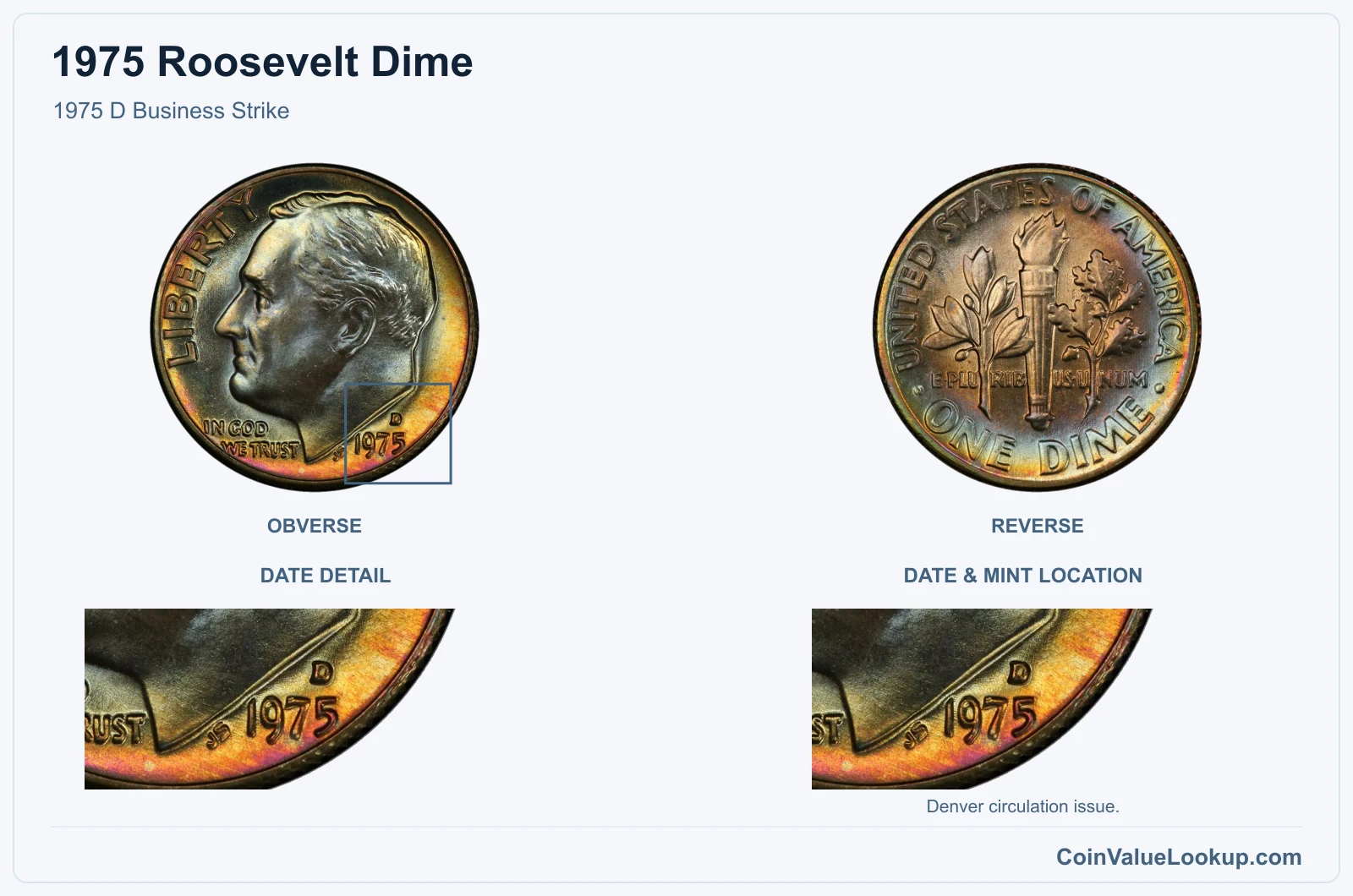
Denver's 1975-D dime carries a small "D" mintmark on the obverse near the date. Same copper-nickel clad composition, same 2.27-gram weight.
At MS 65 the guide value is about $2.79, identical to the no-mintmark issue.
In circulated grades, it is worth face value. If you have a nice uncirculated example with clean fields and fully separated torch bands, it is a pleasant coin to keep but not a windfall.
The Denver mint churned these out in large numbers, so finding one in pocket change is routine.
Range Grade
Price Auction Records Appraisal PO PO 1
—
Coin Identifier FR FR 2
—
Coin Identifier AG AG 3
—
Coin Identifier G G 4
—
Coin Identifier
G 6
—
Coin Identifier VG VG 8
—
Coin Identifier
VG 10
—
Coin Identifier F F 12
—
Coin Identifier
F 15
—
Coin Identifier VF VF 20
—
Coin Identifier
VF 25
—
Coin Identifier
VF 30
—
Coin Identifier
VF 35
—
Coin Identifier XF XF 40
—
Coin Identifier
XF 45
—
Coin Identifier AU AU 50
—
Coin Identifier
AU 53
—
Coin Identifier
AU 55
—
Coin Identifier
AU 58
—
Coin Identifier MS MS 60
—
Coin Identifier
MS 61
—
Coin Identifier
MS 62
—
Coin Identifier
MS 63
—
Coin Identifier
MS 64
Coin Identifier
MS 65
Coin Identifier
MS 66
Coin Identifier
MS 67
Coin Identifier
MS 68
—
—
—
MS 69
—
—
—
MS 70
—
—
—
1975 Roosevelt Dime — S Proof
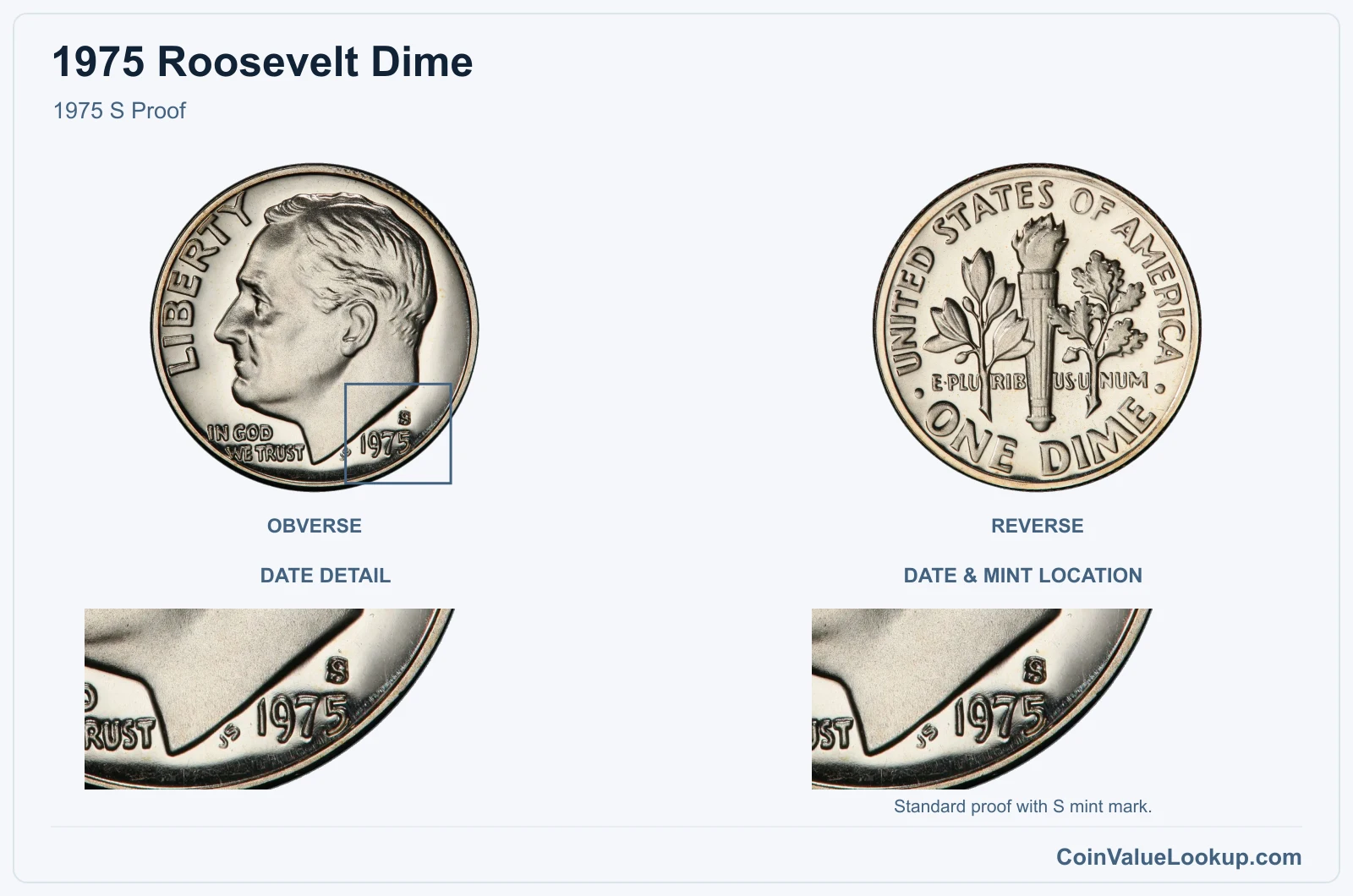
The 1975-S proof was struck at San Francisco with polished dies and specially prepared planchets, producing mirror-like fields and crisp detail. You will find the "S" mintmark on the obverse.
These came in official proof sets — they were not released into circulation.
At PR 65 the USA Coin Book guide places the standard proof at about $3.08. Coins with genuine cameo or deep cameo contrast between frosted devices and mirror fields may carry additional premiums, but those designations require professional confirmation.
This is a copper-nickel clad proof; no regular silver proof exists for 1975 Roosevelt dimes.
Range Grade
Price Auction Records Appraisal PR PR 1
—
Coin Identifier
PR 2
—
Coin Identifier
PR 3
—
Coin Identifier
PR 4
—
Coin Identifier
PR 6
—
Coin Identifier
PR 8
—
Coin Identifier
PR 10
—
Coin Identifier
PR 12
—
Coin Identifier
PR 15
—
Coin Identifier
PR 20
—
Coin Identifier
PR 25
—
Coin Identifier
PR 30
—
Coin Identifier
PR 35
—
Coin Identifier
PR 40
—
Coin Identifier
PR 45
—
Coin Identifier
PR 50
—
Coin Identifier
PR 53
—
Coin Identifier
PR 55
—
Coin Identifier
PR 58
—
Coin Identifier
PR 60
—
Coin Identifier
PR 61
—
Coin Identifier
PR 62
—
Coin Identifier
PR 63
—
Coin Identifier
PR 64
—
Coin Identifier
PR 65
—
Coin Identifier
PR 66
—
Coin Identifier
PR 67
Coin Identifier
PR 68
Coin Identifier
PR 69
Coin Identifier
PR 70
Coin Identifier
1975 Roosevelt Dime — No S Proof
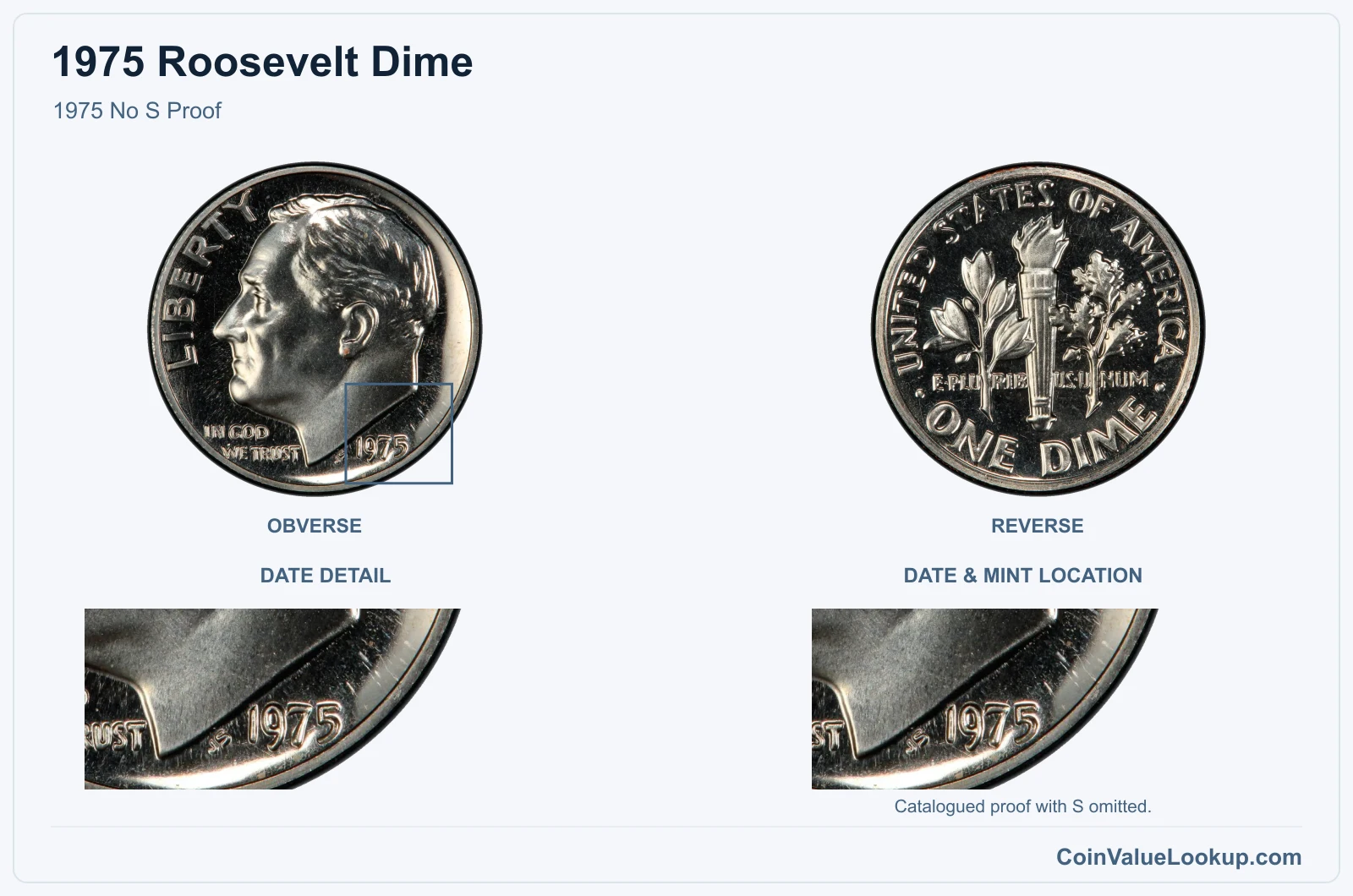
This is the headline coin of 1975 Roosevelt dimes. The No S proof was struck at San Francisco using proof dies, but the "S" mintmark was accidentally omitted.
According to the auctioneer, only two examples are known.
One specimen, graded PCGS PR 67 with a CAC sticker, sold for $506,250 in October 2024. That price reflects the extreme rarity of this specific variety — it is not a guide value for ordinary no-mintmark dimes.
To qualify, a coin must show genuine proof characteristics: mirrored fields, sharp squared rims, and the distinctive look of a coin struck multiple times by polished dies. If your dime just looks like a regular circulation coin without a mintmark, it is a standard business strike, full stop.
Authentication by a major grading service is essential before assigning any premium to a claimed No S proof.
Range Grade
Price Auction Records Appraisal PR PR 1
—
Coin Identifier
PR 2
—
Coin Identifier
PR 3
—
Coin Identifier
PR 4
—
Coin Identifier
PR 6
—
Coin Identifier
PR 8
—
Coin Identifier
PR 10
—
Coin Identifier
PR 12
—
Coin Identifier
PR 15
—
Coin Identifier
PR 20
—
Coin Identifier
PR 25
—
Coin Identifier
PR 30
—
Coin Identifier
PR 35
—
Coin Identifier
PR 40
—
Coin Identifier
PR 45
—
Coin Identifier
PR 50
—
Coin Identifier
PR 53
—
Coin Identifier
PR 55
—
Coin Identifier
PR 58
—
Coin Identifier
PR 60
—
Coin Identifier
PR 61
—
Coin Identifier
PR 62
—
Coin Identifier
PR 63
—
Coin Identifier
PR 64
—
Coin Identifier
PR 65
—
Coin Identifier
PR 66
—
Coin Identifier
PR 67
—
Coin Identifier
PR 68
Coin Identifier
PR 69
—
—
—
PR 70
—
—
—
1975 Roosevelt Dime Error List
1. 1975 Roosevelt Dime — No S Proof
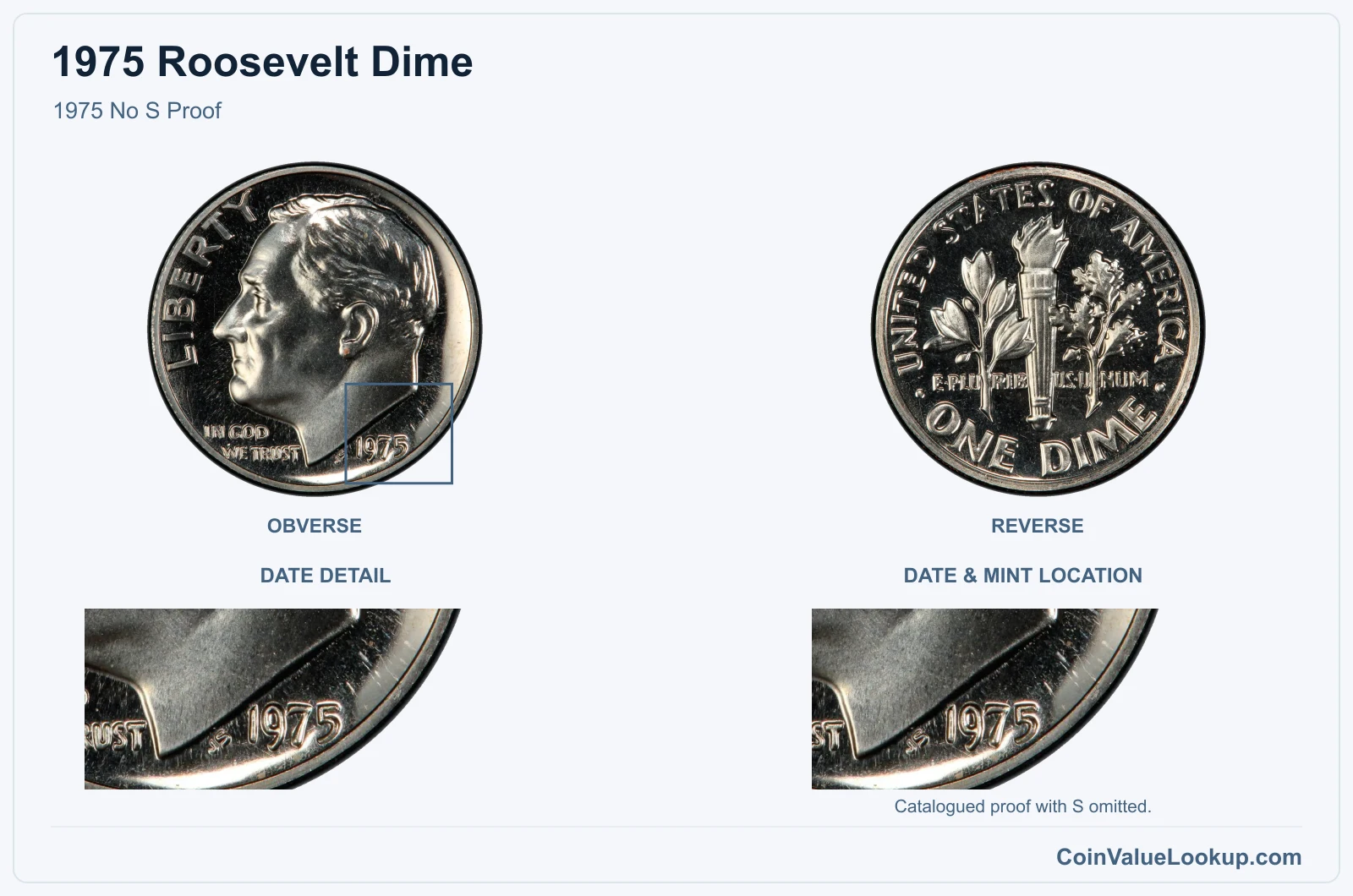
The 1975 No S proof is a San Francisco proof dime where the mintmark was left off the die entirely. The auctioneer described only two known examples when one crossed the block in October 2024 at $506,250 in PR 67 CAC.
That sale is a single extraordinary result, not a standing offer for any 1975 dime.
To identify it, you must first establish that the coin is genuinely proof-struck — look for squared rims, mirror fields and frosted devices. Then confirm no "S" appears where it should.
The common lookalike is simply a normal no-mintmark business strike, which millions of people have. A polished or cleaned circulation dime can mimic reflective surfaces to untrained eyes.
Professional certification from a recognized grading service is the only reliable way to confirm this variety.
2. 1975 Roosevelt Dime — Struck on Copper Planchet
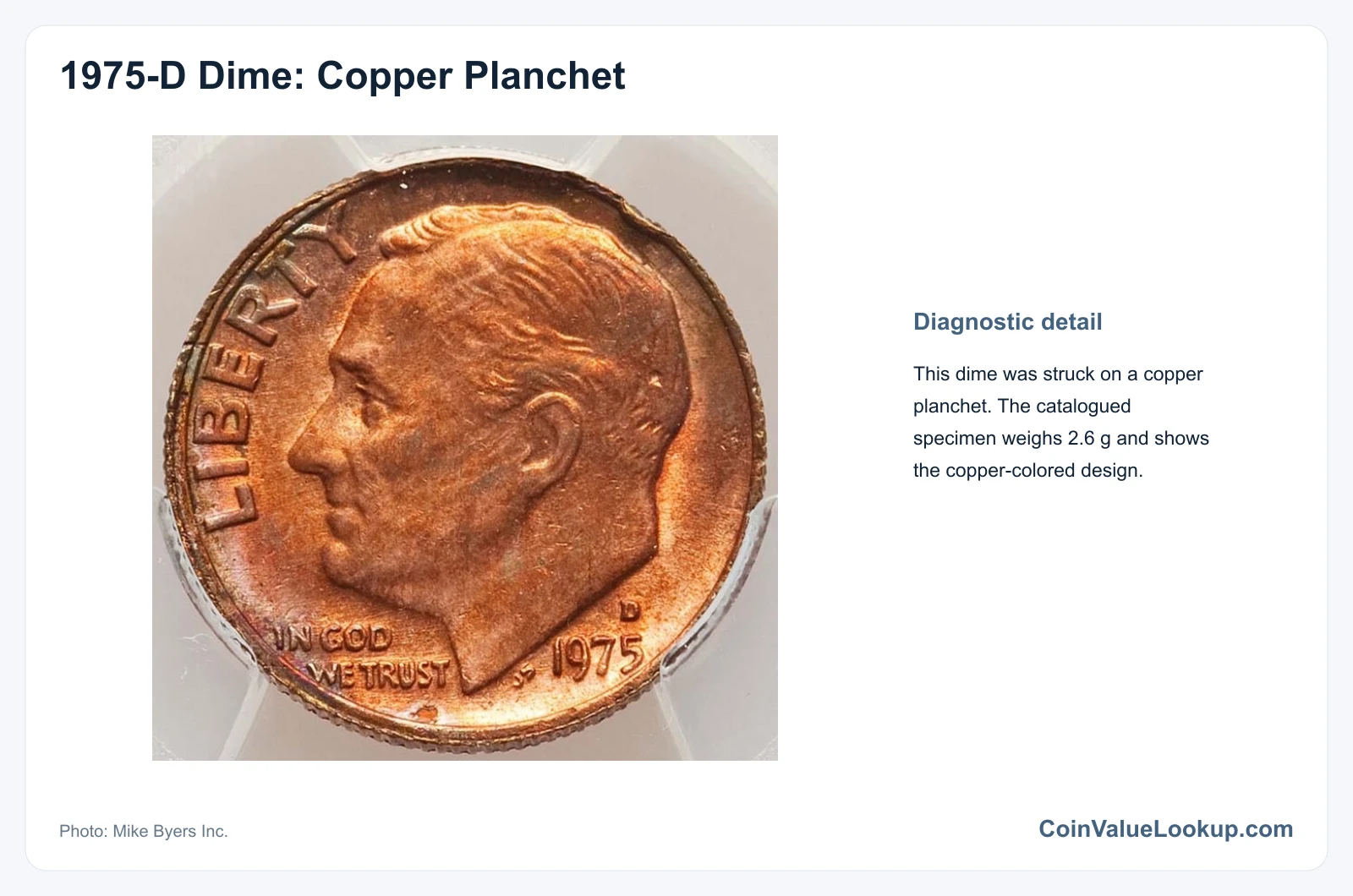
A 1975-D dime struck on a copper planchet instead of the normal clad blank is a verified wrong-planchet error. One certified example, graded PCGS MS 62, weighed 2.6 grams — heavier than the standard 2.27-gram clad dime — and sold for $1,920 in October 2022.
To spot this, check the edge first: a normal clad dime shows a visible layered sandwich of copper and nickel. A copper-planchet strike will have a uniform copper-colored edge.
Weight is your next clue. The main lookalike is a copper-toned or plated clad dime, which still shows the clad layers on the edge and weighs normal.
Do not assume brown color alone means copper; authentication and a precise weight check are necessary.
3. 1975 Roosevelt Dime — Double Curved Clips
A double curved clip happens when the planchet is punched from strip metal that overlaps a previous punch-out, leaving two rounded bites missing from the blank before striking. On the 1975 no-mintmark dime, a certified NGC MS 65 Full Bands example with two curved clips sold for $35 in May 2009.
Coin Value Lookup is a handy place to look up guides for coins like this when you are trying to figure out what you have.
Look for two distinct curved indentations that interrupt the original rim, visible on both sides of the coin in corresponding positions. The lookalike is post-mint damage — someone cutting or filing the edge after the coin left the press.
Genuine clips produce a characteristic weakness in the design opposite the missing area, called the Blakesley effect, and the missing portion follows a smooth factory curve.
4. 1975 Roosevelt Dime — Repunched Mintmark
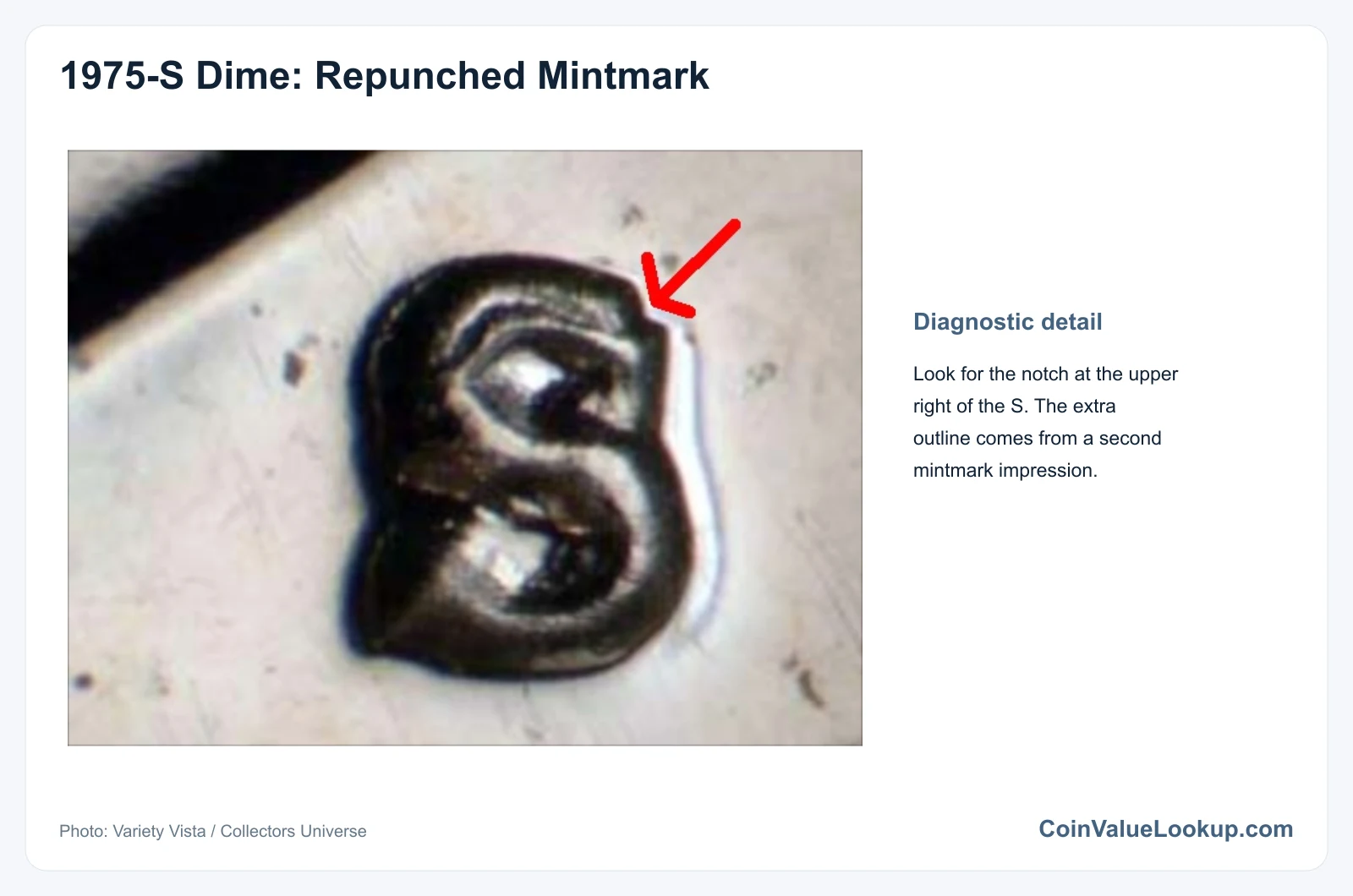
A repunched mintmark variety has been reported for the 1975-S proof, where the "S" shows remnants of a second punch position. Under magnification, you may see doubling, a slight extra outline, or a secondary impression near the primary mintmark.
Compare your coin's mintmark against a normal 1975-S at the same magnification. True repunching produces consistent, repeatable displacement.
The lookalikes include machine doubling — which leaves a flat, shelf-like outline — die chips filling part of the letter, or simple corrosion around the mark. Condition, the clarity of the repunching, and the specific die involved all affect value, so no single price applies to every example.
5. 1975 Roosevelt Dime — Doubled Die Obverse
Doubled die obverse varieties have been reported for the 1975 dime. A true doubled die shows consistent separation or notching on obverse lettering or design elements, caused by a misaligned hub impression during die production.
To check, compare your coin's obverse inscriptions — especially "LIBERTY" and "IN GOD WE TRUST" — against a normal example under the same lighting and magnification. Look for clean, repeatable doubling rather than a flat shelf, which is the hallmark of worthless machine doubling.
Reflections, worn die contours and strike anomalies can also fool you. The value of any doubled die depends on its visibility, the specific die pair, and the coin's overall condition.
6. 1975 Roosevelt Dime — Doubled Die Reverse
Doubled die reverse varieties have also been reported for the 1975 dime. The diagnostic is the same principle as the obverse: look for consistent doubling on reverse legends like "UNITED STATES OF AMERICA" or "ONE DIME," as well as on the torch and leaf details.
Compare your reverse closely to a normal coin. Genuine die doubling produces separated, raised outlines that repeat at the same angle across multiple letters.
Machine doubling, by contrast, leaves flat shelves and does not add metal — it just pushes it sideways. Random nicks, reflections or wear can imitate doubling to an untrained eye.
Value depends on how strong the doubling is, which die produced it, and the coin's grade.
7. 1975 Roosevelt Dime — Off-Center Strike
Off-center strikes occur when the planchet is not seated properly in the collar before the dies come together, producing a displaced design with an unstruck crescent of blank metal along one edge. These have been reported for the 1975 dime.
The key to value is percentage off-center and whether the full date remains visible — a coin with the date struck off the flan loses much of its appeal. A genuine off-center strike shifts the entire design uniformly.
The lookalikes include clipped planchets, which remove metal before striking, one-sided die misalignment, and post-mint flattening or damage that can create an uneven rim. Condition and the degree of displacement both affect what a collector will pay.