2016 Roosevelt Dime Coin Value: How Much Is It Worth?
Most 2016 Roosevelt dimes pulled from pocket change are worth face value — ten cents. In mint-state condition, a USA Coin Book guide estimate places an MS65 example at about $2.50.
The San Francisco clad proof lists around $4.96 in PR65, while the 90% silver proof jumps to roughly $22 at the same grade. Your specific coin's value depends on mint, metal, finish and condition.
Fast Way to Identify Your 2016 Roosevelt Dime
Upload clear photos of both the front and back of your 2016 dime for a preliminary identification. This helps narrow down the mint, finish and whether any obvious variety or error is present.
It is not a substitute for professional authentication, but it is a solid starting point before you dig deeper.
2016 Roosevelt Dime Value
Upload both sides of your 2016 Roosevelt Dime.
Front Obverse
Upload photo
Back Reverse
Upload photo
Which 2016 Roosevelt Dime Versions Are Worth Money?
- Mint-state 2016-P or 2016-D dimes with well-separated torch bands (Full Bands) can carry a premium over ordinary examples of the same grade.
- 2016-S silver proofs, struck in 90% silver and weighing 2.50 grams, are the highest-valued regular issue at roughly $22 in PR65 per USA Coin Book.
- Authenticated die chips on the obverse and reverse of 2016-P business strikes have appeared in certified holders and are worth investigating if you spot raised blobs on your coin.
Step 1: Identify Your 2016 Roosevelt Dime Mint Mark and Version
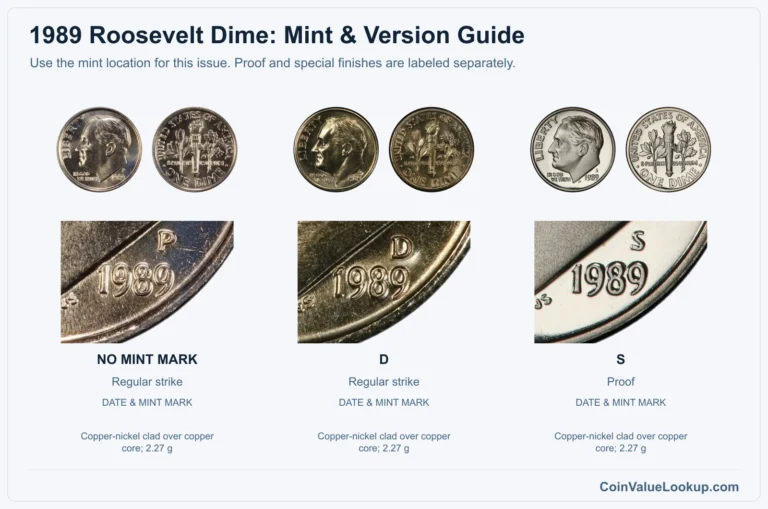
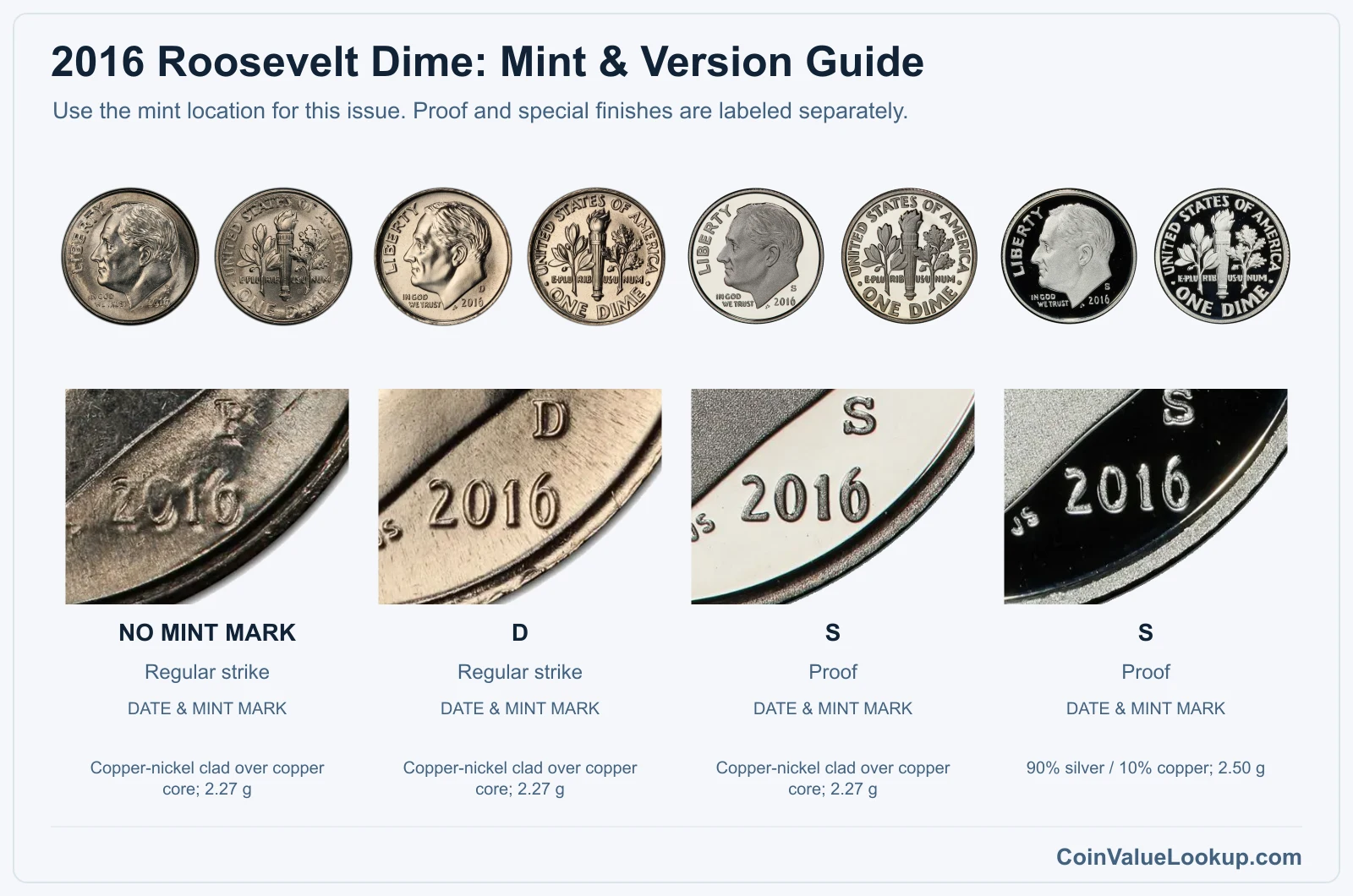
Start with the date. Every 2016 Roosevelt dime shows the year on the obverse below "IN GOD WE TRUST," with a mintmark — P, D or S — just above the date.
Philadelphia coins carry a P, Denver coins a D, and San Francisco coins an S. The S mint produced two separate proof versions: a copper-nickel clad proof and a 90% silver proof.
Both share the same S mintmark, so the mintmark alone does not tell you which one you have.
To separate them, check the edge and weigh the coin. A clad dime (P, D, or S clad proof) weighs 2.27 grams and has a visible layered edge.
The silver proof weighs 2.50 grams and has a uniformly silver-colored edge. Packaging matters too — silver proofs were sold in specific U.S. Mint Silver Proof Sets.
Do not confuse the 2016-W gold Mercury Dime commemorative with a Roosevelt dime. That is a completely different design and denomination, and it falls outside this page's scope.
Step 2: Check Your 2016 Roosevelt Dime Grade
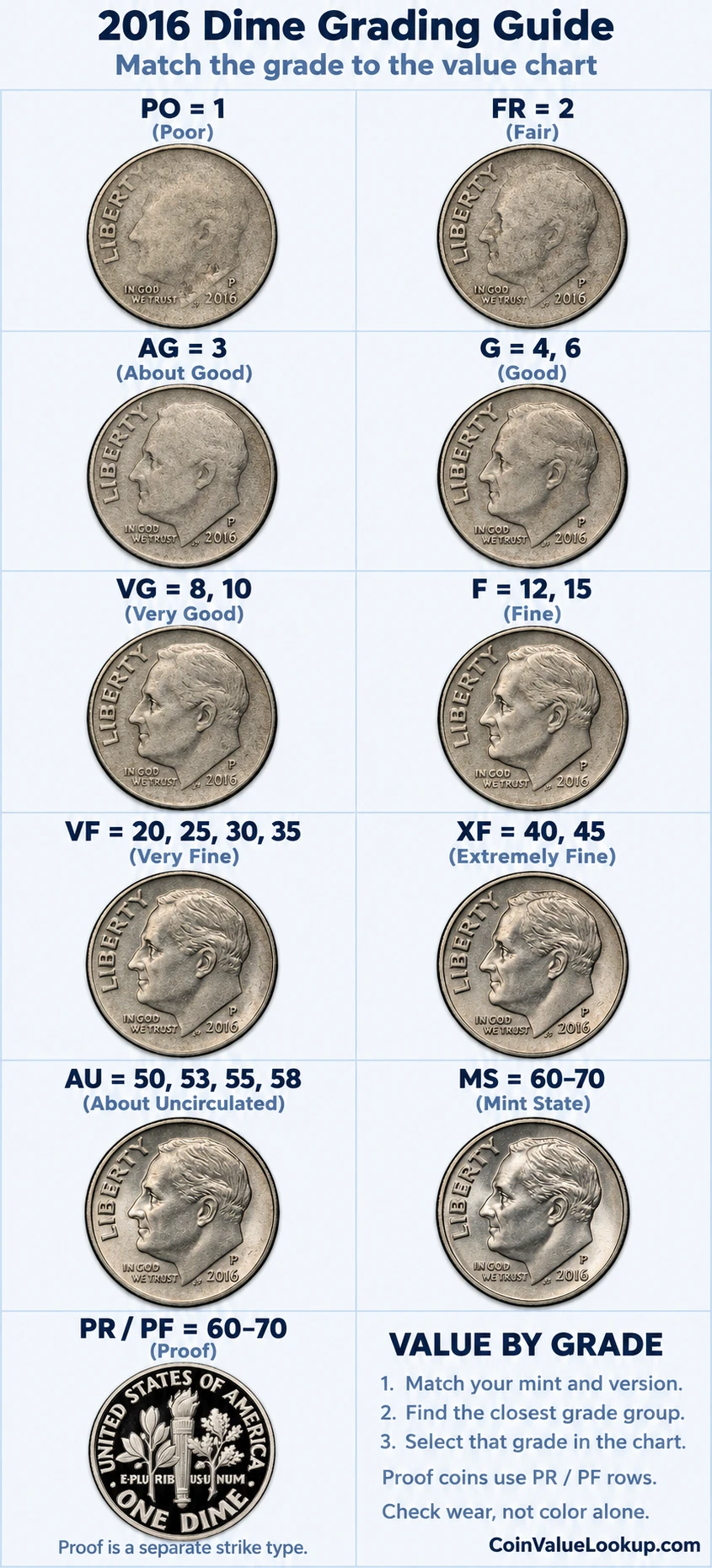
Look at Roosevelt's cheek and jawline first — these are the highest points and the first places to show friction. Smooth, flat spots there mean the coin has circulated.
Hair detail above the ear is the next checkpoint. On a well-struck mint-state coin, individual strands are sharp and separated.
On a worn coin, they blend together into a flat mass.
On the reverse, inspect the torch and the olive and oak branches. A coin grading MS65 will still have original cartwheel luster with only minor contact marks, none of them distracting.
If the coin looks shiny but the luster seems "off," it may have been cleaned rather than preserved.
For the torch, pay attention to the horizontal bands. "Full Bands" means both pairs of horizontal bands are clearly separated — that is a strike quality designation, not an error or a grade.
Weak bands can result from a softer strike rather than wear, so compare within the same finish type.
Proofs have mirror fields and frosted devices by design. Judge proof coins against other proofs, not against business strikes.
Use the comparison image to calibrate your eye for each grade level.
Step 3: Check 2016 Roosevelt Dime Value by Mint and Version
2016 Roosevelt Dime — P Business Strike
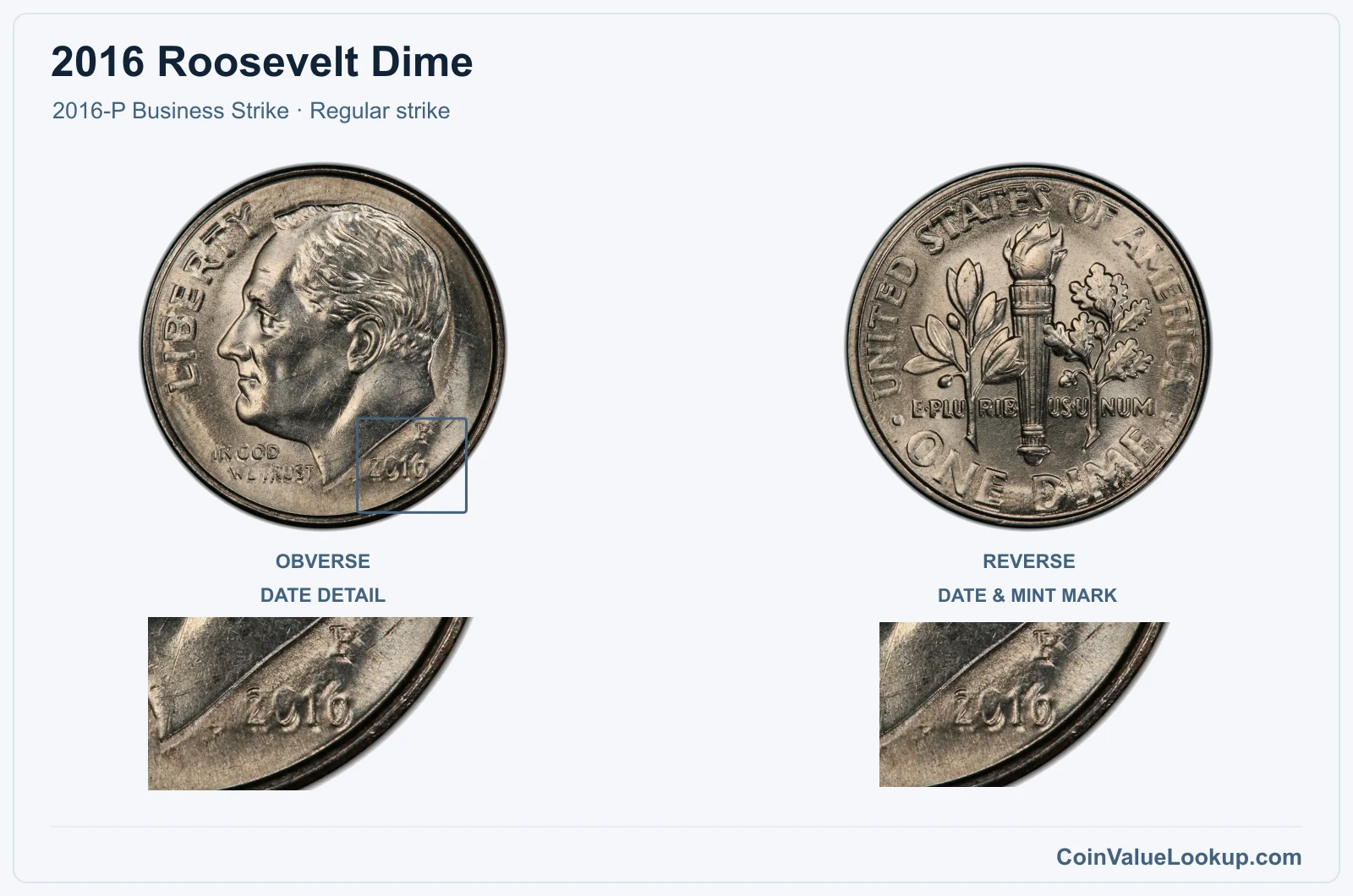
The 2016-P Roosevelt dime was struck at Philadelphia in copper-nickel clad over a copper core, weighing 2.27 grams. Look for the small P mintmark on the obverse above the date.
A USA Coin Book guide estimate puts an MS65 example at about $2.50. In circulated grades these are face-value coins.
The premium kicks in only when the coin is uncirculated with strong luster, minimal bag marks and — ideally — Full Bands on the torch.
Range Grade
Price Auction Records Appraisal PO PO 1
—
Coin Identifier FR FR 2
—
Coin Identifier AG AG 3
—
Coin Identifier G G 4
—
Coin Identifier
G 6
—
Coin Identifier VG VG 8
—
Coin Identifier
VG 10
—
Coin Identifier F F 12
—
Coin Identifier
F 15
—
Coin Identifier VF VF 20
—
Coin Identifier
VF 25
—
Coin Identifier
VF 30
—
Coin Identifier
VF 35
—
Coin Identifier XF XF 40
—
Coin Identifier
XF 45
—
Coin Identifier AU AU 50
—
Coin Identifier
AU 53
—
Coin Identifier
AU 55
—
Coin Identifier
AU 58
—
Coin Identifier MS MS 60
—
Coin Identifier
MS 61
—
Coin Identifier
MS 62
—
Coin Identifier
MS 63
—
Coin Identifier
MS 64
—
Coin Identifier
MS 65
—
Coin Identifier
MS 66
—
Coin Identifier
MS 67
—
Coin Identifier
MS 68
—
—
—
MS 69
—
—
—
MS 70
—
—
—
2016 Roosevelt Dime — D Business Strike
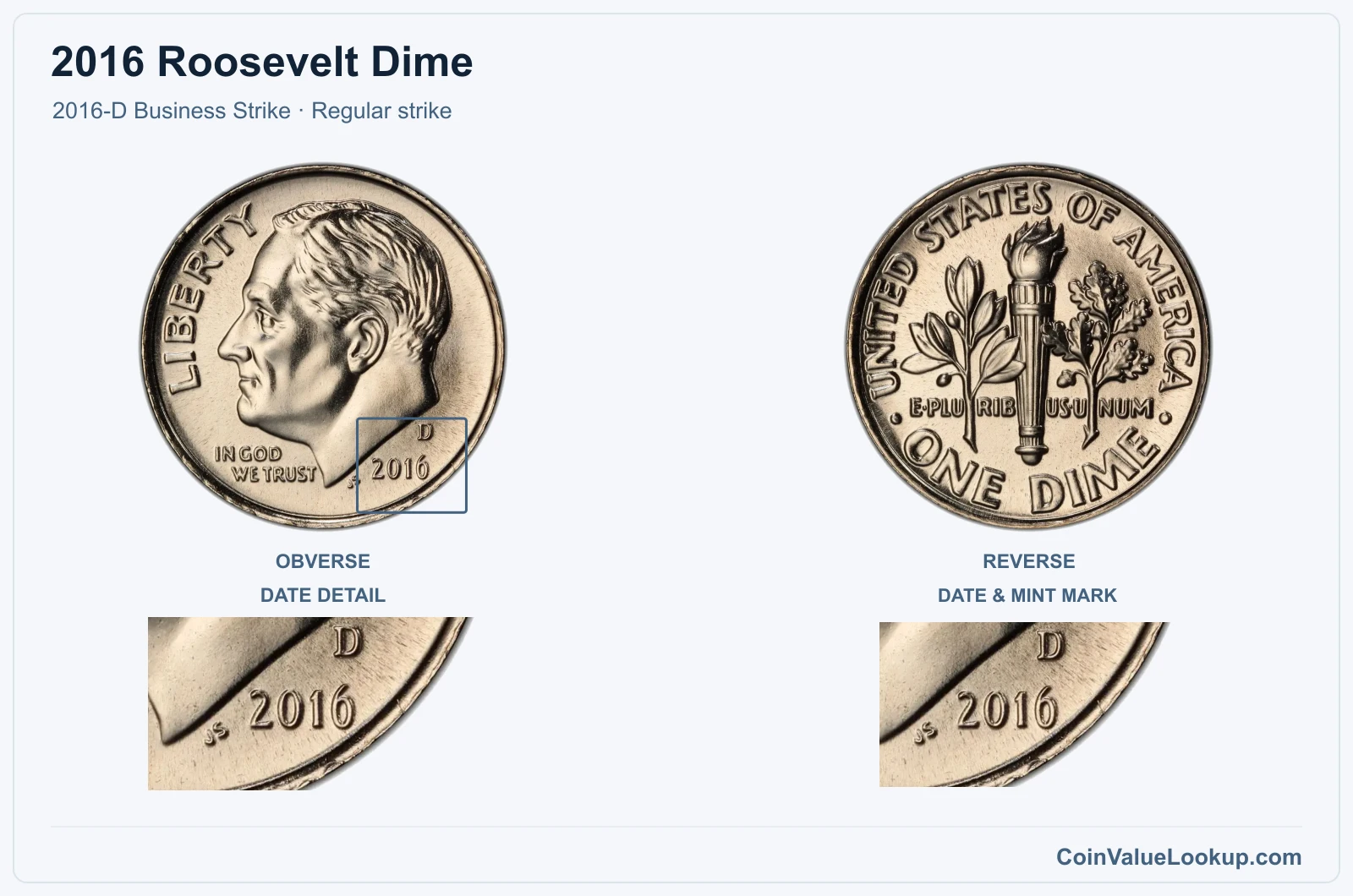
Denver's 2016-D dime is the same copper-nickel clad composition and 2.27-gram weight as the Philadelphia issue. The D mintmark sits in the same spot above the date.
The USA Coin Book guide estimate also places an MS65 at $2.50. In practice, most 2016-D dimes you encounter in change are worth ten cents.
Cherry-picking one from a fresh roll with sharp Full Bands and clean fields is where the hunt gets interesting.
Coin Value Lookup is a good place to look up other Roosevelt dime years and denominations while you are sorting through that roll.
Range Grade
Price Auction Records Appraisal PO PO 1
—
Coin Identifier FR FR 2
—
Coin Identifier AG AG 3
—
Coin Identifier G G 4
—
Coin Identifier
G 6
—
Coin Identifier VG VG 8
—
Coin Identifier
VG 10
—
Coin Identifier F F 12
—
Coin Identifier
F 15
—
Coin Identifier VF VF 20
—
Coin Identifier
VF 25
—
Coin Identifier
VF 30
—
Coin Identifier
VF 35
—
Coin Identifier XF XF 40
—
Coin Identifier
XF 45
—
Coin Identifier AU AU 50
—
Coin Identifier
AU 53
—
Coin Identifier
AU 55
—
Coin Identifier
AU 58
—
Coin Identifier MS MS 60
—
Coin Identifier
MS 61
—
Coin Identifier
MS 62
—
Coin Identifier
MS 63
—
Coin Identifier
MS 64
—
Coin Identifier
MS 65
—
Coin Identifier
MS 66
—
Coin Identifier
MS 67
—
—
—
MS 68
—
—
—
MS 69
—
—
—
MS 70
—
—
—
2016 Roosevelt Dime — S Clad Proof
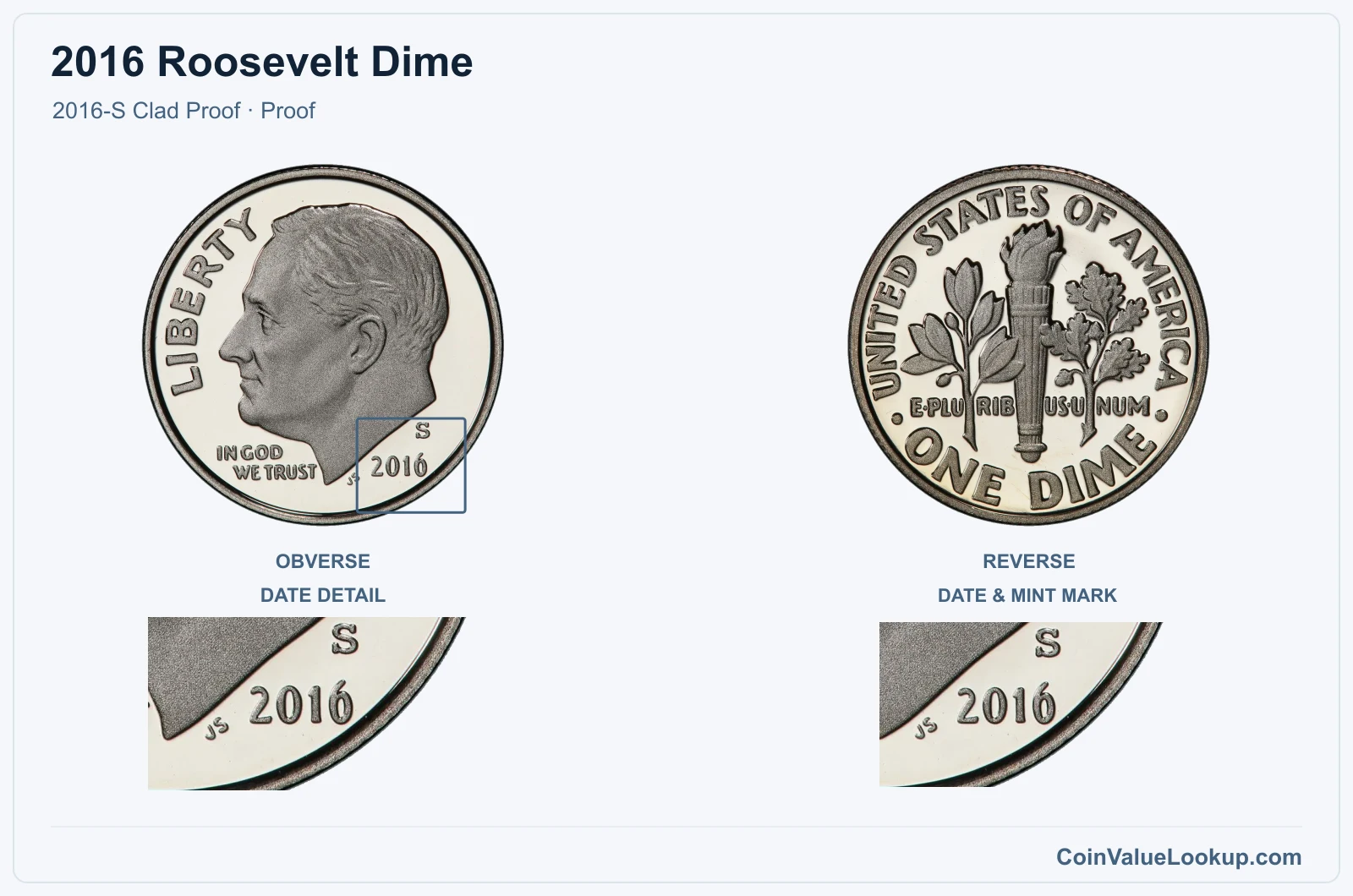
The 2016-S clad proof was made at San Francisco specifically for collector proof sets. It is copper-nickel clad over a copper core, the same 2.27-gram weight as the business strikes, but with mirror fields and frosted devices created during the proof manufacturing process.
A USA Coin Book guide estimate places a PR65 at about $4.96. These almost always come housed in their original government packaging.
A raw one outside its case deserves a closer look at surfaces for handling or haze before you assign a value.
Range Grade
Price Auction Records Appraisal PR PR 1
—
Coin Identifier
PR 2
—
Coin Identifier
PR 3
—
Coin Identifier
PR 4
—
Coin Identifier
PR 6
—
Coin Identifier
PR 8
—
Coin Identifier
PR 10
—
Coin Identifier
PR 12
—
Coin Identifier
PR 15
—
Coin Identifier
PR 20
—
Coin Identifier
PR 25
—
Coin Identifier
PR 30
—
Coin Identifier
PR 35
—
Coin Identifier
PR 40
—
Coin Identifier
PR 45
—
Coin Identifier
PR 50
—
Coin Identifier
PR 53
—
Coin Identifier
PR 55
—
Coin Identifier
PR 58
—
Coin Identifier
PR 60
—
Coin Identifier
PR 61
—
Coin Identifier
PR 62
—
Coin Identifier
PR 63
—
Coin Identifier
PR 64
—
Coin Identifier
PR 65
—
Coin Identifier
PR 66
—
Coin Identifier
PR 67
—
Coin Identifier
PR 68
—
Coin Identifier
PR 69
—
Coin Identifier
PR 70
—
Coin Identifier
2016 Roosevelt Dime — S Silver Proof
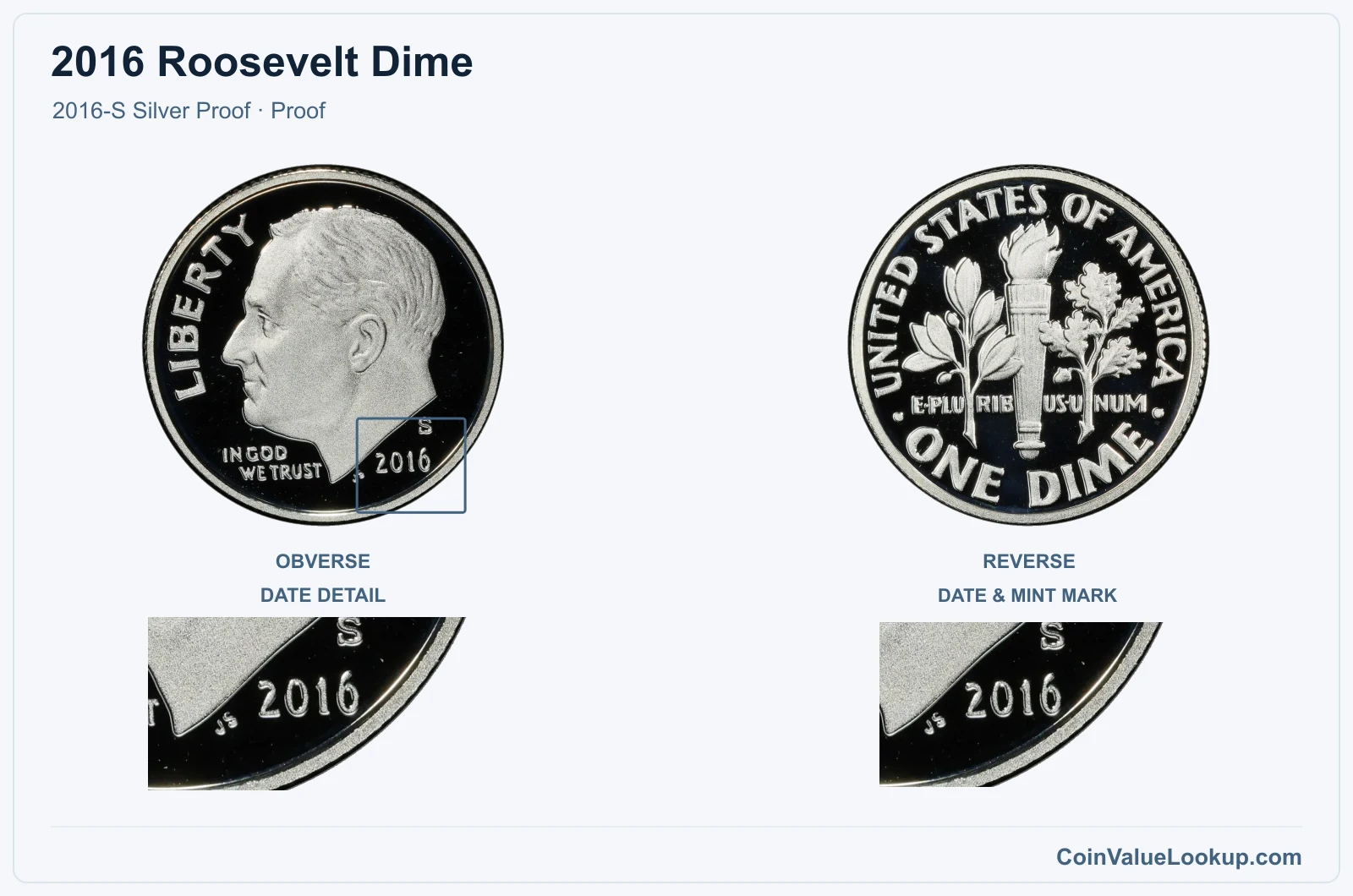
Also struck at San Francisco, the 2016-S silver proof is composed of 90% silver and 10% copper, weighing 2.50 grams — noticeably heavier than the 2.27-gram clad version. The edge is uniformly silver-colored with no visible copper stripe.
The USA Coin Book guide places a PR65 at roughly $22, making this the highest-valued regular-issue 2016 dime. It was packaged in the U.S. Mint's Silver Proof Set.
Despite a database label that once flagged it as a business strike, this coin is a proof — its mirror finish and origin confirm that. Weigh the coin and inspect the edge to confirm you have the silver issue rather than the clad proof.
Range Grade
Price Auction Records Appraisal PR PR 1
—
Coin Identifier
PR 2
—
Coin Identifier
PR 3
—
Coin Identifier
PR 4
—
Coin Identifier
PR 6
—
Coin Identifier
PR 8
—
Coin Identifier
PR 10
—
Coin Identifier
PR 12
—
Coin Identifier
PR 15
—
Coin Identifier
PR 20
—
Coin Identifier
PR 25
—
Coin Identifier
PR 30
—
Coin Identifier
PR 35
—
Coin Identifier
PR 40
—
Coin Identifier
PR 45
—
Coin Identifier
PR 50
—
Coin Identifier
PR 53
—
Coin Identifier
PR 55
—
Coin Identifier
PR 58
—
Coin Identifier
PR 60
—
Coin Identifier
PR 61
—
Coin Identifier
PR 62
—
Coin Identifier
PR 63
—
Coin Identifier
PR 64
—
Coin Identifier
PR 65
—
Coin Identifier
PR 66
—
Coin Identifier
PR 67
—
Coin Identifier
PR 68
—
Coin Identifier
PR 69
—
Coin Identifier
PR 70
—
Coin Identifier
2016 Roosevelt Dime Error List
1. 2016 Roosevelt Dime — Obverse and Reverse Die Chips
Die chips are small pieces that break away from the die surface, leaving raised lumps of metal on the finished coin. On some 2016-P business strikes, both the obverse and reverse carry these raised blobs.
At least one such coin has been certified by NGC in MS65 with the die chips noted on the holder.
To identify a die chip, look for an irregular raised area that sits above the normal design surface. It should be consistent across multiple coins struck from the same die.
The key lookalikes to rule out are corrosion bumps, solder residue and impact damage — all of which are post-mint and typically irregular in a different way than a die chip.
No specific price range is established here. Value depends on the size, location and severity of the chips, plus the coin's overall grade and whether it has been professionally authenticated.
2. 2016 Roosevelt Dime — Doubled Die
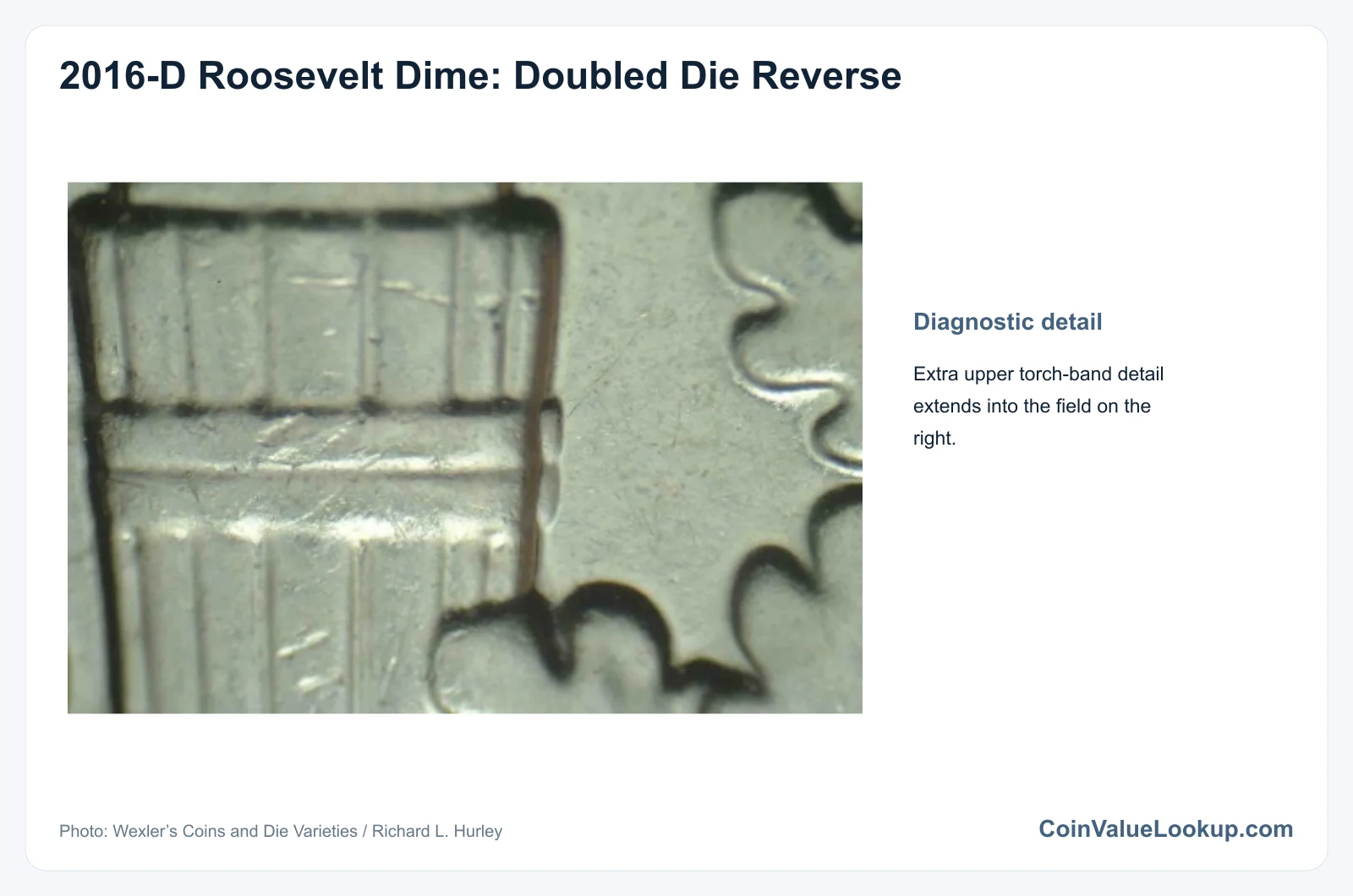
A doubled die occurs when the design is duplicated or shifted on the die itself, producing consistent doubling on every coin struck from that die. On a 2016 dime, look for separation, notching or shelf-like doubling on lettering or facial features compared to a normal example.
The doubling should repeat in exactly the same position on multiple specimens — that is what distinguishes a true doubled die from machine doubling, which tends to look flat and shelf-like in one direction, or from reflections and post-mint impressions. Condition, the degree of visible doubling and which design elements are affected all influence what a given example might be worth.
No specific price range is adopted here. Professional authentication is the safest route if you believe you have found one.
3. 2016 Roosevelt Dime — Off-Center Strike
An off-center strike happens when the blank is not properly seated between the dies, so part of the design is missing and an unstruck crescent of bare metal remains. On a 2016 dime, you want the date still visible — that is critical for identification and desirability.
Do not confuse an off-center strike with a clipped planchet, which shows a curved bite out of the edge, or with one-sided die misalignment that shifts the design but still strikes the full planchet area. Post-mint flattening from damage can also mimic a partial strike.
No specific price is adopted here. The percentage off-center, whether the date is readable, and the coin's overall condition all factor into what a given example may bring.
Authentication is recommended.
4. 2016 Roosevelt Dime — Feeder-Finger Marks
Feeder fingers are mechanical arms inside the press that push blanks into position. When they malfunction or fail to retract fully, they can leave parallel or repeated impression marks on the coin's surface before or during striking.
On a 2016 dime, look for raised or incused parallel lines that follow a consistent pattern across the design. They are typically straight or gently curved and appear in relief — distinct from random handling scratches, which vary in depth and direction, or cleaning hairlines, which are usually finer and more uniformly distributed.
Die-polish lines can also look similar but tend to be very fine and flow in the direction of die maintenance, not planchet feeding. No specific price range is adopted.
The prominence and location of the marks, along with overall coin condition, determine value. Authentication helps confirm the origin.
5. 2016 Roosevelt Dime — Missing Clad Layer
A missing clad layer error means one of the outer copper-nickel layers was absent from the planchet before striking. The result is a coin that looks distinctly different on the affected side — typically showing a copper-colored surface — and weighs less than the normal 2.27 grams.
Check the edge as well. A normal clad dime shows a sandwich of layers; a missing-clad coin will look uneven or show only one clad layer on one side.
The primary lookalikes are environmental toning, aftermarket plating, corrosion and coins where someone has physically removed surface metal after minting.
No specific price is adopted here. Value depends on whether one or both sides are affected, the coin's weight deviation and its condition.
Professional authentication and a precise weight measurement are the best first steps if your coin looks suspicious.
6. 2016 Roosevelt Dime — Struck-Through Error
A struck-through error occurs when foreign material — grease, cloth fibers, a metal fragment — gets trapped between the die and the planchet during striking. The result is a localized area of missing or weakened detail, sometimes with the impression of the object itself visible.
On a 2016 dime, grease-filled dies are the most commonly reported variety. They produce smooth, flat areas where design elements should be, as opposed to the gradual wear you see on a circulated coin.
Ordinary weak strikes, scratches and cleaning can mimic the look, so compare the suspect area carefully against a normal coin.
No specific price is adopted. Value hinges on the size of the affected area, what design element is obscured and whether the coin has been authenticated.
A tiny grease spot on a field is far less desirable than one that obliterates a major design feature.