1993 Roosevelt Dime Coin Value: How Much Is It Worth?
Most 1993 Roosevelt dimes pulled from pocket change are worth face value — ten cents. In uncirculated condition around MS65, a guide estimate from USA Coin Book places the 1993-P or 1993-D at about $2.79.
The S clad proof sits near $6.25 in PR65, and the S silver proof is around $12.04 in PR65. Higher grades, special designations and authenticated mint errors shift that picture considerably.
Fast Way to Identify Your 1993 Roosevelt Dime
Snap clear photos of the front and back of your 1993 dime and upload them here for a preliminary identification. This helps narrow down the mintmark, finish type and general condition so you can figure out which version you actually have.
It is not a substitute for professional authentication, but it is a solid starting point.
1993 Roosevelt Dime Value
Upload both sides of your 1993 Roosevelt Dime.
Front Obverse
Upload photo
Back Reverse
Upload photo
Which 1993 Roosevelt Dime Versions Are Worth Money?
- 1993-P or 1993-D in high mint-state grades with Full Bands torch detail can carry a premium over the $2.79 MS65 guide estimate.
- 1993-S clad proof in pristine condition — guide value near $6.25 at PR65, higher grades bring more.
- 1993-S silver proof confirmed by weight or edge inspection — guide value about $12.04 at PR65, and silver content adds a floor.
- Misaligned obverse die with die clash on a 1993-P — a compound error requiring authentication and individual assessment.
- Off-center strike on a 1993-P — value depends on displacement percentage, date visibility and authenticated condition.
Step 1: Identify Your 1993 Roosevelt Dime Mint Mark and Version
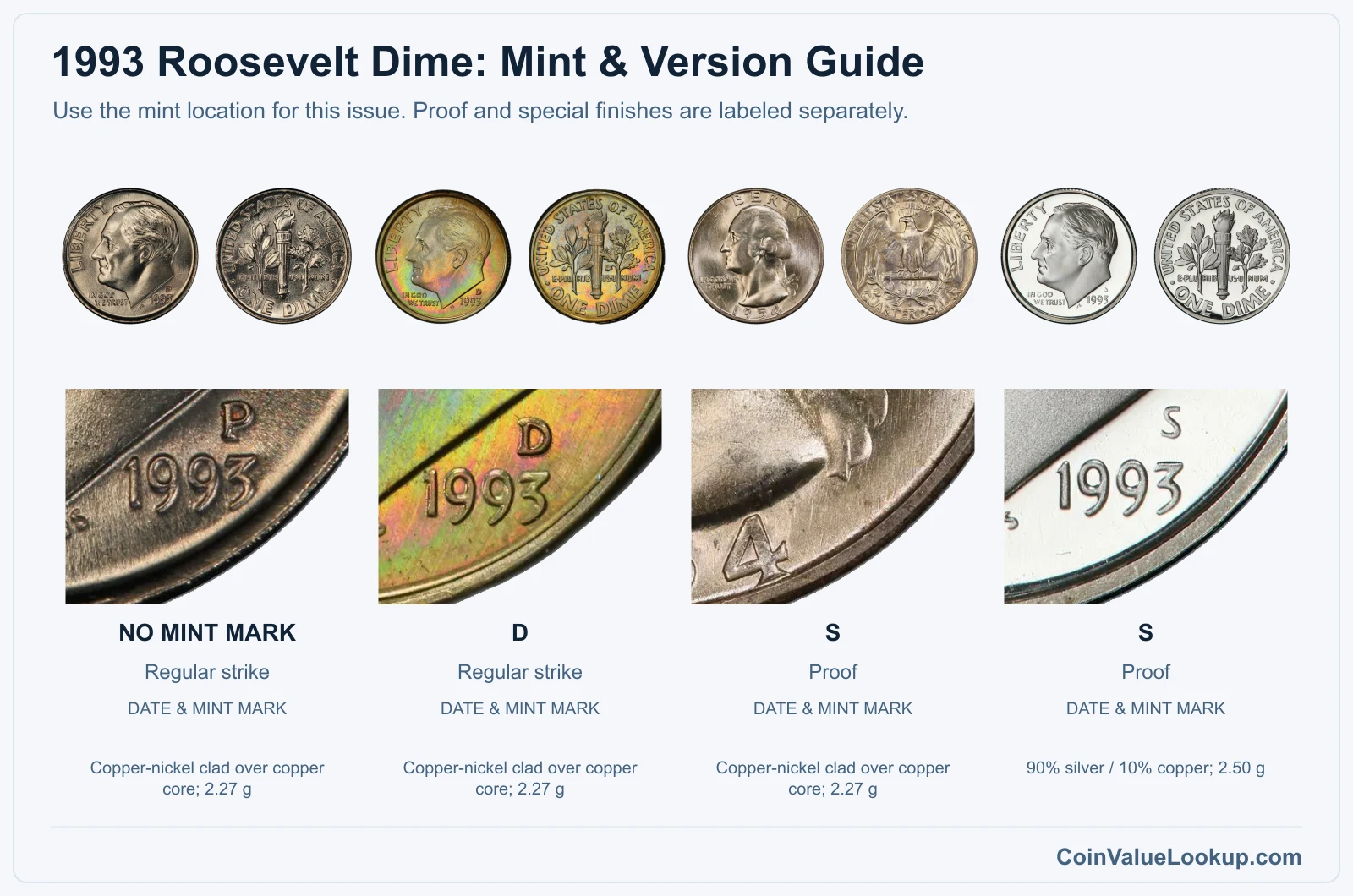
Start with the basics: confirm the 1993 date, Roosevelt's portrait on the obverse and the torch-with-branches reverse. The mintmark — P, D or S — sits on the obverse near the date.
Philadelphia (P) and Denver (D) coins are copper-nickel clad business strikes weighing 2.27 grams. San Francisco (S) produced two separate proof versions in 1993: a clad proof and a silver proof.
Here is the tricky part. Both S proofs carry the same mintmark and the same design.
The mintmark alone does not tell you whether your coin is clad or silver. You need additional clues.
Check the edge. A clad coin usually shows a copper-colored stripe along the rim, while a silver proof does not.
Weight matters too: clad is 2.27 g and silver is 2.50 g. Original government packaging, if you still have it, is the easiest confirmation.
When the metal remains ambiguous after these checks, professional authentication is the way to go.
Step 2: Check Your 1993 Roosevelt Dime Grade
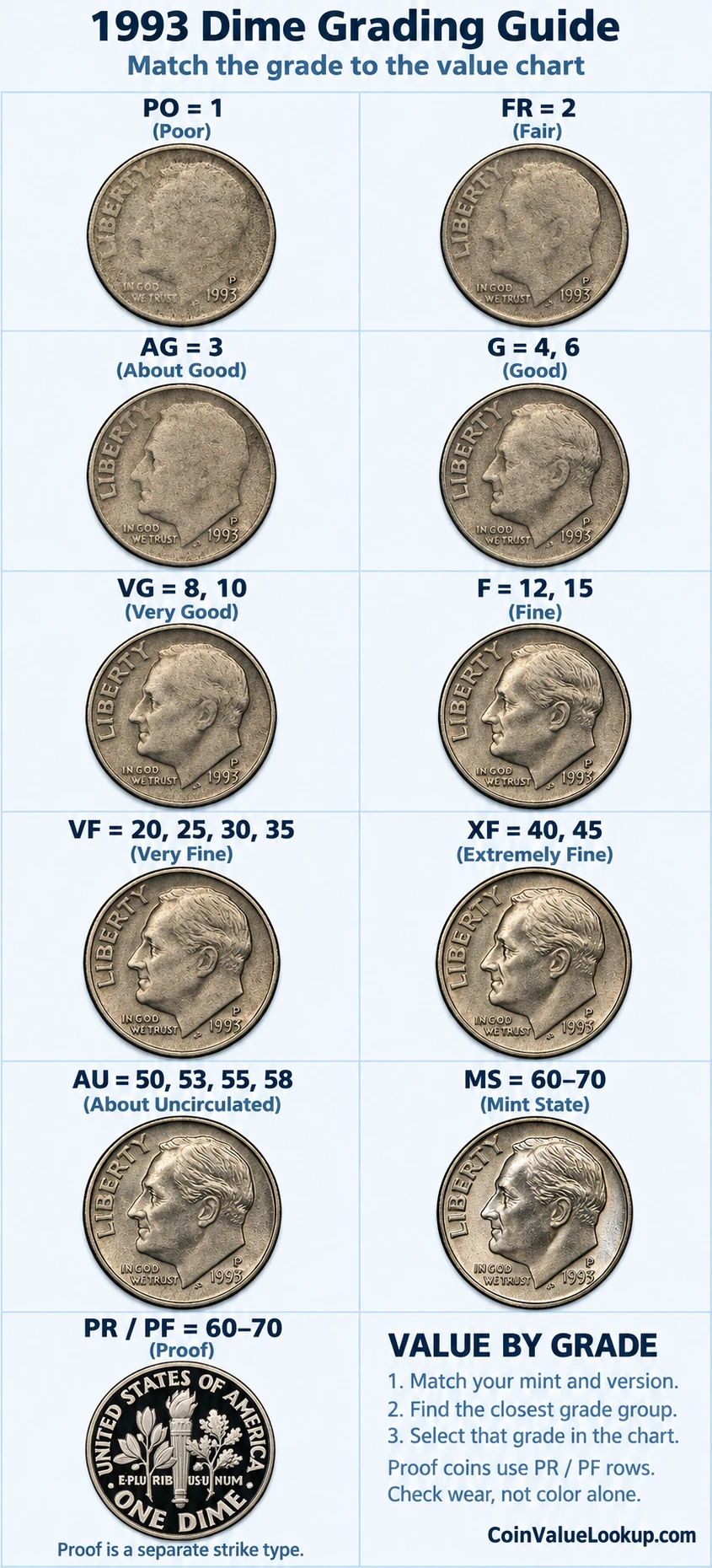
Focus on Roosevelt's cheek, jawline and the hair detail above the ear — these are the first areas to show friction on a dime. On the reverse, check the torch lines and the leaf details for flatness.
A weak strike can mimic wear, so look for original mint luster across the high points. If the luster is intact but the torch bands are soft, that is likely a strike issue, not circulation damage.
Cleaning, hairline scratches and corrosion all reduce a coin's appeal regardless of the technical grade.
For proof coins, surface quality and cameo contrast are evaluated separately from the numerical grade. The comparison image on this page can help you judge relative wear, but an experienced grader or third-party service provides the definitive call.
Full Bands is a strike designation, not a grade. According to PCGS, it requires both horizontal band pairs on the torch to show complete separation.
Coins with Full Bands earn a premium, so compare using that specific designation when pricing.
Step 3: Check 1993 Roosevelt Dime Value by Mint and Version
1993 Roosevelt Dime — P Business Strike
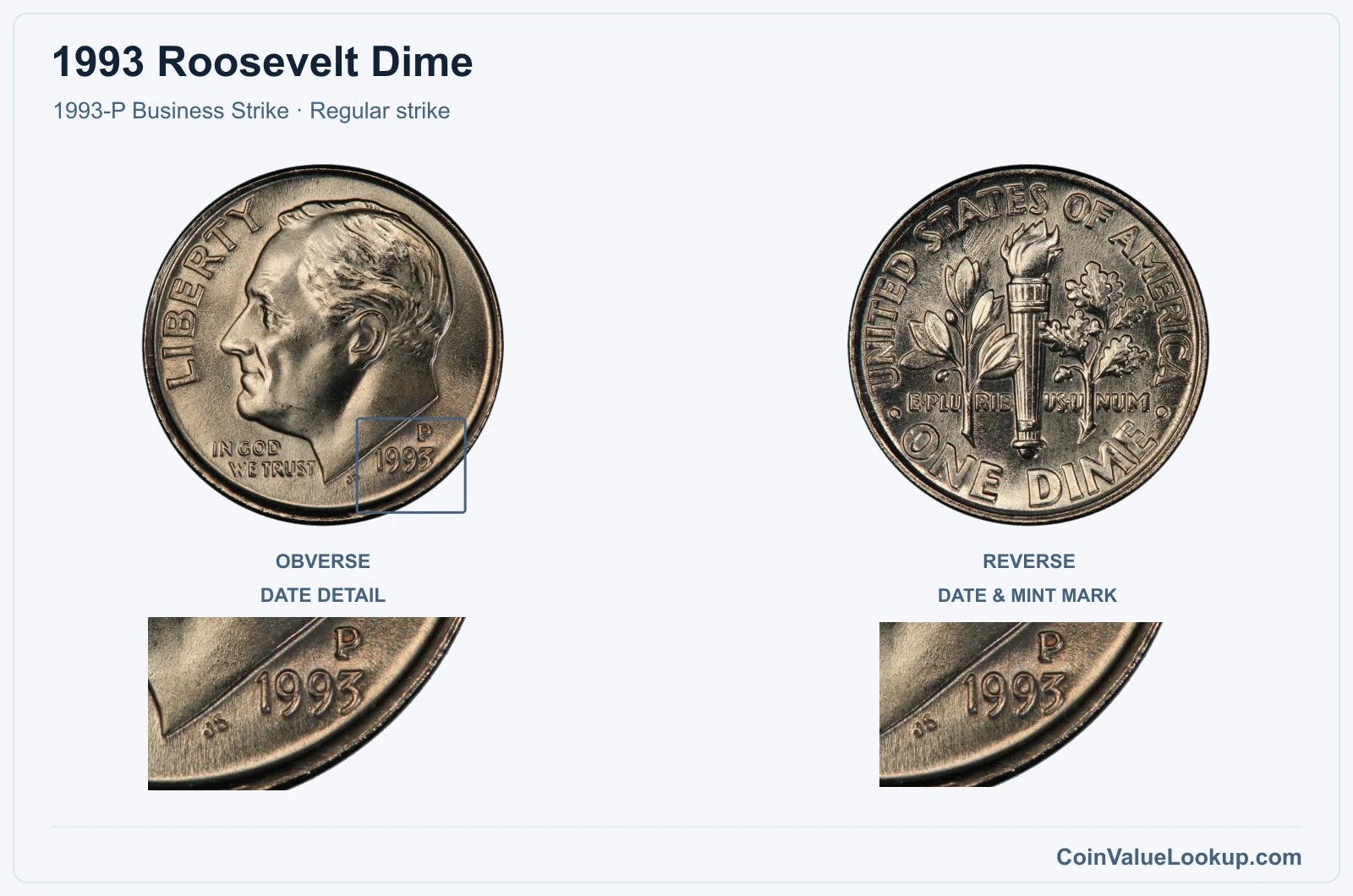
The 1993-P is a copper-nickel clad business strike from the Philadelphia Mint, weighing 2.27 grams. Look for the small "P" mintmark on the obverse near the date.
In typical circulated condition these are worth ten cents, but uncirculated examples grade up from there.
A USA Coin Book guide estimate places the 1993-P at about $2.79 in MS65. Coins certified with the Full Bands designation — meaning both horizontal torch band pairs show full separation — generally trade higher than their non-designated counterparts at the same grade.
Range Grade
Price Auction Records Appraisal PO PO 1
—
Coin Identifier FR FR 2
—
Coin Identifier AG AG 3
—
Coin Identifier G G 4
—
Coin Identifier
G 6
—
Coin Identifier VG VG 8
—
Coin Identifier
VG 10
—
Coin Identifier F F 12
—
Coin Identifier
F 15
—
Coin Identifier VF VF 20
—
Coin Identifier
VF 25
—
Coin Identifier
VF 30
—
Coin Identifier
VF 35
—
Coin Identifier XF XF 40
—
Coin Identifier
XF 45
—
Coin Identifier AU AU 50
—
Coin Identifier
AU 53
—
Coin Identifier
AU 55
—
Coin Identifier
AU 58
—
Coin Identifier MS MS 60
—
Coin Identifier
MS 61
—
Coin Identifier
MS 62
—
Coin Identifier
MS 63
—
Coin Identifier
MS 64
—
Coin Identifier
MS 65
—
Coin Identifier
MS 66
Coin Identifier
MS 67
Coin Identifier
MS 68
—
Coin Identifier
MS 69
—
—
—
MS 70
—
—
—
1993 Roosevelt Dime — D Business Strike
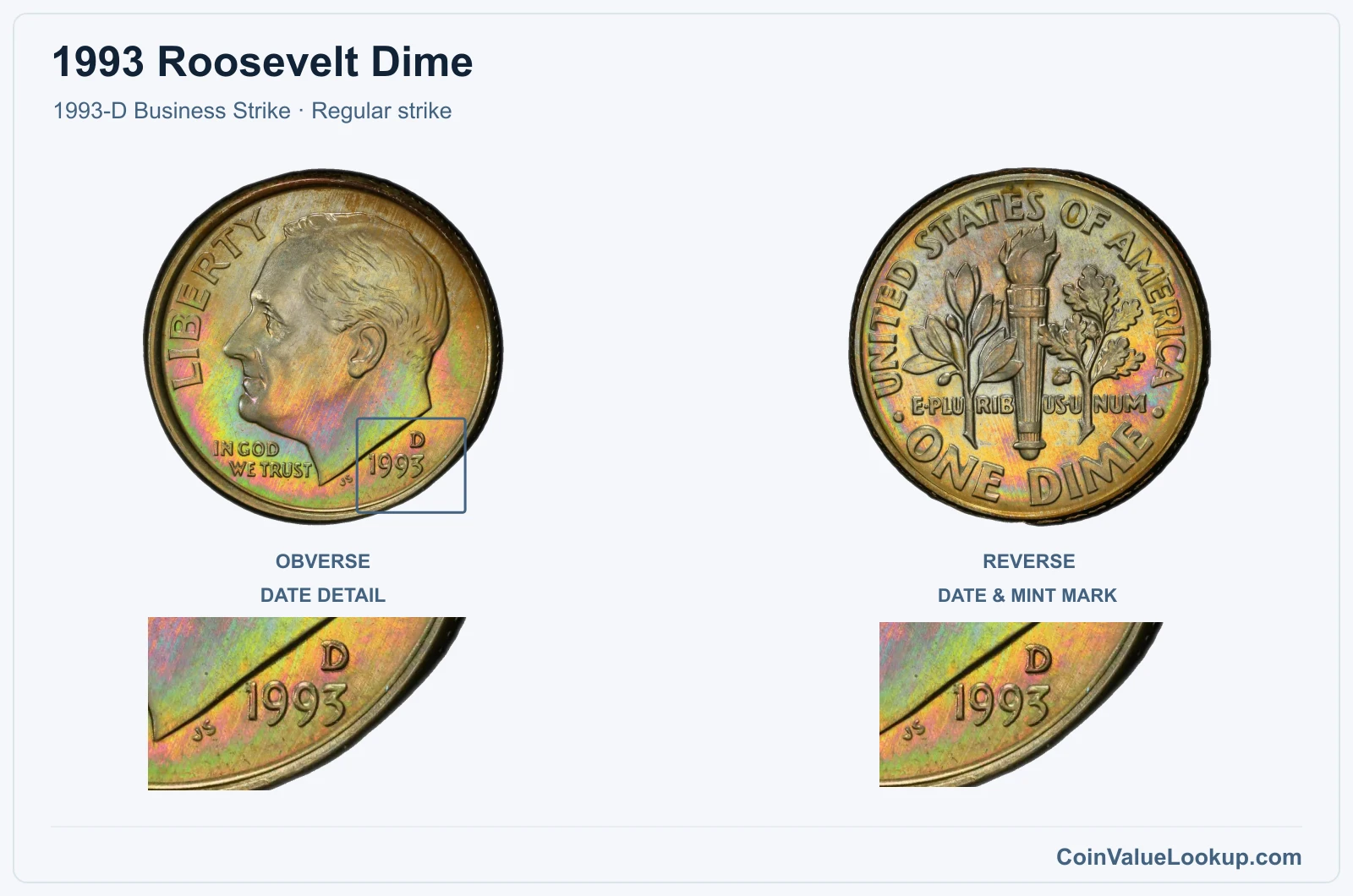
Denver's 1993-D dime shares the same copper-nickel clad composition and 2.27-gram weight as the Philadelphia issue. The "D" mintmark appears on the obverse near the date.
The MS65 guide estimate is also $2.79 per USA Coin Book. Like the P, finding one with Full Bands separation on the torch adds collector interest.
Circulated examples remain face-value coins. Look for strong luster and minimal bag marks if you are hunting for a higher-grade piece.
Coin Value Lookup is a handy place to check guides for Roosevelt dimes and other series when you want to compare values across years and mints.
Range Grade
Price Auction Records Appraisal PO PO 1
—
Coin Identifier FR FR 2
—
Coin Identifier AG AG 3
—
Coin Identifier G G 4
—
Coin Identifier
G 6
—
Coin Identifier VG VG 8
—
Coin Identifier
VG 10
—
Coin Identifier F F 12
—
Coin Identifier
F 15
—
Coin Identifier VF VF 20
—
Coin Identifier
VF 25
—
Coin Identifier
VF 30
—
Coin Identifier
VF 35
—
Coin Identifier XF XF 40
—
Coin Identifier
XF 45
—
Coin Identifier AU AU 50
—
Coin Identifier
AU 53
—
Coin Identifier
AU 55
—
Coin Identifier
AU 58
—
Coin Identifier MS MS 60
—
Coin Identifier
MS 61
—
Coin Identifier
MS 62
—
Coin Identifier
MS 63
Coin Identifier
MS 64
—
Coin Identifier
MS 65
—
Coin Identifier
MS 66
Coin Identifier
MS 67
Coin Identifier
MS 68
—
—
—
MS 69
—
—
—
MS 70
—
—
—
1993 Roosevelt Dime — S Clad Proof
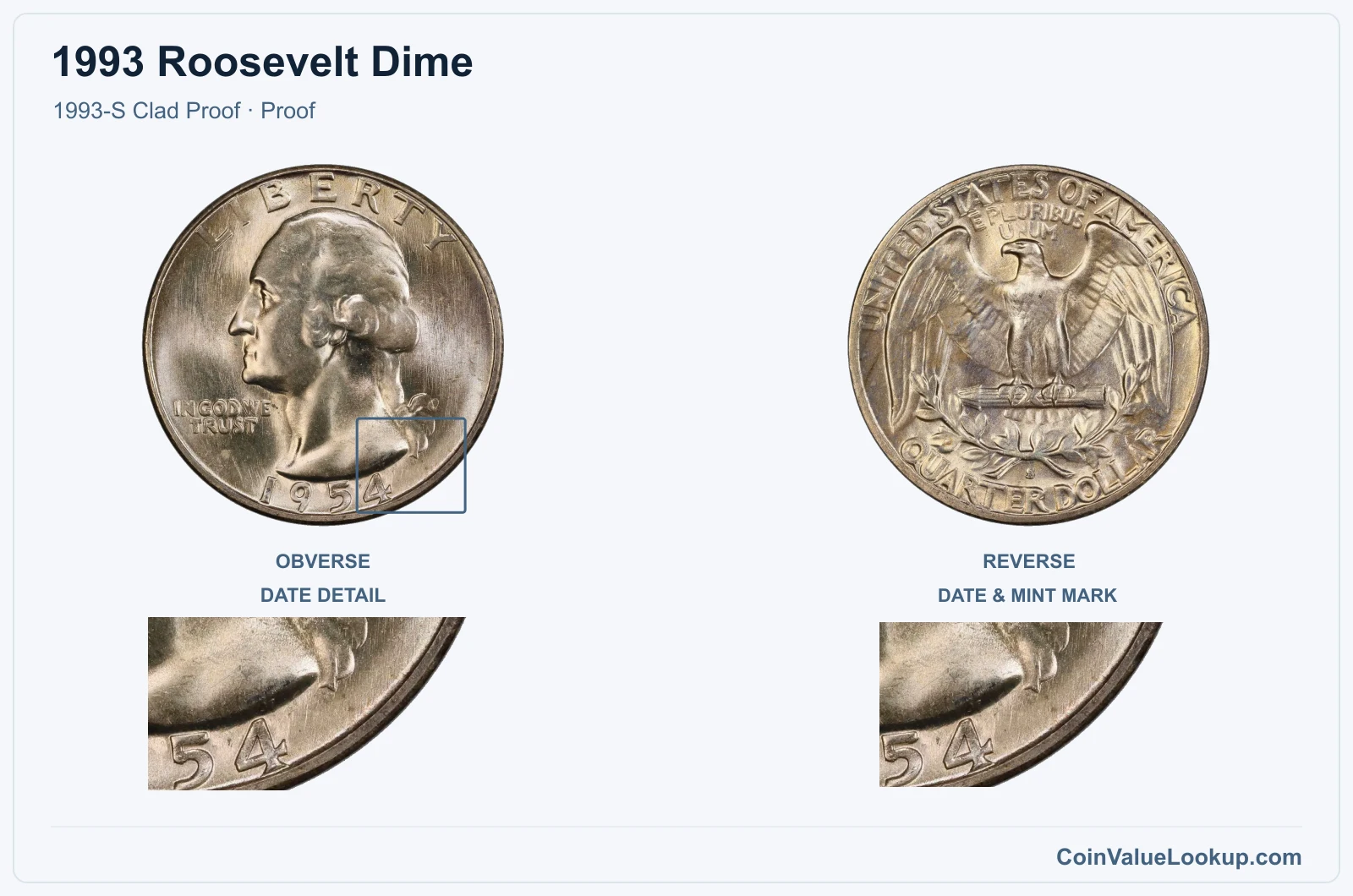
The 1993-S clad proof was struck at San Francisco on the same copper-nickel clad planchets used for business strikes, but with polished dies and multiple strikes to produce mirror fields. It weighs 2.27 grams.
A USA Coin Book guide estimate puts this coin at about $6.25 in PR65. Cameo and deep cameo contrast — where frosted devices stand out against mirror fields — can push values higher, though that contrast is separate from the numerical proof grade.
Remember: the "S" mintmark alone does not confirm this is the clad version rather than the silver proof. Check the edge for a copper-colored stripe, weigh the coin, or refer to the original mint packaging.
Range Grade
Price Auction Records Appraisal PR PR 1
—
Coin Identifier
PR 2
—
Coin Identifier
PR 3
—
Coin Identifier
PR 4
—
Coin Identifier
PR 6
—
Coin Identifier
PR 8
—
Coin Identifier
PR 10
—
Coin Identifier
PR 12
—
Coin Identifier
PR 15
—
Coin Identifier
PR 20
—
Coin Identifier
PR 25
—
Coin Identifier
PR 30
—
Coin Identifier
PR 35
—
Coin Identifier
PR 40
—
Coin Identifier
PR 45
—
Coin Identifier
PR 50
—
Coin Identifier
PR 53
—
Coin Identifier
PR 55
—
Coin Identifier
PR 58
—
Coin Identifier
PR 60
—
Coin Identifier
PR 61
—
Coin Identifier
PR 62
—
Coin Identifier
PR 63
—
Coin Identifier
PR 64
—
Coin Identifier
PR 65
—
Coin Identifier
PR 66
—
Coin Identifier
PR 67
—
Coin Identifier
PR 68
—
Coin Identifier
PR 69
Coin Identifier
PR 70
Coin Identifier
1993 Roosevelt Dime — S Silver Proof
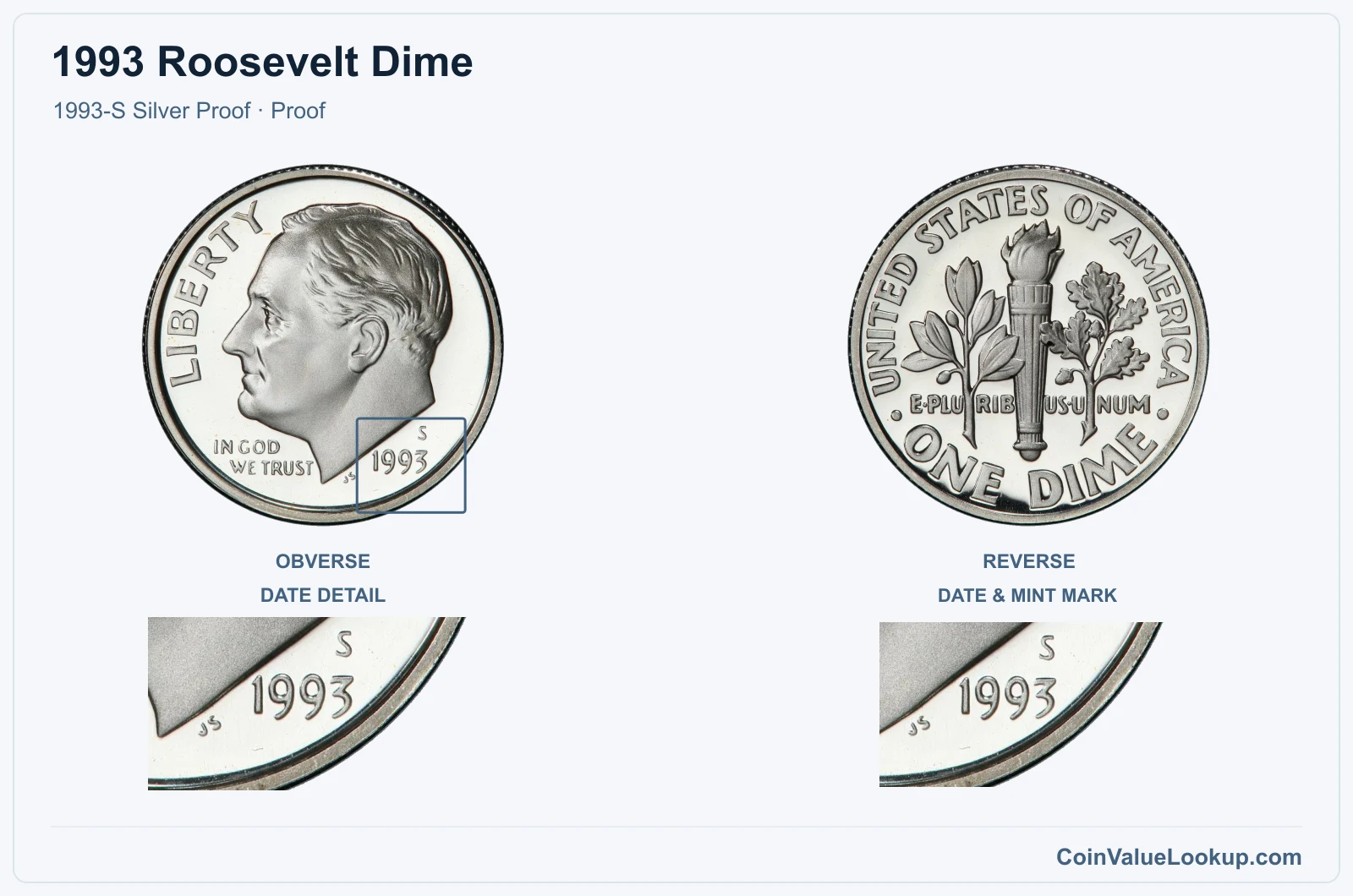
San Francisco also struck a 90% silver, 10% copper proof dime in 1993, weighing 2.50 grams. This coin was part of the Silver Proof Set reintroduced by the United States Mint in 1992.
It looks virtually identical to the clad proof on both sides.
The PR65 guide estimate from USA Coin Book is approximately $12.04. Silver content gives this coin an intrinsic metal floor that the clad version lacks, and that floor moves with the silver market.
To confirm you have the silver version, check for the absence of a copper edge stripe, verify the 2.50-gram weight, or check the original packaging. When neither test is conclusive, a third-party grading service can identify the alloy definitively.
Range Grade
Price Auction Records Appraisal PR PR 1
—
Coin Identifier
PR 2
—
Coin Identifier
PR 3
—
Coin Identifier
PR 4
—
Coin Identifier
PR 6
—
Coin Identifier
PR 8
—
Coin Identifier
PR 10
—
Coin Identifier
PR 12
—
Coin Identifier
PR 15
—
Coin Identifier
PR 20
—
Coin Identifier
PR 25
—
Coin Identifier
PR 30
—
Coin Identifier
PR 35
—
Coin Identifier
PR 40
—
Coin Identifier
PR 45
—
Coin Identifier
PR 50
—
Coin Identifier
PR 53
—
Coin Identifier
PR 55
—
Coin Identifier
PR 58
—
Coin Identifier
PR 60
—
Coin Identifier
PR 61
—
Coin Identifier
PR 62
—
Coin Identifier
PR 63
—
Coin Identifier
PR 64
—
Coin Identifier
PR 65
—
Coin Identifier
PR 66
—
Coin Identifier
PR 67
—
Coin Identifier
PR 68
—
Coin Identifier
PR 69
Coin Identifier
PR 70
Coin Identifier
1993 Roosevelt Dime Error List
1. 1993 Roosevelt Dime — Misaligned Obverse Die with Die Clash
This compound error on a 1993-P business strike combines two problems: the obverse die was misaligned relative to a more centered reverse, and the dies also clashed, leaving transferred design outlines in the fields. You should see both the off-center displacement of the obverse design and ghostly incuse impressions from the opposing die.
A Heritage Auctions lot documented an NGC MS62 example with this combination. No individual sale price is adopted here, so value depends on authentication, the severity of both the misalignment and the clash, and the coin's overall condition.
Do not confuse this with a standard two-sided off-center strike (where both sides shift together) or an incuse brockage (where a previously struck coin acts as a die). The key diagnostic is that the reverse remains roughly centered while the obverse is displaced and clashed die impressions appear in the open fields.
2. 1993 Roosevelt Dime — Off-Center Strike
A 1993-P dime struck off center shows roughly 30% displacement toward 12 o'clock on both sides, leaving an unstruck crescent of blank metal along one edge. The date and mintmark should still be at least partially visible for the coin to be attributed to this year.
A Heritage Auctions lot included an ANACS MS64 example in a multi-coin grouping, so no individual price can be extracted from that sale. Value for off-center errors is driven by displacement percentage, date visibility, overall condition and third-party authentication.
This differs from a single-sided misalignment, where only one die shifts and both sides of the planchet still receive a full impression. With a true off-center strike, the blank itself was not seated properly in the collar, so both faces are displaced and a crescent of unstruck metal remains.
3. 1993 Roosevelt Dime — Broadstrike
A broadstrike happens when a dime is struck without the retaining collar that normally confines the planchet. The result is a coin that spreads outward, appearing slightly wider than normal with a distorted or absent rim.
The design is still centered, which separates it from an off-center strike where the design itself shifts.
For a 1993 dime, look for uniform outward metal flow, a weakened or missing rim and a thinner-than-normal edge profile. The full design should be present but somewhat expanded.
Do not confuse this with a coin that was simply flattened or damaged after leaving the mint — post-strike damage lacks the characteristic even spread and typically shows tool marks or uneven thinning. Condition, visibility of the error and professional authentication all affect value; no specific price range is adopted for this category.
4. 1993 Roosevelt Dime — Clipped Planchet
A clipped planchet error occurs when the blank is punched from strip metal that overlaps a previously punched hole or the edge of the strip. The result is a missing curved, straight or ragged section of the coin.
On a 1993 dime, this shows up as an incomplete edge with a characteristic shape.
One helpful diagnostic: look for a zone of weakness on the opposite side of the coin from the clip. Metal flow during striking cannot fully fill the area farthest from the missing section, creating a subtle soft spot sometimes called the Blakesley effect.
Compare the suspect area against damage caused by a file, cutting tool or corrosion. Post-mint damage tends to leave sharp or irregular edges with tool marks, while a genuine clip has a smooth, natural contour consistent with the blanking process.
Value depends on the size and type of clip, overall condition and authentication.