1993 Kennedy Half Dollar Coin Value: How Much Is It Worth?
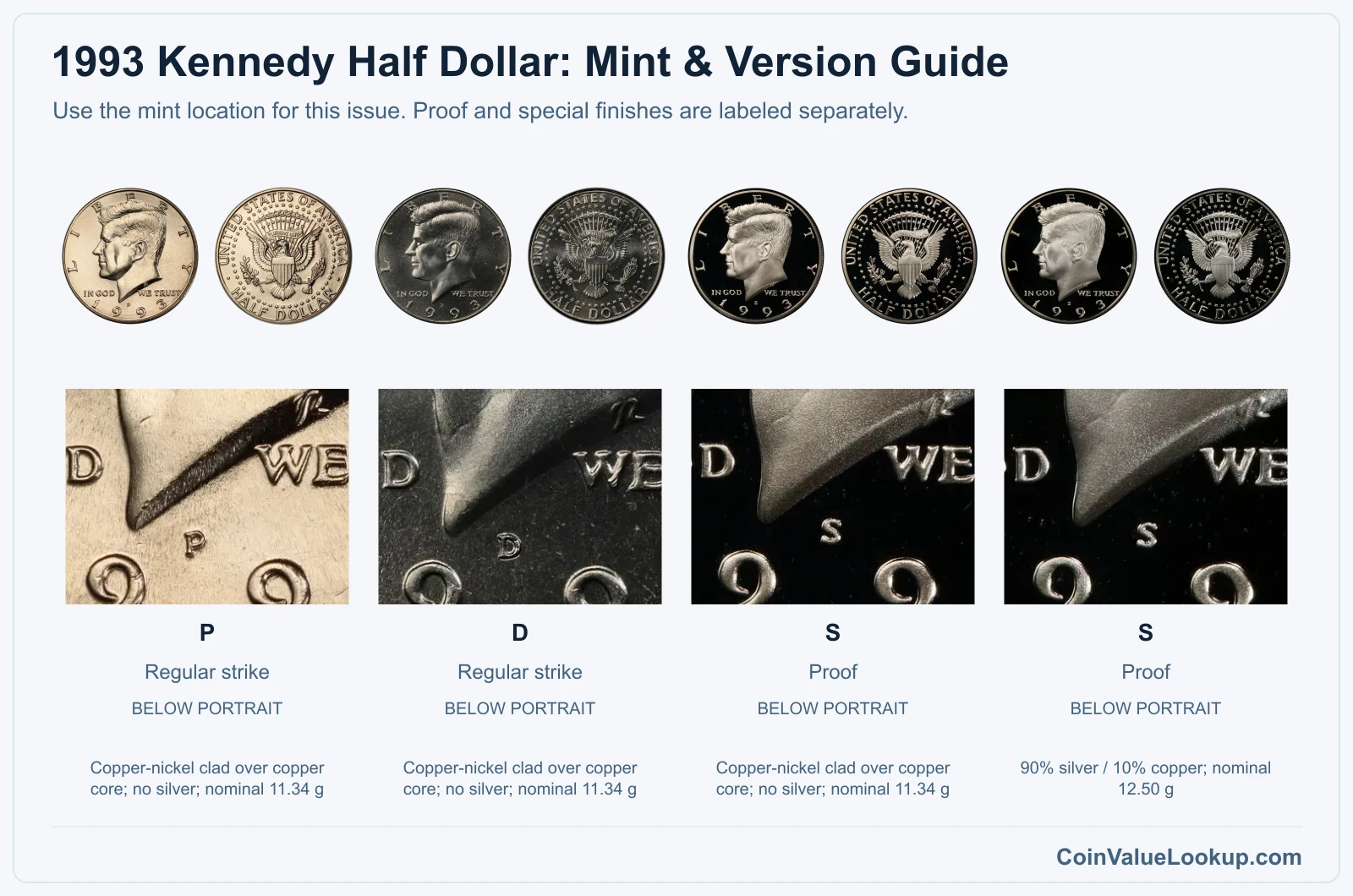
The 1993 Kennedy half dollar carries a face value of 50 cents, and most circulated clad examples are worth exactly that. Collector guide estimates for specific mint and finish combinations range from about $3.62 in Mint State 65 up to $51.00 for a silver proof in PR65, according to USA Coin Book.
Before you check a price chart, you need to know whether your coin is a standard clad strike, a clad proof or a silver proof — the differences matter.
Fast Way to Identify Your 1993 Kennedy Half Dollar
Snap a clear photo of the front and back of your 1993 half dollar and upload both images to our identifier. It will give you a preliminary identification of your coin's mint, finish and version so you can look up the right value range.
This is not a substitute for professional authentication, but it is a solid first step.
1993 Kennedy Half Dollar Value
Upload both sides of your 1993 Kennedy Half Dollar.
Front Obverse
Upload photo
Back Reverse
Upload photo
Which 1993 Kennedy Half Dollar Versions Are Worth Money?
- The 1993-S silver proof (90% silver, ~12.50 g) carries a USA Coin Book guide estimate of $51.00 at PR65 — check weight and edge color to confirm silver content.
- The 1993-S clad proof is estimated at $10.00 in PR65; same S mintmark as the silver proof, but lighter and shows a copper edge stripe.
- Business strikes from Philadelphia or Denver in well-preserved MS65 condition are estimated around $3.62 each — still above face value for the right coin.
- Mint-made errors such as doubled dies, die clashes and off-center strikes have been reported for this year; visibility and condition affect their individual value.
Step 1: Identify Your 1993 Kennedy Half Dollar Mint Mark and Version
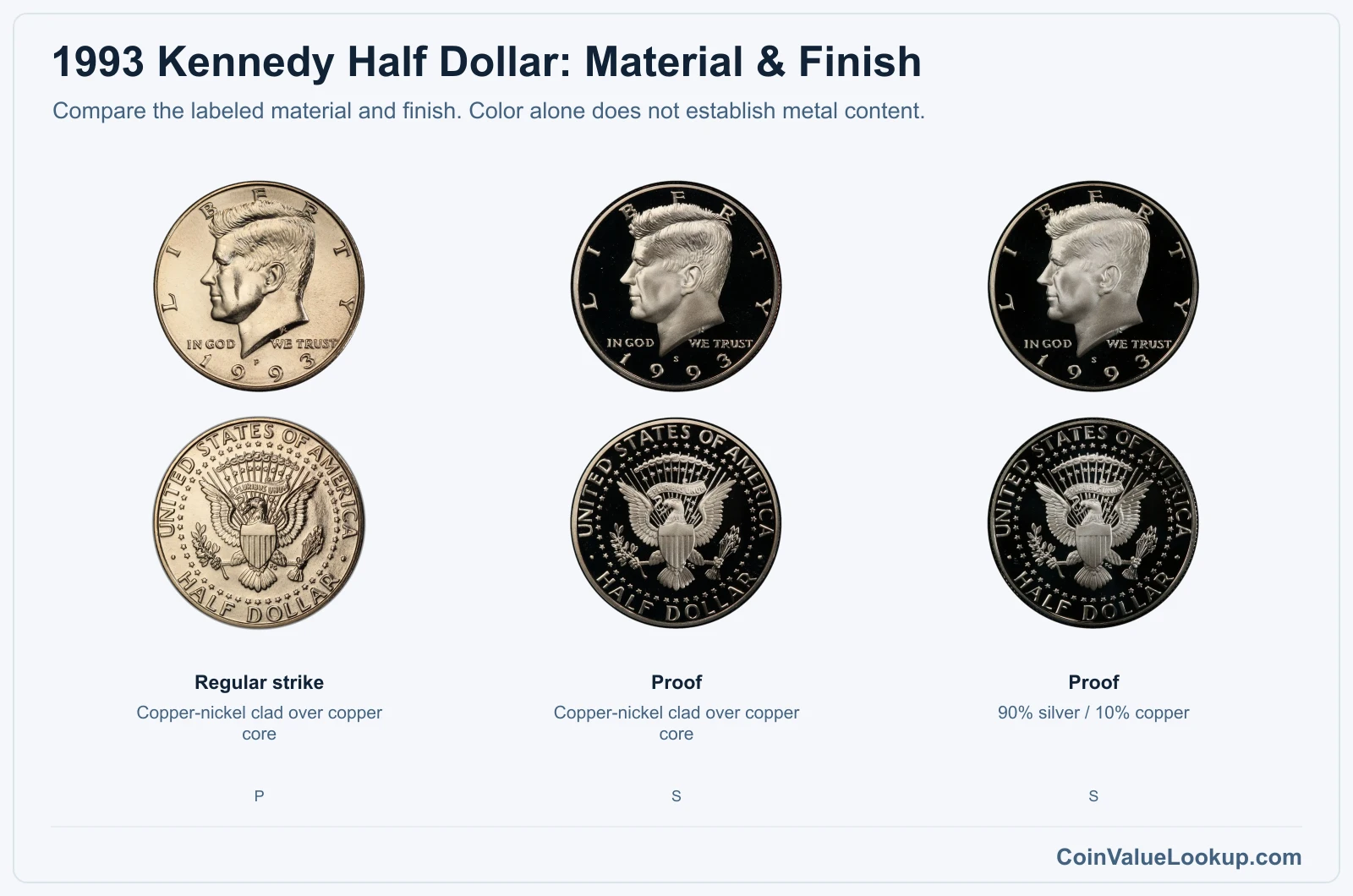
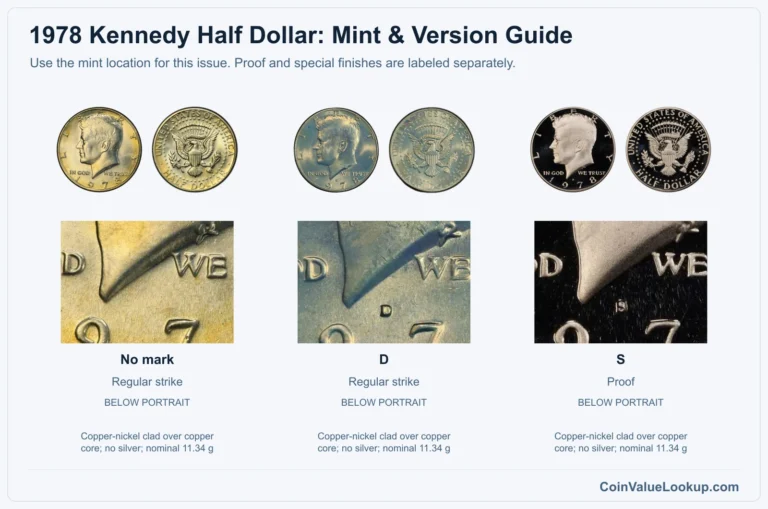
Flip the coin face-up and look just below Kennedy's neck, above the date. That is where the mintmark lives.
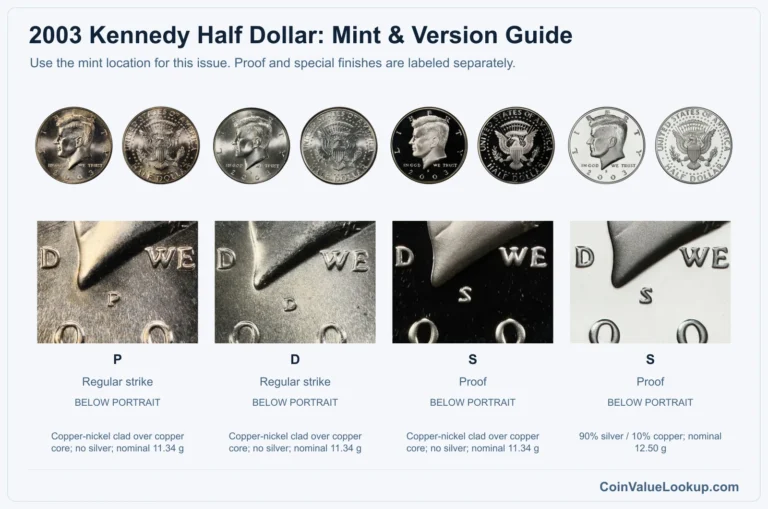
A "P" means Philadelphia, a "D" means Denver, and an "S" means San Francisco. Philadelphia struck business-strike halves, Denver did the same, and San Francisco produced both a clad proof and a 90% silver proof.
The tricky part is telling the two S-mint proofs apart. Both carry an S mintmark and both have mirror fields with frosted devices.
The silver proof weighs about 12.50 grams versus roughly 11.34 grams for the clad version. If you have a gram scale, that is the fastest confirmation.
Edge inspection helps too. A clad coin shows a visible copper-colored stripe along the edge where the copper core is exposed.
A silver proof edge looks uniformly silver-white. Toning and lighting can fool you, so weight plus edge color together give you the most reliable answer without special equipment.
Original government packaging is another clue. Silver proofs shipped in separate sets from the standard clad proof sets.
If you still have the original case or certificate, that settles the question instantly.
Step 2: Check Your 1993 Kennedy Half Dollar Grade
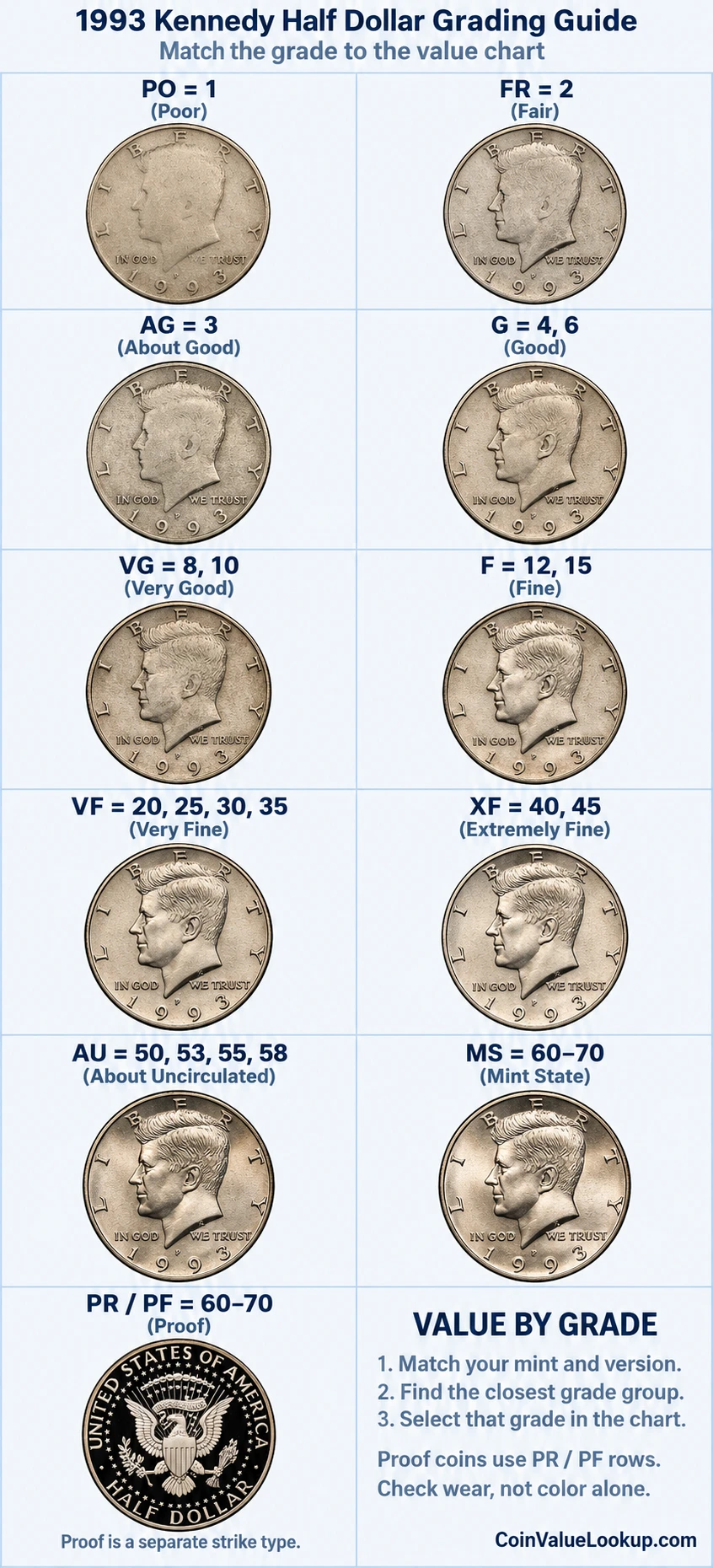
For business strikes from Philadelphia or Denver, start at Kennedy's cheekbone and jawline. In high grades those surfaces show full original luster with no smoothing.
A coin that spent time in a cash register will show flat spots on the cheek first, then the hair above the ear.
The reverse wears on the eagle's breast feathers and the tops of the wings. Compare your coin side-by-side with the grading image to gauge how much detail remains.
Even small differences in sharpness separate a coin worth face value from one a collector might want.
Mint State coins can still look rough. Bag marks — tiny nicks from coins banging together in bulk storage — lower the grade even though the coin never circulated.
A technically uncirculated half covered in contact marks grades lower than a clean one.
Proofs play by different rules. Grade them for hairlines across the mirror fields, haze from improper storage, and contact marks on the high points.
A proof with obvious hairlines visible to the naked eye drops well below PR65. Handle proofs by the edges only, always.
Step 3: Check 1993 Kennedy Half Dollar Value by Mint and Version
1993 Kennedy Half Dollar — P — clad business
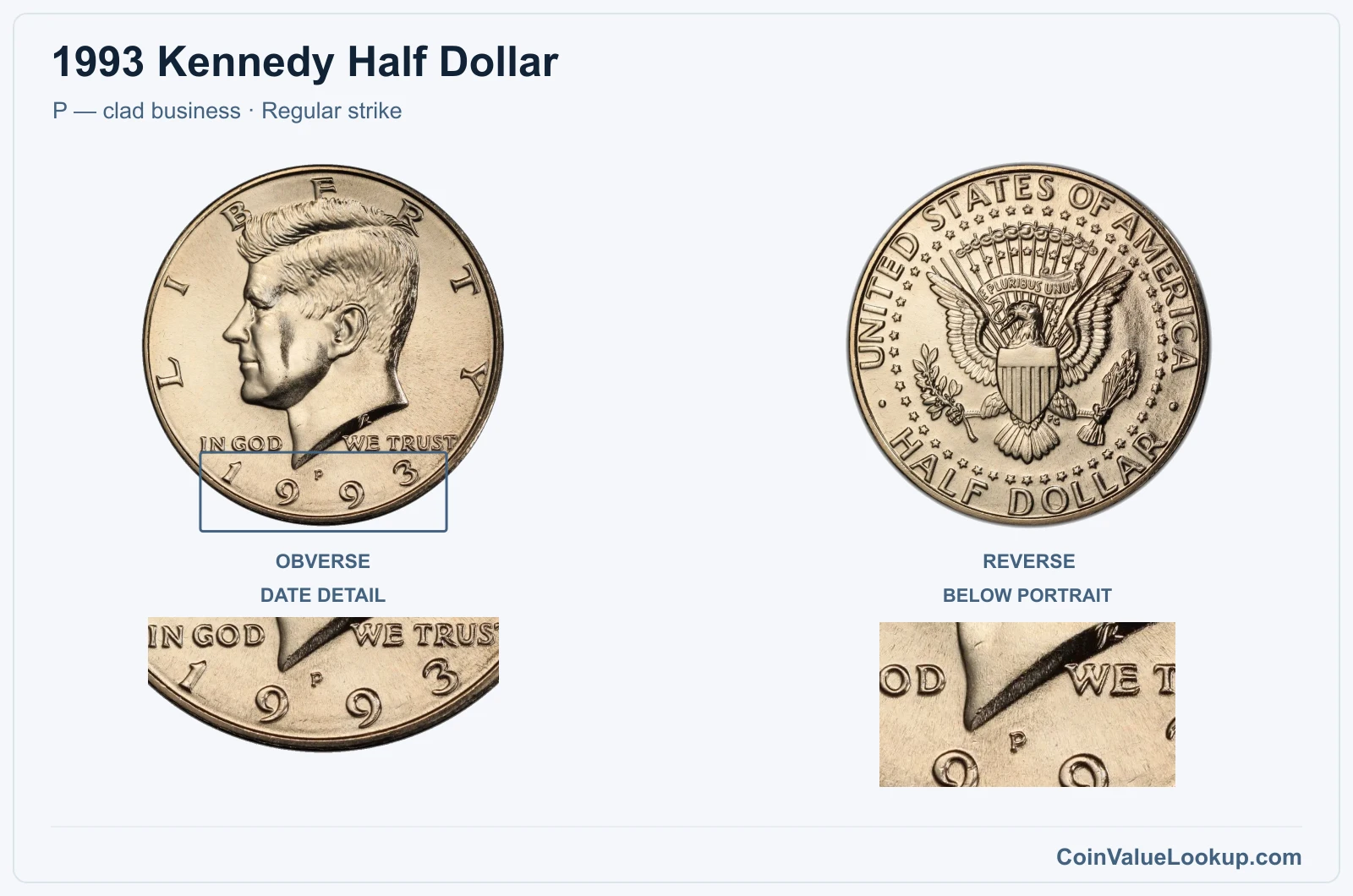
The 1993-P half dollar is a copper-nickel clad business strike weighing about 11.34 grams. Look for the "P" mintmark beneath Kennedy's portrait.
Philadelphia produced these for general circulation, and most saw plenty of pocket time.
Worn examples trade at face value — 50 cents. In pristine MS65 condition, the USA Coin Book guide estimates around $3.62.
That is not a fortune, but it means a sharp, lustrous roll-fresh example is worth setting aside. Check for bag marks on the cheek and full hair detail above the ear before assuming yours qualifies.
Range Grade
Price Auction Records Appraisal PO PO 1
—
Coin Identifier FR FR 2
—
Coin Identifier AG AG 3
—
Coin Identifier G G 4
—
Coin Identifier
G 6
—
Coin Identifier VG VG 8
—
Coin Identifier
VG 10
—
Coin Identifier F F 12
—
Coin Identifier
F 15
—
Coin Identifier VF VF 20
—
Coin Identifier
VF 25
—
Coin Identifier
VF 30
—
Coin Identifier
VF 35
—
Coin Identifier XF XF 40
—
Coin Identifier
XF 45
—
Coin Identifier AU AU 50
—
Coin Identifier
AU 53
—
Coin Identifier
AU 55
—
Coin Identifier
AU 58
—
Coin Identifier MS MS 60
—
Coin Identifier
MS 61
—
Coin Identifier
MS 62
—
Coin Identifier
MS 63
—
Coin Identifier
MS 64
—
Coin Identifier
MS 65
Coin Identifier
MS 66
Coin Identifier
MS 67
Coin Identifier
MS 68
—
—
—
MS 69
—
—
—
MS 70
—
—
—
1993 Kennedy Half Dollar — D — clad business
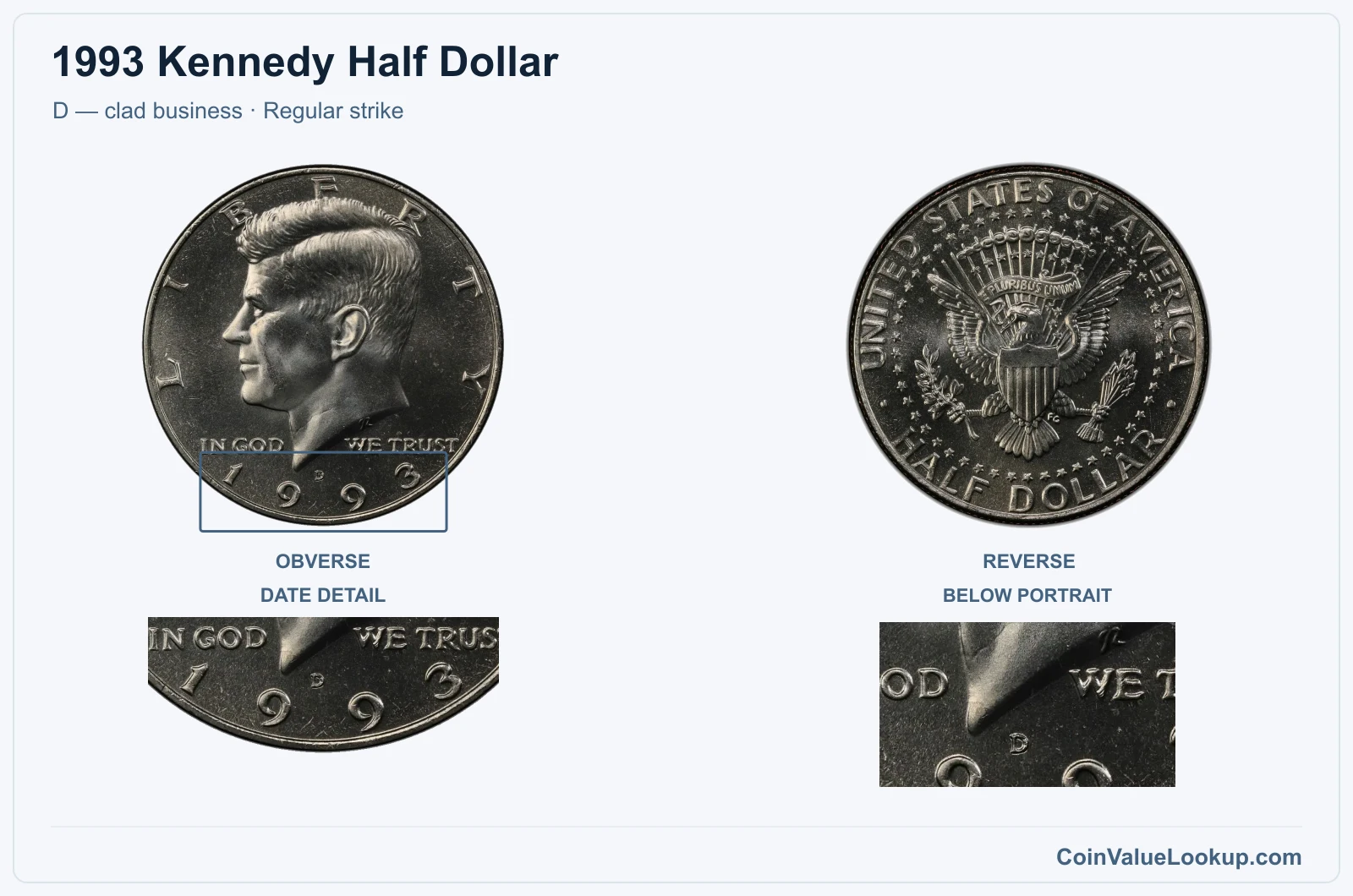
Denver's 1993-D half dollar matches the Philadelphia version in composition and weight: copper-nickel clad, roughly 11.34 grams. The "D" mintmark sits in the same spot beneath Kennedy's neck.
Circulated pieces are face-value coins. At MS65, the USA Coin Book guide estimate is also about $3.62.
Condition is everything here. A roll coin with clean fields and no distracting contact marks is the one worth pulling aside.
Coin Value Lookup is a handy starting point when you want to check values across different Kennedy half dollar years or other U.S. coin series. It can save you a lot of tab-hopping.
Range Grade
Price Auction Records Appraisal PO PO 1
—
Coin Identifier FR FR 2
—
Coin Identifier AG AG 3
—
Coin Identifier G G 4
—
Coin Identifier
G 6
—
Coin Identifier VG VG 8
—
Coin Identifier
VG 10
—
Coin Identifier F F 12
—
Coin Identifier
F 15
—
Coin Identifier VF VF 20
—
Coin Identifier
VF 25
—
Coin Identifier
VF 30
—
Coin Identifier
VF 35
—
Coin Identifier XF XF 40
—
Coin Identifier
XF 45
—
Coin Identifier AU AU 50
—
Coin Identifier
AU 53
—
Coin Identifier
AU 55
—
Coin Identifier
AU 58
—
Coin Identifier MS MS 60
—
Coin Identifier
MS 61
—
Coin Identifier
MS 62
—
Coin Identifier
MS 63
—
Coin Identifier
MS 64
—
Coin Identifier
MS 65
Coin Identifier
MS 66
Coin Identifier
MS 67
Coin Identifier
MS 68
Coin Identifier
MS 69
—
—
—
MS 70
—
—
—
1993 Kennedy Half Dollar — S — clad proof
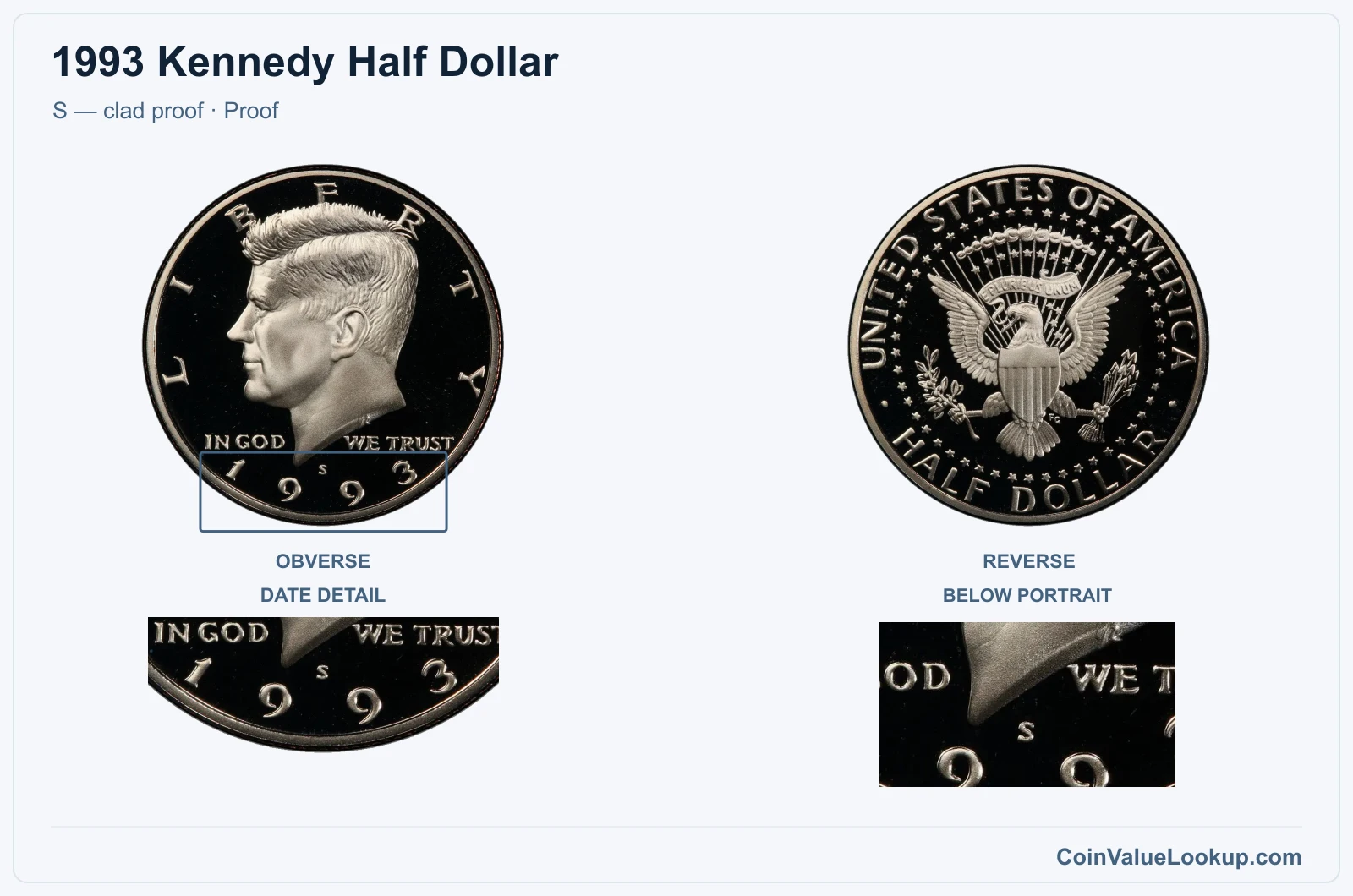
The 1993-S clad proof was struck at San Francisco on copper-nickel clad planchets, the same alloy as the business strikes. It weighs about 11.34 grams.
These came in standard proof sets with mirror-like fields and frosted raised devices.
Do not confuse this with the silver proof — same mintmark, very different coin. Tilt the edge toward a light source: if you see a reddish copper stripe, it is clad.
The USA Coin Book guide places a PR65 clad proof at roughly $10.00. Inspect for hairlines across those mirror fields, because even light mishandling drops the grade quickly.
Range Grade
Price Auction Records Appraisal PR PR 1
—
Coin Identifier
PR 2
—
Coin Identifier
PR 3
—
Coin Identifier
PR 4
—
Coin Identifier
PR 6
—
Coin Identifier
PR 8
—
Coin Identifier
PR 10
—
Coin Identifier
PR 12
—
Coin Identifier
PR 15
—
Coin Identifier
PR 20
—
Coin Identifier
PR 25
—
Coin Identifier
PR 30
—
Coin Identifier
PR 35
—
Coin Identifier
PR 40
—
Coin Identifier
PR 45
—
Coin Identifier
PR 50
—
Coin Identifier
PR 53
—
Coin Identifier
PR 55
—
Coin Identifier
PR 58
—
Coin Identifier
PR 60
—
Coin Identifier
PR 61
—
Coin Identifier
PR 62
—
Coin Identifier
PR 63
—
Coin Identifier
PR 64
—
Coin Identifier
PR 65
—
Coin Identifier
PR 66
—
Coin Identifier
PR 67
Coin Identifier
PR 68
Coin Identifier
PR 69
Coin Identifier
PR 70
Coin Identifier
1993 Kennedy Half Dollar — S — silver proof
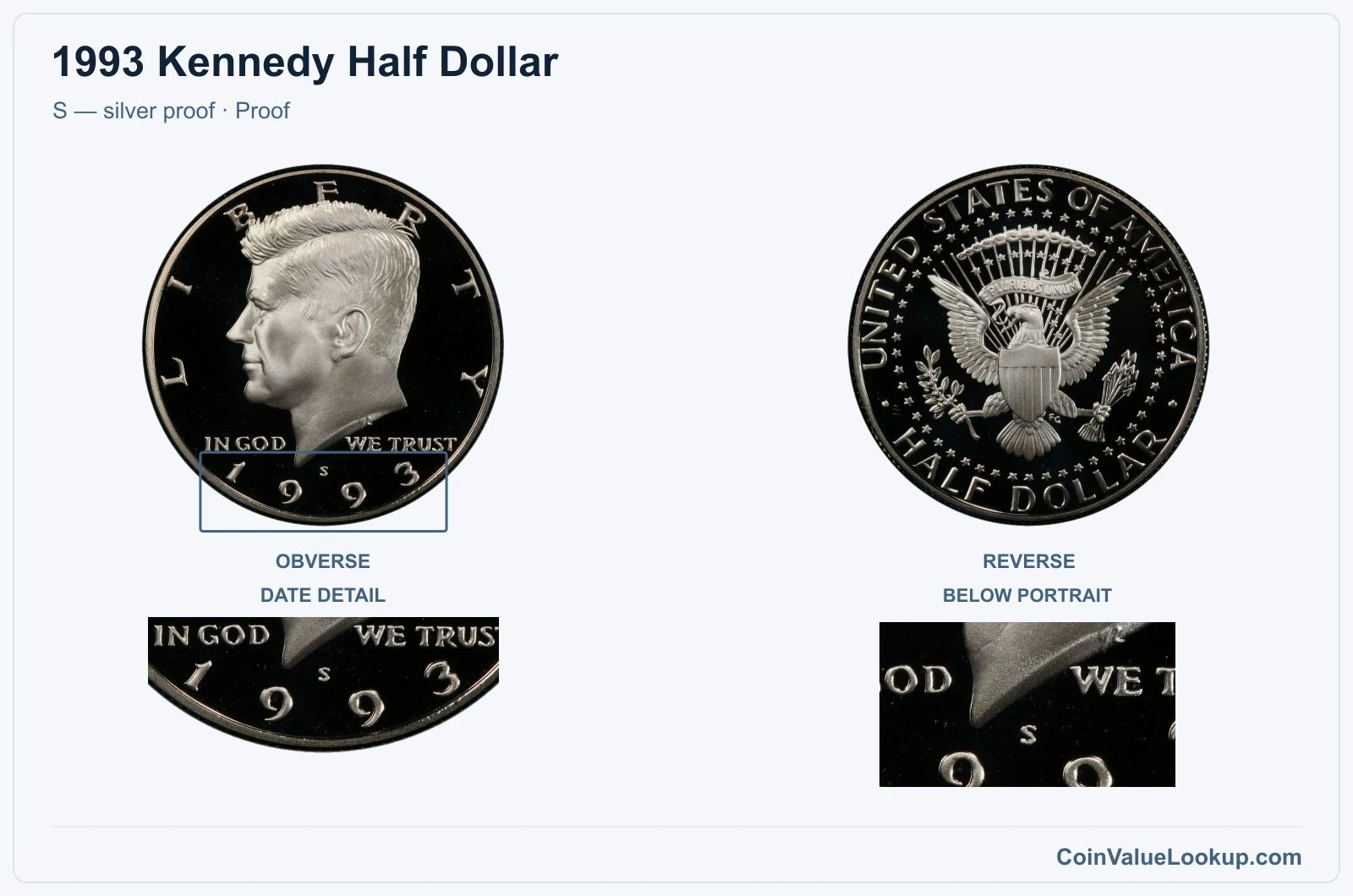
This is the one collectors pay attention to. The 1993-S silver proof is struck on a 90% silver, 10% copper planchet weighing approximately 12.50 grams.
That extra gram-plus over the clad version is your first diagnostic clue.
The edge should look uniformly silver-white with no copper stripe visible. These were sold in separate Silver Proof Sets from the U.S. Mint, so original packaging is strong confirmation.
At PR65, the USA Coin Book guide estimates $51.00 — a meaningful step above every other 1993 Kennedy half.
Keep in mind that silver proof fineness changed to .999 starting in 2019, so this earlier issue uses the traditional 90/10 alloy. Handle it by the edges and store it in a non-PVC holder to preserve those mirror fields.
Range Grade
Price Auction Records Appraisal PR PR 1
—
Coin Identifier
PR 2
—
Coin Identifier
PR 3
—
Coin Identifier
PR 4
—
Coin Identifier
PR 6
—
Coin Identifier
PR 8
—
Coin Identifier
PR 10
—
Coin Identifier
PR 12
—
Coin Identifier
PR 15
—
Coin Identifier
PR 20
—
Coin Identifier
PR 25
—
Coin Identifier
PR 30
—
Coin Identifier
PR 35
—
Coin Identifier
PR 40
—
Coin Identifier
PR 45
—
Coin Identifier
PR 50
—
Coin Identifier
PR 53
—
Coin Identifier
PR 55
—
Coin Identifier
PR 58
—
Coin Identifier
PR 60
—
Coin Identifier
PR 61
—
Coin Identifier
PR 62
—
Coin Identifier
PR 63
—
Coin Identifier
PR 64
—
Coin Identifier
PR 65
—
Coin Identifier
PR 66
—
Coin Identifier
PR 67
Coin Identifier
PR 68
Coin Identifier
PR 69
Coin Identifier
PR 70
Coin Identifier
1993 Kennedy Half Dollar Error List
1. 1993 Kennedy Half Dollar — Clashed Dies
Die clash marks appear when the obverse and reverse dies strike each other without a planchet between them. The result is faint ghost-like impressions of the opposite design transferred onto each die, which then show up on subsequent coins.
On a 1993 Kennedy half, look for traces of the eagle design bleeding through on Kennedy's portrait side, or hints of Kennedy's profile appearing among the eagle's feathers on the reverse. These impressions align with where the opposing features would sit during a normal strike.
Do not confuse die clash marks with random scratches, incuse lines from post-mint damage, or a brockage error, which leaves a much more dramatic mirror image. True clash marks are consistent and positioned where you would expect the opposing die's design to appear.
Value depends on how visible the clash is and the coin's overall condition; no reliable price range is available for this specific year.
2. 1993 Kennedy Half Dollar — Doubled Die Obverse
A doubled die obverse on a 1993 Kennedy half means the die itself received a misaligned secondary impression during its manufacturing. The doubling is baked into the die, so every coin struck from it shows the same consistent separation.
To check, examine the obverse lettering — especially LIBERTY and IN GOD WE TRUST — under magnification and good lighting. Genuine doubled die features show clear notching or separation that repeats in the same direction across multiple design elements.
Compare yours against a normal 1993 half to spot the difference.
The common lookalike is machine doubling, which produces flat, shelf-like distortion rather than rounded, separated design elements. Worn die contours and reflected light can also mimic doubling to the untrained eye.
Condition and the strength of the doubling both affect what a doubled die example is worth; no adopted price range is available for this date.
3. 1993 Kennedy Half Dollar — Off-Center Strike
An off-center strike happens when the planchet is not seated properly between the dies at the moment of impact. The design shifts to one side, leaving a blank crescent of unstruck metal on the opposite edge.
On a 1993 Kennedy half, the key is whether the date remains visible. Collectors strongly prefer off-center coins that still show a readable date, because without it, attributing the year becomes difficult.
A modest 5% shift looks like a minor curiosity; a dramatic 50% shift with a visible date is a different conversation entirely.
Do not mistake a clipped planchet, which has a straight or curved bite taken from the edge, for an off-center strike. Post-mint damage that flattens one side of the coin can also look superficially similar but will not show the characteristic unstruck crescent.
Value varies widely based on the percentage of misalignment and overall condition; no specific price range is available for this year.