2003 Kennedy Half Dollar Coin Value: How Much Is It Worth?
The 2003 Kennedy half dollar carries a face value of fifty cents, and most ordinary clad examples you pull from a roll or a spent mint set are worth exactly that. Collector guide estimates from USA Coin Book place the identified mint and finish branches between roughly $3.62 and $36.00 at specific grades, with the silver proof sitting at the top.
Before you check any price chart, you need to know whether your coin is a business strike, a clad proof, or a silver proof, because those details change everything.
Fast Way to Identify Your 2003 Kennedy Half Dollar
Snap a clear photo of the front and back of your 2003 Kennedy half dollar and upload both images here. Our identifier can give you a preliminary read on the mint, finish and general version so you know which branch to research further.
Good lighting and a steady hand help — blurry shots make it tough to spot mintmarks or proof characteristics.
2003 Kennedy Half Dollar Value
Upload both sides of your 2003 Kennedy Half Dollar.
Front Obverse
Upload photo
Back Reverse
Upload photo
Which 2003 Kennedy Half Dollar Versions Are Worth Money?
- The 2003-S silver proof carries a USA Coin Book guide estimate of $36.00 at PR65 — check the S mintmark and confirm silver content by weight or edge color before assuming you have one.
- Clad proofs from San Francisco are a step above face value, with a guide estimate around $6.25 at PR65, but they are not silver.
- Business strikes graded MS65 from either Philadelphia or Denver list at $3.62 in the same guide — worth checking condition carefully, since worn examples are generally face-value coins.
- Mint-made errors such as doubled dies, off-center strikes and die breaks have been reported for this date; value depends on visibility and condition, so compare your coin closely to known examples.
Step 1: Identify Your 2003 Kennedy Half Dollar Mint Mark and Version
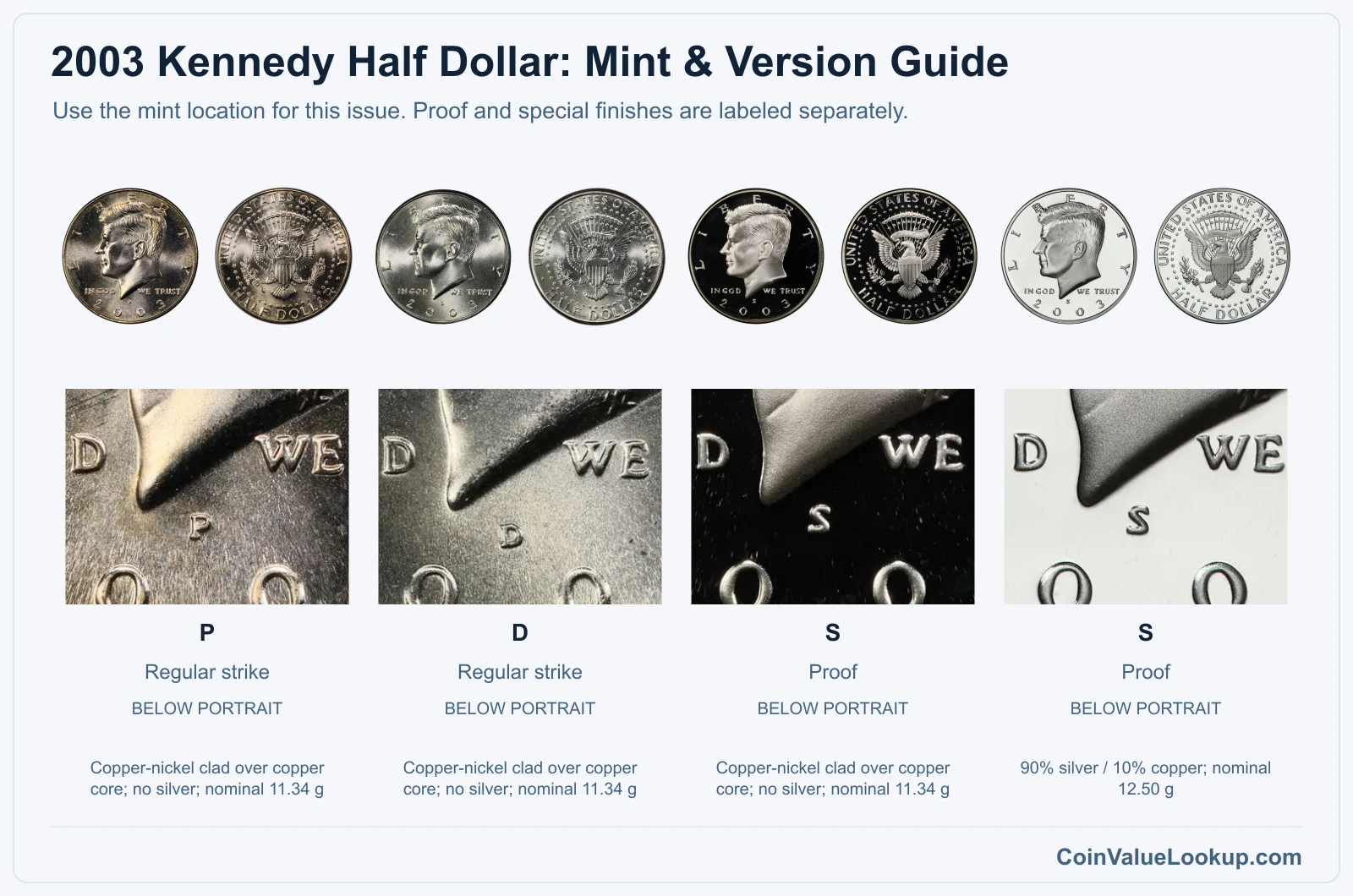
Flip the coin to the obverse and look just beneath Kennedy's portrait, above the date. That is where the mintmark lives.
A "P" means Philadelphia, a "D" means Denver, and an "S" means San Francisco.
Philadelphia coins struck before 1980 carry no mintmark at all, but by 2003 the P was standard. Both the P and D versions are copper-nickel clad business strikes with no silver content.
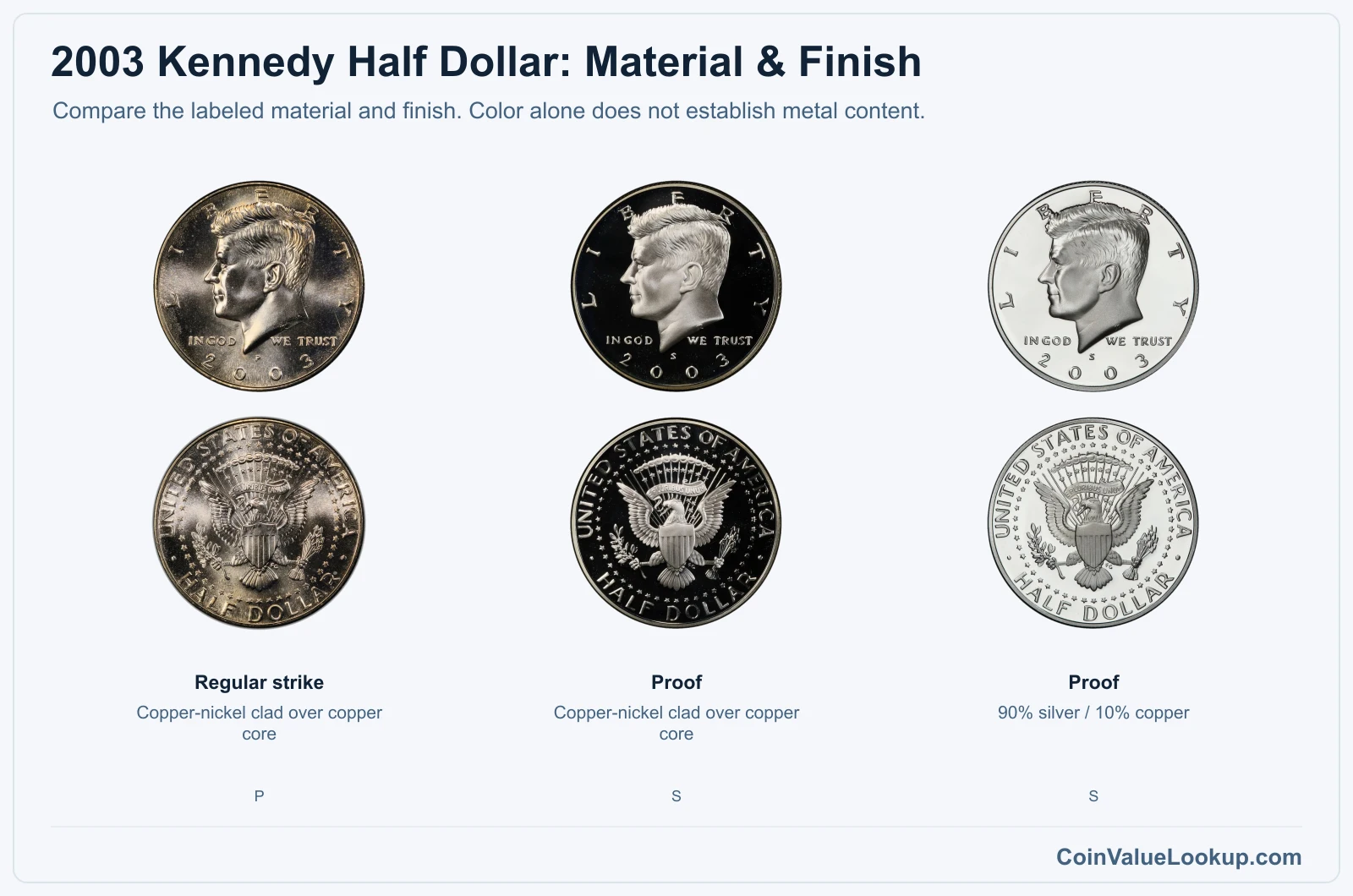
San Francisco produced two different coins this year: a clad proof and a 90% silver proof. Both carry an S mintmark, so the letter alone will not tell you which one you have.
To separate them, compare weight and edge. The silver proof weighs about 12.50 grams versus roughly 11.34 grams for the clad version.
On the edge of the clad coin you may see a visible copper-toned stripe from its layered construction, while the silver proof's edge appears uniformly silver-colored. Original government packaging also helps confirm the alloy.
Do not rely on toning or lighting alone — those can mimic silver or gold on a plain clad coin.
Step 2: Check Your 2003 Kennedy Half Dollar Grade
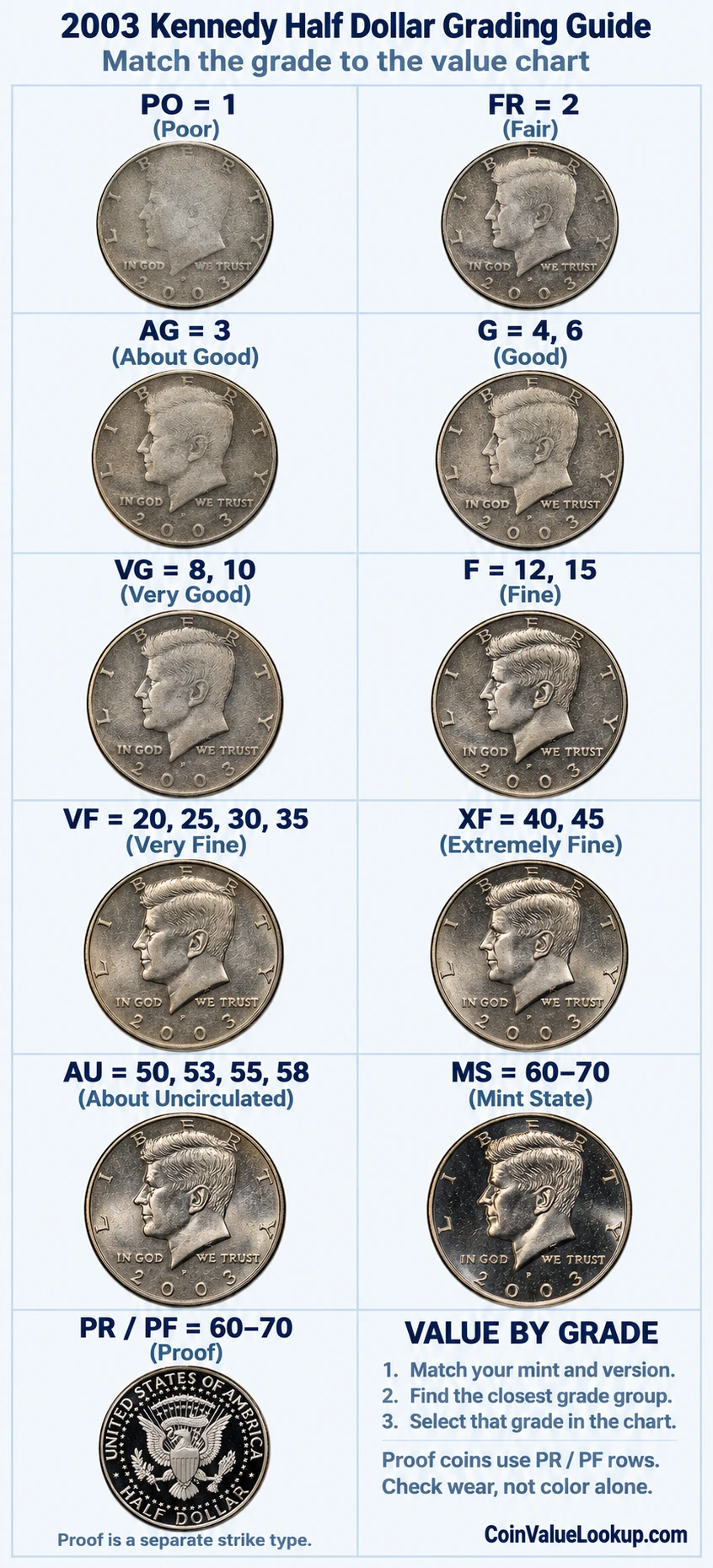
Start on the obverse. Kennedy's cheekbone and jawline are the first areas to show wear — look for any smoothing or loss of skin texture there.
Then check the hair directly above and behind the ear; on a well-struck Mint State coin those strands are sharp and distinct.
Flip to the reverse and examine the eagle's breast feathers and the tops of the wings. Flat spots in those areas signal light wear even when the rest of the coin looks clean.
Bag marks are a separate issue from circulation wear. Two coins can both be uncirculated, but the one covered in tiny contact marks from bouncing around in a mint bag will grade lower.
Use the comparison image to calibrate your eye for the difference between a clean MS65 surface and a heavily marked MS60.
Proofs get graded on a different scale. Look for hairlines from handling, haze from improper storage, and contact marks on the mirror fields.
A proof with obvious hairlines across the field will not earn a high proof grade, no matter how sharp the devices look.
Step 3: Check 2003 Kennedy Half Dollar Value by Mint and Version
2003 Kennedy Half Dollar — P — clad business
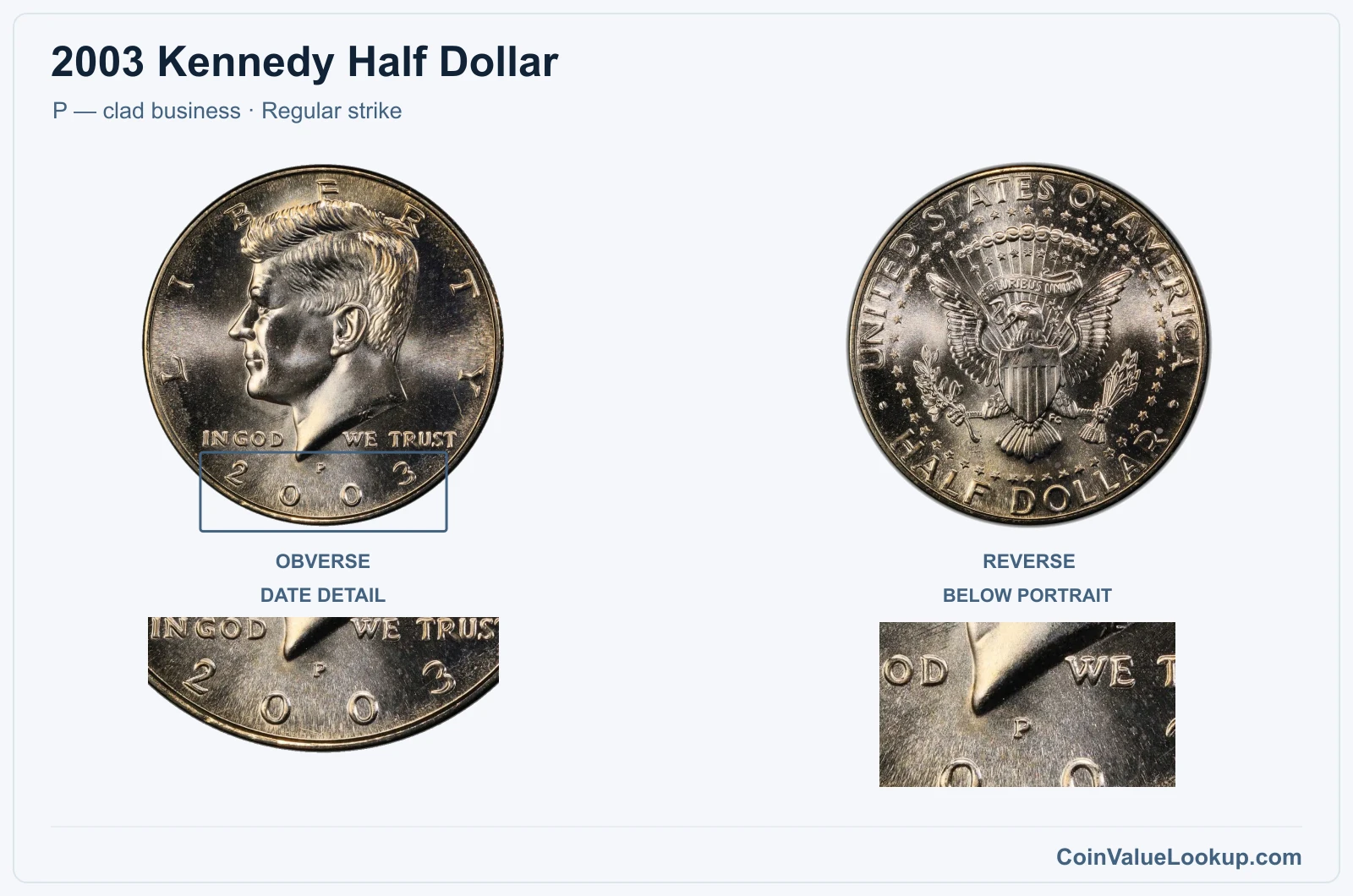
The 2003-P Kennedy half dollar is a copper-nickel clad business strike from Philadelphia, weighing about 11.34 grams. Look for the small "P" mintmark on the obverse beneath Kennedy's portrait.
Most circulated examples are worth fifty cents, full stop. At MS65 the USA Coin Book guide estimate is $3.62.
That modest premium reflects the fact that this year's half dollars were produced largely for collector sets rather than everyday commerce, so many survivors are in decent shape. The key is whether your coin came straight from an original mint set or was broken out and spent — a worn-down example has no collector premium above face value.
Range Grade
Price Auction Records Appraisal PO PO 1
—
Coin Identifier FR FR 2
—
Coin Identifier AG AG 3
—
Coin Identifier G G 4
—
Coin Identifier
G 6
—
Coin Identifier VG VG 8
—
Coin Identifier
VG 10
—
Coin Identifier F F 12
—
Coin Identifier
F 15
—
Coin Identifier VF VF 20
—
Coin Identifier
VF 25
—
Coin Identifier
VF 30
—
Coin Identifier
VF 35
—
Coin Identifier XF XF 40
—
Coin Identifier
XF 45
—
Coin Identifier AU AU 50
—
Coin Identifier
AU 53
—
Coin Identifier
AU 55
—
Coin Identifier
AU 58
—
Coin Identifier MS MS 60
—
Coin Identifier
MS 61
—
Coin Identifier
MS 62
—
Coin Identifier
MS 63
—
Coin Identifier
MS 64
—
Coin Identifier
MS 65
—
Coin Identifier
MS 66
Coin Identifier
MS 67
Coin Identifier
MS 68
—
Coin Identifier
MS 69
—
—
—
MS 70
—
—
—
2003 Kennedy Half Dollar — D — clad business
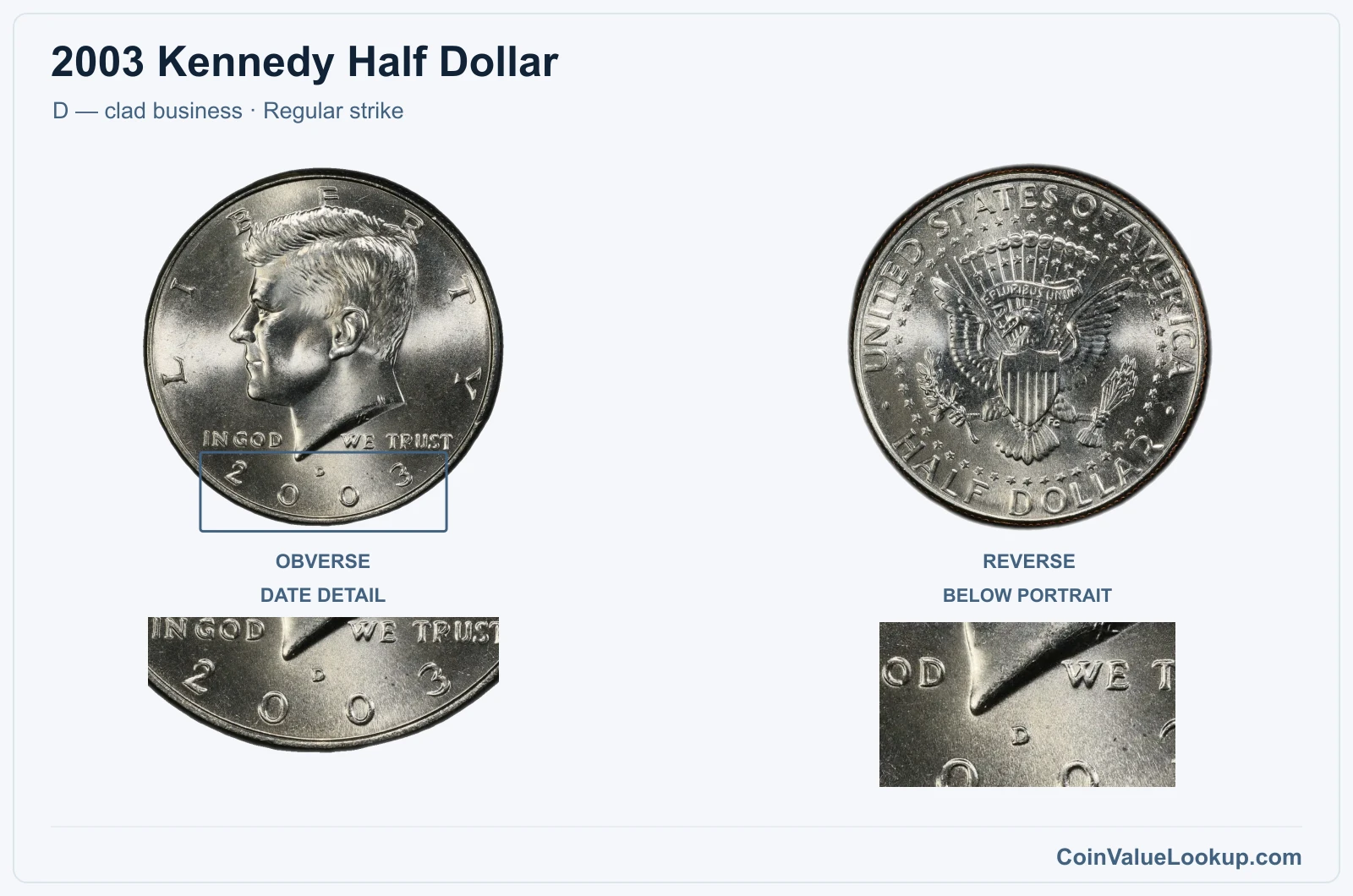
The 2003-D is the Denver-minted clad business strike, identical in composition and weight to the Philadelphia version. Find the "D" mintmark in the same spot beneath Kennedy's portrait.
USA Coin Book lists the MS65 guide estimate at $3.62, the same as its Philadelphia sibling. Like the P issue, these were distributed primarily through mint sets rather than bank rolls.
A coin that stayed in its original holder and avoided contact marks is what collectors are after. Anything with noticeable wear is a face-value coin.
Coin Value Lookup is a good starting point if you want to compare this date against other Kennedy half dollar years or different denominations entirely.
Range Grade
Price Auction Records Appraisal PO PO 1
—
Coin Identifier FR FR 2
—
Coin Identifier AG AG 3
—
Coin Identifier G G 4
—
Coin Identifier
G 6
—
Coin Identifier VG VG 8
—
Coin Identifier
VG 10
—
Coin Identifier F F 12
—
Coin Identifier
F 15
—
Coin Identifier VF VF 20
—
Coin Identifier
VF 25
—
Coin Identifier
VF 30
—
Coin Identifier
VF 35
—
Coin Identifier XF XF 40
—
Coin Identifier
XF 45
—
Coin Identifier AU AU 50
—
Coin Identifier
AU 53
—
Coin Identifier
AU 55
—
Coin Identifier
AU 58
—
Coin Identifier MS MS 60
—
Coin Identifier
MS 61
—
Coin Identifier
MS 62
—
Coin Identifier
MS 63
—
Coin Identifier
MS 64
—
Coin Identifier
MS 65
Coin Identifier
MS 66
Coin Identifier
MS 67
Coin Identifier
MS 68
Coin Identifier
MS 69
—
—
—
MS 70
—
—
—
2003 Kennedy Half Dollar — S — clad proof
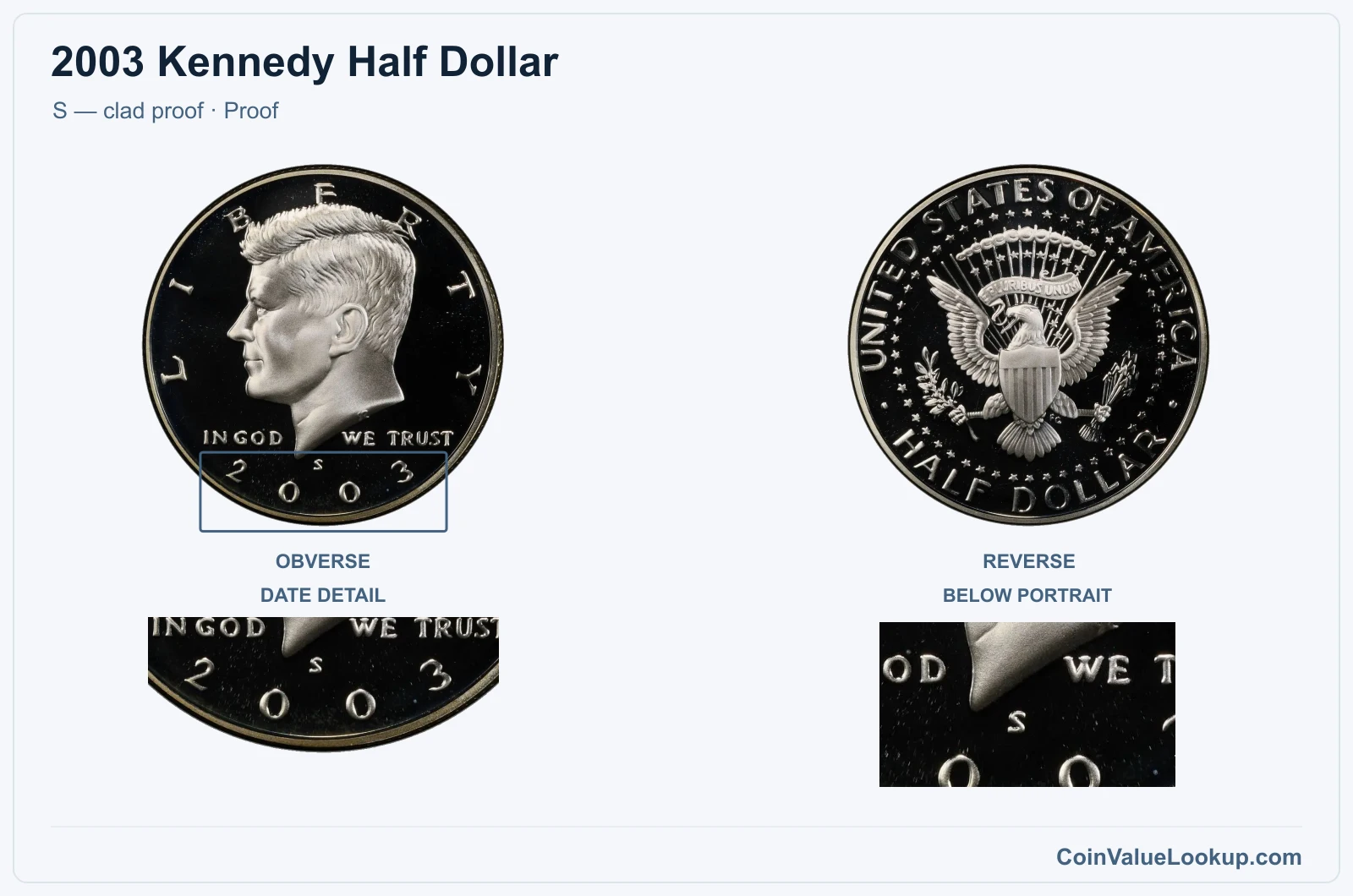
The 2003-S clad proof was struck at San Francisco on copper-nickel clad planchets — no silver here, despite what the mirror finish might suggest. It carries an S mintmark and weighs the same 11.34 grams as the business strikes.
USA Coin Book places the PR65 guide estimate at $6.25. You will typically find these in original proof-set packaging.
Examine the mirror fields for hairlines and the frosted devices for contact marks; those flaws determine the grade. The critical identification step is confirming that this is clad, not silver, since both carry the same mintmark.
Check the edge for a visible copper-colored layer, or weigh the coin — the silver version is noticeably heavier.
Range Grade
Price Auction Records Appraisal PR PR 1
—
Coin Identifier
PR 2
—
Coin Identifier
PR 3
—
Coin Identifier
PR 4
—
Coin Identifier
PR 6
—
Coin Identifier
PR 8
—
Coin Identifier
PR 10
—
Coin Identifier
PR 12
—
Coin Identifier
PR 15
—
Coin Identifier
PR 20
—
Coin Identifier
PR 25
—
Coin Identifier
PR 30
—
Coin Identifier
PR 35
—
Coin Identifier
PR 40
—
Coin Identifier
PR 45
—
Coin Identifier
PR 50
—
Coin Identifier
PR 53
—
Coin Identifier
PR 55
—
Coin Identifier
PR 58
—
Coin Identifier
PR 60
—
Coin Identifier
PR 61
—
Coin Identifier
PR 62
—
Coin Identifier
PR 63
—
Coin Identifier
PR 64
—
Coin Identifier
PR 65
—
Coin Identifier
PR 66
—
Coin Identifier
PR 67
—
Coin Identifier
PR 68
Coin Identifier
PR 69
Coin Identifier
PR 70
Coin Identifier
2003 Kennedy Half Dollar — S — silver proof
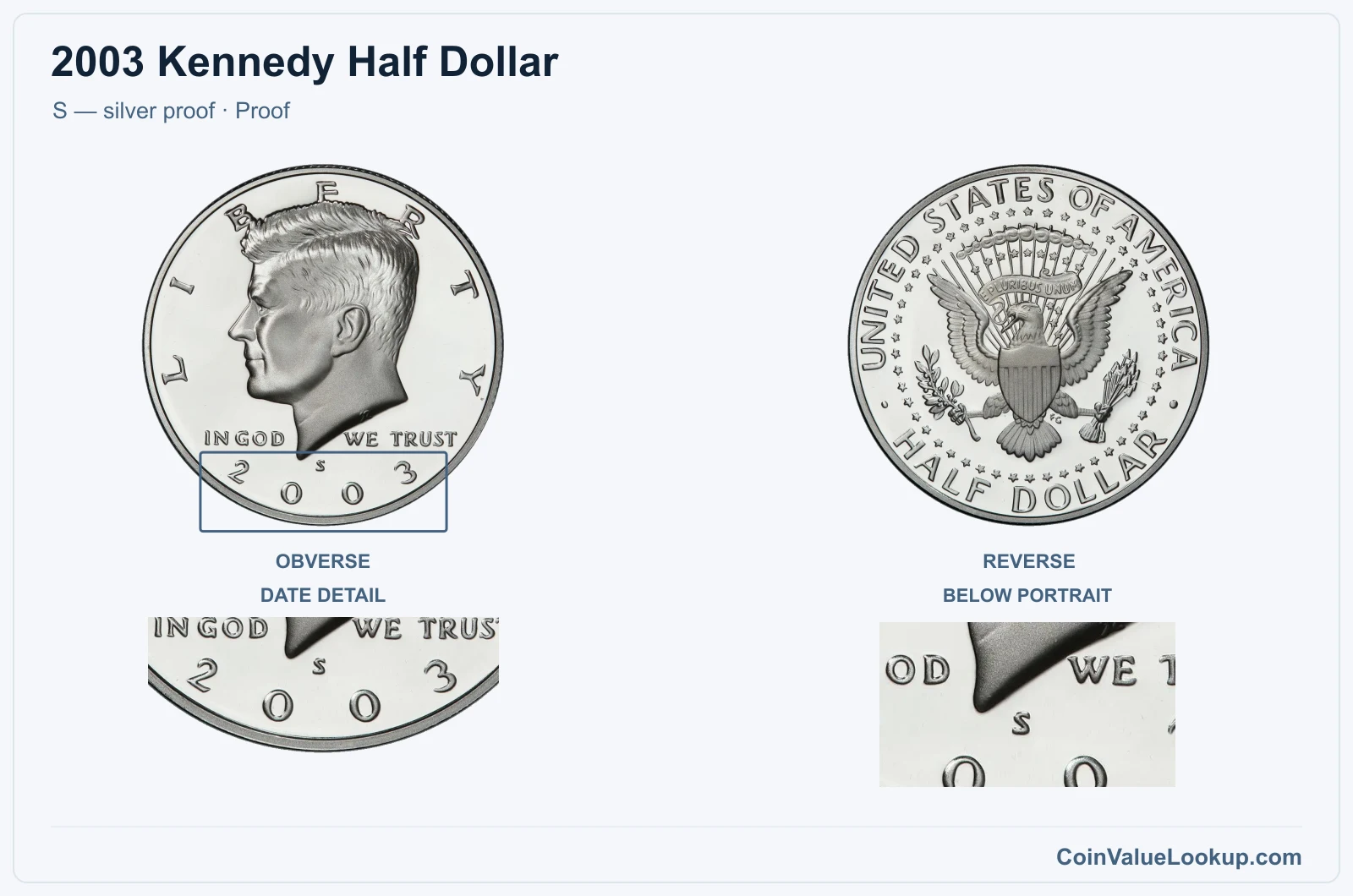
This is the one worth paying attention to. The 2003-S silver proof is struck on a 90% silver, 10% copper planchet weighing approximately 12.50 grams.
It shares the S mintmark with the clad proof, so you cannot rely on the letter alone.
At PR65 the USA Coin Book guide estimate is $36.00 — roughly ten times the face value and nearly six times the clad proof estimate at the same grade. Confirm the alloy before celebrating: weigh the coin on a precise scale and inspect the edge.
A silver proof's edge looks uniformly silver-gray, while the clad version reveals a copper-toned stripe between its outer layers. Original government silver proof set packaging is the easiest confirmation.
Grade the surfaces carefully — hairlines across those mirror fields will drag the grade and value down quickly.
Range Grade
Price Auction Records Appraisal PR PR 1
—
Coin Identifier
PR 2
—
Coin Identifier
PR 3
—
Coin Identifier
PR 4
—
Coin Identifier
PR 6
—
Coin Identifier
PR 8
—
Coin Identifier
PR 10
—
Coin Identifier
PR 12
—
Coin Identifier
PR 15
—
Coin Identifier
PR 20
—
Coin Identifier
PR 25
—
Coin Identifier
PR 30
—
Coin Identifier
PR 35
—
Coin Identifier
PR 40
—
Coin Identifier
PR 45
—
Coin Identifier
PR 50
—
Coin Identifier
PR 53
—
Coin Identifier
PR 55
—
Coin Identifier
PR 58
—
Coin Identifier
PR 60
—
Coin Identifier
PR 61
—
Coin Identifier
PR 62
—
Coin Identifier
PR 63
—
Coin Identifier
PR 64
—
Coin Identifier
PR 65
—
Coin Identifier
PR 66
—
Coin Identifier
PR 67
—
Coin Identifier
PR 68
Coin Identifier
PR 69
Coin Identifier
PR 70
Coin Identifier
2003 Kennedy Half Dollar Error List
1. 2003 Kennedy Half Dollar — Doubled Die Obverse
A doubled die obverse on the 2003 Kennedy half dollar shows consistent doubling on obverse lettering or design elements. Under magnification, look for separation or notching on the letters of LIBERTY, IN GOD WE TRUST, or along the profile itself.
The doubling should repeat in the same direction on every affected element — that consistency is the hallmark of a true doubled die versus machine doubling.
Machine doubling produces a flat, shelf-like distortion that lacks the sharp, separated contour of a genuine doubled die. Reflections and worn die surfaces can also mimic the effect.
Compare your coin to a known normal example under identical lighting before drawing conclusions. Value depends on how visible the doubling is and the coin's overall condition.
2. 2003 Kennedy Half Dollar — Off-Center Strike
An off-center strike happens when the planchet is not seated properly between the dies. On a 2003 Kennedy half, you will see a crescent-shaped blank area on one side, with the design shifted away from center.
The more dramatic the shift, the more collectors notice — but the date and mintmark should still be visible for the coin to attract serious interest.
Do not confuse an off-center strike with a clipped planchet, which produces a curved bite out of the edge, or with post-mint damage where something flattened part of the rim after striking. A genuine off-center coin has an unstruck area that is smooth and flat, matching the original planchet surface.
Condition and the degree of displacement both affect value.
3. 2003 Kennedy Half Dollar — Die Crack / Die Chip
Die cracks show up as thin raised lines on the coin's surface, following the path of a fracture in the steel die. On a 2003 Kennedy half, these can appear anywhere — across the fields, through lettering, or radiating from the rim.
Small raised blobs, called die chips, come from tiny pieces of the die breaking away.
These are distinct from scratches. A die crack is raised above the surface because metal filled the fracture during striking, while a scratch is incised into the surface.
Corrosion and foreign material stuck to the coin can also look like raised features, so inspect carefully. Value depends on the size, location and visual drama of the crack or chip, plus the coin's overall condition.
4. 2003 Kennedy Half Dollar — Die Break / Cud
A cud is a specific type of die break where a piece of the die breaks away at the rim, leaving a raised, featureless blob that connects to the edge of the coin. On a 2003 Kennedy half, a cud will appear as a smooth lump interrupting the normal rim and design.
The boundary between the cud and the surviving design is usually sharp and visible. The bigger the cud, the more attention it gets from error collectors.
Do not confuse a cud with a rim ding or dent from post-mint damage — damage is typically incuse or irregular, while a cud is raised and was struck into the coin. Interior die chips that do not reach the rim are related but technically a different category.
Condition and cud size both influence collector interest.
5. 2003 Kennedy Half Dollar — Struck-Through Error
A struck-through error occurs when foreign material — grease, a thread, a metal fragment — gets trapped between the die and the planchet during striking. On a 2003 Kennedy half, this shows up as a localized depression or an area of missing detail where the obstruction blocked the die's impression.
Grease-filled dies tend to obscure entire letters or sections of the design with a smooth, shallow depression. A retained foreign object, like a staple or wire, leaves a sharper, more defined impression.
Both are legitimate errors, but they look quite different.
Do not mistake ordinary wear, cleaning or weak strikes for struck-through errors. Wear removes detail gradually and uniformly; a struck-through area is localized and often has distinct edges.
Value depends on what the obstruction was, how dramatic the impression looks, and overall coin condition.