2003 Sacagawea Dollar Coin Value: How Much Is It Worth?
The 2003 Sacagawea Dollar is a manganese-brass clad coin that most people still confuse with gold. It is not gold.
Guide estimates for graded examples across the listed versions sit around $7.29 in the specific grades noted below. Most circulated pieces spend at face value, so the key is identifying your mint, finish and whether you hold anything unusual before drawing conclusions.
Fast Way to Identify Your 2003 Sacagawea Dollar
The quickest way to start is by uploading clear photos of both the front and back of your coin. That gives a preliminary identification of your mintmark, finish type and any visible anomalies.
Sharp, well-lit images help distinguish a proof from a business strike and catch details the naked eye might miss.
2003 Sacagawea Dollar Value
Upload both sides of your 2003 Sacagawea Dollar.
Front Obverse
Upload photo
Back Reverse
Upload photo
Which 2003 Sacagawea Dollar Versions Are Worth Money?
- S-mint proof with the soaring eagle reverse — the only 2003 version struck as a proof, valued at $7.29 in PR65 per guide estimates.
- Check your mintmark and finish carefully before assuming a premium; ordinary circulated P and D examples trade near face value.
Step 1: Identify Your 2003 Sacagawea Dollar Mint Mark and Version
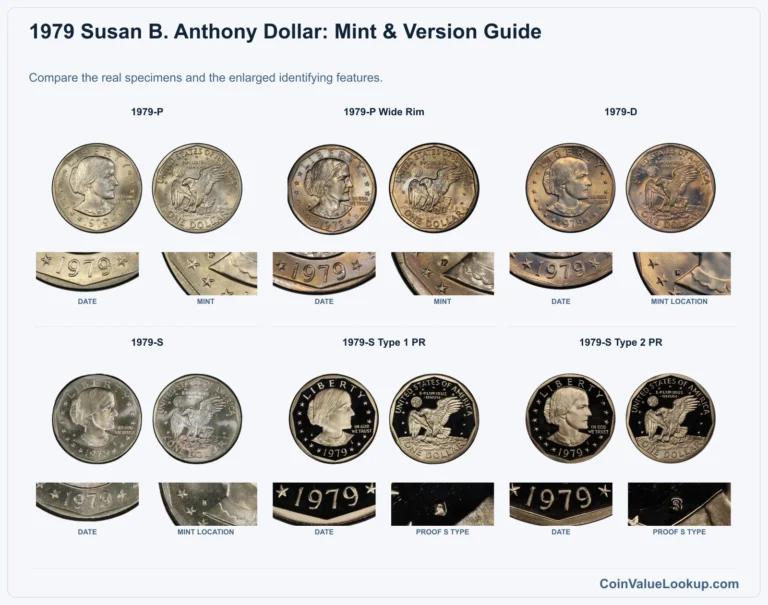
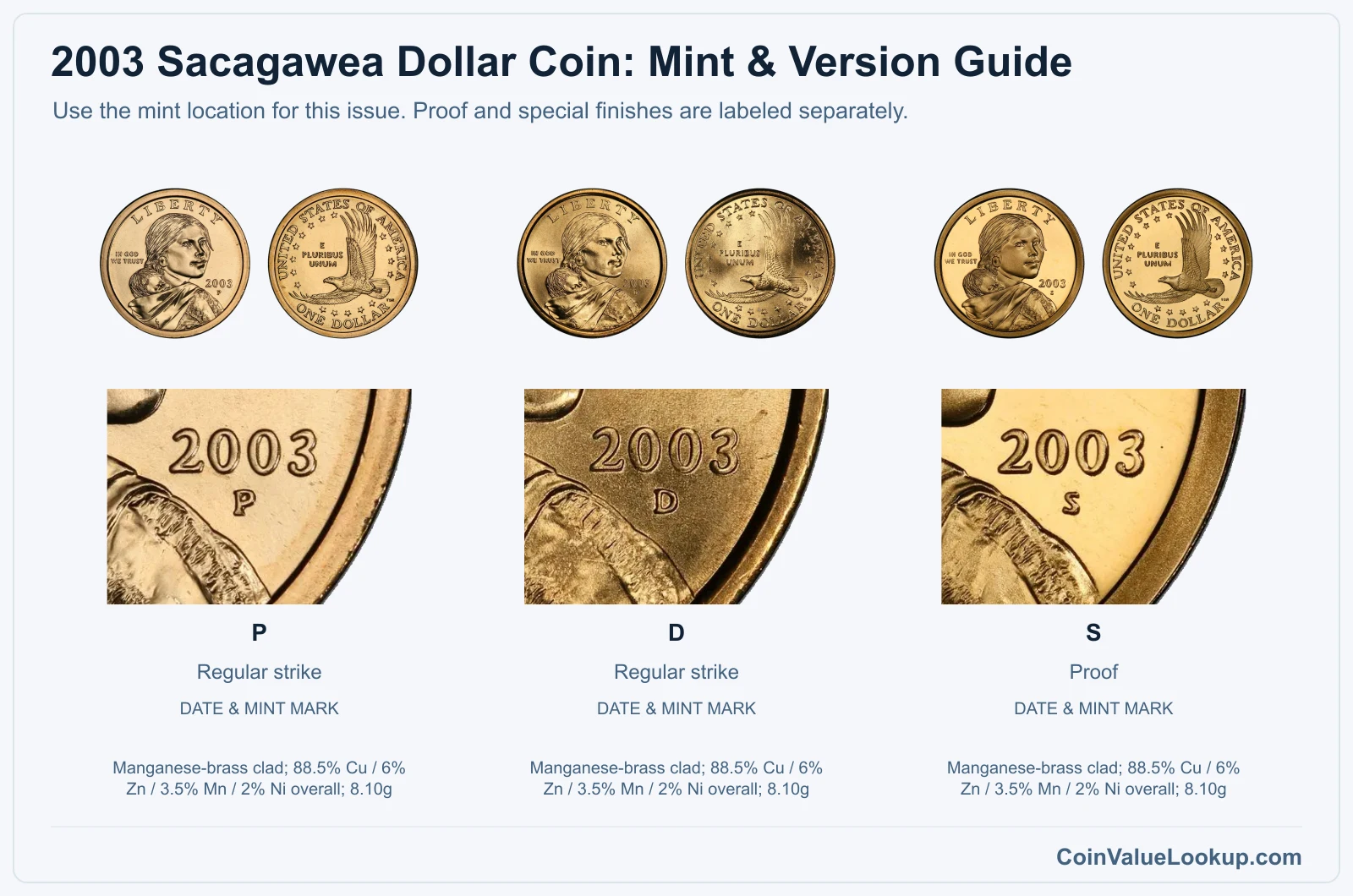
On the 2003 Sacagawea Dollar, look for the mintmark on the obverse just below the date. A "P" means Philadelphia, "D" means Denver, and "S" means San Francisco (proof).
All three share the same soaring-eagle reverse used from 2000 through 2008.
The coin is manganese-brass clad — 88.5% copper, 6% zinc, 3.5% manganese and 2% nickel, weighing 8.10 grams. That golden color fools people every year, but there is zero gold content.
Proofs from San Francisco have mirror-like fields and were sold in collector sets. A coin that came out of a silver proof set is still manganese-brass; the silver composition applies to other denominations in the set, not the dollar.
If you see an "S" mintmark and frosted devices against reflective fields, you have a proof. If the fields look satiny or show bag marks, you have a business strike from P or D.
Step 2: Check Your 2003 Sacagawea Dollar Grade
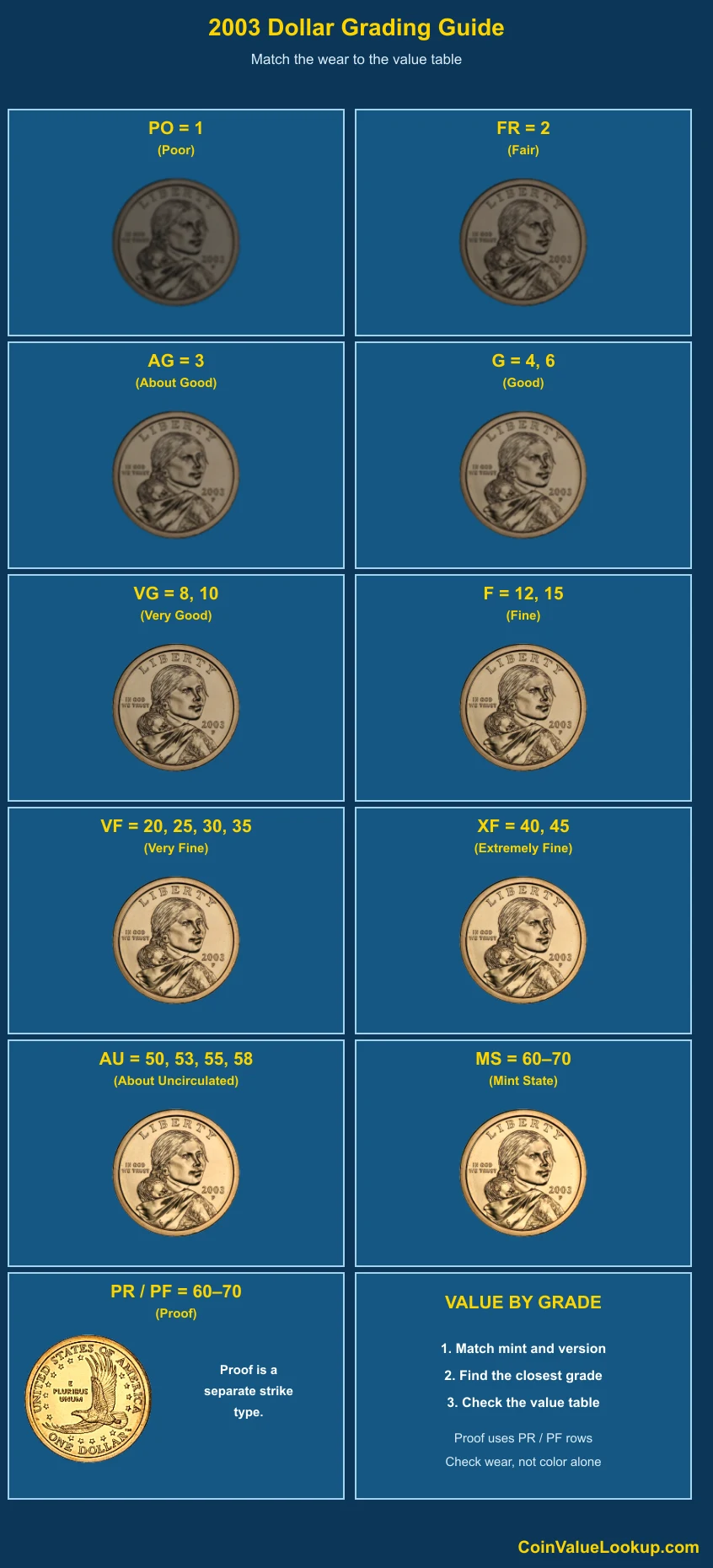
Focus on Sacagawea's cheekbone, the fine detail in her hair and the infant Jean-Baptiste on her back. These are the first spots to lose definition as the coin wears.
On the reverse, check the eagle's breast feathers and wingtips.
A coin grading around MS65 shows original luster with only minor contact marks that do not distract. Lower grades will display flattening on the cheek and dullness across the high points.
Proof coins should be compared against proof standards — look for matching reflective fields and sharp device edges rather than just brightness.
Use the comparison image to see the progression from circulated through AU and into Mint State. That side-by-side is more reliable than guessing from memory.
Step 3: Check 2003 Sacagawea Dollar Value by Mint and Version
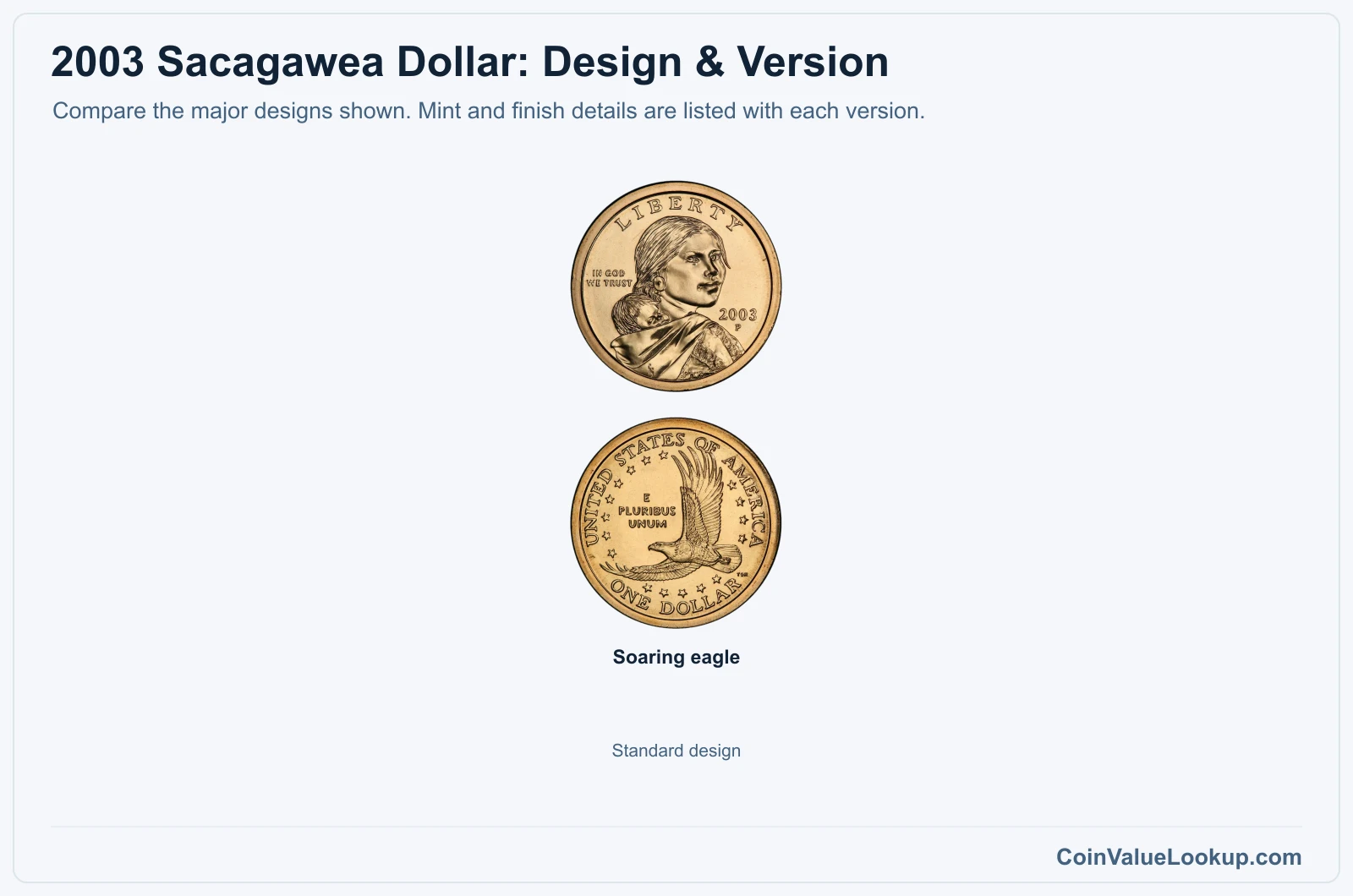
2003 Sacagawea Dollar — P — Soaring eagle
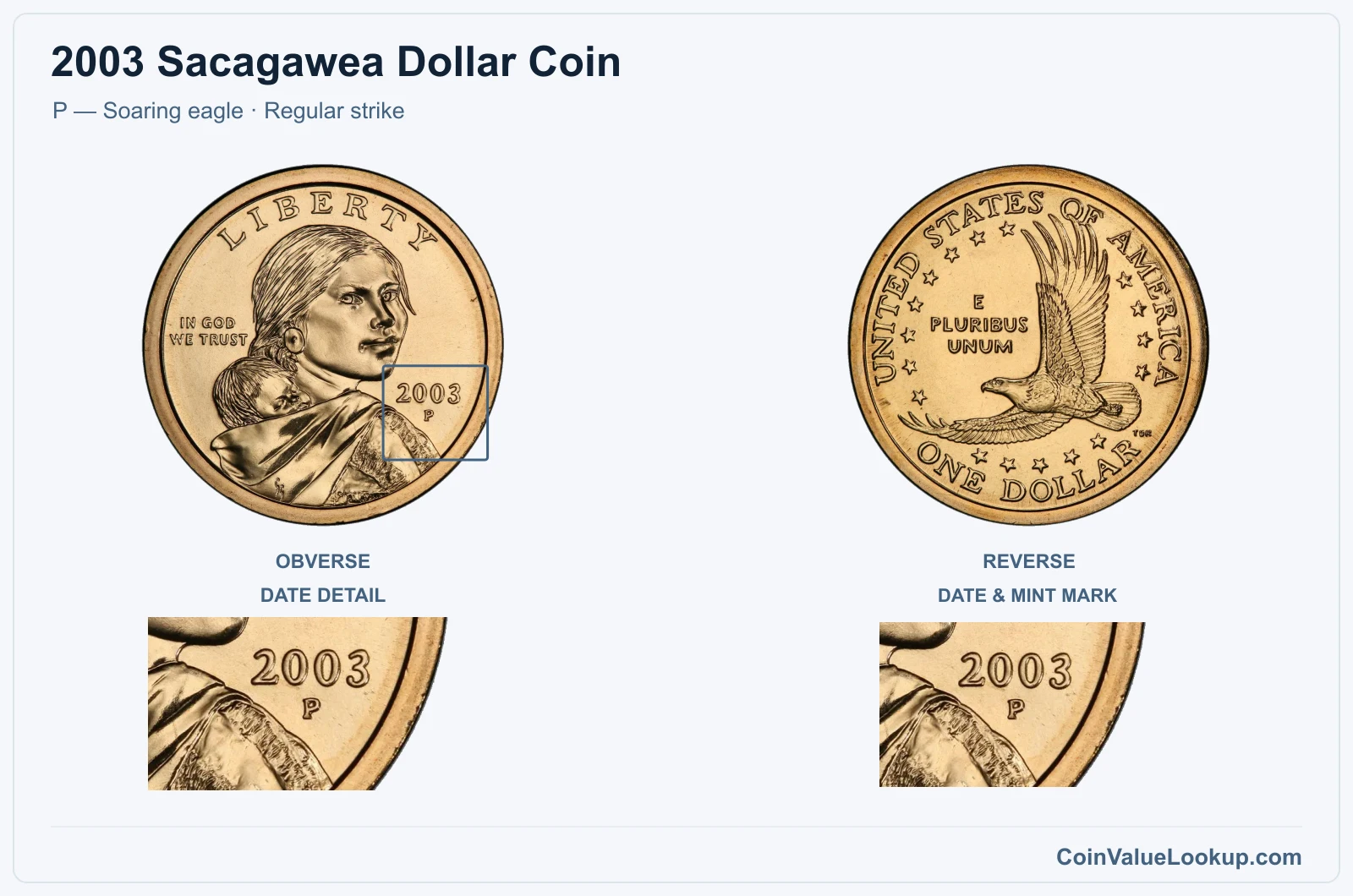
The 2003-P Sacagawea Dollar was struck at Philadelphia for general circulation. You will find a small "P" mintmark on the obverse below the date.
The reverse shows an eagle in flight, the standard design used through 2008.
A USA Coin Book guide estimate places this coin at about $7.29 in MS65 condition, which means full luster with only trivial marks. Circulated examples are worth face value.
Before checking any value chart, confirm the "P" mintmark and the soaring eagle reverse to be sure you are looking at the right entry.
Range Grade
Price Auction Records Appraisal PO PO 1
—
Coin Identifier FR FR 2
—
Coin Identifier AG AG 3
—
Coin Identifier G G 4
—
Coin Identifier
G 6
—
Coin Identifier VG VG 8
—
Coin Identifier
VG 10
—
Coin Identifier F F 12
—
Coin Identifier
F 15
—
Coin Identifier VF VF 20
—
Coin Identifier
VF 25
—
Coin Identifier
VF 30
—
Coin Identifier
VF 35
—
Coin Identifier XF XF 40
—
Coin Identifier
XF 45
—
Coin Identifier AU AU 50
—
Coin Identifier
AU 53
—
Coin Identifier
AU 55
—
Coin Identifier
AU 58
—
Coin Identifier MS MS 60
—
Coin Identifier
MS 61
—
Coin Identifier
MS 62
—
Coin Identifier
MS 63
—
Coin Identifier
MS 64
—
Coin Identifier
MS 65
—
Coin Identifier
MS 66
Coin Identifier
MS 67
Coin Identifier
MS 68
Coin Identifier
MS 69
Coin Identifier
MS 70
—
—
—
2003 Sacagawea Dollar — D — Soaring eagle
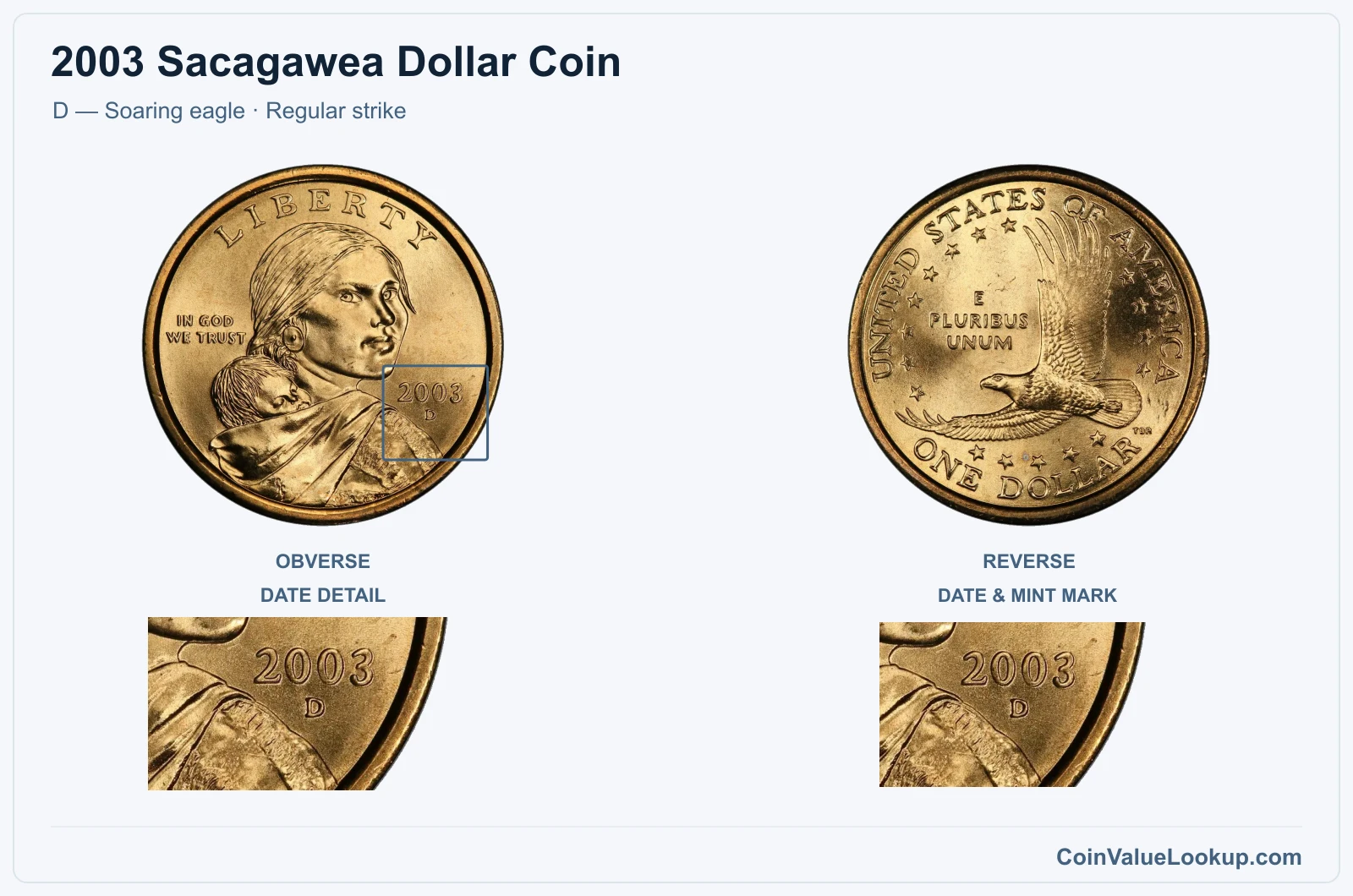
Denver's 2003-D Sacagawea Dollar carries a "D" mintmark on the obverse beneath the date. Same design, same manganese-brass composition, same weight as the Philadelphia issue.
In MS65 condition, guide estimates from USA Coin Book put this at $7.29. Worn pieces spend for a dollar at the store and not a penny more.
The "D" is small but clear under decent light — if you cannot find any mintmark at all, look again with magnification before concluding it is missing.
Coin Value Lookup is a handy place to look up guides for other Sacagawea Dollar years and denominations when you are sorting through a pile of golden dollars.
Range Grade
Price Auction Records Appraisal PO PO 1
—
Coin Identifier FR FR 2
—
Coin Identifier AG AG 3
—
Coin Identifier G G 4
—
Coin Identifier
G 6
—
Coin Identifier VG VG 8
—
Coin Identifier
VG 10
—
Coin Identifier F F 12
—
Coin Identifier
F 15
—
Coin Identifier VF VF 20
—
Coin Identifier
VF 25
—
Coin Identifier
VF 30
—
Coin Identifier
VF 35
—
Coin Identifier XF XF 40
—
Coin Identifier
XF 45
—
Coin Identifier AU AU 50
—
Coin Identifier
AU 53
—
Coin Identifier
AU 55
—
Coin Identifier
AU 58
—
Coin Identifier MS MS 60
—
Coin Identifier
MS 61
—
Coin Identifier
MS 62
—
Coin Identifier
MS 63
—
Coin Identifier
MS 64
—
Coin Identifier
MS 65
Coin Identifier
MS 66
Coin Identifier
MS 67
Coin Identifier
MS 68
Coin Identifier
MS 69
—
—
—
MS 70
—
—
—
2003 Sacagawea Dollar — S — Soaring eagle — proof
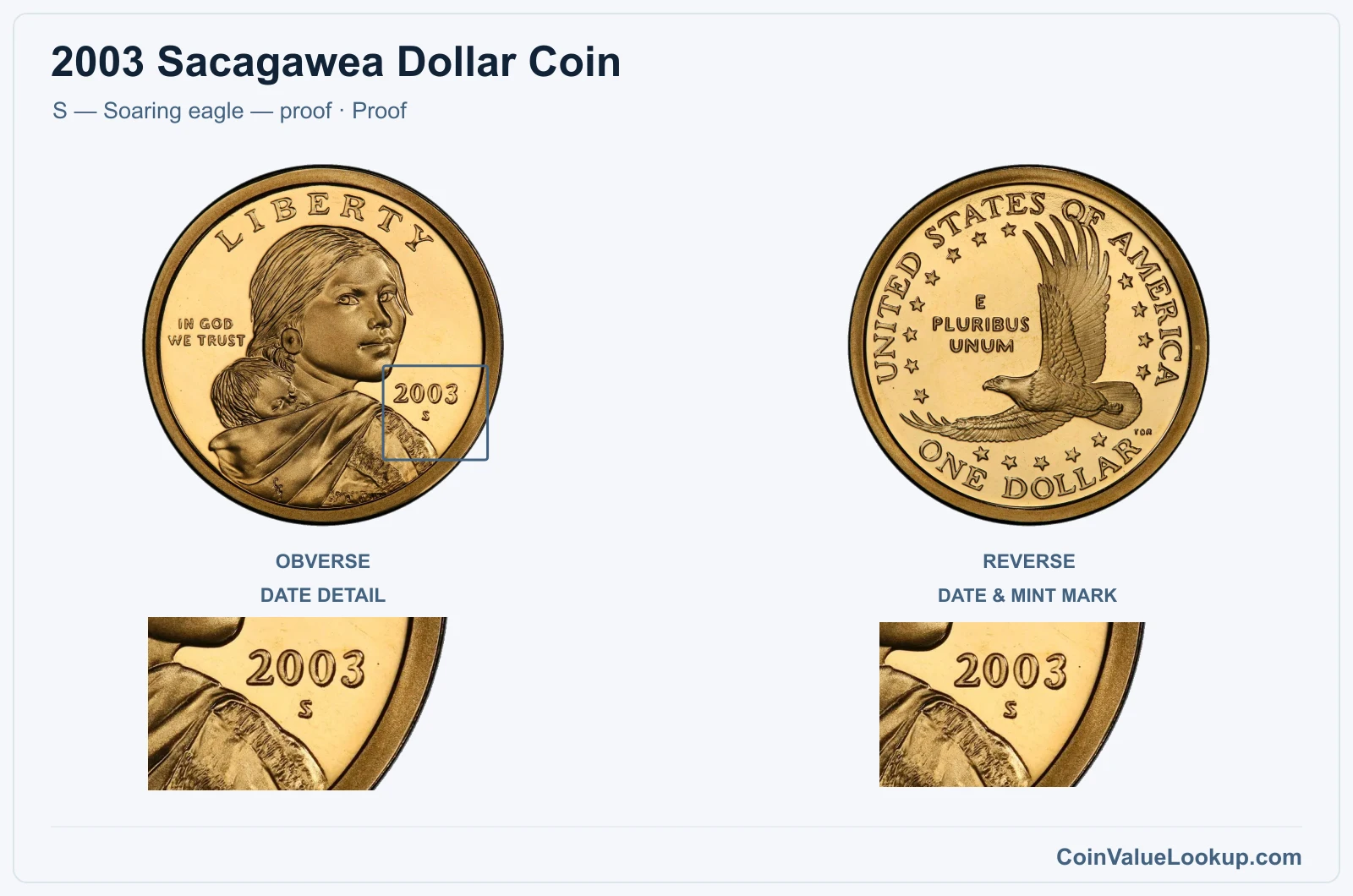
The 2003-S Sacagawea Dollar is a proof struck at San Francisco exclusively for collector sets. It features deeply mirrored fields contrasting with frosted raised devices — Sacagawea, the infant and the soaring eagle all stand out crisply against a reflective background.
Guide estimates from USA Coin Book place the 2003-S proof at $7.29 in PR65. Do not confuse buying a silver proof set with owning a silver dollar; this coin is the same manganese-brass clad composition as its P and D siblings regardless of which set it shipped in.
Confirm the "S" mintmark and the mirror-field finish before treating your coin as a proof.
Range Grade
Price Auction Records Appraisal PR PR 1
—
Coin Identifier
PR 2
—
Coin Identifier
PR 3
—
Coin Identifier
PR 4
—
Coin Identifier
PR 6
—
Coin Identifier
PR 8
—
Coin Identifier
PR 10
—
Coin Identifier
PR 12
—
Coin Identifier
PR 15
—
Coin Identifier
PR 20
—
Coin Identifier
PR 25
—
Coin Identifier
PR 30
—
Coin Identifier
PR 35
—
Coin Identifier
PR 40
—
Coin Identifier
PR 45
—
Coin Identifier
PR 50
—
Coin Identifier
PR 53
—
Coin Identifier
PR 55
—
Coin Identifier
PR 58
—
Coin Identifier
PR 60
—
Coin Identifier
PR 61
—
Coin Identifier
PR 62
—
Coin Identifier
PR 63
—
Coin Identifier
PR 64
—
Coin Identifier
PR 65
—
Coin Identifier
PR 66
—
Coin Identifier
PR 67
—
Coin Identifier
PR 68
Coin Identifier
PR 69
Coin Identifier
PR 70
Coin Identifier
2003 Sacagawea Dollar Error List
1. 2003 Sacagawea Dollar — Die Crack / Die Chip
A die crack on a 2003 Sacagawea Dollar appears as a thin raised line running across the coin's surface. It forms when the steel die develops a fracture, and each subsequent strike transfers that crack as a raised ridge onto the planchet.
A die chip is a smaller cousin — a tiny raised blob where a fragment broke away from the die face.
Look closely under magnification. The line should be raised, not incised.
Scratches from contact or cleaning are cut into the surface, while corrosion tends to be rough and irregular. A genuine die crack will follow a consistent path and may appear on multiple coins from the same die.
Value depends on the crack's size, location and the coin's overall condition. No specific price range applies broadly here — each piece needs individual assessment.
2. 2003 Sacagawea Dollar — Die Break / Cud
A cud on a 2003 Sacagawea Dollar is a raised, featureless lump connected to the rim where a piece of the die broke away entirely. The missing die fragment means that section of the coin received no design impression, leaving a smooth blob that merges into the rim edge.
An interior die break that does not touch the rim is technically not a cud, though collectors still find them interesting. To tell a cud from post-mint damage, check whether the raised area displaces part of the normal design cleanly — a rim dent or corrosion spot will look irregular and often shows disturbed metal flow or discoloration.
Pricing depends on the cud's size, its position relative to key design elements and the coin's grade. Individual assessment is necessary.
3. 2003 Sacagawea Dollar — Struck-Through Error
A struck-through error on a 2003 Sacagawea Dollar occurs when foreign material — grease, a thread, a metal fragment — sits between the die and the planchet during striking. The result is a localized depression or incomplete area where the design did not fully form.
Grease fill-ins typically produce a smooth, shallow blank spot, while a retained foreign object may leave a distinct impression of its own shape. Either way, the affected area is recessed, not raised.
Do not confuse a struck-through with ordinary wear, which removes detail gradually across high points, or with scratches and cleaning marks that cut into the surface. A struck-through area will have sharp boundaries relative to the surrounding, fully struck design.
Value varies with size, location and visibility. Each example warrants its own evaluation.
4. 2003 Sacagawea Dollar — Off-Center Strike
An off-center strike happens when the planchet is not properly seated in the collar before the dies come together. The result on a 2003 Sacagawea Dollar is a shifted design with an unstruck crescent of blank metal along one edge.
The percentage of off-center displacement matters a lot. A barely noticeable 2-3% shift is common and not worth much.
A dramatic 10% or more with the date still visible draws real collector attention.
Do not confuse an off-center strike with a clipped planchet, which removes a curved section before striking, or with post-mint damage like a vice squeeze that flattens one side. On a genuine off-center coin the entire design shifts uniformly and the unstruck area is smooth, original planchet surface.
Individual assessment of each piece determines value.