1839 Liberty Seated Dollar Coin Value: How Much Is It Worth?
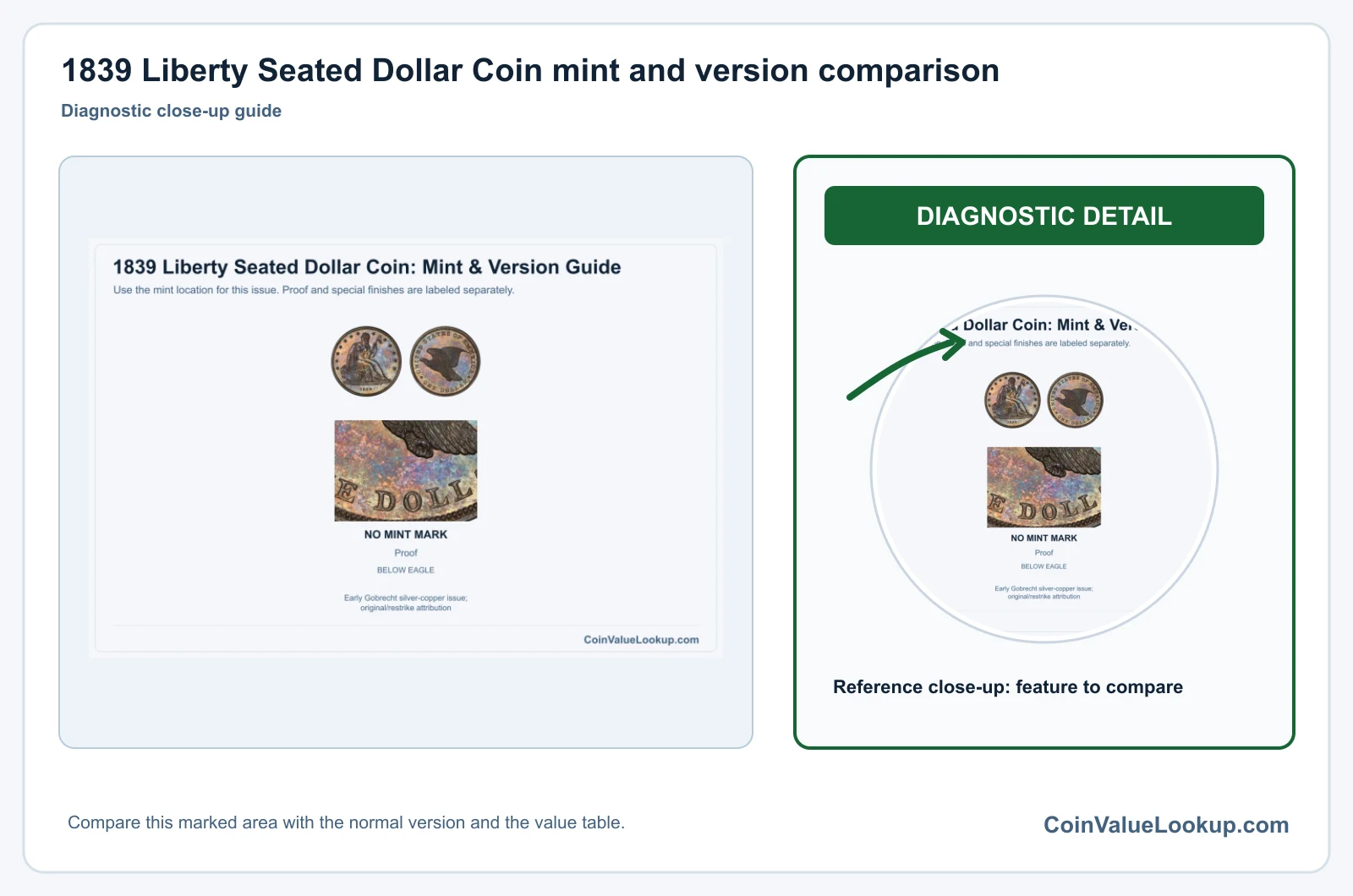
The 1839 Liberty Seated Dollar is not your typical pocket-change dollar. It belongs to the Gobrecht dollar series, a short-lived and highly specialized issue that bridges early U.S. silver coinage and the regular Seated Liberty production that followed.
A guide estimate places the PR60 grade at $46,849.00, though that figure applies to a specific restrike attribution and is not a guaranteed offer. Identifying whether your piece is an original striking or a later restrike is essential before assigning any value.
Fast Way to Identify Your 1839 Liberty Seated Dollar
If you have an 1839-dated Gobrecht dollar — or think you do — upload clear photos of the front and back. This allows a preliminary identification of the design, edge type, and die alignment, which matter enormously for this series.
A quick photo check can help separate a genuine Gobrecht issue from a later reproduction or a misidentified coin.
1839 Liberty Seated Dollar Value
Upload both sides of your 1839 Liberty Seated Dollar.
Front Obverse
Upload photo
Back Reverse
Upload photo
Which 1839 Liberty Seated Dollar Versions Are Worth Money?
- The 1839 Gobrecht proof is a scarce Philadelphia-only issue with a Seated Liberty obverse and flying eagle reverse, carrying a guide estimate of $46,849.00 at PR60.
- The 1839 later restrike shares the same design but was struck after the original production run; proper die-alignment and edge attribution separates it from originals, and it also carries a PR60 guide estimate of $46,849.00.
Step 1: Identify Your 1839 Liberty Seated Dollar Mint Mark and Version
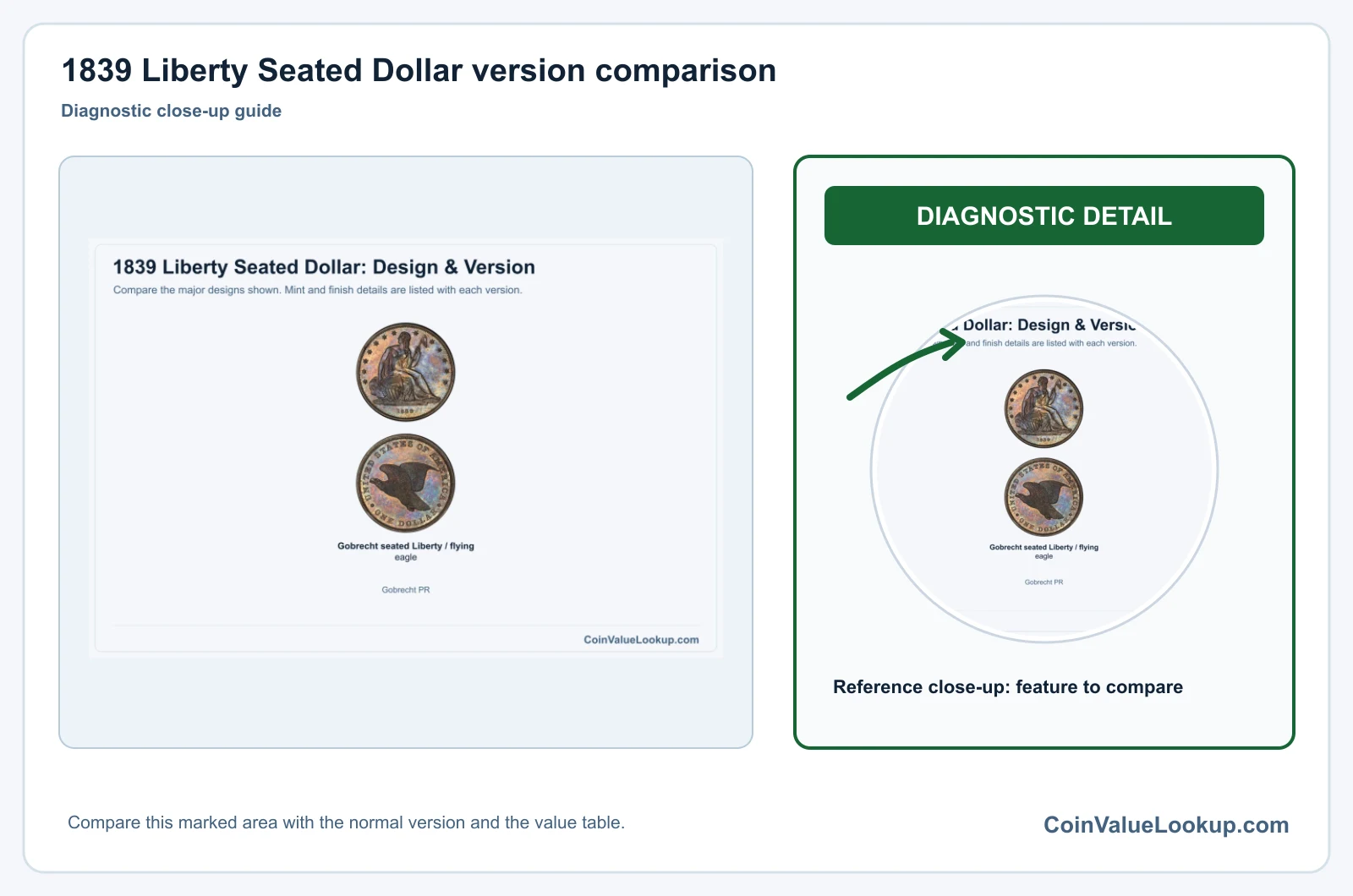
All 1839 Gobrecht dollars were struck at Philadelphia, so there is no mintmark to look for. The obverse shows a seated Liberty figure, and the reverse features a flying eagle — distinct from the perched eagle used on later Seated Liberty dollars.
The material is a silver-copper Gobrecht issue. Earlier 1836-dated production used an .8924 silver standard, while pieces made subsequently used the .900 fine standard.
Do not assume the weight and fineness conventions of the regular 1840–1873 Seated Liberty series apply here.
The critical question is whether the coin is an original issue or a later restrike. Specialist attribution depends on die alignment, edge configuration, and provenance — not just the date on the coin.
The date "1839" does not necessarily mean the coin was physically struck in 1839, since restrikes were produced afterward using original or reworked dies.
Two branches exist for this year: the 1839 Gobrecht proof and the 1839 later restrike. Both are proof-finish coins with a Seated Liberty obverse and flying eagle reverse, but they are valued and collected separately.
Without proper attribution, you cannot accurately assess what you have.
Coin Value Lookup is a helpful starting point if you want to look up other coin guides alongside this one. It covers a wide range of U.S. denominations and years.
Step 2: Check Your 1839 Liberty Seated Dollar Grade
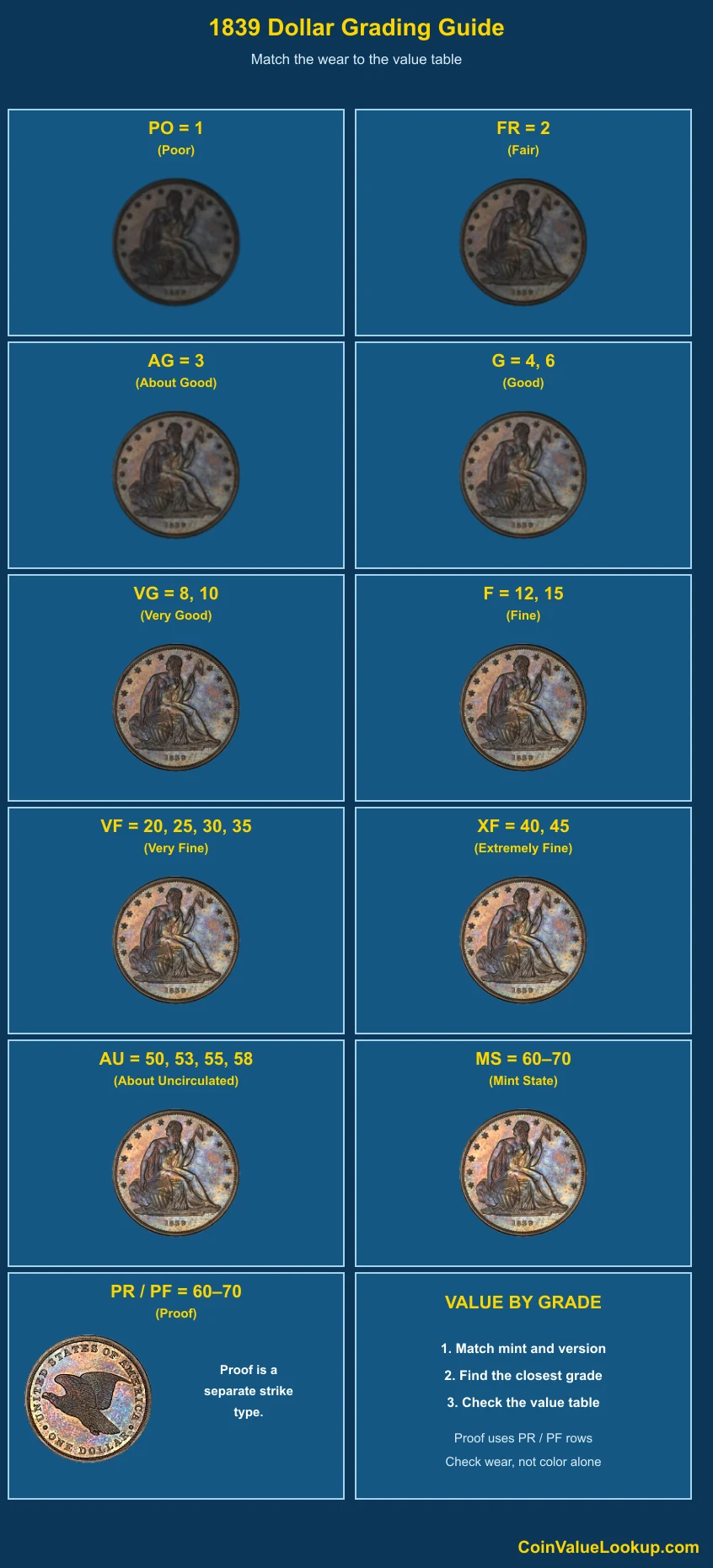
Grading a Gobrecht dollar is not like grading a Morgan. These are proof coins, so you are looking at surface quality, reflectivity, and the absence of handling marks rather than typical circulation wear.
On the obverse, examine Liberty's head, breast, knee, and the fine lines of the shield. On the reverse, check the eagle's breast feathers and wing tips for contact marks or hairlines.
A weakly struck head alone does not mean a lower grade — strike quality varies.
Use a genuine same-type comparison image to evaluate your coin. Proof surfaces should show mirror-like fields when tilted under a light.
Hairlines from old cleanings are common on coins this age and will affect the grade significantly.
Keep in mind that a proof is a manufacturing finish, not simply a high-grade coin that looks shiny. A cleaned or impaired proof still grades differently from a regular strike, and many Gobrecht dollars have been cleaned at some point in their long lives.
Step 3: Check 1839 Liberty Seated Dollar Value by Mint and Version
1839 Liberty Seated Dollar — Gobrecht PR
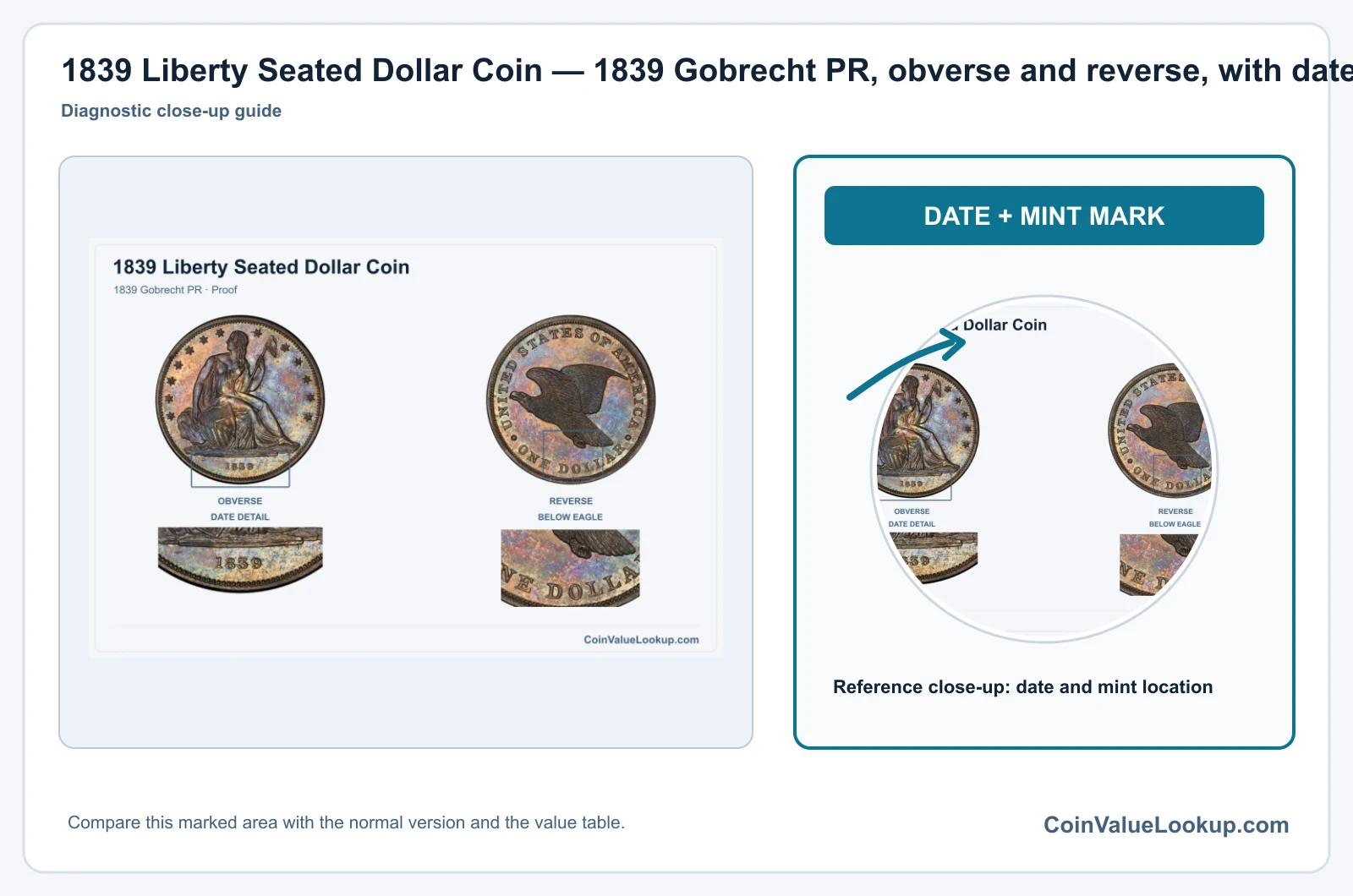
The 1839 Gobrecht proof features the seated Liberty obverse paired with a flying eagle reverse, struck at Philadelphia with no mintmark. This is a proof-finish coin — meaning it was specially manufactured with polished dies and planchets, not simply a well-preserved business strike.
The 1839 silver Gobrecht dollar is catalogued as Judd-104, with a reeded edge and a starless flying-eagle reverse. Original-versus-restrike attribution depends on die state, alignment, and provenance.
A USA Coin Book guide estimate places the PR60 grade at $46,849.00, though this is an illustrative estimate rather than a guaranteed purchase price.
Before assuming your coin matches this version, confirm the edge type, die alignment, and reverse star arrangement. Those details matter more than the date alone.
Range Grade
Price Auction Records Appraisal PR PR 1
—
Coin Identifier
PR 2
—
Coin Identifier
PR 3
—
Coin Identifier
PR 4
—
Coin Identifier
PR 6
—
Coin Identifier
PR 8
—
Coin Identifier
PR 10
—
Coin Identifier
PR 12
—
Coin Identifier
PR 15
—
Coin Identifier
PR 20
—
Coin Identifier
PR 25
—
Coin Identifier
PR 30
—
Coin Identifier
PR 35
—
Coin Identifier
PR 40
—
Coin Identifier
PR 45
Coin Identifier
PR 50
—
Coin Identifier
PR 53
—
Coin Identifier
PR 55
Coin Identifier
PR 58
Coin Identifier
PR 60
—
Coin Identifier
PR 61
Coin Identifier
PR 62
Coin Identifier
PR 63
Coin Identifier
PR 64
Coin Identifier
PR 65
Coin Identifier
PR 66
—
—
—
PR 67
—
—
—
PR 68
—
—
—
PR 69
—
—
—
PR 70
—
—
—
1839 Liberty Seated Dollar — later restrike, attributed silver Gobrecht dollar
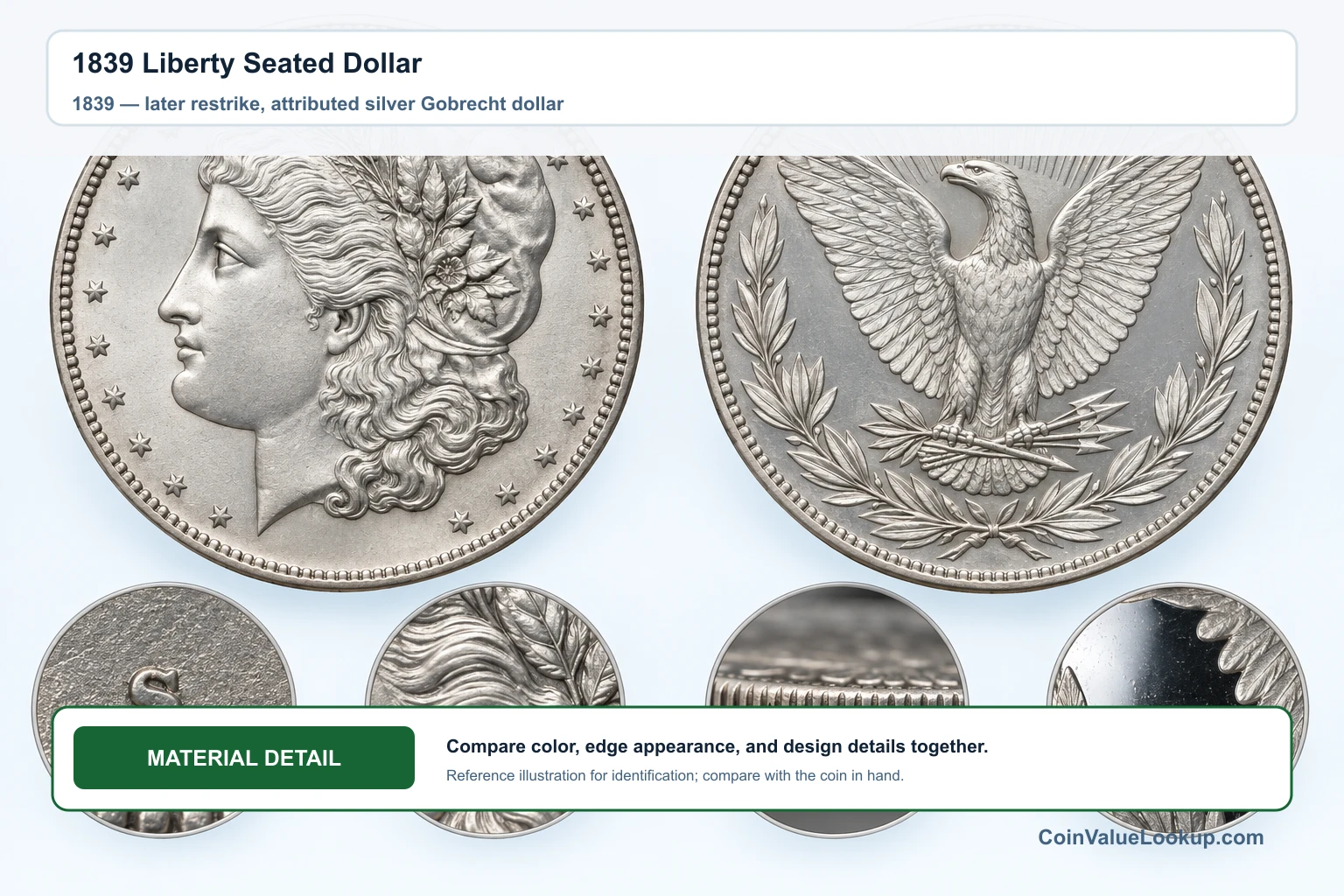
The 1839 later restrike is a Gobrecht dollar that carries an 1839 date but was physically produced after the original striking period. It shares the same seated Liberty obverse and flying eagle reverse design, and it is also a proof-finish coin from the Philadelphia Mint.
Do not assume the date on the coin tells you when it was made. Later restrikes were created using original or reworked dies, sometimes years after the date shown.
Specialist die alignment, edge configuration, and provenance history establish whether a piece is an original or a restrike.
The silver Judd-104 restrike has a reeded edge and a starless flying-eagle reverse; certified examples include die alignments III and IV. The USA Coin Book guide estimate is $46,849.00 at PR60.
Copper patterns and detailed pattern-number varieties fall outside the scope of this guide. If you suspect you have a restrike, professional attribution from a major grading service is the practical next step.
Range Grade
Price Auction Records Appraisal PR PR 1
—
Coin Identifier
PR 2
—
Coin Identifier
PR 3
—
Coin Identifier
PR 4
—
Coin Identifier
PR 6
—
Coin Identifier
PR 8
—
Coin Identifier
PR 10
—
Coin Identifier
PR 12
—
Coin Identifier
PR 50
Coin Identifier
PR 55
Coin Identifier
PR 58
Coin Identifier
PR 60
Coin Identifier
PR 61
Coin Identifier
PR 62
Coin Identifier
PR 63
Coin Identifier
PR 64
Coin Identifier
PR 65
Coin Identifier
PR 66
—
—
—
PR 67
—
—
—
PR 68
—
—
—
PR 69
—
—
—
PR 70
—
—
—