1839 Braided Hair Cent Coin Value: How Much Is It Worth?
The 1839 Braided Hair Cent sits at a crossroads in U.S. large cent history, bridging the older Coronet design and the newer Braided Hair type. Guide estimates for the Type of 1840 business strike range from about $50 in G4 to around $2,171 in MS63, according to USA Coin Book.
That spread does not cover every variety, and rare proofs, restrikes, or major errors require separate evaluation. Identify your exact variety before assuming a value.
Fast Way to Identify Your 1839 Braided Hair Cent
The fastest way to start figuring out what you have is to upload clear photos of the front and back of your coin. Our identifier can give you a preliminary read on the design type, date placement, and general condition.
It is not a substitute for professional authentication, but it points you in the right direction quickly.
1839 Braided Hair Cent Value
Upload both sides of your 1839 Braided Hair Cent.
Front Obverse
Upload photo
Back Reverse
Upload photo
Which 1839 Braided Hair Cent Versions Are Worth Money?
- The 1839 Type of 1840 Braided Hair variety guides around $50 in G4 and up to about $2,171 in MS63, so condition drives value sharply.
- Head of 1838, Silly Head, Booby Head, and 1839/6 are separate Coronet-type varieties; misidentifying your coin as the wrong one can mean a very different value.
- Overdate examples (1839/6) are a recognized die variety worth confirming under magnification before assuming ordinary-date pricing applies.
- Coins with prominent mint errors such as die cracks, cuds, off-center strikes, or laminations deserve individual evaluation based on severity and condition.
Step 1: Identify Your 1839 Braided Hair Cent Mint Mark and Version
The 1839 cent comes in several distinct varieties, and getting the right one matters more than almost anything else for value. Four of them, Head of 1838, Silly Head, Booby Head, and 1839/6, belong to the older Coronet design family.
The fifth, Type of 1840, is the true Braided Hair type covered here.
To tell a Booby Head from a Silly Head, look at the hair near the bust truncation. On the Booby Head, the hair curls wrap around the bottom of the bust.
On the Silly Head, the shoulder line does not extend past the hair.
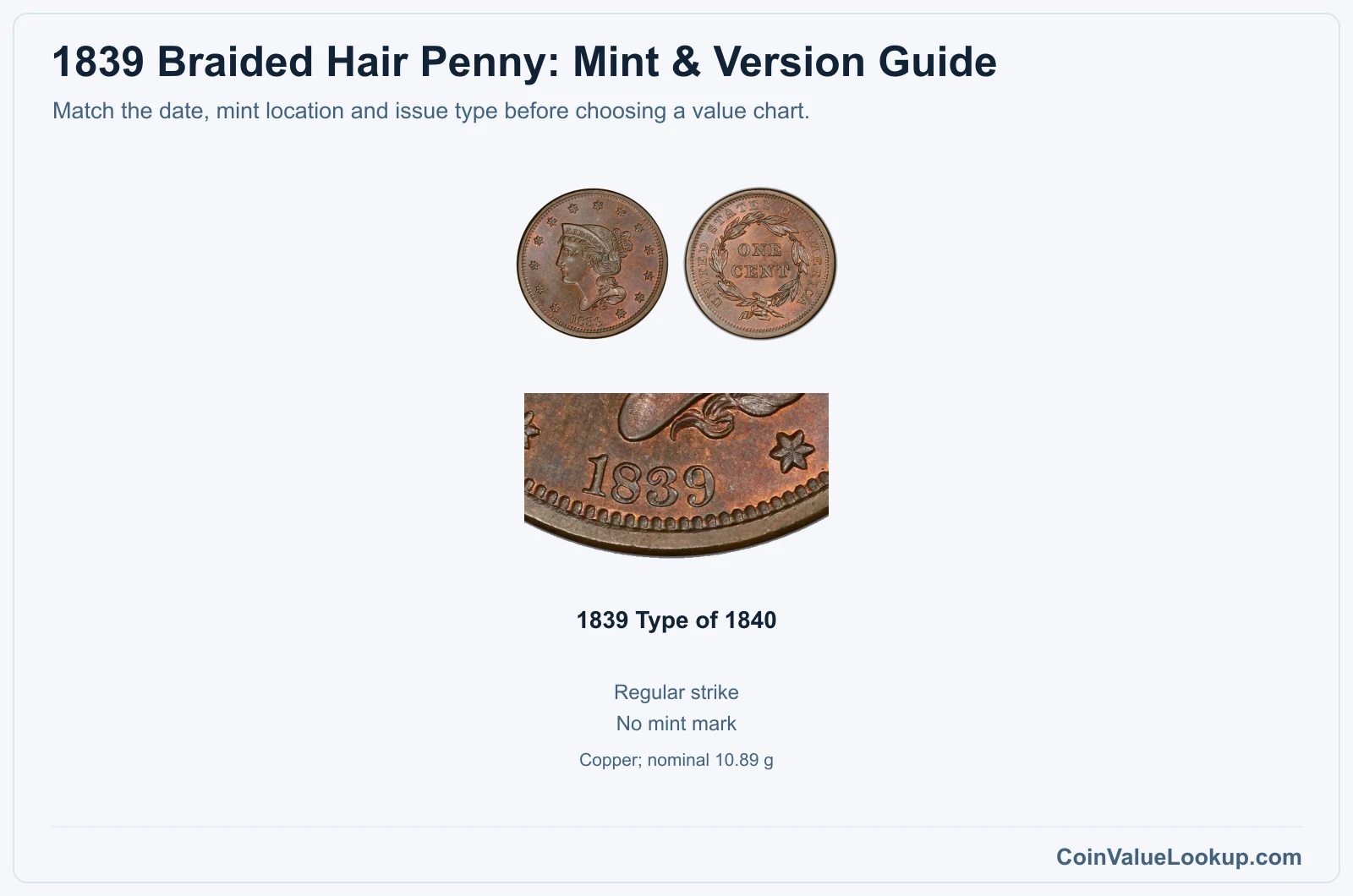
All 1839 cents were struck at Philadelphia, so there is no mintmark to hunt for. Do not assume a branch-mint version exists.
Check both sides carefully plus the edge. The shape of the date numerals, the legend wording, and the wreath style all help confirm which variety you hold.
Weight and material (copper, nominally 10.89 grams) provide supporting evidence, but wear and production tolerances mean weight alone cannot prove authenticity.
Step 2: Check Your 1839 Braided Hair Cent Grade
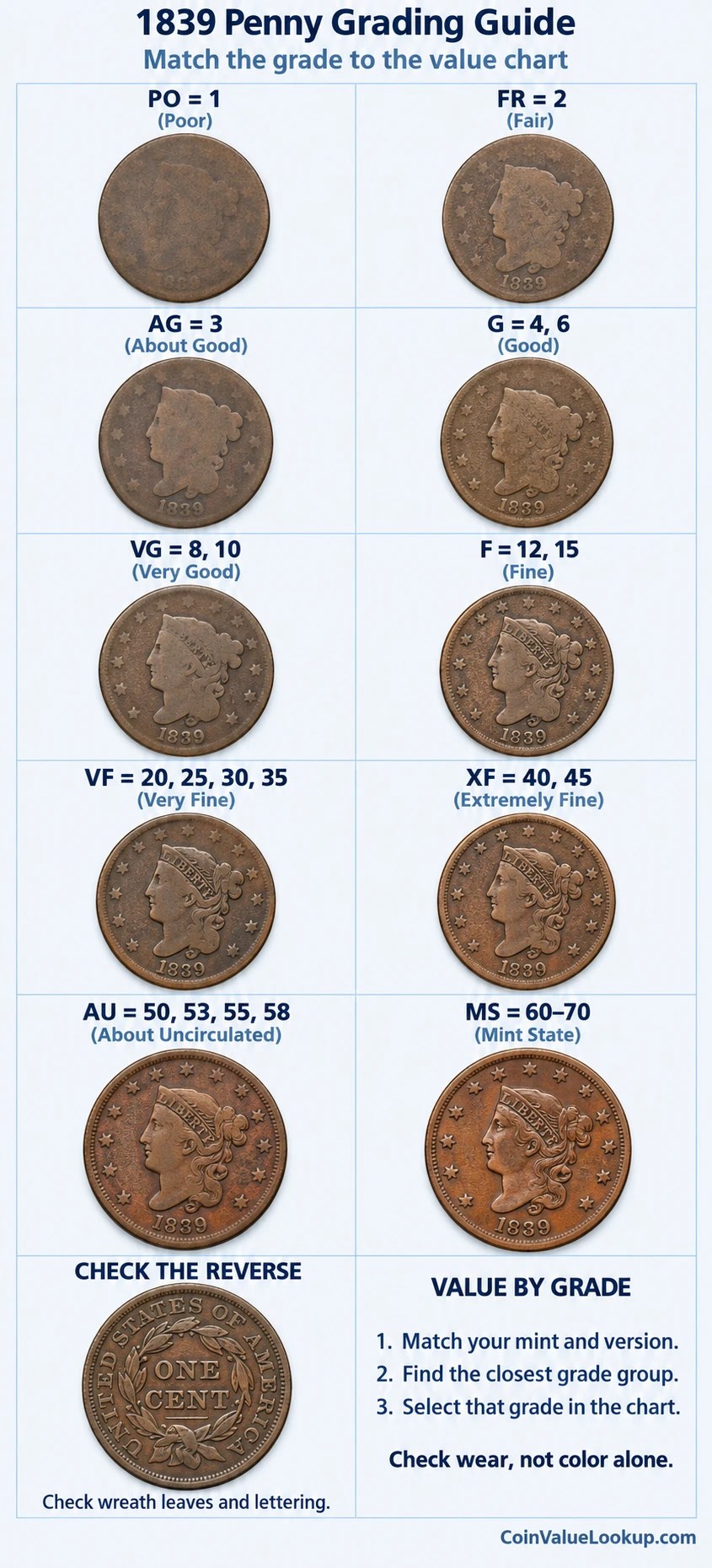
Start by examining the portrait hair detail, the cheek, and the wreath leaf relief. On a well-worn coin (around G4), the major outline of Liberty remains but fine hair strands are gone.
A mid-grade piece (VF range) retains individual curls and sharper leaf veins.
Compare your coin against the reference image of a like-type example at each grade level. Look at the lettering sharpness too; mushy letters drag a grade down faster than you might expect.
Separate honest wear from other problems. A weakly struck coin can look worn but never had full detail to begin with.
Corrosion, porosity, and old cleaning are not the same as circulation wear, and all three can substantially reduce market value even when the underlying detail is decent.
On copper large cents, color designations like BN (brown), RB (red-brown), and RD (red) describe surface color, not different metals. And remember: Proof is a way a coin was made, not a grade above Mint State.
Step 3: Check 1839 Braided Hair Cent Value by Mint and Version
1839 Braided Hair Cent — Type of 1840
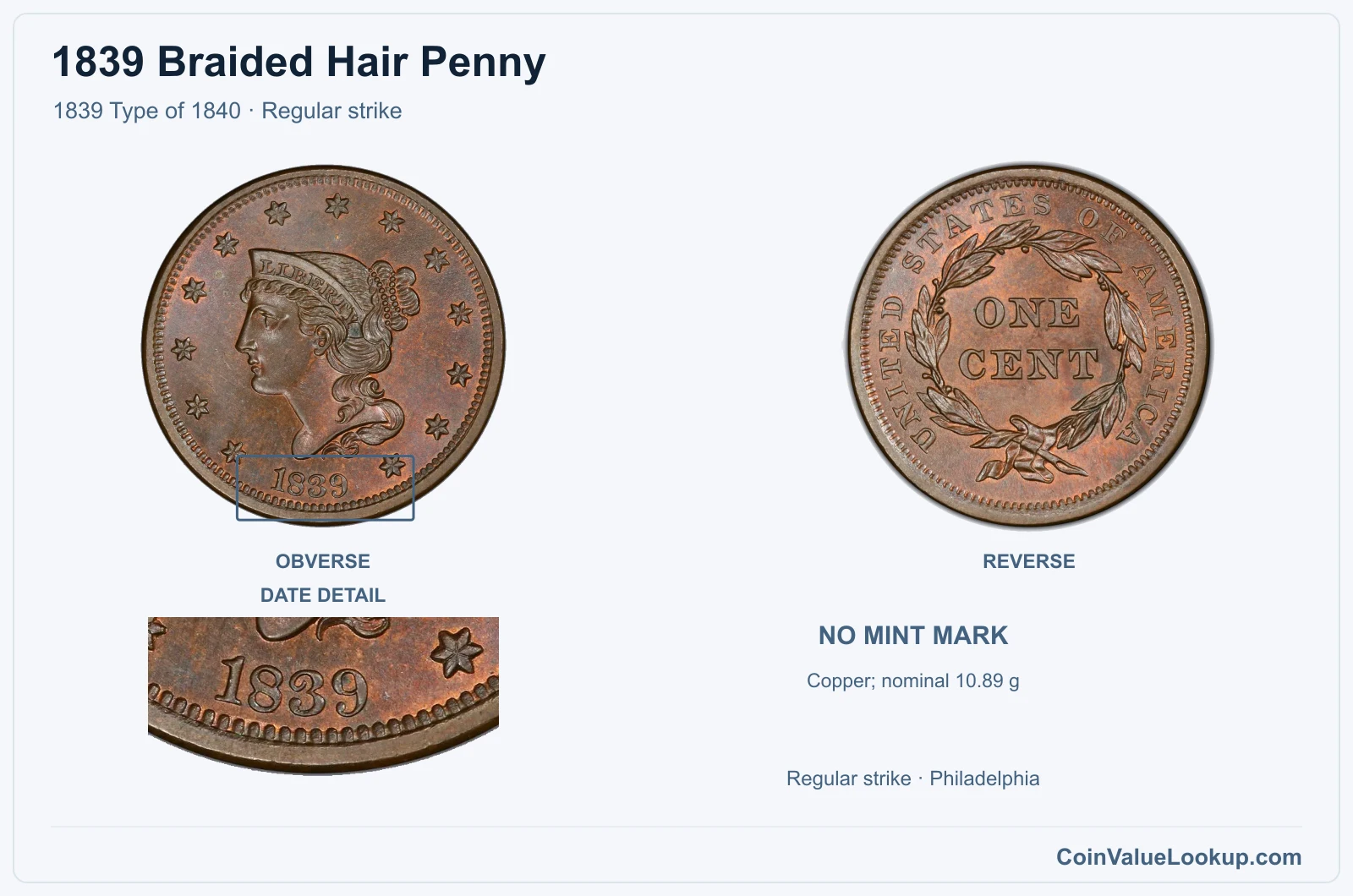
The 1839 Type of 1840 is the Braided Hair design, distinct from the four Coronet-style 1839 varieties. Liberty's portrait shows the mature Braided Hair look that continued through the series' end, with a tighter, more refined hairstyle and a beaded cord binding the hair.
This version was struck at Philadelphia in copper with a nominal weight of 10.89 grams. No mintmark appears on any 1839 cent.
USA Coin Book guide estimates place this variety at roughly $50 in G4 and around $2,171 in MS63. Coins between those endpoints scale with detail and surface quality.
If you are browsing Coin Value Lookup for other large cent years, keep in mind that 1839 is one of the trickiest dates to classify because of the multiple head types. Confirm the Braided Hair portrait before applying these figures.
| Range | Grade | Price | Auction Records | Appraisal |
|---|---|---|---|---|
| PO | PO 1 | — | Coin Identifier | |
| FR | FR 2 | — | Coin Identifier | |
| AG | AG 3 | — | Coin Identifier | |
| G | G 4 | — | Coin Identifier | |
| G 6 | — | Coin Identifier | ||
| VG | VG 8 | — | Coin Identifier | |
| VG 10 | — | Coin Identifier | ||
| F | F 12 | — | Coin Identifier | |
| F 15 | — | Coin Identifier | ||
| VF | VF 20 | Coin Identifier | ||
| VF 25 | Coin Identifier | |||
| VF 30 | Coin Identifier | |||
| VF 35 | Coin Identifier | |||
| XF | XF 40 | Coin Identifier | ||
| XF 45 | Coin Identifier | |||
| AU | AU 50 | Coin Identifier | ||
| AU 53 | Coin Identifier | |||
| AU 55 | Coin Identifier | |||
| AU 58 | Coin Identifier | |||
| MS | MS 60 | Coin Identifier | ||
| MS 61 | — | Coin Identifier | ||
| MS 62 | Coin Identifier | |||
| MS 63 | Coin Identifier | |||
| MS 64 | Coin Identifier | |||
| MS 65 | Coin Identifier | |||
| MS 66 | Coin Identifier | |||
| MS 67 | — | — | — | |
| MS 68 | — | — | — | |
| MS 69 | — | — | — | |
| MS 70 | — | — | — |
1839 Braided Hair Cent Error List
1. 1839 Braided Hair Cent — Die Crack
A die crack shows up as a thin raised line running across the coin's surface, sometimes crossing devices or open fields. These lines formed when a working die fractured under repeated striking pressure.
On an 1839 Braided Hair Cent, look for a line that is raised above the surrounding surface, not incised into it.
The key distinction from a scratch is direction and relief. A scratch is cut into the metal (incuse), while a die crack stands above it.
Corrosion lines and tool marks can also mimic cracks, so examine the line under magnification for consistent raised profile.
No specific price range is adopted for die-crack examples on this date. Value depends on the crack's location, length, and the coin's overall grade and authentication.
A professional assessment is the safest route to a reliable number.
2. 1839 Braided Hair Cent — Die Break / Cud
A cud is a raised, featureless blob of metal that connects to the rim, caused by a chunk of the die breaking away entirely. On an 1839 Braided Hair Cent, a cud replaces part of the design near the edge with a smooth lump.
Smaller interior die breaks also occur but do not touch the rim, and those are typically less dramatic.
Do not confuse a cud with a rim dent or corrosion buildup. A genuine cud has a distinct boundary where normal design abruptly stops and the raised blank area begins.
Corrosion tends to be irregular and pitted, while a rim dent pushes metal inward rather than outward.
No adopted price range exists for cuds on this date. Each piece needs individual evaluation based on size, location, and the coin's authenticated condition.
3. 1839 Braided Hair Cent — Lamination / Split Planchet
A lamination error appears as peeling, flaking, or separated layers of metal on the coin's surface. On an 1839 cent struck in copper, this could show up as a retained flap still attached to the planchet or as an area where a layer has already broken away, exposing rough metal underneath.
Photograph the edge alongside the affected face. That edge view often reveals the separation plane clearly.
Compare what you see against scraping damage or deliberate cuts: post-mint damage tends to leave sharp, irregular gouges, while a lamination follows the metal's internal structure more smoothly.
Corrosion can also lift surface material and look similar, so magnification helps. No numeric price range is adopted for lamination errors on the 1839 Braided Hair Cent.
Severity, size, and overall coin condition drive individual value.
4. 1839 Braided Hair Cent — Off-Center Strike
An off-center strike happens when the planchet is not properly seated between the dies, producing a coin with a crescent of blank metal on one side and a compressed, shifted design. On an 1839 Braided Hair Cent, the key collecting requirement is that the date remains visible; without it, attribution to 1839 is very difficult.
Do not mistake a clipped planchet or post-mint flattening for an off-center strike. A clip removes a curved section of the blank before striking, while off-center coins retain a full round planchet with the design simply displaced.
One-sided die misalignment can also shift design elements but typically less dramatically.
No numeric price is adopted for off-center 1839 cents. The percentage of displacement, date visibility, and authenticated condition all factor into individual assessment.
5. 1839 Braided Hair Cent — Rotated Dies
On a normally aligned U.S. coin, flipping it top-to-bottom (like turning a book page) shows the reverse right-side up. A rotated die error means the reverse appears turned at an angle.
Hold the obverse upright, flip the coin on its vertical axis, and check whether the wreath and denomination are rotated from the expected orientation.
Small rotations (a few degrees) are common production tolerance and rarely attract a premium. Larger rotations, particularly 90 degrees or more, are unusual and draw attention.
Be careful with photographs: a picture taken at an odd angle can fake a rotation that does not actually exist on the coin.
No specific price data is adopted for rotated-die 1839 Braided Hair Cents. Degree of rotation and the coin's overall authenticated grade determine individual value.
6. 1839 Braided Hair Cent — Overdate
An overdate occurs when a new date is punched over an older one in the die, leaving traces of the original numerals visible beneath the final date. The well-known 1839/6 overdate is a recognized Coronet variety, but overdate characteristics can potentially appear on Braided Hair strikes too if an altered die was used.
Under magnification, look for remnants of an earlier digit, especially around the curves and serifs of the final numerals. The underlying contours should be consistent with a specific earlier year, not just vague mushiness.
Ordinary machine doubling produces shelf-like flat outlines and is not an overdate. Date damage from corrosion or contact can also create misleading shapes.
No numeric price is adopted for overdate examples on the 1839 Braided Hair Cent specifically. Authentication and precise variety identification by a professional service are strongly recommended before assuming overdate status, as the premium can be significant.