1821 Coronet Head Cent Coin Value: How Much Is It Worth?
The 1821 Coronet Head Cent is a scarce early copper coin that draws serious attention from collectors. Guide estimates for business strikes range from around $103 in G4 to roughly $30,920 in MS63, according to USA Coin Book.
These figures cover the ordinary Philadelphia issue only. Rare proofs, major errors, and exceptional condition coins fall outside that range and need individual evaluation.
Fast Way to Identify Your 1821 Coronet Head Cent
The quickest way to start figuring out what your 1821 cent is worth is to upload clear photos of both the front and back. Our identifier can give you a preliminary read on the series, design match, and general condition.
Good lighting and a sharp image of the date area help the most. That first step narrows the field before you dig deeper.
1821 Coronet Head Cent Value
Upload both sides of your 1821 Coronet Head Cent.
Front Obverse
Upload photo
Back Reverse
Upload photo
Which 1821 Coronet Head Cent Versions Are Worth Money?
- Business strikes in higher grades are especially scarce; a USA Coin Book guide estimate near $30,920 at MS63 shows how steeply values climb with condition.
- Proof examples from this era require expert authentication of die characteristics and surfaces; no ordinary business-strike price applies to them.
- Clipped planchets, lamination splits, off-center strikes, and rotated dies are reported error categories that can affect value when properly attributed.
- Original, problem-free surfaces on any grade dramatically outperform cleaned, corroded, or damaged examples of the same date.
Step 1: Identify Your 1821 Coronet Head Cent Mint Mark and Version
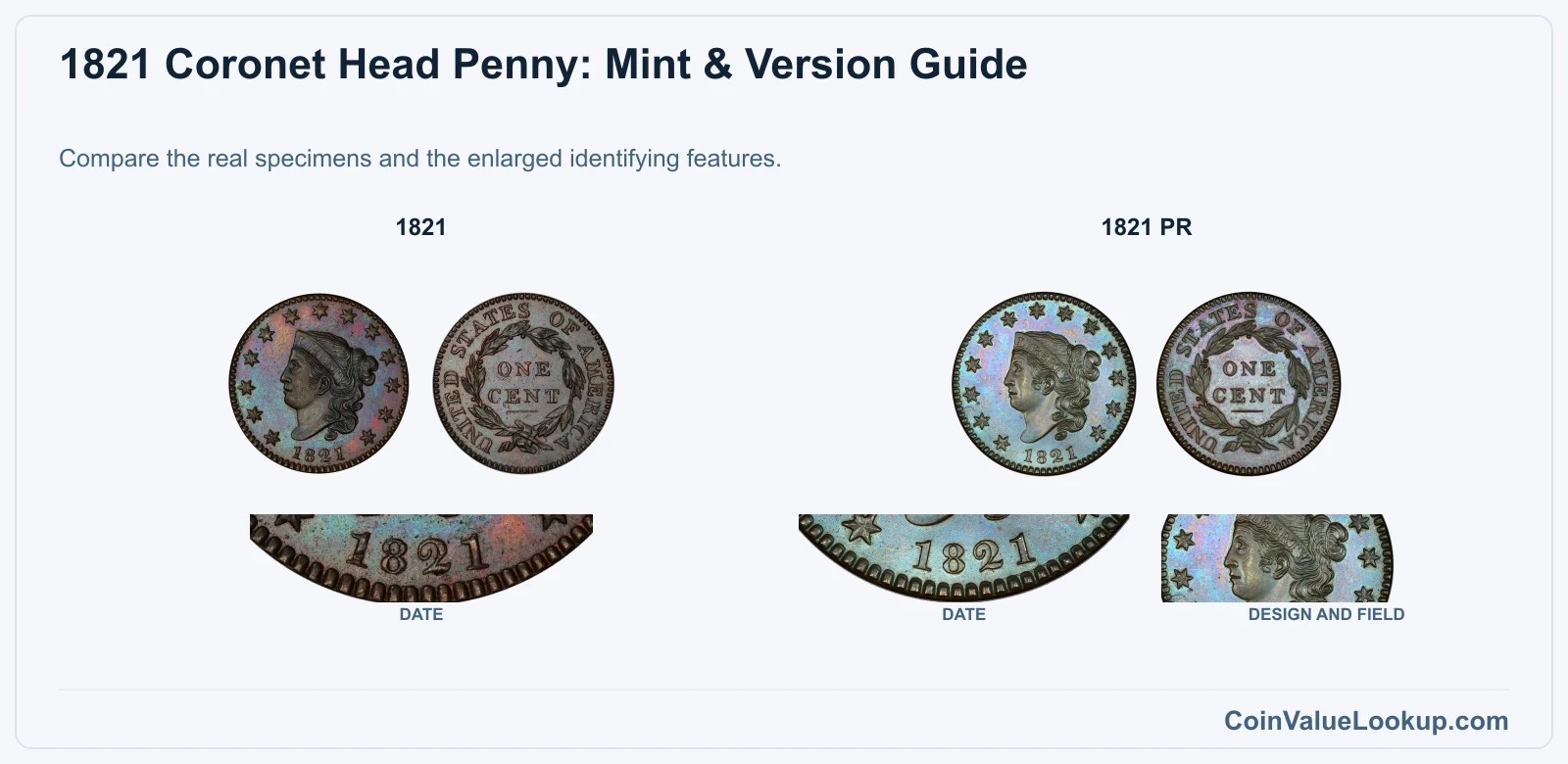
Every 1821 Coronet Head Cent was struck at the Philadelphia Mint, so there is no mintmark to look for. The obverse shows Liberty wearing a coronet inscribed LIBERTY, with stars around the border and the date below.
The reverse features a wreath enclosing the denomination ONE CENT, with UNITED STATES OF AMERICA around the rim.
Make sure you are looking at the correct series. The Coronet Head design ran from 1816 to 1839, and the portrait style differs from earlier Classic Head and later Braided Hair types.
If the hair and headband do not match, you may have a different coin entirely.
Weight can support identification. The nominal spec is about 10.89 grams in copper, but wear, corrosion, and original production tolerances mean a slightly off weight does not automatically prove a fake.
Use weight alongside visual checks, not as a sole test.
Separate ordinary business strikes from any cataloged proof. A proof is identified by specific die characteristics, surface quality, and rim finish, not by shine or perceived beauty.
Polished coins are not proofs.
Step 2: Check Your 1821 Coronet Head Cent Grade
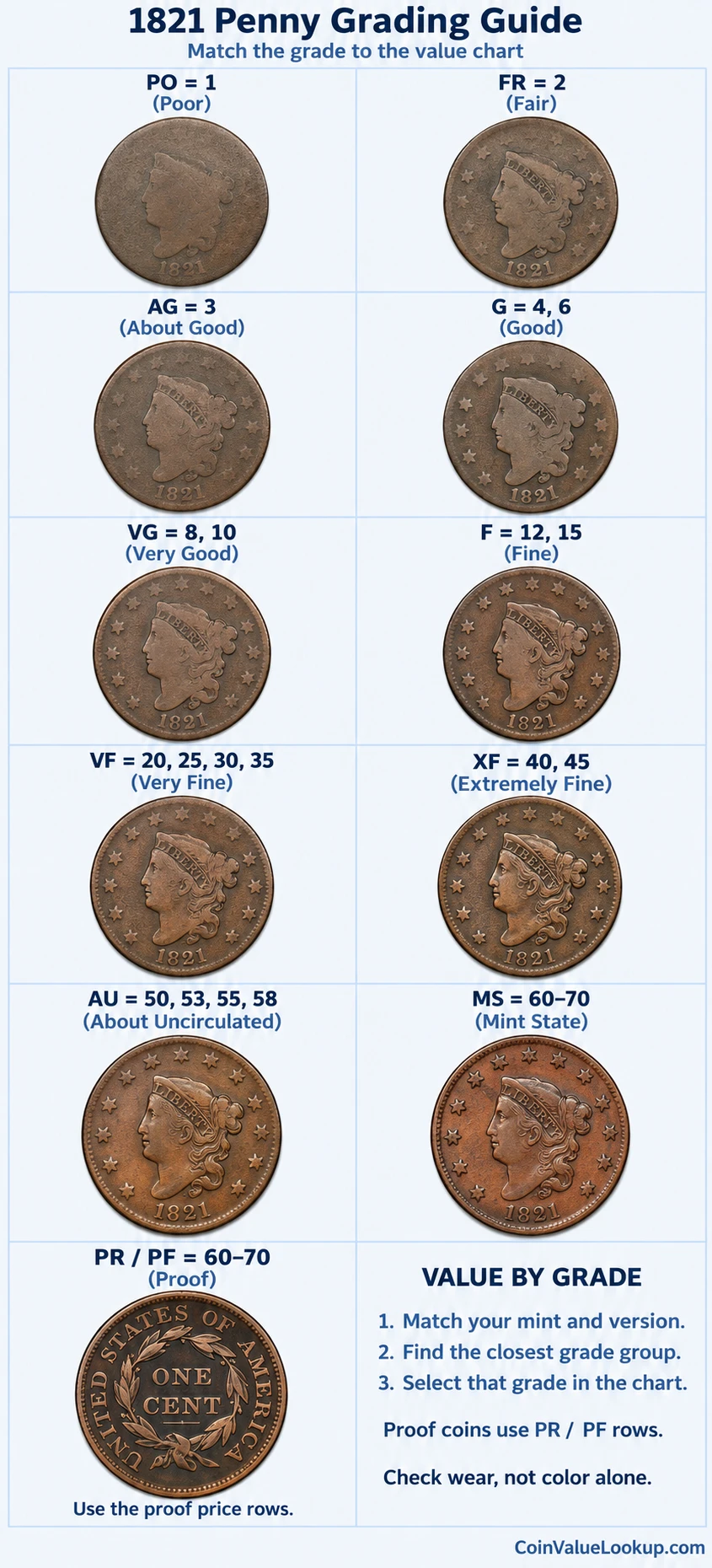
Start by examining Liberty's hair above the ear and the cheek area. On well-worn examples, the hair curls flatten first, then the cheek loses its contour.
A coin grading around Good (G4) will show a clear date and outline of the portrait but most fine detail is gone.
On the reverse, check the individual leaves in the wreath. Higher-grade coins show separate leaf veins and sharp lettering.
By VG, many leaves merge into a flat ribbon shape.
Do not confuse a weak strike with heavy wear. Some early copper cents left the press with soft spots that never had full detail.
Likewise, porosity and corrosion eat into surfaces in ways that look like wear but are actually damage, and the market treats them differently.
Copper coins come in color designations: BN (brown), RB (red-brown), and RD (red). These describe the remaining original color, not different metals.
Most surviving 1821 cents are fully brown. Use the comparison image to match your coin's detail level against known grade benchmarks.
Step 3: Check 1821 Coronet Head Cent Value by Mint and Version
1821 Coronet Head Cent
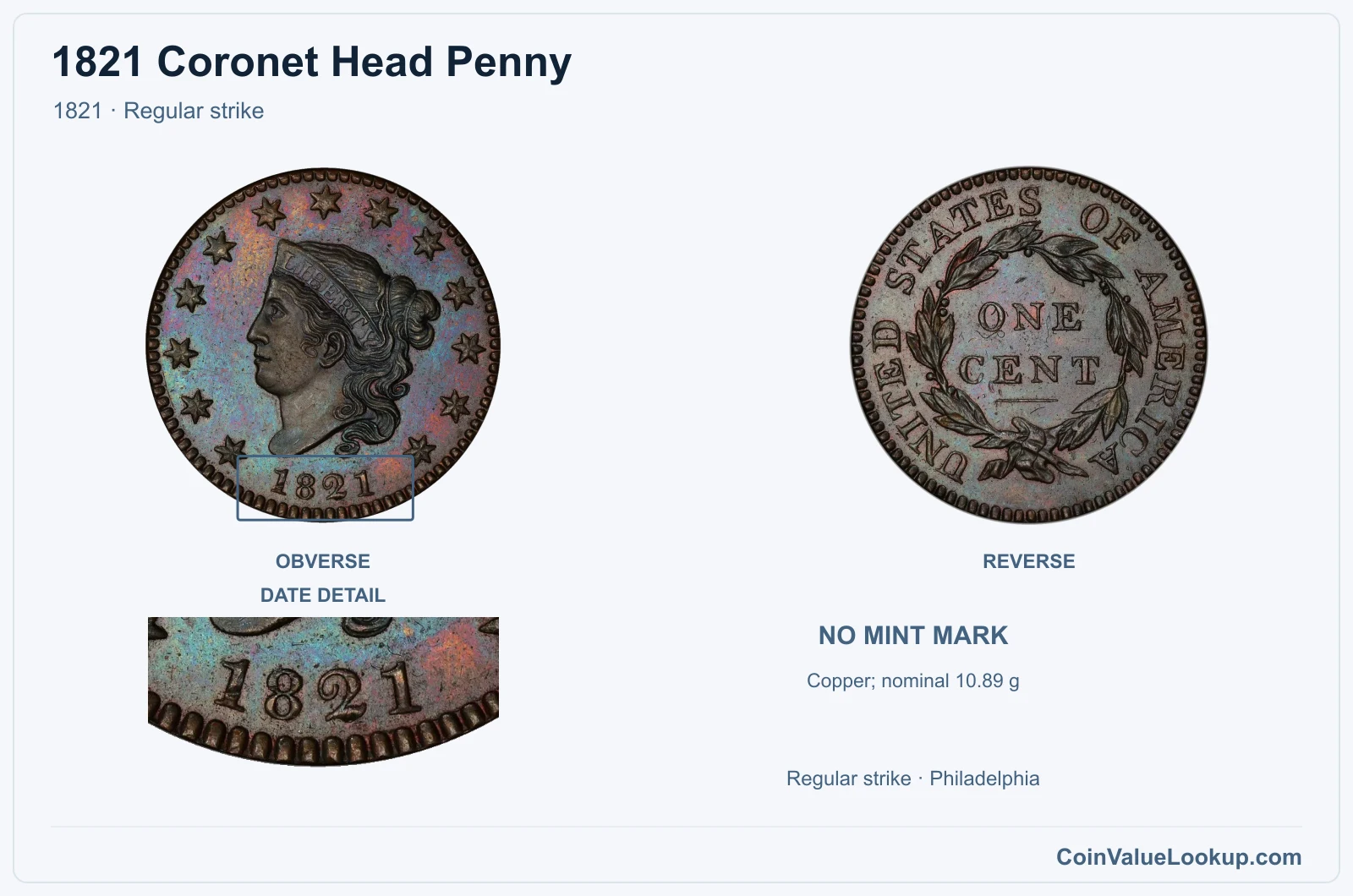
This is the standard 1821 business strike from the Philadelphia Mint, produced in copper at a nominal weight of 10.89 grams. No mintmark appears on the coin.
USA Coin Book guide estimates place it at roughly $103 in G4 and around $30,920 in MS63, illustrating how sharply condition drives value on this date.
Look for the Coronet Head portrait on the obverse and the wreath with ONE CENT on the reverse. Original surfaces with natural brown toning are preferred over cleaned or artificially brightened examples.
Even a mid-grade piece with honest wear and no problems is a solid early copper holding.
Coin Value Lookup is a good starting point if you want to compare this date against other years in the Coronet Head series or check values for different denominations.
| Range | Grade | Price | Auction Records | Appraisal |
|---|---|---|---|---|
| PO | PO 1 | — | Coin Identifier | |
| FR | FR 2 | — | Coin Identifier | |
| AG | AG 3 | Coin Identifier | ||
| G | G 4 | Coin Identifier | ||
| G 6 | Coin Identifier | |||
| VG | VG 8 | Coin Identifier | ||
| VG 10 | Coin Identifier | |||
| F | F 12 | Coin Identifier | ||
| F 15 | Coin Identifier | |||
| VF | VF 20 | Coin Identifier | ||
| VF 25 | Coin Identifier | |||
| VF 30 | Coin Identifier | |||
| VF 35 | Coin Identifier | |||
| XF | XF 40 | Coin Identifier | ||
| XF 45 | Coin Identifier | |||
| AU | AU 50 | Coin Identifier | ||
| AU 53 | Coin Identifier | |||
| AU 55 | Coin Identifier | |||
| AU 58 | Coin Identifier | |||
| MS | MS 60 | Coin Identifier | ||
| MS 61 | Coin Identifier | |||
| MS 62 | Coin Identifier | |||
| MS 63 | Coin Identifier | |||
| MS 64 | — | — | — | |
| MS 65 | — | — | — | |
| MS 66 | — | — | — | |
| MS 67 | — | — | — | |
| MS 68 | — | — | — | |
| MS 69 | — | — | — | |
| MS 70 | — | — | — |
1821 Coronet Head Cent — PR
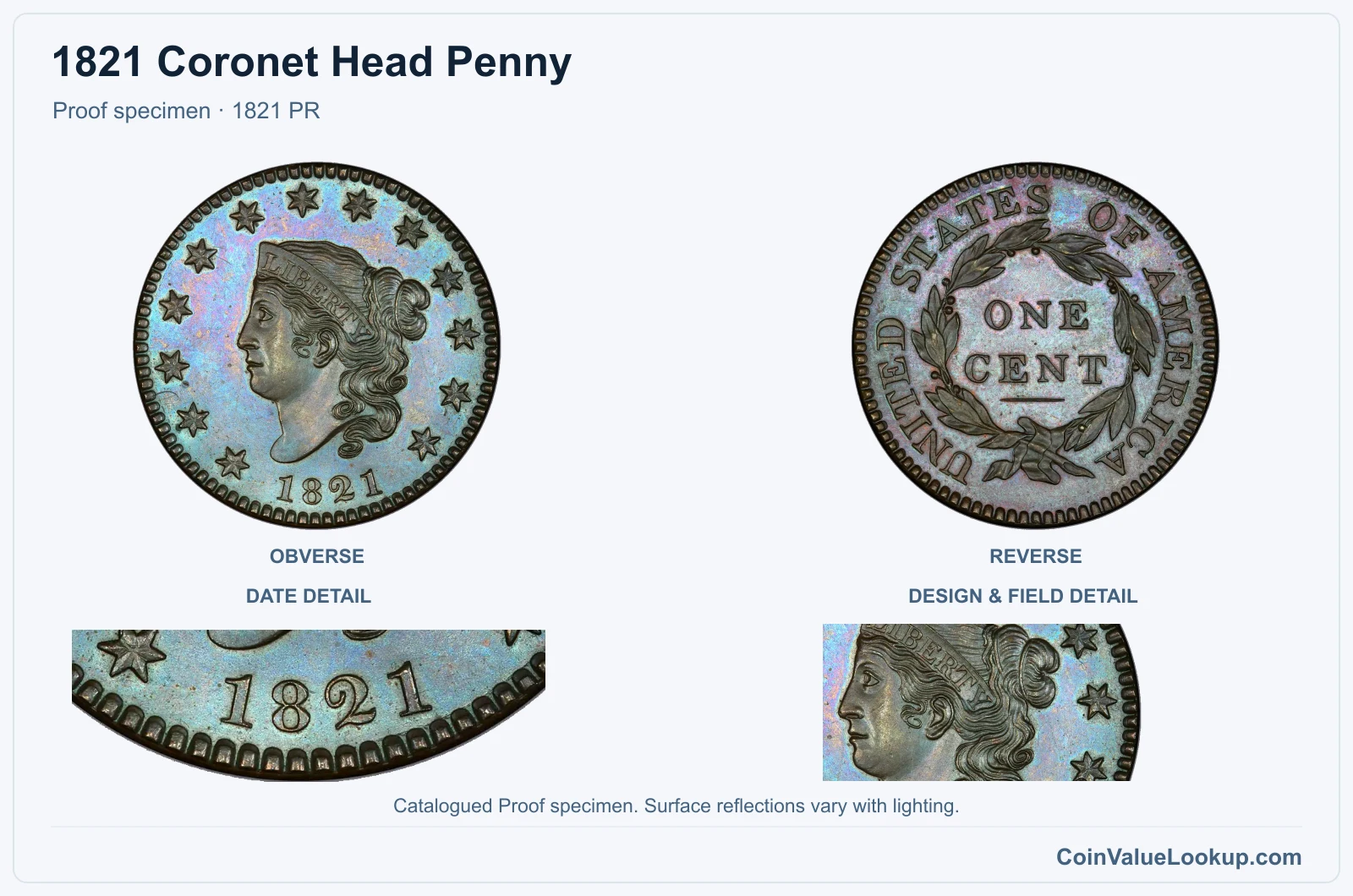
The 1821 Proof Coronet Head Cent is an extremely rare early proof copper coin. Proof status on coins from this era is determined by die characteristics, rim sharpness, surface texture, and overall finish, not by how shiny the coin looks.
Polishing a business strike does not turn it into a proof, no matter how mirror-like the result.
No numeric guide price is adopted for this issue, because each surviving example needs individual assessment by an authenticated identity and condition basis. These proofs are cataloged by major services like PCGS, but a catalog listing alone is not a recent transaction or a guaranteed market value.
If you suspect you have an 1821 proof, professional third-party authentication is essential. Compare your coin's surfaces, rims, and strike quality against confirmed proof references before drawing conclusions.
Assumed proofs that turn out to be polished business strikes are a common disappointment in the early copper market.
| Range | Grade | Price | Auction Records | Appraisal |
|---|---|---|---|---|
| PR | PR 1 | — | Coin Identifier | |
| PR 2 | — | Coin Identifier | ||
| PR 3 | — | Coin Identifier | ||
| PR 4 | — | Coin Identifier | ||
| PR 6 | — | Coin Identifier | ||
| PR 8 | — | Coin Identifier | ||
| PR 10 | — | Coin Identifier | ||
| PR 12 | — | Coin Identifier | ||
| PR 15 | — | Coin Identifier | ||
| PR 20 | — | Coin Identifier | ||
| PR 25 | — | Coin Identifier | ||
| PR 30 | — | Coin Identifier | ||
| PR 35 | — | Coin Identifier | ||
| PR 40 | — | Coin Identifier | ||
| PR 45 | — | Coin Identifier | ||
| PR 50 | — | Coin Identifier | ||
| PR 53 | — | Coin Identifier | ||
| PR 55 | — | Coin Identifier | ||
| PR 58 | — | Coin Identifier | ||
| PR 60 | Coin Identifier | |||
| PR 61 | Coin Identifier | |||
| PR 62 | Coin Identifier | |||
| PR 63 | Coin Identifier | |||
| PR 64 | Coin Identifier | |||
| PR 65 | Coin Identifier | |||
| PR 66 | — | — | — | |
| PR 67 | — | — | — | |
| PR 68 | — | — | — | |
| PR 69 | — | — | — | |
| PR 70 | — | — | — |
1821 Coronet Head Cent Error List
1. 1821 Coronet Head Cent — Clipped Planchet
A clipped planchet error means a portion of the original copper blank was missing before the coin was struck. You will see a curved, straight, or irregular section of missing metal along the edge, and the design near the clip may show weakness from the incomplete blank.
On authentic clips, look for metal flow and a characteristic Blakesley effect, which is weakness on the rim directly opposite the clip. This helps separate a real clip from post-mint damage such as filing, cutting, or corrosion eating away the edge.
No specific price is adopted for clipped 1821 Coronet Head Cents. Value depends on the size and type of clip, overall grade, and whether the date remains fully visible.
Professional attribution is recommended to confirm the error is genuine and not the result of later alteration.
2. 1821 Coronet Head Cent — Lamination / Split Planchet
Lamination errors on an 1821 cent show up as peeling, flaking, or splitting within the copper itself. You might see a thin flap of metal lifting away from the surface, or an area where the planchet has separated into layers.
These defects originate from impurities or inconsistencies in the copper strip before striking.
Photograph both the affected face and the edge together, as the edge view often reveals the split most clearly. Compare what you see against corrosion damage, which can mimic a lamination but usually has a rougher, more pitted texture.
Deliberately scraped or cut coins also look similar at first glance.
No numeric price range is adopted for this error on the 1821 date. Each example requires individual evaluation based on the severity of the lamination, the coin's overall condition, and confirmation that the defect is a genuine mint-produced flaw rather than environmental damage.
3. 1821 Coronet Head Cent — Off-Center Strike
An off-center strike happens when the planchet is not seated properly between the dies. The result is a displaced design with a blank crescent of unstruck metal on one side.
The percentage of off-center shift and whether the date remains visible are the two biggest factors collectors care about.
A coin that is 5% off-center looks like a minor curiosity. One that is 50% off-center with a readable date is a different story entirely.
On the 1821 Coronet Head Cent, keeping the full date within the struck area is critical for identification and value.
Do not confuse an off-center strike with a clipped planchet or one-sided die misalignment. Post-mint flattening or vice damage can also push metal around and create a misleading appearance.
No adopted price exists for this error on the 1821 date, so professional authentication and individual assessment are the way to go.
4. 1821 Coronet Head Cent — Rotated Dies
Rotated die errors occur when one of the two dies shifts from normal alignment. To check, hold the obverse upright, then flip the coin top to bottom.
On a normally aligned U.S. coin, the reverse should also appear upright. If the reverse is tilted, you may have a rotation error.
Small rotations of a few degrees are relatively minor and common in early copper coinage. Larger rotations, say 90 or 180 degrees, are far more dramatic and collectible.
Make sure you are flipping the coin correctly, because a sideways turn instead of a top-to-bottom flip will give a false result.
Watch out for photographs that were simply taken at an angle. A rotated image is not the same as a rotated die.
No numeric price is adopted for this error on the 1821 cent, so any example should be evaluated individually based on the degree of rotation and overall condition.