1821 Capped Bust Quarter Coin Value: How Much Is It Worth?
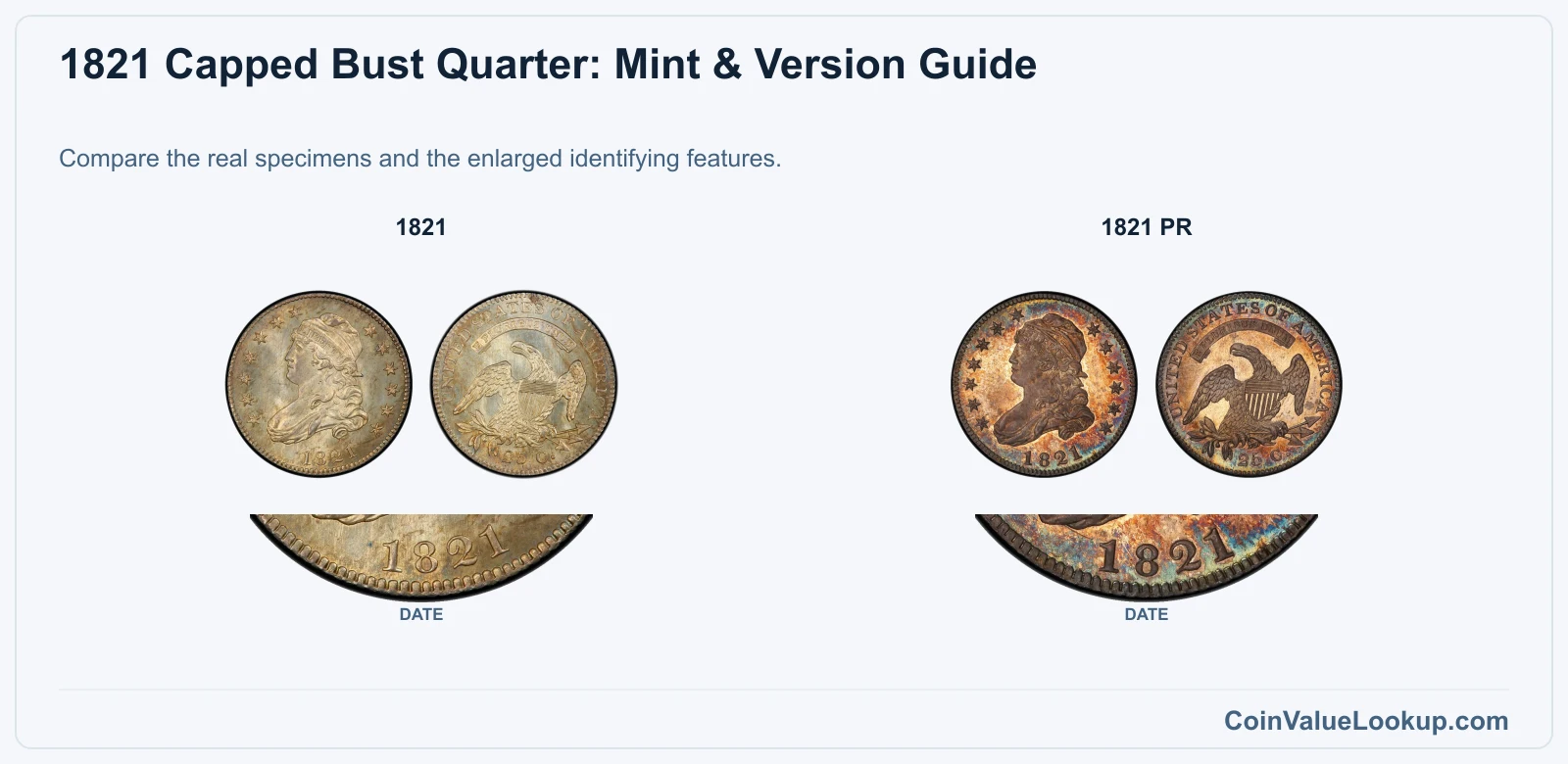
The 1821 Capped Bust quarter was struck at the Philadelphia Mint during an era when quarters were still large-diameter silver pieces with hand-engraved dies. Guide estimates for this date range from about $164.00 in well-worn condition up to $8,591.00 at higher Mint State grades, depending on the specific version and condition of your coin.
A proof version also exists, though it requires individual assessment rather than a simple price lookup.
Fast Way to Identify Your 1821 Capped Bust Quarter
The quickest way to start figuring out what your 1821 quarter is worth is to upload clear photos of the front and back. Our identifier can give you a preliminary read on which version you have and its general condition.
Good lighting and a straight-on angle help — skip the artistic shadows for now.
1821 Capped Bust Quarter Value
Upload both sides of your 1821 Capped Bust Quarter.
Front Obverse
Upload photo
Back Reverse
Upload photo
Which 1821 Capped Bust Quarter Versions Are Worth Money?
- The 1821 business strike ranges from about $164.00 in G4 to $8,591.00 in MS63 per USA Coin Book guide estimates — condition is the main value driver.
- The 1821 proof version has no adopted guide price and requires individual assessment based on authenticated identity and condition.
Step 1: Identify Your 1821 Capped Bust Quarter Mint Mark and Version
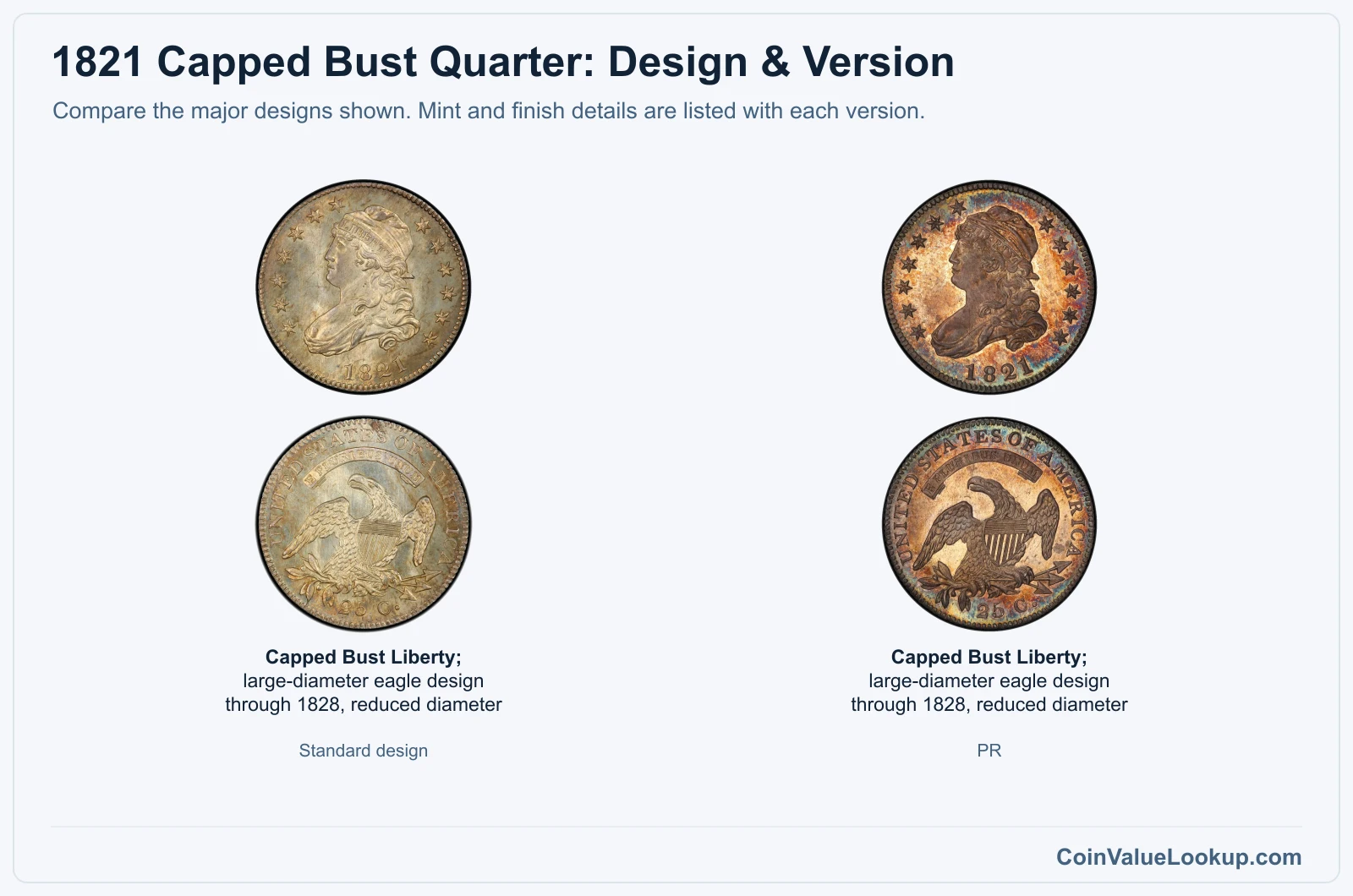
Every 1821 quarter was struck in Philadelphia, so there is no mintmark to hunt for. The design is the Capped Bust type with a large-diameter eagle reverse, which was used through 1828 before the series switched to a smaller planchet.
The coin is a silver-copper alloy of approximately 89.24% silver. That silver content alone gives it meaningful melt value, but collector premiums run well above bullion for most survivors.
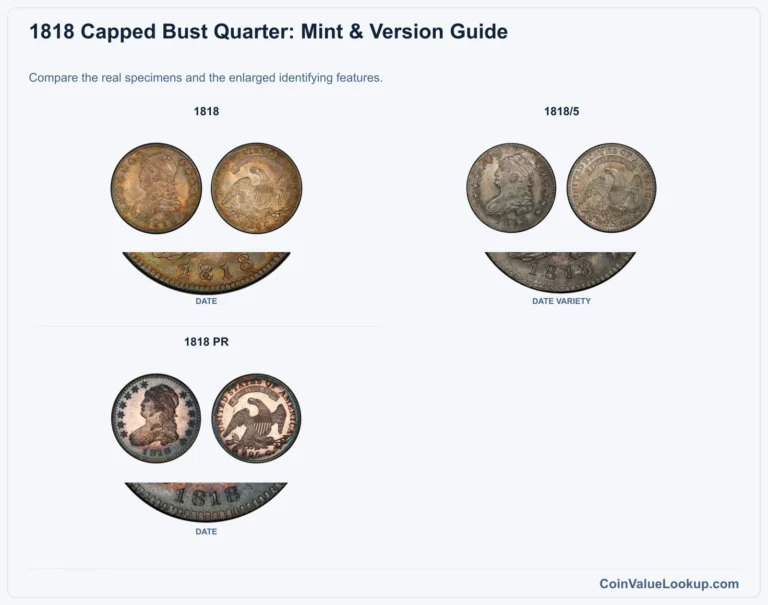
Two branches exist for this date: the regular business strike (1821) and the proof issue (1821 PR). A proof is identified by its manufacturing method — mirrored fields, sharp rims, and squared-off edge details — not simply by being shiny.
Cleaned or polished business strikes can fool you, so compare the overall surface character carefully.
Check the date numerals, the denomination on the reverse, and the presence of "E PLURIBUS UNUM" on the ribbon above the eagle. These features confirm you have the correct large-diameter Capped Bust type rather than a later reduced-size issue.
Step 2: Check Your 1821 Capped Bust Quarter Grade
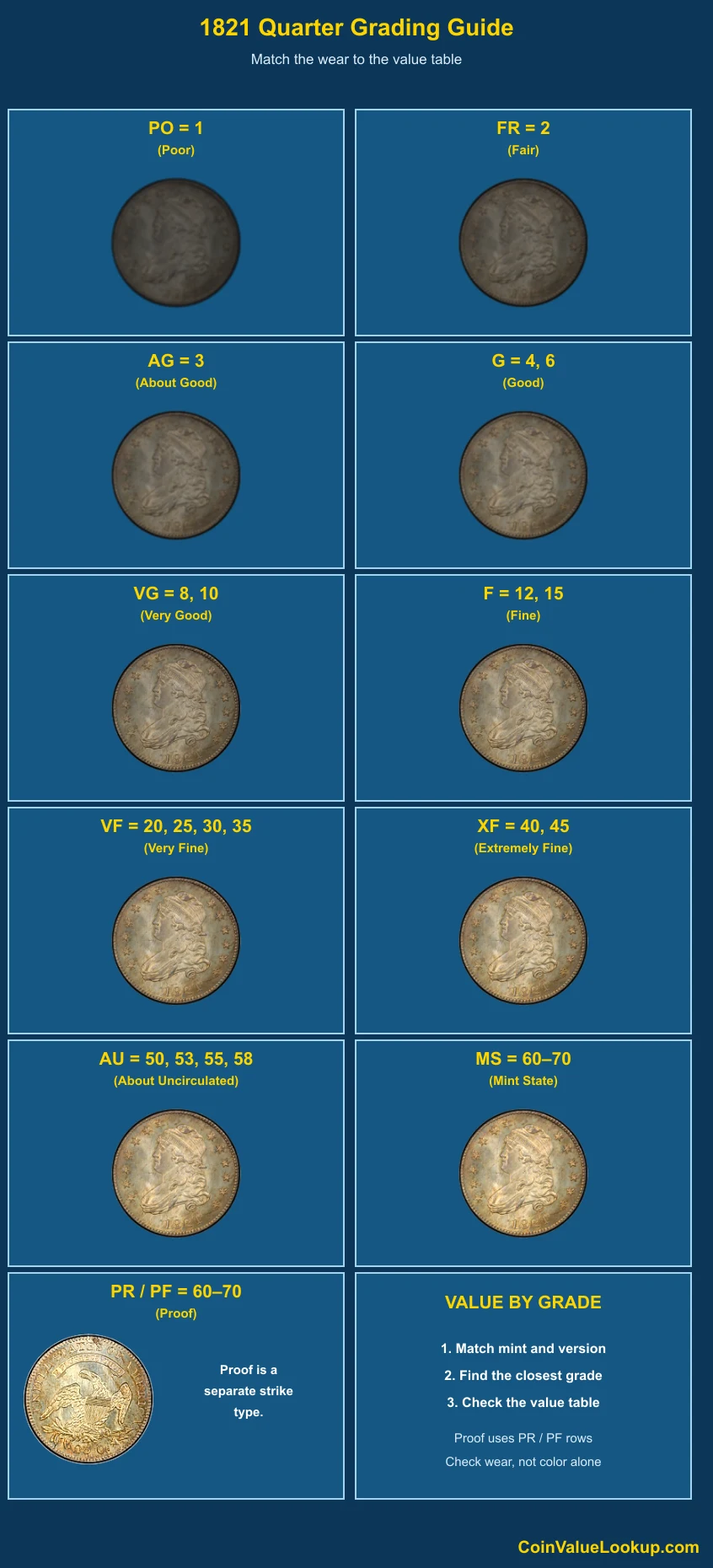
Start with the hair above Liberty's ear and the folds in her cap. On a well-circulated coin, the hair curls flatten first, followed by the cheek losing its roundness.
The eagle's breast feathers and the tops of the wings are the reverse wear points to watch.
Compare your coin's surfaces against the reference image for this type. A coin graded G4 (Good) will show a clear outline and date but most fine detail is gone.
An MS60 piece retains full luster with no wear, though it may have contact marks from other coins.
Strike weakness is a separate issue from wear. Some 1821 quarters left the press with soft detail on the hair curls or eagle feathers simply because the dies were tired or not aligned perfectly.
Do not mistake a weakly struck but unworn coin for a worn one, and do not assume a sharp strike means higher grade if the surfaces show rub.
Coin Value Lookup is a good starting point if you want to compare your coin's condition against guides for other denominations and years. Bookmark it for the next time you pull a mystery coin out of a junk box.
Step 3: Check 1821 Capped Bust Quarter Value by Mint and Version
1821 Capped Bust Quarter
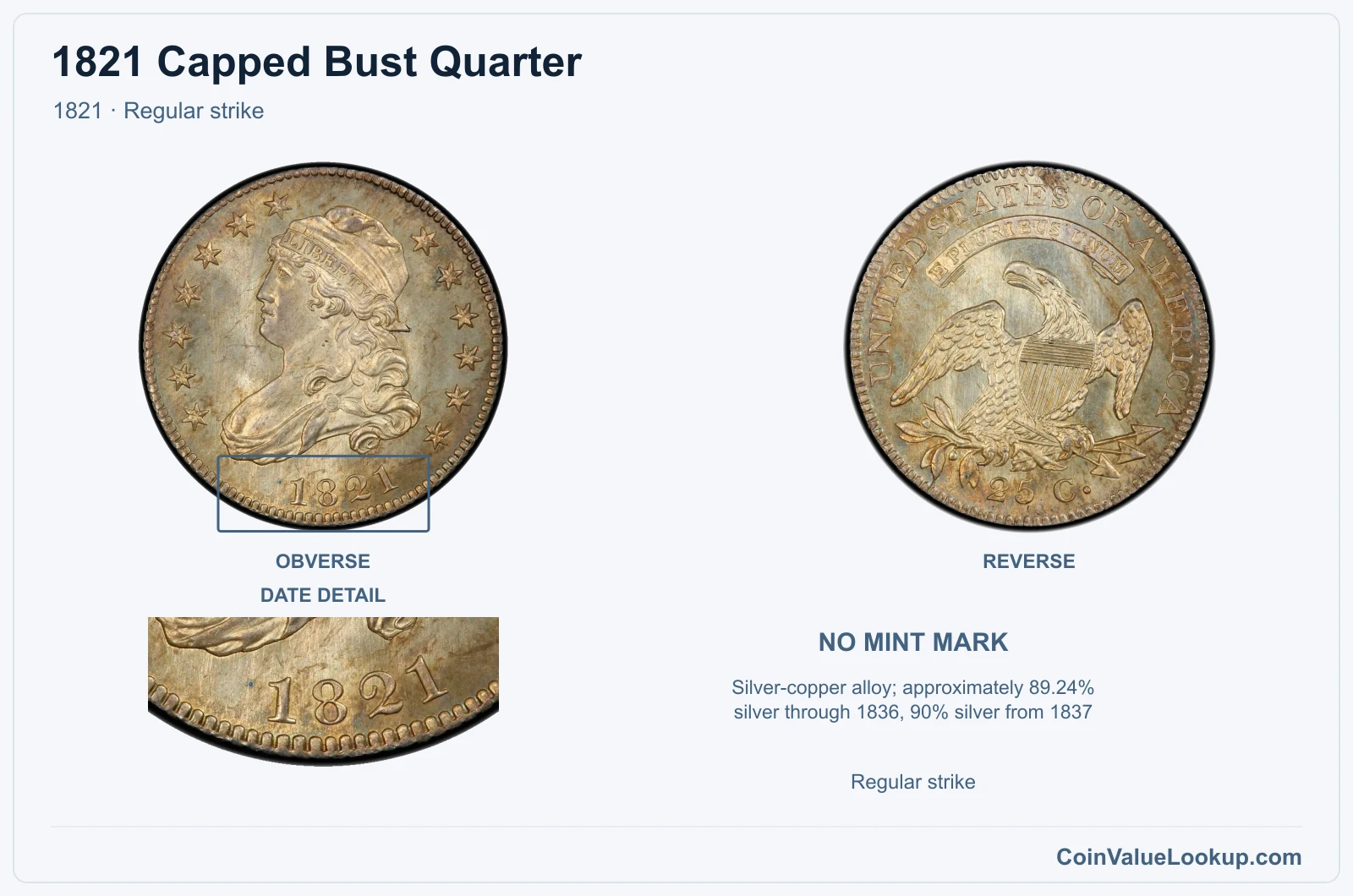
The 1821 business-strike quarter is the version most collectors will encounter. It was produced at Philadelphia with no mintmark, struck on a large-diameter silver-copper planchet of approximately 89.24% silver.
USA Coin Book guide estimates place this coin at about $164.00 in G4 (a heavily worn but readable example), roughly $4,950.00 at MS60 (full detail, no wear, but surface marks allowed), and around $8,591.00 at MS63 (a choice uncirculated coin with fewer blemishes). These are guide estimates, not guaranteed sale prices.
Before comparing grades, confirm original surfaces. A coin that has been cleaned, whizzed, or harshly dipped will trade below guide values even if the remaining detail looks sharp.
Look for natural toning and undisturbed luster in the protected areas around the stars and lettering.
Range Grade
Price Auction Records Appraisal PO PO 1
—
Coin Identifier FR FR 2
—
Coin Identifier AG AG 3
Coin Identifier G G 4
Coin Identifier
G 6
Coin Identifier VG VG 8
Coin Identifier
VG 10
Coin Identifier F F 12
Coin Identifier
F 15
Coin Identifier VF VF 20
Coin Identifier
VF 25
Coin Identifier
VF 30
Coin Identifier
VF 35
Coin Identifier XF XF 40
Coin Identifier
XF 45
Coin Identifier AU AU 50
Coin Identifier
AU 53
Coin Identifier
AU 55
Coin Identifier
AU 58
Coin Identifier MS MS 60
—
Coin Identifier
MS 61
Coin Identifier
MS 62
Coin Identifier
MS 63
Coin Identifier
MS 64
Coin Identifier
MS 65
Coin Identifier
MS 66
Coin Identifier
MS 67
Coin Identifier
MS 68
—
—
—
MS 69
—
—
—
MS 70
—
—
—
1821 Capped Bust Quarter — PR
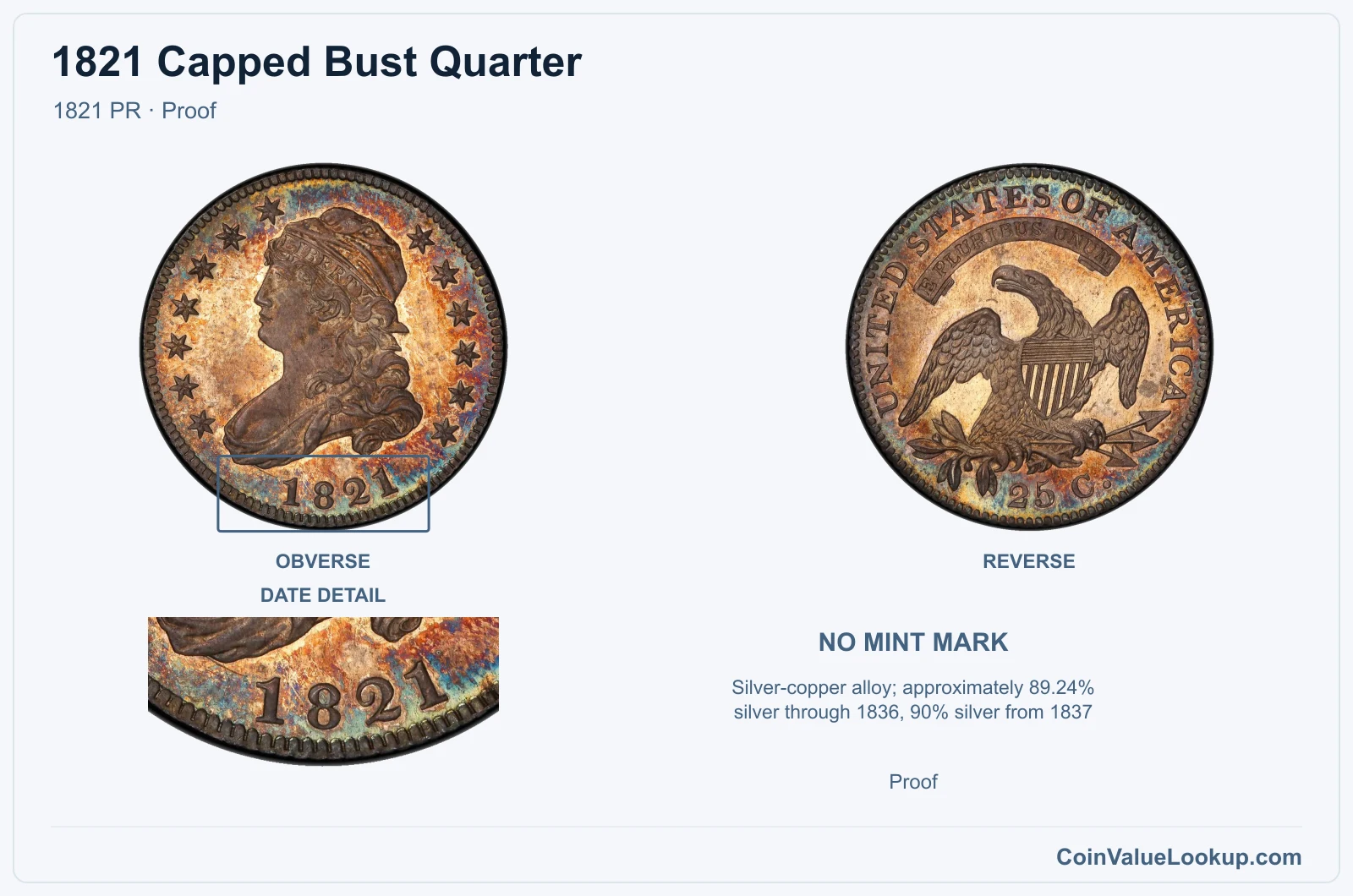
The 1821 proof quarter is a special-manufacture striking, not simply a nice business strike. Proofs from this era were made in tiny numbers for presentation or collector purposes, and genuine survivors are rare.
Identify a proof by its mirror-like fields, well-defined rims, and exceptionally sharp design details struck from polished dies. A business strike that someone buffed on a cloth is not a proof — the geometry of the rim and the depth of the devices are different.
No supported numeric price range has been adopted for this version. Value depends entirely on authenticated identity, the coin's individual condition, and factors like hairlines or haze on the mirrored surfaces.
If you believe you have a proof 1821 quarter, professional authentication by a major grading service is the right next step.
Range Grade
Price Auction Records Appraisal PR PR 1
—
Coin Identifier
PR 2
—
Coin Identifier
PR 3
—
Coin Identifier
PR 4
—
Coin Identifier
PR 6
—
Coin Identifier
PR 8
—
Coin Identifier
PR 10
—
Coin Identifier
PR 12
—
Coin Identifier
PR 15
—
Coin Identifier
PR 20
—
Coin Identifier
PR 25
—
Coin Identifier
PR 30
—
Coin Identifier
PR 35
—
Coin Identifier
PR 40
—
Coin Identifier
PR 45
—
Coin Identifier
PR 50
—
Coin Identifier
PR 53
—
Coin Identifier
PR 55
—
Coin Identifier
PR 58
—
Coin Identifier
PR 60
—
Coin Identifier
PR 61
—
Coin Identifier
PR 62
—
Coin Identifier
PR 63
—
Coin Identifier
PR 64
Coin Identifier
PR 65
Coin Identifier
PR 66
—
Coin Identifier
PR 67
Coin Identifier
PR 68
—
—
—
PR 69
—
—
—
PR 70
—
—
—