1828 Capped Bust Quarter Coin Value: How Much Is It Worth?
The 1828 Capped Bust Quarter is a Philadelphia Mint issue struck in silver, and it comes in a few distinct branches that dramatically affect what your coin is worth. Guide estimates range from about $153.00 in well-worn Good condition to $120,133.00 at the top of the scale for a specific rare variety in Mint State 63.
That spread is not one universal price for every 1828 quarter — your coin's version, condition and surface quality determine where it falls.
Fast Way to Identify Your 1828 Capped Bust Quarter
The quickest way to get a preliminary read on your 1828 quarter is to upload clear photos of both the front and back. Sharp, well-lit images let us compare your coin's design details, wear level and any variety markers against known references.
This is not a substitute for professional authentication, but it gives you a solid starting point before deciding on next steps.
1828 Capped Bust Quarter Value
Upload both sides of your 1828 Capped Bust Quarter.
Front Obverse
Upload photo
Back Reverse
Upload photo
Which 1828 Capped Bust Quarter Versions Are Worth Money?
- 1828 25/50C — the blundered denomination variety — carries guide estimates up to $120,133.00 in MS63; traces of a "50" punch beneath the "25 C." on the reverse are the key identifier.
- Standard 1828 business strikes are valued from about $153.00 in G4 to $9,340.00 in MS63 per USA Coin Book estimates, making even well-worn examples collectible.
- 1828 Proof quarters exist but are extremely rare early Philadelphia Mint proofs; individual assessment by authenticated identity and condition determines their value.
- Check the reverse denomination under magnification before assuming you have the common version — the 25/50C variety is worth roughly twelve times more at the same grade.
Step 1: Identify Your 1828 Capped Bust Quarter Mint Mark and Version
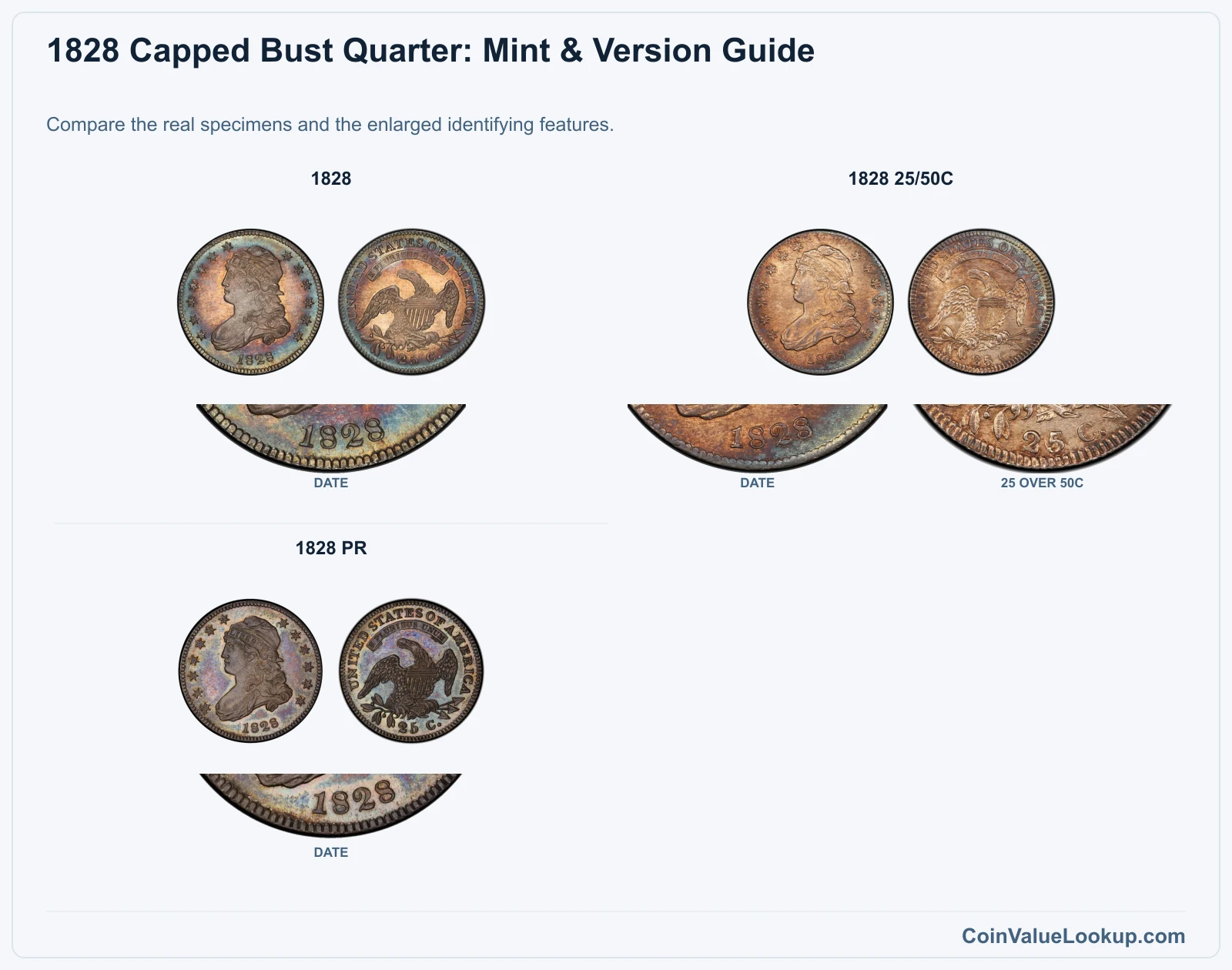
All 1828 Capped Bust Quarters were struck at the Philadelphia Mint, so there is no mintmark to look for. The coin is made from a silver-copper alloy of approximately 89.24% silver.
The obverse shows Liberty wearing a cloth cap, facing left, surrounded by stars and the date 1828. The reverse features a heraldic eagle with a shield on its breast, olive branch and arrows in its talons, and the inscription UNITED STATES OF AMERICA with 25 C.
as the denomination.
This year belongs to the large-diameter Capped Bust design used through 1828 — later issues starting in 1831 switched to a smaller planchet and dropped E PLURIBUS UNUM from the reverse. If your coin is noticeably smaller and lacks that motto, double-check the date.
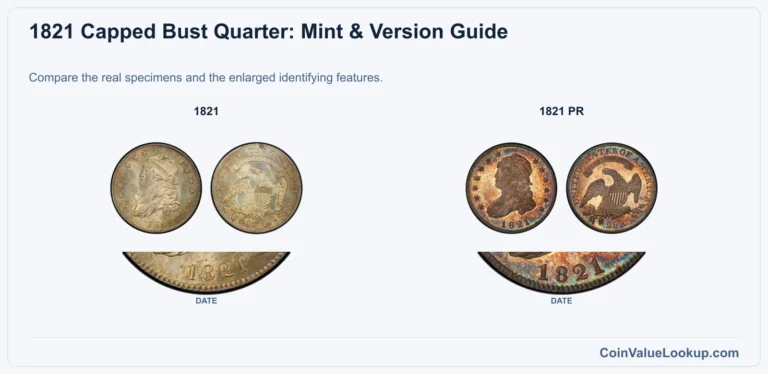
The key branches for 1828 are: the standard business strike (1828), the 25/50C blundered denomination variety, and a proof issue (1828 PR). To separate these, you need to examine the reverse denomination closely and assess whether the coin shows the mirror-like surfaces of a proof striking versus normal luster.
Step 2: Check Your 1828 Capped Bust Quarter Grade
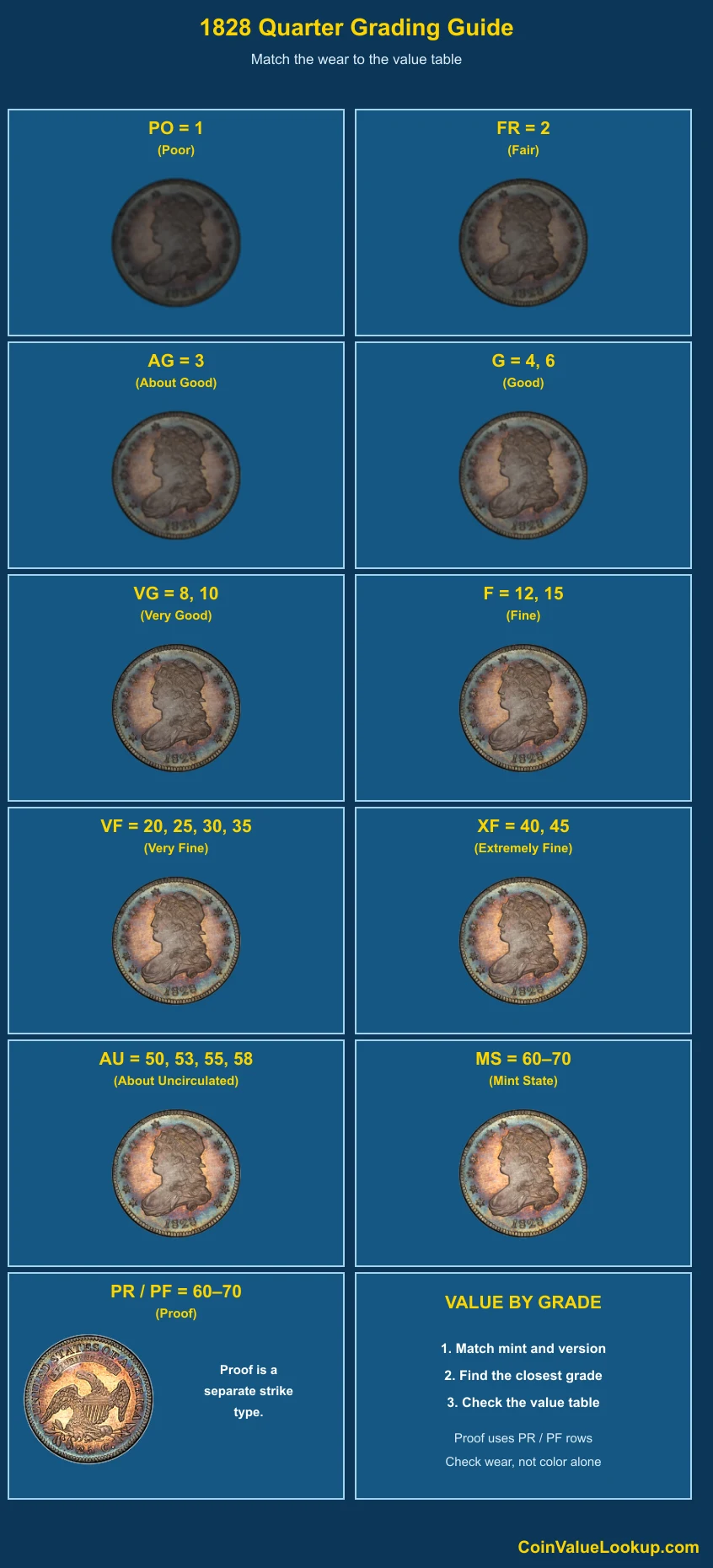
Start with the hair above Liberty's ear and the folds of her cap. On a lightly circulated coin these areas show slight flattening first, while the cheek retains some roundness.
Heavy wear flattens the entire portrait into a smooth outline.
On the reverse, check the eagle's breast feathers and the tops of its wings. These are the highest points and the first to lose definition from contact.
Strike quality matters here. Some 1828 quarters left the press with weak detail in the hair curls or eagle feathers even before anyone spent them.
A softly struck coin is not the same thing as a worn coin — luster in the protected areas is your clue. If the fields still show original cartwheel luster but a few design elements look flat, suspect a weak strike rather than wear.
Use the comparison image to match your coin's overall look. A cleaned coin with bright, unnaturally shiny surfaces will grade lower than one with honest, original toning, even if the detail looks similar.
Hairlines from old cleanings are easiest to spot under angled light.
Step 3: Check 1828 Capped Bust Quarter Value by Mint and Version
1828 Capped Bust Quarter
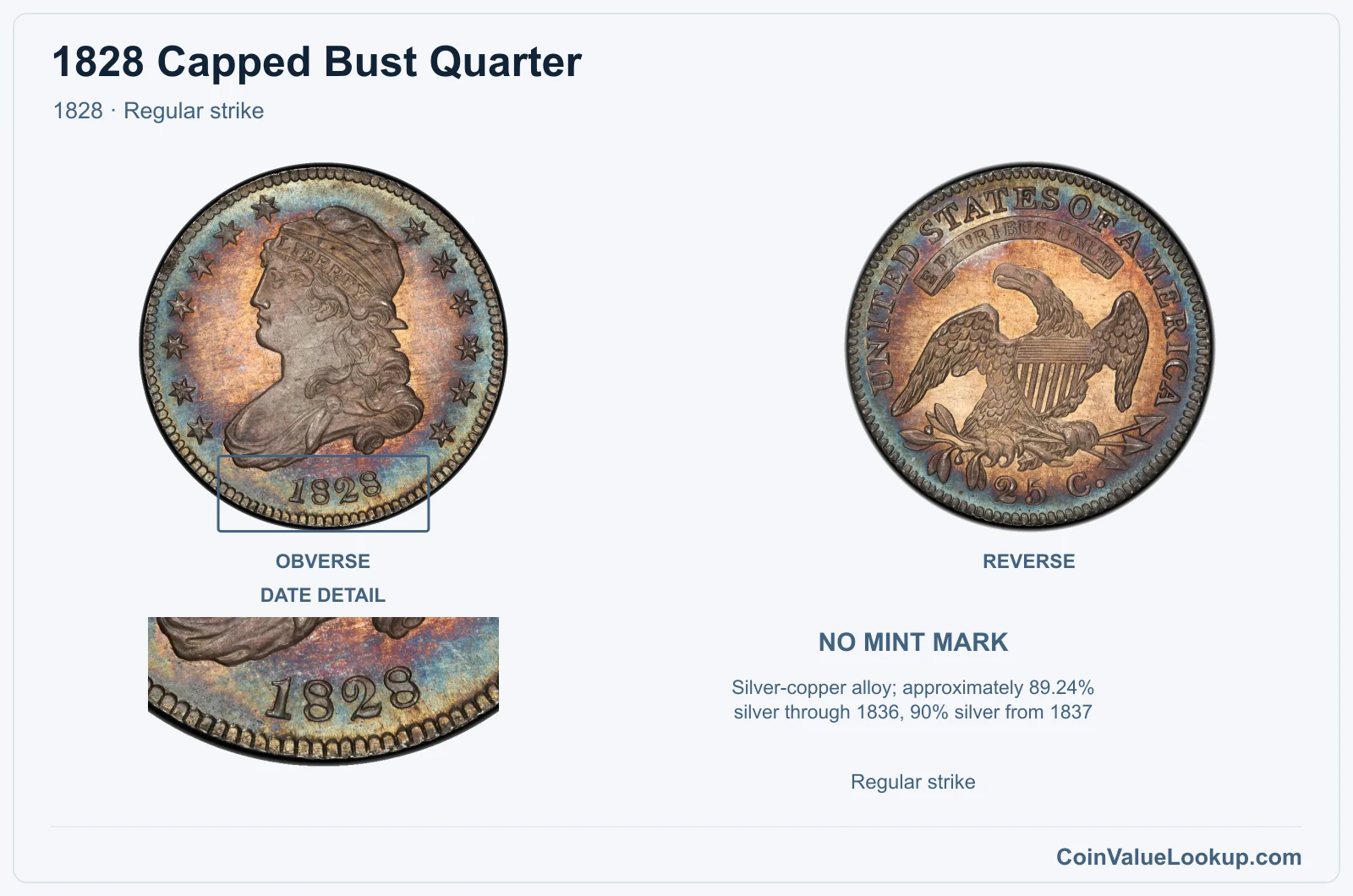
The standard 1828 Capped Bust Quarter is a Philadelphia business strike on the large-diameter planchet. No mintmark appears on the coin.
USA Coin Book guide estimates place this version at about $153.00 in G4 (a heavily worn but identifiable grade), $4,255.00 in MS60 (uncirculated but with contact marks), and $9,340.00 in MS63 (a choice uncirculated coin with good eye appeal). These are retail guide figures, not guaranteed sale prices.
Before comparing grade, confirm your coin does not show traces of an overdenomination on the reverse. Original surfaces with natural toning are preferred by collectors; cleaning or damage will reduce the value below these benchmarks.
Range Grade
Price Auction Records Appraisal PO PO 1
—
Coin Identifier FR FR 2
—
Coin Identifier AG AG 3
—
Coin Identifier G G 4
Coin Identifier
G 6
Coin Identifier VG VG 8
Coin Identifier
VG 10
Coin Identifier F F 12
Coin Identifier
F 15
Coin Identifier VF VF 20
Coin Identifier
VF 25
Coin Identifier
VF 30
Coin Identifier
VF 35
Coin Identifier XF XF 40
Coin Identifier
XF 45
Coin Identifier AU AU 50
Coin Identifier
AU 53
Coin Identifier
AU 55
Coin Identifier
AU 58
Coin Identifier MS MS 60
—
Coin Identifier
MS 61
Coin Identifier
MS 62
Coin Identifier
MS 63
Coin Identifier
MS 64
Coin Identifier
MS 65
Coin Identifier
MS 66
—
Coin Identifier
MS 67
Coin Identifier
MS 68
—
—
—
MS 69
—
—
—
MS 70
—
—
—
1828 Capped Bust Quarter — 25/50C
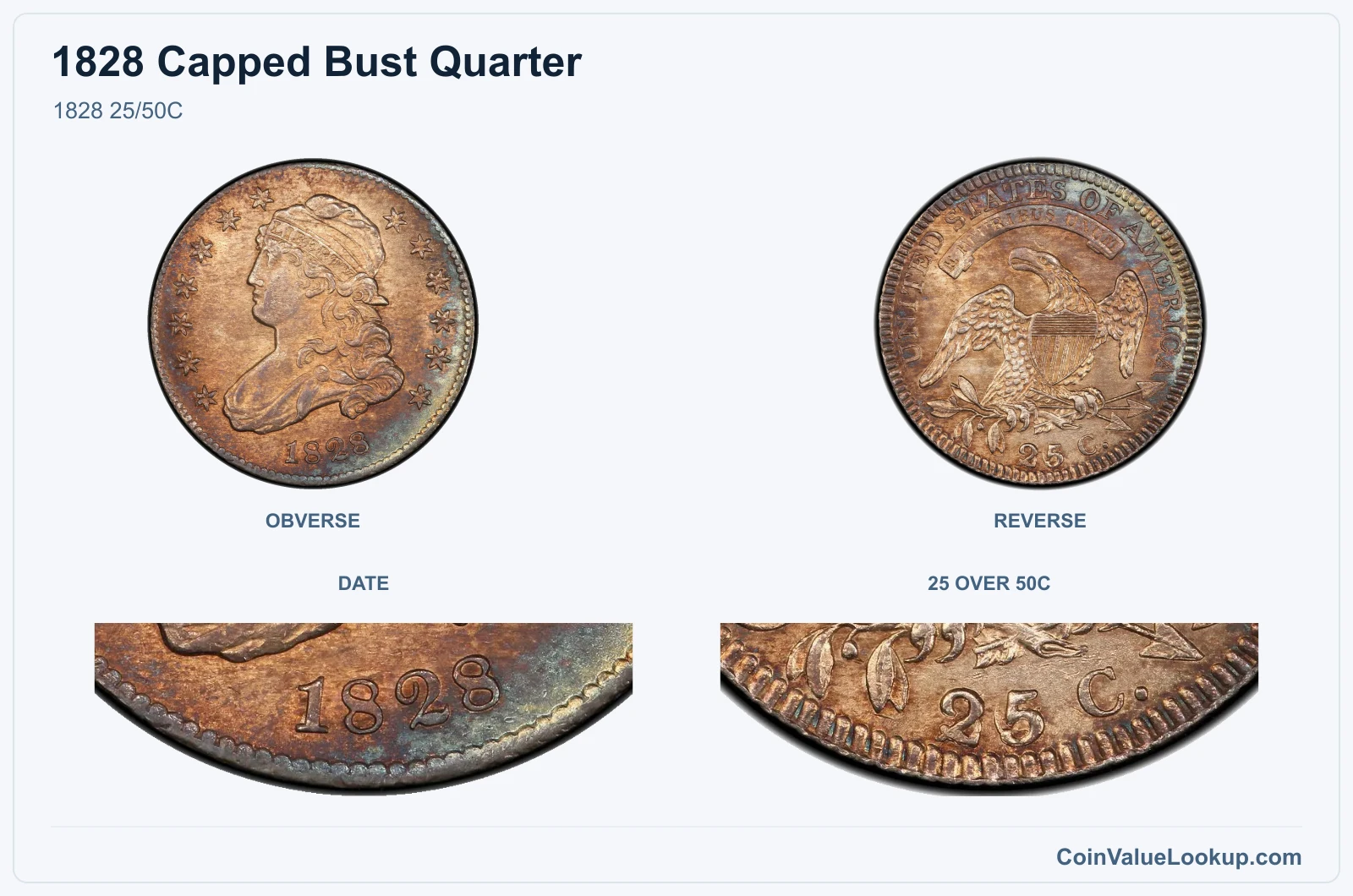
This is the star of the 1828 quarter family. The 1828 25/50C variety happened because a die intended for half dollars — bearing the "50" denomination — was corrected by punching "25 C." over it.
Under magnification on the reverse, you can see remnants of the original "50" lurking beneath the final "25 C." marking. The coin is still a quarter dollar in every respect; the Mint simply reused a partially prepared die.
Guide estimates from USA Coin Book reflect the premium: about $1,887.00 in G4, $24,607.00 in MS60, and $120,133.00 in MS63. Even in low grades this variety commands serious money compared to the standard issue.
You need good magnification and lighting to confirm the traces — do not assume you have this variety based on a fuzzy photo. A coin grading service attribution is the standard way collectors verify it.
Coin Value Lookup can help you explore guides for other Capped Bust quarters and compare values across different years and varieties.
Range Grade
Price Auction Records Appraisal PO PO 1
—
Coin Identifier FR FR 2
Coin Identifier AG AG 3
Coin Identifier G G 4
Coin Identifier
G 6
Coin Identifier VG VG 8
Coin Identifier
VG 10
Coin Identifier F F 12
Coin Identifier
F 15
Coin Identifier VF VF 20
Coin Identifier
VF 25
Coin Identifier
VF 30
—
Coin Identifier
VF 35
Coin Identifier XF XF 40
Coin Identifier
XF 45
—
Coin Identifier AU AU 50
—
Coin Identifier
AU 53
—
Coin Identifier
AU 55
Coin Identifier
AU 58
Coin Identifier MS MS 60
—
Coin Identifier
MS 61
Coin Identifier
MS 62
Coin Identifier
MS 63
Coin Identifier
MS 64
—
—
—
MS 65
—
—
—
MS 66
—
—
—
MS 67
—
—
—
MS 68
—
—
—
MS 69
—
—
—
MS 70
—
—
—
1828 Capped Bust Quarter — PR
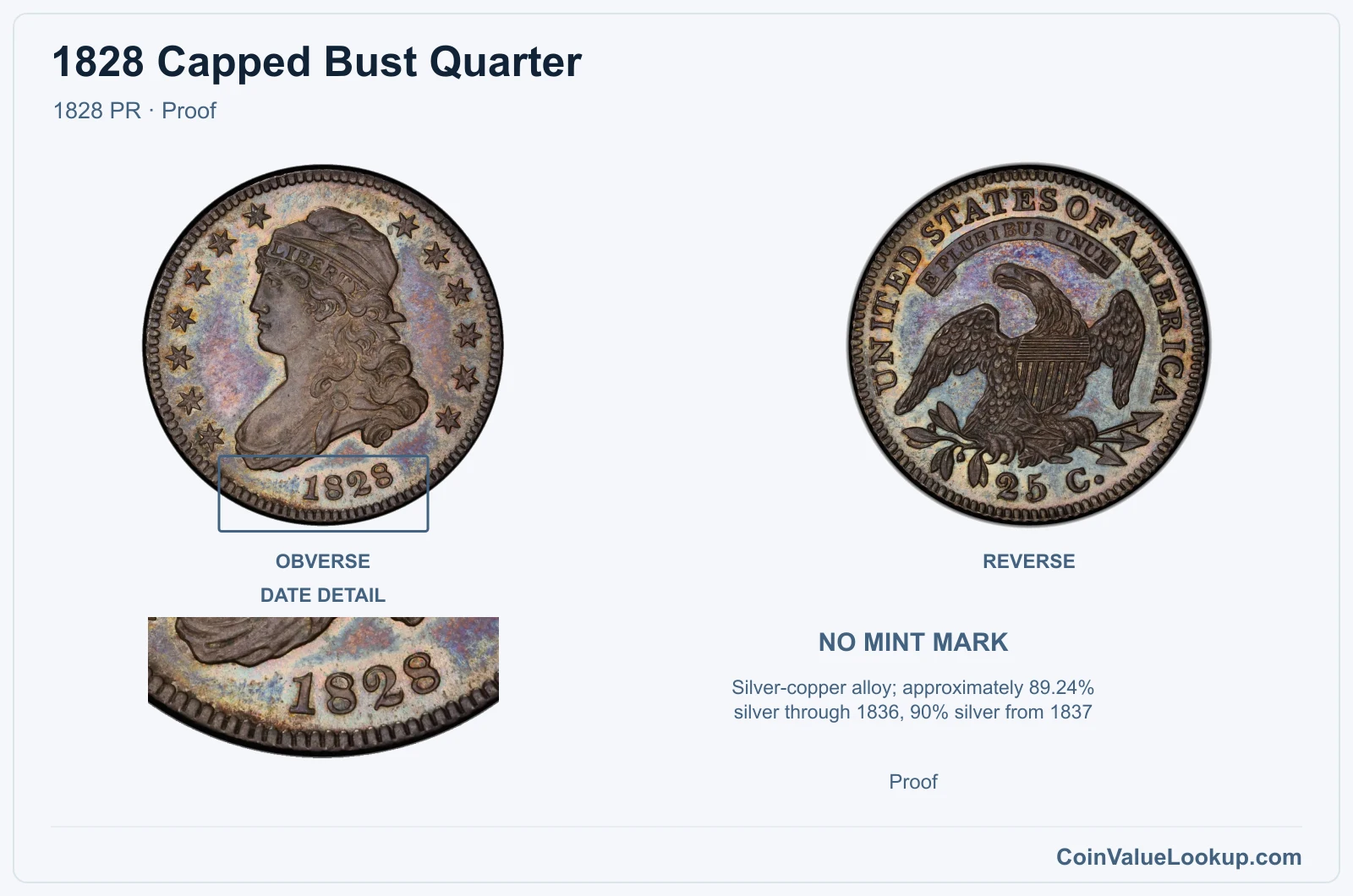
Proof 1828 Capped Bust Quarters are among the earliest proof coinage from the Philadelphia Mint. These were specially struck with polished dies on prepared planchets, producing mirror-like fields and sharp design details that differ from a regular business strike's satiny luster.
Do not confuse a proof with a high-grade uncirculated coin. Proofs show a specific reflective surface character in the fields, and hairlines or haze from handling still affect their collector appeal.
No supported numeric guide range is adopted for this version — each example requires individual assessment based on its authenticated identity and condition. Given the extreme rarity of early proof quarters, professional grading and authentication are essential before drawing any value conclusions.
Range Grade
Price Auction Records Appraisal PR PR 1
—
Coin Identifier
PR 2
—
Coin Identifier
PR 3
—
Coin Identifier
PR 4
—
Coin Identifier
PR 6
—
Coin Identifier
PR 8
—
Coin Identifier
PR 10
—
Coin Identifier
PR 12
—
Coin Identifier
PR 15
—
Coin Identifier
PR 20
—
Coin Identifier
PR 25
—
Coin Identifier
PR 30
—
Coin Identifier
PR 35
—
Coin Identifier
PR 40
—
Coin Identifier
PR 45
—
Coin Identifier
PR 50
—
Coin Identifier
PR 53
—
Coin Identifier
PR 55
—
Coin Identifier
PR 58
—
Coin Identifier
PR 60
—
Coin Identifier
PR 61
—
Coin Identifier
PR 62
Coin Identifier
PR 63
—
Coin Identifier
PR 64
Coin Identifier
PR 65
Coin Identifier
PR 66
Coin Identifier
PR 67
—
—
—
PR 68
—
—
—
PR 69
—
—
—
PR 70
—
—
—
1828 Capped Bust Quarter Error List
1. 1828 Capped Bust Quarter — 25 over 50 Denomination
The 1828 25 over 50 denomination error is a blundered die variety specific to the 1828 Capped Bust Quarter in regular strike. During die preparation, the denomination "50" — intended for a half dollar die — was punched into the reverse die before being corrected with a "25 C." overpunch.
The result is a quarter that carries ghostly traces of the wrong denomination beneath the corrected one.
To check for this, magnify the "25 C." on the reverse and look for remnants of a larger "50" underneath. The traces are subtle and require good magnification and proper lighting.
Do not confuse this with simple doubling, die deterioration, or post-mint damage that might create odd marks near the denomination.
No specific numerical price is adopted for this error beyond the version guide estimates already noted. The coin's value depends on condition, the visibility of the blundered denomination traces, and professional attribution.
If you suspect your coin shows this feature, third-party grading service confirmation is the standard next step.