1832 Capped Bust Quarter Coin Value: How Much Is It Worth?
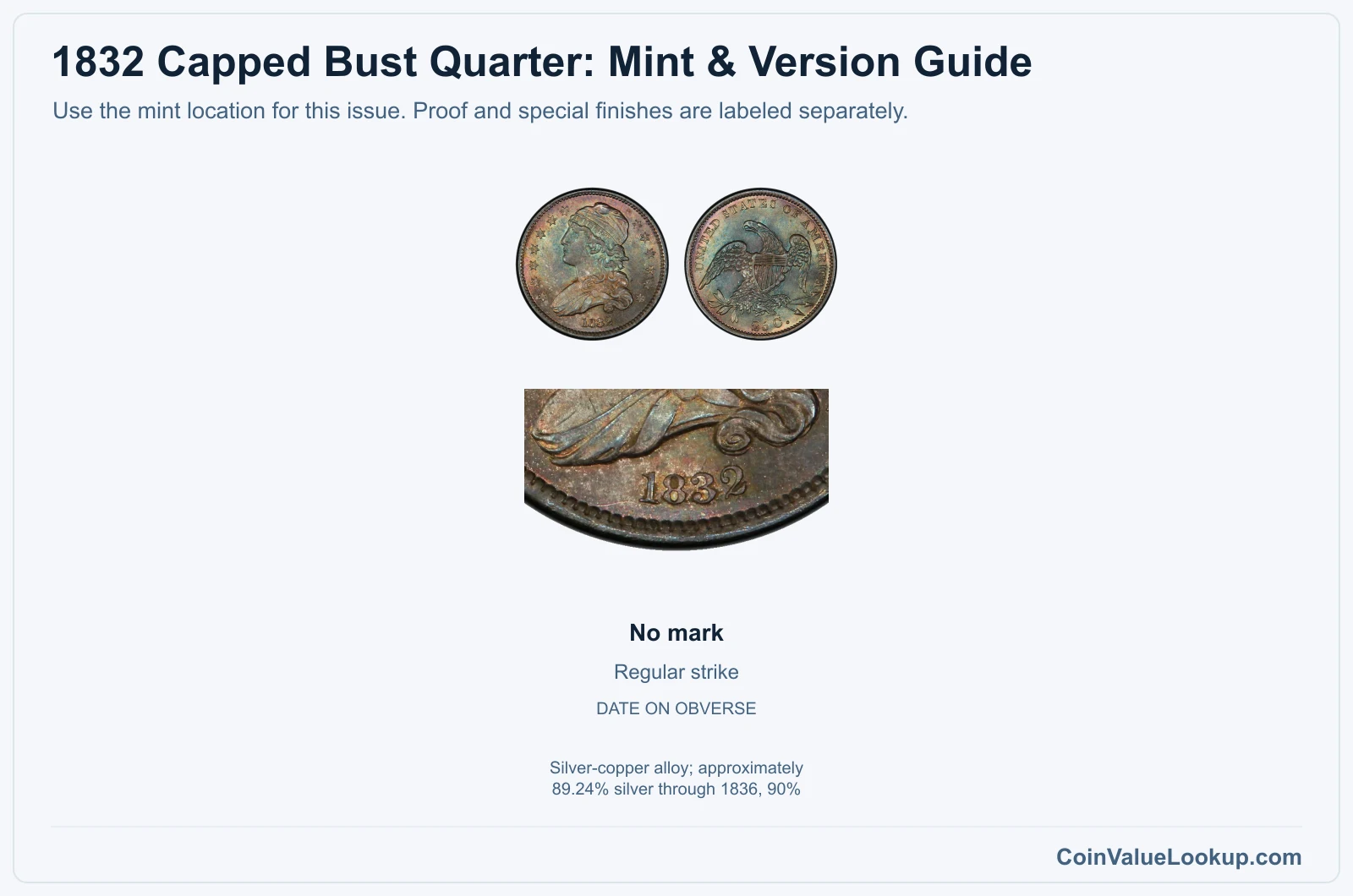
The 1832 Capped Bust quarter was struck at the Philadelphia Mint in a silver-copper alloy of approximately 89.24% silver. Guide estimates for this date range from about $132.00 in well-worn Good-4 condition to $4,951.00 for an uncirculated MS63 example, depending on the coin's preservation and surface quality.
Condition matters enormously here, so read on before assuming where yours falls.
Fast Way to Identify Your 1832 Capped Bust Quarter
The quickest way to get a preliminary identification of your 1832 quarter is to upload clear photos of both the front and back. Good lighting and a straight-on angle help capture the details that matter, like date clarity, surface condition, and any unusual features.
From there, you can start narrowing down what you have.
1832 Capped Bust Quarter Value
Upload both sides of your 1832 Capped Bust Quarter.
Front Obverse
Upload photo
Back Reverse
Upload photo
Which 1832 Capped Bust Quarter Versions Are Worth Money?
- 1832 Philadelphia business strike: USA Coin Book guide estimates reach $4,951.00 at the MS63 grade level, while a well-circulated Good-4 example lists around $132.00.
- Confirm original surfaces and accurate grade before assuming top-end value; cleaning or damage will significantly reduce what a coin brings.
Step 1: Identify Your 1832 Capped Bust Quarter Mint Mark and Version
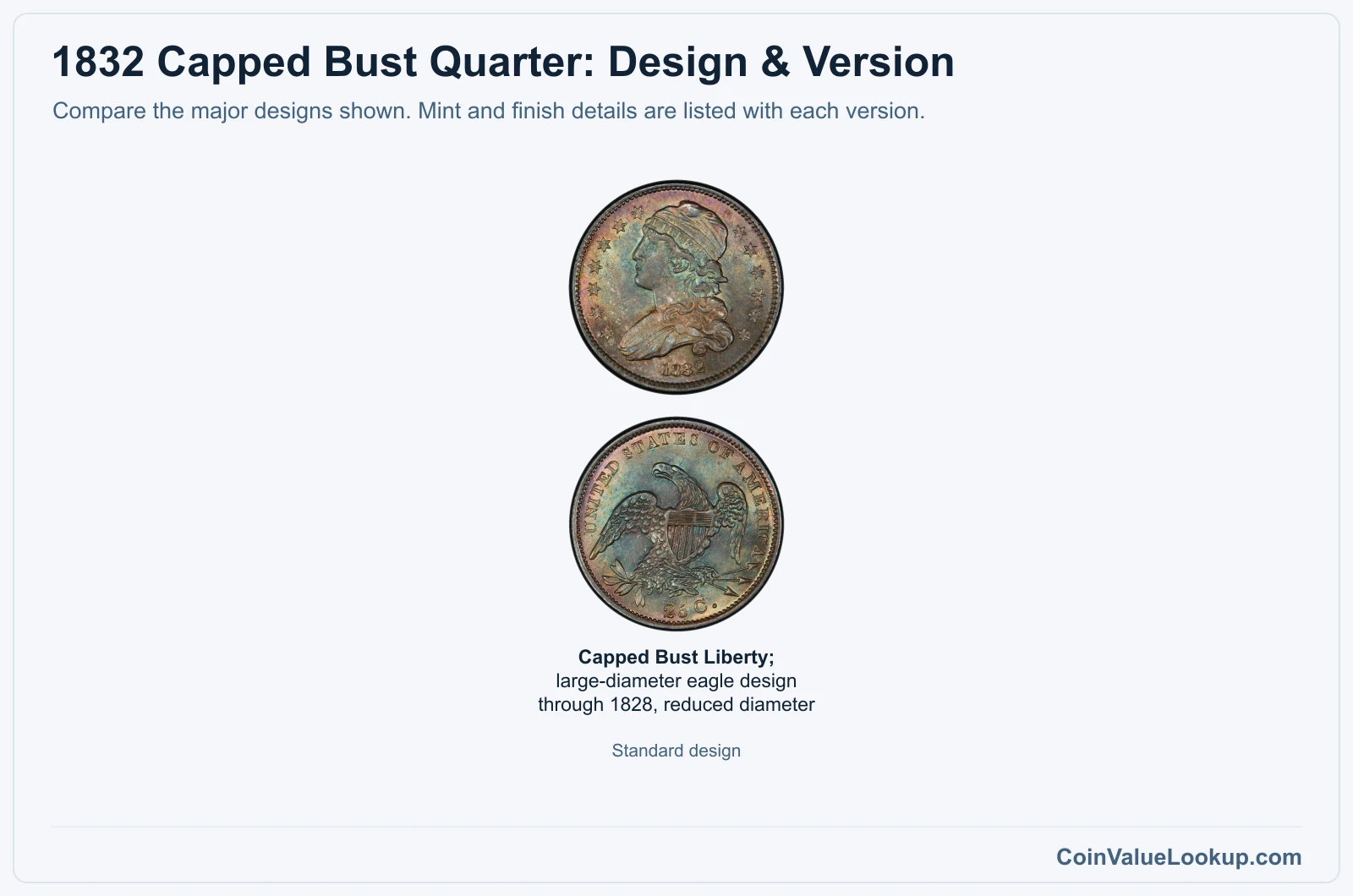
Every 1832 quarter was produced at the Philadelphia Mint, so there is no mintmark to look for. If you see a small letter beneath the eagle on the reverse, you may have a different coin entirely.
The obverse shows a capped Liberty facing left, with the date below. The reverse features a reduced-diameter eagle design without the motto E PLURIBUS UNUM, which distinguishes post-1830 Capped Bust quarters from the earlier, larger versions struck through 1828.
The coin is made of a silver-copper alloy, roughly 89.24% silver. It should have a silver-gray tone if original, though many survivors show varying degrees of natural toning.
A bright, shiny surface on a nearly 200-year-old coin usually signals cleaning, which is worth knowing before you compare values.
For this year there is one main business-strike version to evaluate. Match the design and date first, then turn your attention to grade.
Step 2: Check Your 1832 Capped Bust Quarter Grade
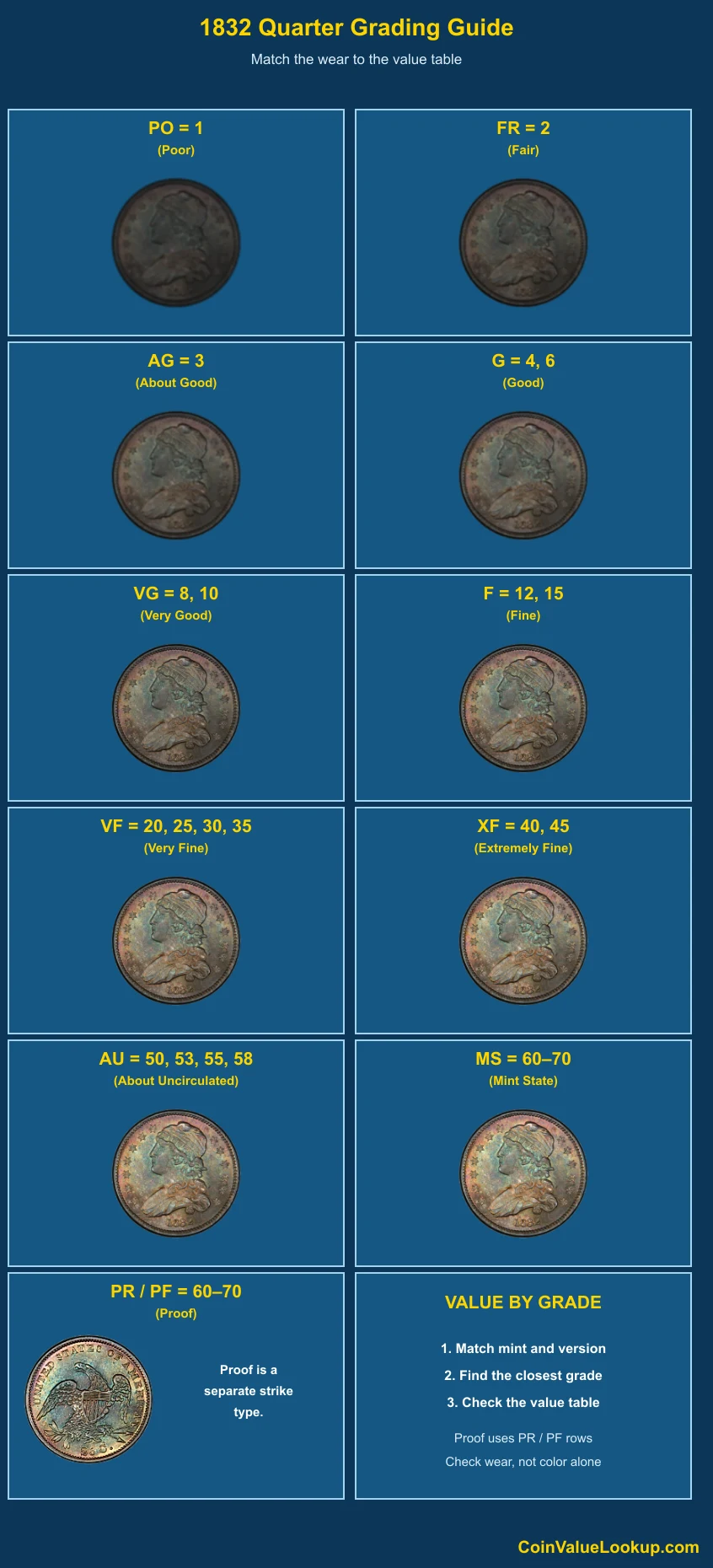
Focus on the hair above Liberty's ear and the folds of her cap on the obverse. These are the first areas to lose detail as the coin circulates.
On the reverse, check the eagle's breast feathers and the tops of the wings.
A coin grading Good-4 will show a full outline of Liberty and the eagle, but most fine detail is worn flat. By contrast, an MS60 coin retains full design detail and original mint luster, though it may show contact marks from jostling against other coins.
Strike weakness is a separate issue from wear. Some 1832 quarters left the press with soft detail in the hair curls or eagle feathers, even though they were never circulated.
Do not confuse a weak strike with heavy wear. Compare your coin's surfaces against known examples of the same type, paying attention to luster and the sharpness of the high points together.
Step 3: Check 1832 Capped Bust Quarter Value by Mint and Version
1832 Capped Bust Quarter
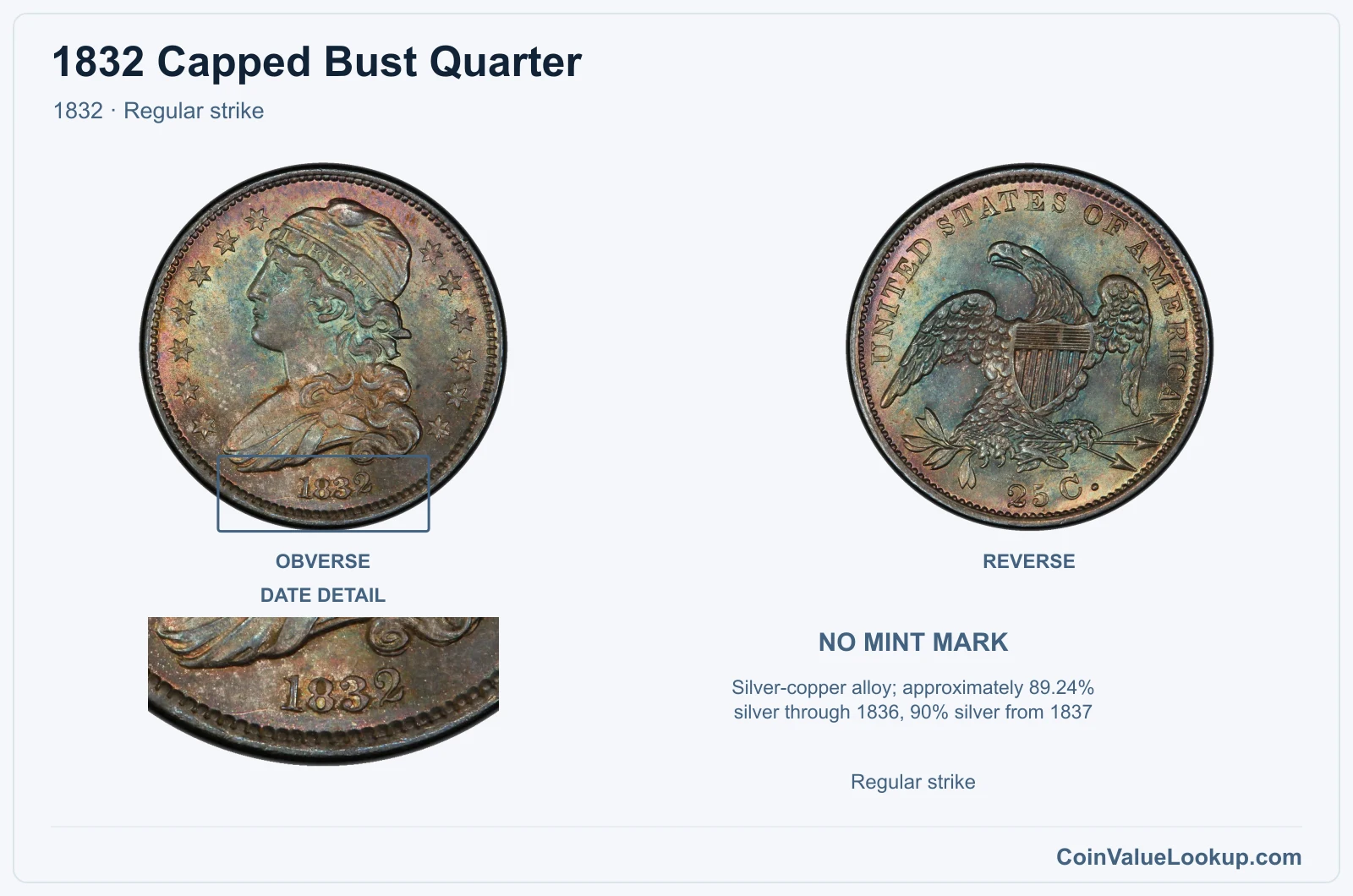
The 1832 quarter was struck only at Philadelphia with no mintmark. It uses the reduced-diameter Capped Bust design introduced in 1831, lacking the E PLURIBUS UNUM motto found on earlier types.
The coin is a silver-copper alloy of approximately 89.24% silver.
USA Coin Book guide estimates place this date at $132.00 in Good-4, $2,506.00 in MS60, and $4,951.00 in MS63. These are retail guide figures, not guaranteed sale prices.
Original surfaces matter a great deal with early silver. A coin that has been cleaned or damaged will trade well below these benchmarks even if the underlying wear level looks acceptable.
Coin Value Lookup is a good starting point if you want to compare guide values across other Capped Bust quarter dates or different denominations from the same era.
Range Grade
Price Auction Records Appraisal PO PO 1
—
Coin Identifier FR FR 2
—
Coin Identifier AG AG 3
—
Coin Identifier G G 4
—
Coin Identifier
G 6
—
Coin Identifier VG VG 8
Coin Identifier
VG 10
Coin Identifier F F 12
Coin Identifier
F 15
Coin Identifier VF VF 20
Coin Identifier
VF 25
Coin Identifier
VF 30
Coin Identifier
VF 35
Coin Identifier XF XF 40
Coin Identifier
XF 45
Coin Identifier AU AU 50
Coin Identifier
AU 53
Coin Identifier
AU 55
Coin Identifier
AU 58
Coin Identifier MS MS 60
Coin Identifier
MS 61
Coin Identifier
MS 62
Coin Identifier
MS 63
Coin Identifier
MS 64
Coin Identifier
MS 65
Coin Identifier
MS 66
—
—
—
MS 67
—
—
—
MS 68
—
—
—
MS 69
—
—
—
MS 70
—
—
—