1832 Capped Bust Dime Coin Value: How Much Is It Worth?
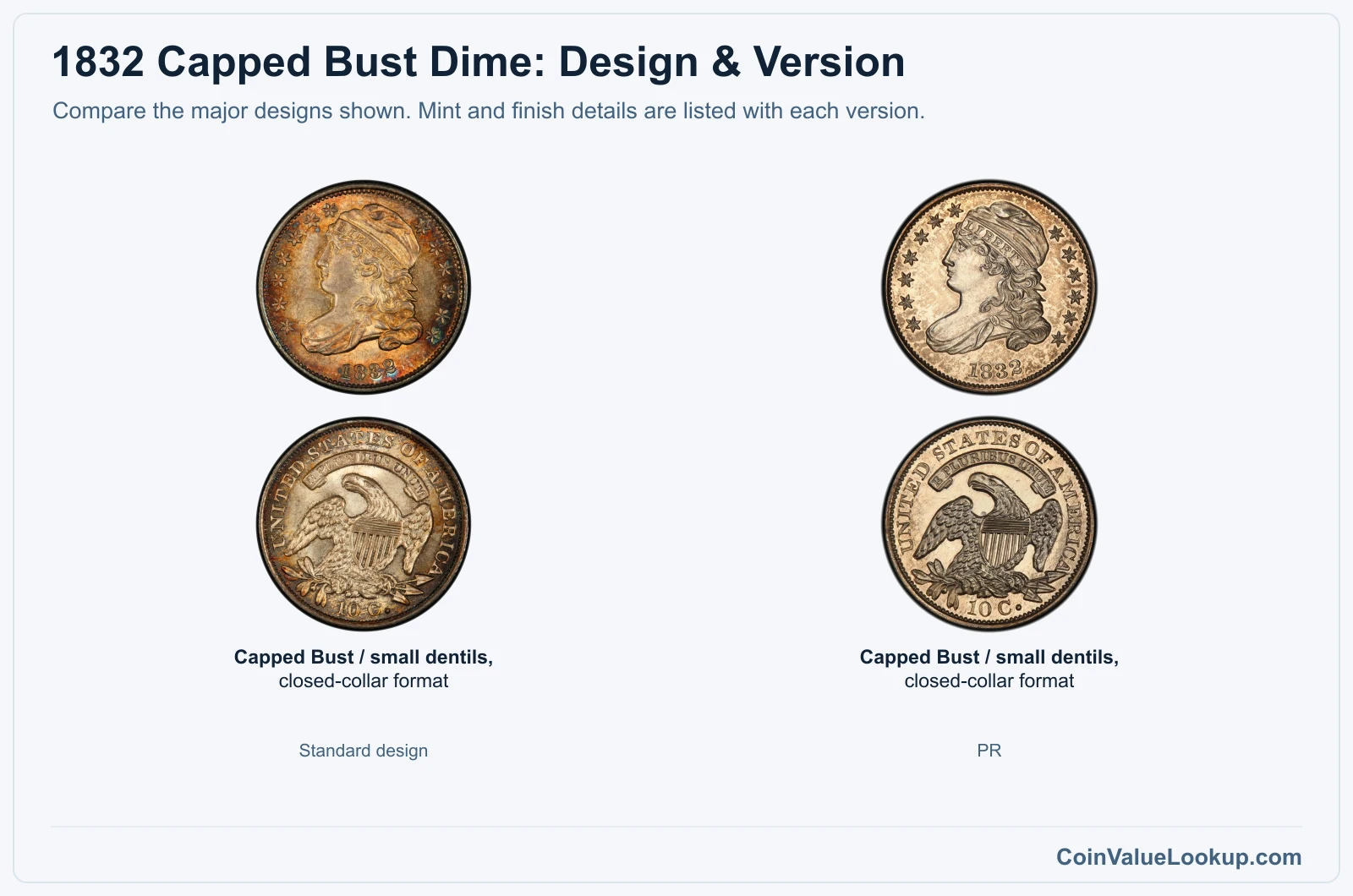
The 1832 Capped Bust Dime is an early American silver coin struck at the Philadelphia Mint, and it remains a popular target for collectors building type sets or early dime runs. Guide estimates for this date range from about $54.00 in Good-4 condition to around $2,344.00 at the MS63 level, depending on the exact branch and grade.
These anchors reflect specific published guide figures and are not guaranteed offers — your coin's actual design variety, wear and surface quality determine where it falls.
Fast Way to Identify Your 1832 Capped Bust Dime
If you have a coin you think might be an 1832 Capped Bust Dime, the quickest way to start is by uploading clear photos of both the front and back. This gives a preliminary identification based on the design, date and overall condition.
Sharp, well-lit images help distinguish details that matter for narrowing down what you have.
1832 Capped Bust Dime Value
Upload both sides of your 1832 Capped Bust Dime.
Front Obverse
Upload photo
Back Reverse
Upload photo
Which 1832 Capped Bust Dime Versions Are Worth Money?
- The 1832 business strike ranges from about $54.00 in G4 to $2,344.00 in MS63 per guide estimates — condition is the main driver of value.
- The 1832 Proof is extremely scarce early proof coinage; no standard guide price is adopted, so each example requires individual assessment by authenticated identity and condition.
- Die cracks and die breaks (cuds) have been reported on this date and can affect value depending on size, location and visibility.
- Always confirm your coin's branch and grade before comparing to any published figure; cleaning, scratches and corrosion reduce comparability to guide anchors.
Step 1: Identify Your 1832 Capped Bust Dime Mint Mark and Version
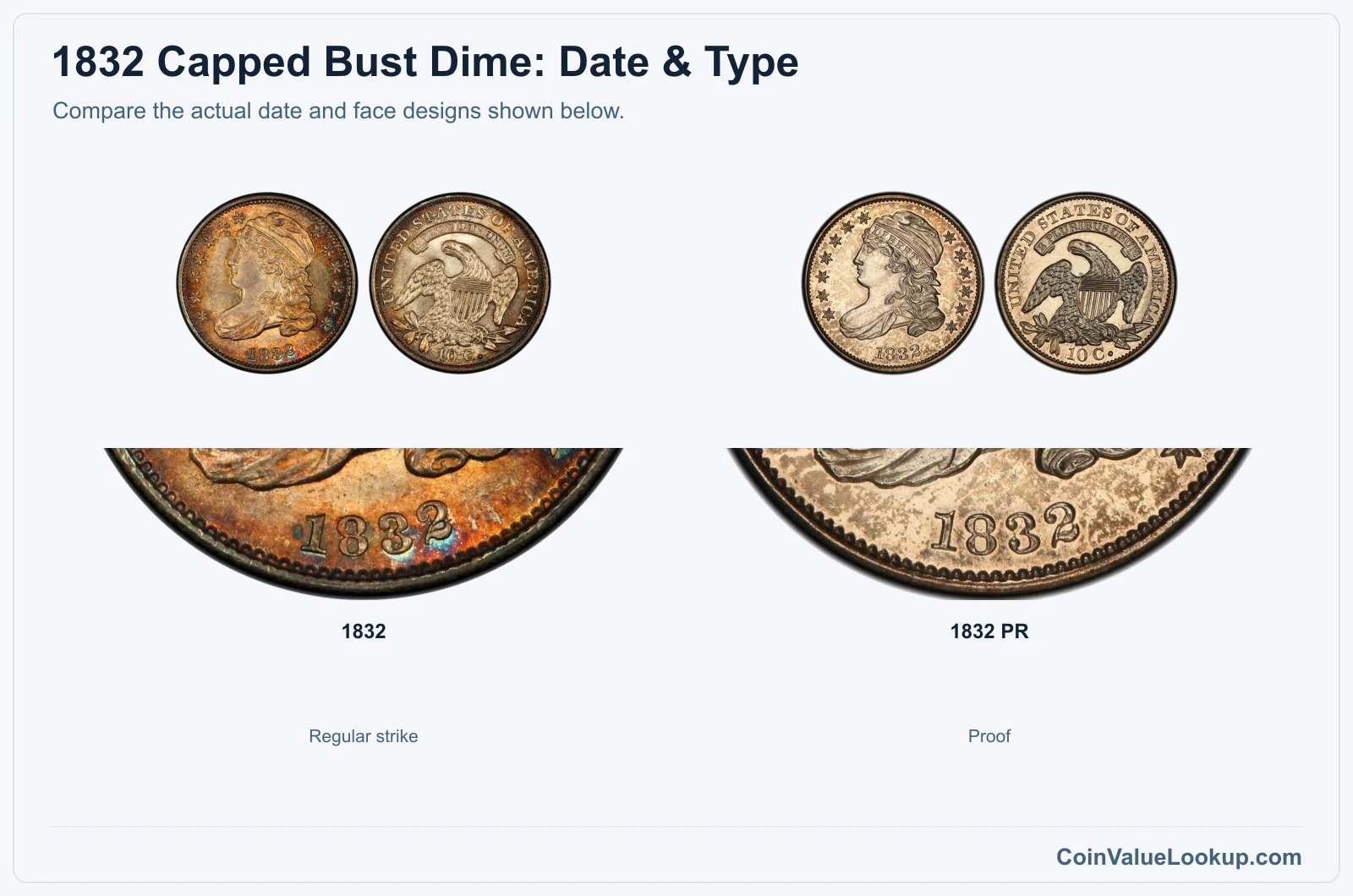
Every 1832 dime was struck at the Philadelphia Mint, so there is no mintmark to look for. The design uses the Capped Bust obverse with small dentils and a closed-collar format — this is the later style, distinct from the earlier wide-border type.
The coin is a silver-copper alloy, roughly 89.24% silver. It is noticeably smaller than a half dime's big brother the quarter, so make sure you are looking at a dime and not a half dime, which is a completely different denomination.
Two branches exist for this date: the regular 1832 business strike and the 1832 Proof. The proof is extremely scarce and requires professional attribution — a shiny or strongly struck circulation coin is not the same thing.
Confirm which branch you have before comparing values.
Step 2: Check Your 1832 Capped Bust Dime Grade
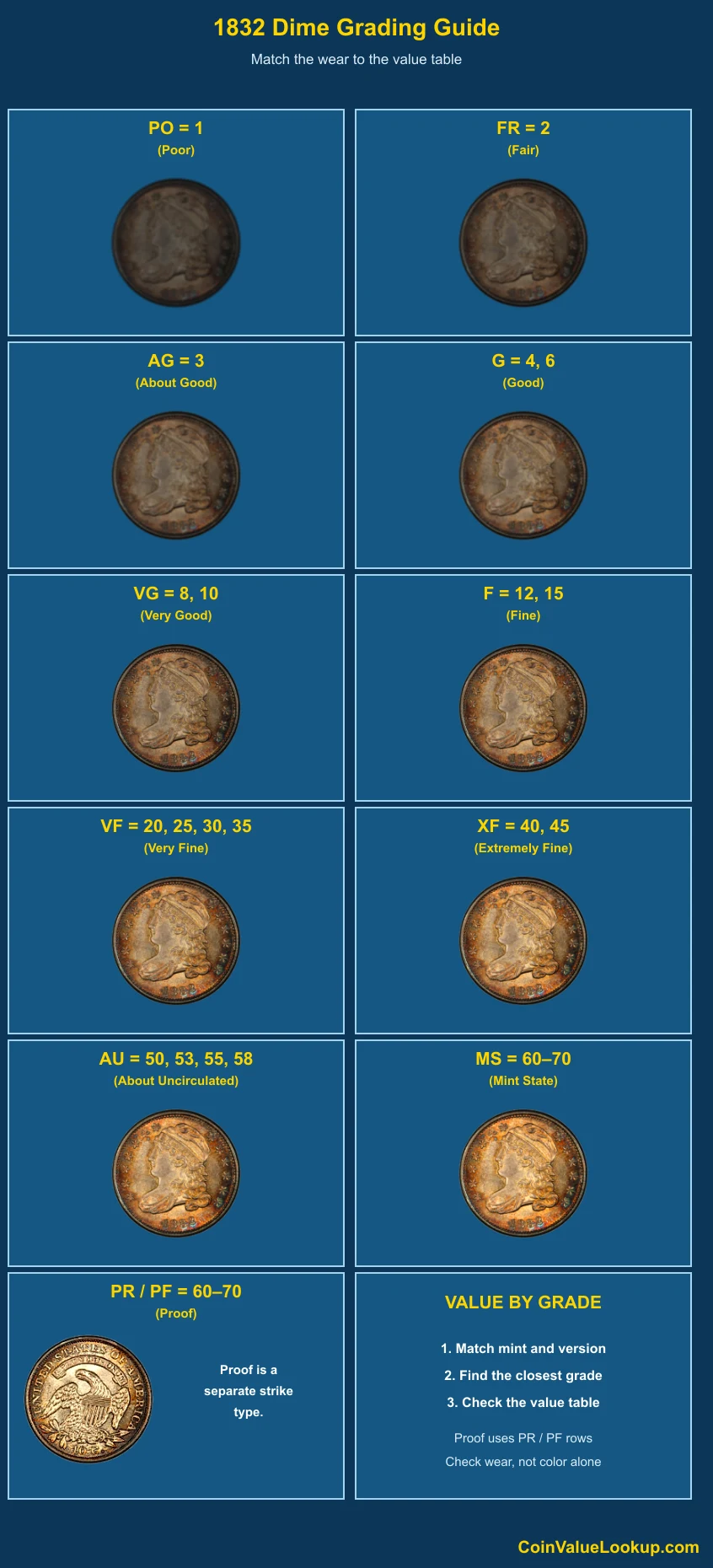
Start by examining the high points on Liberty's portrait: the hair curls above the forehead, the cheek, and the drapery near the cap. On the reverse, check the eagle's breast feathers and wing tips.
These areas lose detail first as a coin circulates.
Early dimes were struck on hand-operated presses, so even unworn coins can show uneven or weak details in spots. Do not confuse original strike weakness with wear.
Look at the overall luster and surface quality together.
Use the comparison image to match your coin's wear against known grade examples of the same type. Contact marks, hairlines and natural toning are all part of the picture.
Whatever you do, resist the urge to clean or polish the coin — original surfaces are far more desirable than a bright but damaged piece.
Coin Value Lookup is a helpful starting point if you want to look up guides for other early U.S. coins alongside this one. It covers a range of denominations and years.
Step 3: Check 1832 Capped Bust Dime Value by Mint and Version
1832 Capped Bust Dime
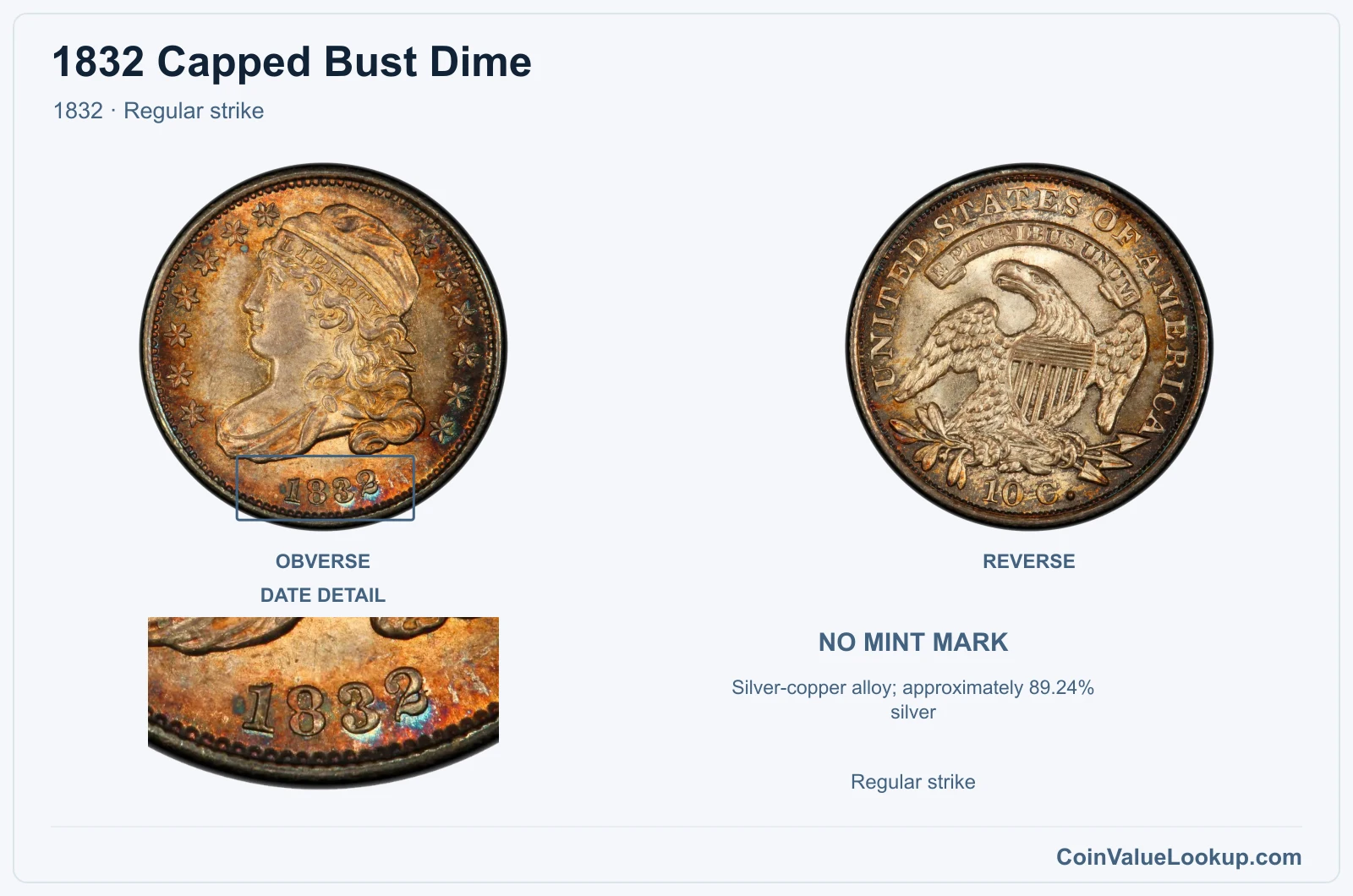
The regular 1832 Capped Bust Dime is a Philadelphia business strike on a silver-copper alloy planchet, about 89.24% silver. There is no mintmark.
Guide estimates place this coin at roughly $54.00 in Good-4 and up to around $2,344.00 in MS63. Those figures are published guide anchors, not guaranteed sale prices.
Before using any value table, match the date and the small-dentils closed-collar design. Original surfaces matter more than brightness — a coin that has been cleaned, scratched or corroded will not compare well to these grade benchmarks.
Actual wear and eye appeal drive what a buyer will pay.
Range Grade
Price Auction Records Appraisal PO PO 1
—
Coin Identifier FR FR 2
—
Coin Identifier AG AG 3
Coin Identifier G G 4
—
Coin Identifier
G 6
—
Coin Identifier VG VG 8
Coin Identifier
VG 10
Coin Identifier F F 12
Coin Identifier
F 15
Coin Identifier VF VF 20
Coin Identifier
VF 25
Coin Identifier
VF 30
Coin Identifier
VF 35
Coin Identifier XF XF 40
Coin Identifier
XF 45
Coin Identifier AU AU 50
Coin Identifier
AU 53
Coin Identifier
AU 55
Coin Identifier
AU 58
Coin Identifier MS MS 60
—
Coin Identifier
MS 61
Coin Identifier
MS 62
Coin Identifier
MS 63
Coin Identifier
MS 64
Coin Identifier
MS 65
Coin Identifier
MS 66
Coin Identifier
MS 67
Coin Identifier
MS 68
—
—
—
MS 69
—
—
—
MS 70
—
—
—
1832 Capped Bust Dime — PR
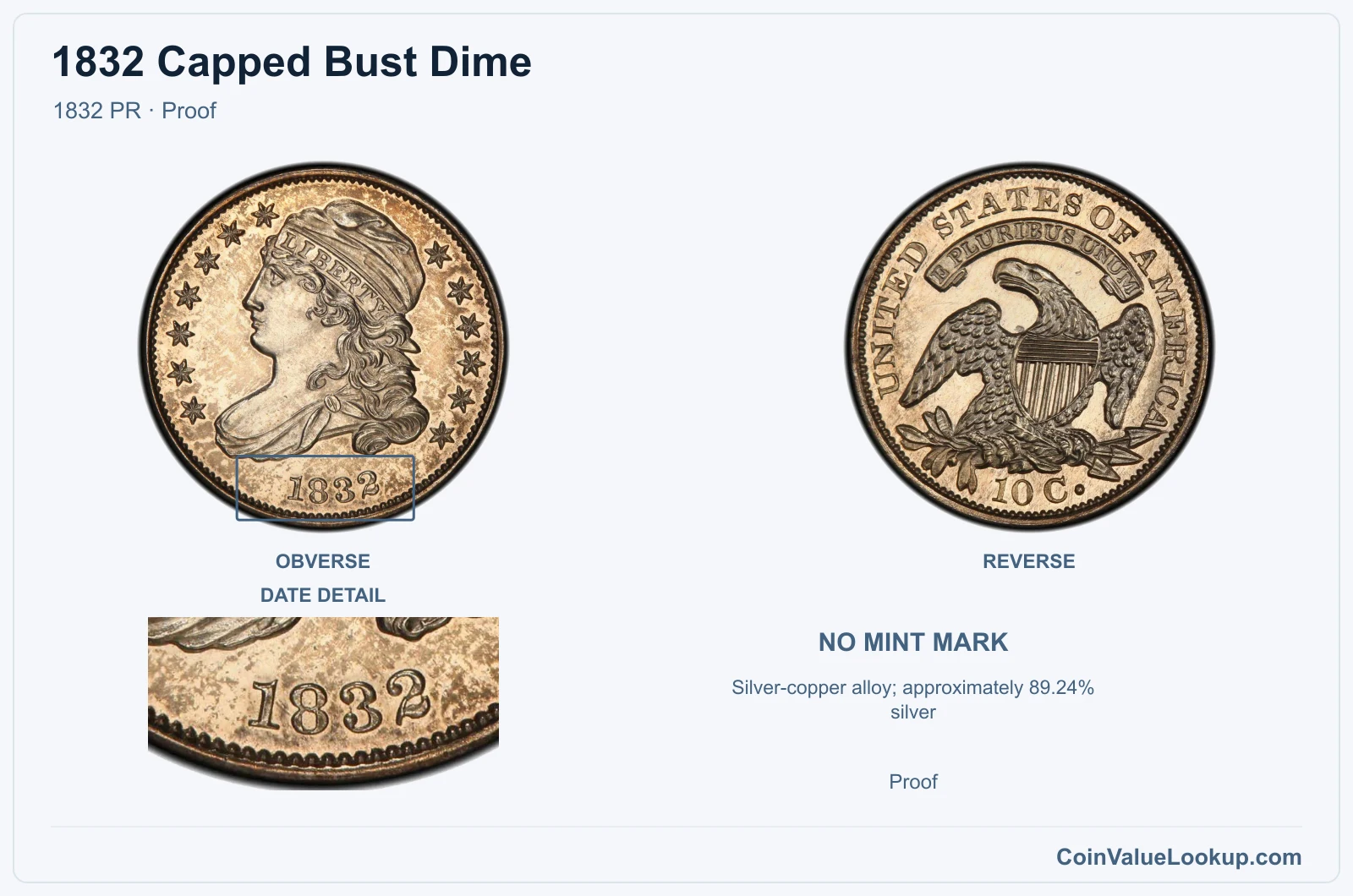
The 1832 Proof Capped Bust Dime is an extremely scarce product of early U.S. Mint proof manufacture. These were made in tiny quantities, likely for presentation or favored collectors, and surviving examples are rarely encountered.
No standard numeric guide price is adopted for this branch because each authenticated proof trades on its own merits — condition, provenance and surfaces all factor in. A reflective or strongly struck circulation coin is not automatically a proof; genuine proofs show deliberate die preparation and distinctive field characteristics that require professional attribution to confirm.
If you suspect you have a proof, the right move is third-party certification from a recognized grading service. Do not rely on appearance alone, and keep the coin's surfaces untouched in the meantime.
Range Grade
Price Auction Records Appraisal PR PR 1
—
Coin Identifier
PR 2
—
Coin Identifier
PR 3
—
Coin Identifier
PR 4
—
Coin Identifier
PR 6
—
Coin Identifier
PR 8
—
Coin Identifier
PR 10
—
Coin Identifier
PR 12
—
Coin Identifier
PR 15
—
Coin Identifier
PR 20
—
Coin Identifier
PR 25
—
Coin Identifier
PR 30
—
Coin Identifier
PR 35
—
Coin Identifier
PR 40
—
Coin Identifier
PR 45
—
Coin Identifier
PR 50
—
Coin Identifier
PR 53
—
Coin Identifier
PR 55
—
Coin Identifier
PR 58
—
Coin Identifier
PR 60
—
Coin Identifier
PR 61
—
Coin Identifier
PR 62
—
Coin Identifier
PR 63
—
Coin Identifier
PR 64
—
Coin Identifier
PR 65
—
—
—
PR 66
—
—
—
PR 67
—
—
—
PR 68
—
—
—
PR 69
—
—
—
PR 70
—
—
—
1832 Capped Bust Dime Error List
1. 1832 Capped Bust Dime — Die Crack / Die Chip
Die cracks appear as thin raised lines on a coin's surface, caused by fractures in the steel die during striking. On 1832 Capped Bust Dimes, these have been reported and can range from fine hairline cracks to broader ones with small raised blobs called die chips where a tiny piece of the die face has broken away.
Look for raised lines that follow no natural design element — they cut across fields, letters or portrait details in a way that regular design features do not. An interior die chip will appear as a small raised lump, usually within a letter or open field area.
Do not confuse die cracks with incuse scratches, corrosion lines or foreign material stuck to the surface. Scratches are recessed into the metal, while die cracks sit above it.
No specific price is adopted for this error; value depends on the crack's size, location and the coin's overall condition.
2. 1832 Capped Bust Dime — Die Break / Cud
A die break occurs when a larger section of the die fractures and falls away, leaving a raised, featureless blob on the struck coin. When this blob connects to the rim, it is called a cud — a flat or slightly rounded mass that replaces part of the normal design at the coin's edge.
On 1832 Capped Bust Dimes, die breaks and cuds have been reported. To identify one, look for a raised area with a clear boundary where normal design elements abruptly stop.
The displaced design portion will be missing underneath the blob.
Do not mistake rim damage from a hit or drop for a cud. Post-strike dents are pushed inward, while a cud is raised and was part of the striking process.
Corrosion buildup can also mimic a break at first glance. No specific price is adopted for this error; value depends on the break's prominence, location and the coin's overall grade and surfaces.