1820 Capped Bust Dime Coin Value: How Much Is It Worth?
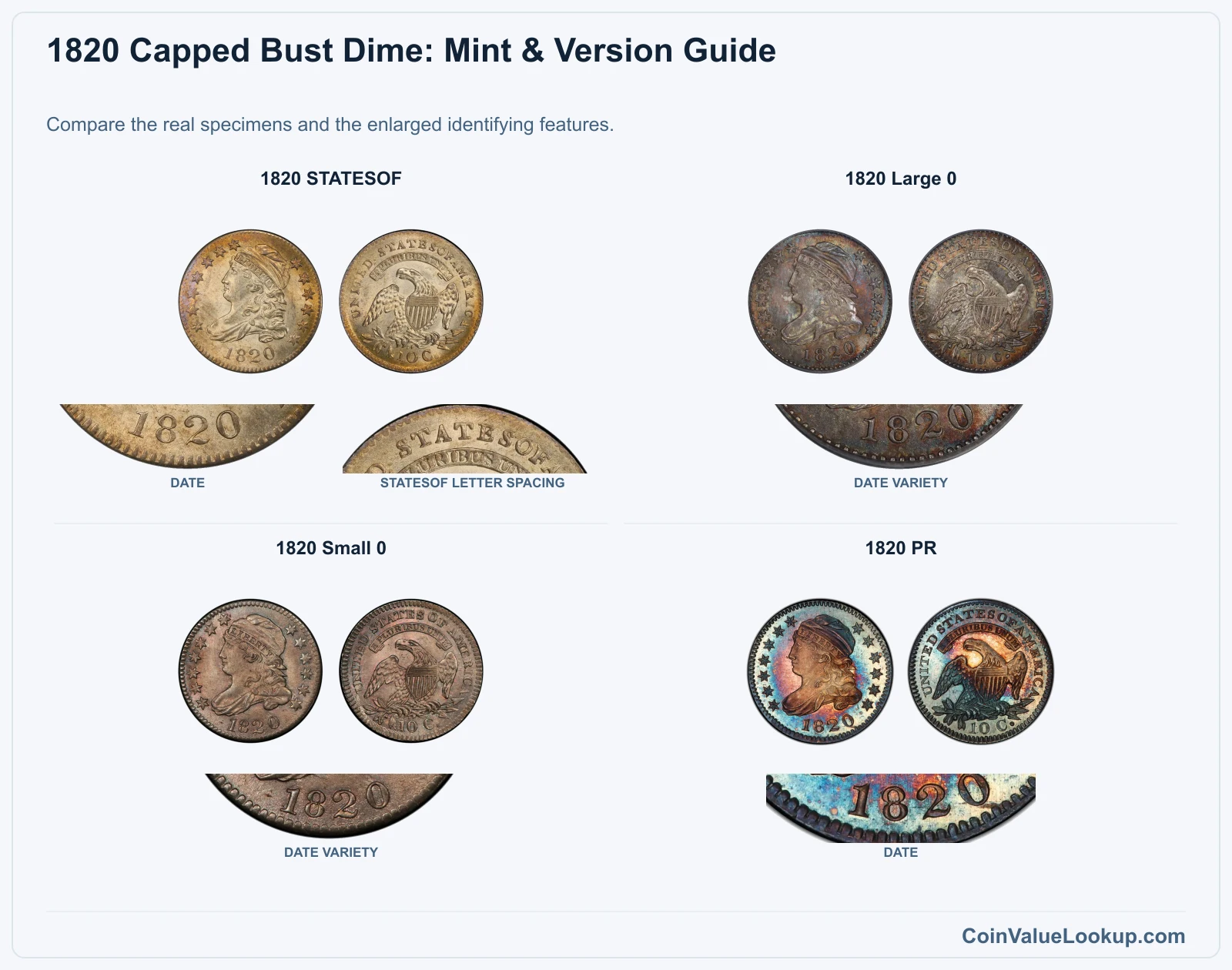
The 1820 Capped Bust Dime is one of the earlier silver dimes struck at the Philadelphia Mint, and it carries real collector appeal two centuries later. Guide estimates for this date range from about $95.00 in well-worn Good-4 condition up to around $9,334.00 for a choice Mint State example, depending on the specific variety and grade.
These anchors reflect particular branches and conditions — cleaning, damage or misidentified varieties will shift what any individual coin is actually worth.
Fast Way to Identify Your 1820 Capped Bust Dime
If you have an 1820 Capped Bust Dime and want a quick read on what you're holding, snap clear photos of both the front and back and upload them here. Our identifier can give you a preliminary take on which variety and approximate condition you might have, so you know where to start your research.
1820 Capped Bust Dime Value
Upload both sides of your 1820 Capped Bust Dime.
Front Obverse
Upload photo
Back Reverse
Upload photo
Which 1820 Capped Bust Dime Versions Are Worth Money?
- The 1820 STATESOF variety carries the highest guide anchor at this date, with estimates from $221.00 in G4 to $9,334.00 in MS63 — check the reverse letter spacing to confirm it.
- The 1820 Large 0 and Small 0 varieties both start around $95.00 in G4 but diverge at higher grades, with the Small 0 reaching about $4,249.00 in MS63 versus $3,636.00 for the Large 0.
- The 1820 Proof is extremely scarce early proof coinage with no adopted price range — individual assessment by an authentication service is essential.
- Repunched or blundered reverse letters have been reported on some 1820 dimes and can add a premium depending on visibility and condition.
Step 1: Identify Your 1820 Capped Bust Dime Mint Mark and Version
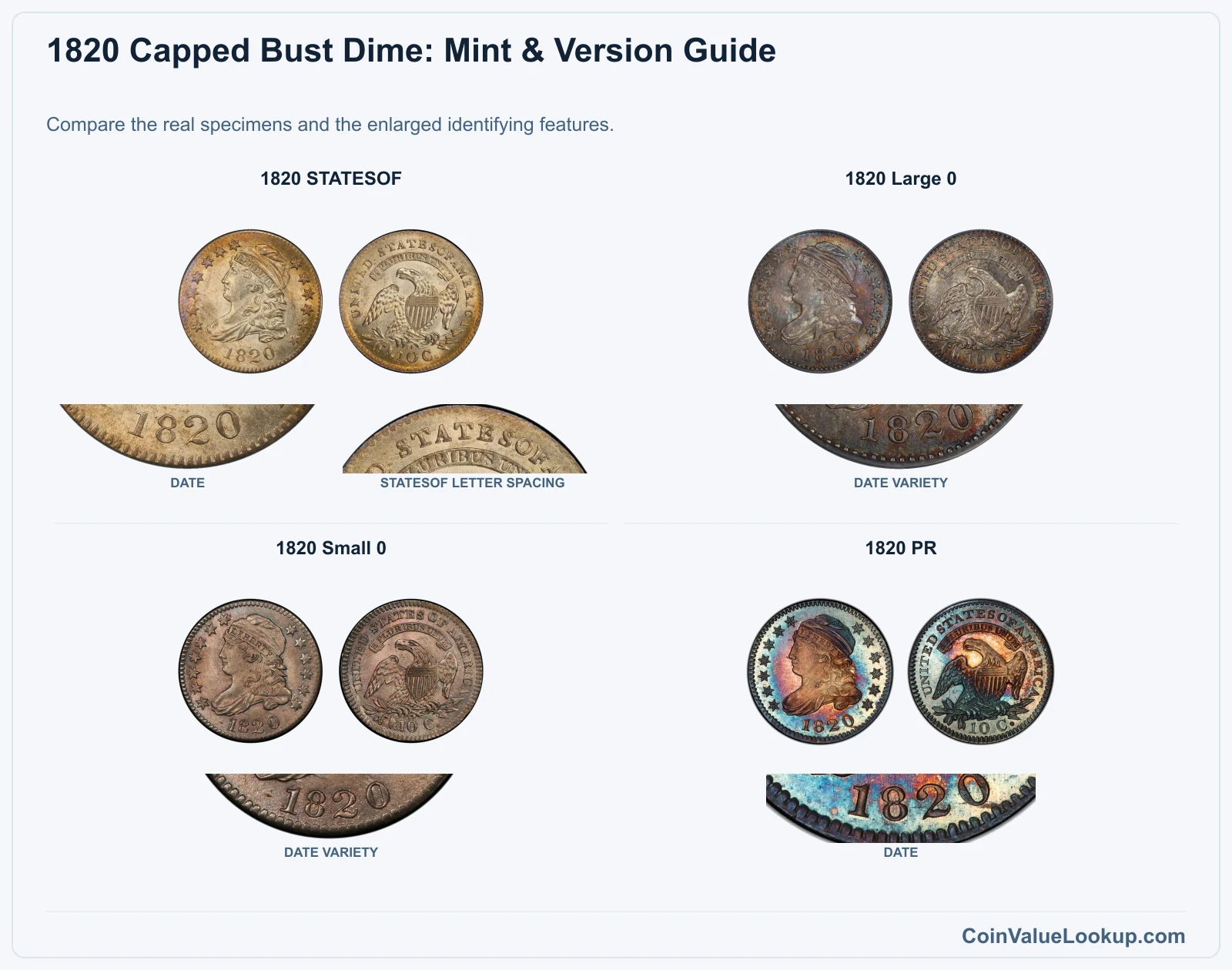
Every 1820 dime was struck in Philadelphia — there is no mintmark to look for. The coin is a silver-copper alloy, roughly 89.24% silver, with the Capped Bust design featuring large dentils and a wider planchet than later dimes.
Four branches exist for this date: the STATESOF variety, the Large 0, the Small 0, and the proof issue (1820 PR). Telling them apart matters because they carry different guide values.
For the STATESOF variety, flip the coin to the reverse and examine the spacing between STATES and OF in the legend. On this variety the two words nearly touch — it is a lettering quirk, not a missing-word error.
The Large 0 and Small 0 varieties refer to the size of the zero in the date. You need a correctly labeled comparison image of each digit style; zooming in on your own coin without a reference is unreliable.
Magnification alone does not establish the variety.
The proof version is extremely scarce early proof manufacture. A circulation strike that looks shiny or strongly detailed is not automatically a proof — only coins with confirmed proof attribution should be treated as such.
And remember, a half dime is a different, smaller denomination entirely; do not confuse the two.
Step 2: Check Your 1820 Capped Bust Dime Grade
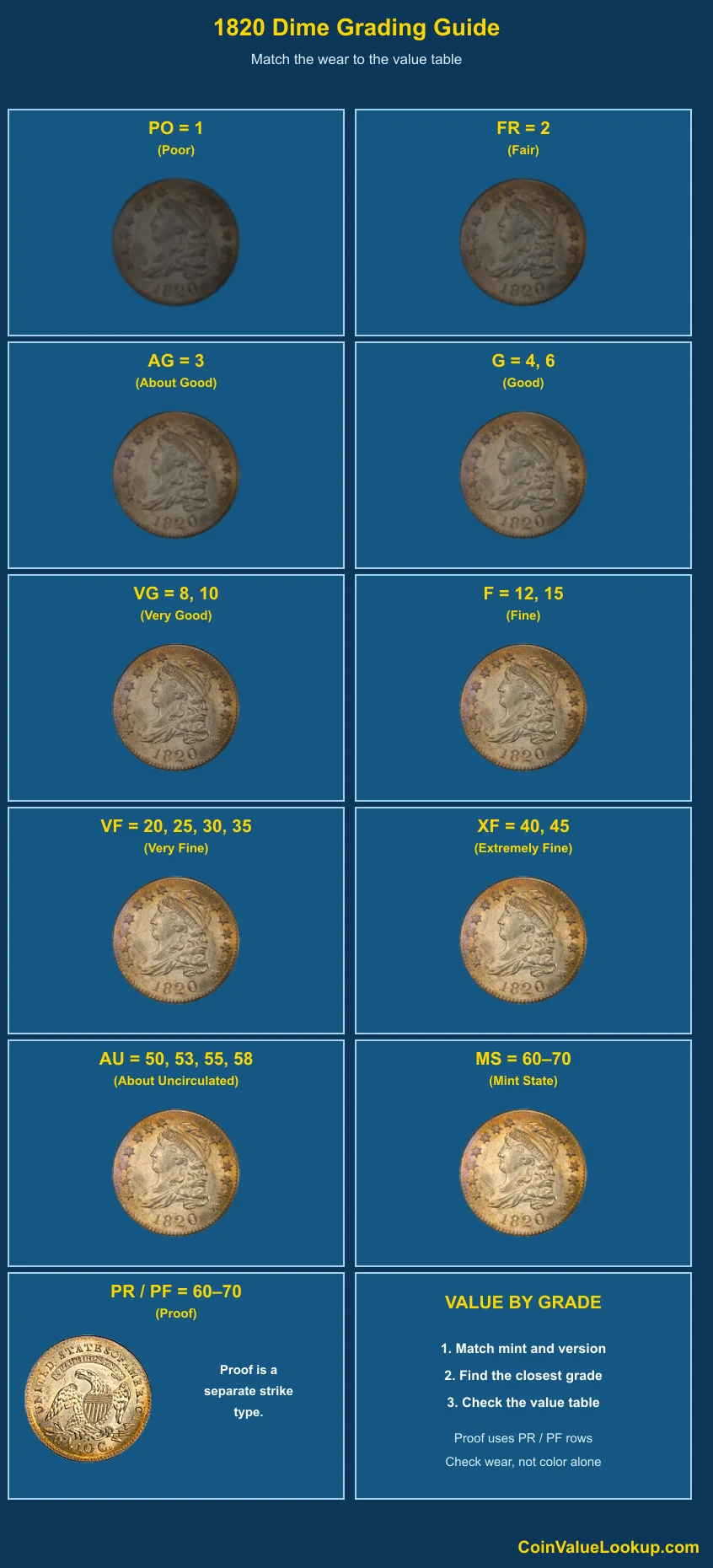
On the obverse, check Liberty's hair curls above the forehead, the smoothness of her cheek, and the detail in the cap and drapery folds near her shoulder. These are the first areas to lose definition as the coin wears.
On the reverse, look at the eagle's breast feathers and the tops of the wings. A coin in Good-4 will show a clear outline of Liberty and the eagle but most fine detail is gone.
A Mint State coin retains full hair and feather detail with original luster across the surfaces.
Early dimes were struck on hand-operated presses, so even an unworn coin can show uneven or weakly impressed areas. Do not mistake strike weakness for wear — check luster and contact marks alongside detail sharpness.
Use the comparison image to gauge where your coin sits on the wear scale.
One more thing: do not clean or polish the coin. Original surfaces, even if toned or a bit grimy, preserve value far better than a scrubbed, artificially bright appearance.
Step 3: Check 1820 Capped Bust Dime Value by Mint and Version
1820 Capped Bust Dime — STATESOF
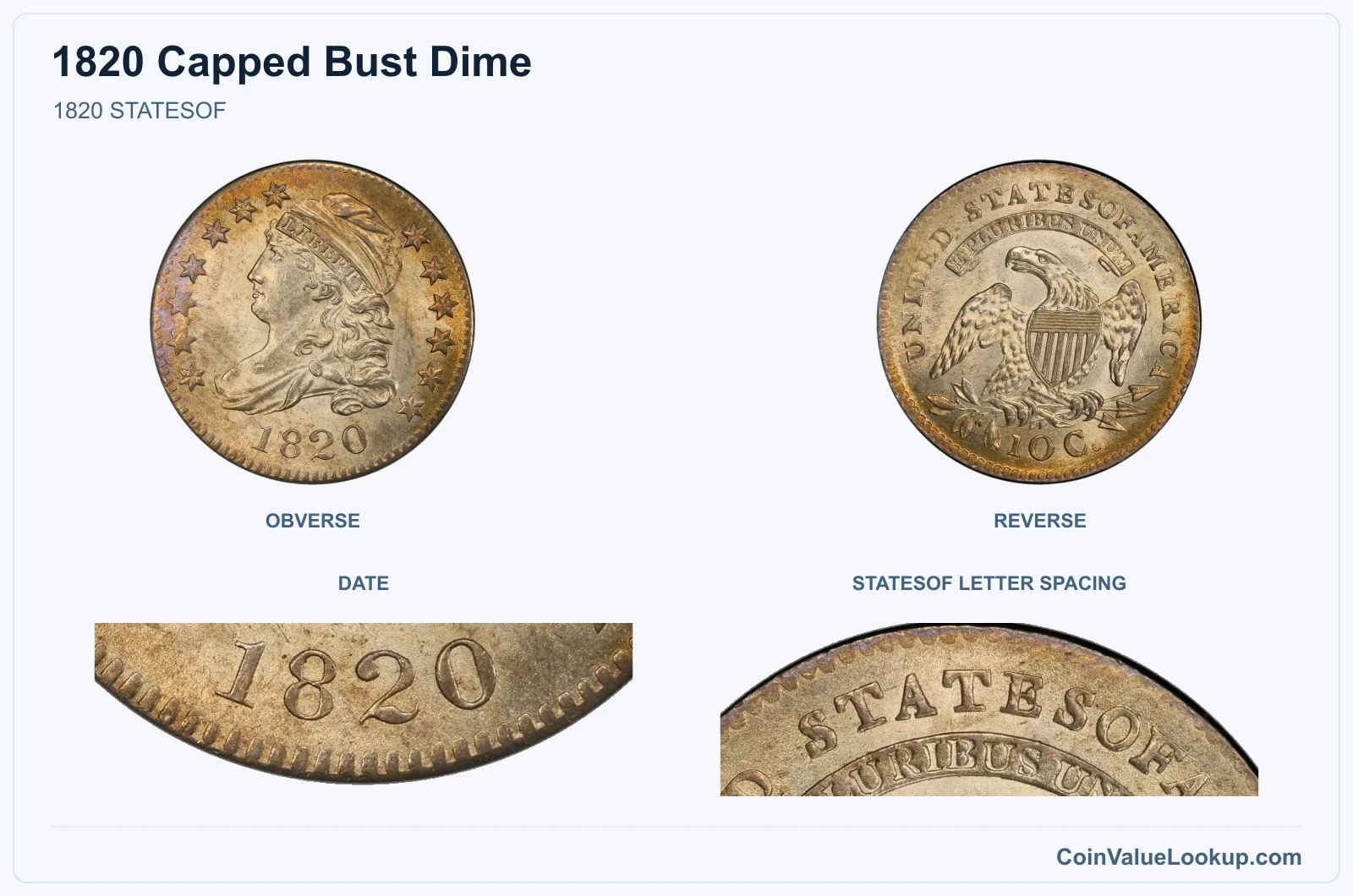
The STATESOF variety is identified on the reverse, where the words STATES and OF in the legend are spaced so closely they nearly merge into one word. This is a die-cutting quirk, not a dramatic error, but it creates a distinct collectible branch.
Guide estimates place this variety at about $221.00 in Good-4 and roughly $9,334.00 in MS63. That spread reflects how much condition matters on a 200-year-old coin.
Original, uncleaned surfaces with honest wear will always compare more favorably than a cleaned example of the same technical grade.
All 1820 dimes were struck in Philadelphia with no mintmark. Confirm the date, the Capped Bust large-dentil design, and the tight STATESOF spacing before using these anchors.
Range Grade
Price Auction Records Appraisal PO PO 1
—
Coin Identifier FR FR 2
—
Coin Identifier AG AG 3
—
Coin Identifier G G 4
Coin Identifier
G 6
—
Coin Identifier VG VG 8
—
Coin Identifier
VG 10
—
Coin Identifier F F 12
Coin Identifier
F 15
Coin Identifier VF VF 20
Coin Identifier
VF 25
Coin Identifier
VF 30
Coin Identifier
VF 35
Coin Identifier XF XF 40
Coin Identifier
XF 45
—
Coin Identifier AU AU 50
—
Coin Identifier
AU 53
—
Coin Identifier
AU 55
Coin Identifier
AU 58
Coin Identifier MS MS 60
—
Coin Identifier
MS 61
—
Coin Identifier
MS 62
Coin Identifier
MS 63
Coin Identifier
MS 64
Coin Identifier
MS 65
Coin Identifier
MS 66
Coin Identifier
MS 67
—
—
—
MS 68
—
—
—
MS 69
—
—
—
MS 70
—
—
—
1820 Capped Bust Dime — Large 0
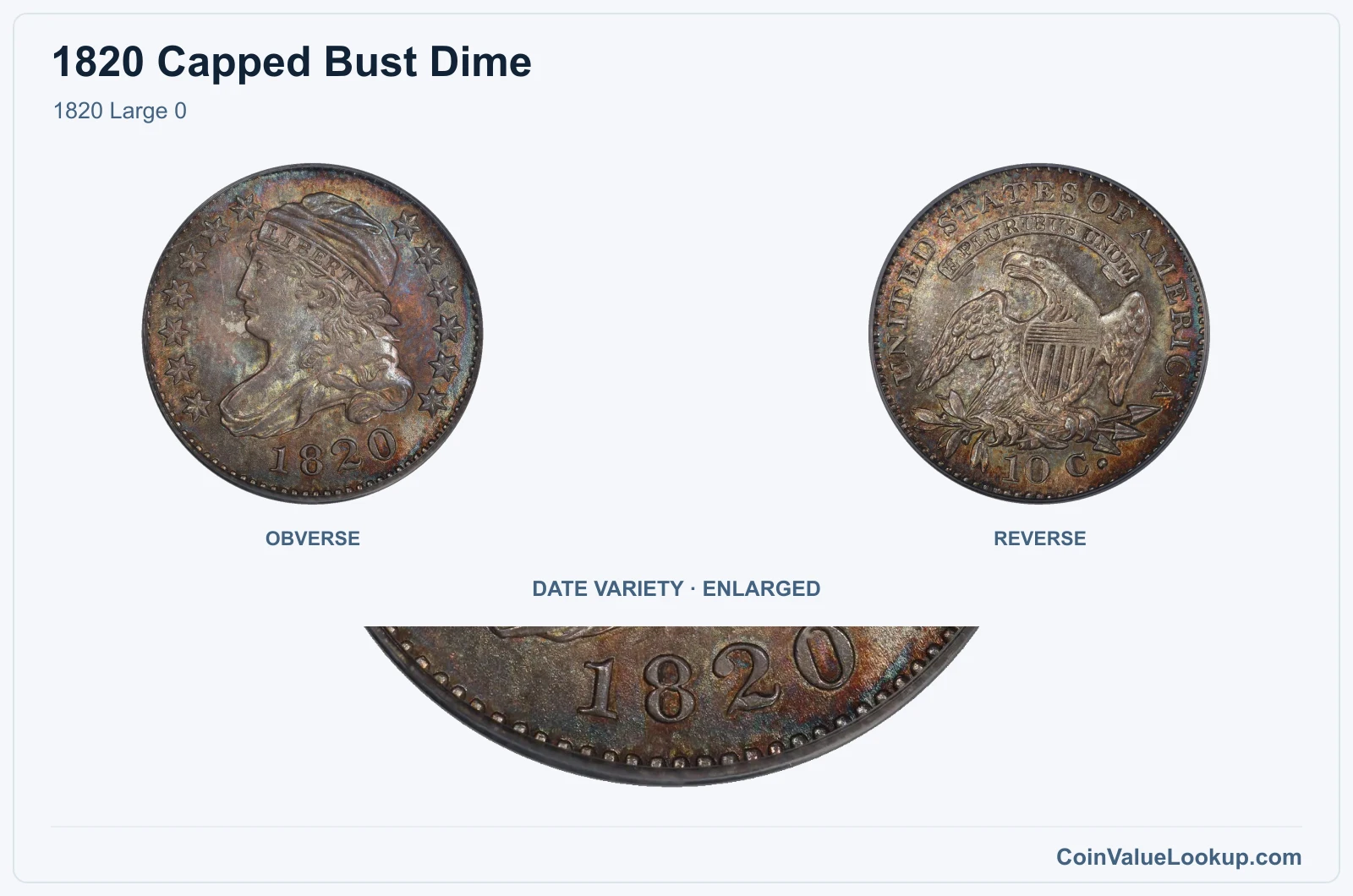
The Large 0 variety refers to the size of the zero in the 1820 date on the obverse. You need a side-by-side labeled reference to distinguish this from the Small 0 — the difference is real but subtle, and simply zooming in on a photo can mislead you.
Guide estimates run from about $95.00 in Good-4 to around $3,636.00 in MS63. These are guide anchors, not guaranteed sale prices.
Coin Value Lookup is a good starting point if you want to look up other dates or denominations in the Capped Bust series. It can help you compare values across years without hunting through multiple sources.
Range Grade
Price Auction Records Appraisal PO PO 1
Coin Identifier FR FR 2
Coin Identifier AG AG 3
Coin Identifier G G 4
—
Coin Identifier
G 6
—
Coin Identifier VG VG 8
Coin Identifier
VG 10
—
Coin Identifier F F 12
Coin Identifier
F 15
Coin Identifier VF VF 20
Coin Identifier
VF 25
Coin Identifier
VF 30
Coin Identifier
VF 35
Coin Identifier XF XF 40
Coin Identifier
XF 45
Coin Identifier AU AU 50
Coin Identifier
AU 53
Coin Identifier
AU 55
Coin Identifier
AU 58
Coin Identifier MS MS 60
—
Coin Identifier
MS 61
—
Coin Identifier
MS 62
Coin Identifier
MS 63
Coin Identifier
MS 64
Coin Identifier
MS 65
Coin Identifier
MS 66
Coin Identifier
MS 67
—
Coin Identifier
MS 68
Coin Identifier
MS 69
—
—
—
MS 70
—
—
—
1820 Capped Bust Dime — Small 0
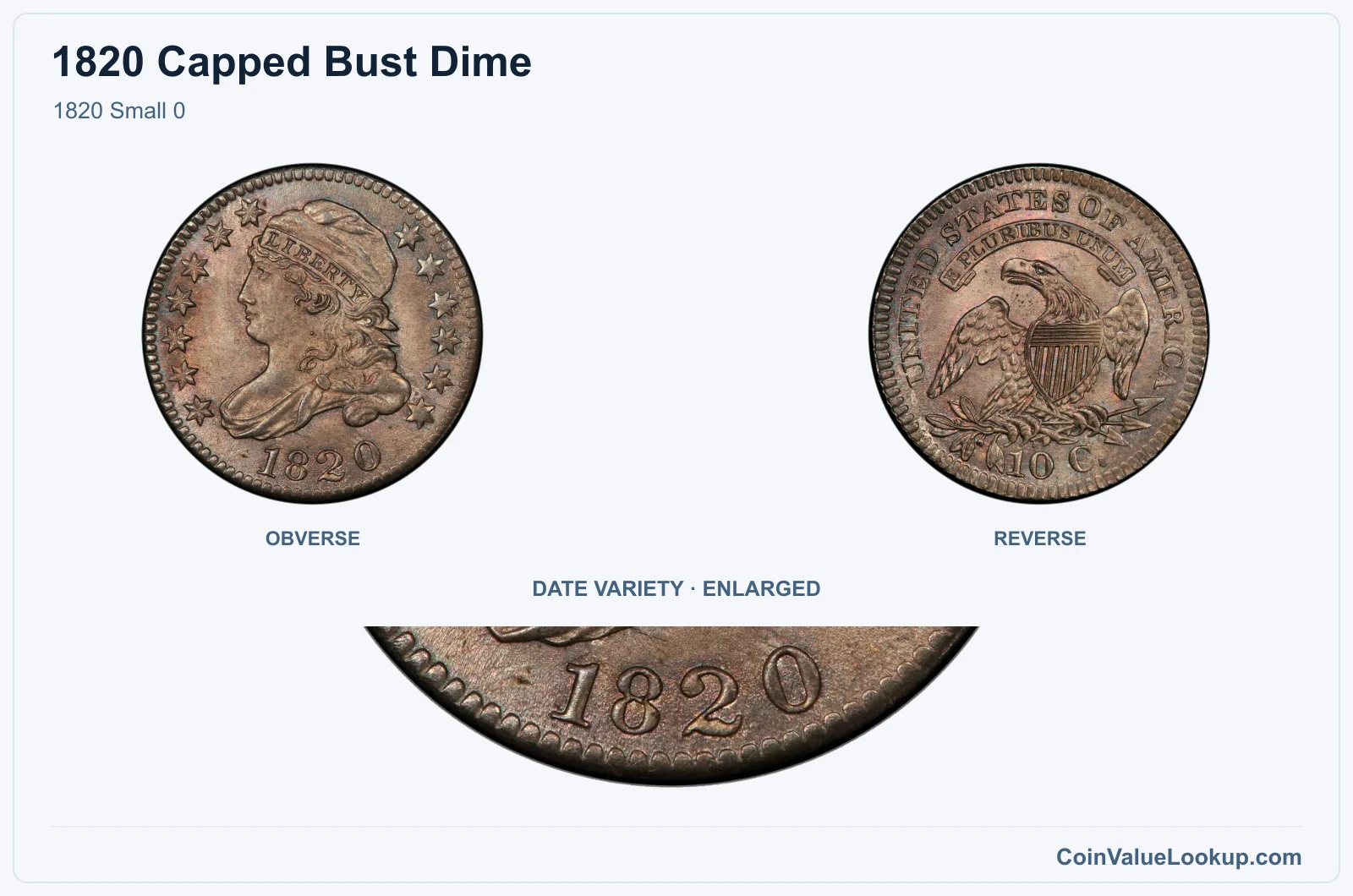
The Small 0 variety is the counterpart to the Large 0, with a noticeably smaller zero digit in the date. Again, use a properly labeled comparison — screen magnification by itself is not enough to pin down which version you have.
Guide estimates start at about $95.00 in Good-4, similar to the Large 0 variety. But in MS63 condition the Small 0 reaches approximately $4,249.00, a meaningful step above its Large 0 sibling at the same grade.
That difference makes correct variety attribution worthwhile if your coin is in higher condition.
As with all 1820 dimes, Philadelphia struck these with no mintmark. Surfaces matter: original toning and luster trump artificial brightness every time.
Range Grade
Price Auction Records Appraisal PO PO 1
—
Coin Identifier FR FR 2
—
Coin Identifier AG AG 3
Coin Identifier G G 4
Coin Identifier
G 6
Coin Identifier VG VG 8
Coin Identifier
VG 10
Coin Identifier F F 12
Coin Identifier
F 15
Coin Identifier VF VF 20
Coin Identifier
VF 25
Coin Identifier
VF 30
Coin Identifier
VF 35
Coin Identifier XF XF 40
Coin Identifier
XF 45
Coin Identifier AU AU 50
Coin Identifier
AU 53
Coin Identifier
AU 55
Coin Identifier
AU 58
Coin Identifier MS MS 60
—
Coin Identifier
MS 61
Coin Identifier
MS 62
Coin Identifier
MS 63
Coin Identifier
MS 64
Coin Identifier
MS 65
Coin Identifier
MS 66
Coin Identifier
MS 67
—
Coin Identifier
MS 68
—
—
—
MS 69
—
—
—
MS 70
—
—
—
1820 Capped Bust Dime — PR
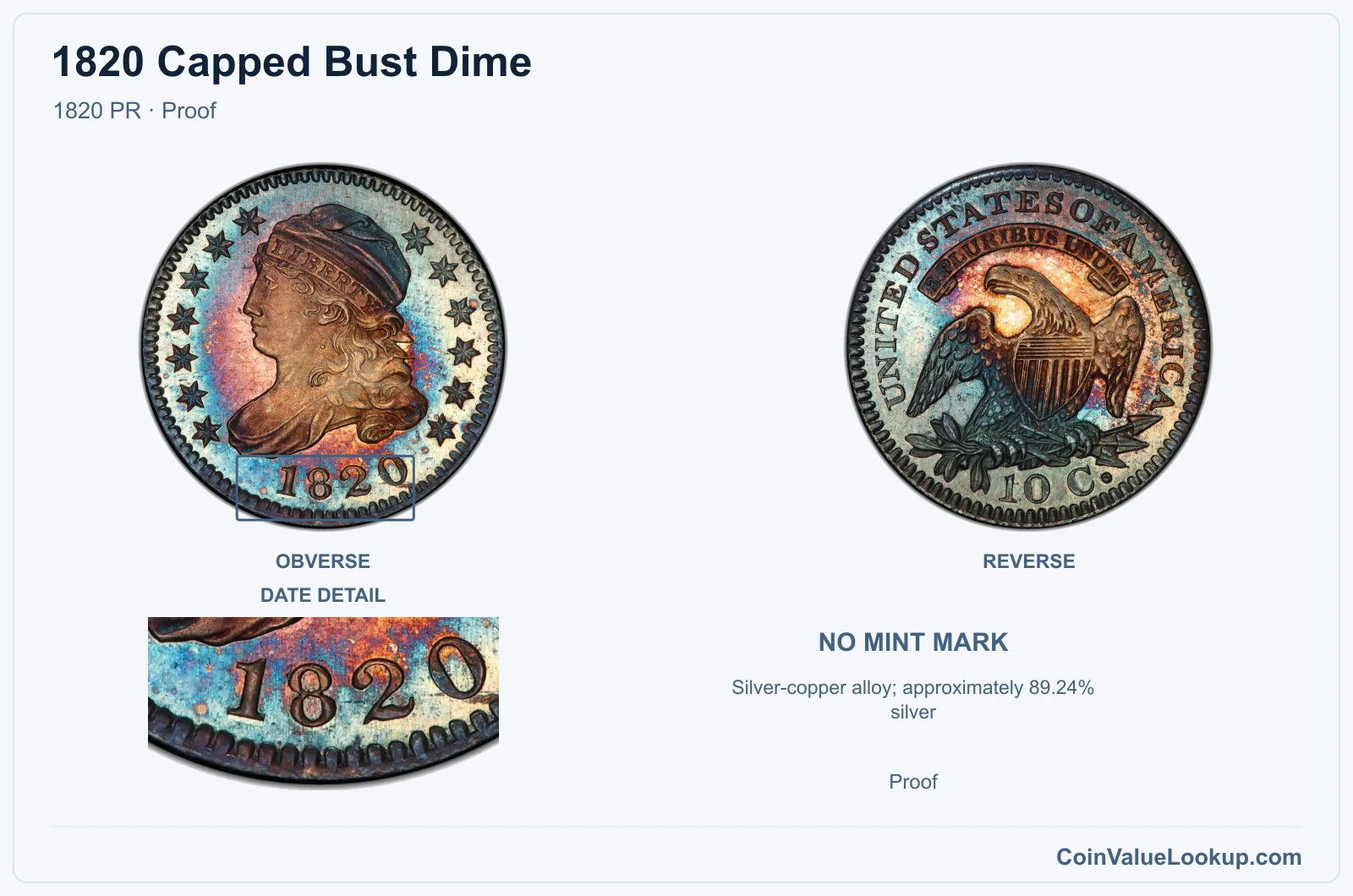
The 1820 Proof is an extremely scarce product of early Philadelphia Mint proof manufacture. Proof is a method of production — mirror-like fields, sharp rims, carefully prepared dies — not a grade above Mint State.
No numerical price range has been adopted for this version. Each surviving example needs individual assessment based on its authenticated identity, preservation and any die characteristics.
A coin that simply looks reflective, well-struck or unusually bright from the 1820 production run is not necessarily a proof. Only specimens with confirmed proof attribution from a recognized authentication service should be evaluated on proof terms.
If you suspect you have one, professional authentication is the only responsible next step.
1820 Capped Bust Dime Proof Value by Grade
Reliable grade-by-grade prices are not currently available. The current price feed has no usable grade-by-grade values for this early Proof. Surviving specimens require individual assessment using authenticated provenance and comparable auction sales.
1820 Capped Bust Dime Error List
1. 1820 Capped Bust Dime — Repunched / Blundered Reverse Letters
Some 1820 Capped Bust Dimes have been reported with repunched or blundered letters on the reverse legend. This shows up as doubled or irregular outlines on individual letters — essentially traces of a first impression that did not align perfectly with the final punch position on the die.
To spot it, compare the reverse lettering of your coin against a normal example. Look for ghost outlines, thickened serifs, or slightly offset secondary images within specific letters.
Not every letter will be affected; the anomaly is usually confined to a few characters.
Do not confuse repunched letters with a doubled die, which involves the entire design. Wear, post-strike scratches, and wishful attribution can also mimic the look.
No numerical price has been adopted for this feature, but condition, the clarity of the repunching, and the specific letters involved all factor into how much additional interest it generates among variety collectors.