1878 Liberty Seated Dime Coin Value: How Much Is It Worth?
The 1878 Liberty Seated Dime spans a broad retail-guide range from about $22 at G4 for a Philadelphia issue up to roughly $3,432 at MS63 for a Carson City piece, according to USA Coin Book estimates. Only Philadelphia and Carson City struck regular dimes this year — there is no genuine 1878-S issue.
Both mints produced coins with Type I and Type II reverses, and 1878 marks the final year Carson City made dimes.
Fast Way to Identify Your 1878 Liberty Seated Dime
The quickest way to start figuring out what your 1878 dime might be worth is to upload clear photos of the front and back. Our identifier can give you a preliminary read on which mint and reverse type you have.
That alone narrows things down considerably, since a Carson City coin lives in a different price universe than a Philadelphia one.
1878 Liberty Seated Dime Value
Upload both sides of your 1878 Liberty Seated Dime.
Front Obverse
Upload photo
Back Reverse
Upload photo
Which 1878 Liberty Seated Dime Versions Are Worth Money?
- Carson City (CC) dimes from 1878 are the last CC dimes ever struck, making them scarce at any grade — guide values start around $316 at G4.
- The Type I versus Type II reverse distinction applies to both Philadelphia and Carson City coins; check the ribbon end and the spacing of E in ONE.
- Philadelphia Proof dimes with the Type II Reverse carry a guide value near $725 at PR63, reflecting their limited mintage as collector pieces.
- Repunched dates and doubled die reverses have been reported for 1878 and can add a premium depending on visibility and condition.
Step 1: Identify Your 1878 Liberty Seated Dime Mint Mark and Version
First, confirm you actually have a Liberty Seated Dime and not a half dime. The obverse shows a seated Liberty figure; the reverse reads ONE DIME inside an agricultural wreath.
The date 1878 sits below Liberty on the obverse.
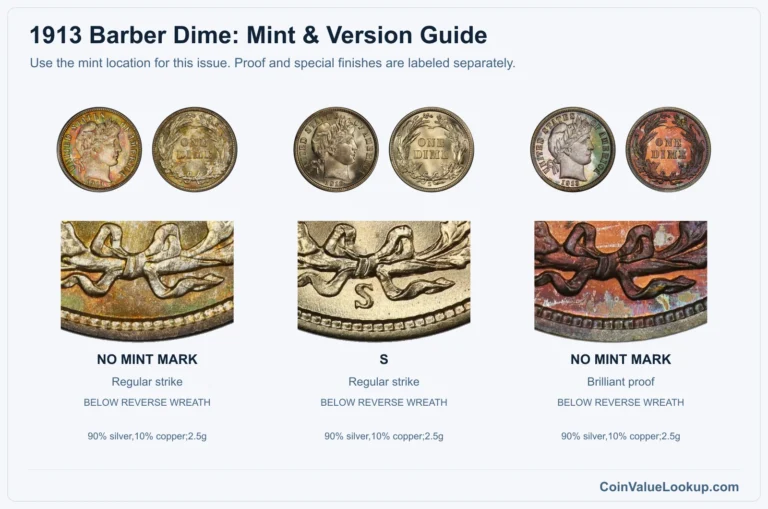
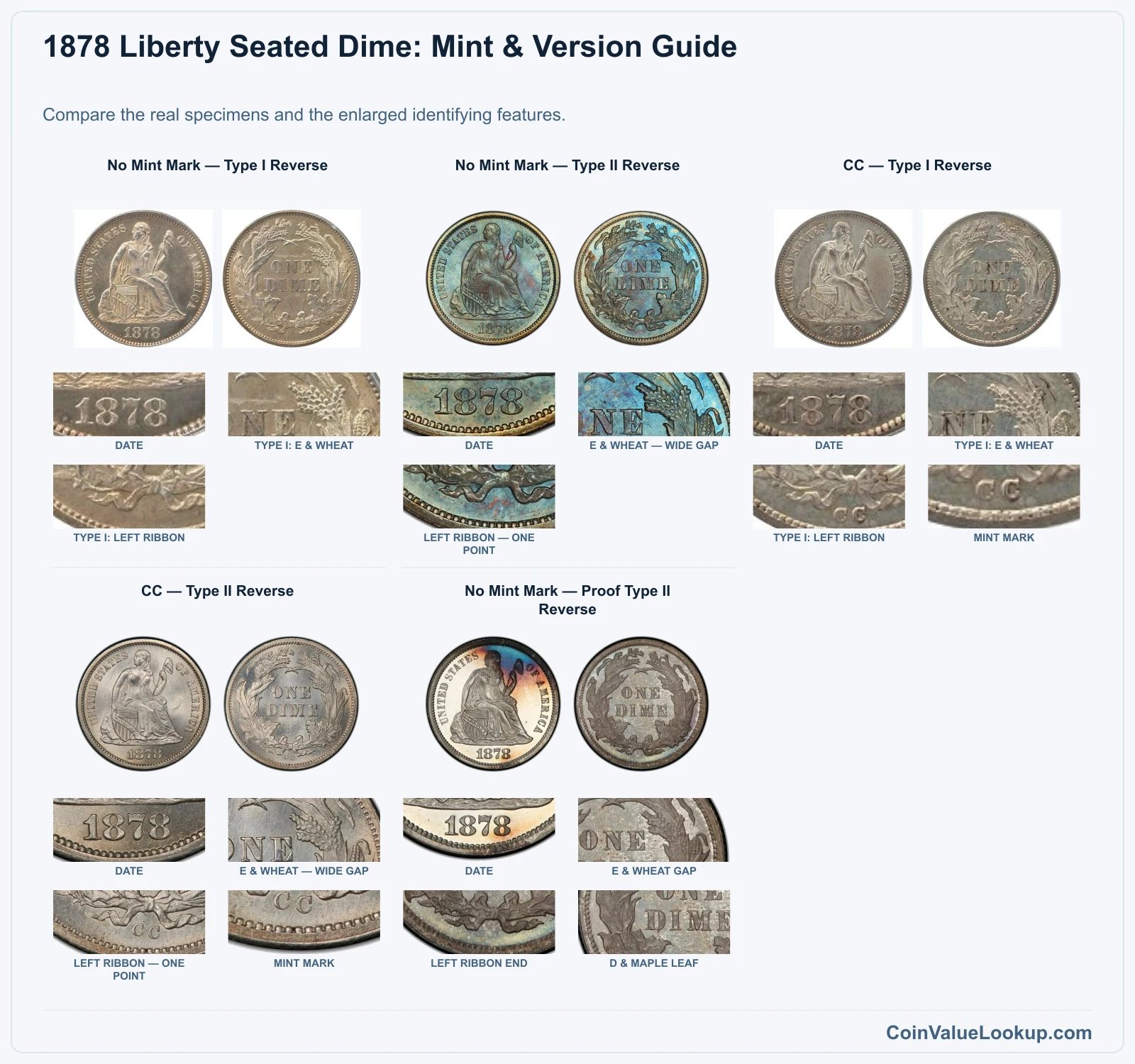
Philadelphia coins carry no mintmark. Carson City pieces have a small "CC" on the reverse, just below the wreath.
If you see an "S" mintmark, be cautious — no regular 1878-S dime was issued.
All 1878 dimes are struck in 90% silver and 10% copper, measuring 17.9mm across with a reeded edge and a nominal weight of 2.50 grams. Both mints used two reverse hub types this year.
On the Type I Reverse, the letter E in ONE sits close to the wheat grains, and the left ribbon end splits into two points. On the Type II Reverse, a wider gap separates the E from the grains, and the left ribbon tapers to a single point.
Grab a loupe and compare. The ribbon detail is the fastest tell once you know where to look.
Step 2: Check Your 1878 Liberty Seated Dime Grade
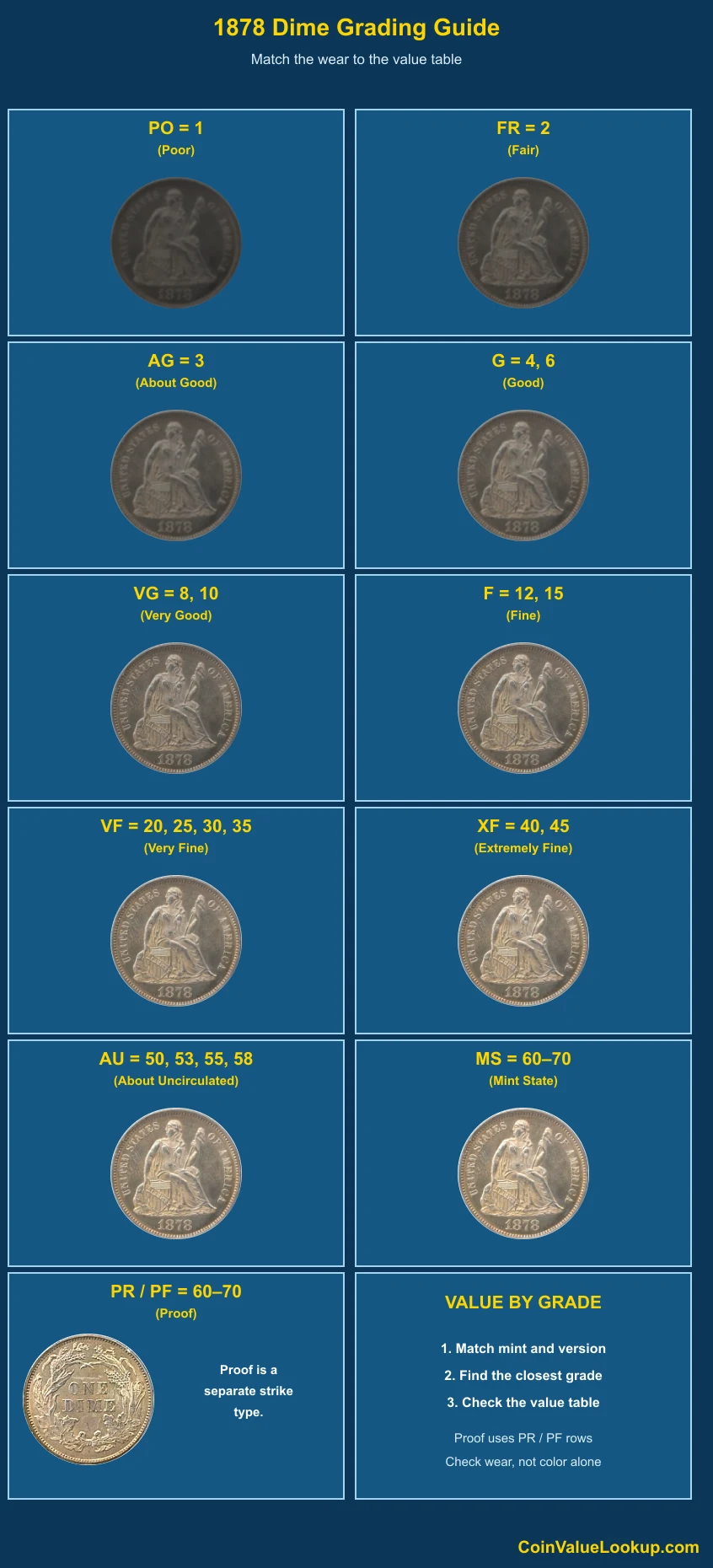
Start with the high points of Liberty: her head, the breast and knee area, and the shield on her lap. These wear first.
On the reverse, check the uppermost wreath leaves for smoothing.
A coin in Good condition (G4) will show a clear outline of Liberty but most interior detail is gone. By Extremely Fine (EF40), most feathers of the eagle shield and Liberty's gown lines remain sharp.
At Mint State (MS63), expect full design detail with original luster across both faces, though some contact marks or minor blemishes are typical.
Do not confuse a weak strike with wear. Some 1878 dimes left the press with soft detail, especially on the head and wreath tips, because of tired dies — not because someone spent the coin at a saloon.
Compare your coin against the reference image to judge actual friction versus strike weakness.
Polished coins are not Proofs. A Proof is a specific manufacturing process with mirror fields from specially prepared dies.
Rubbing a coin shiny does not upgrade it.
Step 3: Check 1878 Liberty Seated Dime Value by Mint and Version
1878 Liberty Seated Dime — No Mint Mark — Type I Reverse
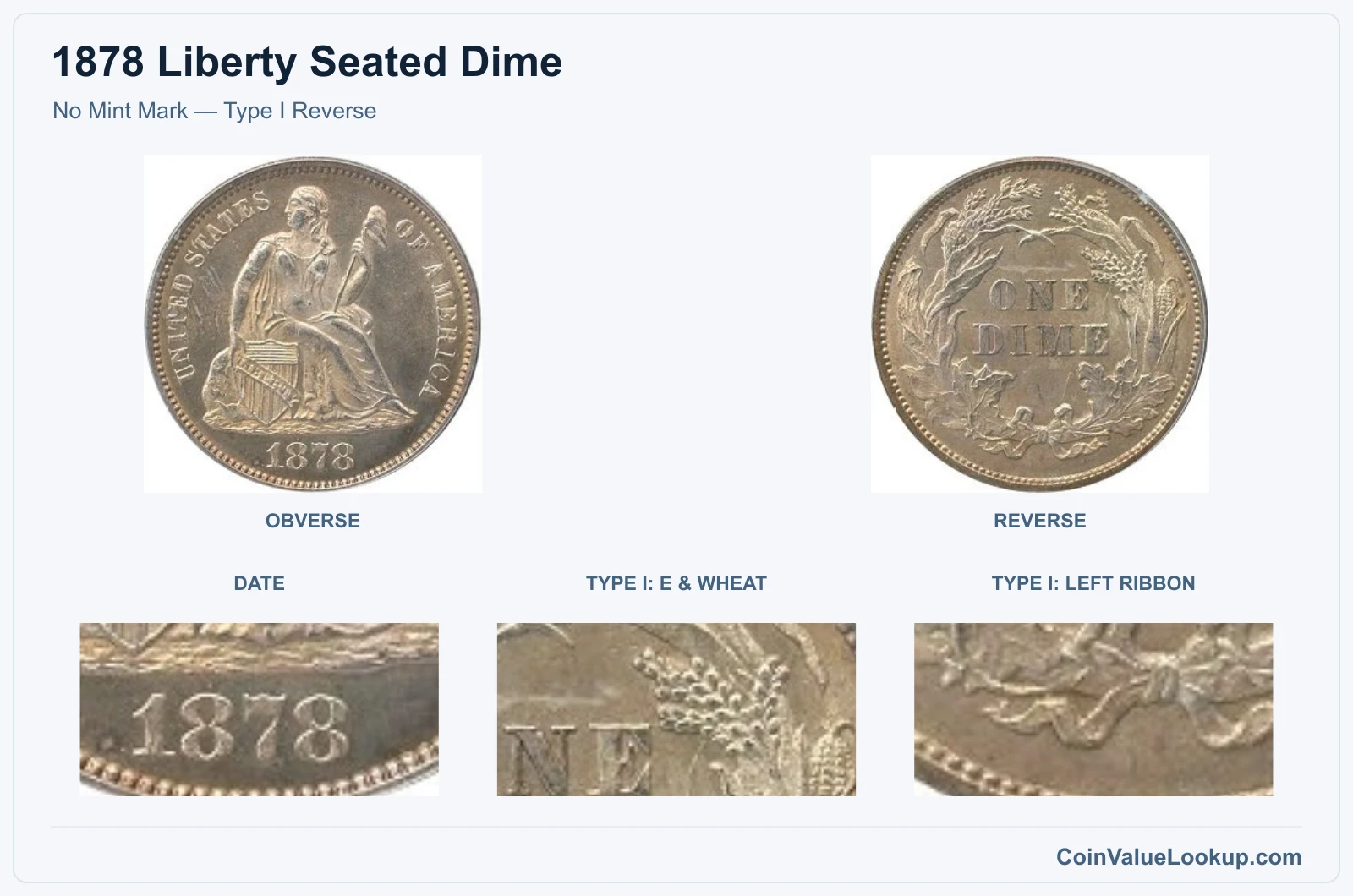
The Philadelphia Type I Reverse business strike has no mintmark anywhere on the coin. To confirm Type I, flip to the reverse and look at the left ribbon end below the wreath bow — it should split into two distinct points.
Also check the letter E in ONE: on a Type I it sits noticeably close to the adjacent wheat grains.
The overall Philadelphia issue carries USA Coin Book guide anchors of about $22 at G4 and $316 at MS63, but those figures are not split between Type I and Type II reverses. Your coin's actual value depends on its authenticated identity, condition, and whether any errors are present.
A professional evaluation is the safest route for anything above average circulated grades.
Ordinary-issue reference: Ordinary-issue reference only: The table below shows prices for the 1878 Liberty Seated Dime (regular strike). It does not represent the value of the specific No Mint Mark — Type I Reverse variety or its variety premium. Year, mint, metal and strike type are matched; the specific variety is not priced by this table.
Range Grade
Price Auction Records Appraisal PO PO 1
—
Coin Identifier FR FR 2
—
Coin Identifier AG AG 3
—
Coin Identifier G G 4
—
Coin Identifier
G 6
—
Coin Identifier VG VG 8
—
Coin Identifier
VG 10
—
Coin Identifier F F 12
—
Coin Identifier
F 15
—
Coin Identifier VF VF 20
—
Coin Identifier
VF 25
—
Coin Identifier
VF 30
—
Coin Identifier
VF 35
—
Coin Identifier XF XF 40
—
Coin Identifier
XF 45
—
Coin Identifier AU AU 50
Coin Identifier
AU 53
—
Coin Identifier
AU 55
Coin Identifier
AU 58
Coin Identifier MS MS 60
—
Coin Identifier
MS 61
Coin Identifier
MS 62
Coin Identifier
MS 63
Coin Identifier
MS 64
Coin Identifier
MS 65
Coin Identifier
MS 66
Coin Identifier
MS 67
Coin Identifier
MS 68
Coin Identifier
MS 69
—
—
—
MS 70
—
—
—
1878 Liberty Seated Dime — No Mint Mark — Type II Reverse
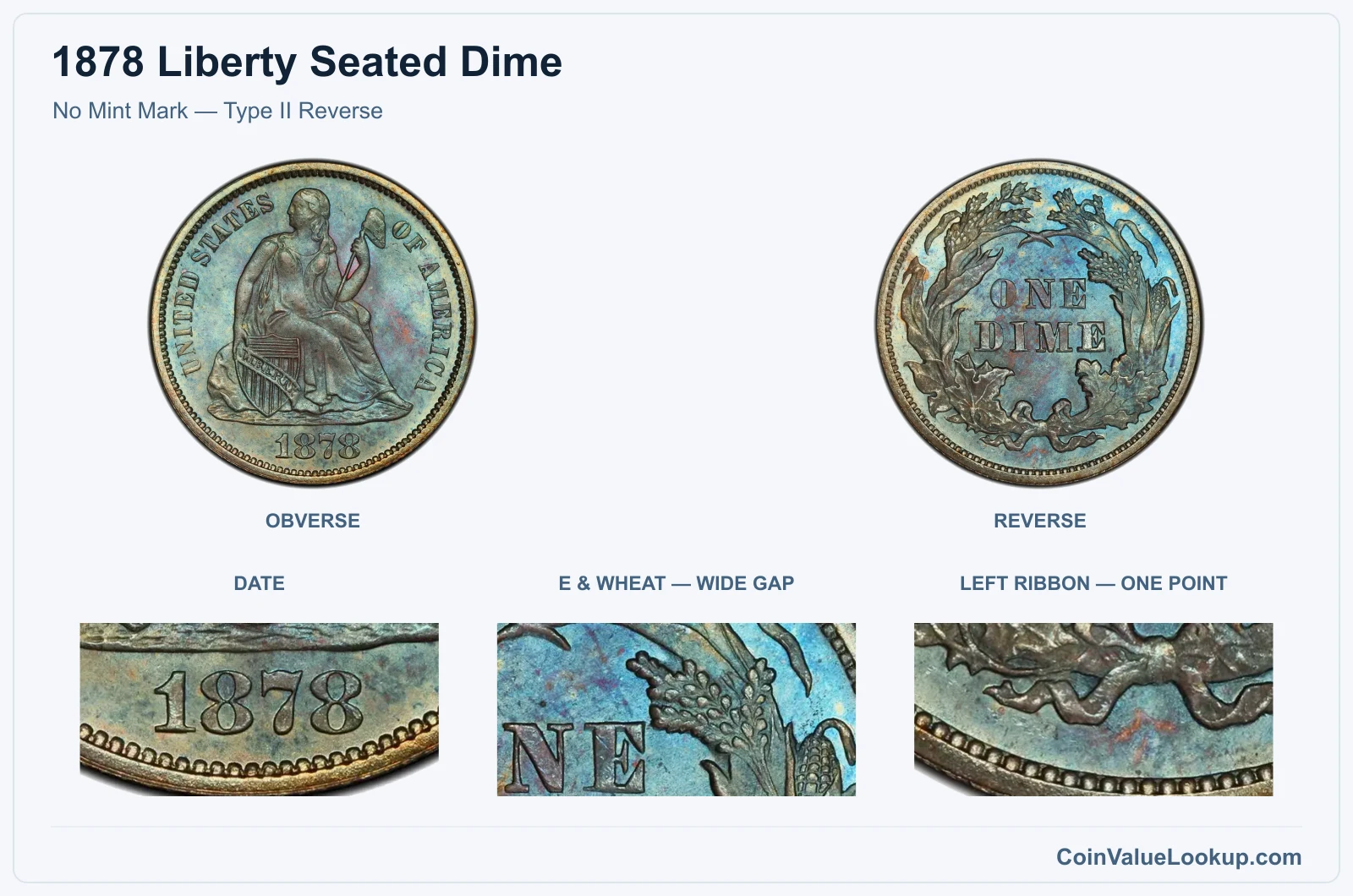
Philadelphia's Type II Reverse business strike also lacks a mintmark. The key difference from Type I is on the reverse: the left ribbon end tapers to a single point instead of splitting, and a wider gap separates the E in ONE from the wheat grains.
It is a subtle but consistent distinction once you see it side by side.
As with the Type I, the unsplit Philadelphia guide anchors sit at roughly $22 in G4 and $316 in MS63 per USA Coin Book. No separate Type II price is established in the guide data available.
Individual value will depend on authenticated identity, grade, and any die varieties or errors present on the specific coin.
Ordinary-issue reference: Ordinary-issue reference only: The table below shows prices for the 1878 Liberty Seated Dime (regular strike). It does not represent the value of the specific No Mint Mark — Type II Reverse variety or its variety premium. Year, mint, metal and strike type are matched; the specific variety is not priced by this table.
Range Grade
Price Auction Records Appraisal PO PO 1
—
Coin Identifier FR FR 2
—
Coin Identifier AG AG 3
—
Coin Identifier G G 4
—
Coin Identifier
G 6
—
Coin Identifier VG VG 8
—
Coin Identifier
VG 10
—
Coin Identifier F F 12
—
Coin Identifier
F 15
—
Coin Identifier VF VF 20
—
Coin Identifier
VF 25
—
Coin Identifier
VF 30
—
Coin Identifier
VF 35
—
Coin Identifier XF XF 40
—
Coin Identifier
XF 45
—
Coin Identifier AU AU 50
Coin Identifier
AU 53
—
Coin Identifier
AU 55
Coin Identifier
AU 58
Coin Identifier MS MS 60
—
Coin Identifier
MS 61
Coin Identifier
MS 62
Coin Identifier
MS 63
Coin Identifier
MS 64
Coin Identifier
MS 65
Coin Identifier
MS 66
Coin Identifier
MS 67
Coin Identifier
MS 68
Coin Identifier
MS 69
—
—
—
MS 70
—
—
—
1878 Liberty Seated Dime — CC — Type I Reverse
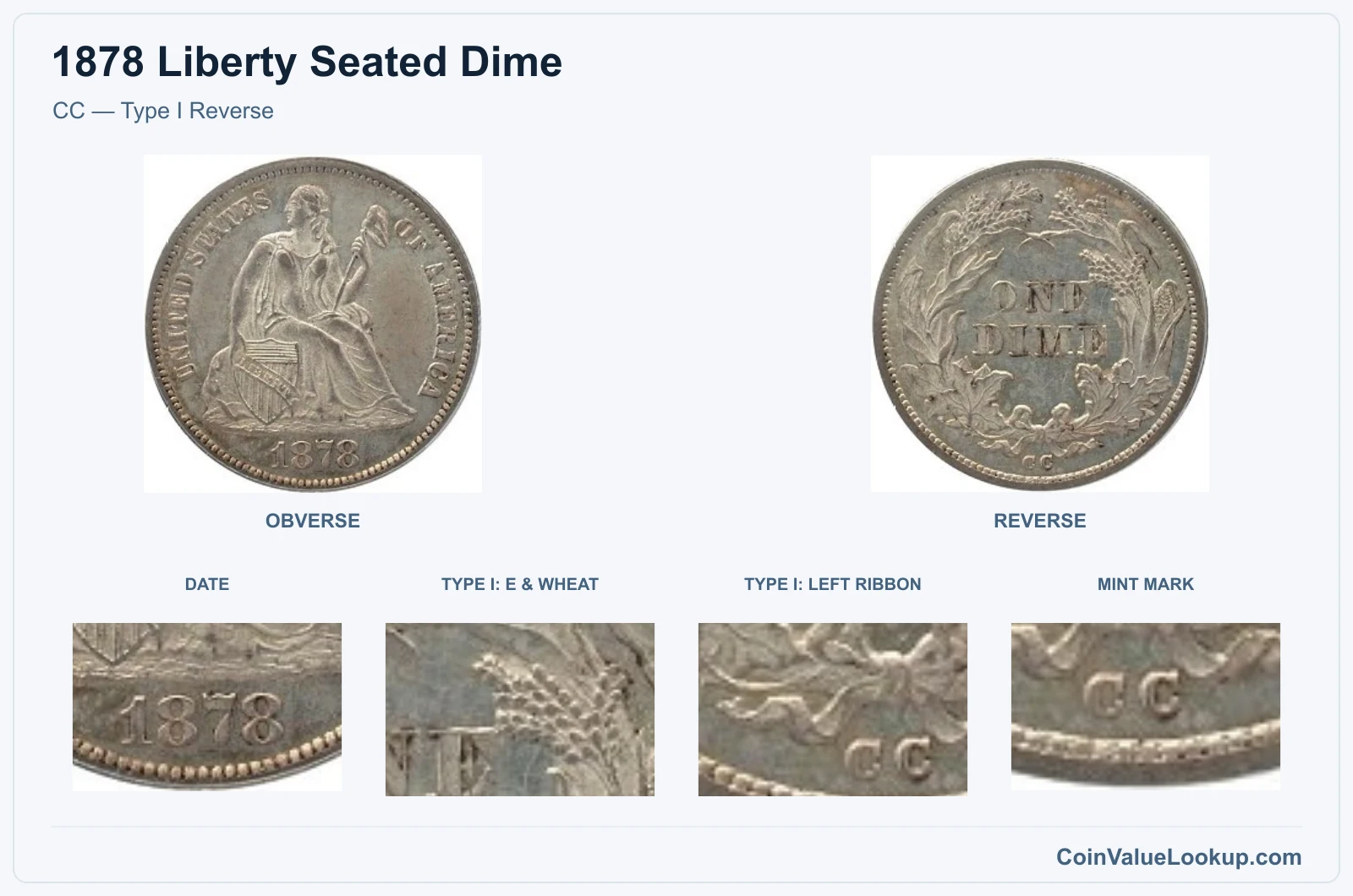
The Carson City Type I Reverse dime carries the small "CC" mintmark on the reverse beneath the wreath. This is the final year any dime was struck at Carson City, so every 1878-CC dime has built-in collector demand simply from scarcity and historical finality.
To confirm Type I, look for the split two-point left ribbon end and the E of ONE sitting close to the wheat grains. The overall CC issue guide anchors from USA Coin Book are about $316 at G4 and $3,432 at MS63, though these are not broken out by reverse type.
Actual value hinges on authenticated identity and condition. Even well-worn examples command meaningful premiums over their Philadelphia counterparts.
Coin Value Lookup is a good starting point if you want to look up other Liberty Seated Dime dates and compare where your coin fits in the series.
Ordinary-issue reference: Ordinary-issue reference only: The table below shows prices for the 1878-CC Liberty Seated Dime (regular strike). It does not represent the value of the specific CC — Type I Reverse variety or its variety premium. Year, mint, metal and strike type are matched; the specific variety is not priced by this table.
Range Grade
Price Auction Records Appraisal PO PO 1
—
Coin Identifier FR FR 2
—
Coin Identifier AG AG 3
Coin Identifier G G 4
Coin Identifier
G 6
Coin Identifier VG VG 8
Coin Identifier
VG 10
Coin Identifier F F 12
Coin Identifier
F 15
Coin Identifier VF VF 20
Coin Identifier
VF 25
Coin Identifier
VF 30
Coin Identifier
VF 35
Coin Identifier XF XF 40
Coin Identifier
XF 45
Coin Identifier AU AU 50
Coin Identifier
AU 53
Coin Identifier
AU 55
Coin Identifier
AU 58
Coin Identifier MS MS 60
—
Coin Identifier
MS 61
Coin Identifier
MS 62
Coin Identifier
MS 63
Coin Identifier
MS 64
Coin Identifier
MS 65
Coin Identifier
MS 66
Coin Identifier
MS 67
Coin Identifier
MS 68
—
Coin Identifier
MS 69
—
—
—
MS 70
—
—
—
1878 Liberty Seated Dime — CC — Type II Reverse
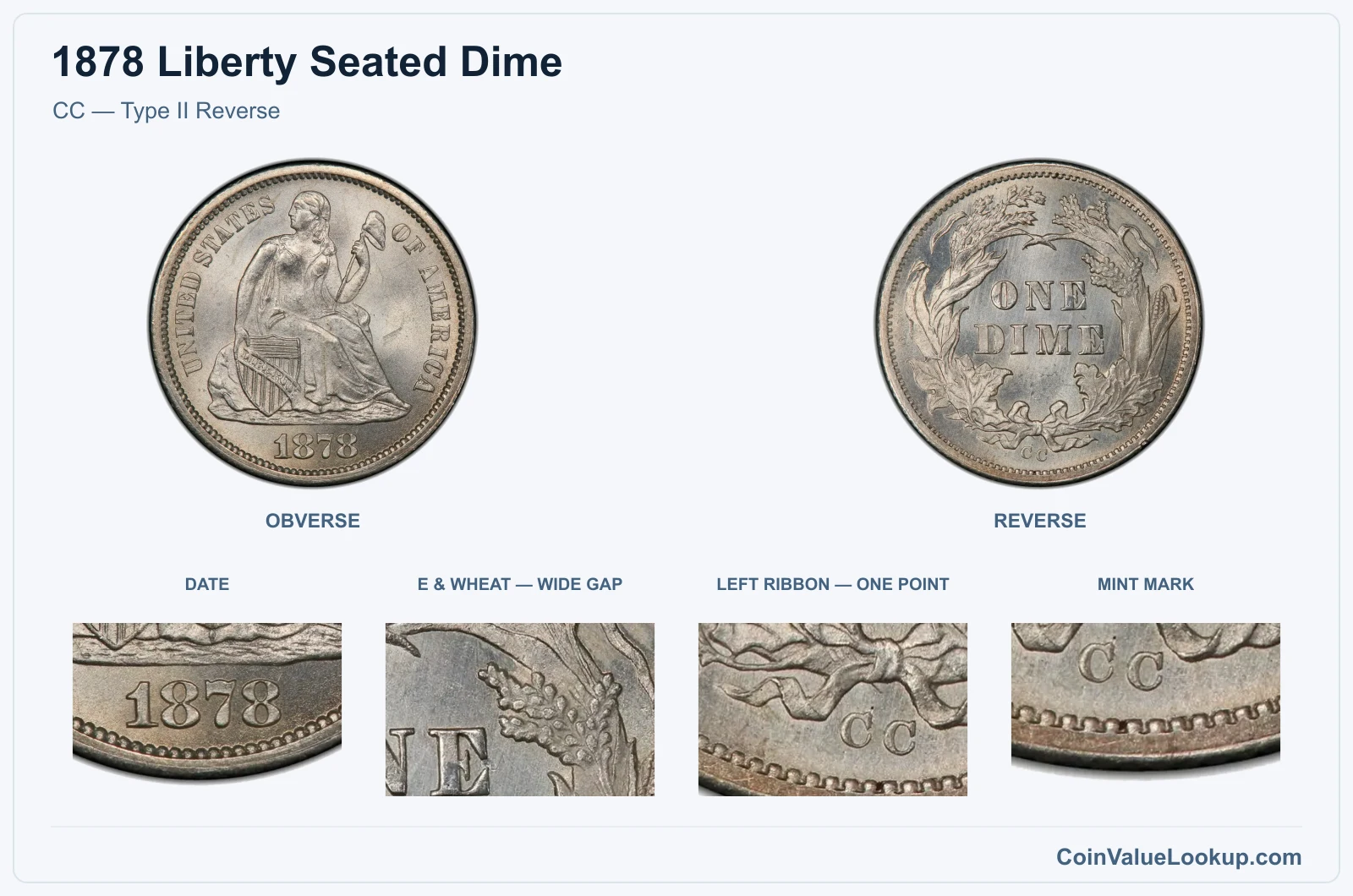
The Carson City Type II Reverse shares the CC mintmark but features the wider E-to-wheat-grain gap and a single-point left ribbon end. This combination — last-year CC mint, Type II hub — makes it a coin specialists actively track.
USA Coin Book's guide anchors for the combined CC issue run from about $316 at G4 to $3,432 at MS63. No separate Type II figure is published in the available data.
Because these coins are scarce across all grades, individual assessment by a professional grading service is especially worthwhile. Condition, originality of surfaces, and precise die variety all factor into what a specific example might bring.
Ordinary-issue reference: Ordinary-issue reference only: The table below shows prices for the 1878-CC Liberty Seated Dime (regular strike). It does not represent the value of the specific CC — Type II Reverse variety or its variety premium. Year, mint, metal and strike type are matched; the specific variety is not priced by this table.
Range Grade
Price Auction Records Appraisal PO PO 1
—
Coin Identifier FR FR 2
—
Coin Identifier AG AG 3
Coin Identifier G G 4
Coin Identifier
G 6
Coin Identifier VG VG 8
Coin Identifier
VG 10
Coin Identifier F F 12
Coin Identifier
F 15
Coin Identifier VF VF 20
Coin Identifier
VF 25
Coin Identifier
VF 30
Coin Identifier
VF 35
Coin Identifier XF XF 40
Coin Identifier
XF 45
Coin Identifier AU AU 50
Coin Identifier
AU 53
Coin Identifier
AU 55
Coin Identifier
AU 58
Coin Identifier MS MS 60
—
Coin Identifier
MS 61
Coin Identifier
MS 62
Coin Identifier
MS 63
Coin Identifier
MS 64
Coin Identifier
MS 65
Coin Identifier
MS 66
Coin Identifier
MS 67
Coin Identifier
MS 68
—
Coin Identifier
MS 69
—
—
—
MS 70
—
—
—
1878 Liberty Seated Dime — No Mint Mark — Proof Type II Reverse
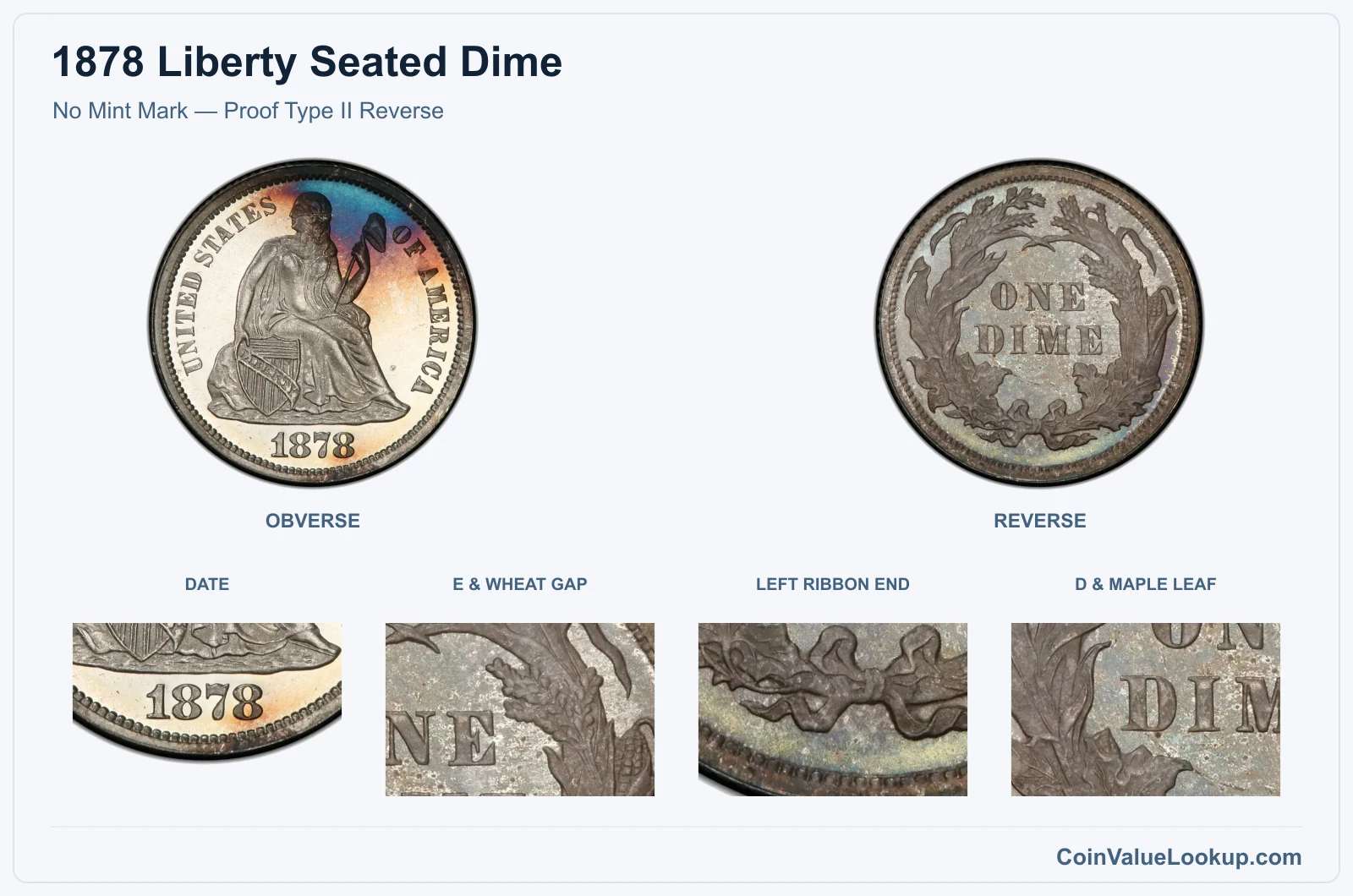
Philadelphia struck a small number of Proof dimes in 1878 using the Type II Reverse hub. Genuine Proofs show deeply mirrored fields on both sides, the result of polished dies and carefully prepared planchets.
The devices may show a slight contrast against those fields, but brilliance alone does not make a coin a Proof.
USA Coin Book lists a guide value of about $725 at PR63 for this issue. Look for squared, fully struck rims and minimal evidence of die polish lines in the fields.
Hairlines from old cleanings are common on Proofs that were handled over the decades; they reduce the grade but do not disqualify the coin from being a Proof. Authentication by a recognized grading service is the standard way to confirm Proof manufacture.
Ordinary-issue reference: Ordinary-issue reference only: The table below shows prices for the 1878 Liberty Seated Dime (proof). It does not represent the value of the specific No Mint Mark — Proof Type II Reverse variety or its variety premium. Year, mint, metal and strike type are matched; the specific variety is not priced by this table.
Range Grade
Price Auction Records Appraisal PR PR 1
—
Coin Identifier
PR 2
—
Coin Identifier
PR 3
—
Coin Identifier
PR 4
—
Coin Identifier
PR 6
—
Coin Identifier
PR 8
—
Coin Identifier
PR 10
—
Coin Identifier
PR 12
—
Coin Identifier
PR 15
—
Coin Identifier
PR 20
—
Coin Identifier
PR 25
—
Coin Identifier
PR 30
—
Coin Identifier
PR 35
—
Coin Identifier
PR 40
—
Coin Identifier
PR 45
—
Coin Identifier
PR 50
—
Coin Identifier
PR 53
—
Coin Identifier
PR 55
—
Coin Identifier
PR 58
Coin Identifier
PR 60
Coin Identifier
PR 61
Coin Identifier
PR 62
Coin Identifier
PR 63
Coin Identifier
PR 64
Coin Identifier
PR 65
Coin Identifier
PR 66
Coin Identifier
PR 67
—
—
—
PR 68
—
—
—
PR 69
—
—
—
PR 70
—
—
—
1878 Liberty Seated Dime Error List
1. 1878 Liberty Seated Dime — Repunched Date
A repunched date on an 1878 dime shows remnants of an earlier position of one or more date numerals alongside the final, accepted placement. Under magnification, look for traces — partial outlines or thickened edges — near the base or tops of the 1, 8, 7, or 8.
The extra impressions come from the date punch being applied more than once during die preparation, each strike slightly offset.
Do not confuse this with machine doubling, which produces a flat, shelf-like displacement across the entire design rather than isolated to specific digits. Damage from a hit or scratch can also mimic a repunch at first glance, but genuine repunching follows the contour of the numeral precisely.
The degree of separation and the coin's overall condition both affect any premium. No specific price data is available for this variety, so professional authentication and individual assessment are the best path to an accurate valuation.
2. 1878 Liberty Seated Dime — Die Crack / Die Chip
Die cracks appear as thin raised lines on the coin's surface, running across the design or connecting features. They form when a working die develops stress fractures during use.
On an 1878 Philadelphia dime, look for fine raised ridges — often extending from the rim inward through lettering or Liberty's figure. A die chip is a small raised blob, usually in a letter or open field, where a tiny piece of the die broke away.
These are different from incuse scratches, which are recessed into the surface, or corrosion pitting and surface crud. A genuine die crack is always raised and consistent along its length.
Larger cracks or rim-connected breaks (cuds) tend to draw more collector interest than hairline fractures. Condition, visibility, and the specific location all influence any added value, but no numeric price range is established for this category on the 1878 date.
3. 1878 Liberty Seated Dime — Clashed Dies
Clashed dies result from the obverse and reverse dies striking each other without a planchet between them. The impact transfers faint mirror-image traces of one design onto the opposing die, which then appear as ghostly impressions on subsequently struck coins.
On an 1878 Philadelphia dime, you might spot faint outlines of the wreath on Liberty's side or traces of the seated figure within the reverse wreath.
The transferred elements should align with where the opposite design would logically appear — that alignment is what distinguishes a genuine clash from random scratches or raised lines caused by other damage. A brockage, where a struck coin sticks to a die and impresses into the next planchet, produces a much more dramatic and complete mirror image.
Clash marks are subtle by comparison. No specific price data exists for clashed 1878 dimes; value depends on the strength of the clash and overall coin condition.
4. 1878 Liberty Seated Dime — Doubled Die Reverse
A doubled die reverse on an 1878 dime shows a clear doubling of design elements on the back of the coin. The reported diagnostic area to examine is the lettering of DIME, particularly around the letter I.
Under magnification, look for distinctly separated contours — two clear outlines of a letter or design element rather than one crisp impression.
This is a hub-doubling variety created during die manufacture, not a strike artifact. Machine doubling, by contrast, produces a flat, shelf-like secondary image that lacks the rounded, fully formed profile of a genuine doubled die.
Reflections from luster or random post-strike damage can also mimic doubling at a glance. Comparing your coin directly against a known normal example is the most reliable way to spot the difference.
No numerical price is available for this variety; value depends on the strength of doubling and the coin's authenticated condition.