1878 Shield Nickel Coin Value: How Much Is It Worth?
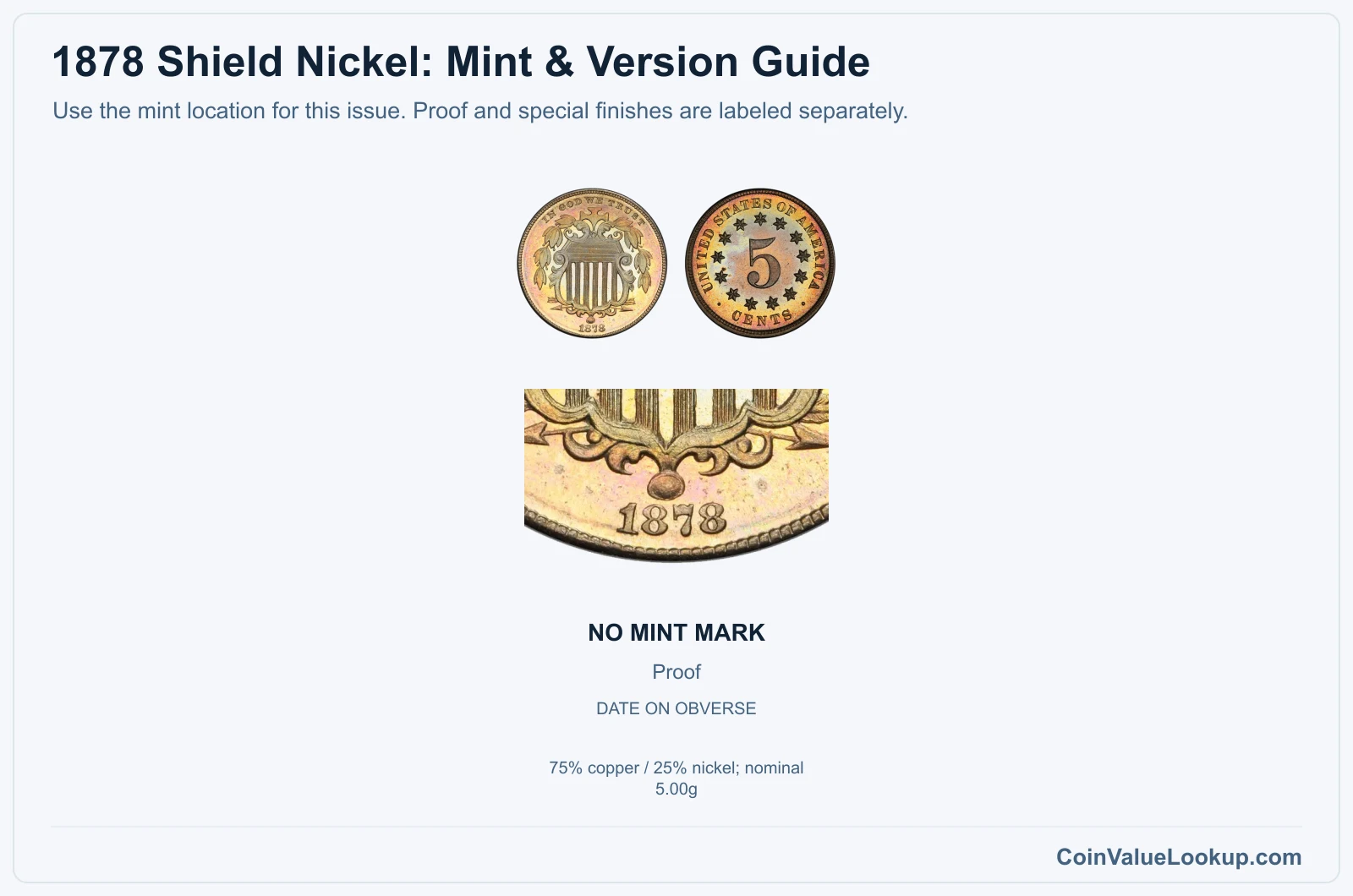
The 1878 Shield Nickel is a proof-only issue — no circulation strikes were made this year. That makes every genuine example a deliberate collectible from the Philadelphia Mint.
Guide estimates place values from roughly $666 for a heavily worn or impaired proof up to about $1,445 at PR63, according to USA Coin Book. Actual results depend on surfaces, eye appeal, and whether the coin has been cleaned or damaged over its long life.
Fast Way to Identify Your 1878 Shield Nickel
Want a quick read on what you have? Upload clear photos of both the front and back of your coin, and our identifier can offer a preliminary take on what you're looking at.
This won't replace professional authentication or grading, but it's a solid first step to see if your nickel matches the proof-only 1878 issue or might be something else entirely.
1878 Shield Nickel Value
Upload both sides of your 1878 Shield Nickel.
Front Obverse
Upload photo
Back Reverse
Upload photo
Which 1878 Shield Nickel Versions Are Worth Money?
- Proof-only year: every genuine 1878 Shield Nickel is a proof, making it scarcer than most dates in the series.
- Confirm the date carefully — a worn final digit can mimic other years, and correct identification as an 1878 is essential to its value.
- A repunched date variety exists on this issue, visible inside the lower loop of the final 8; specialist collectors track this separately.
- Original, uncleaned proof surfaces with strong mirrors carry a meaningful premium over impaired or cleaned examples.
Step 1: Identify Your 1878 Shield Nickel Mint Mark and Version
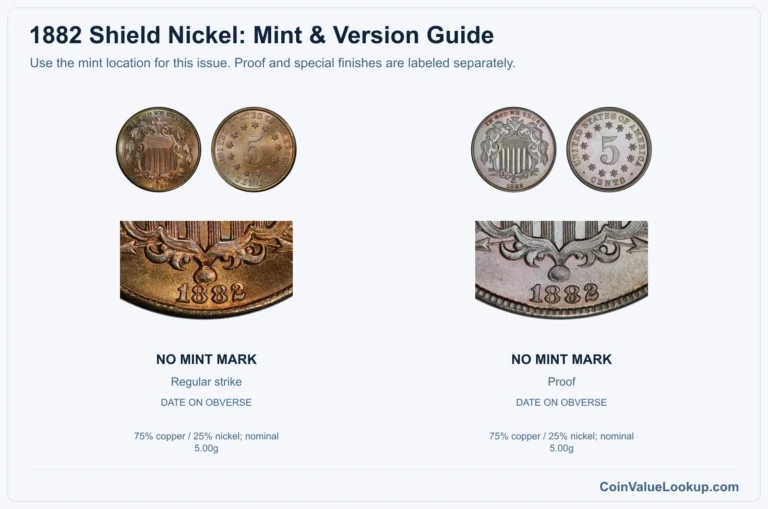
Every genuine 1878 Shield Nickel was struck as a proof at the Philadelphia Mint. There is no mintmark, and the normal absence of a mint letter is not an error — Philadelphia coins of this era simply didn't carry one.
The coin is copper-nickel, 75% copper and 25% nickel, weighing about 5 grams with a 20.5 mm diameter and a plain edge. There is no silver version for this date.
Because 1878 is proof-only, a worn example with a mushy final digit can be tricky. Look at the date carefully: the bottom of the "3" in 1873, for instance, curves differently than the "8" in 1878.
Confirm all four digits before assuming you hold this scarce date. A repunched "8" is sometimes mistaken for an 1878/7 overdate, but that is a separate issue — more on that below.
Step 2: Check Your 1878 Shield Nickel Grade
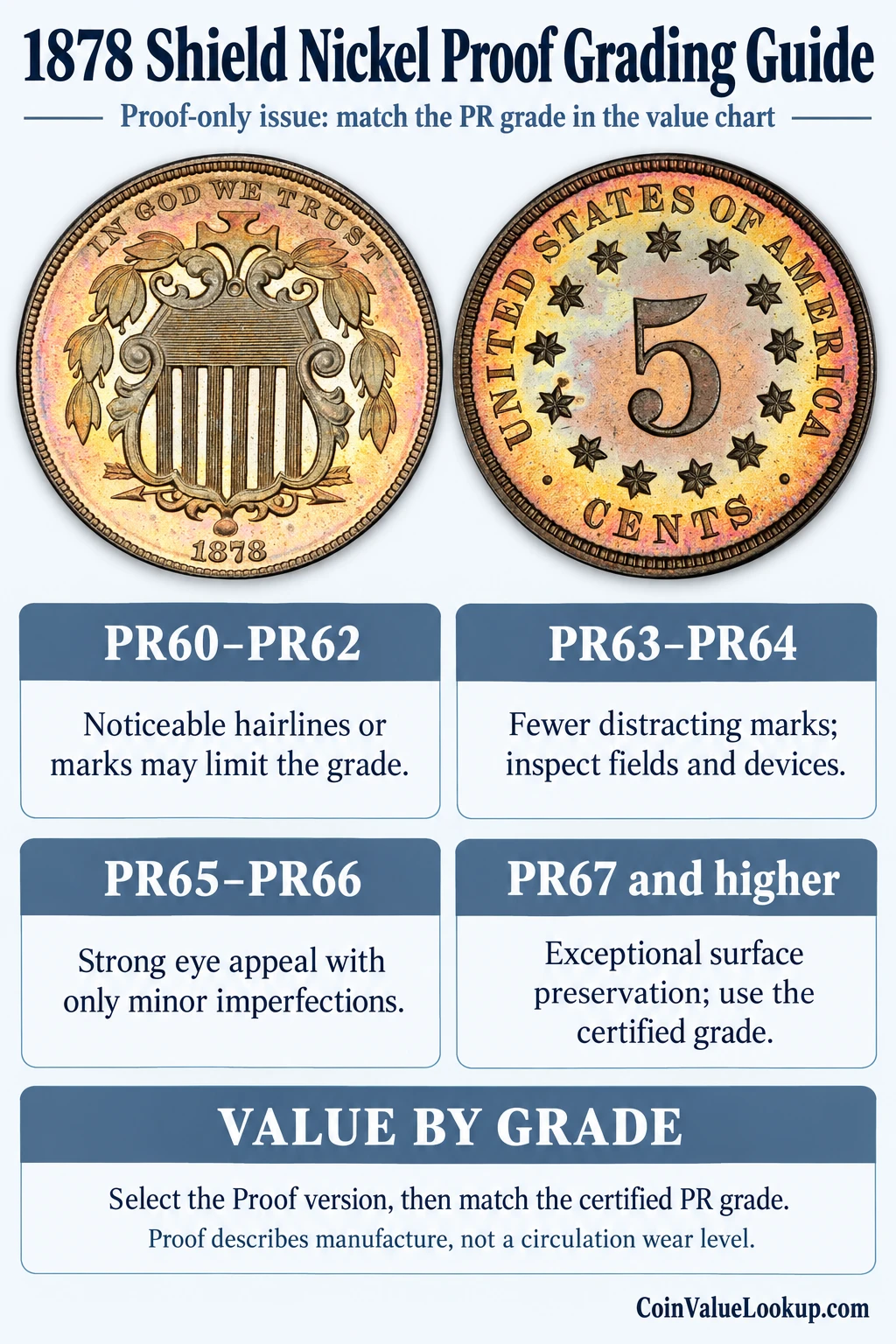
Since every 1878 Shield Nickel is a proof, you should never grade one on the Mint State (MS) scale. Even a beat-up example is an impaired proof, not a circulated business strike.
When evaluating condition, look at the mirrored fields first. A well-preserved proof shows deep reflectivity in the flat areas around the shield and the numeral on the reverse.
Wear will dull those mirrors, starting on the high points of the shield's horizontal lines and the numeral "5" on the back.
Cleaning hairlines are common on old proofs and they hurt value significantly. Hold the coin at an angle under a single light source — fine parallel scratches from a past polishing will light up.
These are different from contact marks, which are random and deeper.
Compare your coin against the reference image for this date. Check the sharpness of the leaves, the shield's cross-hatching, and the stars.
A PR63 coin will show attractive mirrors with only minor blemishes, while lower-grade proofs may have noticeable marks or diminished reflectivity.
Step 3: Check 1878 Shield Nickel Value by Mint and Version
1878 Shield Nickel — No Mint Mark — Proof
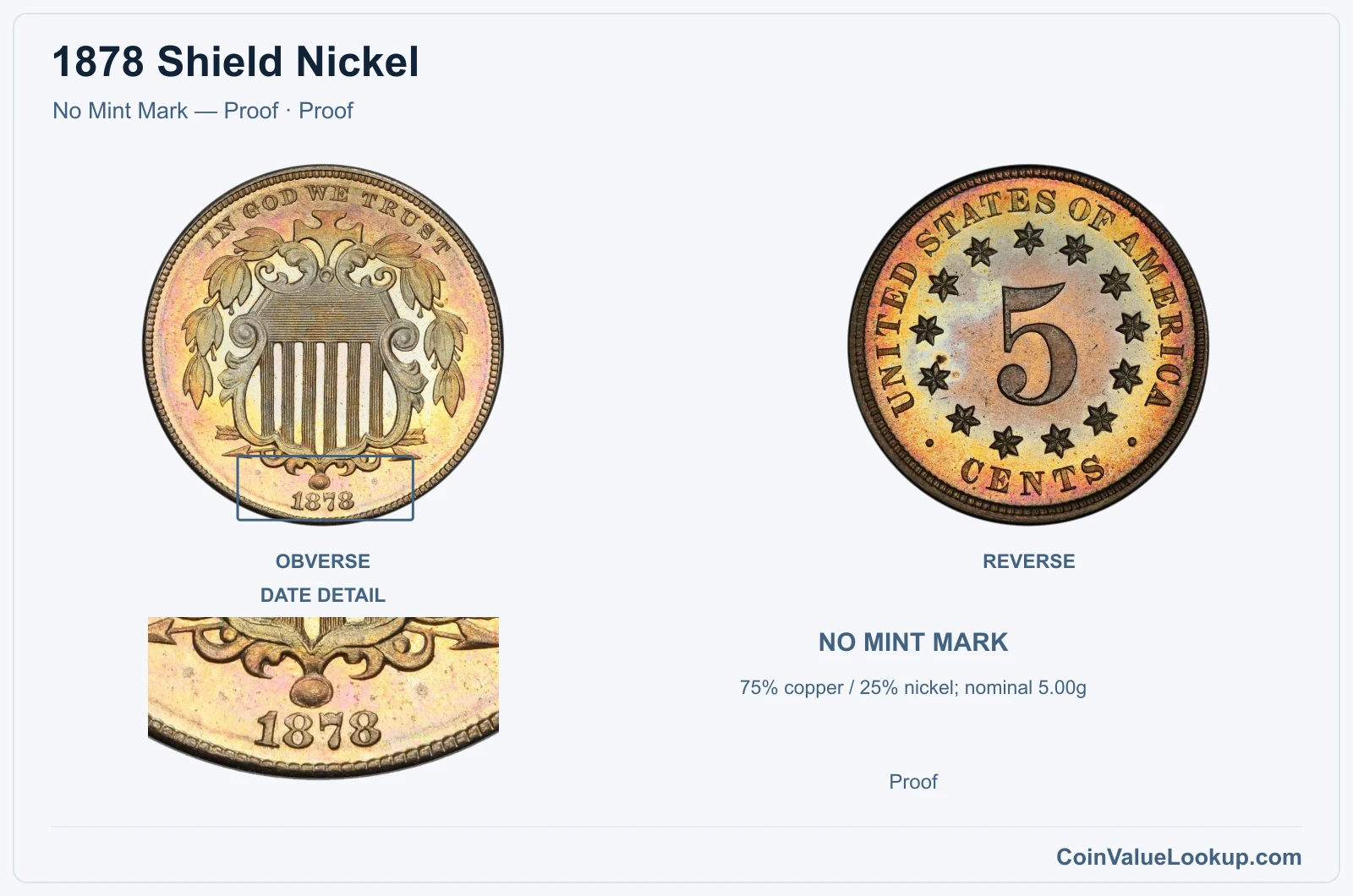
All 1878 Shield Nickels are proofs struck at the Philadelphia Mint with no mintmark. The design is the "No Rays" type used from 1867 onward, featuring a prominent shield on the obverse and a large numeral "5" surrounded by stars on the reverse.
At PR63, USA Coin Book lists a guide estimate of about $1,445. Heavily worn or impaired proofs trade for less, but they still carry the proof-only premium.
Surfaces matter a great deal here: original mirrors with minimal hairlines will always outperform a cleaned coin of the same technical grade.
Coin Value Lookup is a good starting point if you want to compare this date against other Shield Nickel years or check values across the series. It can help you quickly find the right guide for your specific coin.
Range Grade
Price Auction Records Appraisal PR PR 1
—
Coin Identifier
PR 2
—
Coin Identifier
PR 3
—
Coin Identifier
PR 4
—
Coin Identifier
PR 6
—
Coin Identifier
PR 8
—
Coin Identifier
PR 10
—
Coin Identifier
PR 12
Coin Identifier
PR 15
—
Coin Identifier
PR 20
—
Coin Identifier
PR 25
—
Coin Identifier
PR 30
—
Coin Identifier
PR 35
Coin Identifier
PR 40
—
Coin Identifier
PR 45
Coin Identifier
PR 50
—
Coin Identifier
PR 53
—
Coin Identifier
PR 55
Coin Identifier
PR 58
Coin Identifier
PR 60
—
Coin Identifier
PR 61
Coin Identifier
PR 62
Coin Identifier
PR 63
Coin Identifier
PR 64
Coin Identifier
PR 65
Coin Identifier
PR 66
Coin Identifier
PR 67
Coin Identifier
PR 68
—
—
—
PR 69
—
—
—
PR 70
—
—
—
1878 Shield Nickel Error List
1. 1878 Shield Nickel — Repunched Date
A repunched date variety is documented for the 1878 Shield Nickel proof. The diagnostic is an extra curve visible inside the lower loop of the final "8" in the date.
Under magnification, you can see traces of a second impression that didn't align perfectly with the first punch.
This is not the same as an overdate. The 1879/8 is a recognized PCGS variety, but this 1878 repunched date is a different animal — it involves the same digit punched twice, not one digit over another.
Don't assume a funny-looking 8 means you have an overdate.
Watch out for lookalikes. Machine doubling can leave shelf-like flatness near the digits, and outright damage from a hit or corrosion can distort the date area.
True repunching shows a distinct secondary curve with the same style and serif structure as the primary digit. No specific price premium has been established in the sources available, so value will depend on visibility of the repunching and overall proof condition.