1875 Shield Nickel Coin Value: How Much Is It Worth?
An 1875 Shield Nickel in well-worn Good-4 condition carries a USA Coin Book retail guide estimate around $61, while a Mint State MS63 example runs closer to $498. Proof versions are a separate category with their own pricing.
These are guide estimates, not guaranteed sale prices, and actual results depend on the specific coin's condition and originality.
Fast Way to Identify Your 1875 Shield Nickel
Snap clear, well-lit photos of both the front and back of your 1875 Shield Nickel and upload them here. Our identifier can offer a preliminary read on which version you have and its general condition.
It is not a substitute for professional authentication or certified grading, but it gives you a solid starting point.
1875 Shield Nickel Value
Upload both sides of your 1875 Shield Nickel.
Front Obverse
Upload photo
Back Reverse
Upload photo
Which 1875 Shield Nickel Versions Are Worth Money?
- Business strikes range from about $61 at G4 to $498 at MS63 per USA Coin Book estimates; original, problem-free surfaces matter most for these values.
- Proof strikes are a distinct issue with a PR63 guide estimate around $468; confirming proof status requires more than surface shine.
- A Doubled Die Obverse variety has been reported for this date and can carry a premium depending on visibility and condition.
- Repunched Date varieties are also reported and worth checking — look for traces of an earlier punch position in the date numerals.
- Die cracks and die chips occur on some 1875 nickels; large or dramatic examples attract error collectors willing to pay above normal type values.
Step 1: Identify Your 1875 Shield Nickel Mint Mark and Version
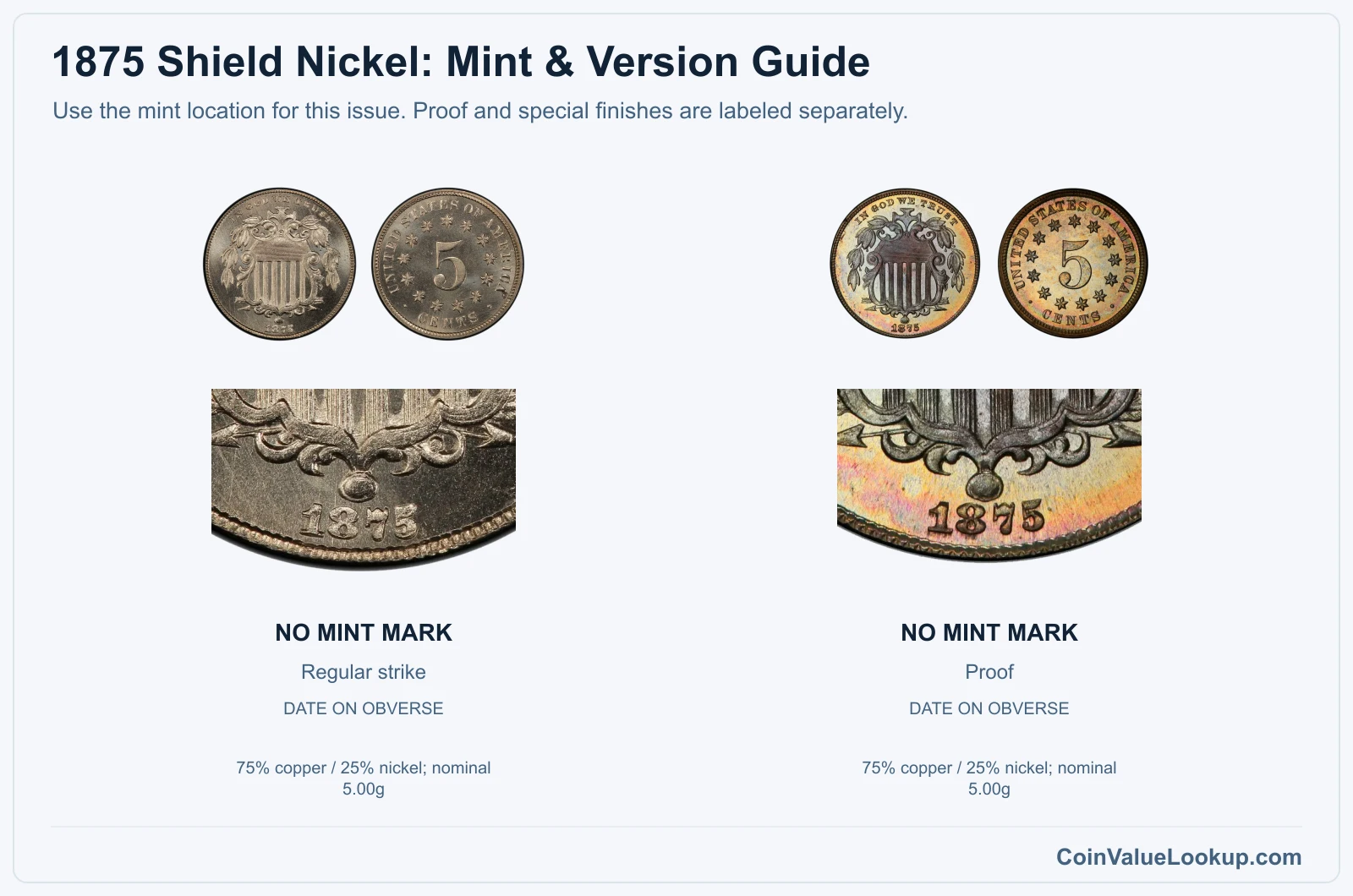
Every 1875 Shield Nickel was struck at the Philadelphia Mint, which used no mintmark. A missing letter below the wreath is completely normal — do not assume it means your coin is rare or unusual.
The obverse shows a prominent Union shield, and the reverse displays a large numeral 5 surrounded by stars. These are the "No Rays" design, since the rays between the stars were dropped back in 1867.
The coin is copper-nickel (75% copper, 25% nickel), weighs about 5 grams, measures 20.5 mm across, and has a plain edge. There is no legitimate silver version of this date.
One important distinction: both business strikes and proofs exist for 1875. Fine die-polish lines can show up on regular circulation strikes, giving them a bright, reflective look that tempts people to call them proofs.
Brightness and polish lines alone are not enough. Genuine proofs have specific surface characteristics best confirmed by comparison with authenticated examples.
Start by deciding whether your coin is a business strike or a proof, then move on to grading. And whatever you do, don't clean it.
Step 2: Check Your 1875 Shield Nickel Grade
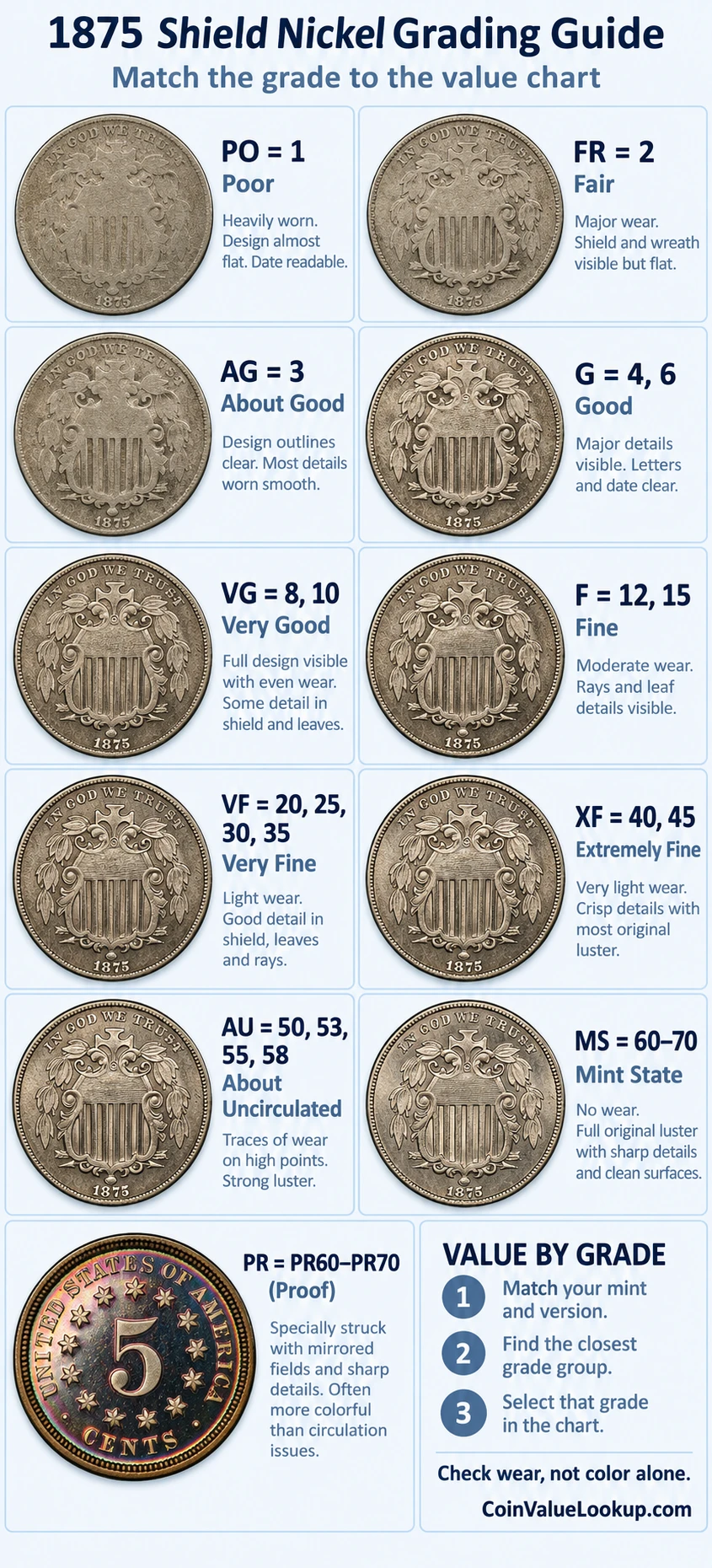
Focus first on the shield on the obverse. The horizontal and vertical lines within the shield are where wear shows up earliest.
In lower grades those lines merge together, especially at the center. Check the cross at the top and the leaves flanking the shield for smoothing.
Here's the tricky part: some 1875 nickels left the mint with a weak strike that makes those shield lines look indistinct even on an uncirculated coin. The key is to compare both sides.
A weakly struck coin still has original mint luster across its surfaces, while a worn coin shows friction and dullness on the high points.
Use the comparison image to match your coin's wear pattern against known grade benchmarks. Separate coins with problems — cleaning, corrosion, scratches, environmental damage — from the guide values listed here, because those estimates assume a problem-free surface.
Step 3: Check 1875 Shield Nickel Value by Mint and Version
1875 Shield Nickel — No Mint Mark — Circulation Strike
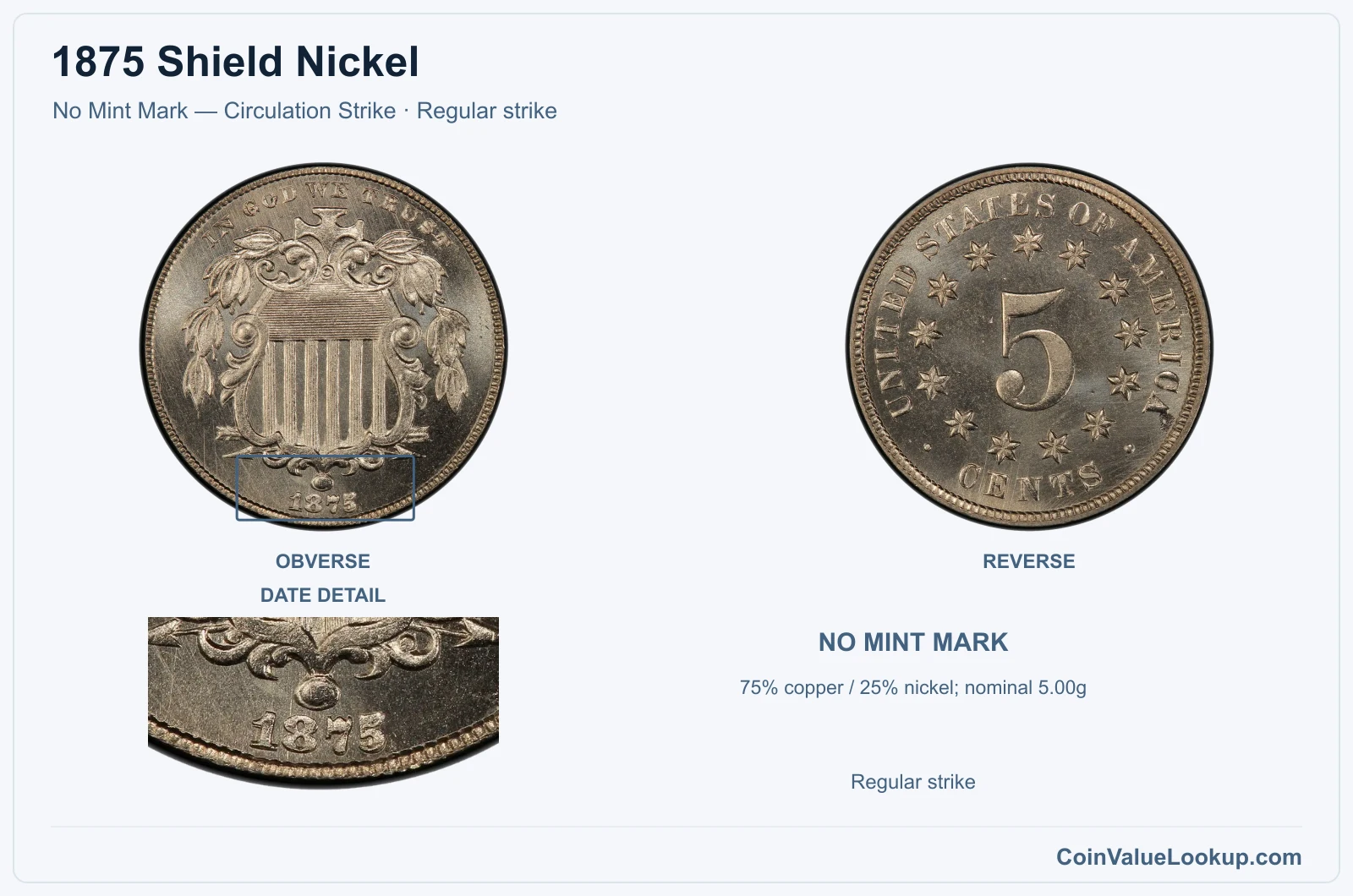
The standard 1875 Shield Nickel is a Philadelphia business strike with no mintmark, struck in copper-nickel. USA Coin Book pegs the retail guide value at roughly $61 in G4 and $498 in MS63.
Surface originality is the biggest factor with these. A coin that still has its original gray or golden-gray luster is far more desirable than one that has been cleaned to look shiny.
Some business strikes show fine die-polish lines from routine die maintenance at the mint, which can create a prooflike appearance. That mirror-like flash does not make the coin a proof.
Compare authenticated examples before drawing conclusions — a genuine proof has different overall surface qualities and edge characteristics than a polished business strike that merely looks bright.
Range Grade
Price Auction Records Appraisal PO PO 1
—
Coin Identifier FR FR 2
—
Coin Identifier AG AG 3
—
Coin Identifier G G 4
—
Coin Identifier
G 6
—
Coin Identifier VG VG 8
—
Coin Identifier
VG 10
—
Coin Identifier F F 12
Coin Identifier
F 15
—
Coin Identifier VF VF 20
Coin Identifier
VF 25
Coin Identifier
VF 30
Coin Identifier
VF 35
Coin Identifier XF XF 40
Coin Identifier
XF 45
Coin Identifier AU AU 50
Coin Identifier
AU 53
Coin Identifier
AU 55
Coin Identifier
AU 58
Coin Identifier MS MS 60
Coin Identifier
MS 61
Coin Identifier
MS 62
Coin Identifier
MS 63
Coin Identifier
MS 64
Coin Identifier
MS 65
Coin Identifier
MS 66
Coin Identifier
MS 67
Coin Identifier
MS 68
—
—
—
MS 69
—
—
—
MS 70
—
—
—
1875 Shield Nickel — No Mint Mark — Proof
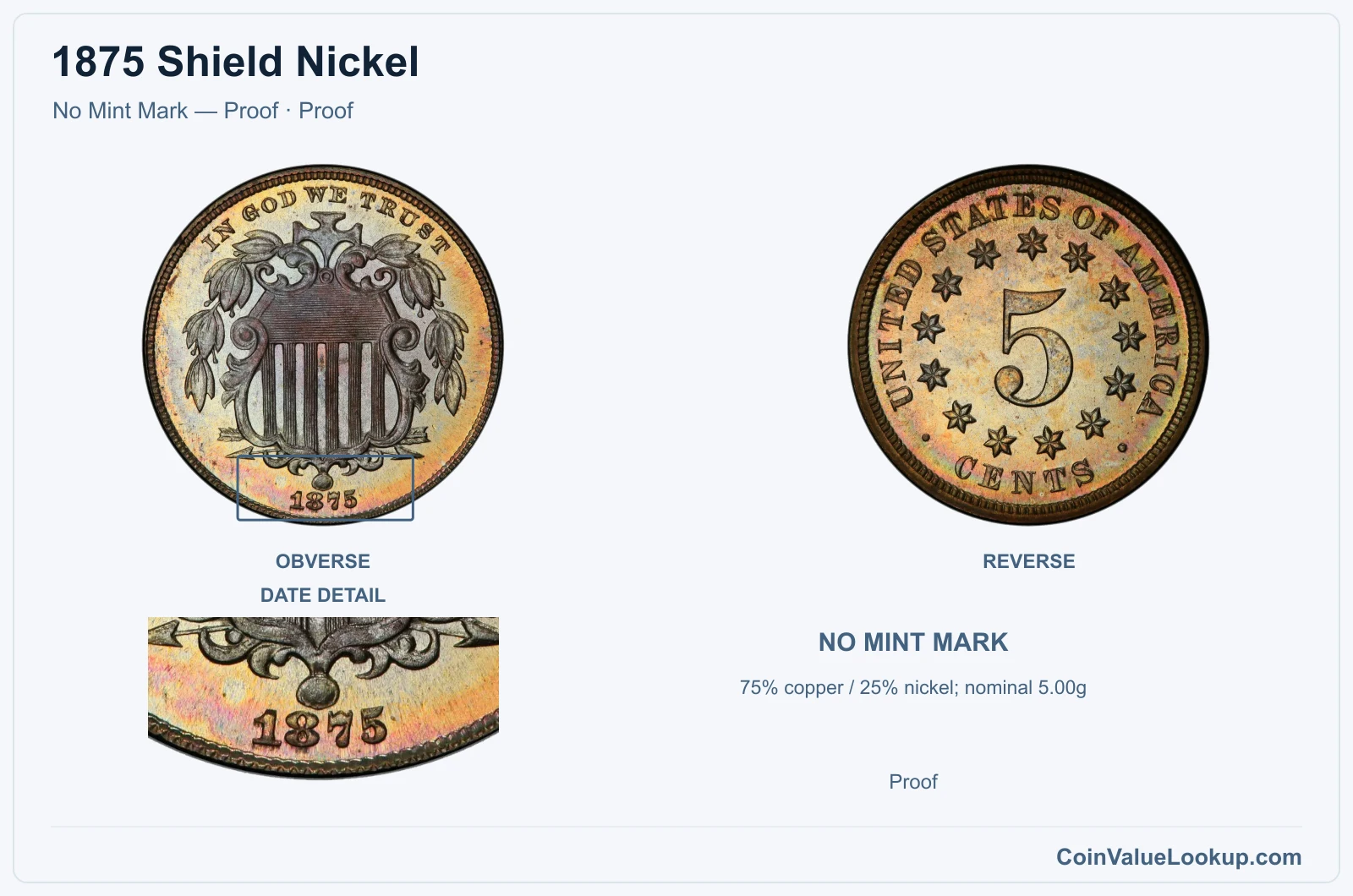
Philadelphia also struck proof Shield Nickels in 1875, and the USA Coin Book guide places a PR63 example around $468. These were made for collectors, using specially prepared dies and planchets.
Do not diagnose a proof from shine alone. Proof surfaces show deep, consistent reflectivity across both sides, and the overall finish differs from a business strike that picked up die-polish lines during production.
Edge quality and strike sharpness also help distinguish the two. If you suspect your coin is a proof, the safest route is comparison with certified, authenticated proof examples or submission to a major grading service.
Coin Value Lookup is a useful place to start when you want to look up guide values for this and other coin series before deciding whether professional grading makes sense for your piece.
Range Grade
Price Auction Records Appraisal PR PR 1
—
Coin Identifier
PR 2
—
Coin Identifier
PR 3
—
Coin Identifier
PR 4
—
Coin Identifier
PR 6
—
Coin Identifier
PR 8
—
Coin Identifier
PR 10
—
Coin Identifier
PR 12
—
Coin Identifier
PR 15
—
Coin Identifier
PR 20
—
Coin Identifier
PR 25
—
Coin Identifier
PR 30
—
Coin Identifier
PR 35
—
Coin Identifier
PR 40
—
Coin Identifier
PR 45
—
Coin Identifier
PR 50
—
Coin Identifier
PR 53
—
Coin Identifier
PR 55
—
Coin Identifier
PR 58
—
Coin Identifier
PR 60
—
Coin Identifier
PR 61
Coin Identifier
PR 62
Coin Identifier
PR 63
Coin Identifier
PR 64
Coin Identifier
PR 65
Coin Identifier
PR 66
Coin Identifier
PR 67
Coin Identifier
PR 68
—
—
—
PR 69
—
—
—
PR 70
—
—
—
1875 Shield Nickel Error List
1. 1875 Shield Nickel — Doubled Die Obverse
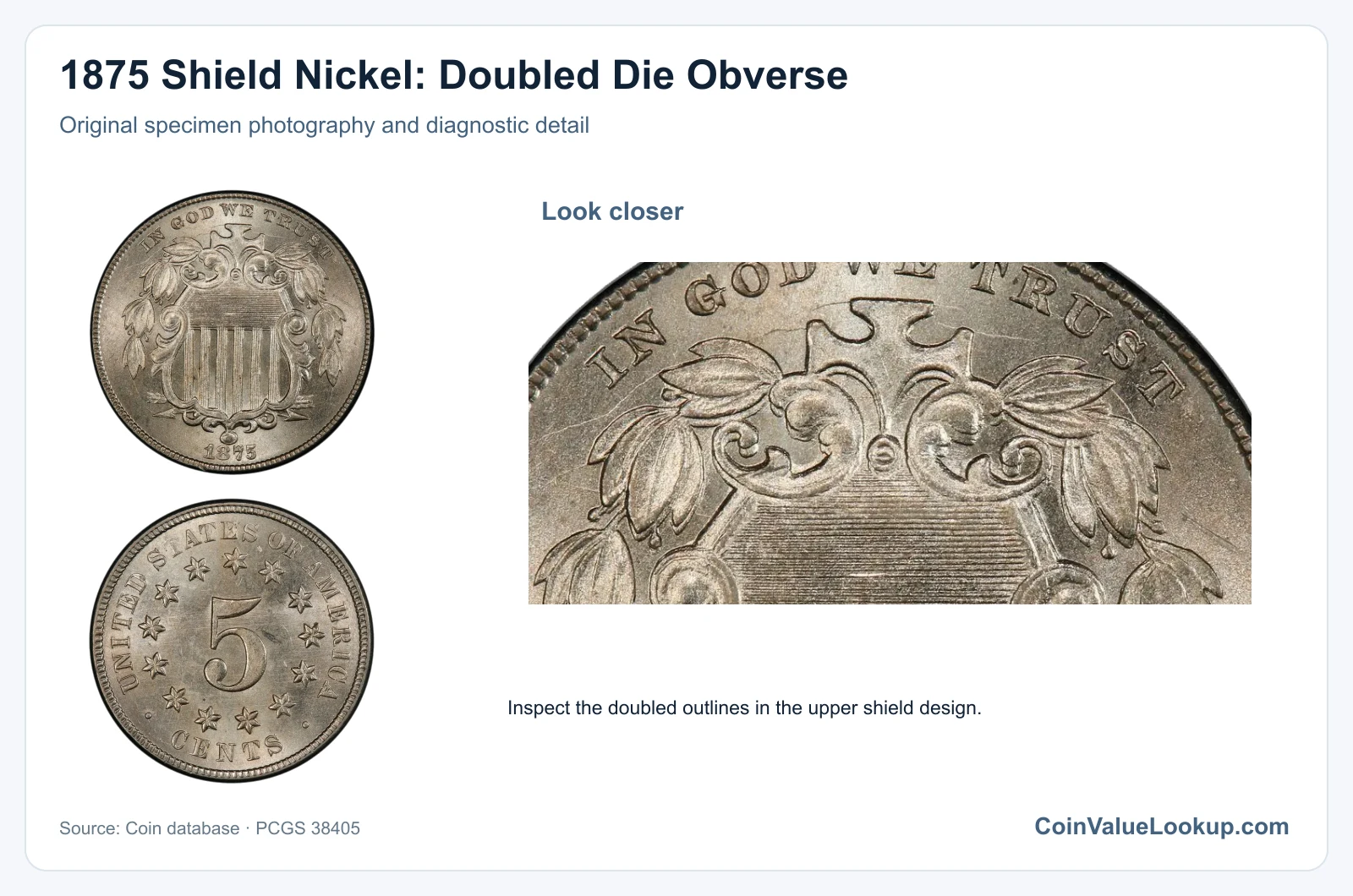
A Doubled Die Obverse has been reported for the 1875 Shield Nickel. This variety is created when a working die receives a slightly misaligned second impression from the hub, leaving duplicated design elements baked into the die itself.
To check for it, examine the obverse lettering and design elements under good magnification and even lighting. Look for consistent separation or notching on the letters — the doubling should repeat in the same direction across multiple elements.
A flat shelf or uniform spread on one side of a letter is a typical indicator.
Don't confuse this with machine doubling, which produces a flat, shelf-like distortion without the raised, rounded profile of a true doubled die. Reflections and worn die contours can also mimic the look.
The value of a doubled die depends on the specific variety, how visible the doubling is, and the coin's overall condition.
2. 1875 Shield Nickel — Repunched Date
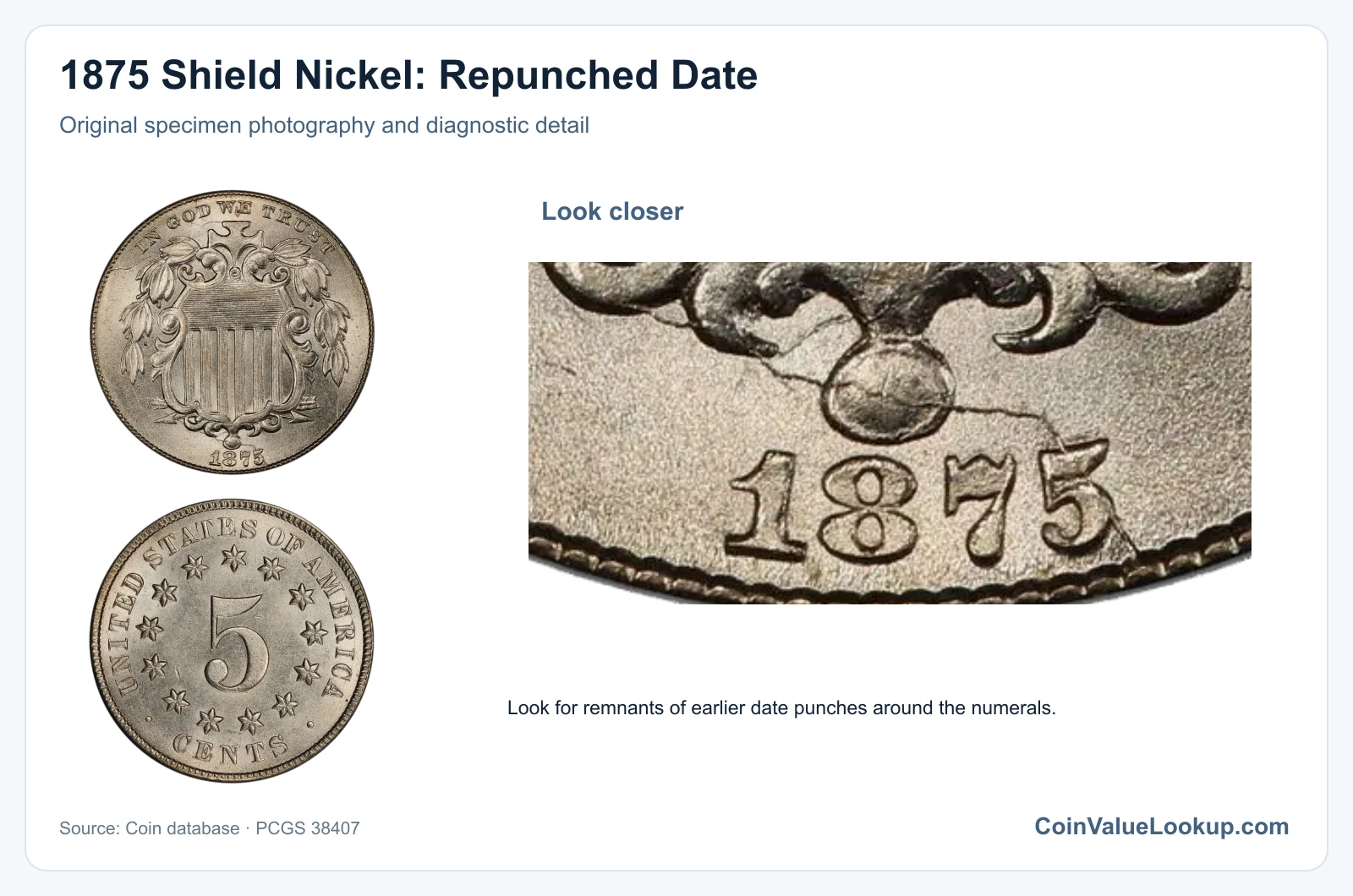
Repunched Date varieties are reported on the 1875 Shield Nickel. During production, date numerals were punched into the working die by hand, and sometimes the first impression landed slightly off position.
The die was then corrected with a second punch, leaving remnants of the first attempt visible beside or beneath the final digits.
Check each numeral in the date under magnification. You are looking for traces of an earlier position — perhaps a ghost of a "1" slightly to the left, or a "7" with a faint extra serif.
The remnants should be consistent with a shifted punch, not random damage.
This is different from a doubled die, which affects the entire obverse design rather than just the date. It is also distinct from a damaged or corroded date, which tends to show irregular pitting or loss of metal rather than clean secondary impressions.
Value depends on the clarity of the repunching and the coin's grade.
3. 1875 Shield Nickel — Die Crack / Die Chip
Die cracks and die chips have been reported on 1875 Shield Nickels. These show up as raised lines or small raised blobs on the coin's surface, caused by fractures or missing pieces in a deteriorating die.
They are part of the coin because the die transferred its damage into every strike.
A die crack typically appears as a thin raised line, often running from the rim toward the interior of the design. A die chip looks like a small raised bump, usually on a flat area or within a letter.
If a crack reaches the rim and a chunk of the die breaks away, it creates a raised blob called a cud — a distinct subcategory.
Do not confuse these with incuse scratches (which are recessed into the surface), corrosion, or foreign material stuck to the coin. True die cracks and chips are raised and repeat from coin to coin struck by the same damaged die.
Value varies with size, location, and the coin's overall condition.