1868 Shield Nickel Coin Value: How Much Is It Worth?
A typical 1868 Shield Nickel in well-worn Good-4 condition runs about $38 according to USA Coin Book retail estimates, climbing to roughly $281 in Mint State 63. Proof examples carry their own separate pricing.
Two different circulation reverse designs exist for this date, and each needs to be matched individually. Certain mint errors have also been reported, so it pays to look closely before assuming your coin is ordinary.
Fast Way to Identify Your 1868 Shield Nickel
The quickest way to start figuring out what you have is to upload clear photos of both sides of your coin. A well-lit, in-focus shot of the front and back gives enough detail for a preliminary identification of the design type, reverse variety, and overall condition.
This is not a substitute for professional authentication, but it points you in the right direction fast.
1868 Shield Nickel Value
Upload both sides of your 1868 Shield Nickel.
Front Obverse
Upload photo
Back Reverse
Upload photo
Which 1868 Shield Nickel Versions Are Worth Money?
- Two distinct circulation reverse designs (Reverse of 1867 and Reverse of 1868) exist for this date; correctly identifying your reverse type is the first step to an accurate evaluation.
- Proof 1868 Shield Nickels in PR63 are estimated around $468 by USA Coin Book; proof attribution requires more than just a shiny surface.
- Mint errors such as doubled dies, repunched dates, off-center strikes, and cuds have been reported for 1868 nickels; condition, visibility, and confirmed identity affect any premium.
- Original, problem-free Mint State business strikes in higher grades deserve closer individual evaluation, since values climb steeply above average circulated grades.
Step 1: Identify Your 1868 Shield Nickel Mint Mark and Version
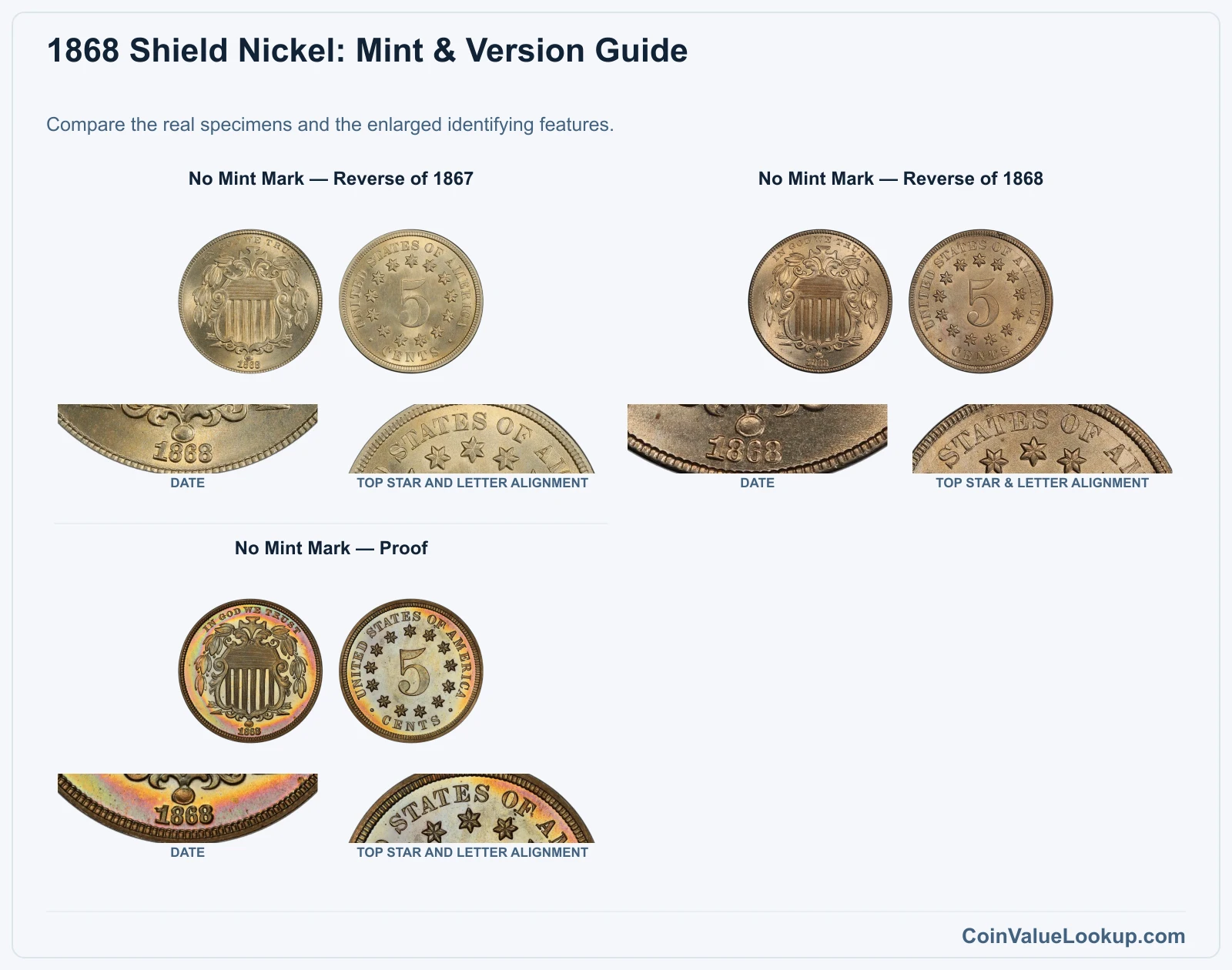
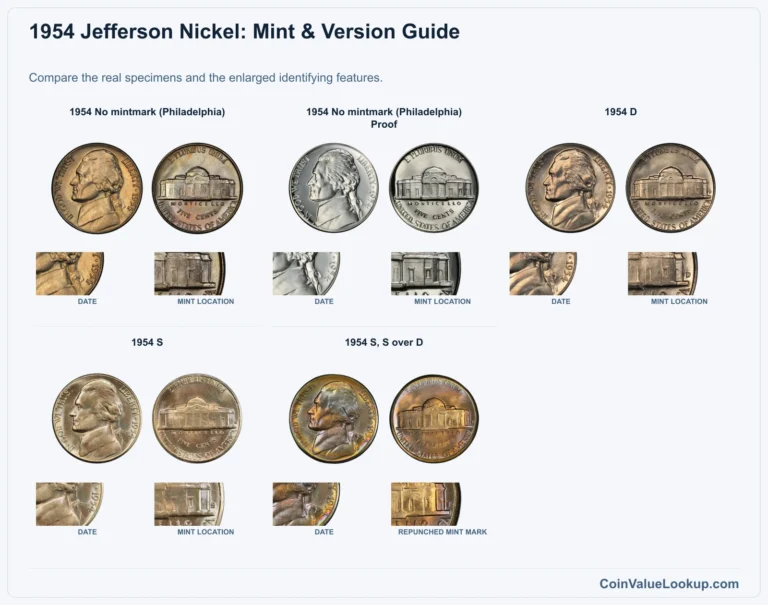
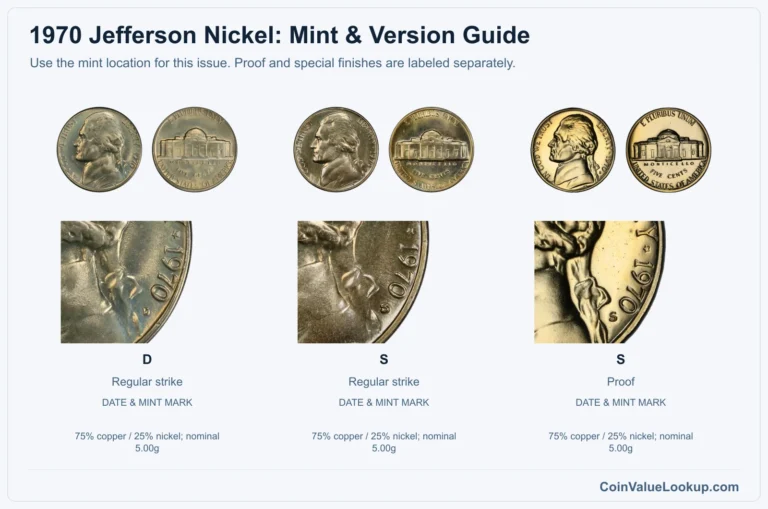
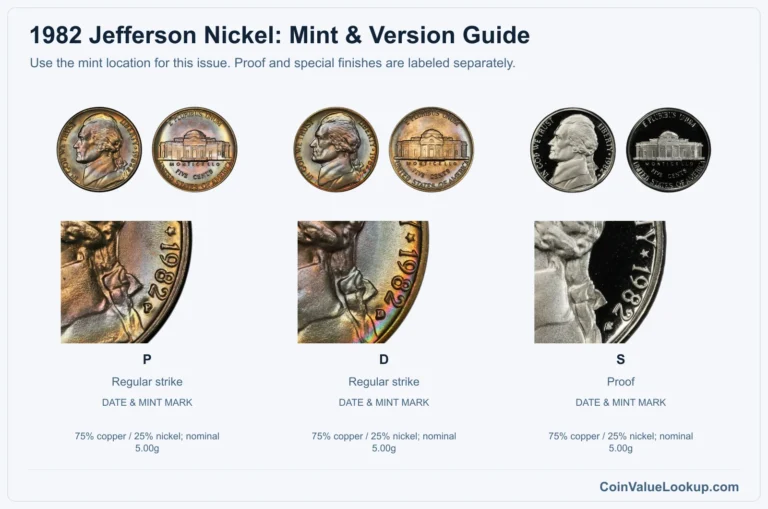
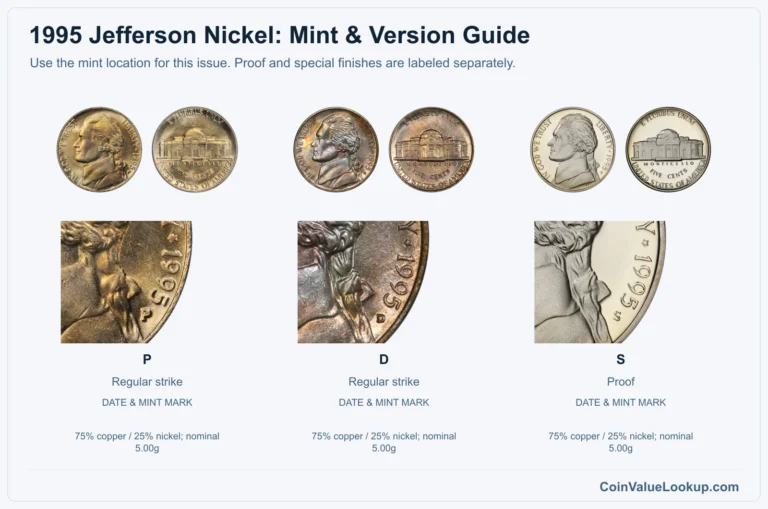
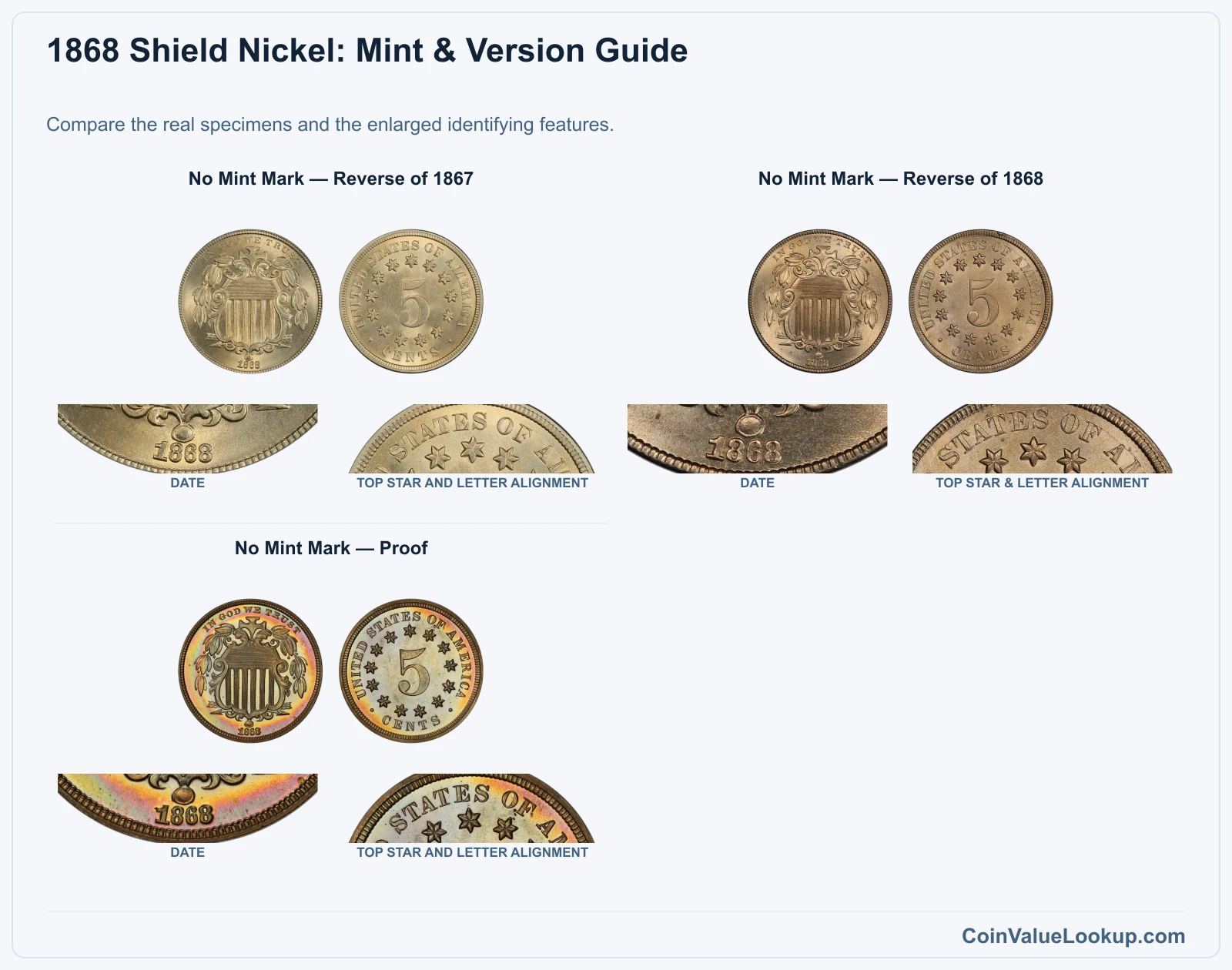
Every 1868 Shield Nickel was struck at the Philadelphia Mint, so there is no mintmark to look for. A missing letter below the wreath is completely normal for this issue.
The coin is copper-nickel (75% copper, 25% nickel), weighs about 5 grams, measures 20.5 mm across, and has a plain edge. No silver version exists.
The obverse carries the familiar Union shield, while the reverse displays a large numeral 5 surrounded by stars and the legend UNITED STATES OF AMERICA. Two circulation reverse designs were used: Reverse of 1867 and Reverse of 1868.
You distinguish them by comparing star-to-letter alignment on the reverse under magnification. This matters because the Reverse of 1868 hub can show missing portions of letters that look like filled dies or grease strikes but are actually part of the hub itself.
Start by deciding which reverse design your coin matches, then determine whether it is a business strike or a proof. After that, grade it.
And please, never clean the coin.
Step 2: Check Your 1868 Shield Nickel Grade
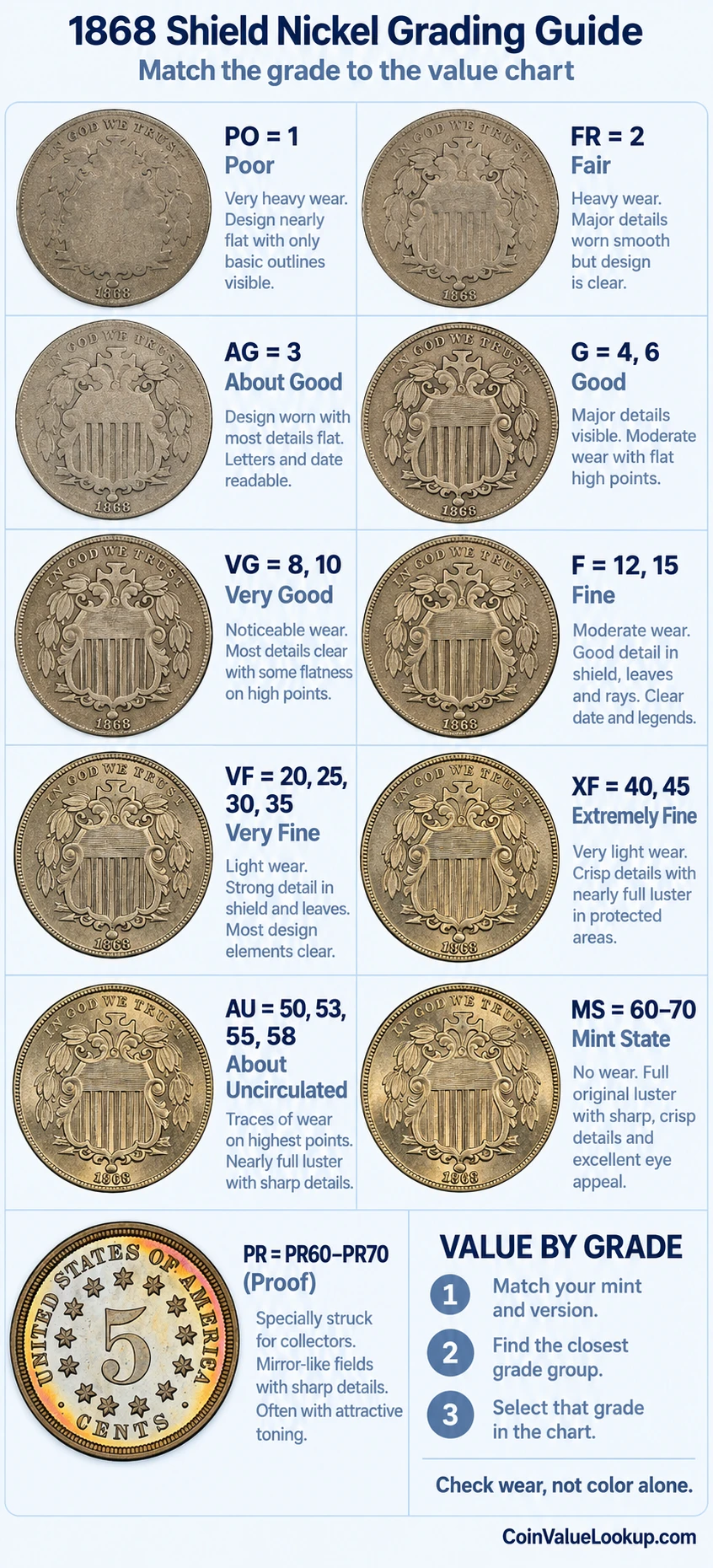
Focus on the highest relief areas first. On the obverse, check the horizontal and vertical shield lines and the central cross for signs of friction.
On the reverse, look at the numeral 5 and the star tips.
Here is the tricky part with Shield Nickels: a weakly struck coin can look worn even if it never circulated. If the shield lines are indistinct but luster is present and unbroken across both faces, you may have a poorly struck Mint State coin rather than a circulated one.
Compare your coin to the grading reference image to see how genuine wear differs from incomplete striking.
Coins that have been cleaned, corroded, or damaged should not be compared against guide values for problem-free examples. Those conditions reduce value significantly and are visible as unnatural surface brightness, pitting, or rim distortion.
Step 3: Check 1868 Shield Nickel Value by Mint and Version
1868 Shield Nickel — No Mint Mark — Reverse of 1867
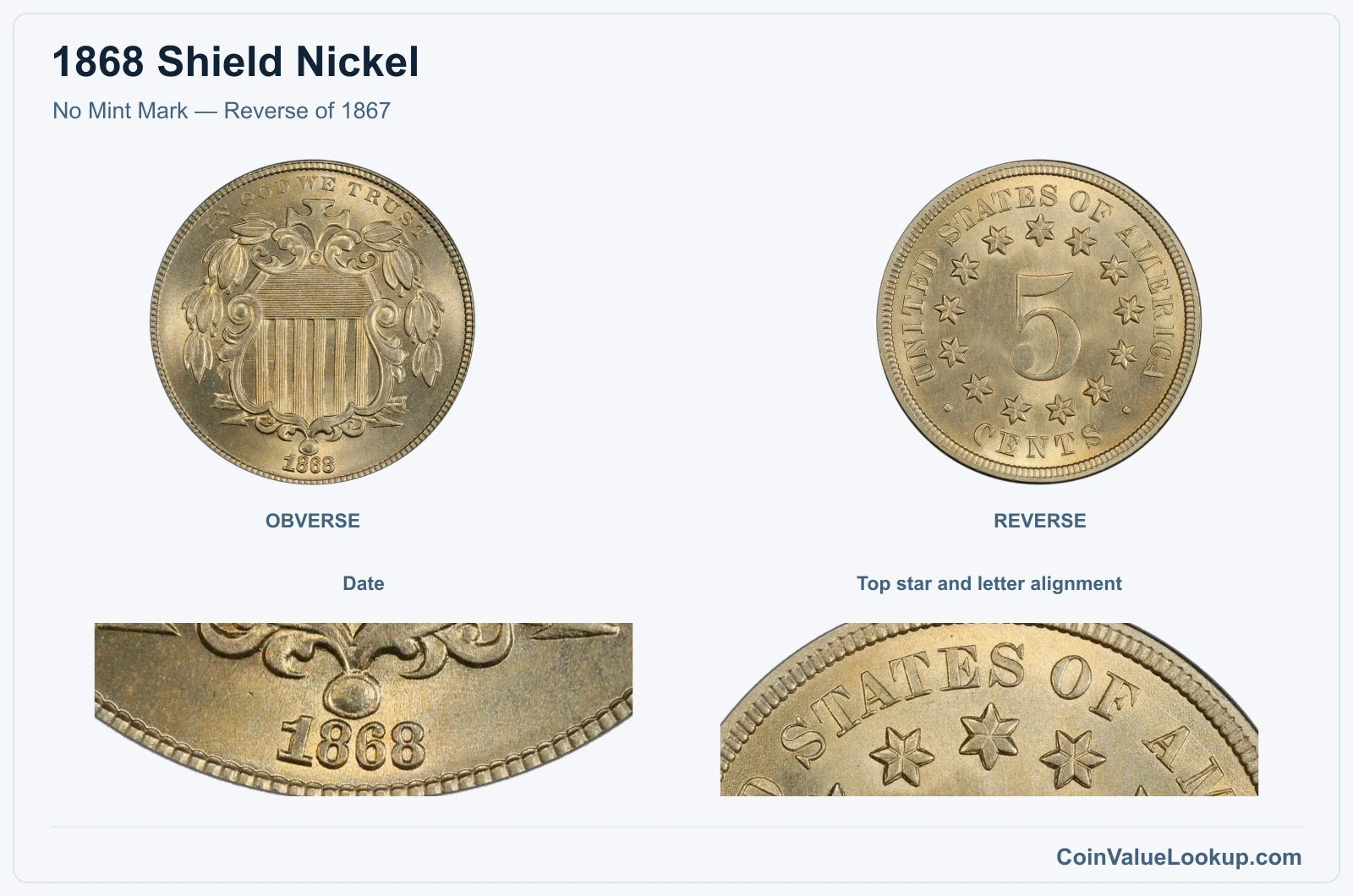
This is the 1868 business strike paired with the Reverse of 1867 die design. To confirm it, compare the alignment of the stars relative to the legend letters on the reverse under magnification.
The positioning differs measurably from the later hub.
No specific numeric price range is adopted for this subtype separate from the general 1868 guide figures. Value depends on authenticated identity, overall condition, and whether any errors are present.
A certified attribution from a major grading service helps pin down what you have.
Range Grade
Price Auction Records Appraisal PO PO 1
—
Coin Identifier FR FR 2
—
Coin Identifier AG AG 3
—
Coin Identifier G G 4
Coin Identifier
G 6
Coin Identifier VG VG 8
—
Coin Identifier
VG 10
—
Coin Identifier F F 12
—
Coin Identifier
F 15
—
Coin Identifier VF VF 20
Coin Identifier
VF 25
—
Coin Identifier
VF 30
Coin Identifier
VF 35
Coin Identifier XF XF 40
Coin Identifier
XF 45
Coin Identifier AU AU 50
Coin Identifier
AU 53
Coin Identifier
AU 55
Coin Identifier
AU 58
Coin Identifier MS MS 60
—
Coin Identifier
MS 61
Coin Identifier
MS 62
Coin Identifier
MS 63
Coin Identifier
MS 64
Coin Identifier
MS 65
Coin Identifier
MS 66
Coin Identifier
MS 67
Coin Identifier
MS 68
—
—
—
MS 69
—
—
—
MS 70
—
—
—
1868 Shield Nickel — No Mint Mark — Reverse of 1868
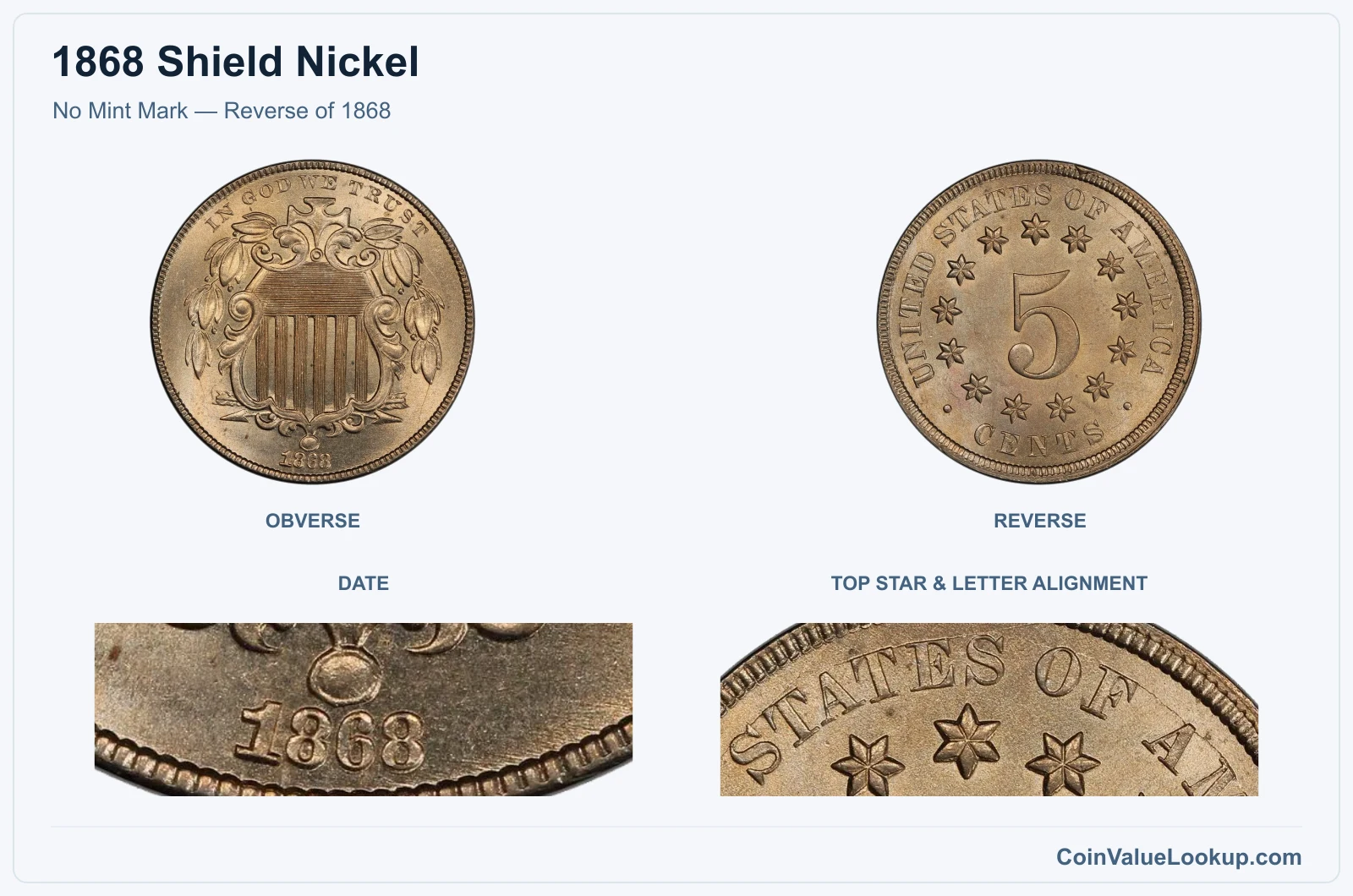
The Reverse of 1868 business strike uses a revised hub that sometimes shows broken or incomplete letters in the legend. These missing letter segments are part of the hub itself, not grease-filled dies or damage.
That distinction matters, because a coin with hub-related letter gaps is attributed differently than one struck through debris.
Star alignment under magnification is again the key diagnostic. If your coin's reverse stars and legend spacing match the later configuration, you have this version.
No separate numeric price range is adopted here; value depends on authenticated identity, condition, and any confirmed errors. Individual assessment is the way to go.
Range Grade
Price Auction Records Appraisal PO PO 1
—
Coin Identifier FR FR 2
—
Coin Identifier AG AG 3
—
Coin Identifier G G 4
Coin Identifier
G 6
Coin Identifier VG VG 8
—
Coin Identifier
VG 10
—
Coin Identifier F F 12
—
Coin Identifier
F 15
—
Coin Identifier VF VF 20
Coin Identifier
VF 25
—
Coin Identifier
VF 30
Coin Identifier
VF 35
Coin Identifier XF XF 40
Coin Identifier
XF 45
Coin Identifier AU AU 50
Coin Identifier
AU 53
Coin Identifier
AU 55
Coin Identifier
AU 58
Coin Identifier MS MS 60
—
Coin Identifier
MS 61
Coin Identifier
MS 62
Coin Identifier
MS 63
Coin Identifier
MS 64
Coin Identifier
MS 65
Coin Identifier
MS 66
Coin Identifier
MS 67
Coin Identifier
MS 68
—
—
—
MS 69
—
—
—
MS 70
—
—
—
1868 Shield Nickel — No Mint Mark — Proof
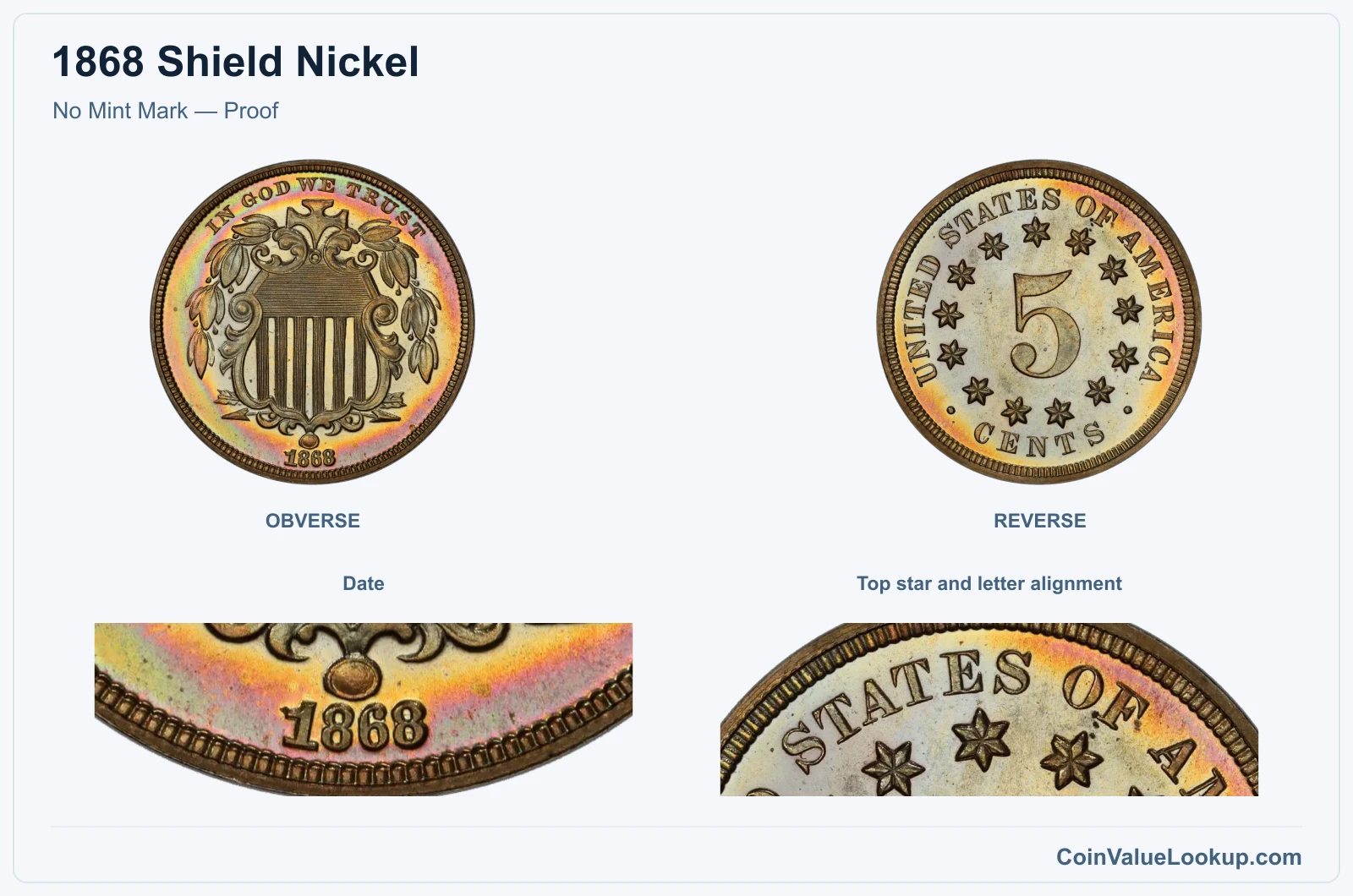
Proof 1868 Shield Nickels were struck at Philadelphia using the Reverse of 1867 design. A proof is a manufacturing method, not a grade above Mint State.
Genuine proofs show squared rims, fully struck details, and mirror-like fields that differ from a merely lustrous business strike.
Coin Value Lookup can help you compare your coin against guides for different years and denominations as you research. If you are unsure whether your coin is truly a proof, professional authentication is strongly recommended.
USA Coin Book estimates a PR63 example at about $468. That is a retail guide figure, not a guaranteed sale price.
Range Grade
Price Auction Records Appraisal PR PR 1
—
Coin Identifier
PR 2
—
Coin Identifier
PR 3
—
Coin Identifier
PR 4
—
Coin Identifier
PR 6
—
Coin Identifier
PR 8
—
Coin Identifier
PR 10
—
Coin Identifier
PR 12
—
Coin Identifier
PR 15
—
Coin Identifier
PR 20
—
Coin Identifier
PR 25
—
Coin Identifier
PR 30
—
Coin Identifier
PR 35
—
Coin Identifier
PR 40
—
Coin Identifier
PR 45
—
Coin Identifier
PR 50
—
Coin Identifier
PR 53
—
Coin Identifier
PR 55
—
Coin Identifier
PR 58
—
Coin Identifier
PR 60
—
Coin Identifier
PR 61
Coin Identifier
PR 62
Coin Identifier
PR 63
Coin Identifier
PR 64
Coin Identifier
PR 65
Coin Identifier
PR 66
Coin Identifier
PR 67
Coin Identifier
PR 68
—
—
—
PR 69
—
—
—
PR 70
—
—
—
1868 Shield Nickel Error List
1. 1868 Shield Nickel — Doubled Die Obverse
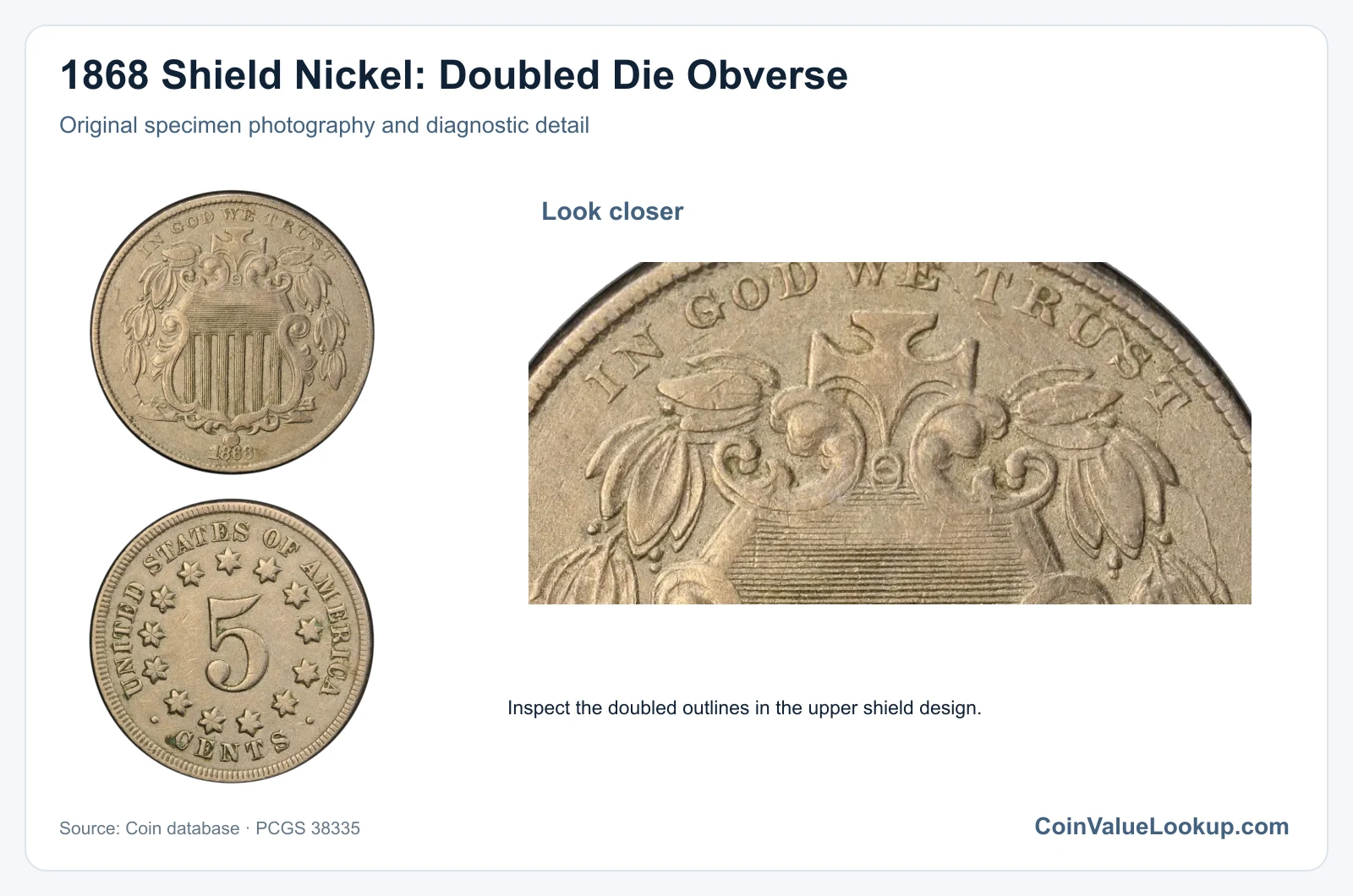
A Doubled Die Obverse on an 1868 Shield Nickel shows consistent separation or notching on obverse letters or design elements. Under magnification, the doubling will appear uniform across affected areas, not random or shelf-like.
Compare your coin's obverse to a normal 1868 under the same lighting. Genuine hub doubling produces matching directional spread, while machine doubling tends to leave flat, shelf-like distortion with reduced detail.
Reflections from curved surfaces can also mimic doubling at certain angles.
No specific price range is adopted for this error. Value depends on the visibility of the doubling, overall coin condition, and confirmed attribution by a grading service.
2. 1868 Shield Nickel — Repunched Date
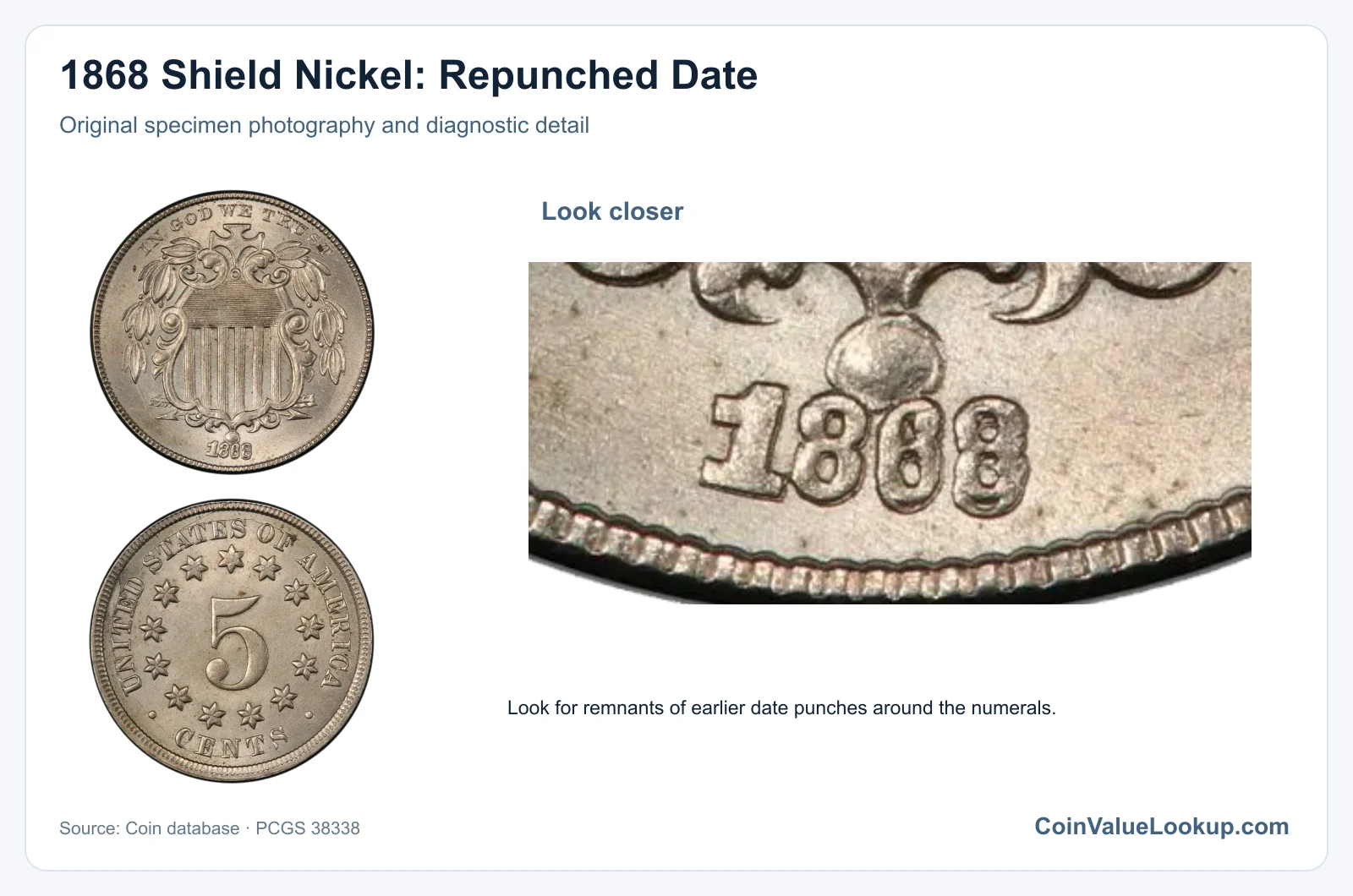
A Repunched Date occurs when the date numerals were punched into the die more than once in slightly different positions. On an 1868 Shield Nickel, look for remnants of an earlier date impression peeking out beside or beneath the final digits.
These traces are usually visible near the tops or bases of the numerals 1, 8, 6, or 8.
This is different from a doubled die, which affects the entire design from a misaligned hub. A repunched date is localized to the date area.
Do not confuse it with post-strike damage or machine doubling, which looks flatter and less distinct.
No adopted price range exists for this variety. Condition, clarity of the repunching, and professional attribution all influence any premium.
3. 1868 Shield Nickel — Die Break / Cud
A cud is a raised, featureless blob of metal that connects to the rim. It forms when a piece of the die breaks away entirely, leaving a void that fills with metal during striking.
On an 1868 Shield Nickel, check the rim edges on both sides for any irregular raised lump that obliterates part of the design.
Smaller interior die breaks that do not reach the rim are technically die chips, not cuds. Rim dents and corrosion are post-mint damage and look depressed or pitted rather than raised and smooth.
A true cud has a distinct boundary where normal design stops and the raised blank area begins.
No specific price is adopted. Size, location, and coin condition all factor into any premium.
4. 1868 Shield Nickel — Clashed Dies
Clashed dies happen when the obverse and reverse dies strike each other without a planchet between them. The impact transfers ghost-like traces of the opposite design onto each die, and those traces then appear on subsequently struck coins.
On an 1868 Shield Nickel, look in the open fields for faint outlines that mirror the opposing side's design elements, positioned where you would expect them based on the coin's orientation. These marks should be consistent and aligned, not random.
Scratches, incuse lines, and post-mint damage can mimic a clash at first glance but lack the systematic alignment. No adopted price range exists for this error.
Value depends on how visible the clash is, the coin's condition, and confirmed attribution.
5. 1868 Shield Nickel — Off-Center Strike
An off-center strike means the planchet was not properly seated between the dies, so part of the design is missing and a blank crescent appears along one edge. The percentage off-center and whether the date remains visible are the two biggest factors for collectibility.
On an 1868 Shield Nickel, confirm that the blank area is crescent-shaped and that the struck portion shows normal detail progressively fading toward the unstruck zone. A clipped planchet has a curved or straight missing section but the design is fully centered.
Post-mint flattening or a bent coin will show distortion rather than a clean unstruck area.
No price range is adopted. The degree of displacement, date visibility, and overall condition determine value.
6. 1868 Shield Nickel — Doubled Die Reverse
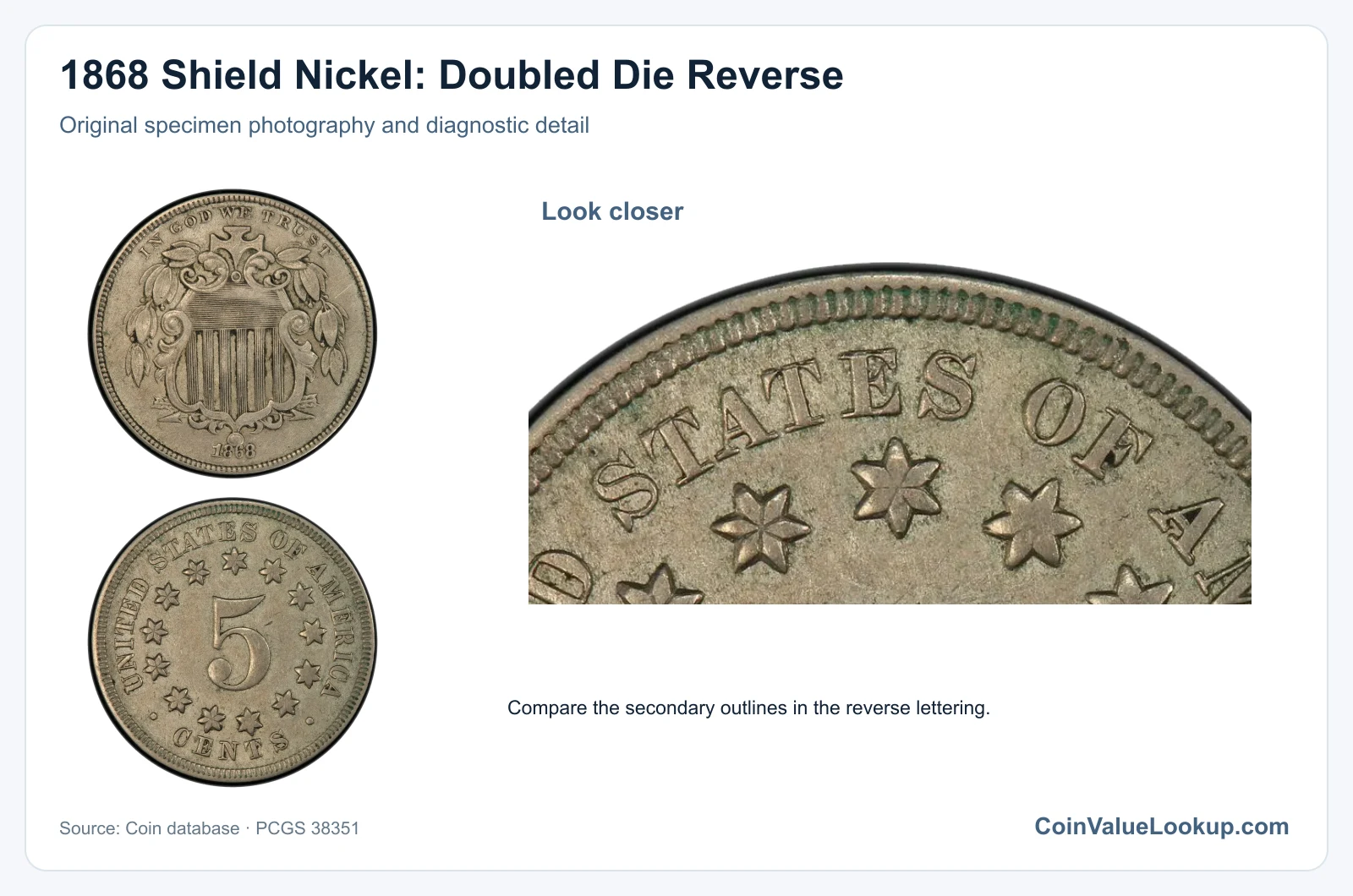
A Doubled Die Reverse shows consistent doubling on reverse legend letters, the numeral 5, or other design elements. Under magnification, look for separation or notching that repeats in the same direction across multiple features.
Compare your coin's reverse closely with a normal 1868 example. Machine doubling produces flat, shelf-like distortion and actually removes detail, while true hub doubling adds a second, slightly offset image with full detail on both impressions.
Random damage and surface reflections can also fool you at lower magnification.
No specific price range is adopted. Value depends on the particular variety, how visible the doubling is, and the coin's grade.
Professional attribution is recommended for any suspected doubled die.
7. 1868 Shield Nickel — Die Crack / Die Chip
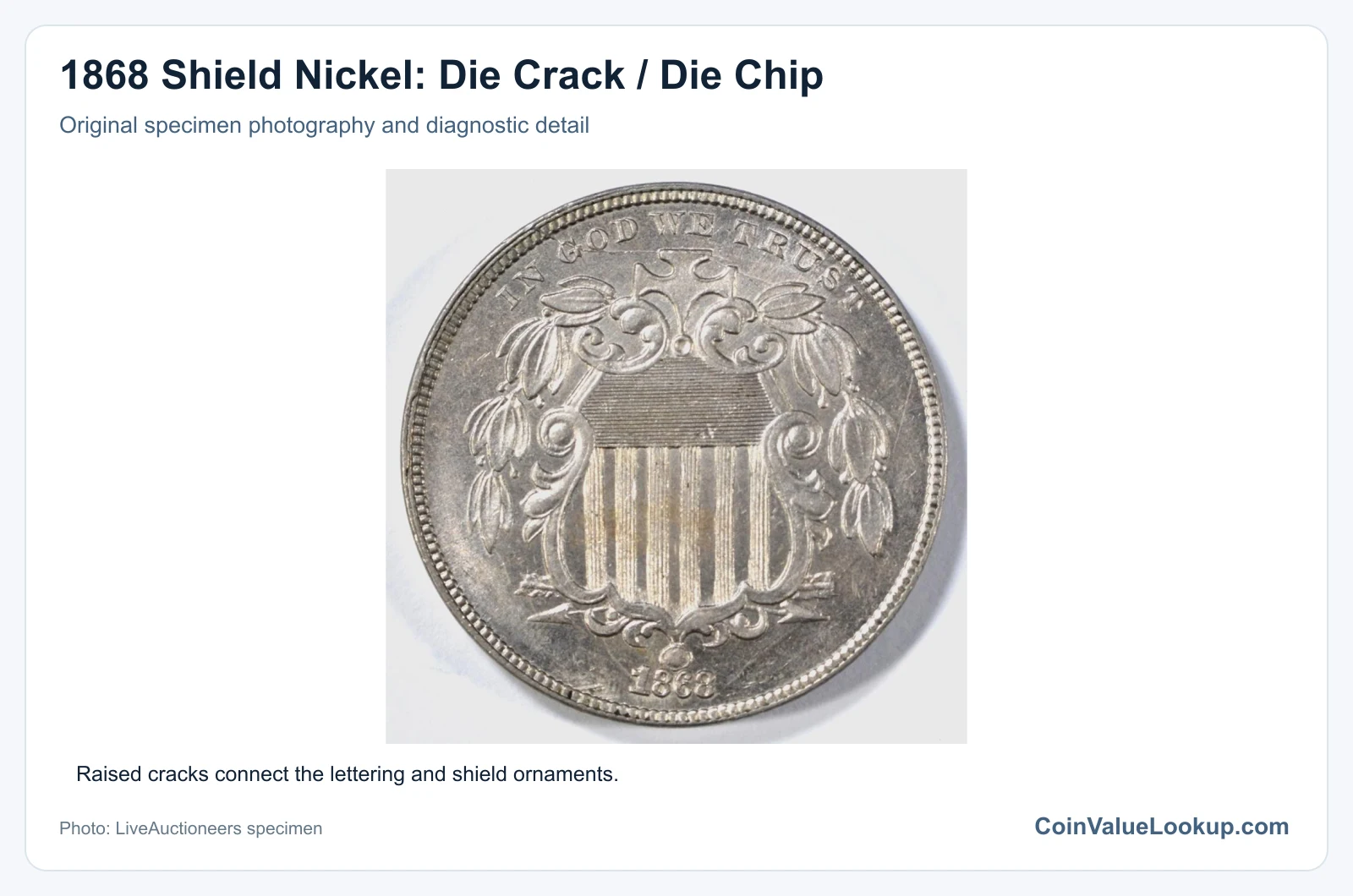
Die cracks appear as thin, raised lines on the coin's surface, formed when the steel die develops fractures from repeated use. Die chips are small raised blobs from localized damage to the die face.
Both are common on well-used dies.
On an 1868 Shield Nickel, check both sides for any raised line that runs across the design or a small raised lump within a letter or device. A die crack that reaches the rim but does not obliterate a large area is still a crack, not a cud.
Incuse scratches, surface corrosion, and foreign material stuck to the coin are post-mint and sit below or on the surface rather than being raised.
No adopted price range exists. Prominence, location, and coin condition affect any premium.
8. 1868 Shield Nickel — Die Gouge / Named Raised-Line Variety
A die gouge is a raised line or extra-metal feature caused by physical damage to the die itself, such as a tool scraping across its surface. The result on the coin is a raised mark in a specific, repeatable position on every coin struck from that die.
On an 1868 Shield Nickel, look for a raised line or blob that appears in a consistent location relative to the surrounding design. Compare against a normal coin to confirm the feature is not just a random scratch.
An incuse scratch sits below the surface, while a die gouge is raised above it. Unrelated die cracks tend to follow stress lines, whereas gouges can appear at any angle.
No price range is adopted. The feature's visibility, position, and the coin's condition all matter.
9. 1868 Shield Nickel — Misplaced Date
A misplaced date occurs when a trace of one or more date numerals appears outside the normal date position, typically because the die was punched in the wrong spot before being corrected. On an 1868 Shield Nickel, look near the ball (or dentils area) just above the date for a faint extra numeral impression.
This is a subtle variety. You will need magnification and good lighting to see the displaced digit trace.
Die chips and corrosion in the same area can create bumps that superficially resemble a misplaced numeral, but they lack the defined shape of an actual digit.
No adopted price range exists. Value depends on how clearly the misplaced numeral is visible and the coin's overall condition.