1995 Jefferson Nickel Coin Value: How Much Is It Worth?
The 1995 Jefferson nickel is a common modern coin, but grade and variety matter. Ordinary circulated examples trade near face value.
Selected USA Coin Book retail guide anchors for uncirculated pieces range from about $0.30 at MS60 to $1.24 at MS65, depending on mint. Proofs and authenticated errors occupy their own price tiers entirely.
Fast Way to Identify Your 1995 Jefferson Nickel
Snap clear photos of both sides of your 1995 nickel and upload them here for a preliminary identification. Good lighting helps — natural daylight or a desk lamp at a low angle works well.
This step can help you figure out which mint, finish, and condition category your coin falls into before you dig deeper.
1995 Jefferson Nickel Value
Upload both sides of your 1995 Jefferson Nickel.
Front Obverse
Upload photo
Back Reverse
Upload photo
Which 1995 Jefferson Nickel Versions Are Worth Money?
- Certified Full Steps examples from P or D mints can sell for premiums above standard uncirculated prices; check the Monticello steps carefully.
- The 1995-S proof has a PR65 guide anchor around $6.25, with cameo and deep cameo versions valued separately.
- A nickel struck on a defective cent blank sold at Heritage in August 2010 for $891.25 — a scarce wrong-planchet error.
- A nickel struck on a dime blank (2.3 grams) brought $336 at Heritage in July 2022; weight and size confirm the blank.
- Doubled die obverse, broadstrike, die crack, and lamination errors are also reported for this year and worth inspecting.
Step 1: Identify Your 1995 Jefferson Nickel Mint Mark and Version
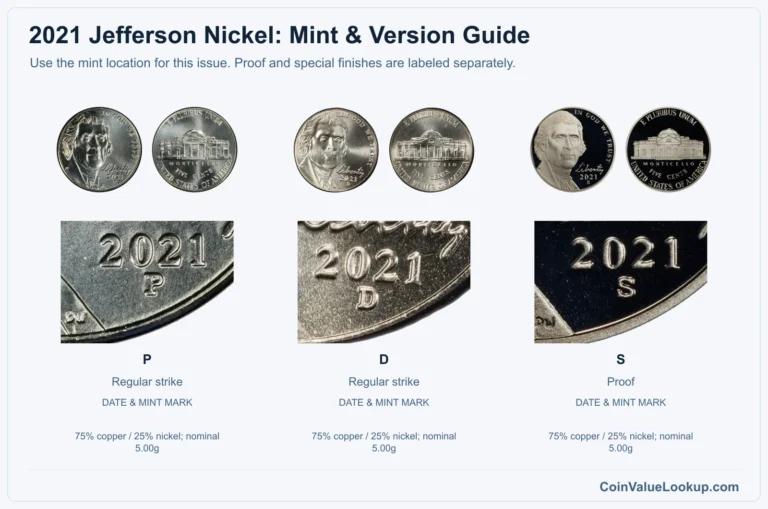
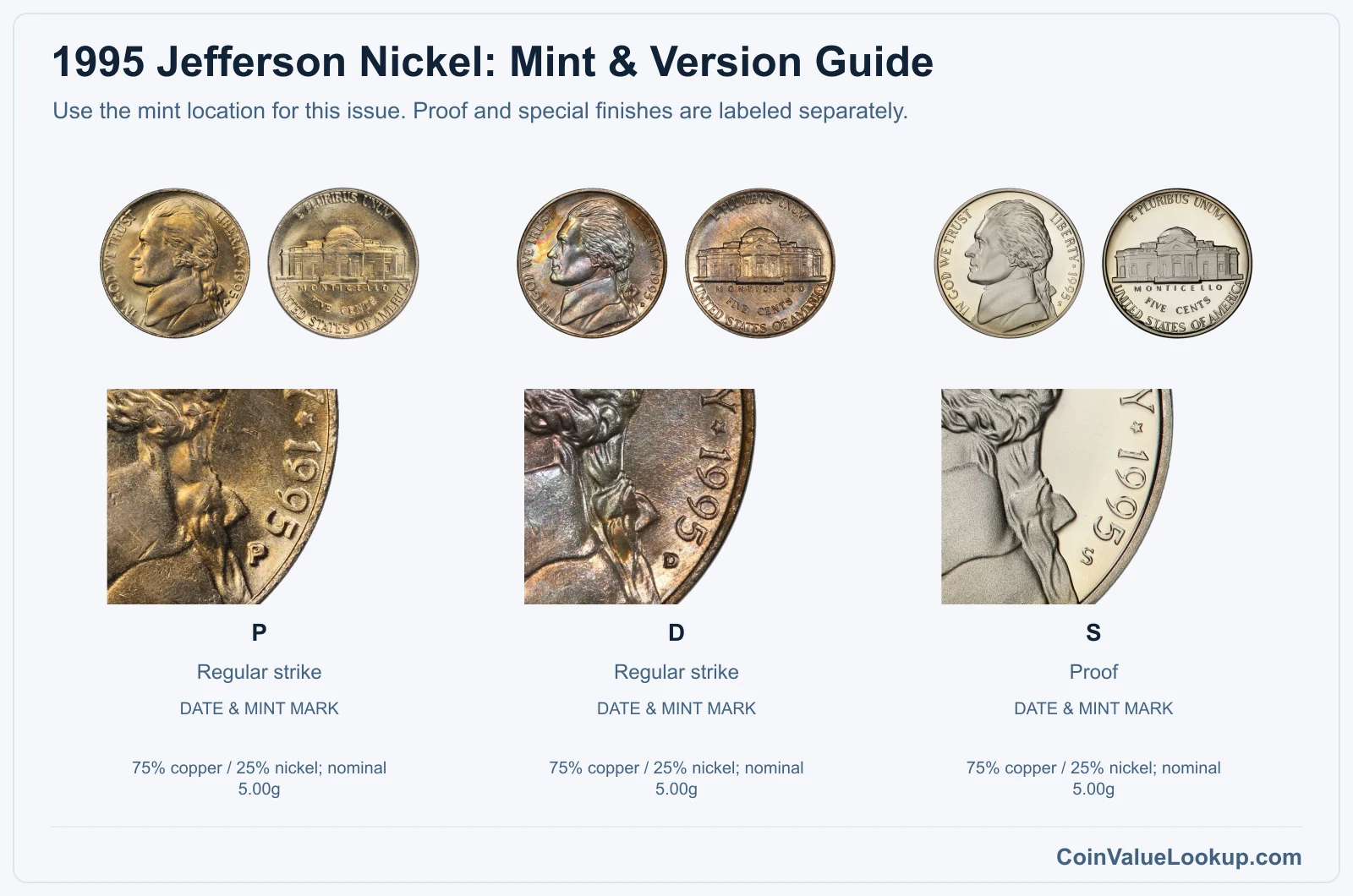
Start by finding the mintmark on the obverse, just below the date and to the right. A "P" means Philadelphia, "D" means Denver, and "S" means San Francisco proof.
No other mints struck Jefferson nickels in 1995.
All three versions use the same 75% copper, 25% nickel alloy at a nominal 5.00 grams and 21.2 mm diameter with a plain edge. The design is the standard Jefferson portrait on the obverse and Monticello on the reverse.
Proofs have a mirror-like finish and sharply defined details. Do not diagnose a proof just because a coin looks shiny — it needs correct attribution and provenance, not just brightness.
Record the date, mintmark, weight, and both faces before selecting a value chart.
Step 2: Check Your 1995 Jefferson Nickel Grade
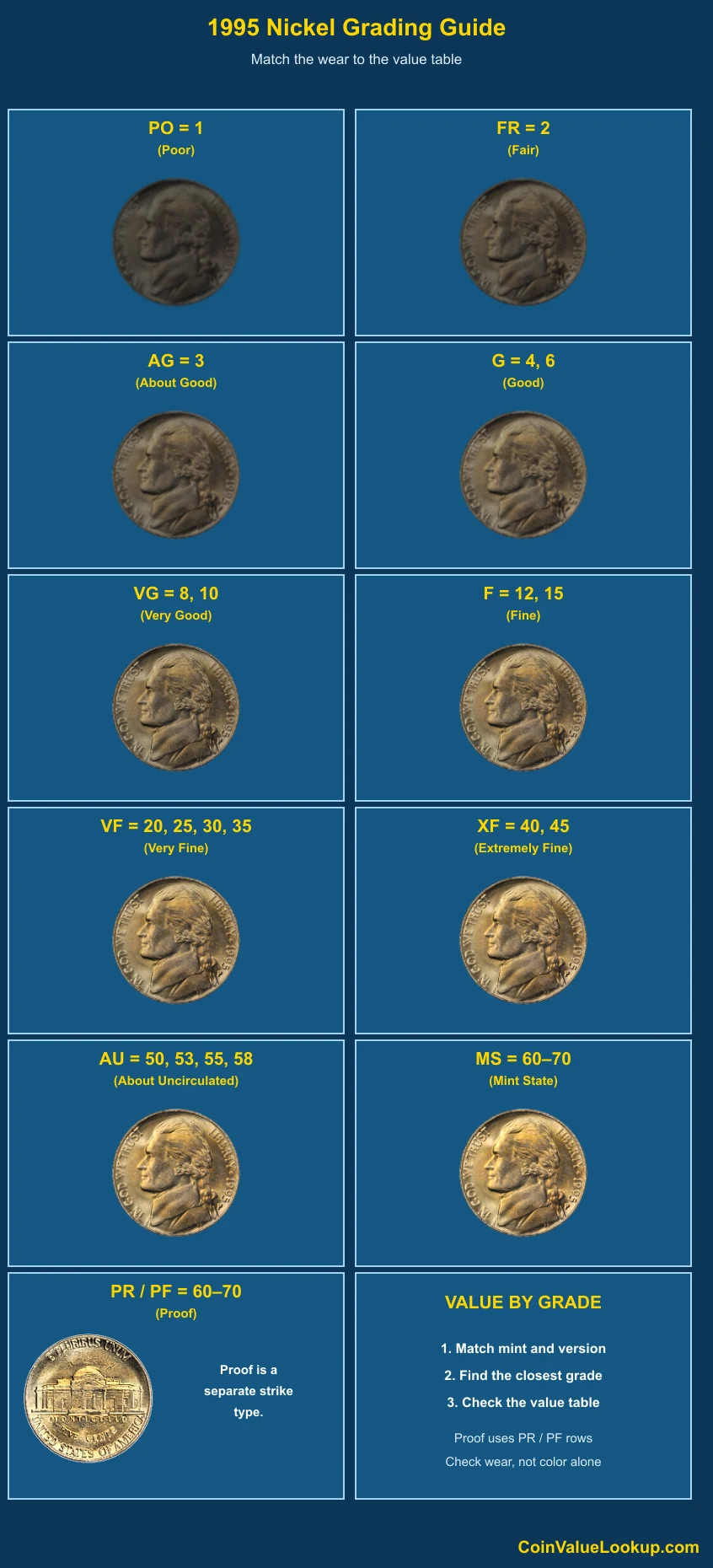
Focus on Jefferson's cheek and hair above the ear — these are the first spots to show friction. Even light rub will dull the original luster there before anywhere else.
On the reverse, check the horizontal lines of Monticello's steps and the pillars for softness.
Use the comparison image to match your coin's wear pattern against known grade benchmarks. A coin with full original luster and no contact marks lands in Mint State territory.
One with slight highpoint wear drops to About Uncirculated.
Full Steps is a separate strike-quality designation applied only to Mint State coins — it is not a grade and not an error. Coins with complete, uninterrupted steps on Monticello can command premiums when certified, but incomplete steps are often just a weak strike, not damage.
Proof cameo designations work the same way: they describe the contrast between frosted devices and mirrored fields, not a higher numerical grade.
Step 3: Check 1995 Jefferson Nickel Value by Mint and Version
1995 Jefferson Nickel — P Business strike
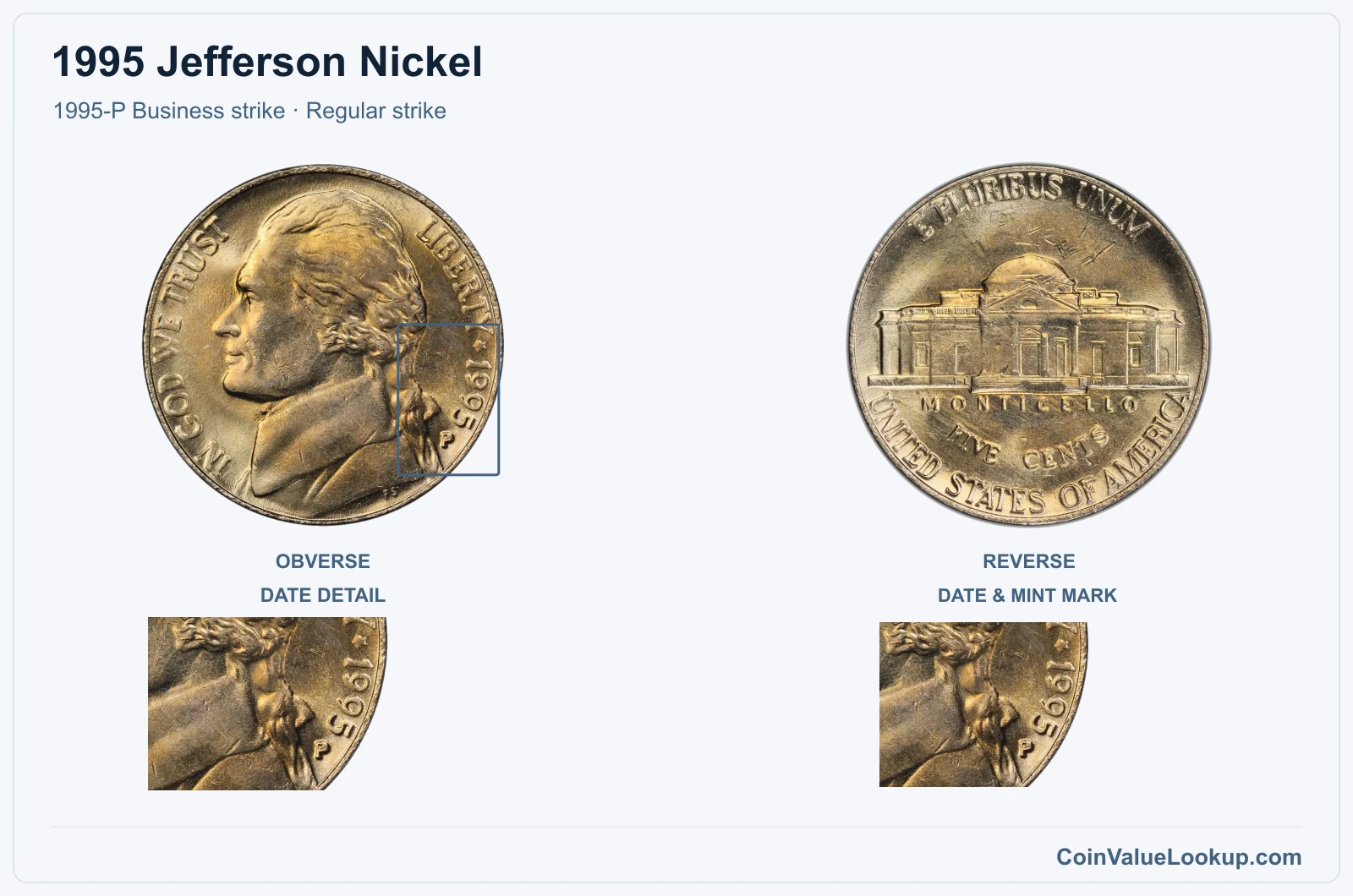
The 1995-P is the Philadelphia business strike, carrying a small "P" mintmark below the date. It uses the standard 75% copper, 25% nickel composition at 5.00 grams.
USA Coin Book lists retail guide anchors of about $0.30 at MS60 and $1.24 at MS65. Circulated examples are worth face value.
If you have an uncirculated piece with strong luster and clean surfaces, it is worth grading carefully — particularly for Full Steps designation, which can push the premium above these baseline figures when certified.
| Range | Grade | Price | Auction Records | Appraisal |
|---|---|---|---|---|
| PO | PO 1 | — | Coin Identifier | |
| FR | FR 2 | — | Coin Identifier | |
| AG | AG 3 | — | Coin Identifier | |
| G | G 4 | — | Coin Identifier | |
| G 6 | — | Coin Identifier | ||
| VG | VG 8 | — | Coin Identifier | |
| VG 10 | — | Coin Identifier | ||
| F | F 12 | — | Coin Identifier | |
| F 15 | — | Coin Identifier | ||
| VF | VF 20 | — | Coin Identifier | |
| VF 25 | — | Coin Identifier | ||
| VF 30 | — | Coin Identifier | ||
| VF 35 | — | Coin Identifier | ||
| XF | XF 40 | — | Coin Identifier | |
| XF 45 | — | Coin Identifier | ||
| AU | AU 50 | — | Coin Identifier | |
| AU 53 | — | Coin Identifier | ||
| AU 55 | — | Coin Identifier | ||
| AU 58 | — | Coin Identifier | ||
| MS | MS 60 | — | Coin Identifier | |
| MS 61 | — | Coin Identifier | ||
| MS 62 | — | Coin Identifier | ||
| MS 63 | Coin Identifier | |||
| MS 64 | Coin Identifier | |||
| MS 65 | — | Coin Identifier | ||
| MS 66 | Coin Identifier | |||
| MS 67 | Coin Identifier | |||
| MS 68 | — | — | — | |
| MS 69 | — | — | — | |
| MS 70 | — | — | — |
1995 Jefferson Nickel — D Business strike
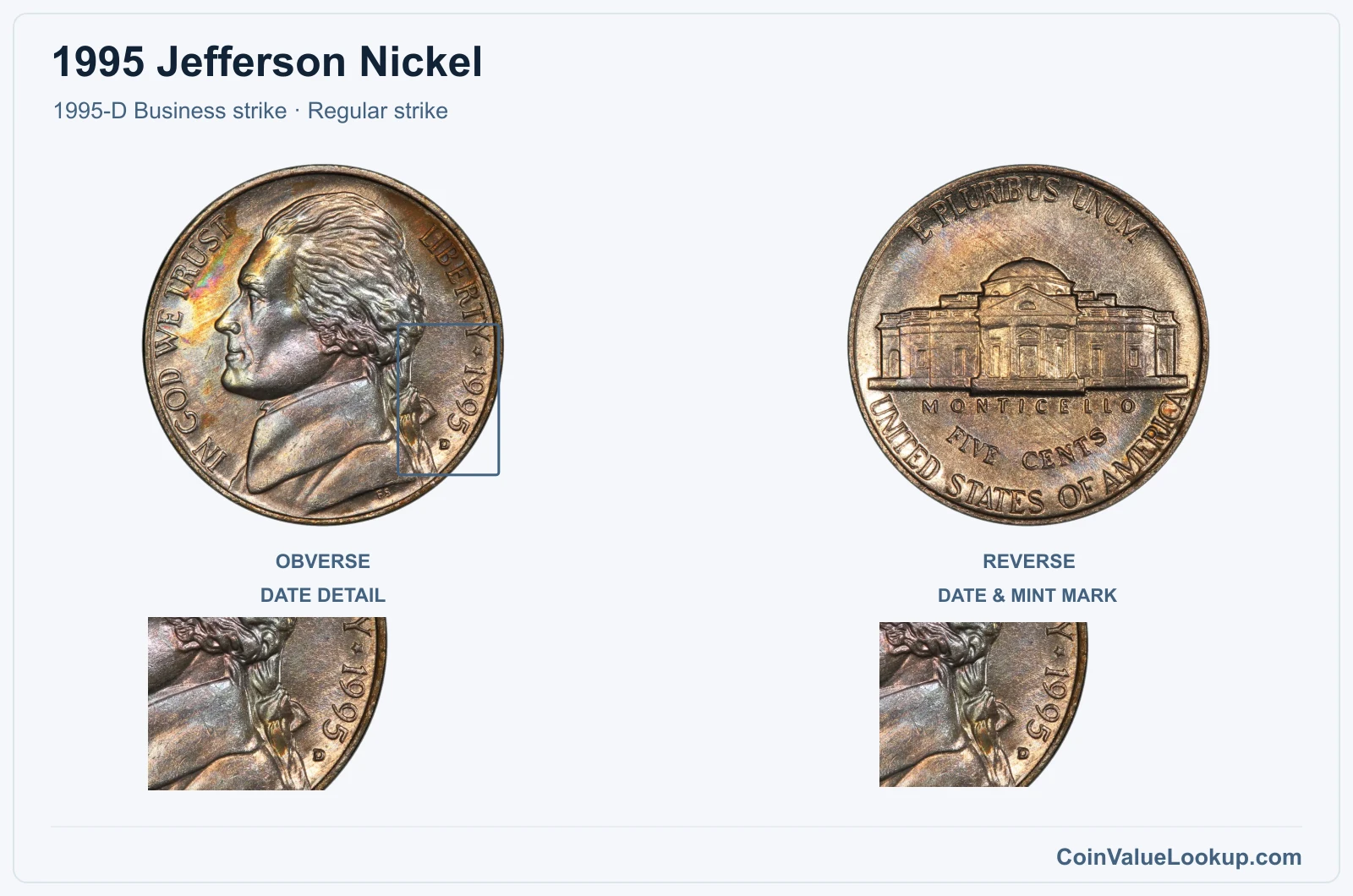
The 1995-D comes from Denver and shows a "D" mintmark in the same obverse position. Same alloy, same weight, same design as its Philadelphia sibling.
Guide anchors from USA Coin Book sit at roughly $0.61 for MS60 and $1.24 for MS65. That small MS60 premium over the P-mint reflects typical guide variation, not major scarcity.
Again, Full Steps certified coins can trade higher. Worn examples from pocket change are face-value coins — no need to get excited about a well-traveled Denver nickel.
| Range | Grade | Price | Auction Records | Appraisal |
|---|---|---|---|---|
| PO | PO 1 | — | Coin Identifier | |
| FR | FR 2 | — | Coin Identifier | |
| AG | AG 3 | — | Coin Identifier | |
| G | G 4 | — | Coin Identifier | |
| G 6 | — | Coin Identifier | ||
| VG | VG 8 | — | Coin Identifier | |
| VG 10 | — | Coin Identifier | ||
| F | F 12 | — | Coin Identifier | |
| F 15 | — | Coin Identifier | ||
| VF | VF 20 | — | Coin Identifier | |
| VF 25 | — | Coin Identifier | ||
| VF 30 | — | Coin Identifier | ||
| VF 35 | — | Coin Identifier | ||
| XF | XF 40 | — | Coin Identifier | |
| XF 45 | — | Coin Identifier | ||
| AU | AU 50 | — | Coin Identifier | |
| AU 53 | — | Coin Identifier | ||
| AU 55 | — | Coin Identifier | ||
| AU 58 | — | Coin Identifier | ||
| MS | MS 60 | — | Coin Identifier | |
| MS 61 | — | Coin Identifier | ||
| MS 62 | Coin Identifier | |||
| MS 63 | — | Coin Identifier | ||
| MS 64 | — | Coin Identifier | ||
| MS 65 | — | Coin Identifier | ||
| MS 66 | Coin Identifier | |||
| MS 67 | — | — | — | |
| MS 68 | — | — | — | |
| MS 69 | — | — | — | |
| MS 70 | — | — | — |
1995 Jefferson Nickel — S Proof
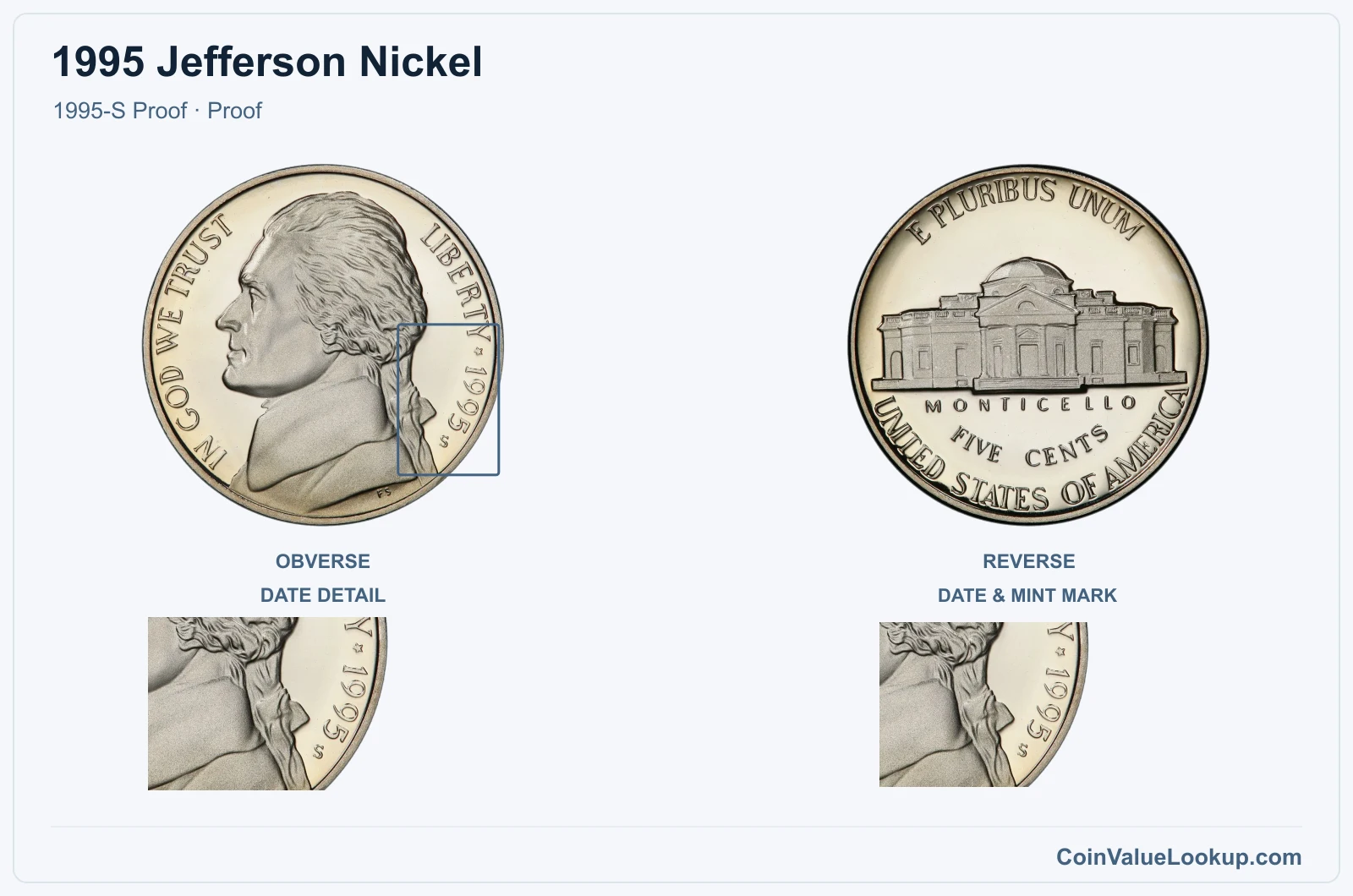
The 1995-S is a proof-only issue struck at San Francisco for collectors, not released into general circulation. You will find the "S" mintmark on the obverse below the date.
USA Coin Book lists a PR65 guide anchor of about $6.25. That figure is a generic proof anchor — it does not specifically cover deep cameo or cameo designations, which carry their own market.
These proofs were sold in official Mint proof sets, so provenance and original packaging help confirm authenticity.
Coin Value Lookup is a handy starting point if you want to look up guide values for other years or denominations in the Jefferson nickel series.
| Range | Grade | Price | Auction Records | Appraisal |
|---|---|---|---|---|
| PR | PR 1 | — | Coin Identifier | |
| PR 2 | — | Coin Identifier | ||
| PR 3 | — | Coin Identifier | ||
| PR 4 | — | Coin Identifier | ||
| PR 6 | — | Coin Identifier | ||
| PR 8 | — | Coin Identifier | ||
| PR 10 | — | Coin Identifier | ||
| PR 12 | — | Coin Identifier | ||
| PR 15 | — | Coin Identifier | ||
| PR 20 | — | Coin Identifier | ||
| PR 25 | — | Coin Identifier | ||
| PR 30 | — | Coin Identifier | ||
| PR 35 | — | Coin Identifier | ||
| PR 40 | — | Coin Identifier | ||
| PR 45 | — | Coin Identifier | ||
| PR 50 | — | Coin Identifier | ||
| PR 53 | — | Coin Identifier | ||
| PR 55 | — | Coin Identifier | ||
| PR 58 | — | Coin Identifier | ||
| PR 60 | — | Coin Identifier | ||
| PR 61 | — | Coin Identifier | ||
| PR 62 | — | Coin Identifier | ||
| PR 63 | — | Coin Identifier | ||
| PR 64 | — | Coin Identifier | ||
| PR 65 | — | Coin Identifier | ||
| PR 66 | — | Coin Identifier | ||
| PR 67 | Coin Identifier | |||
| PR 68 | Coin Identifier | |||
| PR 69 | Coin Identifier | |||
| PR 70 | Coin Identifier |
1995 Jefferson Nickel Error List
1. 1995 Jefferson Nickel — Off-center on defective cent blank
This is a dramatic wrong-planchet error: a 1995 Jefferson nickel design struck on a defective Lincoln cent blank. Because the cent blank is smaller, outer portions of the design — including peripheral lettering — get cropped off.
The coin was also about 10% off center.
A Heritage Auctions example graded NGC MS65 Red from the P mint sold in August 2010 for $891.25. The "Red" designation and copper-colored appearance reflect the cent blank's composition, not a plated nickel.
Confirm the material and weight through professional attribution rather than relying on color alone.
Lookalikes include copper-plated nickels, chemically altered coins, or nickels that have been ground down to cent size. Authentic wrong-planchet errors will weigh close to a cent's standard and carry verifiable third-party certification.
2. 1995 Jefferson Nickel — Struck through capped die
A struck-through-capped-die error occurs when a previously struck coin sticks to the die and acts like a cap, interfering with subsequent strikes. On a 1995-P nickel, this shows up as a distorted or partially obscured obverse portrait while the reverse remains relatively normal.
A Heritage Auctions example graded NGC MS64 Full Steps from the P mint sold in October 2022 for $79. Full Steps on an error coin is an unusual combination that added to the appeal.
Do not confuse this with ordinary heavy wear or a coin whose portrait was intentionally ground away. Genuine capped-die strikes produce a distinctive mushroomed or spread-out distortion on the affected side, with metal flow patterns that cannot be replicated by post-mint damage.
3. 1995 Jefferson Nickel — Struck on dime blank
Another wrong-planchet variety: a 1995-P nickel struck on a clad dime blank. The dime planchet is significantly smaller and lighter — about 2.3 grams versus the nickel's standard 5.0 grams — so the finished coin is noticeably undersized with the design cropped at the edges.
A Heritage Auctions example graded NGC AU55 from the P mint sold in July 2022 for $336. The authenticated piece showed the characteristic size reduction and edge profile of a dime blank.
A trimmed nickel can mimic this error superficially, but a genuine dime-blank strike will have the correct clad edge visible and the proper weight. Professional certification is essentially required to confirm this type of error convincingly.
4. 1995 Jefferson Nickel — Broadstrike
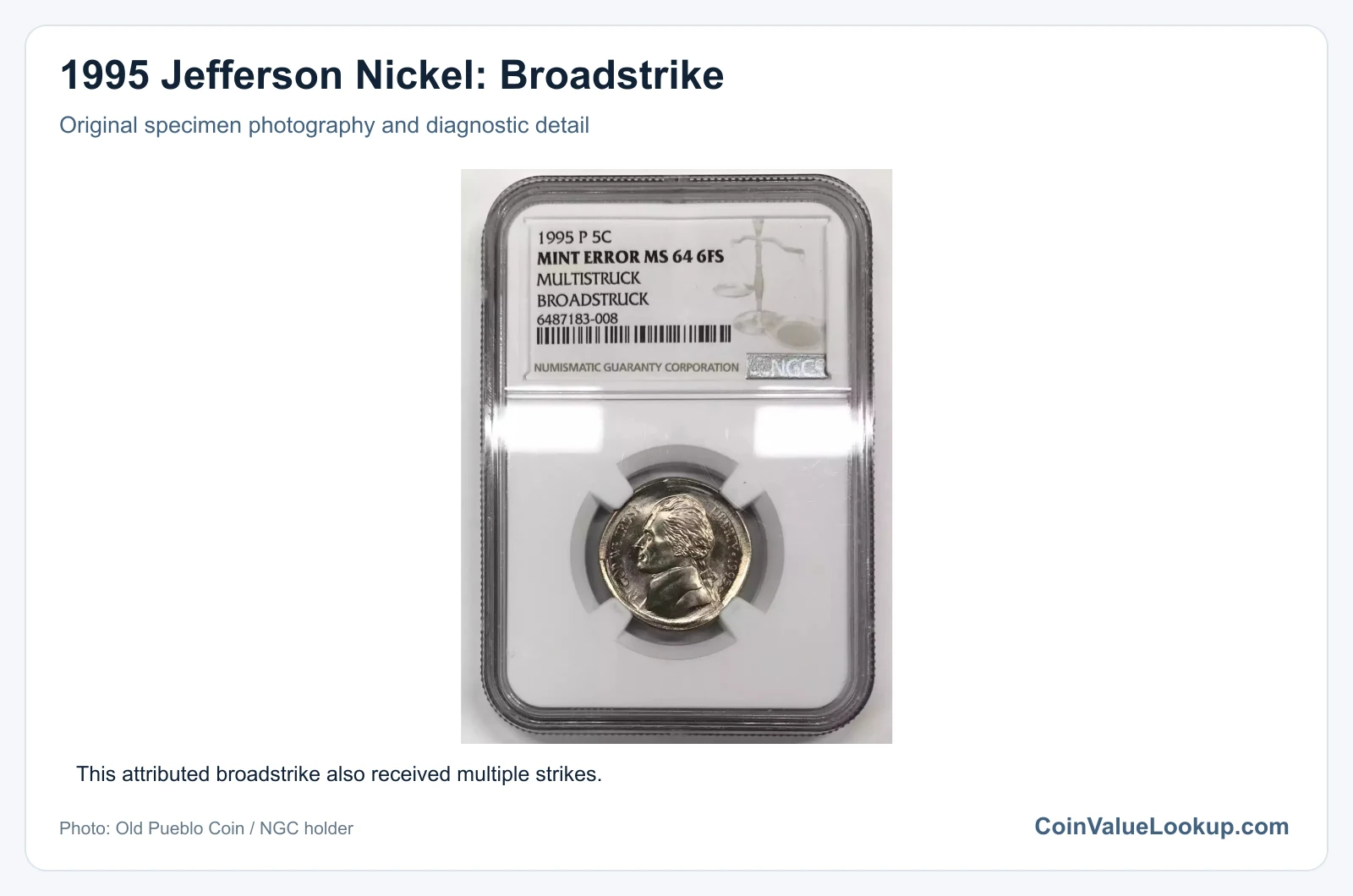
A broadstrike happens when the collar die — the ring that confines a coin's edge during striking — fails to contain the planchet. The result is a coin slightly wider than normal with a spread-out design and no defined rim or edge reeding.
Broadstrike errors have been reported for the 1995 nickel. The value of any individual broadstrike depends on how dramatic the spread is, the coin's overall condition, and whether it has been professionally attributed.
There is no single adopted price for this category.
Do not confuse a broadstrike with an off-center strike, which shifts the design away from center, or with a coin that was flattened after leaving the mint. A true broadstrike still has a centered design — it just spills outward past the normal diameter.
5. 1995 Jefferson Nickel — Doubled Die Obverse
Doubled die obverse errors on 1995 nickels show consistent doubling on obverse lettering or design elements. The key word is consistent: the separation or notching appears in the same direction and magnitude across multiple letters or features.
To check, compare your coin's obverse inscriptions — especially "IN GOD WE TRUST" and "LIBERTY" — against a normal 1995 nickel under the same lighting and magnification. Look for a clear secondary image or shelf-like separation.
Machine doubling, which is flat and shelf-like without distinct separation, is a common lookalike that carries little to no premium. Reflections or worn die contours can also mimic doubling.
Value depends on the strength and visibility of the doubling and the coin's condition. No specific price is adopted for this category.
6. 1995 Jefferson Nickel — Die Crack / Die Chip
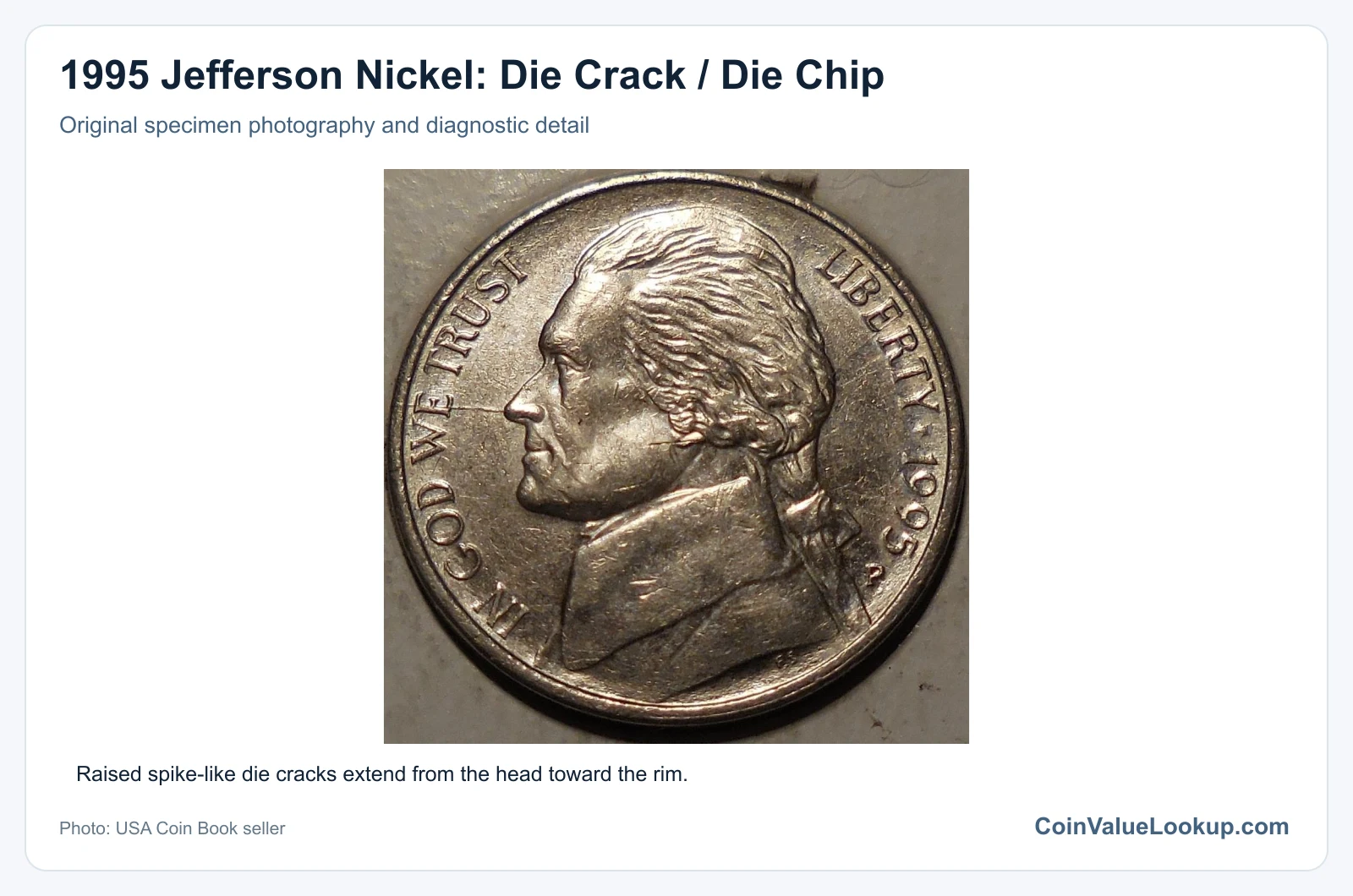
Die cracks appear as thin raised lines on a coin's surface, caused by fractures in the steel die during production. Die chips are small raised blobs from a chunk breaking away.
A cud is a larger raised area connected to the rim where a significant piece of the die broke off.
These have been reported on 1995 nickels. Examine both sides carefully under magnification.
Raised lines are key — scratches are incuse, meaning they go into the surface, not above it.
Corrosion, foreign material stuck to the surface, or contact marks from other coins can all mimic die cracks at first glance. Run a fingernail across the feature: a genuine die crack or chip is raised metal, part of the coin's surface.
Value depends on size, location, and condition. No specific price is adopted here.
7. 1995 Jefferson Nickel — Lamination / Split Planchet
Lamination errors occur when layers within the alloy separate, creating peeling flaps, missing chunks, or visible splits in the metal. On a 1995 nickel, look for a retained flap of metal lifting from the surface or a smooth void where a layer detached.
Photograph both the affected face and the edge together — the edge profile often reveals the separation clearly. This helps distinguish a genuine lamination from post-mint scraping, corrosion pitting, or a deliberately cut coin.
These errors have been reported for this year. Value depends on the size and visibility of the lamination, the affected area, and overall coin condition.
No specific price is adopted for this category. Professional attribution strengthens any claim significantly, since surface damage from environmental exposure can look surprisingly similar.