1905 Liberty Nickel Coin Value: How Much Is It Worth?
A 1905 Liberty Nickel in well-worn G4 condition books at about $2.50 according to a USA Coin Book guide estimate, while an uncirculated MS63 example reaches around $154. Proofs sit higher, with a PR63 anchor of roughly $344.
These are guide estimates, not guaranteed sale prices. Condition, eye appeal and whether you have a business strike or proof all matter.
Fast Way to Identify Your 1905 Liberty Nickel
The quickest way to start figuring out what your 1905 Liberty Nickel is worth is to upload clear photos of the front and back. Our identifier can give you a preliminary read on the version and general condition.
Good lighting and a steady hand help — try to capture the full rim on both sides so details like the date and CENTS on the reverse are legible.
1905 Liberty Nickel Value
Upload both sides of your 1905 Liberty Nickel.
Front Obverse
Upload photo
Back Reverse
Upload photo
Which 1905 Liberty Nickel Versions Are Worth Money?
- Business strikes in MS63 or better can bring $154 or more per USA Coin Book estimates, a significant jump over circulated grades.
- Proofs carry their own premium, with a PR63 example listed around $344 in the same guide.
- A misplaced date — numeral remnants visible in the denticles below the date — is distinct from a repunched date and worth investigating.
- Repunched date varieties, where an earlier punch impression sits beside the final numerals, can attract variety collectors.
- Off-metal strikes, such as the reported Philippine 10-centavo planchet error, are rare and individually assessed.
Step 1: Identify Your 1905 Liberty Nickel Mint Mark and Version
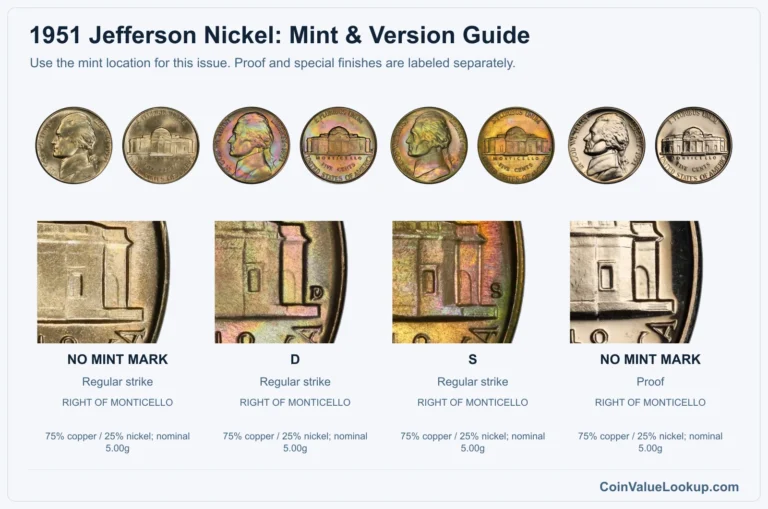
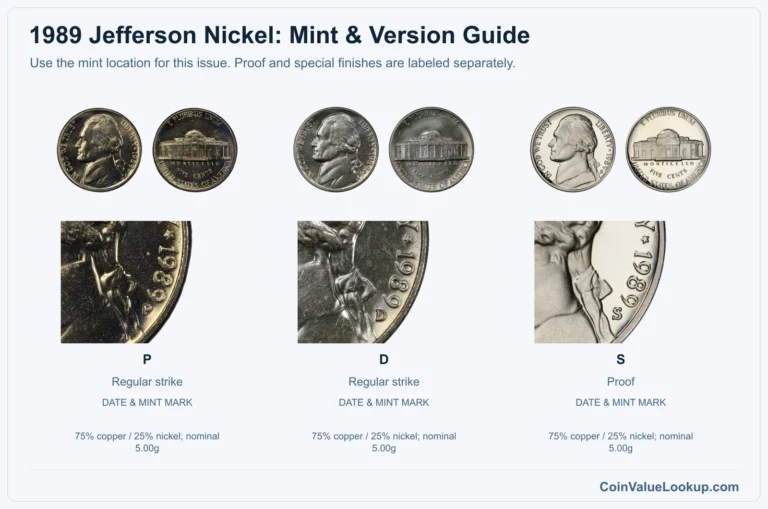
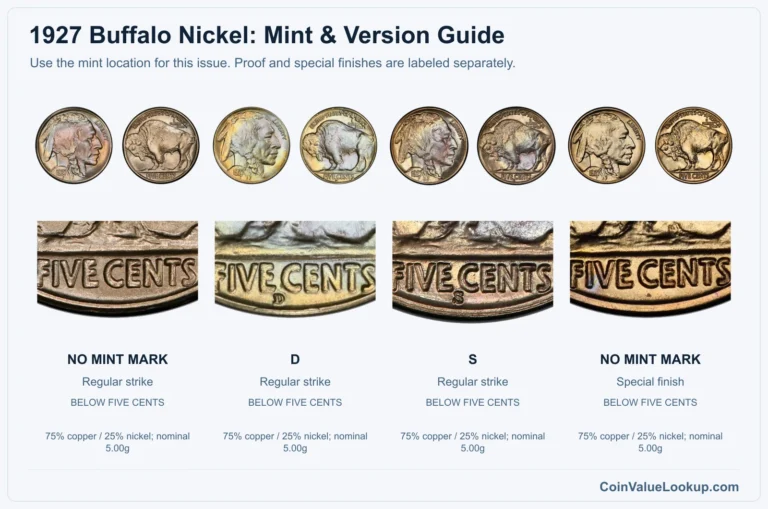
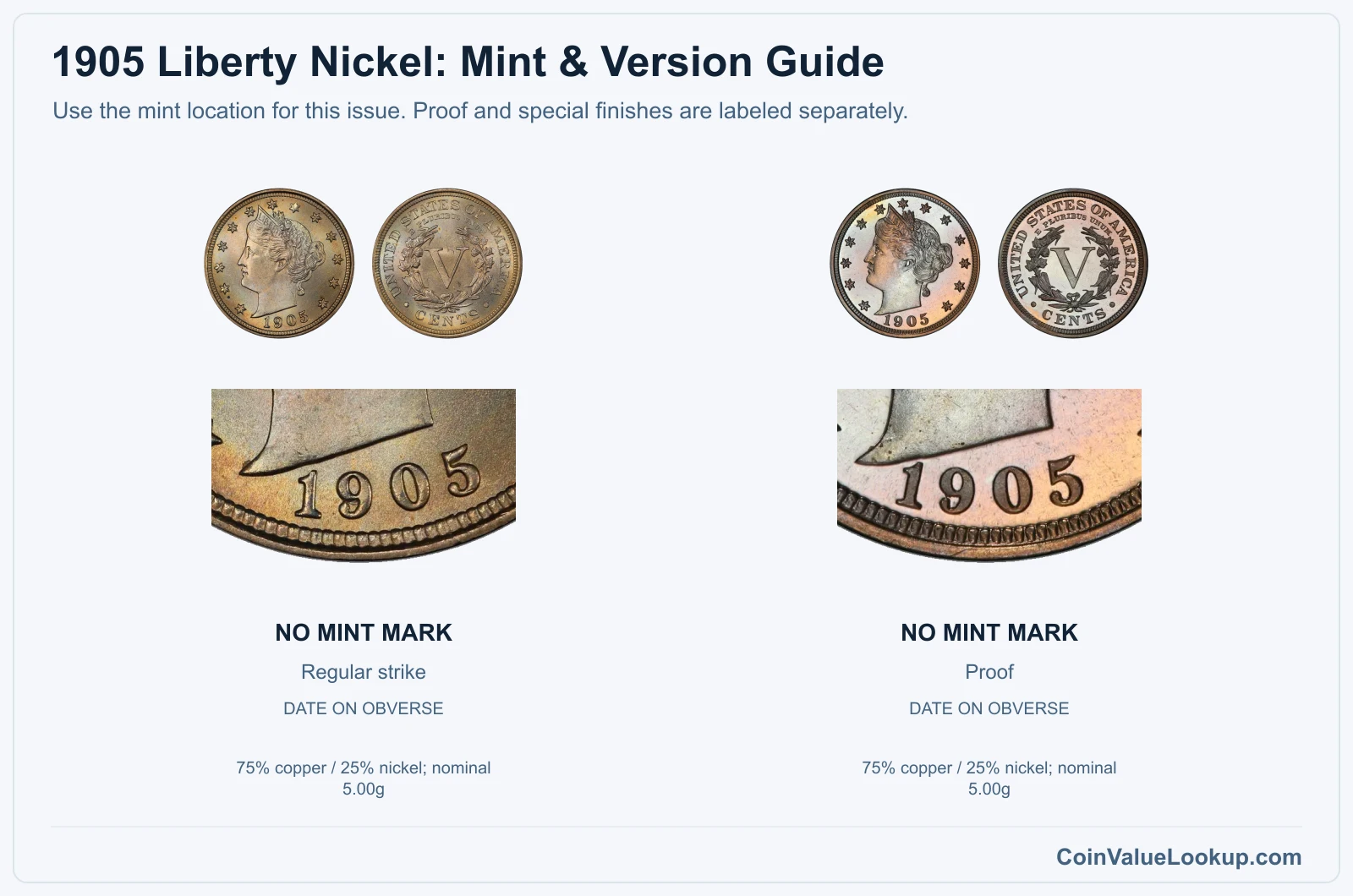
Every 1905 Liberty Nickel was struck at the Philadelphia Mint, so there is no mintmark to look for. You will not find a D or S on this date.
The coin is 75% copper and 25% nickel, weighs about 5 grams, measures 21.2 mm across, and has a plain edge.
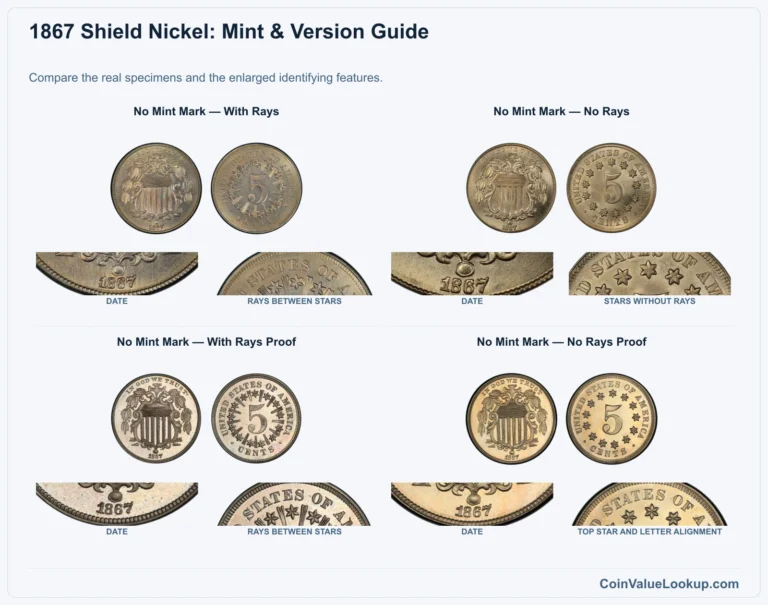
All regular-issue 1905 nickels carry the word CENTS on the reverse inside the wreath. The "No CENTS" design was a separate, intentional type used only in 1883, so do not confuse the two.
The two legitimate branches for 1905 are the normal business strike and the proof. No silver version or branch-mint issue exists for this year.
If your coin looks silvery and abnormally light, it may be plated or altered — not a silver variety.
Step 2: Check Your 1905 Liberty Nickel Grade
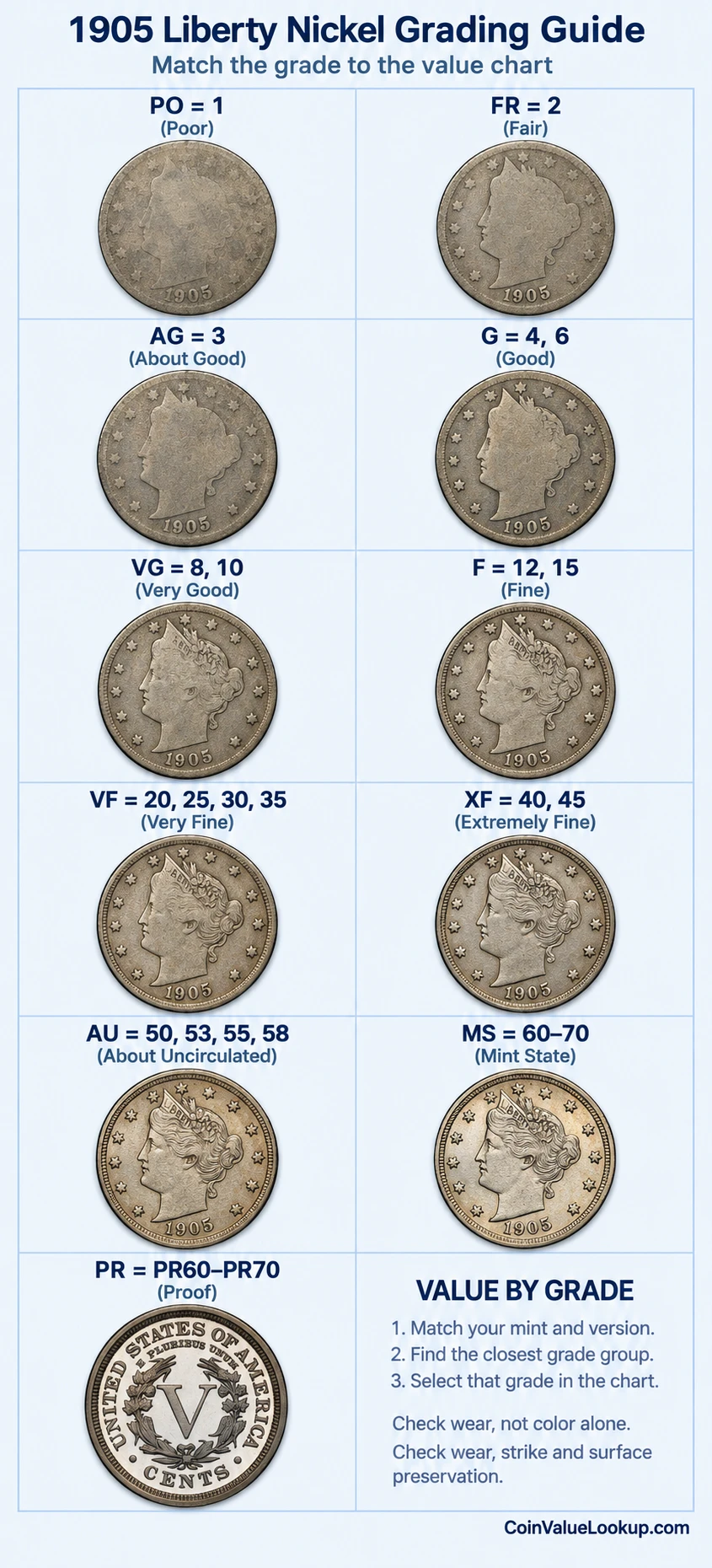
Start with the obverse. Look at the word LIBERTY on the coronet — on a heavily worn coin the letters merge into the headband, while a lightly circulated example keeps all seven letters sharp.
The high points of the hair curls above the ear and the cheek are next to go.
Flip it over. The corn ears and the wreath details wear down progressively; a coin grading Fine will still show individual kernels, while a Good example may have them nearly flat.
For uncirculated coins, luster is the giveaway. A full, unbroken cartwheel across the fields means no wear, but contact marks and weak strikes can fool you.
Compare your coin against the reference image — weak detail from a soft strike is not the same as wear from circulation.
Proof is a manufacturing method, not a grade above Mint State. Proof 1905 nickels have mirrored fields and squared rims.
Check for hairlines under magnification; those fine lines from cleaning or mishandling are the main grade separators among proofs.
Step 3: Check 1905 Liberty Nickel Value by Mint and Version
1905 Liberty Nickel — No Mint Mark — With CENTS Circulation
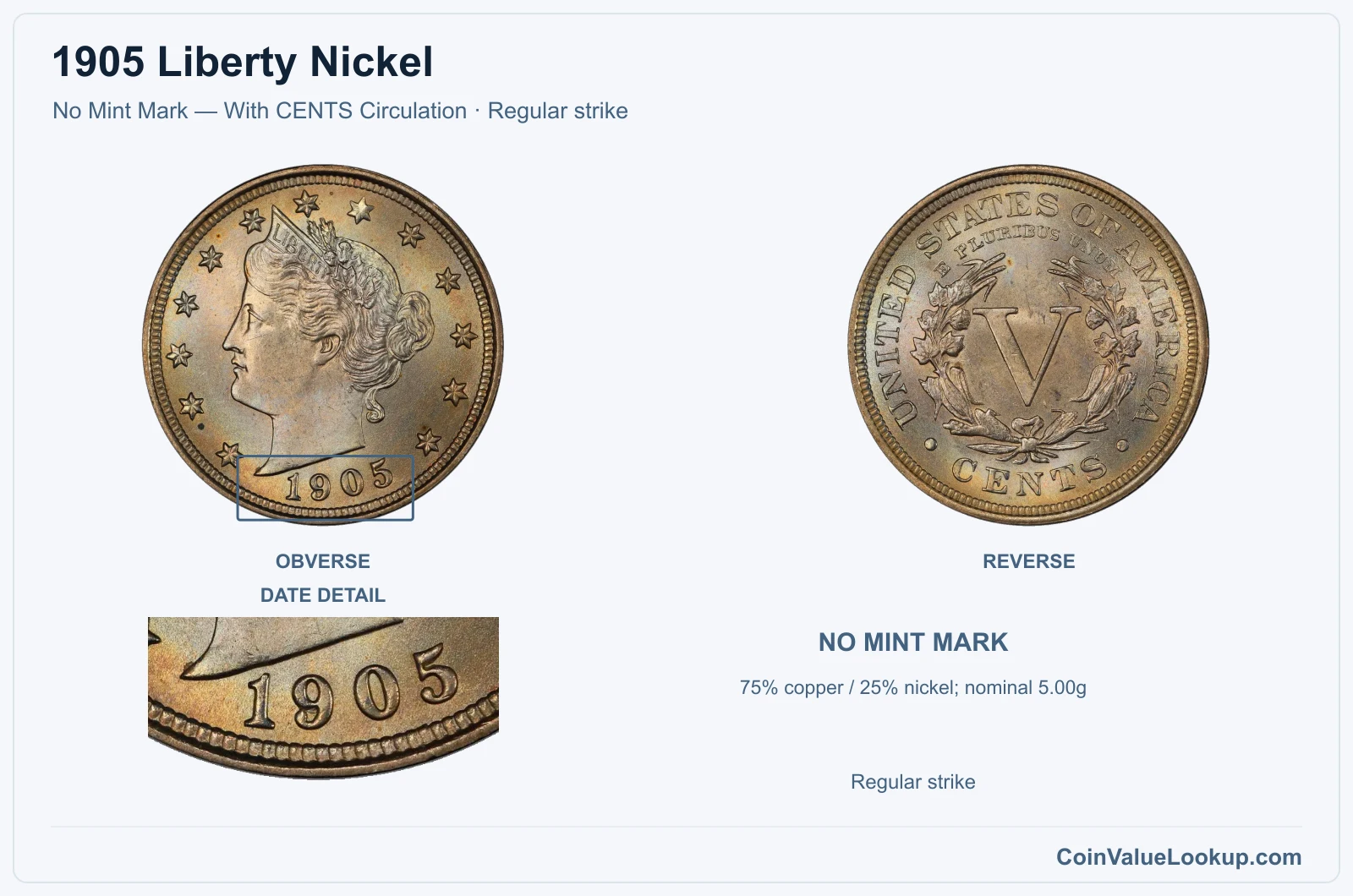
This is the standard Philadelphia business strike, the coin most people will find. It carries the With CENTS reverse used from late 1883 onward.
Guide estimates from USA Coin Book place a G4 example at about $2.50 and an MS63 at roughly $154 — a wide spread that shows how much condition matters on a common date.
Look for full LIBERTY on the headband, sharp hair curls and undisturbed luster in higher grades. A note for variety hunters: misplaced date remnants have been reported in the denticles below the date on some 1905 dies.
These are different from a repunched date, which shows doubling within the date area itself.
Range Grade
Price Auction Records Appraisal PO PO 1
—
Coin Identifier FR FR 2
—
Coin Identifier AG AG 3
—
Coin Identifier G G 4
—
Coin Identifier
G 6
—
Coin Identifier VG VG 8
—
Coin Identifier
VG 10
—
Coin Identifier F F 12
—
Coin Identifier
F 15
—
Coin Identifier VF VF 20
—
Coin Identifier
VF 25
—
Coin Identifier
VF 30
—
Coin Identifier
VF 35
—
Coin Identifier XF XF 40
—
Coin Identifier
XF 45
—
Coin Identifier AU AU 50
Coin Identifier
AU 53
—
Coin Identifier
AU 55
—
Coin Identifier
AU 58
Coin Identifier MS MS 60
Coin Identifier
MS 61
Coin Identifier
MS 62
Coin Identifier
MS 63
Coin Identifier
MS 64
Coin Identifier
MS 65
Coin Identifier
MS 66
Coin Identifier
MS 67
Coin Identifier
MS 68
—
—
—
MS 69
—
—
—
MS 70
—
—
—
1905 Liberty Nickel — No Mint Mark — With CENTS Proof
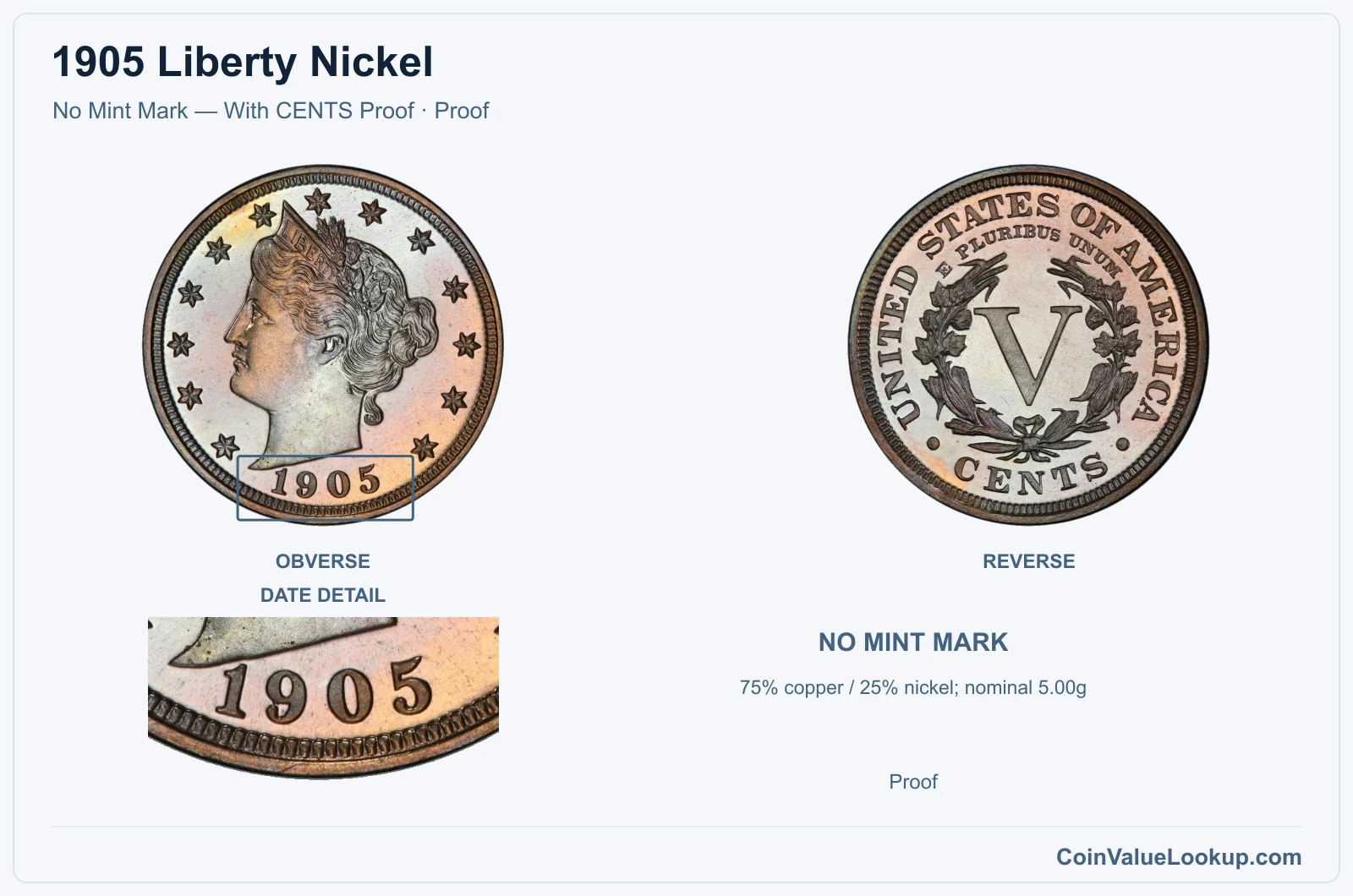
Philadelphia also produced proof 1905 Liberty Nickels for collectors. A PR63 example carries a USA Coin Book guide estimate of about $344, reflecting the labor-intensive proof manufacturing process and the smaller number struck.
Authentic proofs show deeply mirrored fields, sharp squared rims and full design detail from multiple die strikes at lower press speed. When photographing a proof for identification, capture the reflective fields and rims from a slight angle so the mirror finish is visible.
Coin Value Lookup is a handy starting point if you want to compare your 1905 proof against other Liberty Nickel dates or different denominations entirely. You can browse coin guides organized by year and type.
Range Grade
Price Auction Records Appraisal PR PR 1
—
Coin Identifier
PR 2
—
Coin Identifier
PR 3
—
Coin Identifier
PR 4
—
Coin Identifier
PR 6
—
Coin Identifier
PR 8
—
Coin Identifier
PR 10
—
Coin Identifier
PR 12
—
Coin Identifier
PR 15
—
Coin Identifier
PR 20
—
Coin Identifier
PR 25
—
Coin Identifier
PR 30
—
Coin Identifier
PR 35
—
Coin Identifier
PR 40
—
Coin Identifier
PR 45
—
Coin Identifier
PR 50
—
Coin Identifier
PR 53
—
Coin Identifier
PR 55
—
Coin Identifier
PR 58
—
Coin Identifier
PR 60
—
Coin Identifier
PR 61
Coin Identifier
PR 62
Coin Identifier
PR 63
Coin Identifier
PR 64
Coin Identifier
PR 65
Coin Identifier
PR 66
Coin Identifier
PR 67
Coin Identifier
PR 68
Coin Identifier
PR 69
—
—
—
PR 70
—
—
—
1905 Liberty Nickel Error List
1. 1905 Liberty Nickel — Misplaced Date
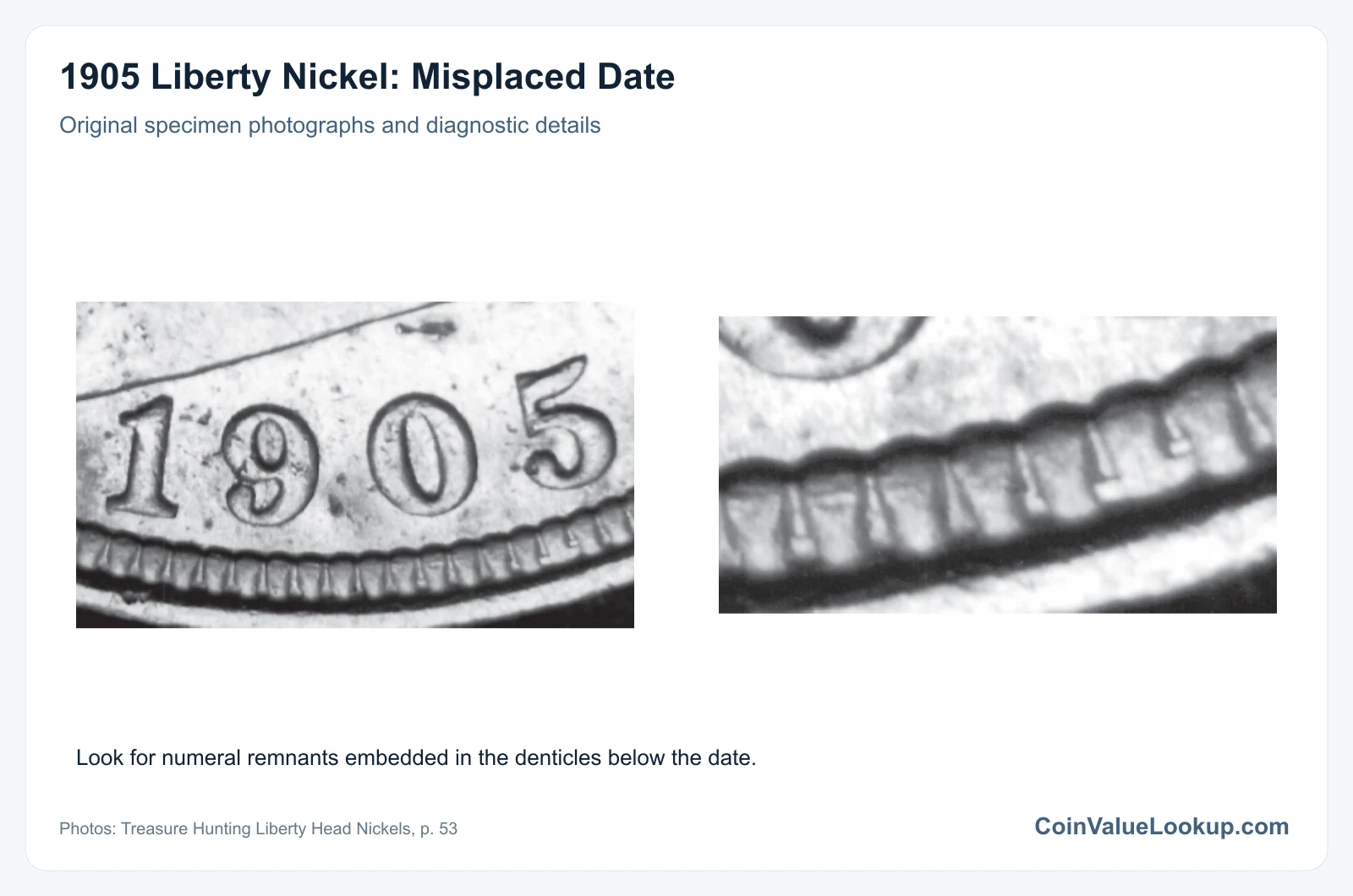
A misplaced date on a 1905 Liberty Nickel means remnants of one or more date numerals appear inside the denticles — the small tooth-like projections along the rim — rather than in the normal date position. This happened when a date punch landed too low during die preparation.
To check, examine the denticles directly below the date under magnification. You are looking for faint outlines of a digit partially embedded in or overlapping the denticle area.
Compare against an attributed example if possible.
Do not confuse this with die chips, scratches or damaged denticles, which lack the recognizable shape of a numeral. A repunched date, by contrast, shows doubling within the intended date area.
Condition, visibility of the displaced numeral and overall coin grade all influence whether a misplaced date adds meaningful value.
2. 1905 Liberty Nickel — Wrong Planchet / Off-Metal Strike
A 1905 Liberty Nickel struck on a wrong planchet is a dramatic mint error. One reported example was struck on a Philippine 10-centavo planchet — a foreign blank that happened to be at the Philadelphia Mint, which produced Philippine coinage in this era.
To evaluate a suspect coin, compare its weight, diameter, edge characteristics and design completeness against a normal 1905 nickel. A wrong-planchet strike will typically show an incomplete or distorted design because the blank differs in size or thickness.
Be careful with lookalikes. Plated coins, acid-treated surfaces, corrosion or deliberate alterations can mimic an off-metal appearance.
Professional attribution is important for a claim this significant. Value depends on the specific planchet, the coin's condition and how much of the design transferred.
3. 1905 Liberty Nickel — Clipped Planchet
A clipped planchet error occurs when the coin blank is punched from strip metal that was not fed correctly, leaving a curved, straight or irregular missing section along the edge. On a 1905 Liberty Nickel, look for a crescent-shaped absence at the rim with a smooth, rounded edge profile that matches the original blanking process.
A genuine clip often produces a weak area in the design on the opposite side of the coin, called the Blakesley effect. That opposite-side weakness is a useful confirmation tool.
Do not mistake a filed edge, post-mint cut or corrosion loss for a clip. Deliberate removal leaves sharp or uneven tool marks, while a real clip has a consistent contour.
The size and location of the clip, overall eye appeal and grade all factor into any premium.
4. 1905 Liberty Nickel — Lamination / Split After Strike
Lamination errors show up as peeling metal, a retained flap or an internal separation within the alloy. On a 1905 nickel, this results from impurities or voids trapped in the planchet during the rolling process before striking.
Inspect both faces and the edge. A lamination may appear as a thin raised flap still attached to the surface, or as a smooth exposed layer where metal has already broken away.
Photographing the edge alongside the affected face gives the best documentation.
This is different from post-mint scraping, corrosion pitting or a deliberately cut coin, all of which leave irregular or tool-marked surfaces. A genuine lamination follows the metal's internal structure.
Value depends on the size and visibility of the separation, whether the flap is still intact and the coin's overall condition.
5. 1905 Liberty Nickel — Mated Blank and Split-Planchet Strike
A mated blank and split-planchet strike is an unusual error where a blank planchet and a split piece end up struck together in the press. The result is two pieces that share matching struck and contact surfaces — essentially a bonded pair.
If you suspect you have this error on a 1905 Liberty Nickel, keep both pieces together. Show the matching contact areas in your photos, because the relationship between the two pieces is what makes this error significant.
Do not confuse this with pieces glued together after minting or a coin that was simply cut in half. Genuine mated pairs show consistent strike evidence and complementary surfaces.
A split-only-after-strike piece lacks the second bonded blank. Value is assessed individually based on completeness, condition and how clearly the mating is demonstrated.
6. 1905 Liberty Nickel — Off-Center Strike
An off-center strike happens when the planchet is not properly seated between the dies, producing a design that is shifted to one side with an unstruck crescent of blank metal on the opposite edge.
For a 1905 Liberty Nickel, the key question is whether the date remains fully visible. Off-center errors with a readable date are far more desirable than those where the date has shifted out of the struck area.
Do not confuse an off-center strike with a clipped planchet, a one-sided die misalignment or post-mint flattening. A genuine off-center coin has a complete, round planchet — the design simply did not land in the middle.
The percentage of off-center shift, date visibility and overall condition all affect value.
7. 1905 Liberty Nickel — Die Crack / Die Chip
Die cracks appear as thin raised lines on the coin's surface, following the path of a fracture in the steel die. Die chips are small raised blobs where a tiny piece of the die face broke away.
Both are common on well-used dies.
On a 1905 Liberty Nickel, examine both faces under magnification. A die crack will be raised — you can feel it with a fingernail — and often runs from one design element toward the rim.
A die chip appears as a small raised lump, often near lettering or stars.
Do not confuse these with incuse scratches, which are recessed into the surface, or with surface corrosion and foreign material deposits. An interior chip that does not connect to the rim is distinct from a cud.
Most minor die cracks carry little premium, but dramatic or well-positioned examples attract variety collectors.
8. 1905 Liberty Nickel — Die Break / Cud
A cud is a major die break that connects to the rim, leaving a raised, featureless blob of metal where part of the design should be. It forms when a section of the die edge physically breaks away, so the planchet metal flows into the void.
On a 1905 Liberty Nickel, look along the rim for an area that appears as a raised, smooth lump with no design detail, bordered on one side by the coin's edge. The adjacent design elements will show displacement or distortion.
A rim dent is the opposite — it is pushed inward, not raised outward. Corrosion buildup can also mimic a cud but lacks the sharp boundary where normal design stops and the featureless blob begins.
Size, location and overall coin condition all influence a cud's desirability.
9. 1905 Liberty Nickel — Repunched Date
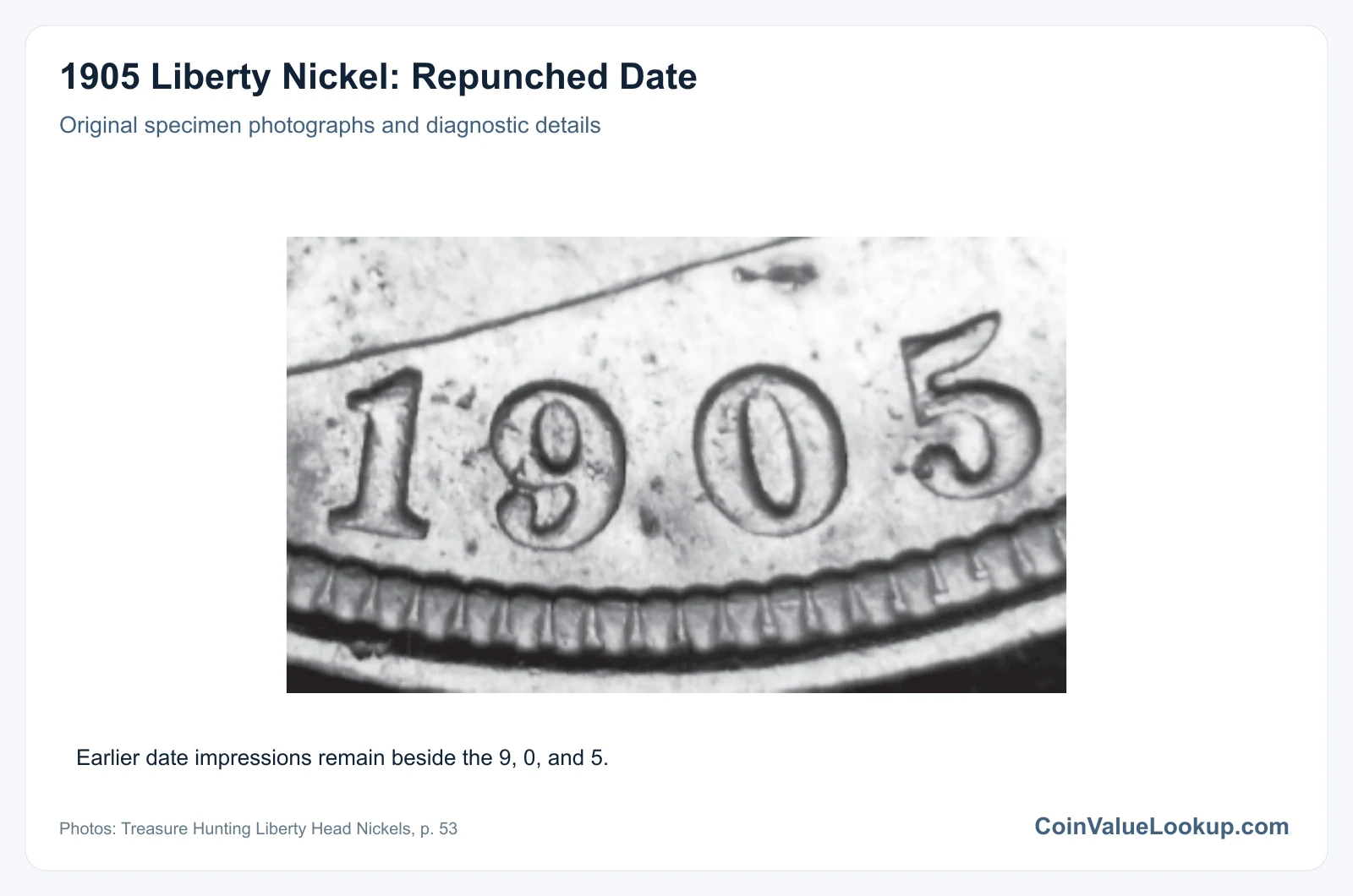
A repunched date on a 1905 Liberty Nickel shows traces of an earlier date-punch impression sitting beside or slightly offset from the final numerals. This happened when the date was hand-punched into the working die and the first attempt did not land perfectly.
Under magnification, look for shadowy outlines or partial serifs of a numeral next to or slightly above or below each digit of the date. The remnants follow the shape of the actual numeral, not random scratches.
This is a die variety, separate from mechanical doubling, which produces flat shelf-like images and affects the entire design. It is also distinct from a misplaced date, where numeral remnants appear down in the denticles rather than adjacent to the final date.
Condition and the clarity of the repunching both play into how collectors value these.