1950 Jefferson Nickel Coin Value: How Much Is It Worth?
The 1950 Jefferson Nickel sits at an interesting crossroads in the series. Ordinary worn examples carry modest value, but uncirculated pieces range from about $2.50 at MS60 up to roughly $30 at MS65 depending on the mint, according to USA Coin Book guide estimates.
Proofs, Full Steps designations, and authenticated mint errors each occupy their own pricing tier entirely separate from everyday pocket change.
Fast Way to Identify Your 1950 Jefferson Nickel
Snap a clear photo of both sides of your coin and upload them here for a preliminary identification. This can help you figure out which mint produced your nickel, whether it has a mintmark, and what condition category it likely falls into.
It is not a substitute for professional grading or authentication, but it gives you a solid starting point.
1950 Jefferson Nickel Value
Upload both sides of your 1950 Jefferson Nickel.
Front Obverse
Upload photo
Back Reverse
Upload photo
Which 1950 Jefferson Nickel Versions Are Worth Money?
- Uncirculated 1950 Philadelphia nickels with strong original luster can reach about $19 at MS65 per USA Coin Book, well above face value.
- The 1950-D is the low-mintage circulation strike of the year; guide estimates run roughly $19 at MS60 to $30 at MS65, though low mintage alone does not guarantee every coin is expensive.
- 1950 Philadelphia proofs with mirrored fields carry a guide estimate around $92 at PR65; cameo contrast examples are a separate market tier.
- Coins with uninterrupted Monticello steps qualifying for Full Steps designation can command premiums above standard Mint State values.
Step 1: Identify Your 1950 Jefferson Nickel Mint Mark and Version
Look at the obverse for the date, 1950, below Jefferson's bust. Then flip the coin over.
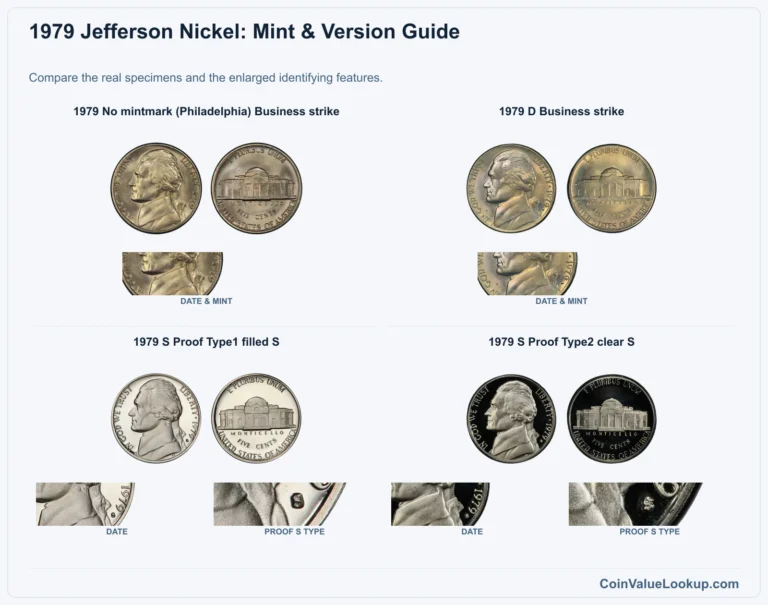
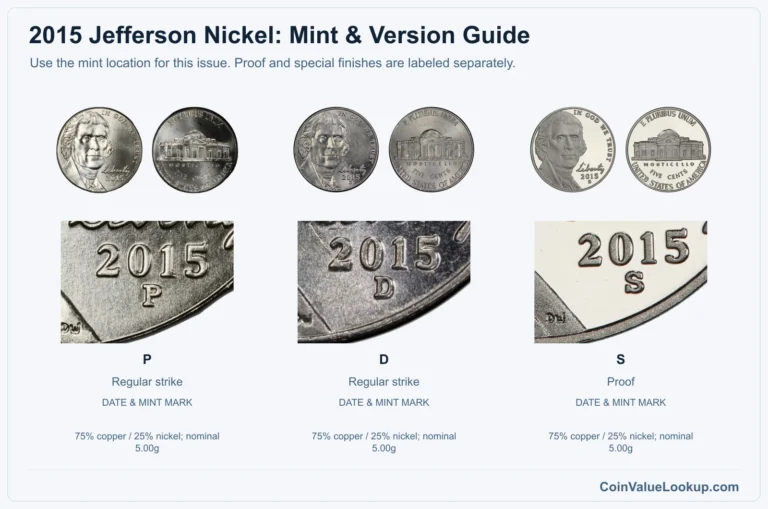
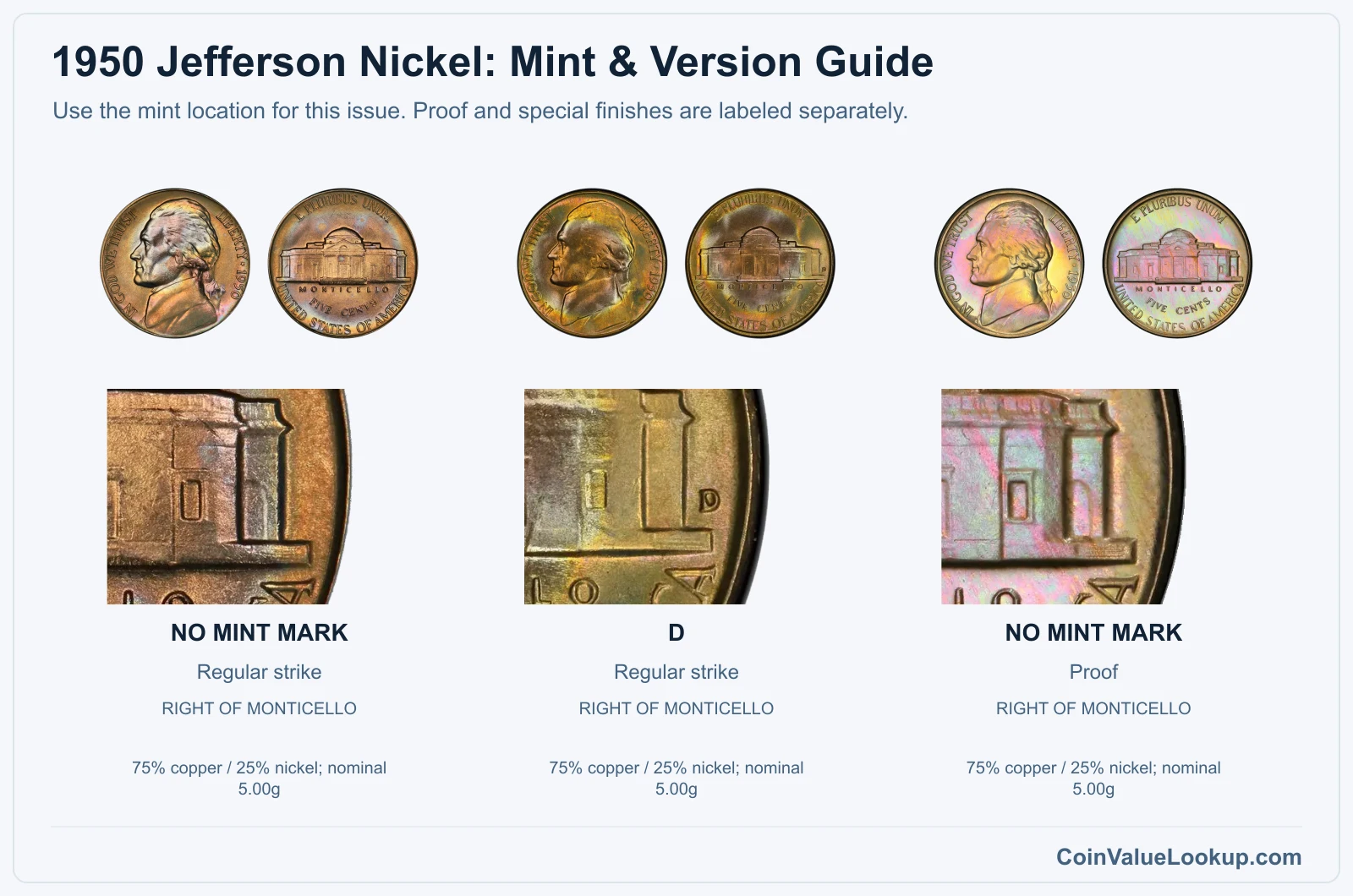
If there is no small letter to the right of Monticello, your coin was struck in Philadelphia. A tiny "D" in that spot means Denver.
There is no 1950-S issue.
All regular 1950 nickels are 75% copper and 25% nickel, weigh about 5.00 grams, and measure 21.2 mm across with a plain edge. A polished business strike is not a proof, no matter how shiny someone has made it.
Genuine proofs have deeply mirrored fields and were produced exclusively at Philadelphia for collectors.
Separate your coin into three lanes: circulated, uncirculated business strike, or proof. That distinction matters more than anything else for pricing, because guide values for one finish do not apply to another.
Step 2: Check Your 1950 Jefferson Nickel Grade
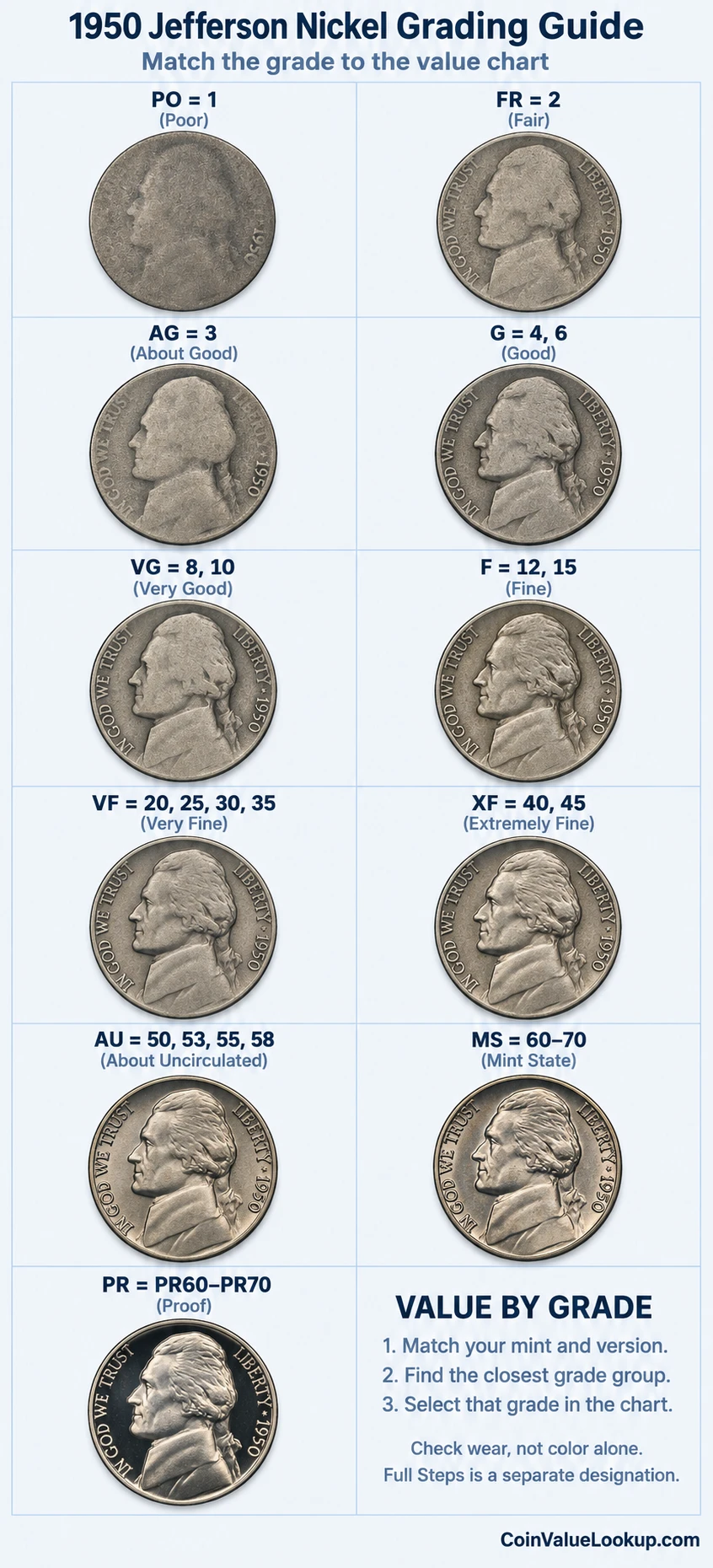
Start with Jefferson's cheek and the hair detail directly above his ear. On a well-worn coin, the cheek is flat and the hair strands merge into a smooth lump.
As grade improves, individual hair lines sharpen and the original mint luster survives in protected areas.
Flip to the reverse. Check the roof line of Monticello and the four columns.
Wear shows there first as softness across the horizontal roof edge. Then examine the steps at the base of Monticello.
Those steps are a strike-quality indicator, not a wear indicator. The PCGS Full Steps designation requires at least five clearly separated steps on coins grading MS60 or higher.
A weakly struck coin can look uncirculated yet still lack full steps, so do not confuse strike quality with grade.
Use the comparison image to match your coin's overall luster, surface abrasion, and detail sharpness against known grade examples. Luster and contact marks together tell the story better than any single checkpoint.
Step 3: Check 1950 Jefferson Nickel Value by Mint and Version
1950 Jefferson Nickel — No mintmark (Philadelphia)
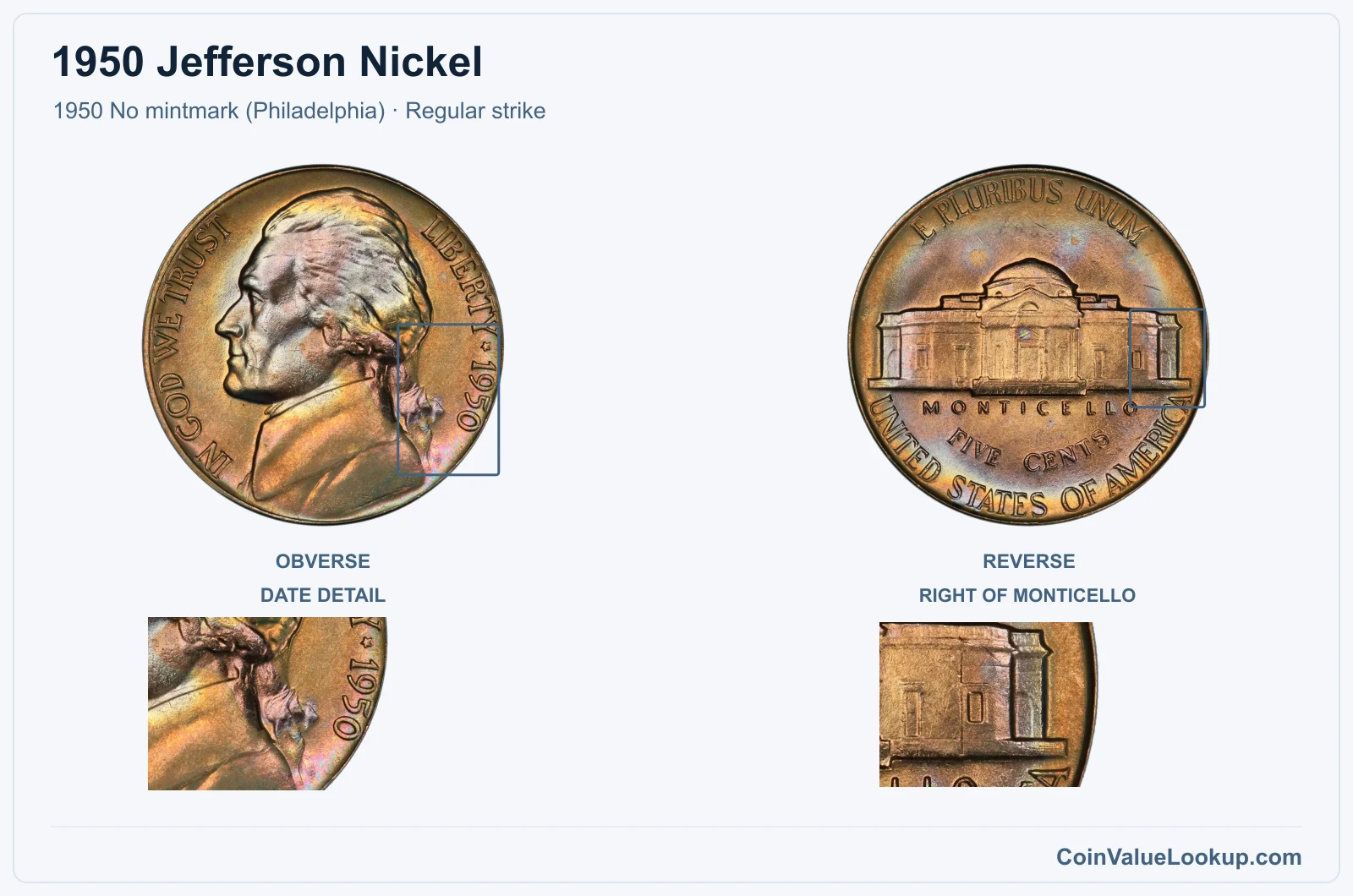
The 1950 Philadelphia nickel carries no mintmark. It is struck in 75% copper and 25% nickel, weighs about 5.00 grams, and has a plain edge.
On the reverse, the area to the right of Monticello is blank where a Denver coin would show a "D."
USA Coin Book guide estimates place this coin at roughly $2.50 in MS60 condition and about $19 at MS65. Worn examples sit below these uncirculated benchmarks and are not priced from the MS65 column.
Coins with fully separated Monticello steps occupy a separate value tier and should not be confused with standard Mint State pricing.
| Range | Grade | Price | Auction Records | Appraisal |
|---|---|---|---|---|
| PO | PO 1 | — | Coin Identifier | |
| FR | FR 2 | — | Coin Identifier | |
| AG | AG 3 | — | Coin Identifier | |
| G | G 4 | — | Coin Identifier | |
| G 6 | — | Coin Identifier | ||
| VG | VG 8 | — | Coin Identifier | |
| VG 10 | — | Coin Identifier | ||
| F | F 12 | — | Coin Identifier | |
| F 15 | — | Coin Identifier | ||
| VF | VF 20 | — | Coin Identifier | |
| VF 25 | — | Coin Identifier | ||
| VF 30 | — | Coin Identifier | ||
| VF 35 | — | Coin Identifier | ||
| XF | XF 40 | — | Coin Identifier | |
| XF 45 | — | Coin Identifier | ||
| AU | AU 50 | — | Coin Identifier | |
| AU 53 | — | Coin Identifier | ||
| AU 55 | — | Coin Identifier | ||
| AU 58 | — | Coin Identifier | ||
| MS | MS 60 | — | Coin Identifier | |
| MS 61 | — | Coin Identifier | ||
| MS 62 | — | Coin Identifier | ||
| MS 63 | — | Coin Identifier | ||
| MS 64 | Coin Identifier | |||
| MS 65 | Coin Identifier | |||
| MS 66 | Coin Identifier | |||
| MS 67 | Coin Identifier | |||
| MS 68 | — | — | — | |
| MS 69 | — | — | — | |
| MS 70 | — | — | — |
1950 Jefferson Nickel — No mintmark (Philadelphia) Proof
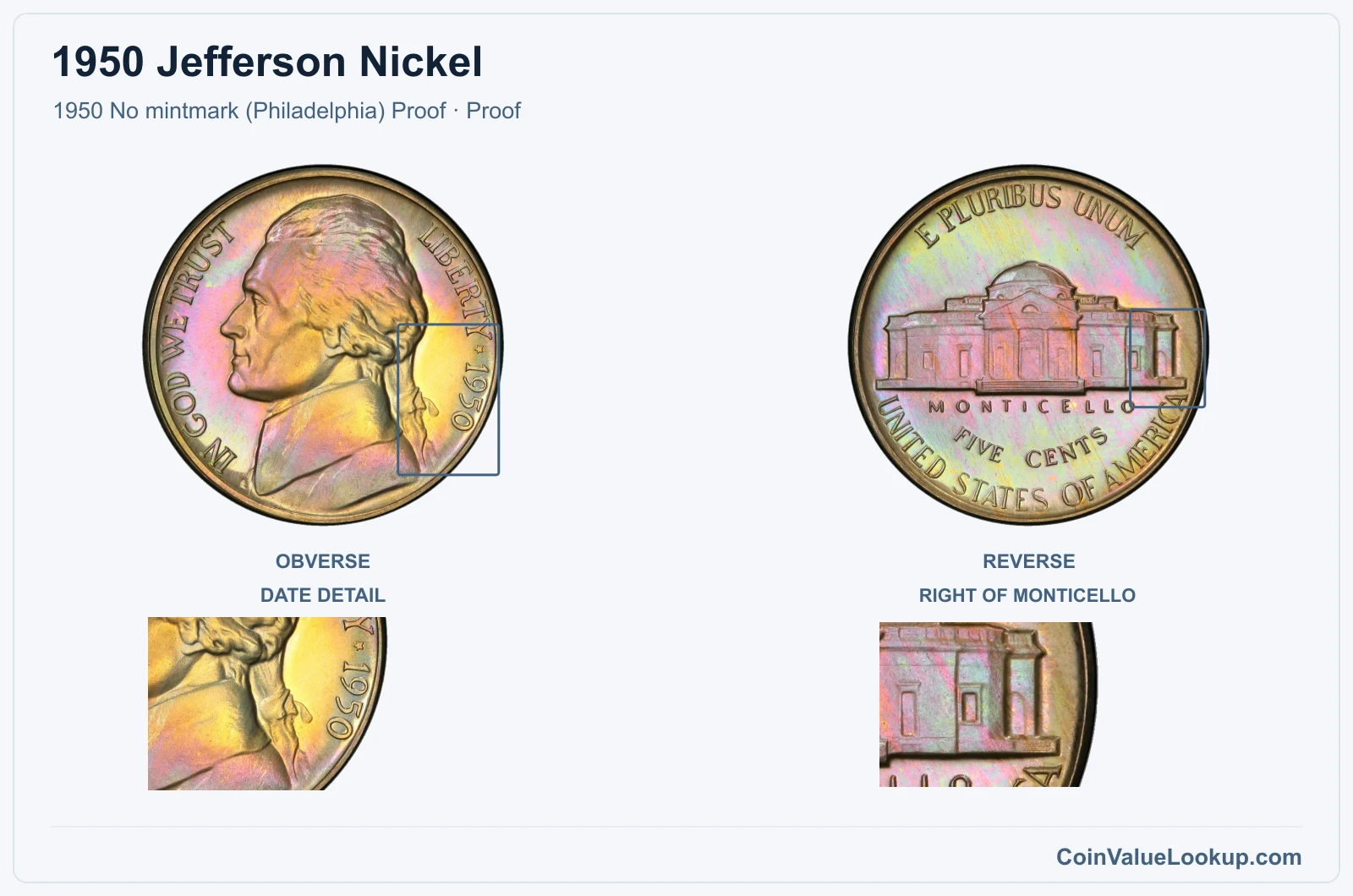
Philadelphia also struck proof nickels in 1950, resuming proof production for collectors. These have deeply mirrored fields and sharply defined devices, and they carry no mintmark just like the business strikes.
The difference is unmistakable once you have seen a real one: hold it at an angle and the flat fields reflect like a dark mirror while the design elements stand in sharp relief. A polished circulation strike is not the same thing.
USA Coin Book's guide estimate for a PR65 example is about $92. Cameo and Deep Cameo examples, which show frosted devices against mirror fields, belong to their own pricing category and are not covered by that figure.
Hairlines and handling marks matter a lot at these grades, so professional certification helps establish exactly where a proof sits.
Coin Value Lookup is a handy place to look up coin guides across many series if you want to compare your proof against other years or denominations.
| Range | Grade | Price | Auction Records | Appraisal |
|---|---|---|---|---|
| PR | PR 1 | — | Coin Identifier | |
| PR 2 | — | Coin Identifier | ||
| PR 3 | — | Coin Identifier | ||
| PR 4 | — | Coin Identifier | ||
| PR 6 | — | Coin Identifier | ||
| PR 8 | — | Coin Identifier | ||
| PR 10 | — | Coin Identifier | ||
| PR 12 | — | Coin Identifier | ||
| PR 15 | — | Coin Identifier | ||
| PR 20 | — | Coin Identifier | ||
| PR 25 | — | Coin Identifier | ||
| PR 30 | — | Coin Identifier | ||
| PR 35 | — | Coin Identifier | ||
| PR 40 | — | Coin Identifier | ||
| PR 45 | — | Coin Identifier | ||
| PR 50 | — | Coin Identifier | ||
| PR 53 | — | Coin Identifier | ||
| PR 55 | — | Coin Identifier | ||
| PR 58 | — | Coin Identifier | ||
| PR 60 | Coin Identifier | |||
| PR 61 | — | Coin Identifier | ||
| PR 62 | — | Coin Identifier | ||
| PR 63 | Coin Identifier | |||
| PR 64 | Coin Identifier | |||
| PR 65 | Coin Identifier | |||
| PR 66 | Coin Identifier | |||
| PR 67 | Coin Identifier | |||
| PR 68 | Coin Identifier | |||
| PR 69 | — | — | — | |
| PR 70 | — | — | — |
1950 Jefferson Nickel — D
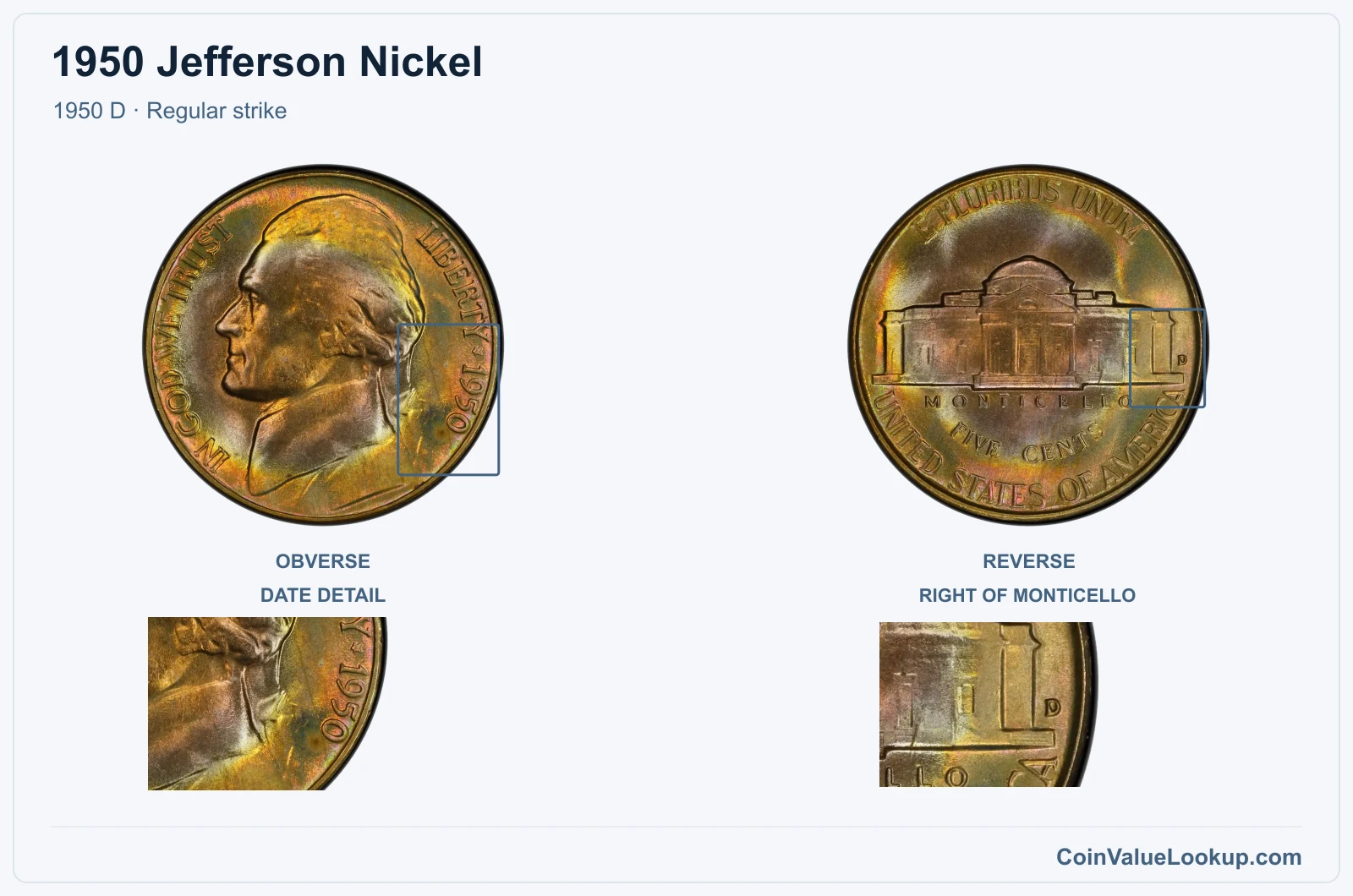
The 1950-D is the famous low-mintage entry for the year. You will find a small "D" mintmark on the reverse, to the right of Monticello.
Same composition as Philadelphia: 75% copper, 25% nickel, 5.00 grams, plain edge.
Guide estimates from USA Coin Book put this at about $19 in MS60 and around $30 at MS65. Those numbers apply to standard uncirculated coins without Full Steps.
The low mintage generated collector hoarding from the start, so many survivors are actually in decent shape. That means a raw 1950-D in average uncirculated condition is not automatically rare, even if the total mintage sounds impressive on paper.
| Range | Grade | Price | Auction Records | Appraisal |
|---|---|---|---|---|
| PO | PO 1 | — | Coin Identifier | |
| FR | FR 2 | — | Coin Identifier | |
| AG | AG 3 | — | Coin Identifier | |
| G | G 4 | — | Coin Identifier | |
| G 6 | — | Coin Identifier | ||
| VG | VG 8 | — | Coin Identifier | |
| VG 10 | — | Coin Identifier | ||
| F | F 12 | — | Coin Identifier | |
| F 15 | — | Coin Identifier | ||
| VF | VF 20 | — | Coin Identifier | |
| VF 25 | — | Coin Identifier | ||
| VF 30 | — | Coin Identifier | ||
| VF 35 | — | Coin Identifier | ||
| XF | XF 40 | — | Coin Identifier | |
| XF 45 | — | Coin Identifier | ||
| AU | AU 50 | — | Coin Identifier | |
| AU 53 | — | Coin Identifier | ||
| AU 55 | — | Coin Identifier | ||
| AU 58 | — | Coin Identifier | ||
| MS | MS 60 | — | Coin Identifier | |
| MS 61 | — | Coin Identifier | ||
| MS 62 | Coin Identifier | |||
| MS 63 | Coin Identifier | |||
| MS 64 | Coin Identifier | |||
| MS 65 | Coin Identifier | |||
| MS 66 | Coin Identifier | |||
| MS 67 | Coin Identifier | |||
| MS 68 | — | — | — | |
| MS 69 | — | — | — | |
| MS 70 | — | — | — |
1950 Jefferson Nickel Error List
1. 1950 Jefferson Nickel — Struck on a silver dime planchet
This error occurs when a 1950 nickel die strikes a 90% silver dime planchet instead of the correct nickel blank. The result is a coin with the full Jefferson nickel design crammed onto a smaller, thinner, silver-colored disc.
The design is visibly cropped at the edges because the dime blank is smaller in diameter.
Weight and diameter are the key diagnostics. A genuine example weighs what a dime planchet weighs and measures smaller than 21.2 mm.
The silver composition also gives the surface a different color and luster than copper-nickel.
Do not confuse this with a plated nickel or a normal nickel that happens to look unusually white. Professional authentication is essential.
A Heritage Auctions sale in May 2022 brought $2,040 for a Philadelphia example graded PCGS MS62, which gives you a concrete data point for what one confirmed specimen realized.
2. 1950 Jefferson Nickel — Reverse die crack
A documented 1950 Philadelphia nickel shows a raised die crack on the reverse that starts at the rim, runs through Monticello, and extends nearly to the opposite rim. The crack appears as a thin raised line because metal fills the developing fissure in the die during striking.
The key diagnostic is tracing the full route of the crack across the building. Match it against the documented specimen rather than assuming any line qualifies.
An incuse scratch, post-mint tooling mark, or a toning line that follows surface contours is not the same thing; a genuine die crack is raised above the field.
No specific price range is adopted for this error. Value depends on the crack's prominence, the coin's overall condition, and whether it has been authenticated.
Individual assessment by a grading service is the most reliable path to establishing what a particular example is worth.
3. 1950 Jefferson Nickel — Broadstrike
A broadstrike happens when the coin is struck without the normal retaining collar that gives a nickel its round, uniform edge. The metal spreads outward freely, producing a coin that is wider than normal with a distorted or absent rim.
Look for the full design still roughly centered but with the edge profile visibly wrong. The coin will feel thinner near the perimeter, and the rim may be weak or missing entirely.
Do not confuse this with an off-center strike, which shifts the design to one side and leaves an unstruck crescent, or with a coin that was flattened after it left the mint by a hammer or railroad track.
No specific price is adopted for this error on the 1950 nickel. The value of any broadstrike depends on condition, how dramatic the spread is, and professional authentication.
4. 1950 Jefferson Nickel — Clipped Planchet
A clipped planchet error means a portion of the original blank was missing before the coin was struck. The clip can be curved, straight, or ragged depending on what went wrong during blank production.
You will see a section of the coin's edge that is absent, and the design near the clip often shows weakness because there was not enough metal to fill the die completely.
Check the edge texture at the missing area. A genuine clip often produces a characteristic metal flow pattern called a Blakesley effect on the opposite side.
Compare that with an edge that was filed, cut, or corroded after minting, which will show tool marks or pitting rather than smooth flow lines.
No numerical price is adopted here. Value depends on the clip size, location, condition, and authentication.
5. 1950 Jefferson Nickel — Off-Center Strike
An off-center strike results when the planchet is not properly seated between the dies. Part of the design is missing, replaced by a blank crescent of unstruck metal.
The more dramatic the shift, the more visually striking the coin.
Collectors generally prefer off-center errors that still show the full date, since that confirms the year. A 1950 nickel struck, say, 10% off-center looks mildly odd, while one at 50% is half blank.
Do not confuse this with a clipped planchet, which removes a chunk of the blank itself, or with post-mint flattening that distorts the design without leaving an unstruck crescent.
No specific price range is adopted for off-center 1950 nickels. Condition, the percentage of off-center shift, date visibility, and professional authentication all factor into what a given example might bring.
6. 1950 Jefferson Nickel — Repunched Mintmark
A repunched mintmark occurs when the mintmark punch was applied more than once in slightly different positions, leaving traces of the earlier impression. On a 1950 nickel this would appear on the reverse near Monticello where the mintmark sits.
Inspect the mintmark under magnification. You are looking for a ghost image, a partial second letter slightly offset from the primary mark.
Compare your coin at the same magnification as a known normal example so you are not fooled by optical tricks.
Do not mistake machine doubling, which produces flat shelf-like doubling, or a die chip filling part of the letter, or simple corrosion around the mark for a true repunched mintmark. No numerical price is adopted for this variety.
Value hinges on the strength of the remnant punch, the coin's condition, and whether a professional service confirms the attribution.