1955 Jefferson Nickel Coin Value: How Much Is It Worth?
The 1955 Jefferson nickel is a coin worth a closer look, especially in higher grades. Ordinary worn examples carry modest collector value, but uncirculated pieces range from about $1.24 at MS60 to $25 at MS65 according to USA Coin Book guide estimates.
Proofs, the D over S overmintmark variety, and authenticated mint errors each occupy their own price tiers and deserve separate attention.
Fast Way to Identify Your 1955 Jefferson Nickel
Snap clear photos of both sides of your 1955 nickel and upload them here for a preliminary identification. Good lighting helps capture the mintmark area to the right of Monticello and any unusual features on Jefferson's portrait.
This step can help you figure out which version you have before diving into grading or variety research.
1955 Jefferson Nickel Value
Upload both sides of your 1955 Jefferson Nickel.
Front Obverse
Upload photo
Back Reverse
Upload photo
Which 1955 Jefferson Nickel Versions Are Worth Money?
- Uncirculated Philadelphia strikes with full original luster guide around $1.24 at MS60 up to $25 at MS65, and coins with uninterrupted Monticello steps can carry a Full Steps premium above those figures.
- Philadelphia proofs with mirrored fields guide at about $22 in PR65; cameo contrast examples are assessed separately.
- The 1955 D over S overmintmark variety guides at $43 in MS60 and $249 in MS65, making the mintmark area the first place to check on any Denver-mint piece.
Step 1: Identify Your 1955 Jefferson Nickel Mint Mark and Version
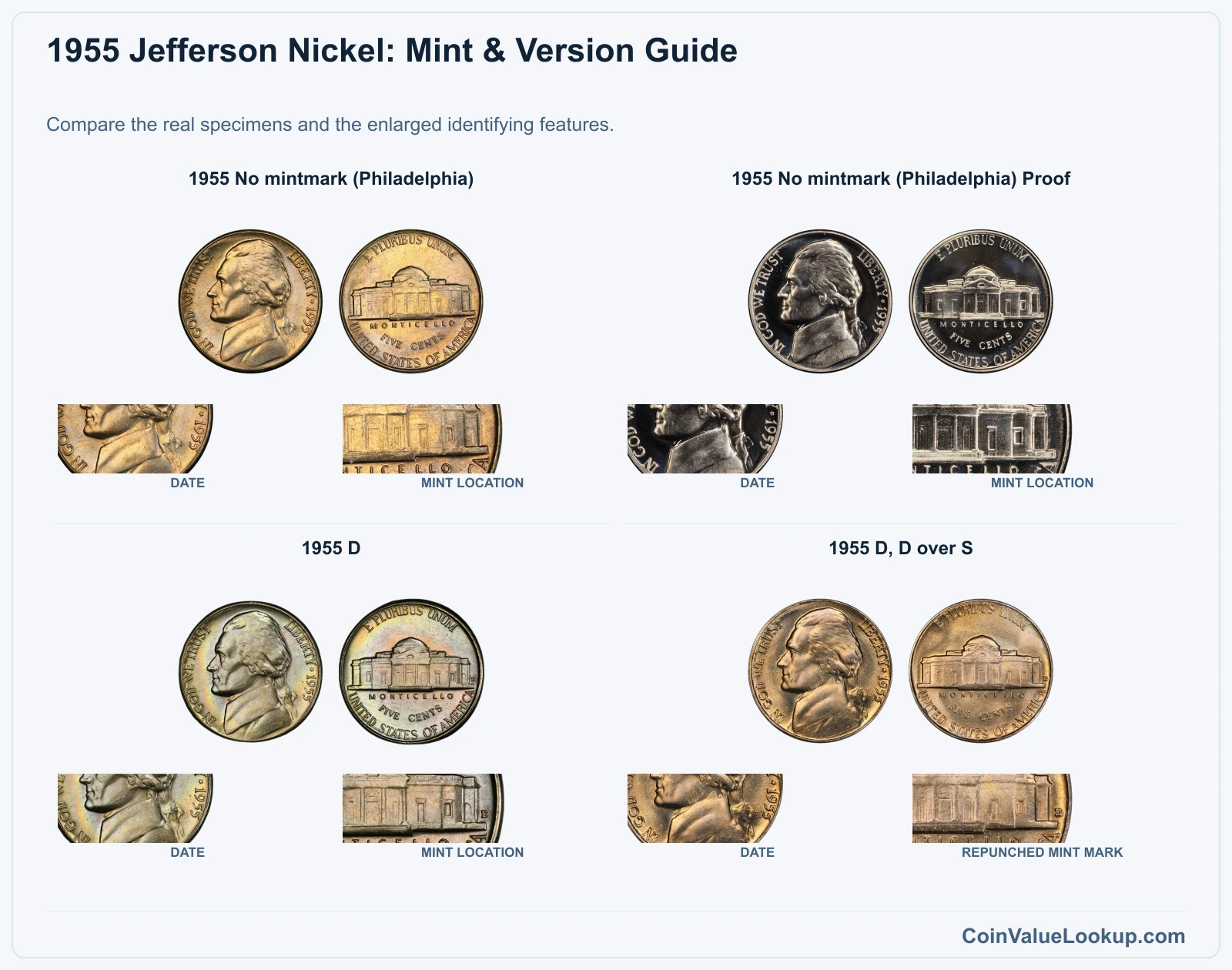
Start with the date on the obverse. Then flip the coin and look to the right of Monticello for a small mintmark.
No mintmark means Philadelphia. A "D" means Denver.
But before you file it under ordinary Denver, grab a loupe and check whether the top of that D shows a faint serif from an underlying S. That is the 1955 D over S variety, and it is a different animal entirely.
All standard 1955 nickels are 75% copper and 25% nickel, weigh 5.00 grams, and measure 21.2 mm with a plain edge. Proofs were struck at Philadelphia and share the same composition, but their mirrored fields and sharp devices set them apart from business strikes.
A polished circulation coin is not a proof, no matter how shiny someone got it.
Step 2: Check Your 1955 Jefferson Nickel Grade
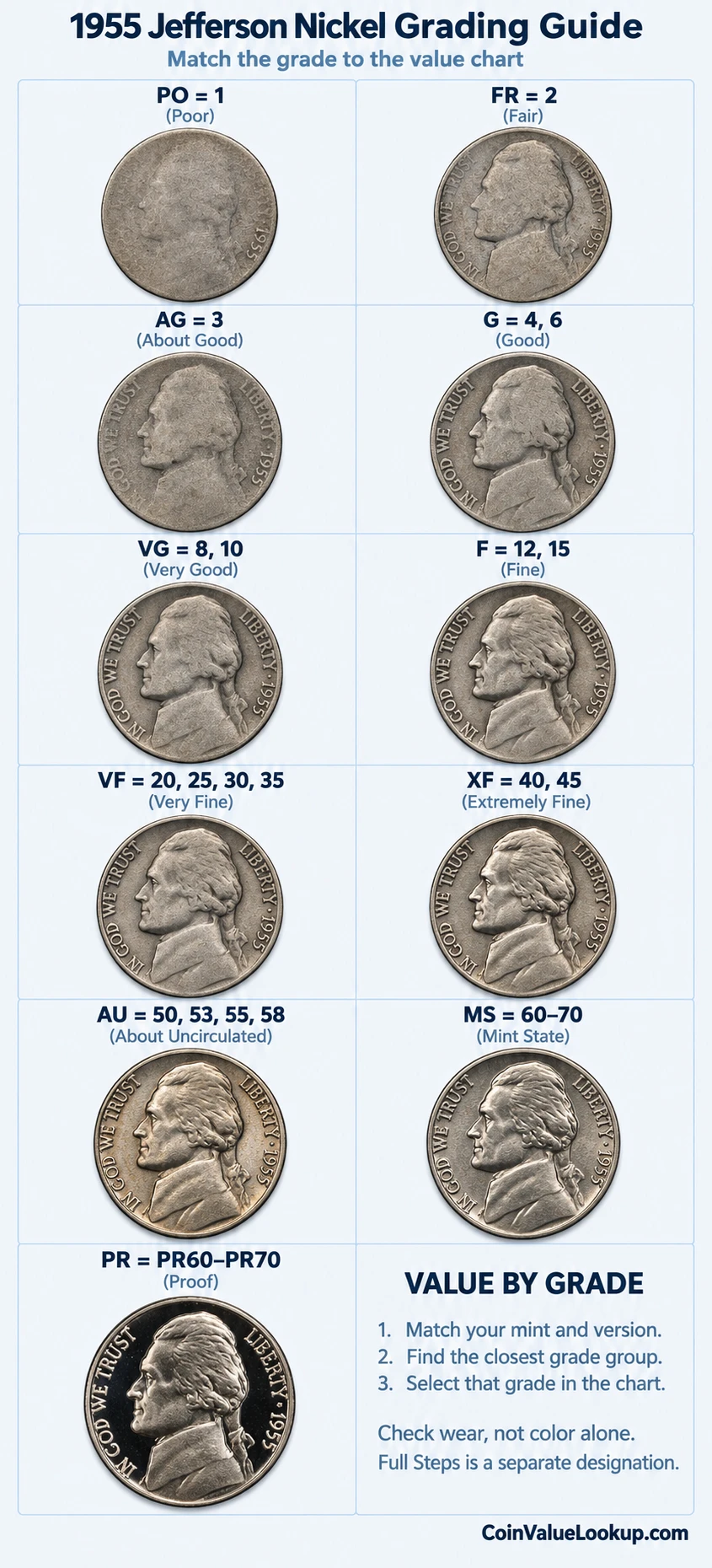
Look at Jefferson's cheekbone first. On a well-worn coin the cheek blends into the surrounding field, and the hair detail above the ear is flat.
As the grade improves, individual strands reappear and original mint luster covers the high points.
Flip to the reverse and examine the Monticello roofline and columns. These wear next, and the steps at the base of the building tell you a lot about the original strike quality.
If at least five steps are fully separated and uninterrupted, a coin may qualify for the PCGS Full Steps designation, which carries its own premium above ordinary Mint State prices.
Weak steps can result from a soft strike, not just wear, so use luster and surface abrasion alongside design sharpness. The comparison image is your friend here: line up the cheek, hair, columns and steps side by side before settling on a grade.
Step 3: Check 1955 Jefferson Nickel Value by Mint and Version
1955 Jefferson Nickel — No mintmark (Philadelphia)
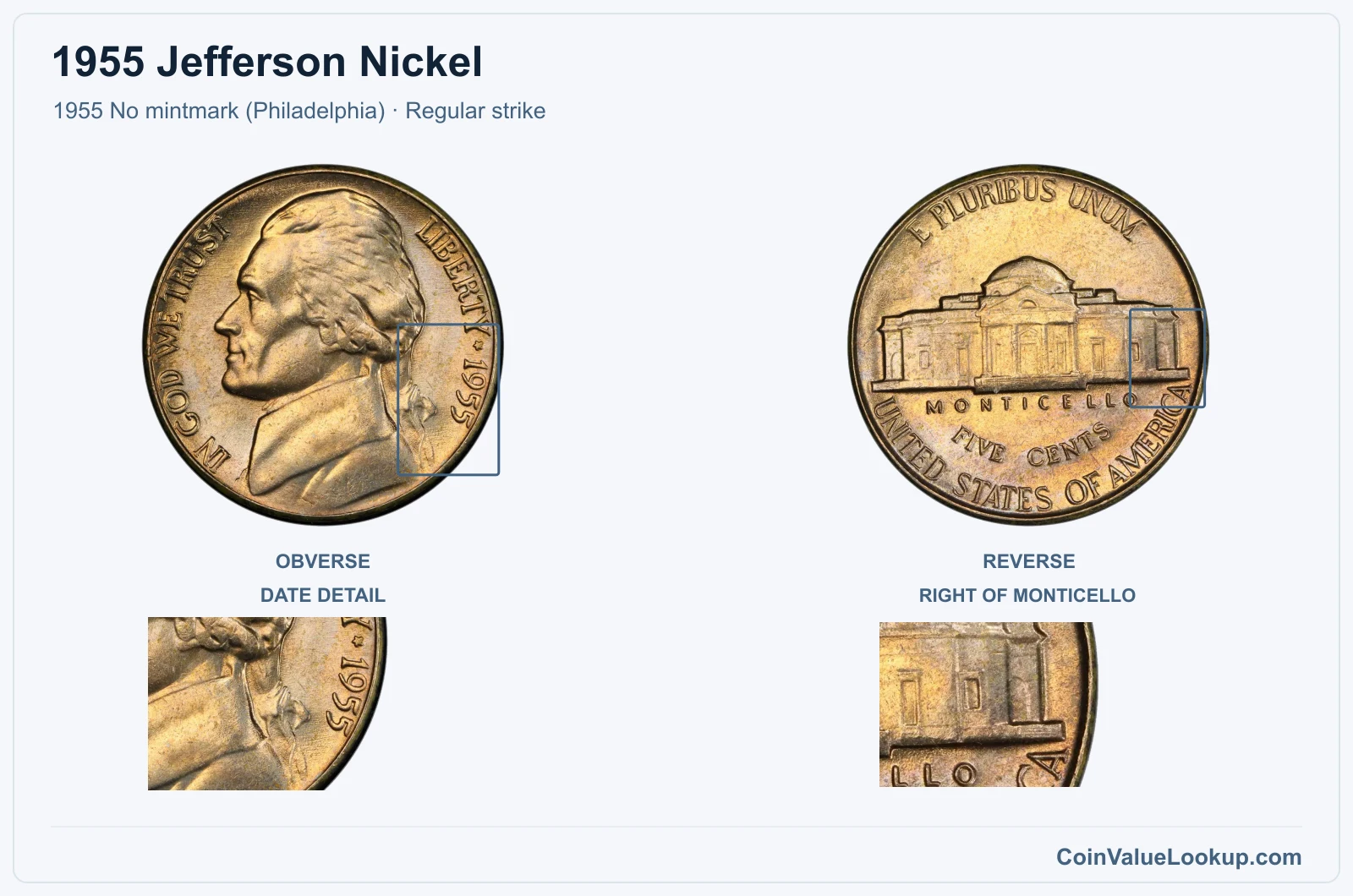
The Philadelphia business strike carries no mintmark. Both sides should show the standard Jefferson portrait and Monticello reverse with no mirrored finish.
USA Coin Book guide estimates place this version at about $1.24 in MS60 and $25 in MS65. Those figures apply to ordinary Mint State coins, not Full Steps pieces, which command their own premium.
Worn circulated examples are not priced from the MS65 column. Look for unbroken luster across Jefferson's cheek and clean fields to separate a true uncirculated coin from a cleaned one.
| Range | Grade | Price | Auction Records | Appraisal |
|---|---|---|---|---|
| PO | PO 1 | — | Coin Identifier | |
| FR | FR 2 | — | — | — |
| AG | AG 3 | — | — | — |
| G | G 4 | — | — | — |
| G 6 | — | — | — | |
| VG | VG 8 | — | — | — |
| VG 10 | — | — | — | |
| F | F 12 | — | — | — |
| F 15 | — | — | — | |
| VF | VF 20 | — | — | — |
| VF 25 | — | — | — | |
| VF 30 | — | — | — | |
| VF 35 | — | — | — | |
| XF | XF 40 | — | Coin Identifier | |
| XF 45 | — | Coin Identifier | ||
| AU | AU 50 | — | Coin Identifier | |
| AU 53 | — | Coin Identifier | ||
| AU 55 | Coin Identifier | |||
| AU 58 | — | Coin Identifier | ||
| MS | MS 60 | — | Coin Identifier | |
| MS 61 | — | Coin Identifier | ||
| MS 62 | — | Coin Identifier | ||
| MS 63 | — | Coin Identifier | ||
| MS 64 | Coin Identifier | |||
| MS 65 | Coin Identifier | |||
| MS 66 | Coin Identifier | |||
| MS 67 | Coin Identifier | |||
| MS 68 | — | — | — | |
| MS 69 | — | — | — | |
| MS 70 | — | — | — |
1955 Jefferson Nickel — No mintmark (Philadelphia) Proof
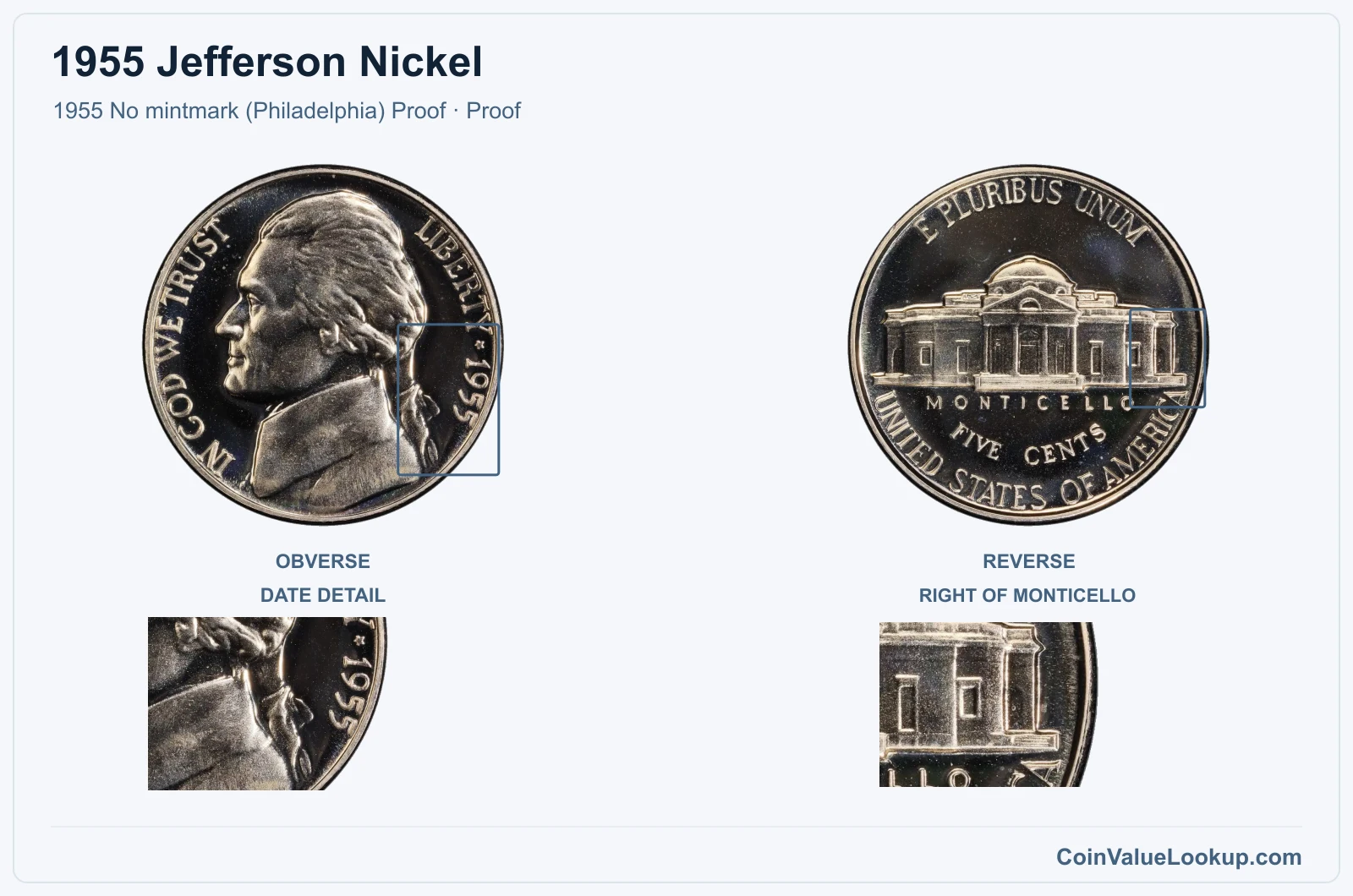
Philadelphia also produced collector proofs in 1955, struck with polished dies on prepared planchets. The fields should be deeply mirrored, and the devices sharp and fully formed.
No mintmark appears on these coins.
A USA Coin Book guide estimate puts PR65 examples at about $22. Cameo and Deep Cameo designations, which reflect frosted devices against mirror fields, are graded separately and are not covered by that figure.
Hairlines from mishandling pull the grade down quickly on proofs, so tilt the coin under a single light source and watch for fine lines across the open fields.
Coin Value Lookup is a handy starting point if you want to compare this proof against other Jefferson nickel years or denominations.
| Range | Grade | Price | Auction Records | Appraisal |
|---|---|---|---|---|
| PR | PR 1 | — | Coin Identifier | |
| PR 2 | — | Coin Identifier | ||
| PR 3 | — | Coin Identifier | ||
| PR 4 | — | Coin Identifier | ||
| PR 6 | — | Coin Identifier | ||
| PR 8 | — | Coin Identifier | ||
| PR 10 | — | Coin Identifier | ||
| PR 12 | — | Coin Identifier | ||
| PR 15 | — | Coin Identifier | ||
| PR 20 | — | Coin Identifier | ||
| PR 25 | — | Coin Identifier | ||
| PR 30 | — | Coin Identifier | ||
| PR 35 | — | Coin Identifier | ||
| PR 40 | — | Coin Identifier | ||
| PR 45 | — | Coin Identifier | ||
| PR 50 | — | Coin Identifier | ||
| PR 53 | — | Coin Identifier | ||
| PR 55 | — | Coin Identifier | ||
| PR 58 | — | Coin Identifier | ||
| PR 60 | Coin Identifier | |||
| PR 61 | — | Coin Identifier | ||
| PR 62 | — | Coin Identifier | ||
| PR 63 | — | Coin Identifier | ||
| PR 64 | — | Coin Identifier | ||
| PR 65 | Coin Identifier | |||
| PR 66 | Coin Identifier | |||
| PR 67 | Coin Identifier | |||
| PR 68 | Coin Identifier | |||
| PR 69 | Coin Identifier | |||
| PR 70 | — | — | — |
1955 Jefferson Nickel — D
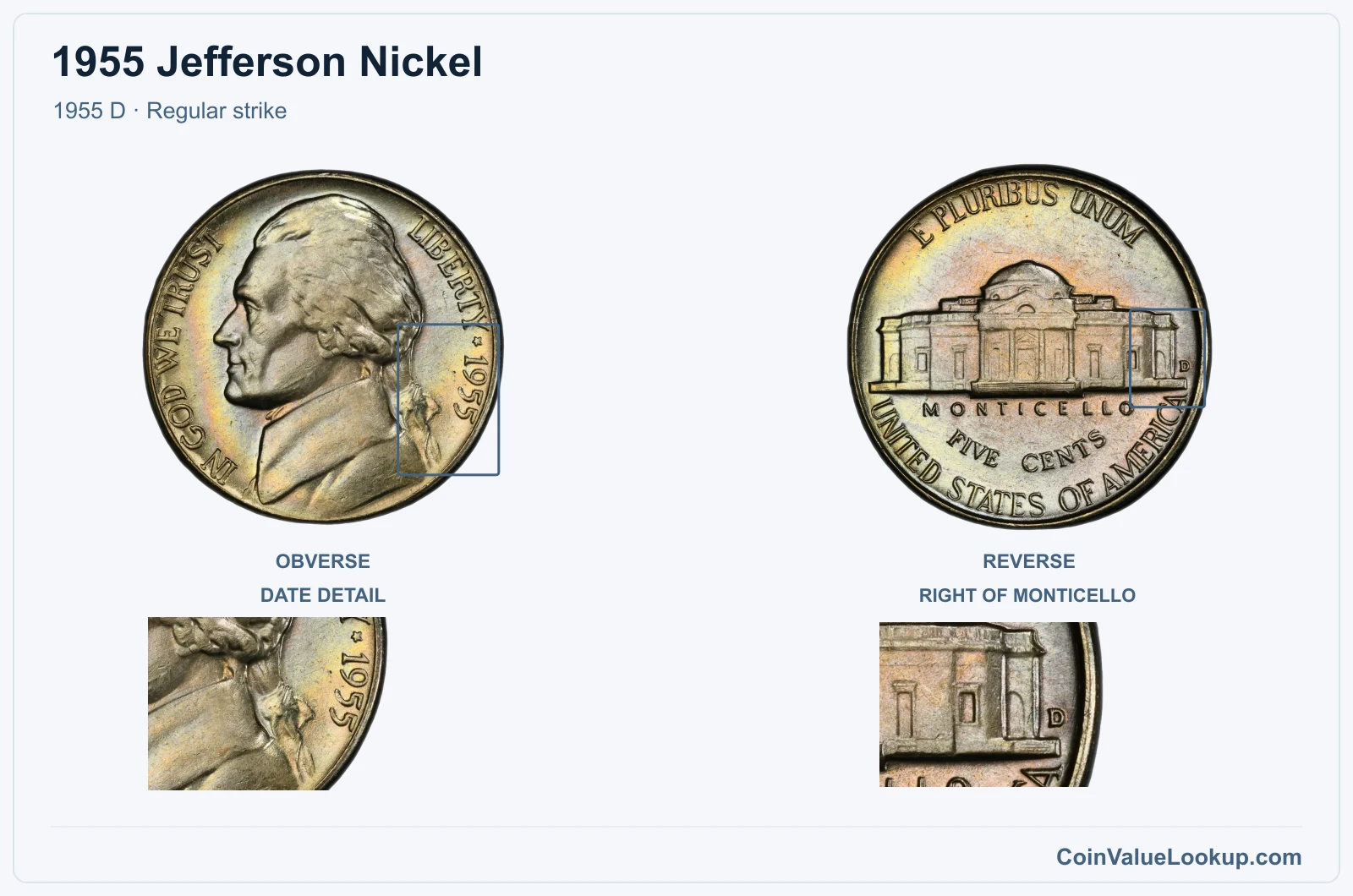
The Denver business strike shows a small "D" mintmark to the right of Monticello on the reverse. Before you price it as an ordinary D-mint coin, check that mintmark carefully for any trace of an underlying S.
The USA Coin Book guide estimates this version at about $19 in MS65. Full Steps coins are assessed on a separate scale.
Circulated-grade pricing is not provided in the guide for this issue, so condition matters: a worn 1955-D is common, while a lustrous gem-grade example is a different story.
| Range | Grade | Price | Auction Records | Appraisal |
|---|---|---|---|---|
| PO | PO 1 | — | Coin Identifier | |
| FR | FR 2 | — | — | — |
| AG | AG 3 | — | — | — |
| G | G 4 | — | — | — |
| G 6 | — | — | — | |
| VG | VG 8 | — | — | — |
| VG 10 | — | — | — | |
| F | F 12 | — | — | — |
| F 15 | — | — | — | |
| VF | VF 20 | — | — | — |
| VF 25 | — | — | — | |
| VF 30 | — | — | — | |
| VF 35 | — | — | — | |
| XF | XF 40 | — | Coin Identifier | |
| XF 45 | — | Coin Identifier | ||
| AU | AU 50 | — | Coin Identifier | |
| AU 53 | — | Coin Identifier | ||
| AU 55 | — | Coin Identifier | ||
| AU 58 | — | Coin Identifier | ||
| MS | MS 60 | — | Coin Identifier | |
| MS 61 | — | Coin Identifier | ||
| MS 62 | — | Coin Identifier | ||
| MS 63 | Coin Identifier | |||
| MS 64 | Coin Identifier | |||
| MS 65 | Coin Identifier | |||
| MS 66 | Coin Identifier | |||
| MS 67 | — | Coin Identifier | ||
| MS 68 | — | — | — | |
| MS 69 | — | — | — | |
| MS 70 | — | — | — |
1955 Jefferson Nickel — D, D over S
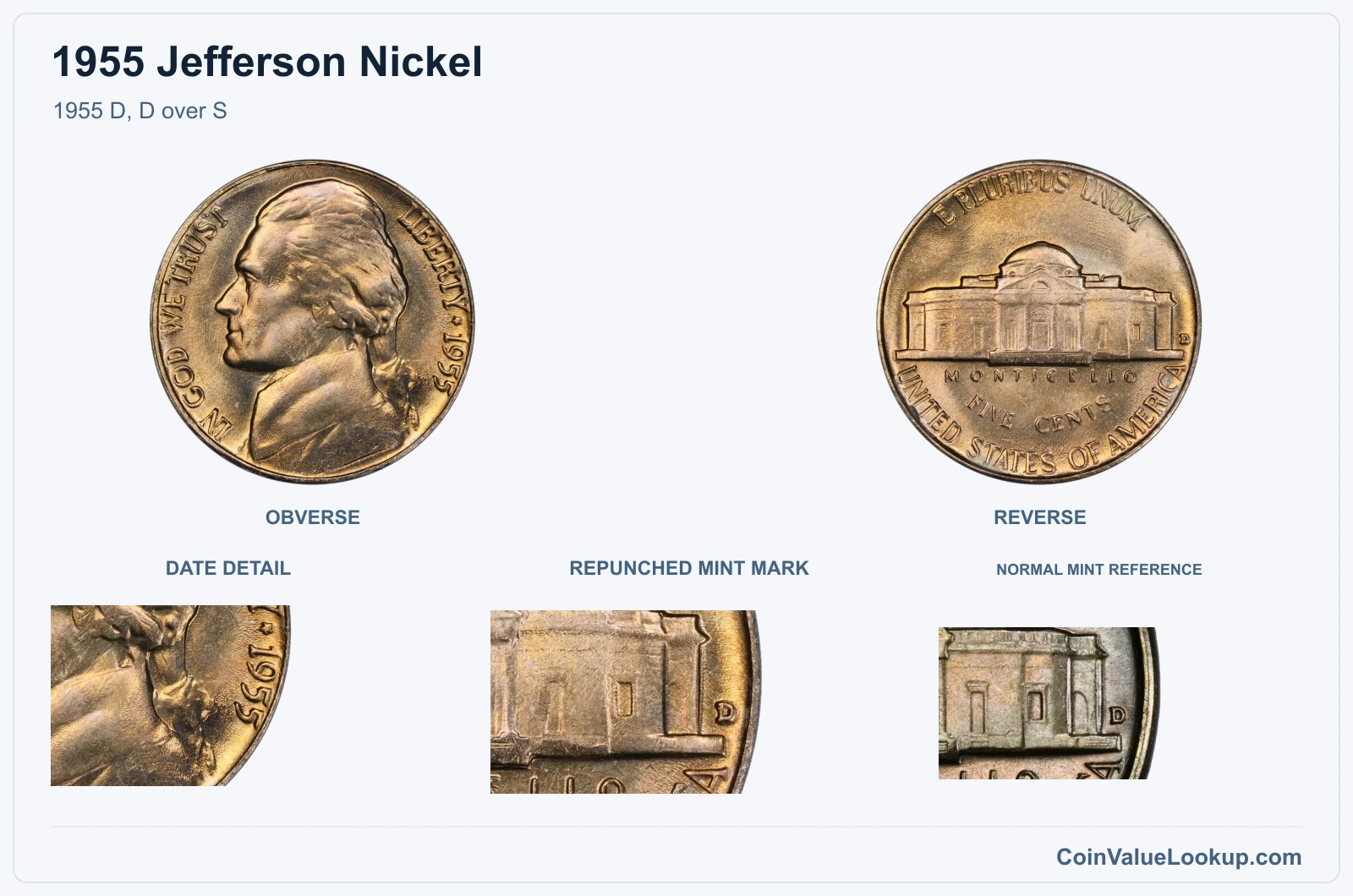
This is the one to hunt for. The 1955 D over S overmintmark shows the top serif of an S peeking out beneath the top of the D mintmark.
You will need at least a 5x loupe to see it clearly, and comparing your coin to an attributed reference image helps a lot.
USA Coin Book guide estimates place this variety at about $43 in MS60 and $249 in MS65, well above the ordinary Denver-mint prices. Full Steps premiums are not included in those figures.
Because the remnant S is small, scratches or loose die metal near the mintmark can fool you, so look specifically for a curved serif rather than a random line. Third-party attribution from a grading service adds confidence and resale value.
| Range | Grade | Price | Auction Records | Appraisal |
|---|---|---|---|---|
| PO | PO 1 | — | Coin Identifier | |
| FR | FR 2 | — | Coin Identifier | |
| AG | AG 3 | — | Coin Identifier | |
| G | G 4 | — | Coin Identifier | |
| G 6 | — | Coin Identifier | ||
| VG | VG 8 | — | Coin Identifier | |
| VG 10 | — | Coin Identifier | ||
| F | F 12 | — | Coin Identifier | |
| F 15 | — | Coin Identifier | ||
| VF | VF 20 | — | Coin Identifier | |
| VF 25 | — | Coin Identifier | ||
| VF 30 | — | Coin Identifier | ||
| VF 35 | — | Coin Identifier | ||
| XF | XF 40 | — | Coin Identifier | |
| XF 45 | — | Coin Identifier | ||
| AU | AU 50 | — | Coin Identifier | |
| AU 53 | — | Coin Identifier | ||
| AU 55 | — | Coin Identifier | ||
| AU 58 | — | Coin Identifier | ||
| MS | MS 60 | — | Coin Identifier | |
| MS 61 | — | Coin Identifier | ||
| MS 62 | — | Coin Identifier | ||
| MS 63 | — | Coin Identifier | ||
| MS 64 | Coin Identifier | |||
| MS 65 | Coin Identifier | |||
| MS 66 | Coin Identifier | |||
| MS 67 | — | — | — | |
| MS 68 | — | — | — | |
| MS 69 | — | — | — | |
| MS 70 | — | — | — |
1955 Jefferson Nickel Error List
1. 1955 Jefferson Nickel — D over S mintmark
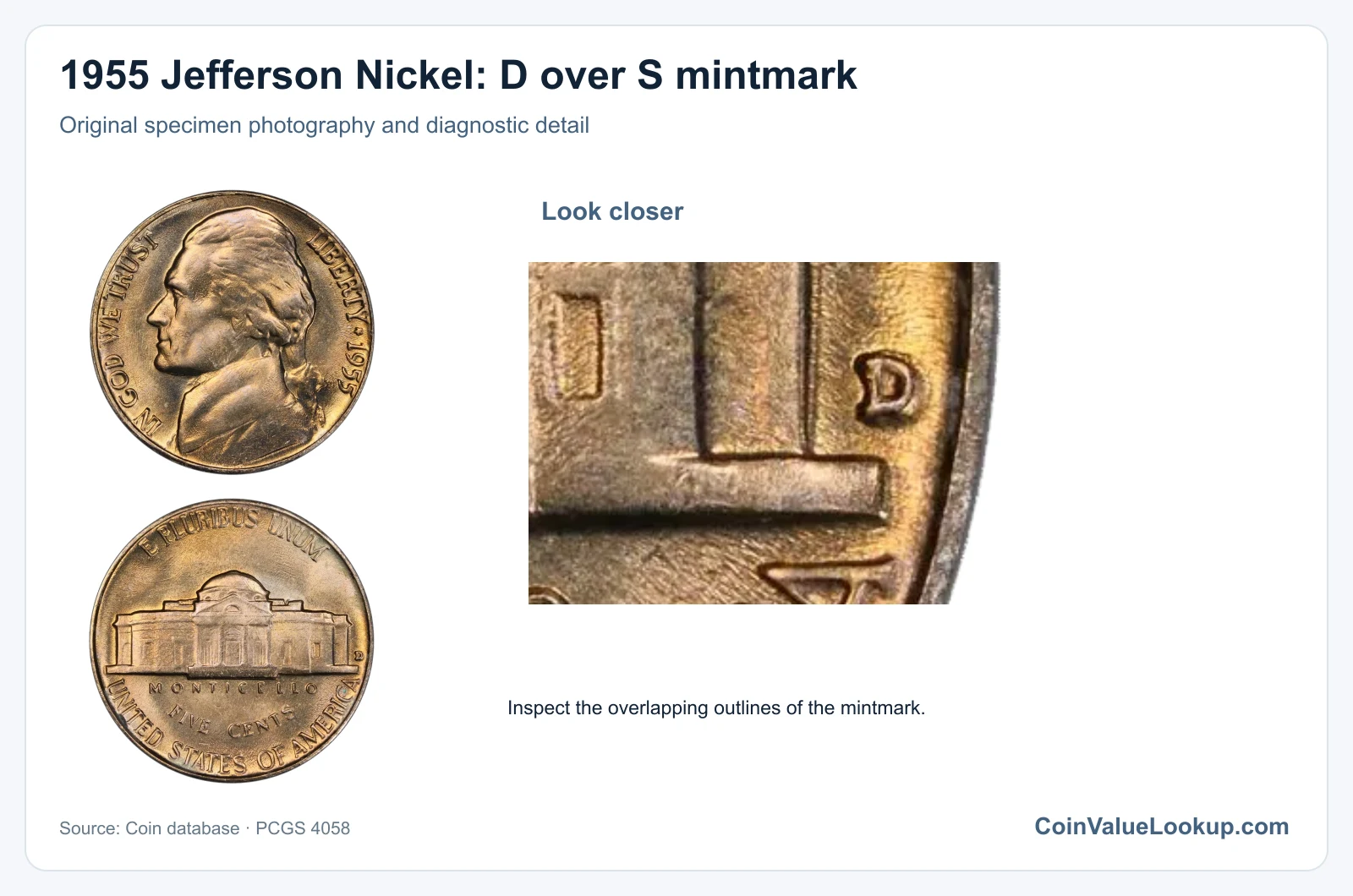
The 1955 D over S is a recognized overmintmark variety where a Denver D was punched over an earlier S mintmark. Under magnification, the top serif of the S curves out from beneath the top of the D.
It is subtle but consistent and repeatable across every coin from that die.
USA Coin Book guide estimates run about $43 at MS60 and $249 at MS65; Full Steps prices are not included. Watch out for lookalikes: a scratch, a small die chip, or machine doubling near the mintmark can mimic the appearance of a second letter.
The real S remnant has a smooth, curved profile that matches the font of a period S punch. Third-party attribution from PCGS or NGC is the standard way to confirm this variety for resale.
2. 1955 Jefferson Nickel — Struck on a silver dime planchet
A 1955 Jefferson nickel struck on a silver dime planchet is a dramatic wrong-planchet error. The blank is smaller and lighter than a normal nickel, roughly 2.5 grams instead of 5.00 grams, and the design extends off the edge of the undersized flan.
On the known Heritage Auctions example graded NGC AU55, the top of the final "55" in the date runs off the coin, but the date remains identifiable.
That Heritage piece sold for $499.38 in October 2012. A coin with a cut or filed edge, or one that has been plated to look silver, is not the same thing.
Authenticated planchet attribution by a major grading service is essential because weight, diameter and metal content all need to be verified.
3. 1955 Jefferson Nickel — Off-center strike
Off-center strikes happen when the planchet is not seated properly between the dies. On a 1955 nickel, this creates an unstruck crescent on one side and an incomplete rim on the opposite side.
The key is that both faces are misaligned in the same direction.
A 1955-D example struck roughly 15% off-center, graded NGC MS66, sold through Heritage Auctions in October 2010 for $402.50. Value depends on the percentage of offset and whether the full date is visible.
Do not confuse a true off-center strike with a single-die misalignment, which shifts only one side, or with a physically trimmed coin that shows tool marks on the edge.
4. 1955 Jefferson Nickel — Doubled Die Obverse
Doubled die obverse varieties have been reported for the 1955 Jefferson nickel. On a genuine doubled die, you will see consistent separation or notching on obverse lettering or design elements when compared to a normal coin under the same lighting.
The doubling should be uniform across the affected area, not just a flat shelf along one edge of a letter. Machine doubling, which is far more common, tends to produce a flat, shelf-like distortion and carries little or no premium.
Condition and the visibility of the doubling both affect value, so there is no single price to cite. Comparing your coin side by side with a known normal example at the same magnification is the best first step.
5. 1955 Jefferson Nickel — Doubled Die Reverse
Doubled die reverse varieties have also been reported for the 1955 nickel. These show consistent doubling on reverse legends or design contours, visible under magnification when compared to a normal coin.
Look at the lettering around Monticello and the building's details. Genuine die doubling produces a clear second image that follows the contour of each letter uniformly.
Machine doubling, by contrast, appears as a flat, mushy shelf on one side of the design elements and is essentially worthless as an error. Value depends on the specific variety, its visibility, and the coin's overall condition, so no single price applies here.
6. 1955 Jefferson Nickel — Repunched Mintmark
Repunched mintmark varieties exist for the 1955 nickel, where the mintmark punch was applied more than once in slightly different positions. The result is a visible remnant of an earlier impression near or under the final mintmark.
Inspect the D mintmark to the right of Monticello at moderate magnification and compare it to a normal example at the same scale. A genuine repunched mintmark shows a second, offset impression of the same letter, not just a blob of metal.
Die chips, corrosion, or machine doubling around the mark can mimic an RPM but lack the crisp letterform shape. Condition and the clarity of the secondary punch affect value; no single guide price is available for this category.
7. 1955 Jefferson Nickel — Die Crack / Die Chip
Die cracks and die chips have been reported on 1955 Jefferson nickels. These show up as raised lines or small raised blobs on the coin's surface, transferred from fractures in the steel die during striking.
An interior die crack appears as a thin raised line crossing the design. A rim-connected break, sometimes called a cud, produces a larger raised lump where part of the die has broken away entirely.
Both are worth distinguishing from incuse scratches, which are recessed into the surface, or from corrosion and foreign material stuck to the coin. Value varies with the size, location, and visual impact of the break, so no single price applies across all examples.