1992 Jefferson Nickel Coin Value: How Much Is It Worth?
Most 1992 Jefferson nickels pulled from pocket change are worth face value or close to it. Uncirculated examples carry modest guide values, with selected retail anchors ranging from about $0.30 at MS60 up to roughly $3.62 at MS65, depending on mint and grade.
Proofs and authenticated errors occupy separate price tiers. These guide figures are retail estimates, not guaranteed buy offers for every coin.
Fast Way to Identify Your 1992 Jefferson Nickel
Snap a clear photo of the front and back of your 1992 nickel and upload both images. Our identifier can give you a preliminary read on the mint, finish, and general version so you know which value chart to consult.
It works best with good lighting and a steady shot — blurry photos make attribution harder for everyone.
1992 Jefferson Nickel Value
Upload both sides of your 1992 Jefferson Nickel.
Front Obverse
Upload photo
Back Reverse
Upload photo
Which 1992 Jefferson Nickel Versions Are Worth Money?
- Uncirculated 1992-P nickels in MS65 condition carry a USA Coin Book guide value around $3.62 — well above face value but still modest.
- 1992-D nickels in MS65 guide near $3.36; the jump from MS60 ($0.30) shows how grade drives value even for common dates.
- 1992-S proofs in PR65 guide around $4.27 per USA Coin Book; cameo and deep cameo finishes may carry separate premiums not reflected in that generic figure.
- Certified Full Steps examples of either P or D mints can command premiums above standard uncirculated values — worn coins do not inherit those prices.
- Authenticated errors such as the struck-over-cent double denomination have sold individually for hundreds of dollars at auction.
Step 1: Identify Your 1992 Jefferson Nickel Mint Mark and Version
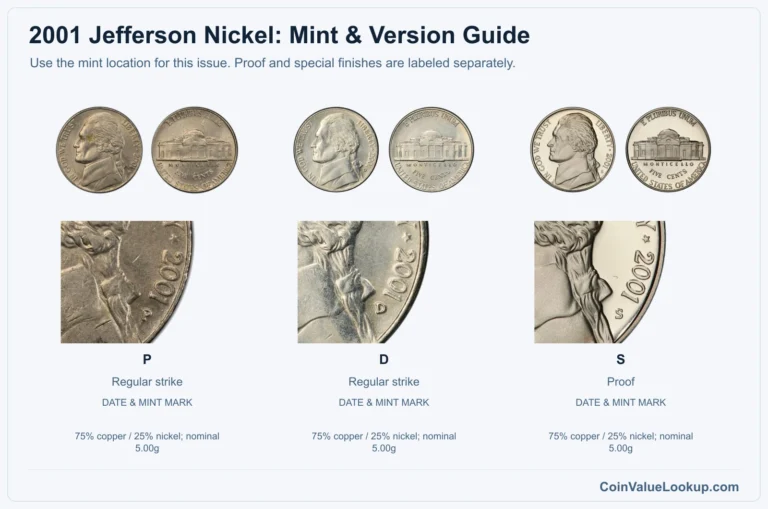
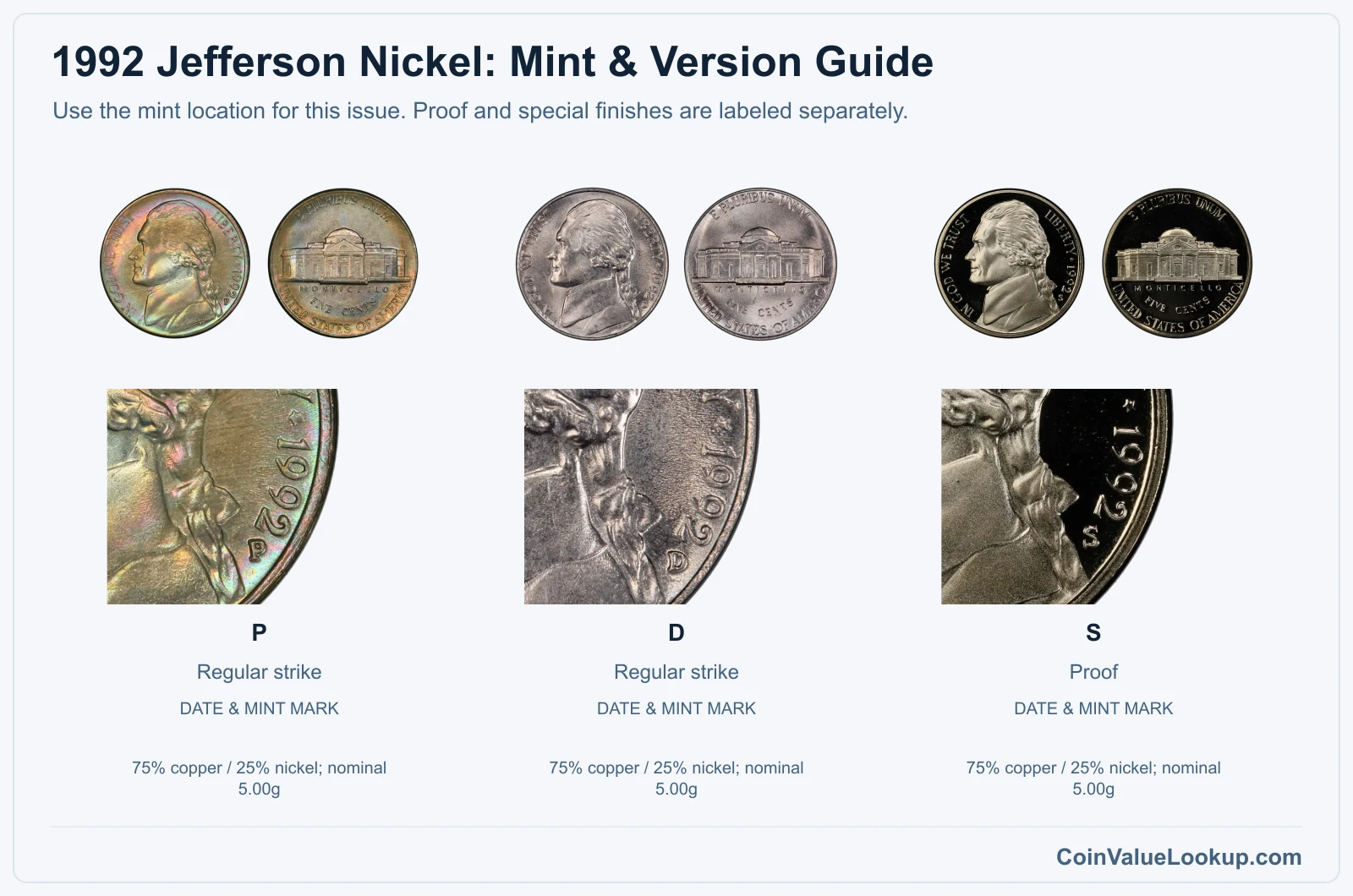
Start by finding the mintmark on the obverse, just below the date. A "P" means Philadelphia, "D" means Denver, and "S" means San Francisco proof.
All three share the standard Jefferson portrait on the front and Monticello on the reverse.
Every 1992 nickel is 75% copper and 25% nickel, weighs about 5 grams, and measures 21.2 mm with a plain edge. Record your coin's date, mintmark, and whether the surfaces look frosted or reflective before comparing it to a value chart.
A bright, mirror-like surface does not automatically mean proof. Proof coins were sold in sealed sets from the San Francisco Mint and carry an "S" mintmark.
Brightness from cleaning or light wear can fool you, so don't diagnose finish from shininess alone.
Step 2: Check Your 1992 Jefferson Nickel Grade
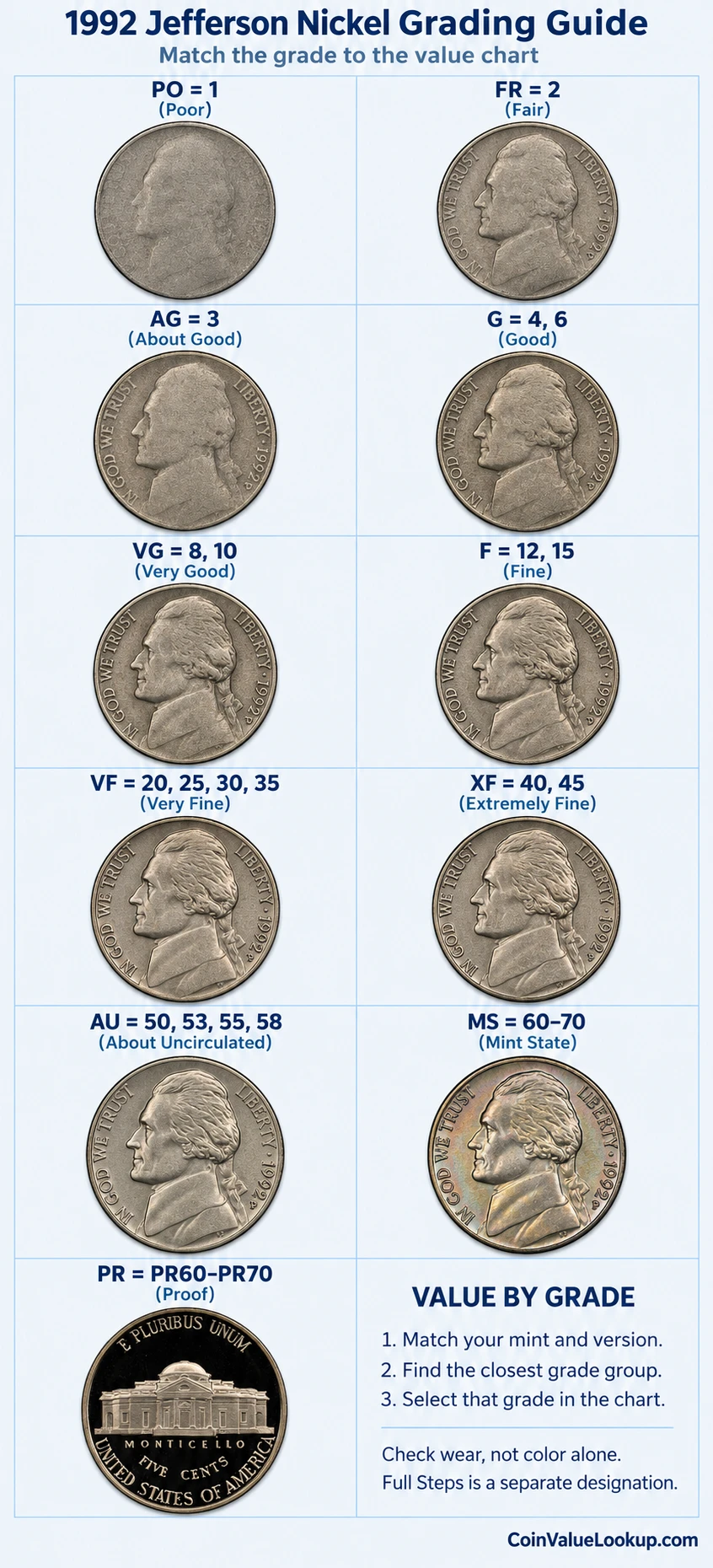
Focus on Jefferson's cheek and hair above the ear — these are the first spots to lose detail as a coin circulates. A coin with full, sharp cheek texture and no flattening is heading toward Mint State territory.
Flip it over and check the Monticello steps. Incomplete steps can result from a weak strike at the mint rather than actual wear, so don't confuse the two.
Full Steps is a separate designation applied to Mint State coins by grading services; it is not a numerical grade.
Luster matters. An uncirculated coin should have unbroken cartwheel shine across both sides.
Compare your coin to the reference image to see how wear patterns typically progress from AU down through lower circulated grades.
For proofs, look at the contrast between frosted devices and mirrored fields. Cameo or deep cameo designations are separate filters that grading services assign, and they carry their own market.
A generic proof guide value does not reflect those premium finishes.
Step 3: Check 1992 Jefferson Nickel Value by Mint and Version
1992 Jefferson Nickel — P Business strike
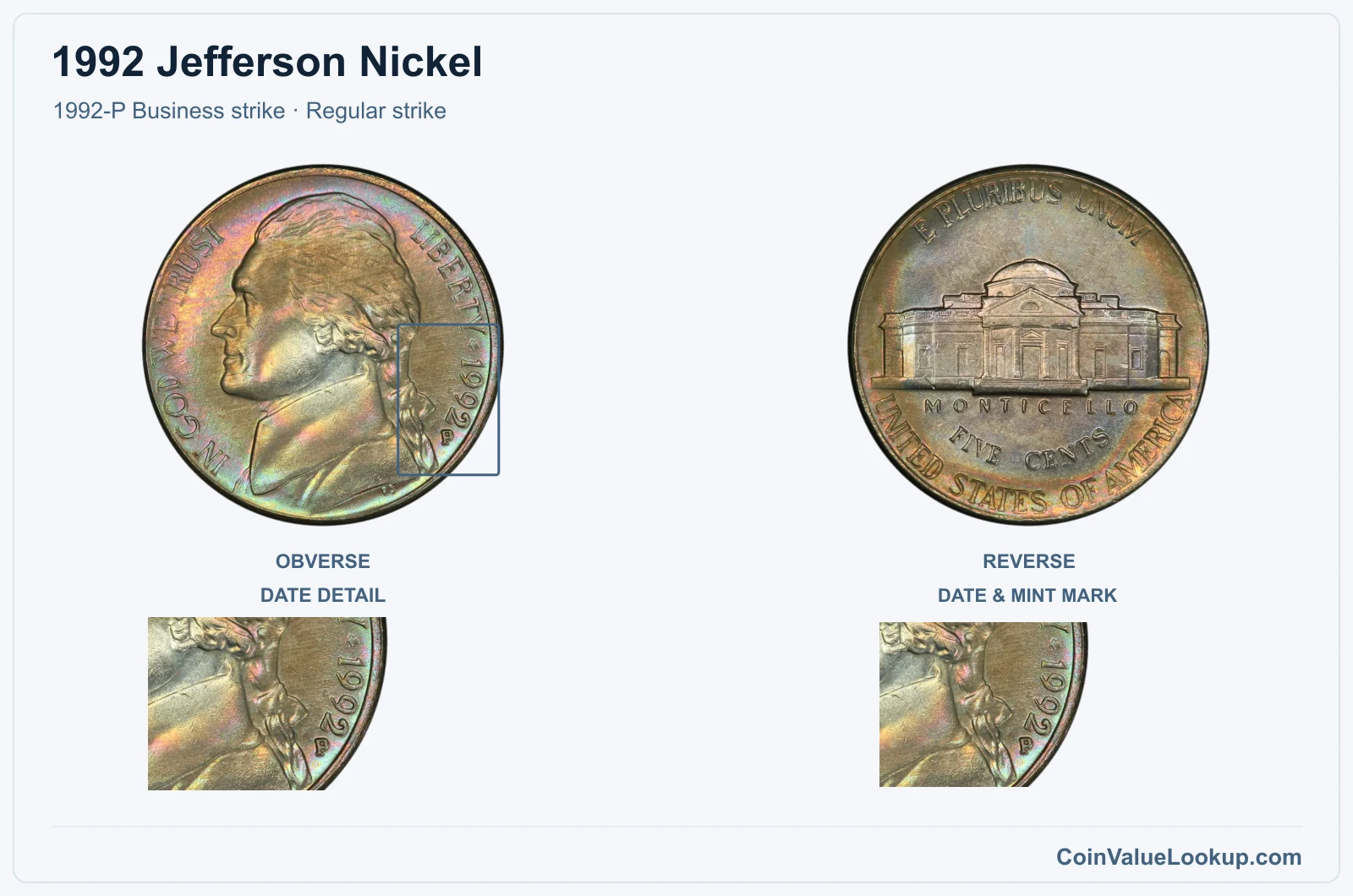
The 1992-P is a Philadelphia business strike with the standard Jefferson portrait and Monticello reverse. It weighs about 5 grams in the normal 75% copper / 25% nickel alloy.
Look for the small "P" mintmark on the obverse beneath the date.
USA Coin Book lists a retail guide value near $1.88 at MS60 and about $3.62 at MS65. Circulated examples are generally worth face value.
If your coin grades Mint State with strong, fully separated Monticello steps, a Full Steps designation from a grading service could push its market appeal above these generic anchors.
| Range | Grade | Price | Auction Records | Appraisal |
|---|---|---|---|---|
| PO | PO 1 | — | Coin Identifier | |
| FR | FR 2 | — | Coin Identifier | |
| AG | AG 3 | — | Coin Identifier | |
| G | G 4 | — | Coin Identifier | |
| G 6 | — | Coin Identifier | ||
| VG | VG 8 | — | Coin Identifier | |
| VG 10 | — | Coin Identifier | ||
| F | F 12 | — | Coin Identifier | |
| F 15 | — | Coin Identifier | ||
| VF | VF 20 | — | Coin Identifier | |
| VF 25 | — | Coin Identifier | ||
| VF 30 | — | Coin Identifier | ||
| VF 35 | — | Coin Identifier | ||
| XF | XF 40 | — | Coin Identifier | |
| XF 45 | — | Coin Identifier | ||
| AU | AU 50 | — | Coin Identifier | |
| AU 53 | — | Coin Identifier | ||
| AU 55 | — | Coin Identifier | ||
| AU 58 | — | Coin Identifier | ||
| MS | MS 60 | — | Coin Identifier | |
| MS 61 | — | Coin Identifier | ||
| MS 62 | — | Coin Identifier | ||
| MS 63 | — | Coin Identifier | ||
| MS 64 | — | Coin Identifier | ||
| MS 65 | — | Coin Identifier | ||
| MS 66 | Coin Identifier | |||
| MS 67 | — | — | — | |
| MS 68 | — | — | — | |
| MS 69 | — | — | — | |
| MS 70 | — | — | — |
1992 Jefferson Nickel — D Business strike
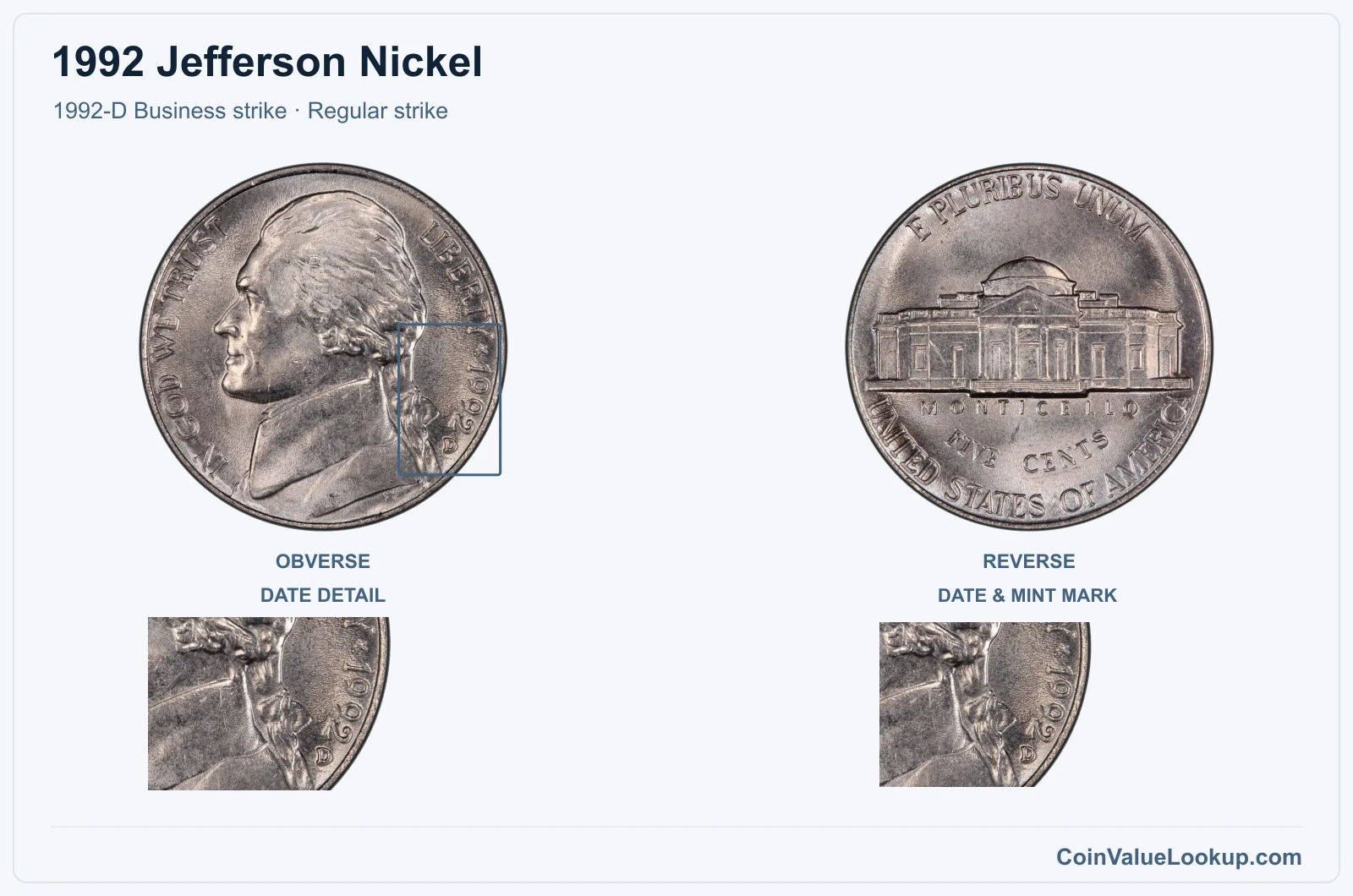
Denver struck plenty of 1992 nickels, and the "D" mintmark sits in the same obverse location below the date. Same alloy, same weight, same design — 75% copper and 25% nickel at roughly 5 grams.
Guide values per USA Coin Book sit around $0.30 at MS60 and $3.36 at MS65. That wide gap tells you the story: condition is everything for a common-date nickel.
Circulated pieces are face-value coins. If you have a sharp uncirculated example, compare it carefully against graded references before getting excited.
Coin Value Lookup is a good starting point when you want to look up guides for other dates and denominations in the Jefferson series.
| Range | Grade | Price | Auction Records | Appraisal |
|---|---|---|---|---|
| PO | PO 1 | — | Coin Identifier | |
| FR | FR 2 | — | Coin Identifier | |
| AG | AG 3 | — | Coin Identifier | |
| G | G 4 | — | Coin Identifier | |
| G 6 | — | Coin Identifier | ||
| VG | VG 8 | — | Coin Identifier | |
| VG 10 | — | Coin Identifier | ||
| F | F 12 | — | Coin Identifier | |
| F 15 | — | Coin Identifier | ||
| VF | VF 20 | — | Coin Identifier | |
| VF 25 | — | Coin Identifier | ||
| VF 30 | — | Coin Identifier | ||
| VF 35 | — | Coin Identifier | ||
| XF | XF 40 | — | Coin Identifier | |
| XF 45 | — | Coin Identifier | ||
| AU | AU 50 | — | Coin Identifier | |
| AU 53 | — | Coin Identifier | ||
| AU 55 | — | Coin Identifier | ||
| AU 58 | — | Coin Identifier | ||
| MS | MS 60 | — | Coin Identifier | |
| MS 61 | — | Coin Identifier | ||
| MS 62 | — | Coin Identifier | ||
| MS 63 | — | Coin Identifier | ||
| MS 64 | — | Coin Identifier | ||
| MS 65 | — | Coin Identifier | ||
| MS 66 | Coin Identifier | |||
| MS 67 | — | — | — | |
| MS 68 | — | — | — | |
| MS 69 | — | — | — | |
| MS 70 | — | — | — |
1992 Jefferson Nickel — S Proof
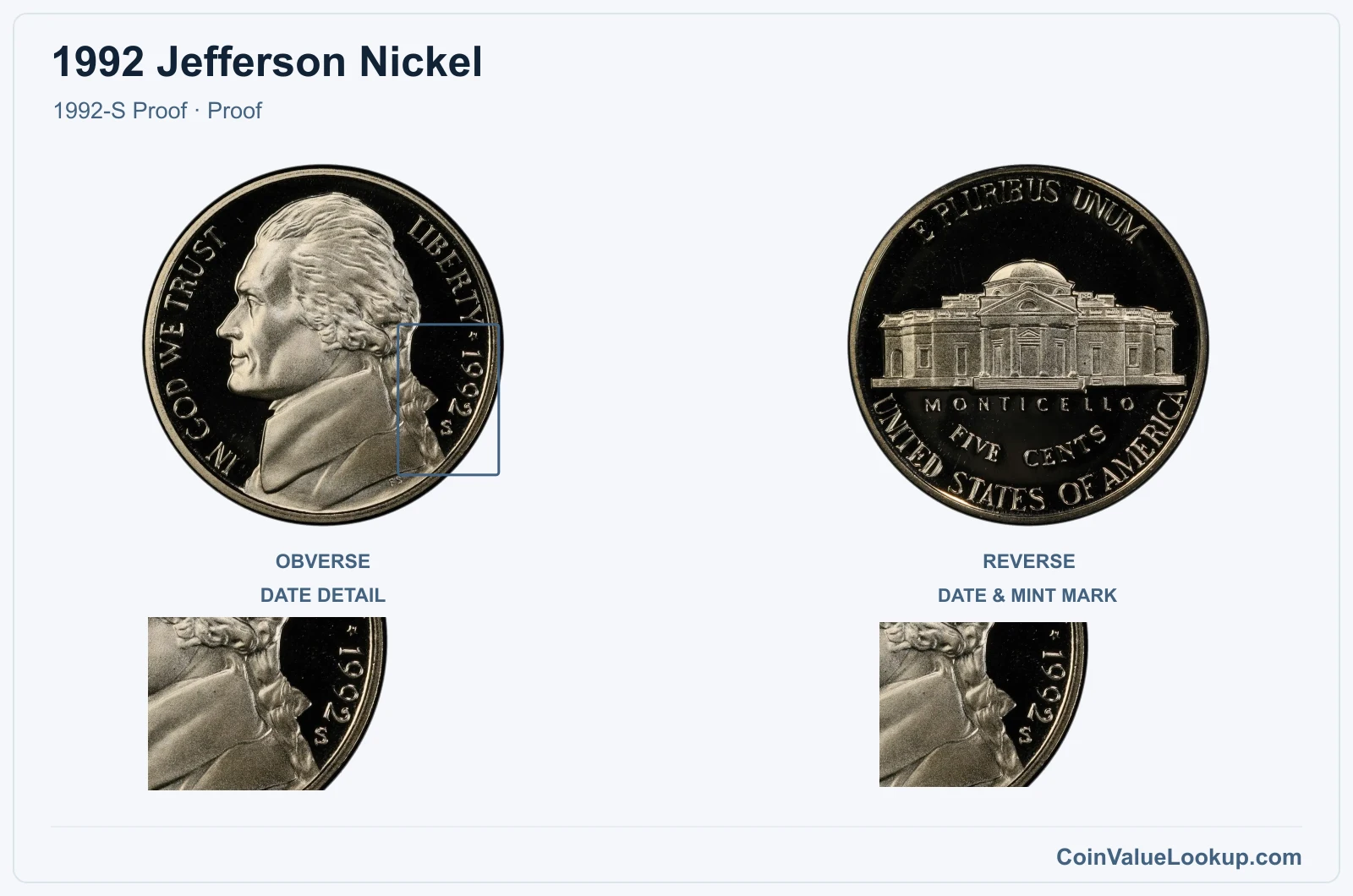
The 1992-S proof was produced at the San Francisco Mint exclusively for collector sets. It carries an "S" mintmark and should display mirrored fields with sharply struck devices.
Same 75% copper / 25% nickel composition as the business strikes.
USA Coin Book places the generic PR65 guide value at about $4.27. That figure does not specifically account for cameo or deep cameo designations, which are graded separately and can trade at different levels.
If your proof came from a sealed government set and shows strong frost-to-mirror contrast, it may be worth having a grading service evaluate the cameo quality individually.
| Range | Grade | Price | Auction Records | Appraisal |
|---|---|---|---|---|
| PR | PR 1 | — | Coin Identifier | |
| PR 2 | — | Coin Identifier | ||
| PR 3 | — | Coin Identifier | ||
| PR 4 | — | Coin Identifier | ||
| PR 6 | — | Coin Identifier | ||
| PR 8 | — | Coin Identifier | ||
| PR 10 | — | Coin Identifier | ||
| PR 12 | — | Coin Identifier | ||
| PR 15 | — | Coin Identifier | ||
| PR 20 | — | Coin Identifier | ||
| PR 25 | — | Coin Identifier | ||
| PR 30 | — | Coin Identifier | ||
| PR 35 | — | Coin Identifier | ||
| PR 40 | — | Coin Identifier | ||
| PR 45 | — | Coin Identifier | ||
| PR 50 | — | Coin Identifier | ||
| PR 53 | — | Coin Identifier | ||
| PR 55 | — | Coin Identifier | ||
| PR 58 | — | Coin Identifier | ||
| PR 60 | — | Coin Identifier | ||
| PR 61 | — | Coin Identifier | ||
| PR 62 | — | Coin Identifier | ||
| PR 63 | — | Coin Identifier | ||
| PR 64 | — | Coin Identifier | ||
| PR 65 | — | Coin Identifier | ||
| PR 66 | — | Coin Identifier | ||
| PR 67 | — | Coin Identifier | ||
| PR 68 | Coin Identifier | |||
| PR 69 | Coin Identifier | |||
| PR 70 | Coin Identifier |
1992 Jefferson Nickel Error List
1. 1992 Jefferson Nickel — Struck over a1992 cent
This is a double-denomination error: a 1992 cent planchet that somehow entered the nickel press and received the Jefferson nickel design on top of the existing Lincoln cent design. Remnants of the cent's design survive underneath, which is the key diagnostic.
On the authenticated example, the coin was graded NGC MS63 RB from the Philadelphia Mint.
A Heritage Auctions sale in November 2020 recorded one example at $630. That is a single auction result, not a standing market price — your coin's value would depend on its own authentication, grade, and the visibility of the underlying cent design.
Do not confuse this with an unstruck wrong-planchet blank or two coins glued together. The cent imagery must be genuinely struck under the nickel design, confirmed by a third-party grading service.
2. 1992 Jefferson Nickel — Off-center strike
An off-center strike happens when the planchet is not seated properly in the press, producing a blank crescent on one side and a shifted design. The reported 1992 example is a D-mint coin graded ANACS MS63, struck about 20% off center at the 7:00 position.
This specific coin appeared in a Heritage Auctions lot in January 2022 that sold for $99 — but that was a three-coin lot, so the price cannot be attributed to this single nickel. Any individual valuation would need to account for the percentage and direction of the off-center shift, whether the date is fully visible, and overall condition.
Look-alikes include a single misaligned die (which still fills the planchet), trimmed rims, or post-mint damage. A genuine off-center strike will show undisturbed metal in the blank area with no signs of cutting or filing.
3. 1992 Jefferson Nickel — Major die break
A major die break leaves a raised, irregular blob of metal where a chunk of the die itself fractured and fell away. The reported 1992 example is a P-mint coin graded ANACS AU50.
The raised area replaces part of the original design and typically connects to or interacts with the rim.
No specific price is adopted for this error. Value depends heavily on the size and location of the break, the coin's overall condition, and third-party authentication.
A dramatic retained cud connecting to the rim will attract more interest than a small interior break.
Don't mistake an incuse gouge, corrosion pit, or soldered blob for a die break. Genuine die breaks produce raised metal with a specific texture that differs from the surrounding design, and they repeat across multiple coins from the same die.
4. 1992 Jefferson Nickel — Doubled Die Reverse
A doubled die reverse on a 1992 nickel shows duplicated or spread design elements on the Monticello side. Compare the reverse lettering — especially MONTICELLO and the denomination — against a known normal coin under magnification.
Any true doubling will be consistent and crisp, not mushy or shelf-like.
No specific price is adopted for this variety. What a doubled die reverse is worth depends on the visibility of the doubling, the specific die involved, and the coin's condition.
The main impostor is machine doubling, which produces flat, shelf-like displacement rather than the rounded, separated image of a genuine hub-doubled die. Random scratches and reflections can also mimic doubling under certain lighting.
If you suspect you have one, clear close-up photos of the affected area are essential for proper evaluation.
5. 1992 Jefferson Nickel — Broadstrike
A broadstrike occurs when the collar die — the ring that normally contains the planchet and forms the coin's edge — is absent or improperly positioned during striking. The result is a coin with full design but noticeably wider than normal, with a smooth or distorted rim instead of the usual uniform edge.
For 1992 nickels, broadstrikes have been reported as a recognized error category. No specific numerical price is adopted here; value depends on the degree of spread, sharpness of the design, and authenticated condition.
Don't confuse a broadstrike with an off-center coin, which shifts the design and leaves a blank area. Also rule out post-mint flattening — a coin smashed in a vise will show distorted detail and often surface damage that a genuine broadstrike does not.
6. 1992 Jefferson Nickel — Struck-Through Error
A struck-through error happens when foreign material — grease, a fragment of metal, fabric, or other debris — gets trapped between the die and planchet during striking. The result is a localized depression, an impression of the object, or a patch of missing design detail.
These have been reported for 1992 nickels. No numerical price is adopted.
Value hinges on what the coin was struck through, how dramatic the impression is, and the coin's grade.
Grease-filled dies tend to produce soft, undefined patches, while a retained foreign object leaves a more distinct impression. Don't mistake ordinary wear, cleaning scratches, or a weak strike area for a struck-through error.
Genuine examples show a specific interruption in an otherwise well-struck field or design element, and the depression should not show tool marks or post-mint abrasion.
7. 1992 Jefferson Nickel — Clipped Planchet
A clipped planchet means the blank was incompletely punched from the metal strip before striking, leaving a missing section. The clip can be curved, straight, or irregular depending on what went wrong during the blanking process.
For 1992 nickels, clipped planchets are a reported error category. No specific price is adopted.
Value depends on the size and type of clip, whether the date and mintmark survived, and overall condition.
A genuine clip often shows a characteristic weakness in the design directly opposite the missing area, caused by incomplete metal flow during striking. The edge at the clip should look naturally torn or sheared, not filed or cut.
Compare it closely: a coin that was damaged after minting — nicked by a lawnmower blade, for instance — will have sharp, unnatural edges and no corresponding opposite-side weakness.