2001 Jefferson Nickel Coin Value: How Much Is It Worth?
Most 2001 Jefferson nickels are worth close to face value in circulated condition. Uncirculated business strikes from Philadelphia or Denver carry USA Coin Book retail guide estimates of roughly $0.30 at MS60 up to about $1.24 at MS65.
San Francisco proofs and genuine mint errors occupy a different tier entirely. Guide values are retail estimates, not guaranteed purchase offers, and your coin's actual worth depends on its specific condition and version.
Fast Way to Identify Your 2001 Jefferson Nickel
The quickest way to start figuring out what you have is to snap clear photos of both sides of your 2001 nickel and upload them here. That gives us enough to do a preliminary identification of the mint, finish, and any obvious oddities.
It is not a substitute for professional authentication or grading, but it is a solid first step.
2001 Jefferson Nickel Value
Upload both sides of your 2001 Jefferson Nickel.
Front Obverse
Upload photo
Back Reverse
Upload photo
Which 2001 Jefferson Nickel Versions Are Worth Money?
- 2001-S proofs trade in the collector market with a guide estimate around $3.08 at PR65, well above the face value of business strikes.
- Genuine errors such as a nickel struck on a cent planchet or a dramatic double strike can reach hundreds of dollars at auction, verified by third-party grading services.
- Condition matters: even common P or D strikes in pristine uncirculated grades carry a small premium over face value.
Step 1: Identify Your 2001 Jefferson Nickel Mint Mark and Version
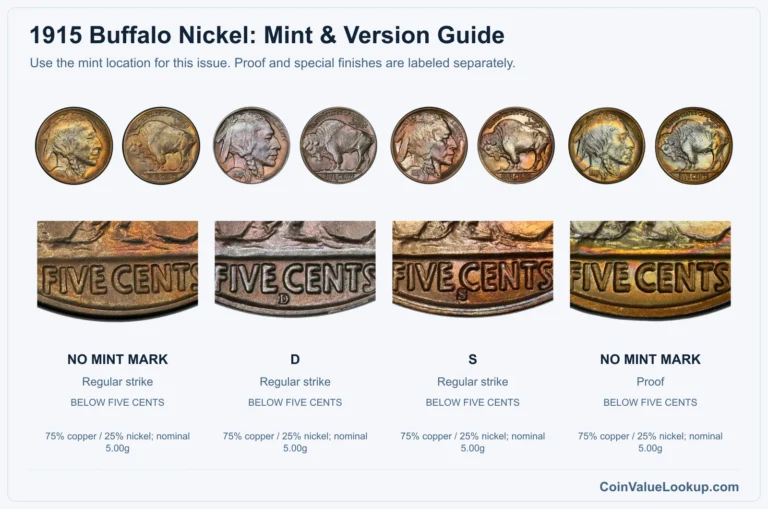
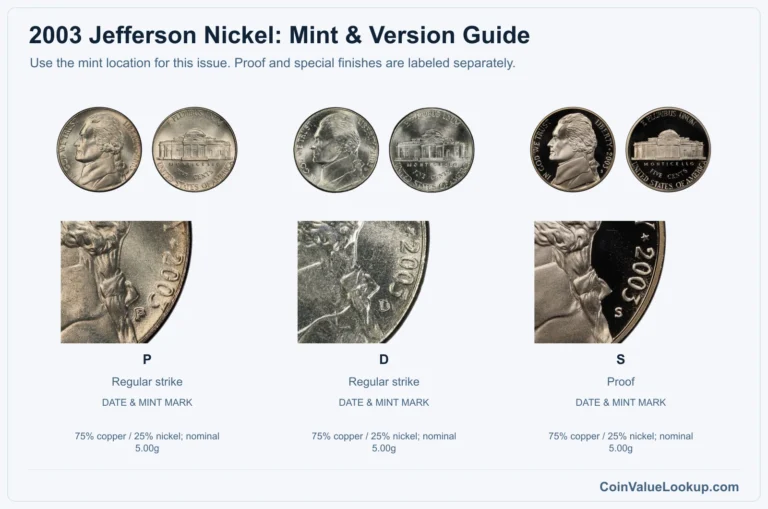
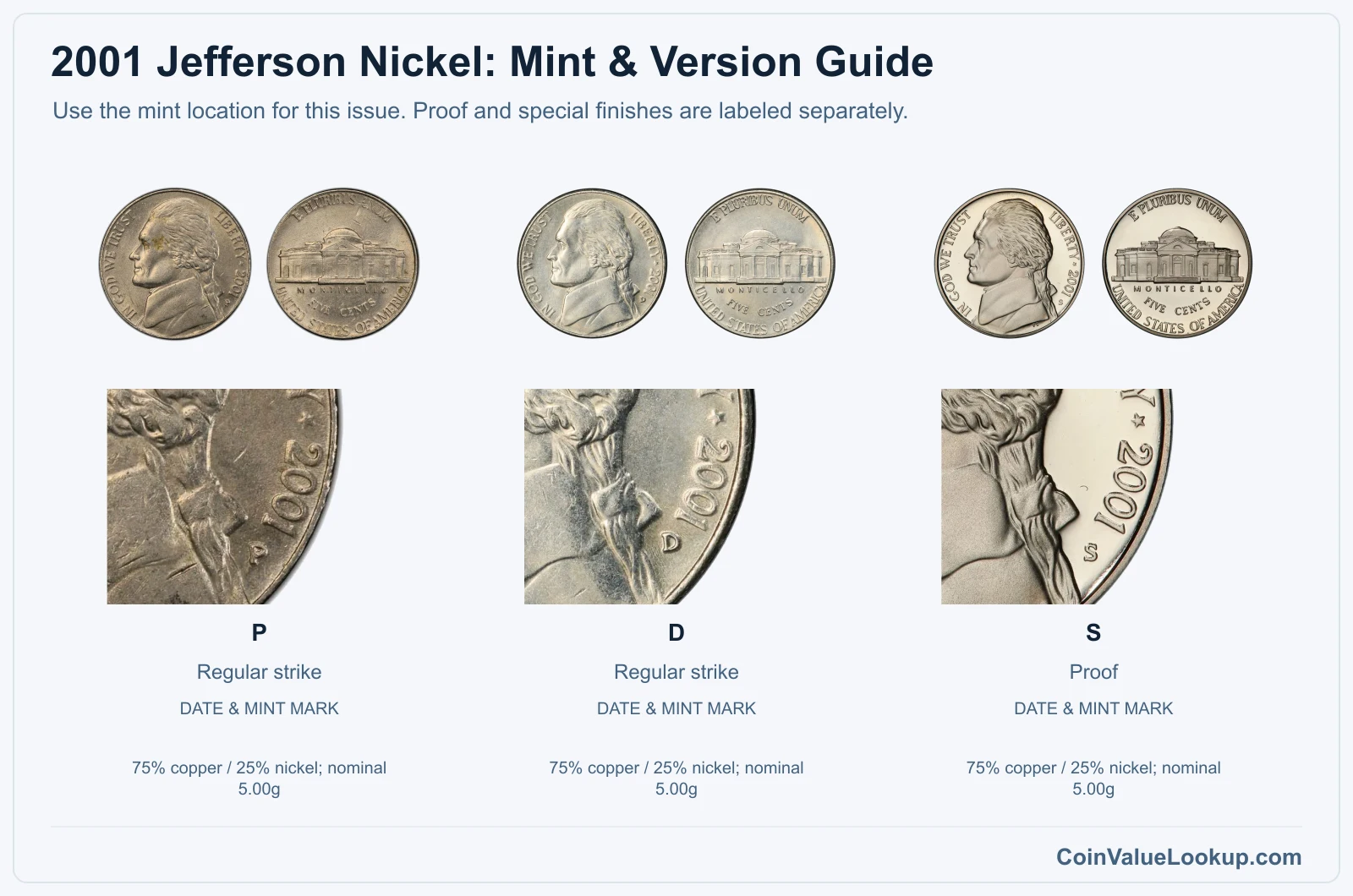
Start by finding the date on the obverse, just to the right of Jefferson's bust. Below the date, look for a small "P" (Philadelphia), "D" (Denver), or "S" (San Francisco).
If you see no letter at all, look again; since 1980 Philadelphia nickels carry a "P" mintmark.
All three 2001 versions share the classic Jefferson profile obverse paired with the Monticello reverse. The composition is 75% copper and 25% nickel, weighing about 5.00 grams with a plain edge and a diameter of 21.2 mm.
Color alone does not tell you the alloy, so weigh the coin if you have doubts.
The "S" mint version is a proof, struck on polished planchets with specially prepared dies for collectors. It was never released into circulation, so finding one in pocket change would be extremely unusual.
P and D strikes are ordinary business issues meant for commerce.
Step 2: Check Your 2001 Jefferson Nickel Grade
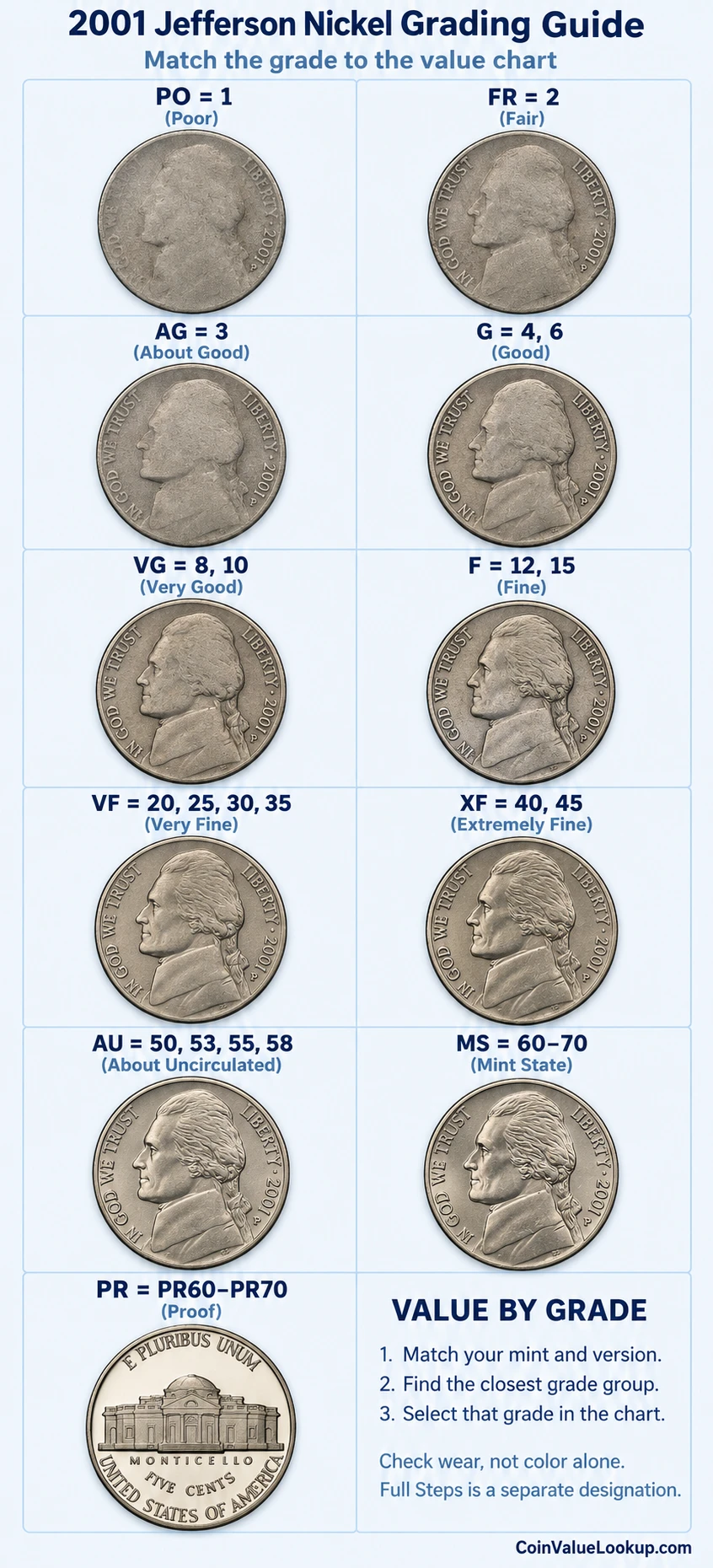
Focus first on Jefferson's cheekbone and the hair detail above his ear. On a well-worn coin those areas flatten into smooth patches, while an uncirculated example retains sharp, rounded contours and original mint luster across the entire surface.
Flip the coin over and study the Monticello building. The columns, triangular pediment, and the steps at the base all lose definition as a coin wears.
Step sharpness, however, is partly about strike quality, not just wear, so a soft strike can look worn even on an untouched coin.
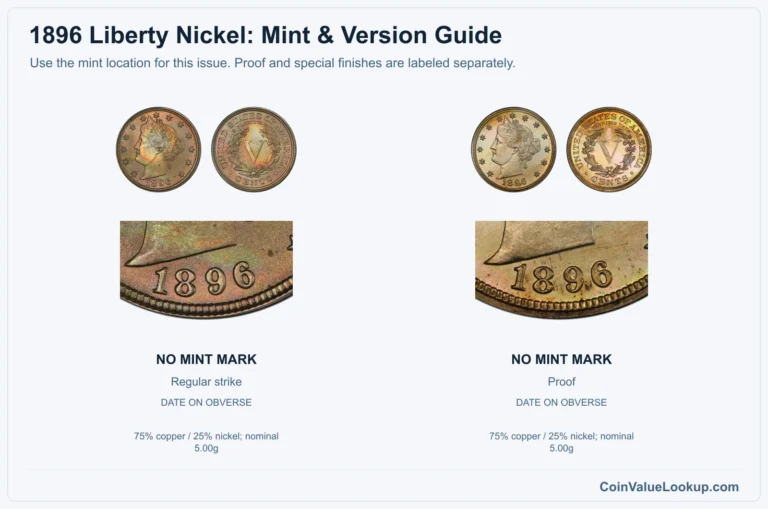
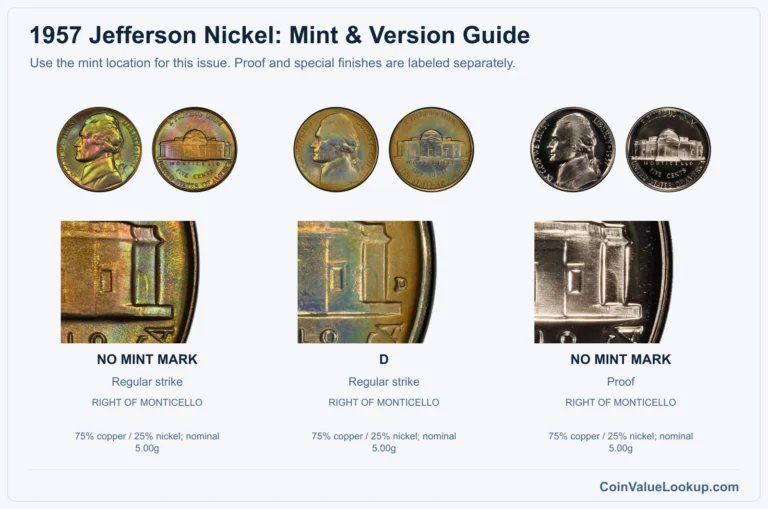
Use the comparison image of the same design type to judge your coin. The 2001 nickel uses the traditional portrait and Monticello reverse, so do not compare it against the 2005-and-later redesigned portraits or the 2004 Westward Journey reverses.
Surface marks, bag contact and toning also affect the grade a professional service would assign.
Step 3: Check 2001 Jefferson Nickel Value by Mint and Version
2001 Jefferson Nickel — P — Business strike
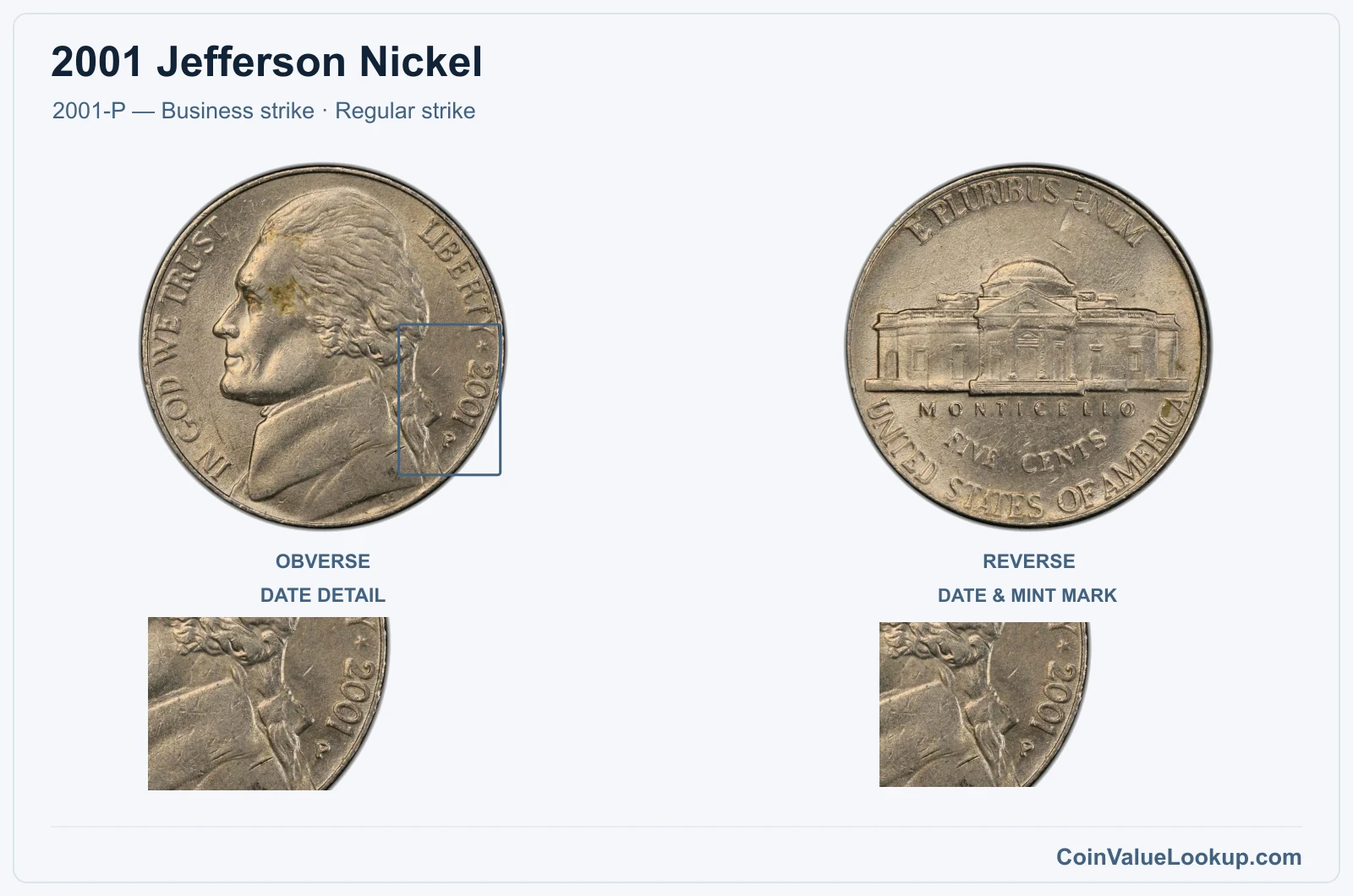
The 2001-P Jefferson nickel is a standard business strike from the Philadelphia Mint. It features the familiar Jefferson profile on the obverse and Monticello on the reverse, struck in 75% copper and 25% nickel at a nominal weight of 5.00 grams.
USA Coin Book lists retail guide estimates of about $0.30 in MS60 condition and roughly $1.24 in MS65. These figures reflect ordinary examples without special designations.
A coin from your pocket is almost certainly worth face value; the small premium applies only to pieces with full original luster and minimal contact marks.
| Range | Grade | Price | Auction Records | Appraisal |
|---|---|---|---|---|
| PO | PO 1 | — | Coin Identifier | |
| FR | FR 2 | — | Coin Identifier | |
| AG | AG 3 | — | Coin Identifier | |
| G | G 4 | — | Coin Identifier | |
| G 6 | — | Coin Identifier | ||
| VG | VG 8 | — | Coin Identifier | |
| VG 10 | — | Coin Identifier | ||
| F | F 12 | — | Coin Identifier | |
| F 15 | — | Coin Identifier | ||
| VF | VF 20 | — | Coin Identifier | |
| VF 25 | — | Coin Identifier | ||
| VF 30 | — | Coin Identifier | ||
| VF 35 | — | Coin Identifier | ||
| XF | XF 40 | — | Coin Identifier | |
| XF 45 | — | Coin Identifier | ||
| AU | AU 50 | — | Coin Identifier | |
| AU 53 | — | Coin Identifier | ||
| AU 55 | — | Coin Identifier | ||
| AU 58 | — | Coin Identifier | ||
| MS | MS 60 | — | Coin Identifier | |
| MS 61 | — | Coin Identifier | ||
| MS 62 | — | Coin Identifier | ||
| MS 63 | — | Coin Identifier | ||
| MS 64 | — | Coin Identifier | ||
| MS 65 | — | Coin Identifier | ||
| MS 66 | — | Coin Identifier | ||
| MS 67 | Coin Identifier | |||
| MS 68 | — | — | — | |
| MS 69 | — | — | — | |
| MS 70 | — | — | — |
2001 Jefferson Nickel — D — Business strike
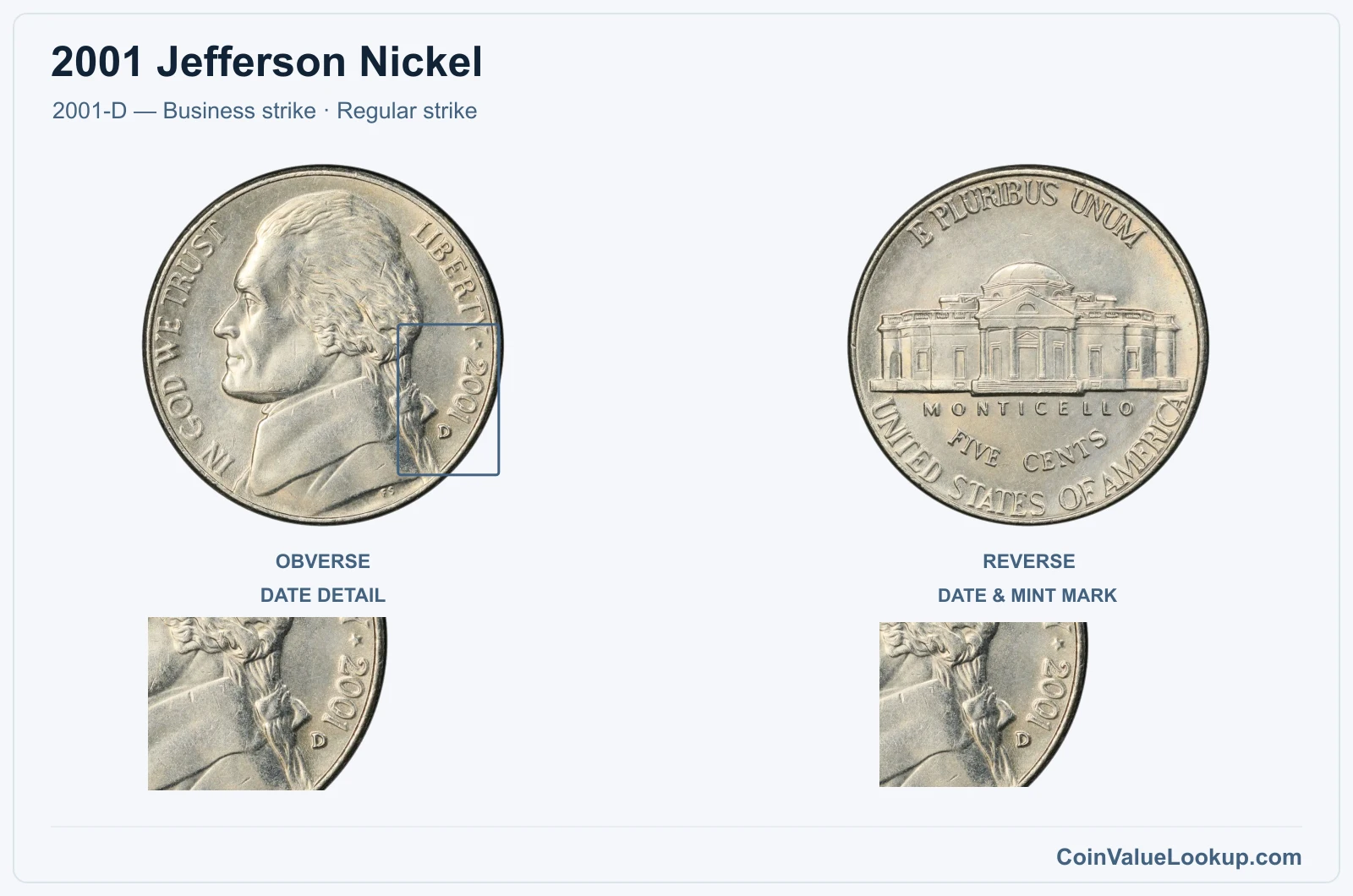
The 2001-D comes from the Denver Mint and is identical in design, composition, and weight to its Philadelphia sibling. Look for the small "D" below the date to confirm this version.
Guide estimates from USA Coin Book match the P mint: about $0.30 at MS60 and $1.24 at MS65. In practice, neither mint commands a meaningful premium over the other for this date in ordinary grades.
Circulated pieces remain at face value.
Coin Value Lookup is a handy place to look up guides for other dates and denominations in the Jefferson nickel series if you are sorting through a jar of change.
| Range | Grade | Price | Auction Records | Appraisal |
|---|---|---|---|---|
| PO | PO 1 | — | Coin Identifier | |
| FR | FR 2 | — | Coin Identifier | |
| AG | AG 3 | — | Coin Identifier | |
| G | G 4 | — | Coin Identifier | |
| G 6 | — | Coin Identifier | ||
| VG | VG 8 | — | Coin Identifier | |
| VG 10 | — | Coin Identifier | ||
| F | F 12 | — | Coin Identifier | |
| F 15 | — | Coin Identifier | ||
| VF | VF 20 | — | Coin Identifier | |
| VF 25 | — | Coin Identifier | ||
| VF 30 | — | Coin Identifier | ||
| VF 35 | — | Coin Identifier | ||
| XF | XF 40 | — | Coin Identifier | |
| XF 45 | — | Coin Identifier | ||
| AU | AU 50 | — | Coin Identifier | |
| AU 53 | — | Coin Identifier | ||
| AU 55 | — | Coin Identifier | ||
| AU 58 | — | Coin Identifier | ||
| MS | MS 60 | — | Coin Identifier | |
| MS 61 | — | Coin Identifier | ||
| MS 62 | — | Coin Identifier | ||
| MS 63 | Coin Identifier | |||
| MS 64 | Coin Identifier | |||
| MS 65 | — | Coin Identifier | ||
| MS 66 | Coin Identifier | |||
| MS 67 | — | — | — | |
| MS 68 | — | — | — | |
| MS 69 | — | — | — | |
| MS 70 | — | — | — |
2001 Jefferson Nickel — S PR — Proof
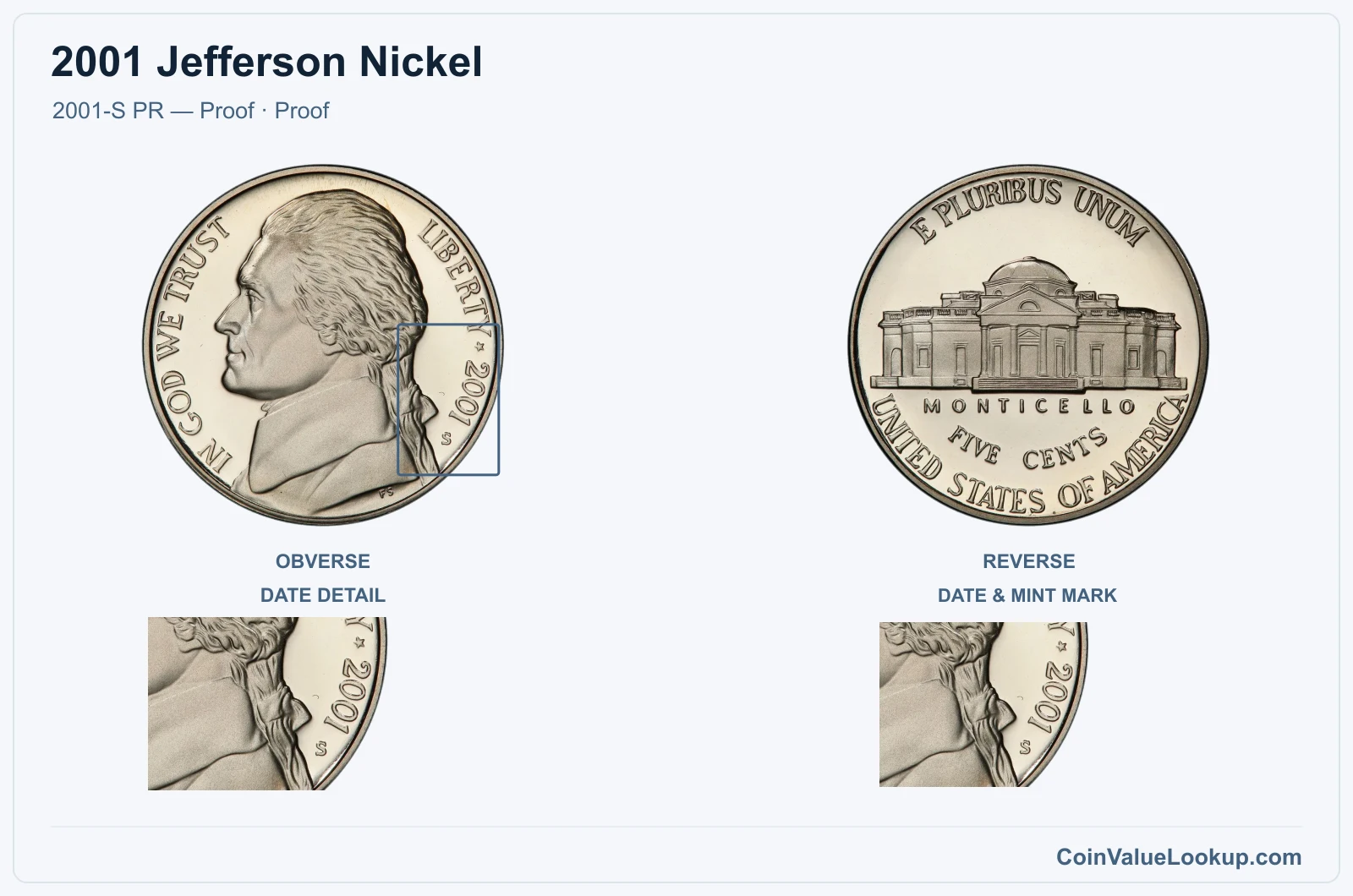
The 2001-S proof was struck at the San Francisco Mint exclusively for collector sets. It carries a sharp "S" mintmark and was produced on polished planchets, giving it mirror-like fields that circulated coins never have.
USA Coin Book places the PR65 retail guide estimate at approximately $3.08. That is modest compared to earlier proof nickels, but it still represents a clear premium over face value.
If your coin has this mirror finish and an "S" mintmark, keep it protected; hairlines and fingerprints reduce proof appeal quickly.
| Range | Grade | Price | Auction Records | Appraisal |
|---|---|---|---|---|
| PR | PR 1 | — | Coin Identifier | |
| PR 2 | — | Coin Identifier | ||
| PR 3 | — | Coin Identifier | ||
| PR 4 | — | Coin Identifier | ||
| PR 6 | — | Coin Identifier | ||
| PR 8 | — | Coin Identifier | ||
| PR 10 | — | Coin Identifier | ||
| PR 12 | — | Coin Identifier | ||
| PR 15 | — | Coin Identifier | ||
| PR 20 | — | Coin Identifier | ||
| PR 25 | — | Coin Identifier | ||
| PR 30 | — | Coin Identifier | ||
| PR 35 | — | Coin Identifier | ||
| PR 40 | — | Coin Identifier | ||
| PR 45 | — | Coin Identifier | ||
| PR 50 | — | Coin Identifier | ||
| PR 53 | — | Coin Identifier | ||
| PR 55 | — | Coin Identifier | ||
| PR 58 | — | Coin Identifier | ||
| PR 60 | — | Coin Identifier | ||
| PR 61 | — | Coin Identifier | ||
| PR 62 | — | Coin Identifier | ||
| PR 63 | — | Coin Identifier | ||
| PR 64 | — | Coin Identifier | ||
| PR 65 | — | Coin Identifier | ||
| PR 66 | — | Coin Identifier | ||
| PR 67 | — | Coin Identifier | ||
| PR 68 | Coin Identifier | |||
| PR 69 | Coin Identifier | |||
| PR 70 | Coin Identifier |
2001 Jefferson Nickel Error List
1. 2001 Jefferson Nickel — Struck over a cent
A 2001 nickel struck over a Lincoln cent is a dramatic wrong-planchet error. The Lincoln design survives as a ghostly undertype, and on the documented example the cent's date is visible near Jefferson's nose, with the Lincoln portrait oriented nearly upside down relative to the nickel design.
A PCGS MS64 Red example from the Denver Mint sold through Heritage Auctions in September 2019 for $576.
To distinguish this from a normal coin, look for traces of a second, foreign design underneath the nickel impression. A simple off-color blank or a vice-transfer impression from pressing two coins together will not show genuine die-struck undertype detail.
Professional authentication is essential for this category.
2. 2001 Jefferson Nickel — Double strike with clashed dies
A double-struck 2001 nickel shows two overlapping impressions of the design, with the second strike dramatically displaced. The documented example is a Denver Mint coin graded NGC MS64, where the second strike landed roughly 60% off center, and the dies also show evidence of a die clash.
Heritage Auctions sold this piece in January 2018 for $360.
What you see on the coin is two distinct sets of design elements at different positions, not the slight shelf-like doubling of a doubled die or the flat, spread appearance of machine doubling. The displacement is unmistakable.
If both strikes are visible and the coin shows genuine die impressions rather than post-strike damage, it warrants professional evaluation.
3. 2001 Jefferson Nickel — Rotated dies
A rotated-die error means the obverse and reverse dies were misaligned in their rotation, so when you flip the coin on its vertical axis the back image appears tilted instead of perfectly upright. The documented example is a 2001-P nickel graded NGC MS65 with a Six Full Steps designation.
The exact degree of rotation was not specified in the source.
Value depends on the severity of the rotation, the coin's condition, and third-party authentication confirming the error. A coin that merely looks tilted in a photo or a flip holder is not necessarily a rotated-die error, so always compare by physically flipping the coin end over end while watching the reverse orientation.
Legitimate examples deserve professional review.
4. 2001 Jefferson Nickel — Struck-Through Error
A struck-through error occurs when foreign material, often grease, a metal fragment, or a thread, sits on the die or planchet during striking and leaves its impression on the finished coin. On a 2001 nickel, look for a localized depression or area of incomplete design that does not match normal wear.
A grease fill tends to produce a smooth, flat blank spot, while a retained foreign object may leave a distinct outline or texture.
Do not confuse this with ordinary wear, cleaning, or a weak strike from tired dies. Struck-through areas appear as specific obstructions, not gradual loss of detail.
Value for this error depends on visibility, size, and the coin's overall condition. Individual assessment by a grading service is the reliable path to pricing.
5. 2001 Jefferson Nickel — Partial Collar Strike
A partial collar strike happens when the coin blank is not fully seated inside the collar die during striking. The result is a stepped or uneven edge: part of the rim looks normal while the rest flares outward or shows an abrupt shelf.
Hold the coin at eye level and rotate it slowly to see the edge transition.
This is different from post-mint edge damage, which tends to show irregular dents or gouges, and from a complete broadstrike, where the entire edge is uniformly spread without any collar confinement at all. On a 2001 nickel, value depends on how dramatic the misalignment is and the coin's overall condition.
Professional authentication helps separate genuine partial collar errors from damaged coins.
6. 2001 Jefferson Nickel — Die Cap / Capped-Die Strike
A die cap error is one of the more visually dramatic mint mistakes. It occurs when a struck coin sticks to a die and is hammered repeatedly into subsequent blanks, gradually cupping into a bottle-cap shape.
The side that adhered to the die becomes progressively distorted, while the opposite side may show a mirror-image brockage of the design.
Do not confuse a die cap with a coin that was simply bent, squeezed in a vise, or weakly struck. A genuine capped-die coin has a distinctive concave cupping with evidence of repeated strikes.
For a 2001 nickel, value hinges on the degree of cupping, overall preservation, and authenticated identity. These are uncommon enough that professional certification is strongly recommended.
7. 2001 Jefferson Nickel — Off-Center Strike
An off-center strike results from the blank not being properly centered between the dies. The design appears shifted to one side, and a blank crescent of unstruck metal is visible on the opposite edge.
The most collectible examples retain a readable date despite the misalignment, so check for that first.
A clipped planchet or post-mint flattening can look vaguely similar, but neither produces a cleanly displaced full design paired with a smooth unstruck area. On a 2001 nickel, value depends on the percentage of off-center shift, whether the date is visible, and the coin's condition.
A 5% shift is a curiosity; a 50% shift with a visible date is a serious error coin. Authentication confirms the diagnosis.
8. 2001 Jefferson Nickel — Die Crack / Die Chip
Die cracks and die chips appear as raised lines or small raised lumps on the coin's surface, caused by fractures or missing pieces in the steel die. On a 2001 nickel, look for thin raised ridges running across the design or a small blob of raised metal, especially near the rim or within letters.
A crack that reaches the rim and breaks away a section of the die creates what collectors call a cud, a larger raised lump at the edge.
These are different from incuse scratches, corrosion, or bits of foreign material stuck to the surface. Raised features come from the die, while scratches cut into the coin.
Value varies widely based on size, location, and condition, so each piece really needs individual evaluation by a professional grading service.