1915 Buffalo Nickel Coin Value: How Much Is It Worth?
A 1915 Buffalo Nickel can be worth anywhere from about $8.64 in well-worn Good-4 condition for a Philadelphia strike up to $1,523 in Mint State 63 for the San Francisco issue, based on USA Coin Book guide estimates. Matte proofs, branch-mint versions, and scarce error varieties can push values even higher depending on condition and demand.
Fast Way to Identify Your 1915 Buffalo Nickel
Want a quick read on your 1915 Buffalo Nickel? Upload clear photos of the front and back of your coin.
Make sure the date is legible, the area below FIVE CENTS on the reverse is visible, and lighting is even. That gives enough detail for a preliminary identification of your coin's mint and version.
1915 Buffalo Nickel Value
Upload both sides of your 1915 Buffalo Nickel.
Front Obverse
Upload photo
Back Reverse
Upload photo
Which 1915 Buffalo Nickel Versions Are Worth Money?
- San Francisco (S) coins command the highest guide values across grades, with estimates reaching $1,523 at MS63 due to lower survival rates in top condition.
- Denver (D) strikes carry a solid premium over Philadelphia issues, listed around $438 at MS63 versus $123 for no-mintmark coins.
- Matte proof examples from Philadelphia are a separate collectible category with a PR63 guide estimate of $1,345, identified by their satin fields and sharp rims rather than mirror surfaces.
- Doubled Die Obverse and Repunched Mintmark errors are reported for this date and can add value depending on the strength and visibility of the variety.
Step 1: Identify Your 1915 Buffalo Nickel Mint Mark and Version
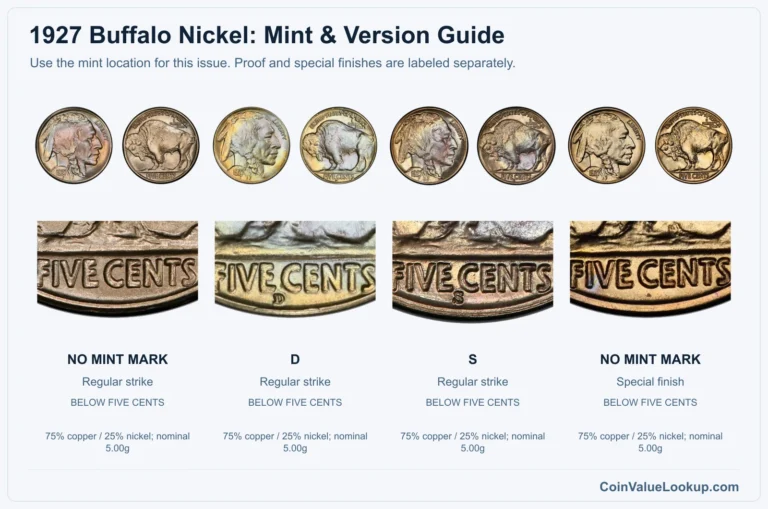
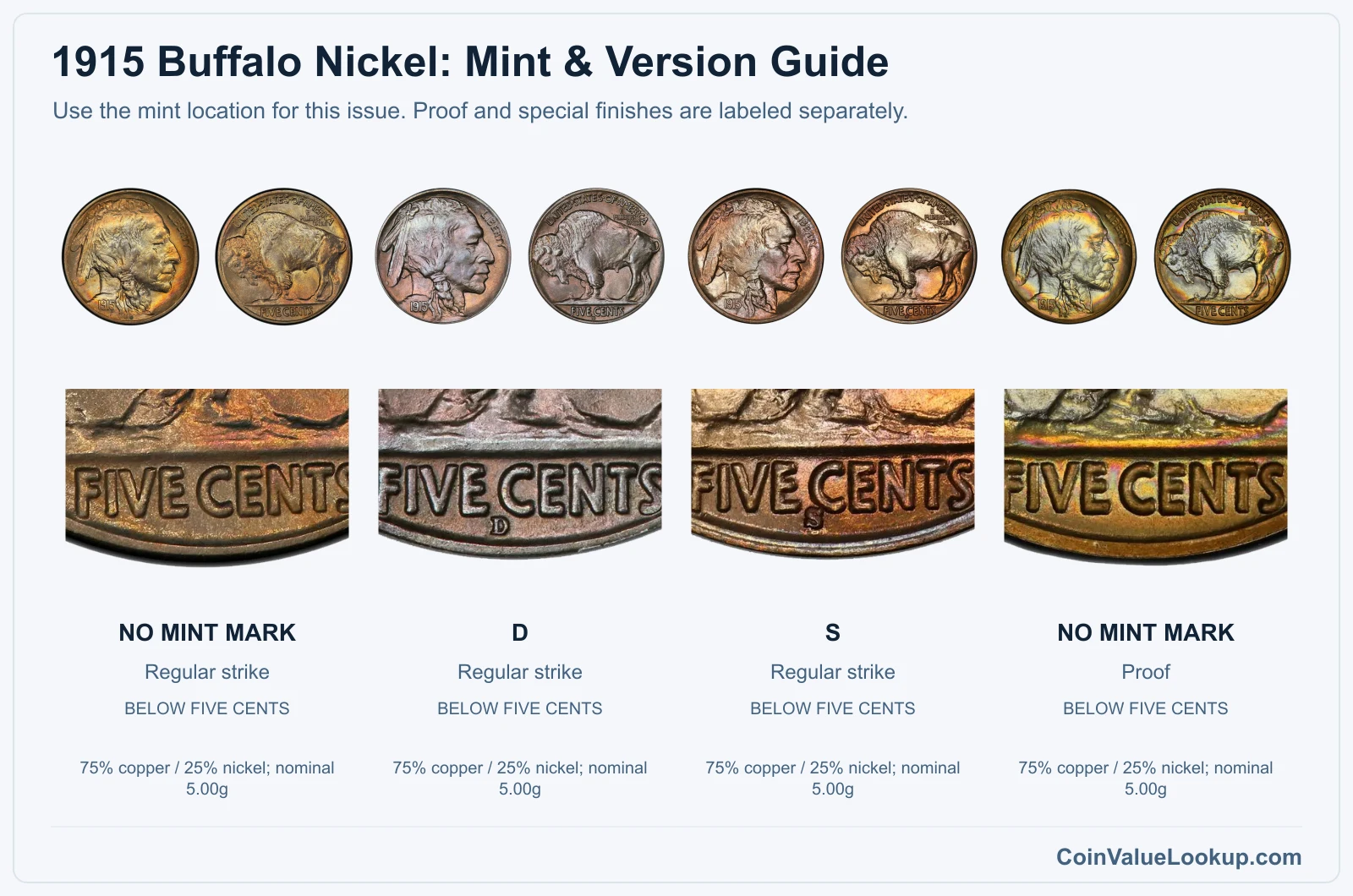
Every 1915 Buffalo Nickel uses the Type 2 reverse design, where FIVE CENTS sits in a recessed area below the bison. There was no Type 1 variety this year; that design was limited to 1913.
Three mints produced circulation strikes. Philadelphia coins carry no mintmark at all.
Denver coins show a small D on the reverse, just below FIVE CENTS. San Francisco coins display an S in the same spot.
The coin is 75% copper and 25% nickel, weighs about 5 grams, measures 21.2 mm across, and has a plain edge. There is no regular silver version of this denomination, so do not expect a different color or weight.
Philadelphia also struck a small number of matte proof examples in 1915. These have a distinctive granular, satin-like surface rather than the mirror finish most people associate with proofs.
Identifying a matte proof takes careful examination of the fields and rim sharpness, not just whether the coin looks shiny.
Step 2: Check Your 1915 Buffalo Nickel Grade
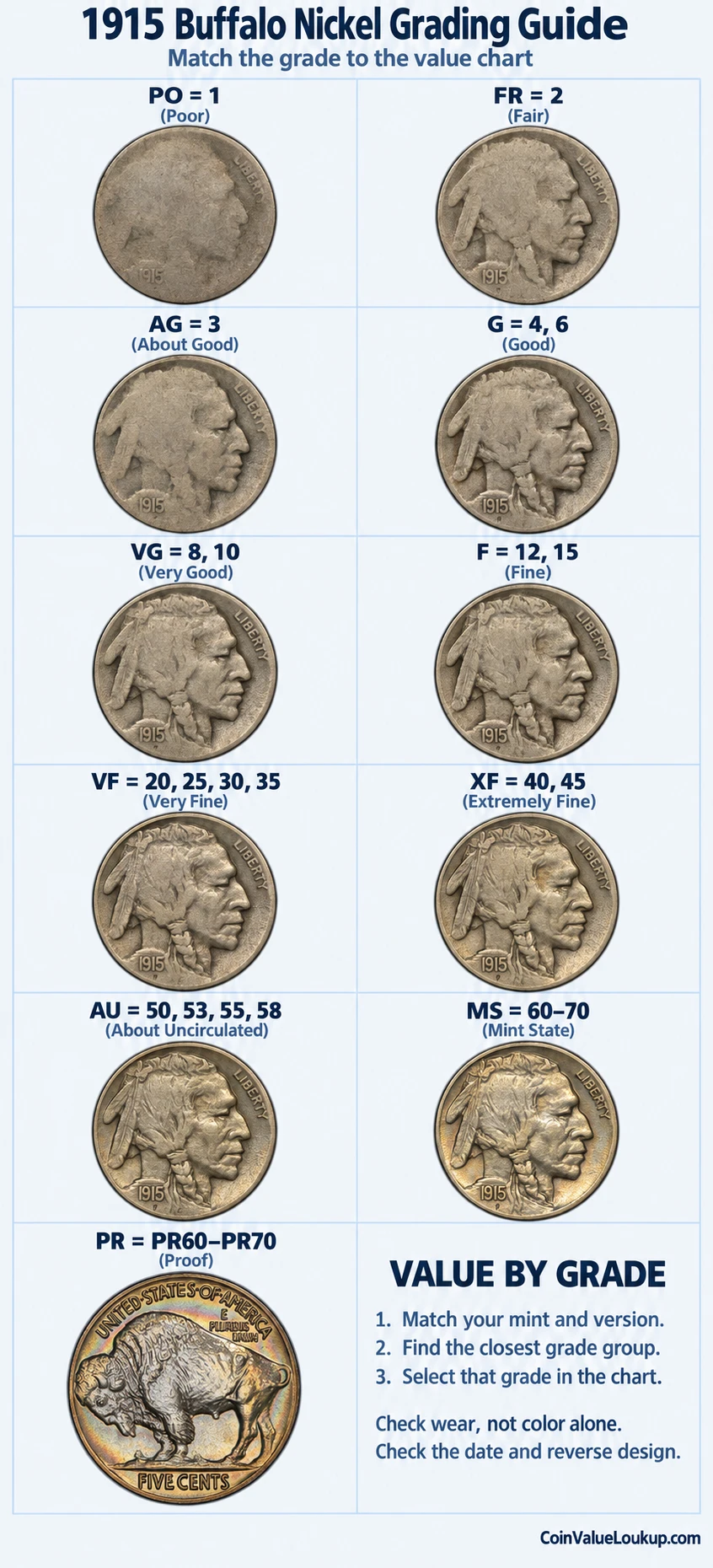
Start by checking the Native American portrait on the obverse. In lower grades the hair braid and cheek flatten first, and the feathers lose individual separation.
On the reverse, the bison's shoulder and horn are the key wear points.
Here is the tricky part: a weak horn does not automatically mean heavy wear. Some Buffalo Nickels left the mint with soft strikes, especially from certain die pairs.
Compare your coin's overall sharpness, not just the horn, against the grading comparison image.
Original luster matters a lot for mid-grade and higher coins. Look for cartwheel reflections when you tilt the coin under a single light source.
Cleaned or polished surfaces kill collector premium fast.
Never use acid or chemical restorers to bring out a worn date. That permanently damages the surface and drops the coin's value to essentially zero collector interest.
Step 3: Check 1915 Buffalo Nickel Value by Mint and Version
1915 Buffalo Nickel — No Mint Mark — Type2 Circulation
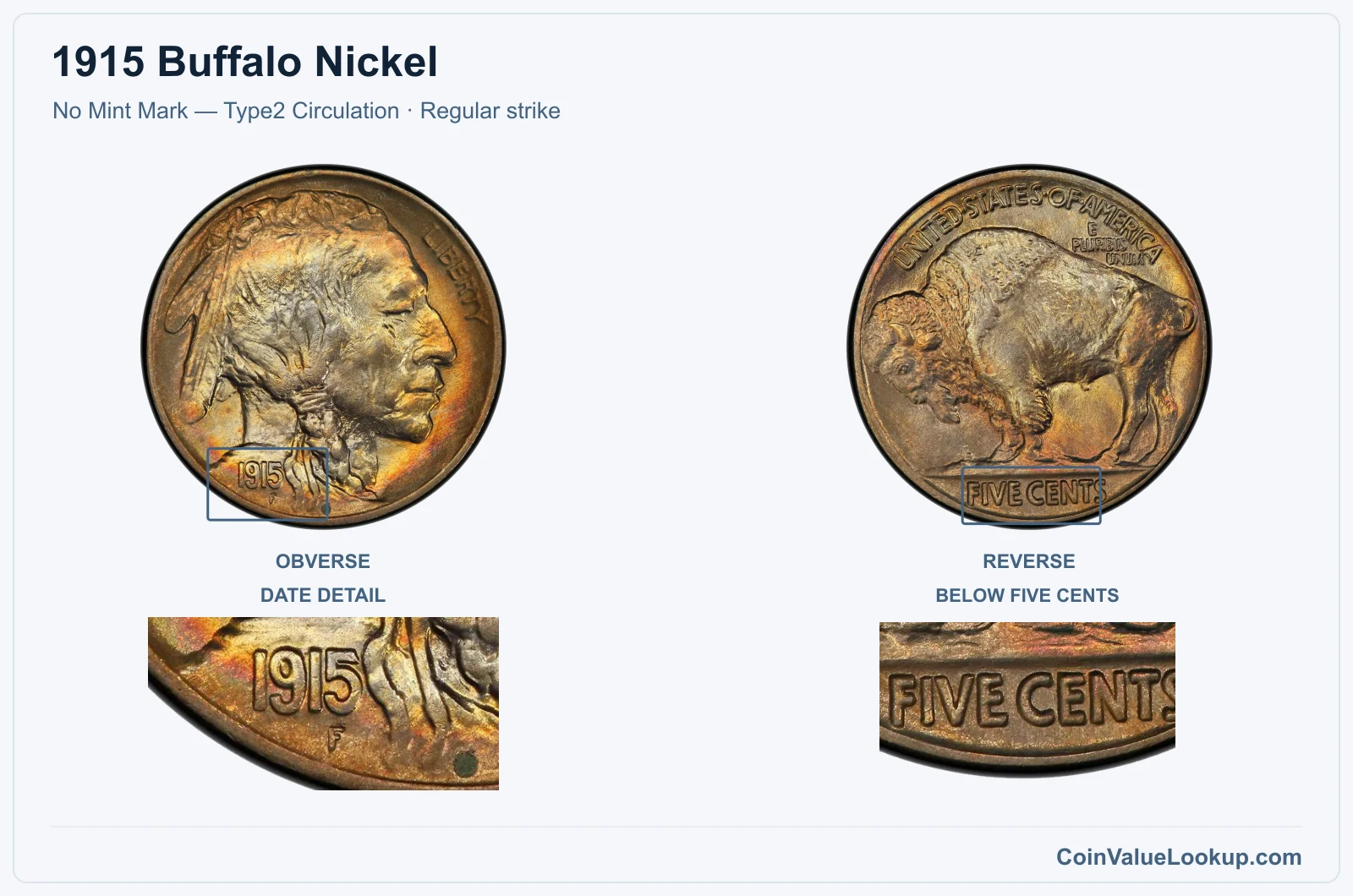
The 1915 Philadelphia Buffalo Nickel has no mintmark. Look at the reverse below FIVE CENTS: if that space is blank, you have the P-mint coin.
This is the most common version of the year. USA Coin Book guide estimates place it at about $8.64 in Good-4 and around $123 in MS63.
Those are retail guide figures, not guaranteed sale prices.
Original surfaces and a full, sharp strike matter enormously for higher-grade examples. Even slight cleaning drops the appeal for serious collectors.
Range Grade
Price Auction Records Appraisal PO PO 1
—
Coin Identifier FR FR 2
—
Coin Identifier AG AG 3
—
Coin Identifier G G 4
—
Coin Identifier
G 6
—
Coin Identifier VG VG 8
—
Coin Identifier
VG 10
—
Coin Identifier F F 12
—
Coin Identifier
F 15
—
Coin Identifier VF VF 20
—
Coin Identifier
VF 25
—
Coin Identifier
VF 30
—
Coin Identifier
VF 35
—
Coin Identifier XF XF 40
—
Coin Identifier
XF 45
Coin Identifier AU AU 50
Coin Identifier
AU 53
—
Coin Identifier
AU 55
Coin Identifier
AU 58
Coin Identifier MS MS 60
—
Coin Identifier
MS 61
Coin Identifier
MS 62
Coin Identifier
MS 63
Coin Identifier
MS 64
Coin Identifier
MS 65
Coin Identifier
MS 66
Coin Identifier
MS 67
Coin Identifier
MS 68
—
Coin Identifier
MS 69
—
—
—
MS 70
—
—
—
1915 Buffalo Nickel — D — Type2 Circulation
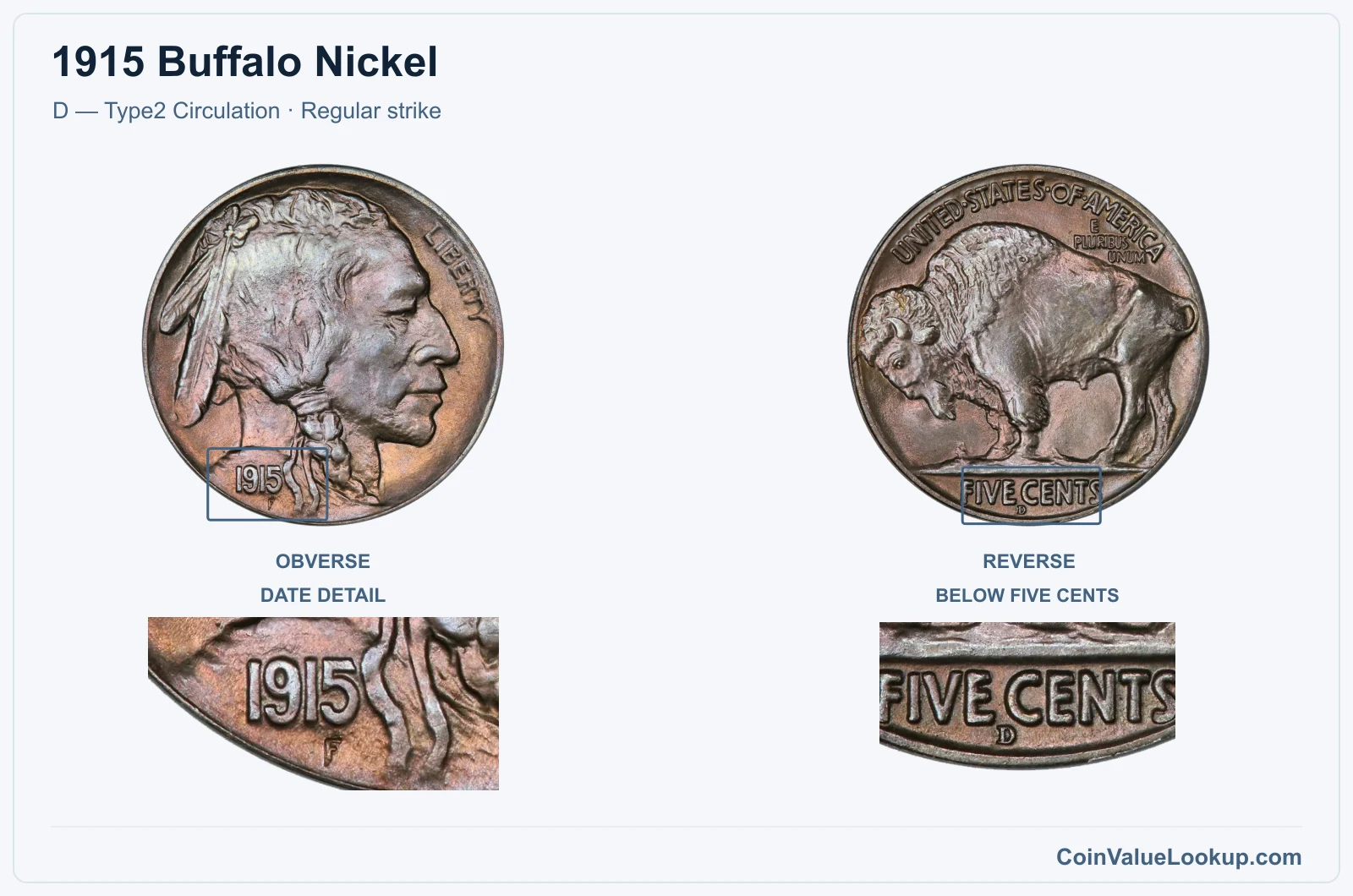
The Denver issue carries a small D mintmark on the reverse, sitting just below the recessed FIVE CENTS denomination. Confirm the letter under magnification because wear and grime can obscure it.
Guide estimates from USA Coin Book run about $34 in Good-4 and around $438 at MS63. That is a significant jump over the Philadelphia version, reflecting lower original production and fewer survivors in upper grades.
When evaluating a D-mint coin, pay attention to strike quality. Denver dies sometimes produced softer details on the bison's head and shoulder, which should not be confused with circulation wear.
Range Grade
Price Auction Records Appraisal PO PO 1
—
Coin Identifier FR FR 2
Coin Identifier AG AG 3
—
Coin Identifier G G 4
—
Coin Identifier
G 6
—
Coin Identifier VG VG 8
Coin Identifier
VG 10
Coin Identifier F F 12
Coin Identifier
F 15
Coin Identifier VF VF 20
Coin Identifier
VF 25
Coin Identifier
VF 30
Coin Identifier
VF 35
Coin Identifier XF XF 40
Coin Identifier
XF 45
Coin Identifier AU AU 50
Coin Identifier
AU 53
Coin Identifier
AU 55
Coin Identifier
AU 58
Coin Identifier MS MS 60
Coin Identifier
MS 61
Coin Identifier
MS 62
Coin Identifier
MS 63
Coin Identifier
MS 64
Coin Identifier
MS 65
Coin Identifier
MS 66
Coin Identifier
MS 67
Coin Identifier
MS 68
—
—
—
MS 69
—
—
—
MS 70
—
—
—
1915 Buffalo Nickel — S — Type2 Circulation
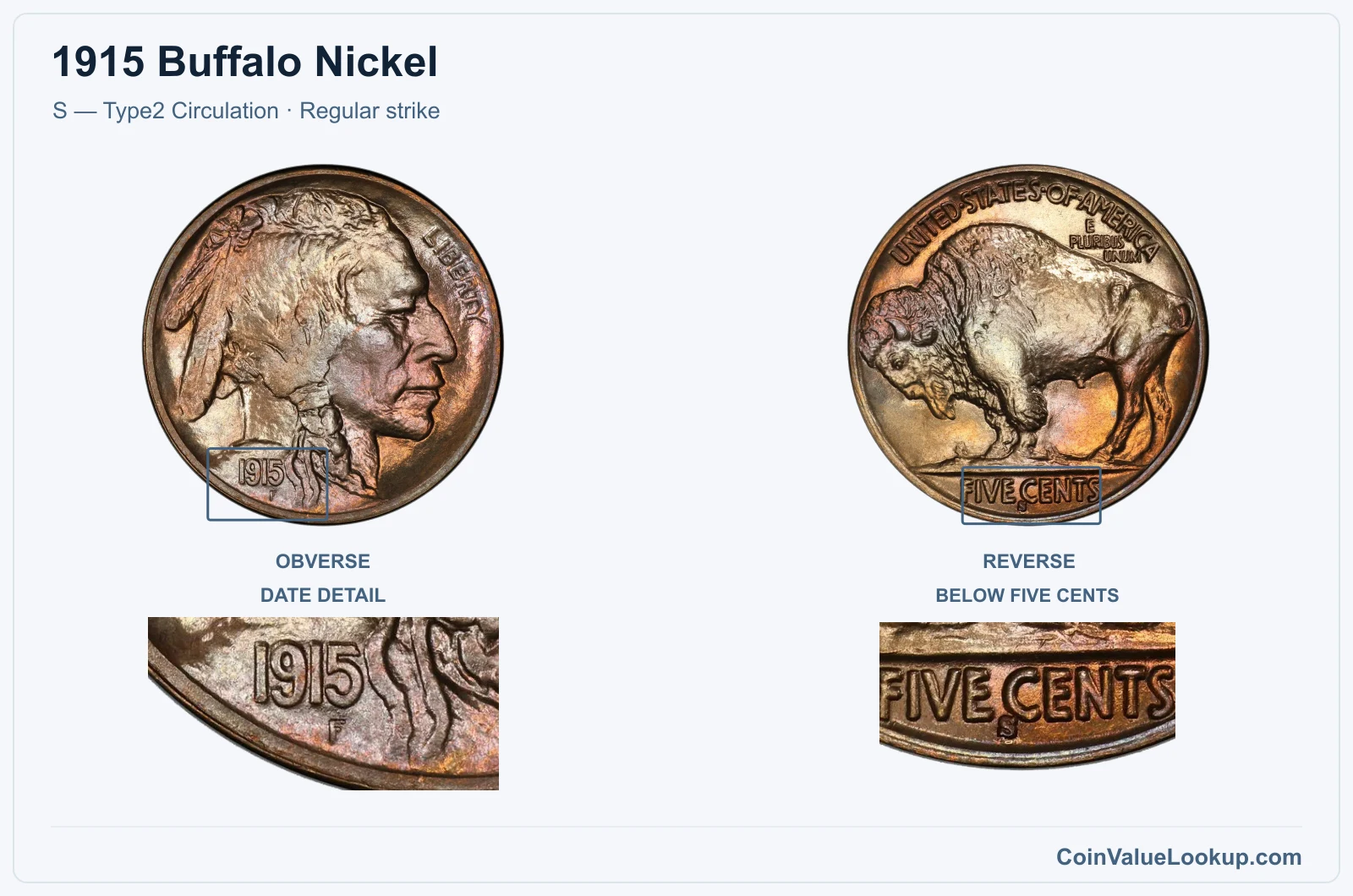
The San Francisco coin shows an S mintmark below FIVE CENTS on the reverse. This is the key date branch for 1915 circulation strikes.
USA Coin Book estimates put it at roughly $57 in Good-4 and approximately $1,523 at MS63. The steep climb between grades reflects how few S-mint coins survived without heavy wear.
Coin Value Lookup is a good starting point if you want to look up guide values for other dates and mints in the Buffalo Nickel series. You can browse by year and denomination to compare across different issues.
When photographing an S-mint coin, make sure the mintmark is clearly visible. A readable date and sharp mintmark image are essential for any serious assessment.
Range Grade
Price Auction Records Appraisal PO PO 1
—
Coin Identifier FR FR 2
—
Coin Identifier AG AG 3
Coin Identifier G G 4
Coin Identifier
G 6
Coin Identifier VG VG 8
Coin Identifier
VG 10
Coin Identifier F F 12
Coin Identifier
F 15
Coin Identifier VF VF 20
Coin Identifier
VF 25
Coin Identifier
VF 30
Coin Identifier
VF 35
Coin Identifier XF XF 40
Coin Identifier
XF 45
Coin Identifier AU AU 50
Coin Identifier
AU 53
Coin Identifier
AU 55
Coin Identifier
AU 58
Coin Identifier MS MS 60
Coin Identifier
MS 61
Coin Identifier
MS 62
Coin Identifier
MS 63
Coin Identifier
MS 64
Coin Identifier
MS 65
Coin Identifier
MS 66
Coin Identifier
MS 67
Coin Identifier
MS 68
—
—
—
MS 69
—
—
—
MS 70
—
—
—
1915 Buffalo Nickel — No Mint Mark — Type2 Matte Proof
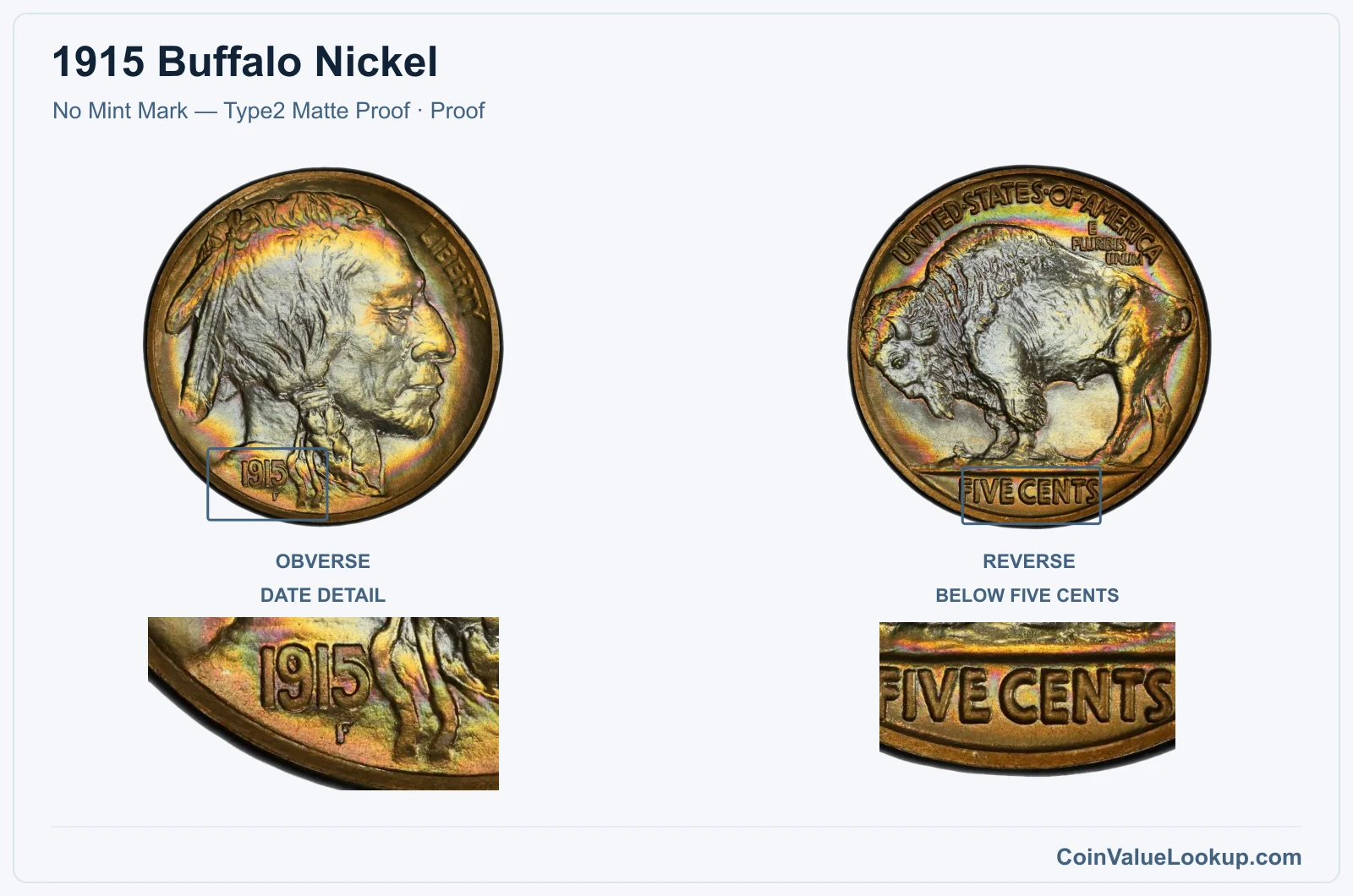
Philadelphia produced matte proof Buffalo Nickels from 1913 through 1916, and 1915 is part of that short run. These are not the brilliant mirror proofs most people picture.
Instead, they have a fine granular texture across the fields with exceptionally sharp design details and crisp rims.
USA Coin Book lists a guide estimate of about $1,345 at PR63. Matte proofs need professional authentication because the finish can be confused with a well-struck business strike that has original luster.
A shiny coin is not automatically a proof.
Examine the rim and field texture carefully. Genuine matte proofs show a uniform satin surface that differs from the cartwheel luster of a circulation strike, and their rims tend to be sharper and more squared-off.
Range Grade
Price Auction Records Appraisal PR PR 1
—
Coin Identifier
PR 2
—
Coin Identifier
PR 3
—
Coin Identifier
PR 4
—
Coin Identifier
PR 6
—
Coin Identifier
PR 8
—
Coin Identifier
PR 10
—
Coin Identifier
PR 12
—
Coin Identifier
PR 15
—
Coin Identifier
PR 20
—
Coin Identifier
PR 25
—
Coin Identifier
PR 30
—
Coin Identifier
PR 35
—
Coin Identifier
PR 40
—
Coin Identifier
PR 45
—
Coin Identifier
PR 50
—
Coin Identifier
PR 53
—
Coin Identifier
PR 55
—
Coin Identifier
PR 58
—
Coin Identifier
PR 60
—
Coin Identifier
PR 61
Coin Identifier
PR 62
Coin Identifier
PR 63
Coin Identifier
PR 64
Coin Identifier
PR 65
Coin Identifier
PR 66
Coin Identifier
PR 67
Coin Identifier
PR 68
Coin Identifier
PR 69
—
—
—
PR 70
—
—
—
1915 Buffalo Nickel Error List
1. 1915 Buffalo Nickel — Doubled Die Obverse
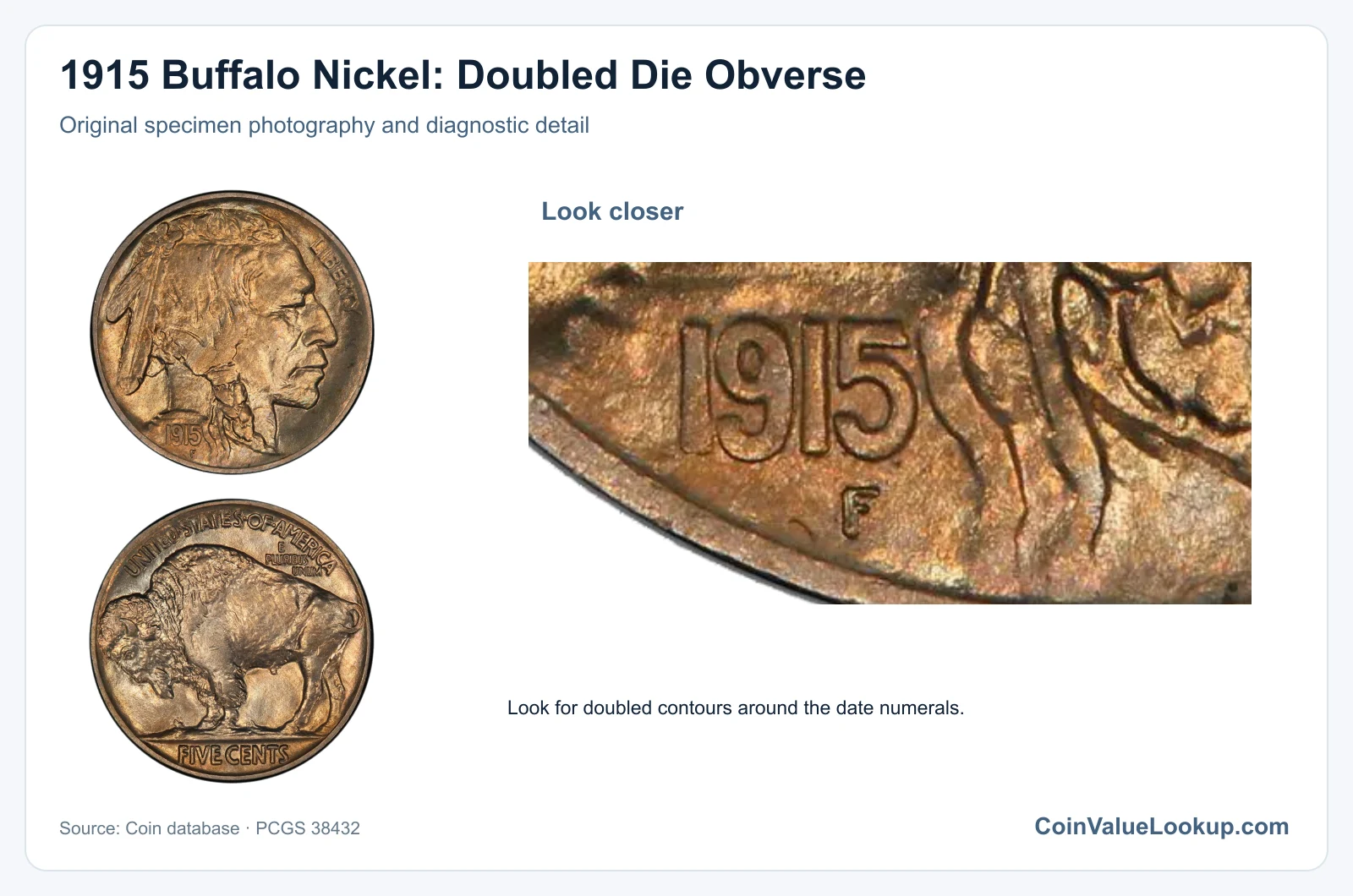
A Doubled Die Obverse has been reported for the 1915 Philadelphia Buffalo Nickel. The reported doubling appears at the nose, eyelid, and lip of the Native American portrait on the obverse.
To check for this, compare your coin's obverse details against a normal 1915 nickel under the same lighting conditions. Look for consistent separation or notching along those facial features.
The doubling should repeat in a uniform direction across all affected areas.
Do not confuse this with machine doubling, which tends to produce a flat, shelf-like distortion rather than crisp separation. Reflected light and worn die contours can also mimic doubling to the untrained eye.
No specific price range is established here. The value of a doubled die depends heavily on the strength of the doubling, the coin's overall condition, and collector demand for that particular variety.
2. 1915 Buffalo Nickel — Repunched Mintmark
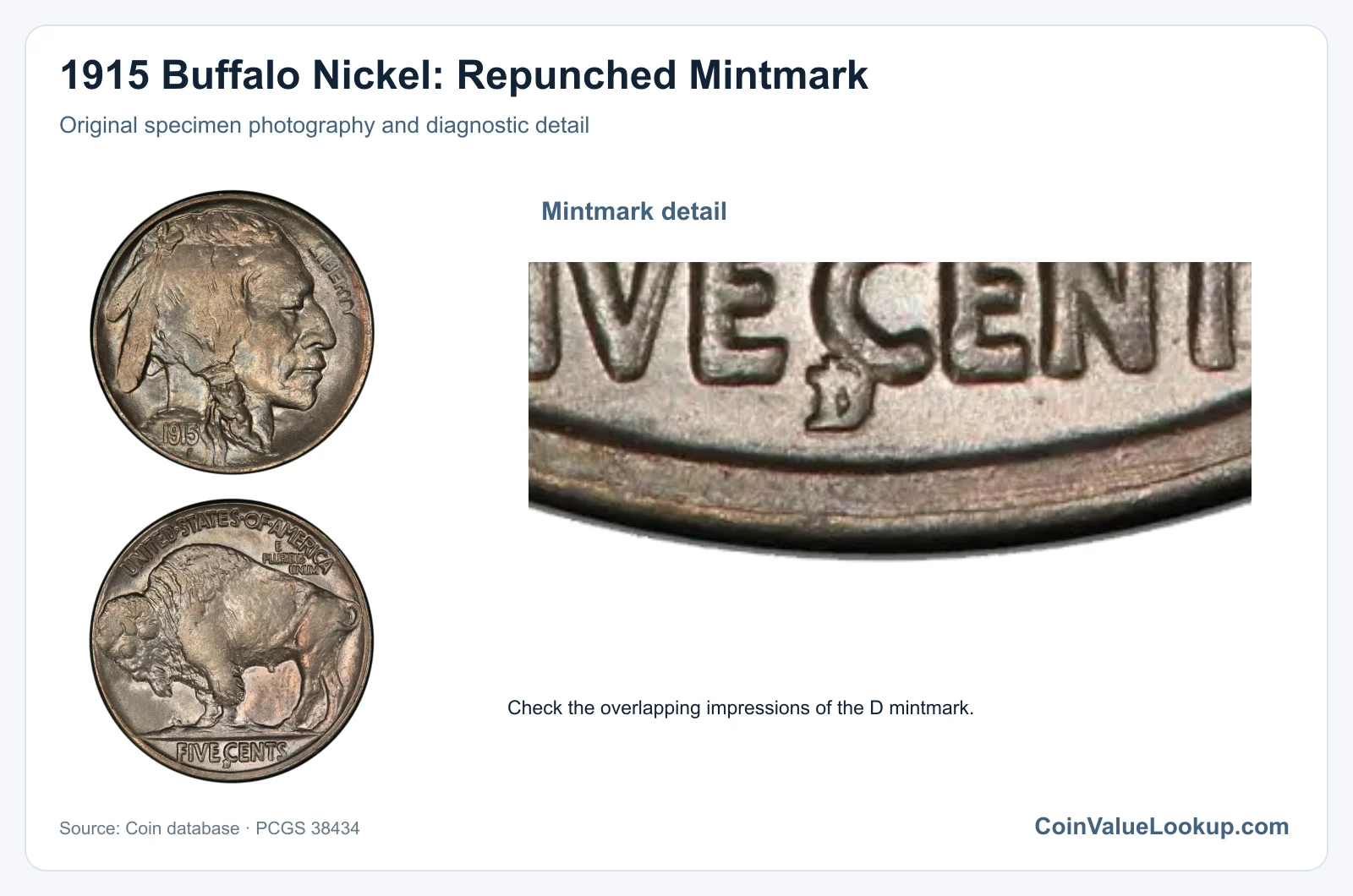
Repunched mintmarks have been reported on both the 1915-D and 1915-S Buffalo Nickels. This variety occurs when the mintmark punch was applied more than once in slightly different positions, leaving traces of the earlier strike.
Inspect the D or S mintmark under magnification. You are looking for remnants of a second impression, an extra outline, partial letter, or offset shadow near the primary mark.
Compare against a normal mintmark at the same magnification to see if the extra detail is genuinely from a second punch.
Machine doubling around the mintmark, die chips, and surface corrosion can all create similar-looking anomalies. A true repunched mintmark shows clean, die-struck letter edges on both the primary and secondary impressions.
No specific price range is adopted for this variety. Value depends on how visible and dramatic the repunching is, the coin's grade, and how much interest it generates among variety collectors.