1915 Wheat Penny Coin Value: How Much Is It Worth?
A 1915 Wheat Penny can be worth anywhere from about $3.08 in well-worn Good-4 condition up to $639 at the MS63 level, depending on which mint produced it. Proofs, major varieties, and error coins are priced separately.
Original surfaces, color, and the degree of wear all affect what a buyer will actually pay.
Fast Way to Identify Your 1915 Wheat Penny
The quickest way to start figuring out what you have is to snap clear photos of both sides of your coin and upload them here. A front and back image under good lighting helps with preliminary identification of your mint, approximate condition, and whether any obvious variety or error features are present.
It is not a substitute for professional authentication, but it gives you a solid starting point.
1915 Wheat Penny Value
Upload both sides of your 1915 Wheat Penny.
Front Obverse
Upload photo
Back Reverse
Upload photo
Which 1915 Wheat Penny Versions Are Worth Money?
- The 1915-S is the priciest regular-issue branch, with guide values of about $19 in Good-4 and $639 in MS63, making it worth checking your mintmark carefully.
- Philadelphia matte proofs from 1915 carry a guide value around $1,064 at PR63 and require professional verification due to their distinctive prepared surfaces and squared rims.
- Denver and Philadelphia business strikes start around $3.08 in Good-4 but climb to $131 (Philadelphia) or $154 (Denver) at MS63, rewarding coins with strong original surfaces.
- Recognized error types such as doubled die obverse, off-center strikes, and repunched mintmarks on branch-mint coins can add value depending on severity and authenticated identity.
Step 1: Identify Your 1915 Wheat Penny Mint Mark and Version
First, flip the coin over and confirm you see two wheat ears framing "ONE CENT" on the back. That is the Wheat reverse design used on Lincoln cents from 1909 through 1958.
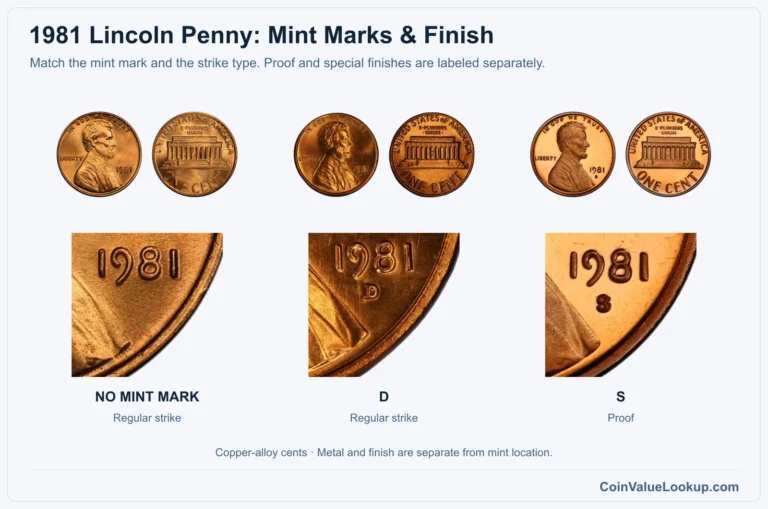
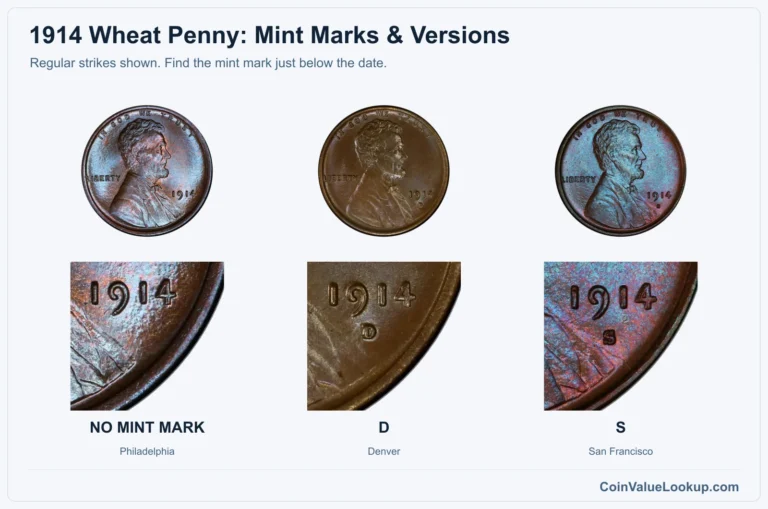
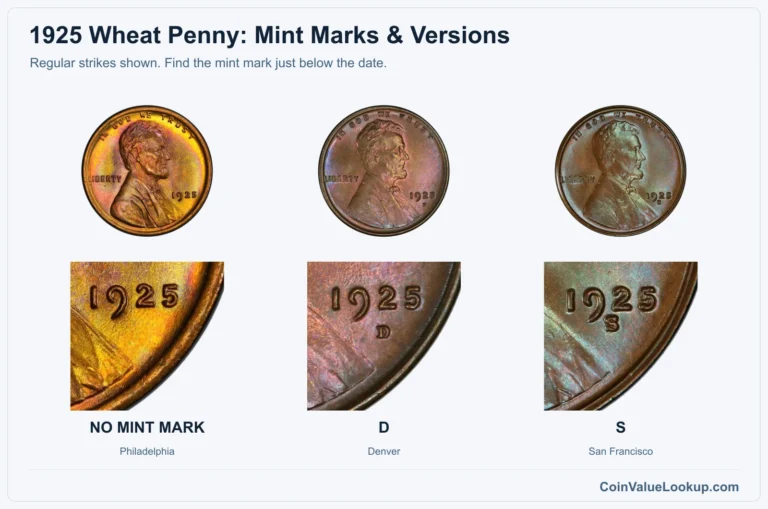
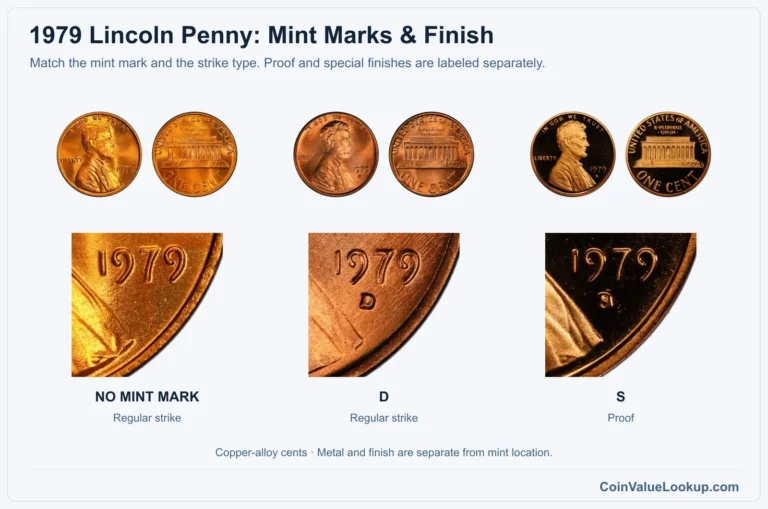
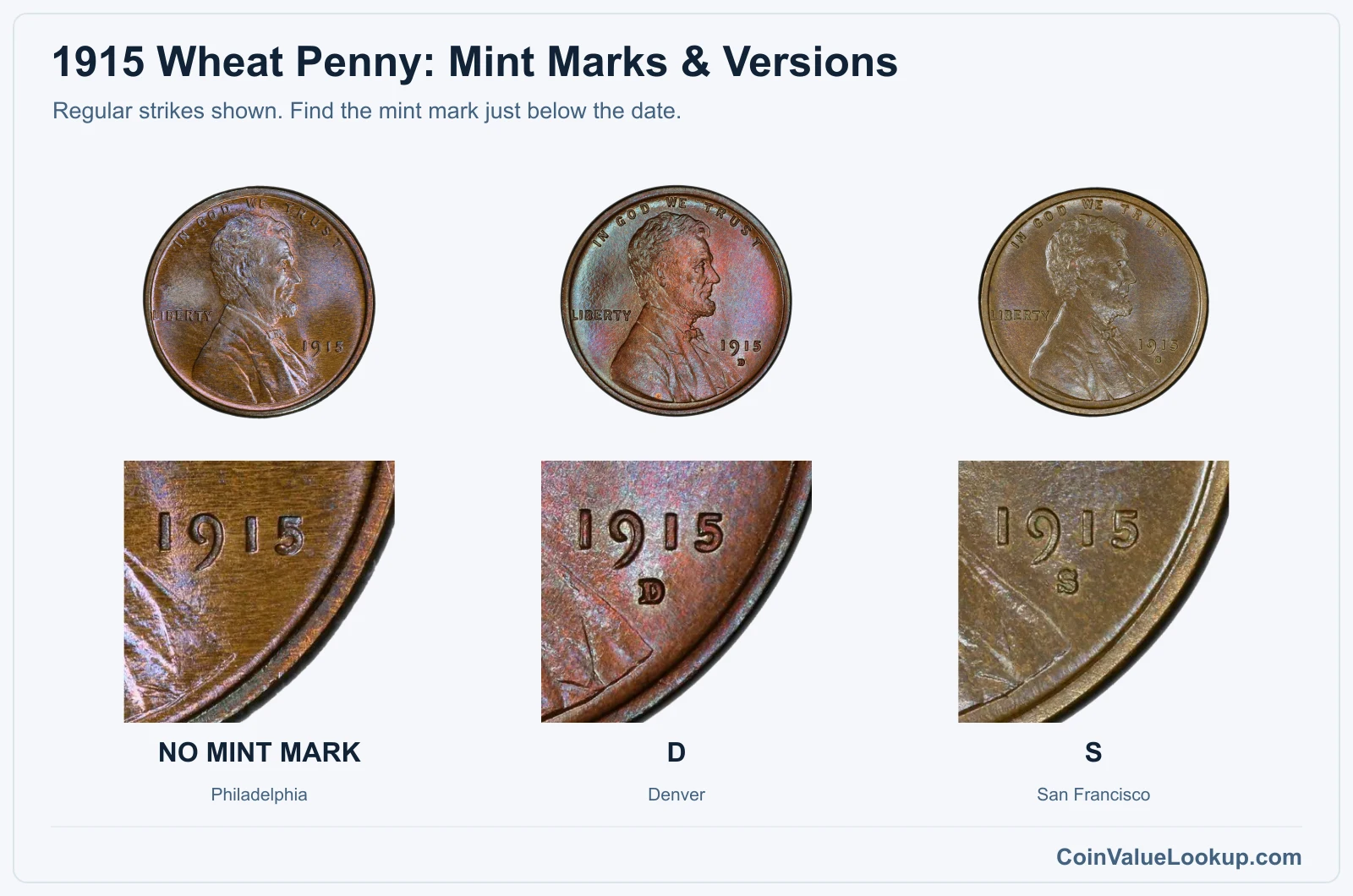
Now check the front, just below the date. If there is no letter, your coin was struck in Philadelphia.
A small "D" means Denver, and an "S" means San Francisco. These mintmarks are tiny, so use magnification if you can.
The 1915 is a standard copper-alloy cent, 95% copper with 5% tin and zinc, weighing about 3.11 grams with a plain edge. If your coin is noticeably lighter or heavier, it may be damaged, corroded, or not genuine.
Philadelphia also produced matte proof versions in 1915. Matte proofs have squared rims, precisely rendered detail, and a distinctive prepared surface that looks very different from the mirror finish of modern proofs.
A well-struck circulation coin is not a proof just because the detail is sharp. If you suspect you have a proof, professional authentication is the smart move.
Don't confuse color with grade. Red, red-brown, and brown describe surface toning, not wear level.
A brown MS63 and a red MS63 are both uncirculated but carry very different premiums. Cleaning and corrosion lower appeal regardless of the underlying grade.
Step 2: Check Your 1915 Wheat Penny Grade
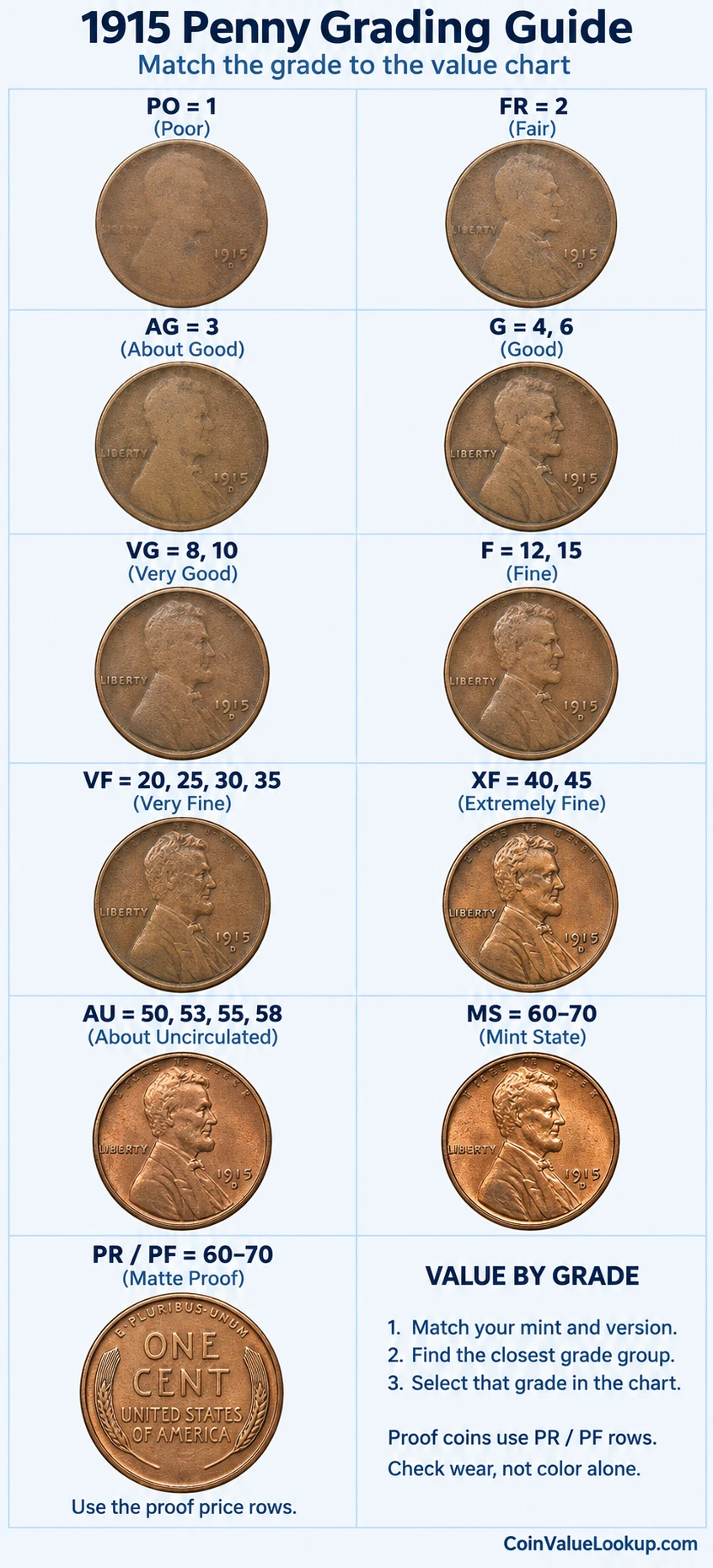
Start with Lincoln's cheek and jawline on the obverse. These are the highest points and the first places that lose definition from circulation.
In lower grades like Good-4, Lincoln's portrait is mostly a flat outline with a visible date. By Fine-12, you can make out the ear and some hair detail.
On the reverse, the wheat stalks tell the same story. Heavily worn coins lose the fine lines between the grains.
As you move into About Uncirculated, the wheat lines should be nearly complete, with only the slightest rub on the high points.
At MS63, you expect no wear at all, just full luster with some contact marks or minor blemishes that keep it from a higher grade. Compare your coin against the reference image to gauge where it falls.
One caution: a weak original strike can leave soft detail that mimics wear. Look at the surrounding fields for luster and flow lines.
If the fields are satiny and undisturbed but the hair detail is mushy, you may have a strike issue rather than a grade issue.
Spots, corrosion, and evidence of cleaning are separate factors that hurt value. A coin can technically grade AU-55 and still struggle to sell if it has been harshly cleaned.
Step 3: Check 1915 Wheat Penny Value by Mint and Version
1915 Wheat Penny
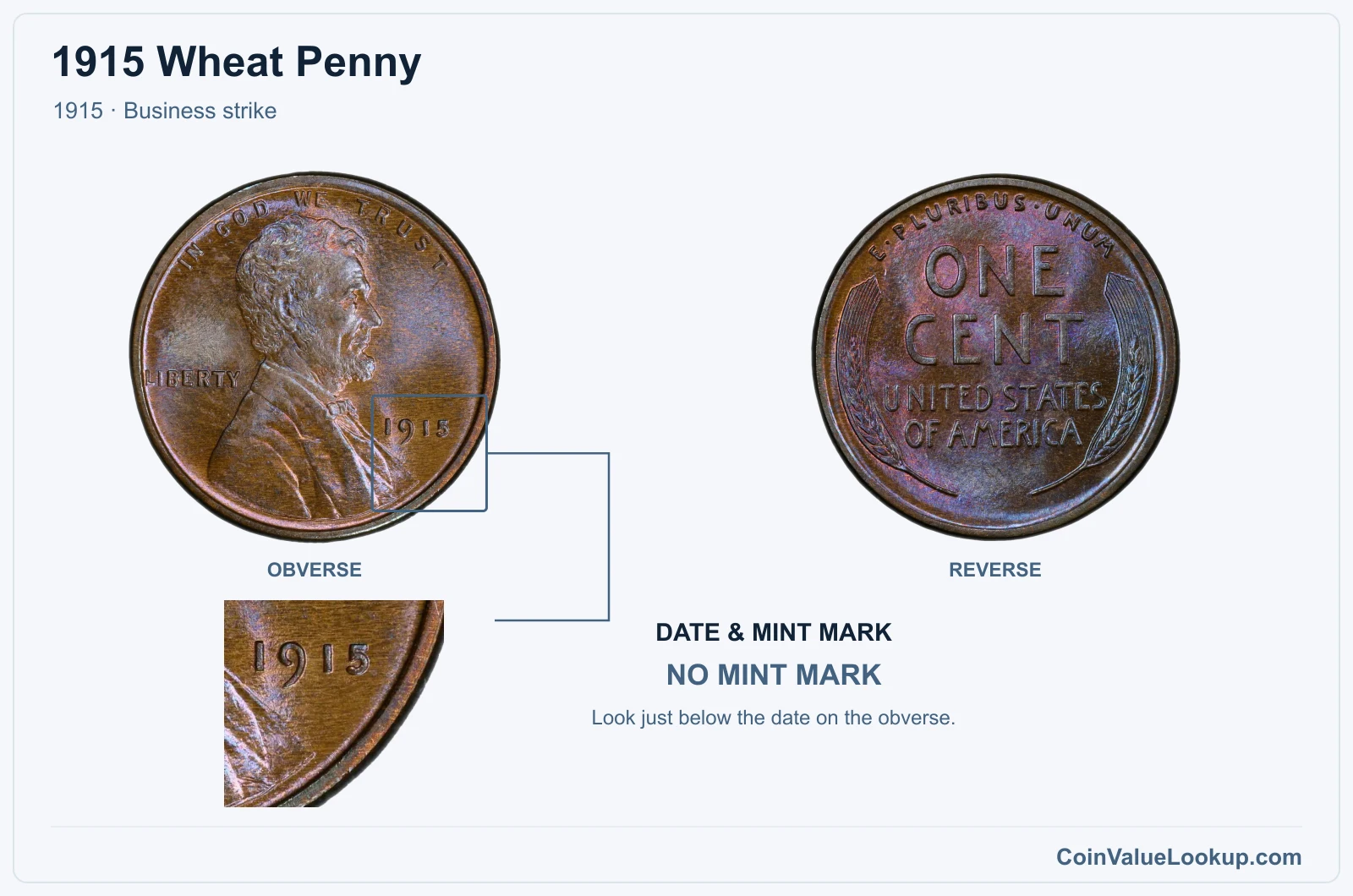
The 1915 Philadelphia cent carries no mintmark below the date. Philadelphia's output for this year was smaller than some neighboring dates in the series, so it gets a bit more respect than, say, a 1916.
In circulated grades, a guide estimate puts it around $3.08 in Good-4. Jump to MS63 and you are looking at roughly $131.
Original, problem-free surfaces matter a lot in this range. Cleaned or corroded examples trade well below guide figures regardless of their technical grade.
Color is not specified in this guide estimate, so do not assume these numbers reflect a certified red designation.
| Range | Grade | Price | Auction Records | Appraisal |
|---|---|---|---|---|
| PO | PO 1 | — | Coin Identifier | |
| FR | FR 2 | — | Coin Identifier | |
| AG | AG 3 | — | Coin Identifier | |
| G | G 4 | — | Coin Identifier | |
| G 6 | — | Coin Identifier | ||
| VG | VG 8 | — | Coin Identifier | |
| VG 10 | — | Coin Identifier | ||
| F | F 12 | — | Coin Identifier | |
| F 15 | — | Coin Identifier | ||
| VF | VF 20 | — | Coin Identifier | |
| VF 25 | — | Coin Identifier | ||
| VF 30 | Coin Identifier | |||
| VF 35 | — | Coin Identifier | ||
| XF | XF 40 | Coin Identifier | ||
| XF 45 | Coin Identifier | |||
| AU | AU 50 | Coin Identifier | ||
| AU 53 | — | Coin Identifier | ||
| AU 55 | Coin Identifier | |||
| AU 58 | Coin Identifier | |||
| MS | MS 60 | — | Coin Identifier | |
| MS 61 | — | Coin Identifier | ||
| MS 62 | Coin Identifier | |||
| MS 63 | Coin Identifier | |||
| MS 64 | Coin Identifier | |||
| MS 65 | Coin Identifier | |||
| MS 66 | Coin Identifier | |||
| MS 67 | — | — | — | |
| MS 68 | — | — | — | |
| MS 69 | — | — | — | |
| MS 70 | — | — | — |
1915 Wheat Penny — D
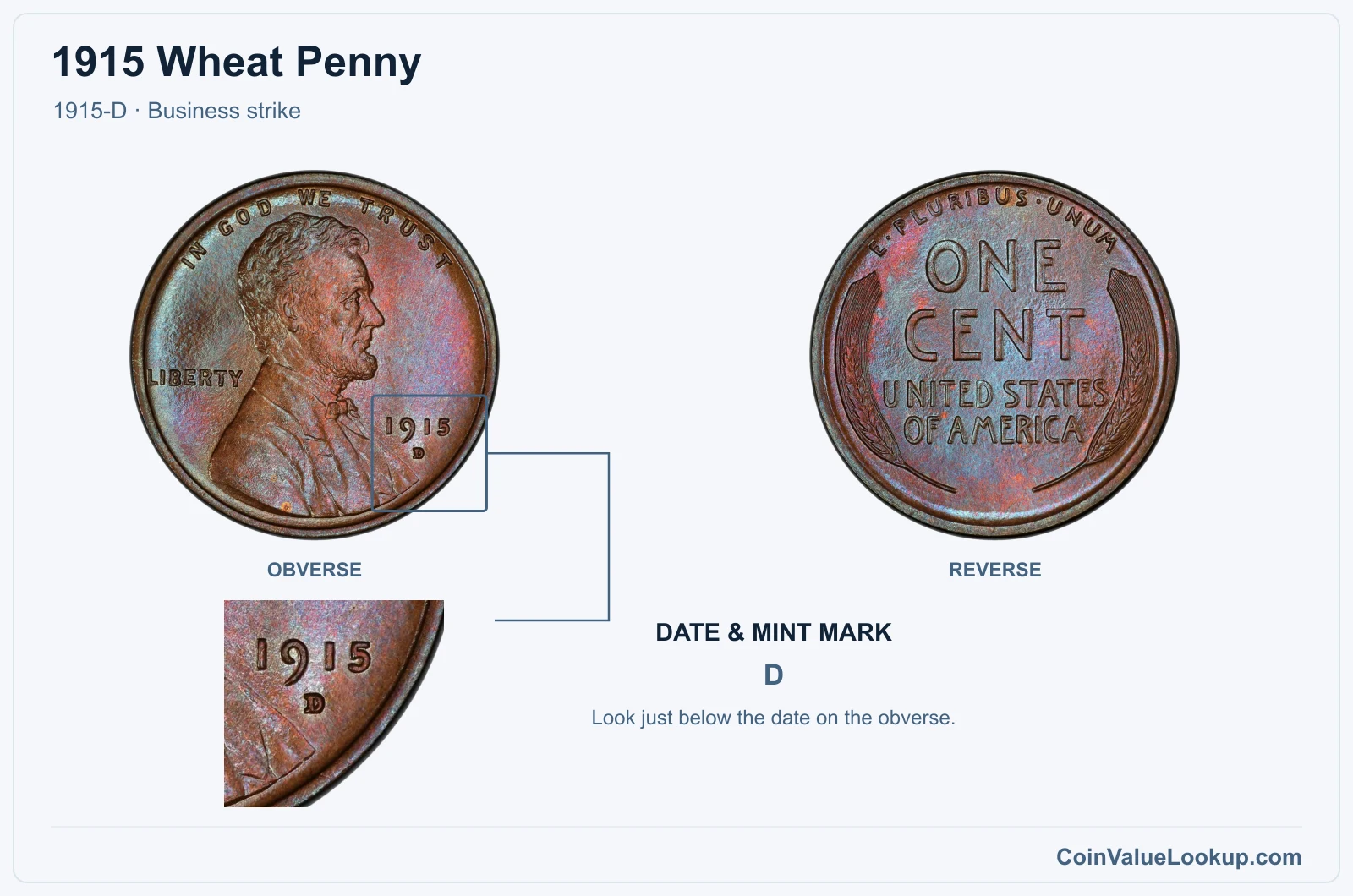
Look for a small "D" below the date. The 1915-D was struck in Denver and trades at about $3.08 in Good-4, rising to around $154 at MS63 according to the guide.
That MS63 figure edges past Philadelphia, reflecting moderate collector demand for the Denver issue.
If you are browsing Coin Value Lookup to compare values across dates and mints, the 1915-D sits in the middle of the pack for this year. As always, these guide estimates represent approximate retail, not what a dealer will hand you on the spot.
Unspecified color means you should not treat them as certified red-designation prices.
| Range | Grade | Price | Auction Records | Appraisal |
|---|---|---|---|---|
| PO | PO 1 | — | Coin Identifier | |
| FR | FR 2 | — | Coin Identifier | |
| AG | AG 3 | — | Coin Identifier | |
| G | G 4 | — | Coin Identifier | |
| G 6 | — | Coin Identifier | ||
| VG | VG 8 | — | Coin Identifier | |
| VG 10 | — | Coin Identifier | ||
| F | F 12 | Coin Identifier | ||
| F 15 | — | Coin Identifier | ||
| VF | VF 20 | — | Coin Identifier | |
| VF 25 | Coin Identifier | |||
| VF 30 | Coin Identifier | |||
| VF 35 | Coin Identifier | |||
| XF | XF 40 | — | Coin Identifier | |
| XF 45 | — | Coin Identifier | ||
| AU | AU 50 | — | Coin Identifier | |
| AU 53 | Coin Identifier | |||
| AU 55 | Coin Identifier | |||
| AU 58 | Coin Identifier | |||
| MS | MS 60 | Coin Identifier | ||
| MS 61 | Coin Identifier | |||
| MS 62 | Coin Identifier | |||
| MS 63 | Coin Identifier | |||
| MS 64 | Coin Identifier | |||
| MS 65 | Coin Identifier | |||
| MS 66 | Coin Identifier | |||
| MS 67 | — | — | — | |
| MS 68 | — | — | — | |
| MS 69 | — | — | — | |
| MS 70 | — | — | — |
1915 Wheat Penny — S
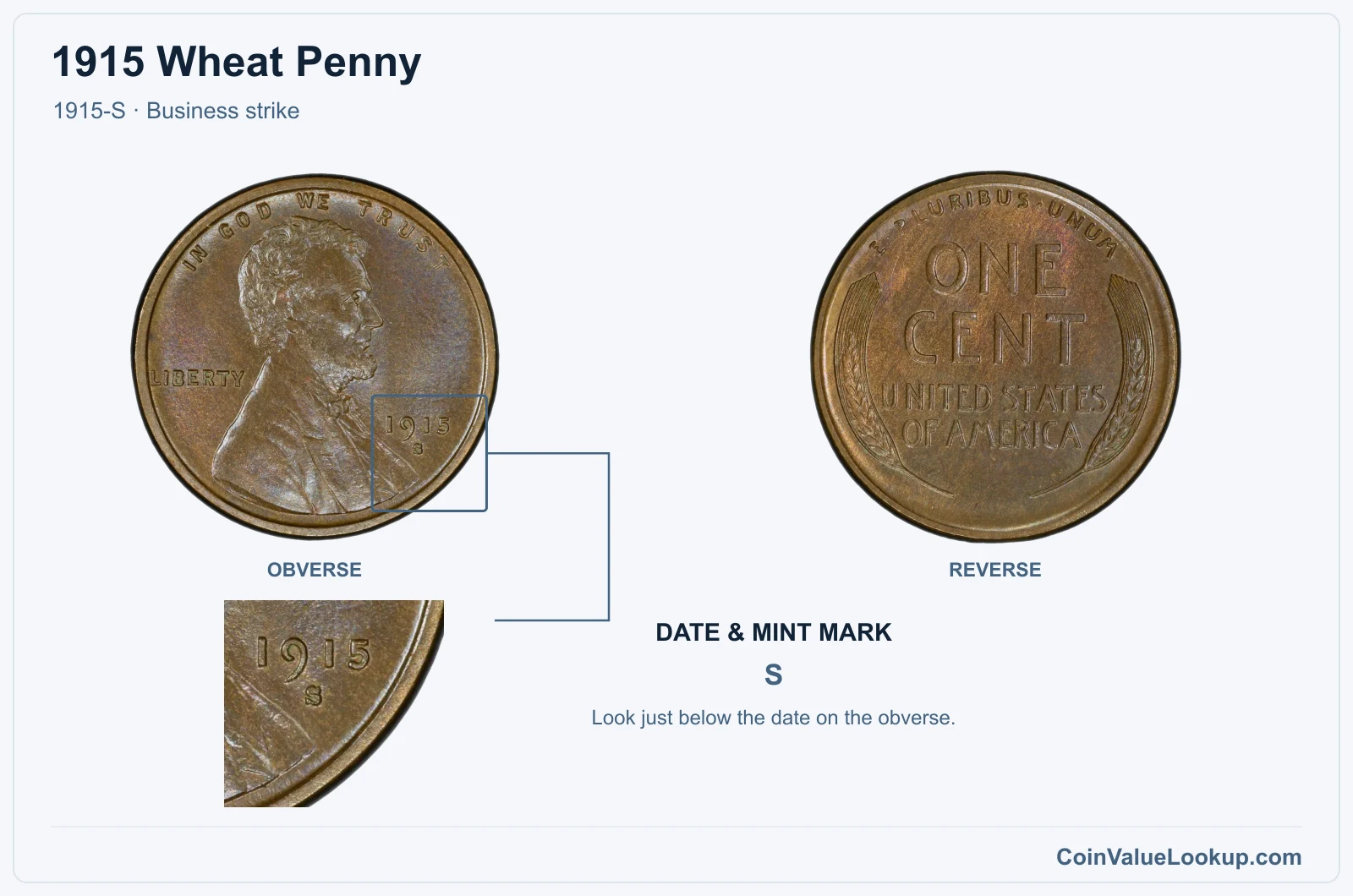
The 1915-S is the coin you want to find. That "S" mintmark below the date signals San Francisco, and it carries the steepest climb in this year's lineup.
Guide estimates start at about $19 in Good-4, already several times what Philadelphia or Denver command in the same grade. At MS63, the figure rises to roughly $639.
The San Francisco mint produced fewer cents this year, and that scarcity shows up in every grade tier. Because these are worth real money even in lower grades, counterfeits and added mintmarks exist.
Verify the S is naturally positioned and shows proper die characteristics rather than being tooled onto a Philadelphia coin. Problem-free originals with honest wear are genuinely collectible.
| Range | Grade | Price | Auction Records | Appraisal |
|---|---|---|---|---|
| PO | PO 1 | — | Coin Identifier | |
| FR | FR 2 | — | Coin Identifier | |
| AG | AG 3 | — | Coin Identifier | |
| G | G 4 | — | Coin Identifier | |
| G 6 | — | Coin Identifier | ||
| VG | VG 8 | — | Coin Identifier | |
| VG 10 | — | Coin Identifier | ||
| F | F 12 | Coin Identifier | ||
| F 15 | — | Coin Identifier | ||
| VF | VF 20 | Coin Identifier | ||
| VF 25 | Coin Identifier | |||
| VF 30 | Coin Identifier | |||
| VF 35 | Coin Identifier | |||
| XF | XF 40 | Coin Identifier | ||
| XF 45 | Coin Identifier | |||
| AU | AU 50 | Coin Identifier | ||
| AU 53 | Coin Identifier | |||
| AU 55 | Coin Identifier | |||
| AU 58 | Coin Identifier | |||
| MS | MS 60 | — | Coin Identifier | |
| MS 61 | Coin Identifier | |||
| MS 62 | Coin Identifier | |||
| MS 63 | Coin Identifier | |||
| MS 64 | Coin Identifier | |||
| MS 65 | Coin Identifier | |||
| MS 66 | — | Coin Identifier | ||
| MS 67 | — | — | — | |
| MS 68 | — | — | — | |
| MS 69 | — | — | — | |
| MS 70 | — | — | — |
1915 Wheat Penny — PR
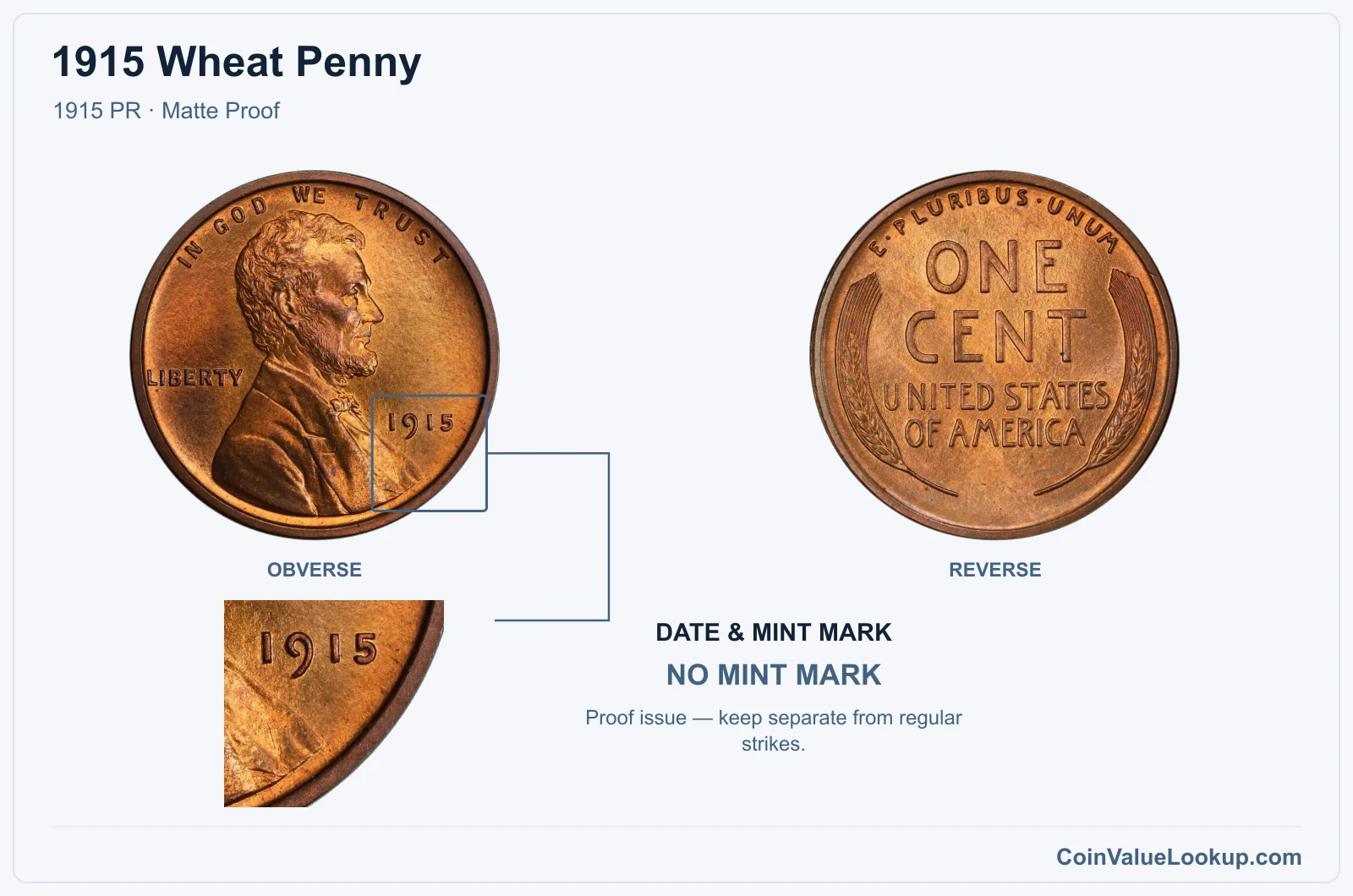
Philadelphia struck matte proof Lincoln cents from 1909 through 1916, and the 1915 is part of that short run. These are not the shiny mirror proofs you see on modern coins.
Matte proofs have a distinctive granular surface created by specially prepared dies, along with squared, sharp rims and precise detail throughout the design. At PR63, the guide estimate is about $1,064.
Identifying a genuine matte proof requires experience. The rims should be noticeably sharper and more squared off than any business strike, and the surface texture is uniform and deliberate rather than lustrous.
A well-struck circulation coin is not a proof. If you think you have one, third-party certification is the practical next step before assigning this kind of value.
| Range | Grade | Price | Auction Records | Appraisal |
|---|---|---|---|---|
| PR | PR 1 | — | Coin Identifier | |
| PR 2 | — | Coin Identifier | ||
| PR 3 | — | Coin Identifier | ||
| PR 4 | — | Coin Identifier | ||
| PR 6 | — | Coin Identifier | ||
| PR 8 | — | Coin Identifier | ||
| PR 10 | — | Coin Identifier | ||
| PR 12 | — | Coin Identifier | ||
| PR 15 | — | Coin Identifier | ||
| PR 20 | — | Coin Identifier | ||
| PR 25 | — | Coin Identifier | ||
| PR 30 | — | Coin Identifier | ||
| PR 35 | — | Coin Identifier | ||
| PR 40 | — | Coin Identifier | ||
| PR 45 | — | Coin Identifier | ||
| PR 50 | — | Coin Identifier | ||
| PR 53 | — | Coin Identifier | ||
| PR 55 | — | Coin Identifier | ||
| PR 58 | — | Coin Identifier | ||
| PR 60 | — | Coin Identifier | ||
| PR 61 | — | Coin Identifier | ||
| PR 62 | Coin Identifier | |||
| PR 63 | Coin Identifier | |||
| PR 64 | Coin Identifier | |||
| PR 65 | Coin Identifier | |||
| PR 66 | Coin Identifier | |||
| PR 67 | Coin Identifier | |||
| PR 68 | — | — | — | |
| PR 69 | — | — | — | |
| PR 70 | — | — | — |
1915 Wheat Penny Error List
1. 1915 Wheat Penny — Doubled Die Obverse
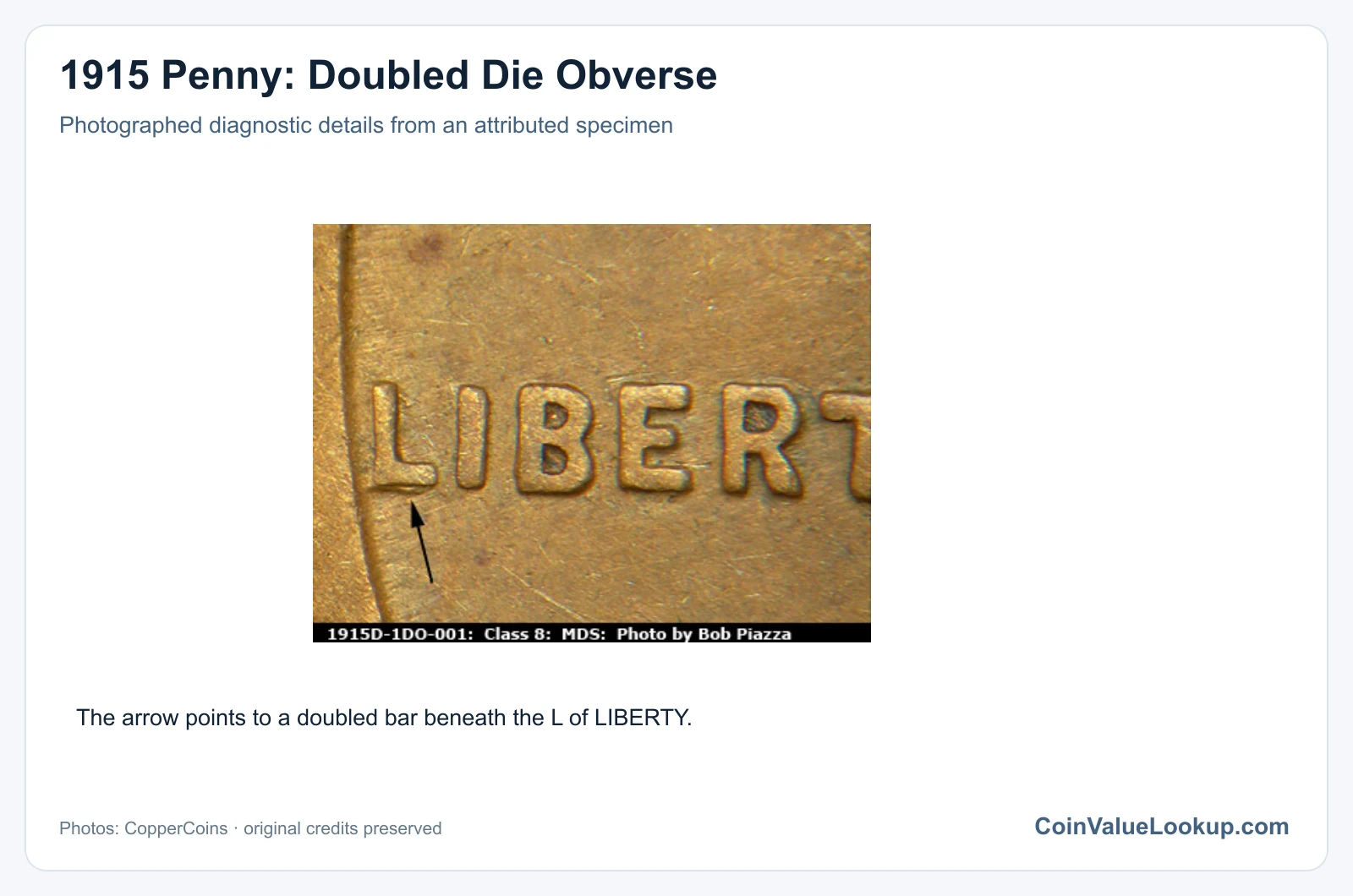
A doubled die obverse on a 1915 Wheat cent shows consistent separation or notching in the obverse lettering or design elements. The key word is consistent: true die doubling repeats in the same direction across multiple letters or features because the entire die received a second impression during manufacture.
Compare your coin's inscriptions against a normal 1915 under the same lighting and magnification. Look for a secondary image on letters like LIBERTY or IN GOD WE TRUST.
Machine doubling, which is flat shelf-like distortion from loose die fit during striking, is the most common lookalike and does not carry the same premium.
No specific price range is adopted for this category. Value depends on the authenticated identity, severity of the doubling, and the coin's overall condition.
2. 1915 Wheat Penny — Lamination / Split Planchet
Lamination errors occur when the planchet metal separates internally, creating a visible flap, peel, or void on the coin's surface. On a 1915 cent, look for areas where the copper alloy appears to lift away or split, sometimes retaining a thin flap of metal.
Photograph both the affected face and the edge of the coin together. The edge can reveal whether the separation runs through the thickness of the planchet or is only surface-deep.
Corrosion, deliberate scraping, and post-mint damage can mimic lamination. True lamination follows the metal's internal structure and typically has smooth, rounded edges where the layers parted naturally during or before striking.
Rough gouges and tool marks point to damage instead.
No specific price range is adopted. Assessment depends on the authenticated nature of the flaw, its size, and the coin's grade.
3. 1915 Wheat Penny — Struck-Through Error
A struck-through error happens when foreign material sits between the die and the planchet at the moment of striking. The result is a localized depression or incomplete design element where the obstruction blocked the die's impression.
On a 1915 cent, this might appear as an odd smooth area, a fabric-like texture, or a distinct impression of whatever got caught in the press.
Keep grease fills and retained foreign objects as separate descriptions. A grease-filled die typically produces a mushy, filled area, while a retained object can leave a sharper, more defined impression.
Ordinary wear, scratches, and weak strikes are common lookalikes. The difference is that a struck-through area is recessed and interrupts the surrounding design cleanly rather than showing directional abrasion.
No specific price is adopted. Value depends on authentication, the size of the affected area, and overall coin condition.
4. 1915 Wheat Penny — Die Crack / Die Chip
Die cracks show up as thin raised lines on the coin's surface, running across the design or from the rim inward. A die chip is a small raised blob where a piece of the die face broke away, leaving a void that filled with metal during striking.
On a 1915 cent, check both sides carefully under magnification.
A rim-connected crack that produces a significant raised area of unstruck design is called a cud, which is a different tier of collectibility than a minor hairline crack.
Lookalikes include incuse scratches, which are recessed rather than raised, and corrosion or foreign material stuck to the surface. True die cracks are raised, follow a consistent path, and repeat identically on every coin struck by that damaged die.
No specific price is adopted for this error. Severity, location, and the coin's overall condition all factor into individual assessment.
5. 1915 Wheat Penny — Clashed Dies
Clashed dies result from the obverse and reverse dies striking each other without a planchet between them. The impact transfers traces of each die's design onto the opposing die, and those ghost images then appear on subsequently struck coins.
On a 1915 cent, you might see faint wheat-ear lines in the obverse field or a hint of Lincoln's profile behind the reverse text.
The transferred elements should align with where the opposite design would contact the die during a normal strike cycle. Random raised lines, scratches, or a brockage impression from a previously struck coin are not die clashes.
No specific price range is adopted. The value of a clashed-die 1915 cent depends on how visible and dramatic the clash is, whether both sides show it, and the coin's authenticated condition.
6. 1915 Wheat Penny — Repunched Mintmark
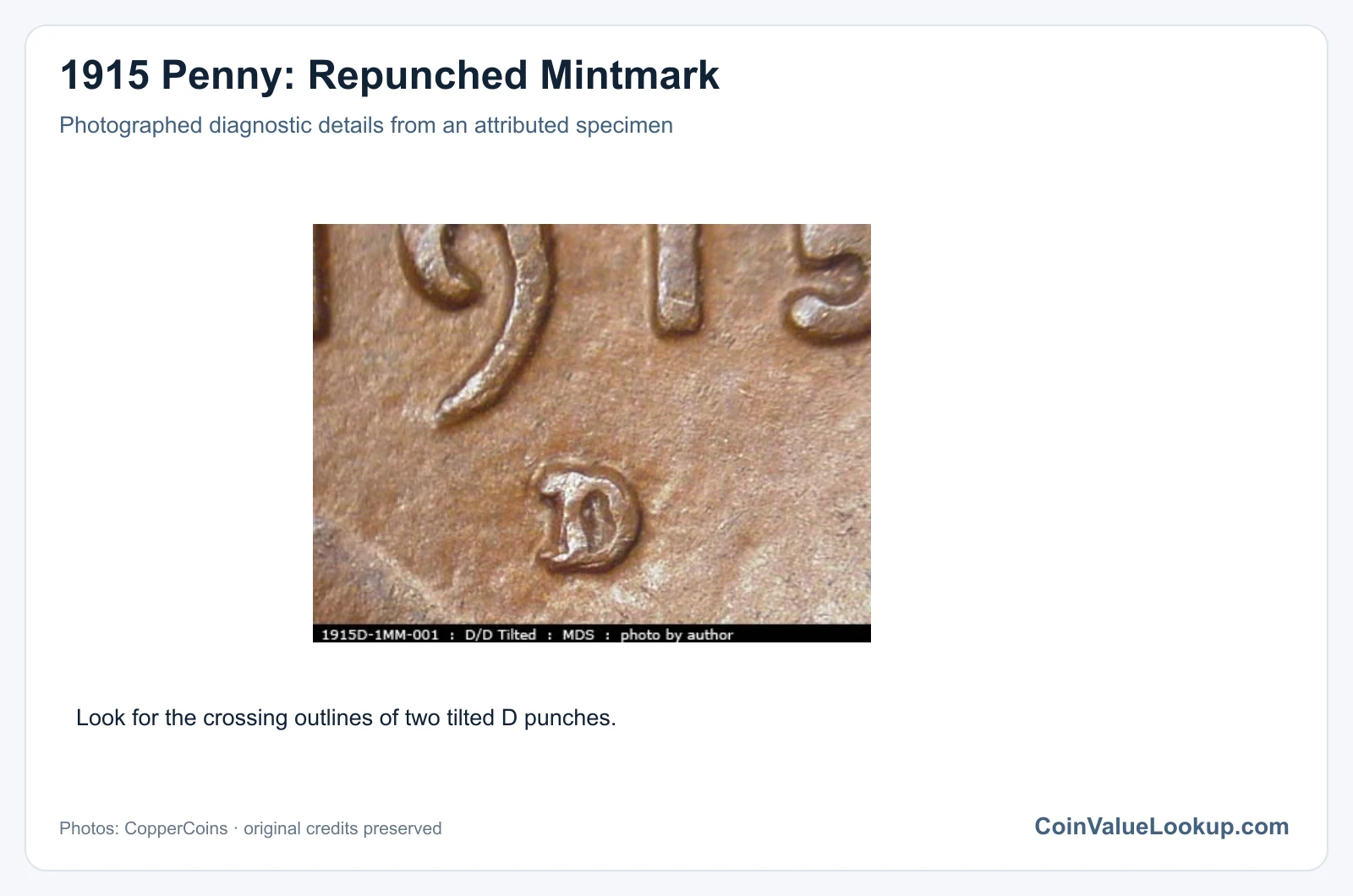
A repunched mintmark applies only to the 1915-D and 1915-S, since Philadelphia coins carry no mintmark. During this era, mintmarks were punched into each working die individually by hand, and sometimes the punch landed slightly off position before being corrected.
The result is a visible remnant of the first placement alongside the final mintmark.
Inspect the D or S below the date at high magnification. You are looking for a secondary outline, a notch, or a partial letter offset from the primary mark.
Compare against a normal example at the same magnification to see whether the feature is genuinely a repunch or just die deterioration.
Machine doubling, die chips, and corrosion around the mintmark can mimic a repunched mark. No specific price range is adopted.
Assessment depends on authenticated identity and the coin's overall grade.
7. 1915 Wheat Penny — Off-Center Strike
An off-center strike occurs when the planchet is not properly seated between the dies, producing a design that is shifted to one side with an unstruck crescent of blank metal opposite it. The percentage off-center matters: a 5% shift is minor, while 50% or more is dramatic and far less common.
For a 1915 cent, the date needs to remain visible for the coin to be attributed to this year, which is what makes off-center examples with a readable date more collectible than those where the date disappeared into the unstruck area.
Do not confuse an off-center strike with a clipped planchet, which has a curved bite out of the edge, or with post-mint flattening from damage. A true off-center strike shows a smooth, as-manufactured blank crescent.
No specific price is adopted. Value depends on the percentage of displacement, date visibility, and authenticated condition.