1925 Wheat Penny Coin Value: How Much Is It Worth?
A 1925 Wheat Penny can range from around $0.30 in well-worn Good-4 condition up to about $281 at the MS63 grade level, depending on which mint struck it. Those figures cover the three regular business-strike branches — Philadelphia, Denver, and San Francisco — and do not include major error varieties, which are valued separately.
Original surfaces, the degree of wear, and copper color all play a role in what a particular coin will actually bring.
Fast Way to Identify Your 1925 Wheat Penny
The quickest way to start figuring out what your 1925 cent is worth is to upload clear photos of both the front and the back. Our identifier can give you a preliminary read on the mint, general condition, and version so you know where to focus your research.
Good lighting and a steady close-up make a real difference.
1925 Wheat Penny Value
Upload both sides of your 1925 Wheat Penny.
Front Obverse
Upload photo
Back Reverse
Upload photo
Which 1925 Wheat Penny Versions Are Worth Money?
- The 1925-S in MS63 condition carries a guide value around $281 — the highest of the three regular mints at that grade.
- The 1925-D commands roughly $154 at MS63, making uncirculated Denver examples worth careful inspection.
- Even the common Philadelphia issue jumps to about $30 at MS63, a big leap from its $0.30 Good-4 estimate.
- Recognized error varieties such as doubled die obverse and repunched mintmark coins are valued individually by authenticated identity and condition, and can exceed normal-issue prices.
- Strong original copper surfaces with no cleaning or corrosion add appeal across every grade level.
Step 1: Identify Your 1925 Wheat Penny Mint Mark and Version
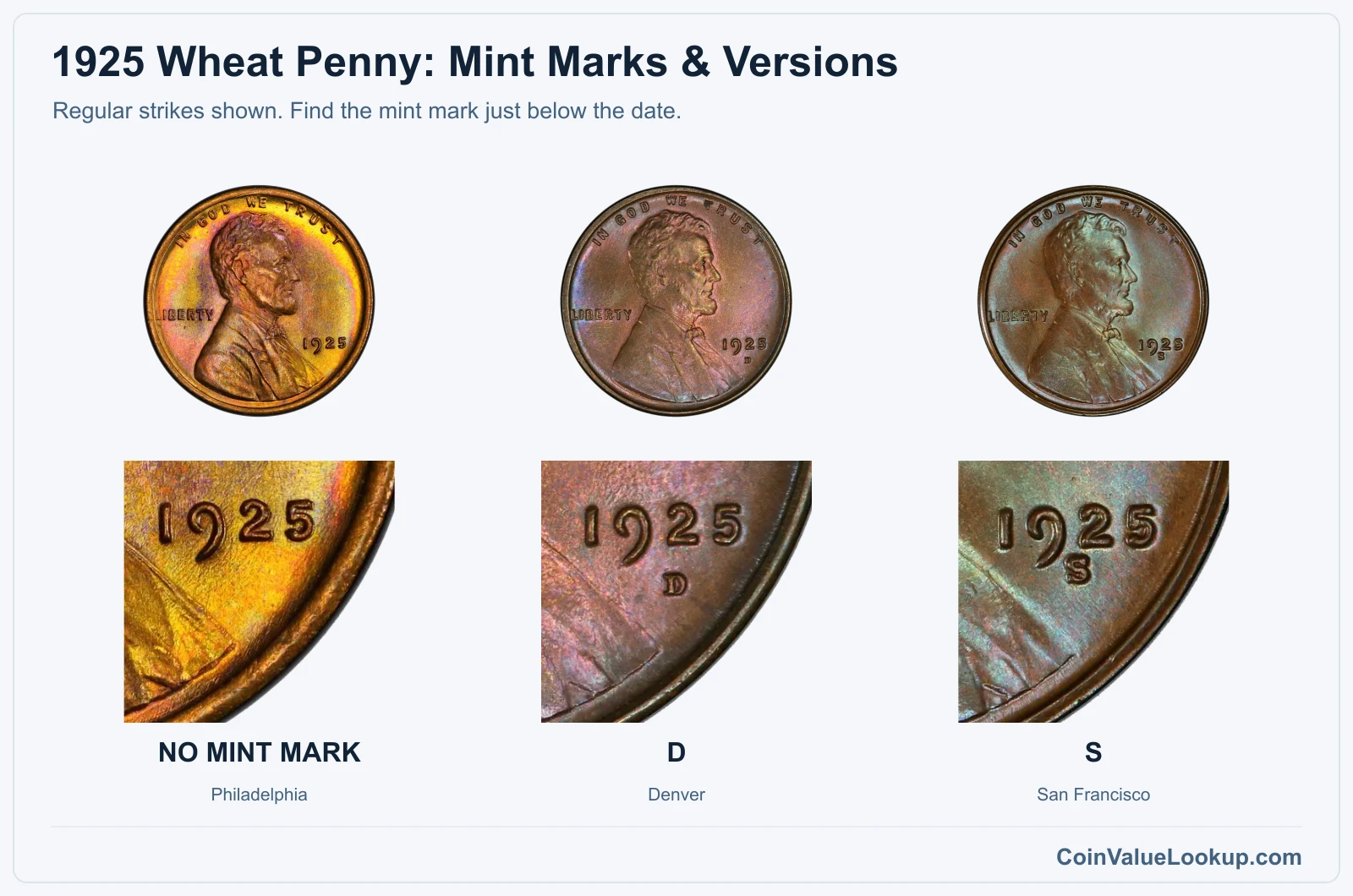
Flip the coin over first and confirm you see two wheat ears on the reverse — that is the Wheat cent design, produced from 1909 through 1958. The obverse carries Lincoln's portrait, and the date 1925 sits below it.
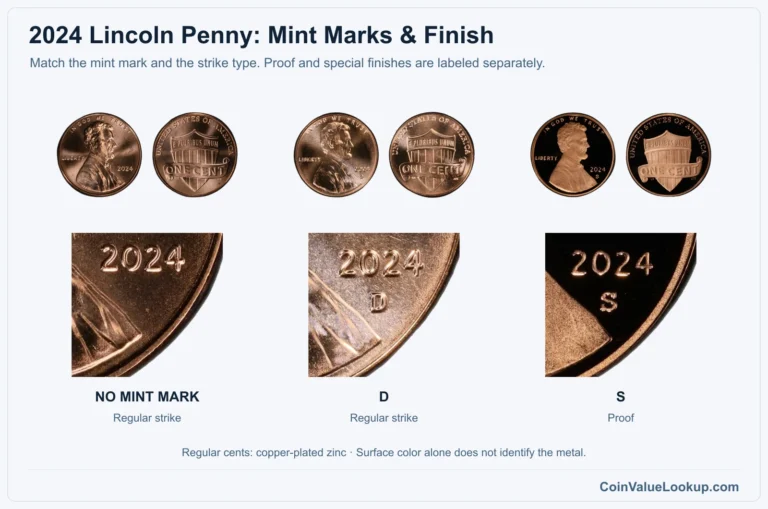
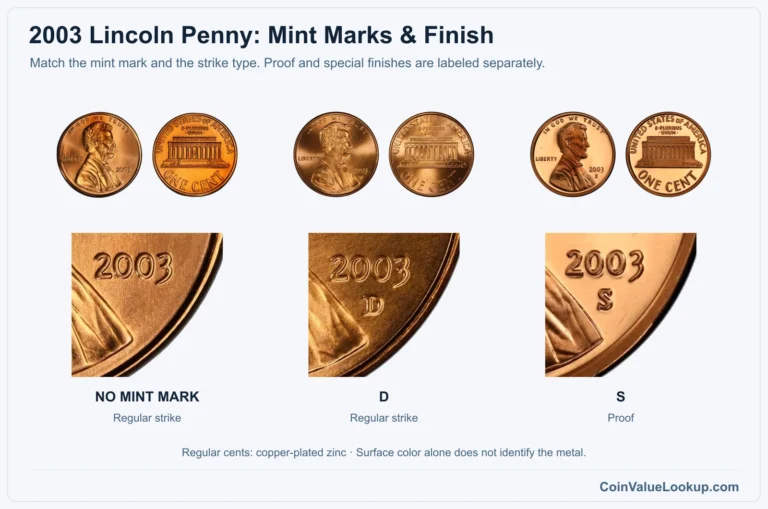
Now look just below the date for a small mintmark letter. No letter means Philadelphia.
A "D" means Denver. An "S" means San Francisco.
These three mints are your starting branches for 1925.
The coin should be a plain-edge copper-alloy cent weighing approximately 3.11 grams, composed of 95% copper with 5% tin and zinc. If yours is noticeably lighter, heavier, or has a reeded edge, something unusual is going on and it deserves closer inspection.
Do not confuse soft detail from a tired, worn die with actual circulation wear. Some 1925 cents left the press looking a bit mushy from the start.
True wear shows flattening on the highest points — Lincoln's cheekbone, jaw, and hair — along with loss of the fine lines in the wheat stalks.
Step 2: Check Your 1925 Wheat Penny Grade
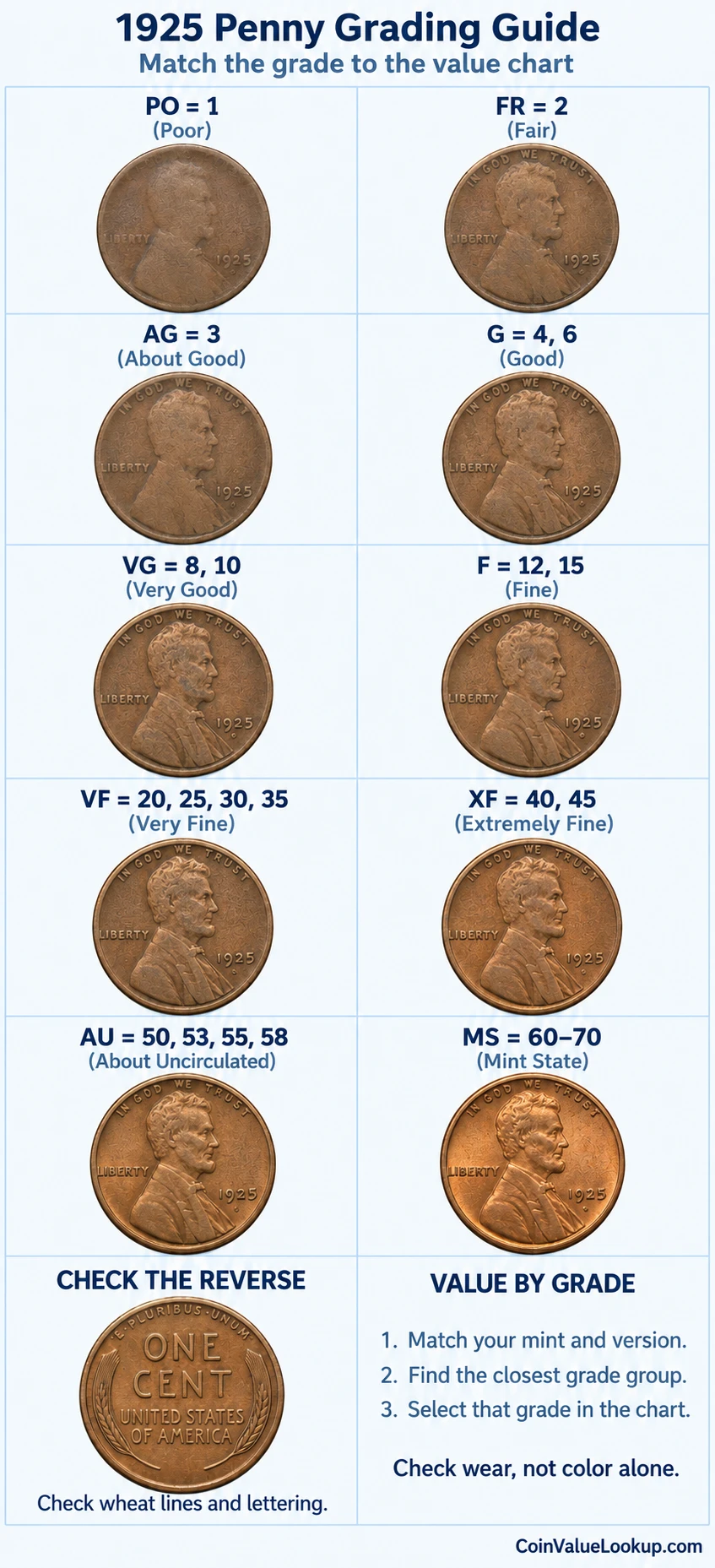
Start with Lincoln's cheek and jawline on the obverse. In lower grades like Good-4, these areas are smooth and merged together, and "LIBERTY" in the headband may be partially gone.
Move up to Fine and Very Fine, and you will see separated hair strands above the ear and a distinct jawline returning.
At About Uncirculated, only the very highest points — the cheek, the jaw hinge, the tops of the wheat grains — show any rub. Full mint luster should be visible across most of the surface.
An MS63 coin has no wear at all, though it may carry a few contact marks from other coins bouncing around in bags.
Use the comparison image to match your coin against known wear patterns. Pay special attention to the hair detail directly behind Lincoln's ear; that is one of the first spots to go flat.
Color matters separately from wear. A coin can be graded MS63 in brown, red-brown, or red, and these color designations affect value differently.
The guide prices referenced here do not specify color, so treat them as general benchmarks rather than quotes for a certified red example.
Cleaning, corrosion, and environmental damage each lower a coin's desirability regardless of how sharp the detail looks. A cleaned coin with AU detail may sell for less than an honestly circulated Fine coin with original surfaces.
Step 3: Check 1925 Wheat Penny Value by Mint and Version
1925 Wheat Penny
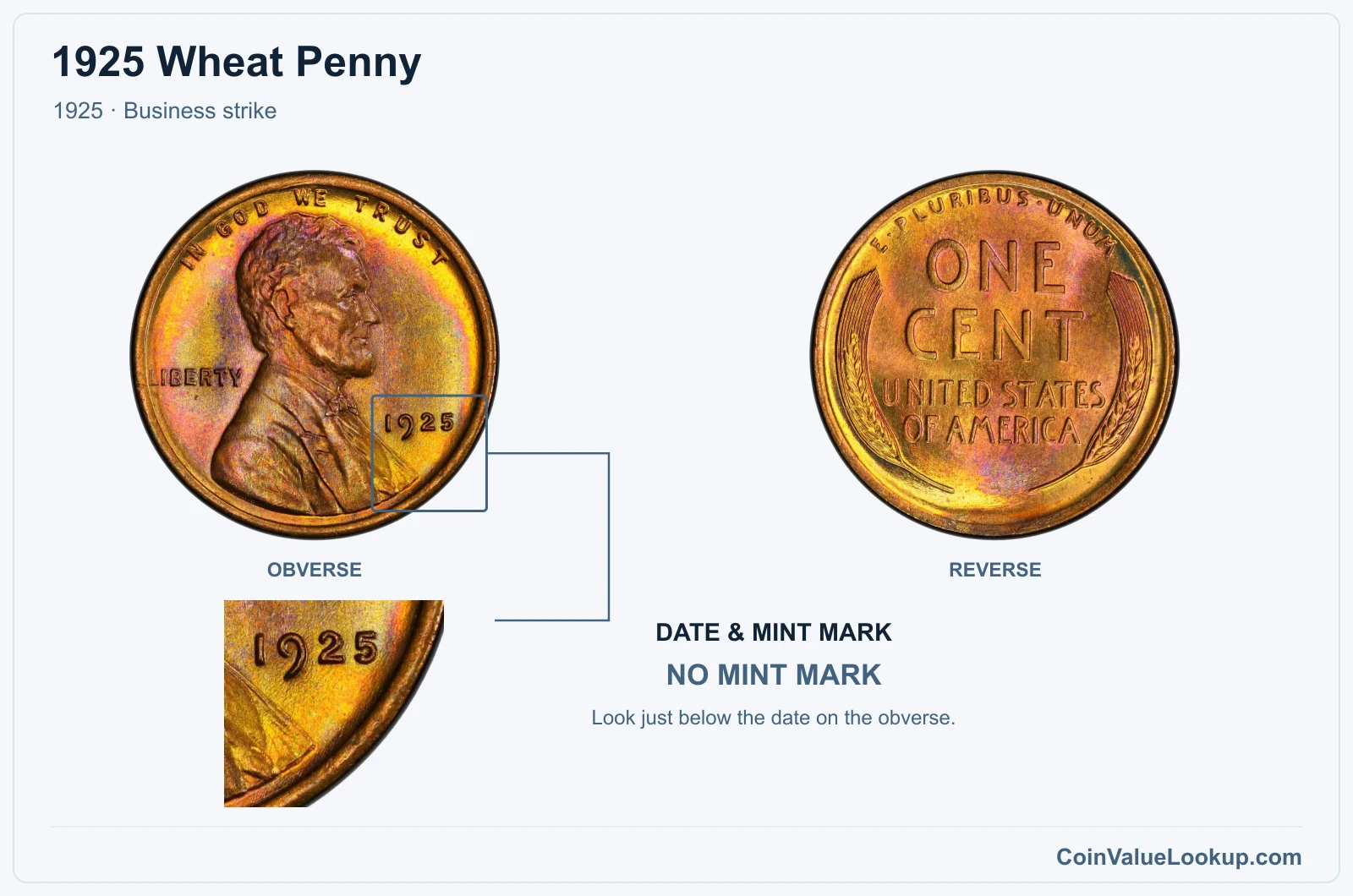
The 1925 Philadelphia cent has no mintmark below the date. It is the most available of the three mints for this year, and circulated examples in Good-4 condition carry a guide estimate of about $0.30 according to USA Coin Book.
Jump to MS63 uncirculated and the guide value rises to around $30. That is a significant multiplier, which tells you that surviving mint-state examples are far less common than the bags of worn ones floating around.
When evaluating yours, check Lincoln's hair detail and cheek. Soft, mushy features can result from a worn die at the mint rather than from pocket wear, so compare against known examples before assuming heavy circulation.
| Range | Grade | Price | Auction Records | Appraisal |
|---|---|---|---|---|
| PO | PO 1 | — | Coin Identifier | |
| FR | FR 2 | — | Coin Identifier | |
| AG | AG 3 | — | Coin Identifier | |
| G | G 4 | — | Coin Identifier | |
| G 6 | — | Coin Identifier | ||
| VG | VG 8 | — | Coin Identifier | |
| VG 10 | — | Coin Identifier | ||
| F | F 12 | — | Coin Identifier | |
| F 15 | — | Coin Identifier | ||
| VF | VF 20 | — | Coin Identifier | |
| VF 25 | — | Coin Identifier | ||
| VF 30 | — | Coin Identifier | ||
| VF 35 | — | Coin Identifier | ||
| XF | XF 40 | — | Coin Identifier | |
| XF 45 | — | Coin Identifier | ||
| AU | AU 50 | — | Coin Identifier | |
| AU 53 | — | Coin Identifier | ||
| AU 55 | — | Coin Identifier | ||
| AU 58 | — | Coin Identifier | ||
| MS | MS 60 | — | Coin Identifier | |
| MS 61 | Coin Identifier | |||
| MS 62 | — | Coin Identifier | ||
| MS 63 | Coin Identifier | |||
| MS 64 | Coin Identifier | |||
| MS 65 | Coin Identifier | |||
| MS 66 | Coin Identifier | |||
| MS 67 | — | — | — | |
| MS 68 | — | — | — | |
| MS 69 | — | — | — | |
| MS 70 | — | — | — |
1925 Wheat Penny — D
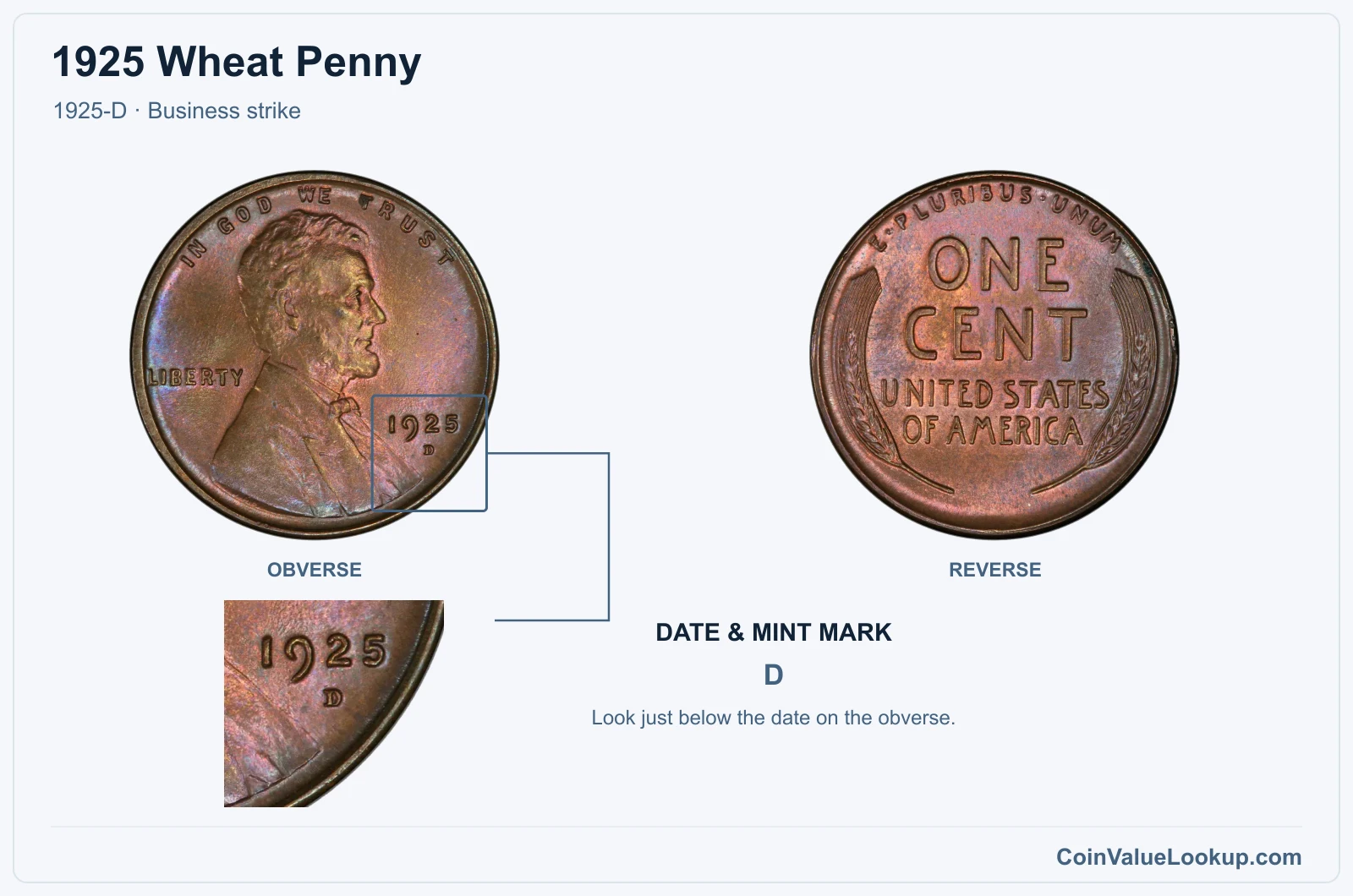
Look for a small "D" mintmark below the date. The 1925-D was struck at the Denver Mint and trades at a premium over the Philadelphia issue in every grade.
In Good-4, the guide estimate is about $1.24. At MS63, the value climbs to roughly $154 — a steep curve that reflects genuine scarcity in uncirculated condition.
Original surfaces matter here. A well-preserved 1925-D with honest wear and no cleaning will appeal to collectors far more than a harshly cleaned coin that technically has sharper detail.
If your coin still shows some luster in the protected areas around the letters and wheat stalks, that is a good sign.
| Range | Grade | Price | Auction Records | Appraisal |
|---|---|---|---|---|
| PO | PO 1 | — | Coin Identifier | |
| FR | FR 2 | — | Coin Identifier | |
| AG | AG 3 | — | Coin Identifier | |
| G | G 4 | — | Coin Identifier | |
| G 6 | — | Coin Identifier | ||
| VG | VG 8 | — | Coin Identifier | |
| VG 10 | — | Coin Identifier | ||
| F | F 12 | — | Coin Identifier | |
| F 15 | — | Coin Identifier | ||
| VF | VF 20 | — | Coin Identifier | |
| VF 25 | — | Coin Identifier | ||
| VF 30 | — | Coin Identifier | ||
| VF 35 | — | Coin Identifier | ||
| XF | XF 40 | Coin Identifier | ||
| XF 45 | Coin Identifier | |||
| AU | AU 50 | Coin Identifier | ||
| AU 53 | Coin Identifier | |||
| AU 55 | Coin Identifier | |||
| AU 58 | Coin Identifier | |||
| MS | MS 60 | — | Coin Identifier | |
| MS 61 | Coin Identifier | |||
| MS 62 | Coin Identifier | |||
| MS 63 | Coin Identifier | |||
| MS 64 | Coin Identifier | |||
| MS 65 | Coin Identifier | |||
| MS 66 | Coin Identifier | |||
| MS 67 | — | — | — | |
| MS 68 | — | — | — | |
| MS 69 | — | — | — | |
| MS 70 | — | — | — |
1925 Wheat Penny — S
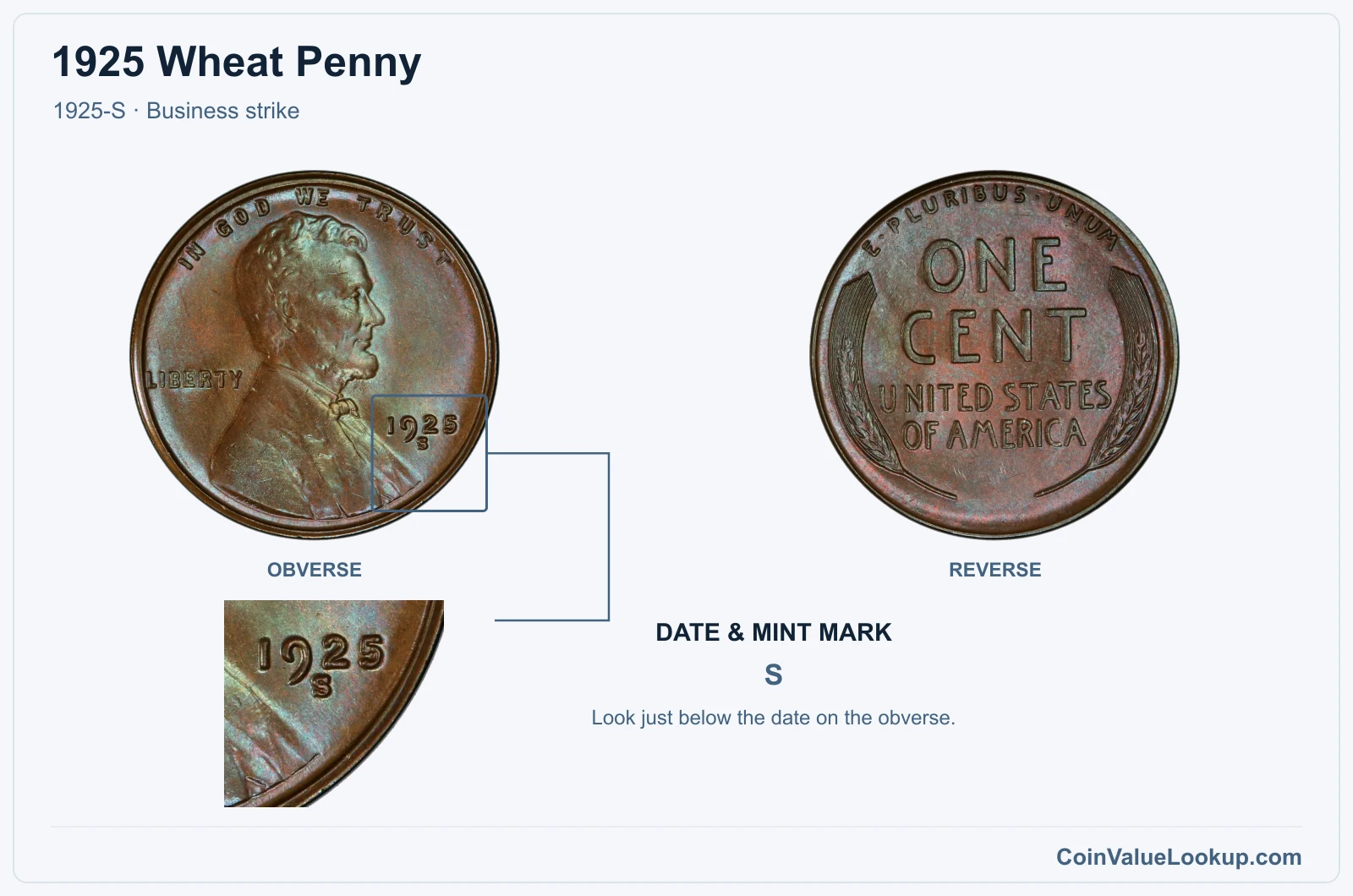
The 1925-S carries a small "S" mintmark below the date, indicating the San Francisco Mint. Among the three business-strike branches for 1925, this one commands the highest guide value at MS63 — approximately $281 according to USA Coin Book.
Circulated pieces in Good-4 sit at about $1.24, identical to the Denver issue at that grade. The real separation happens in higher grades, where the San Francisco coin pulls ahead.
San Francisco cents from this era are sometimes found with weak strikes, so look carefully at the hair detail above Lincoln's ear. If the detail is soft but the fields still carry luster, you may have a weakly struck mint-state coin rather than an AU piece with wear.
Coin Value Lookup is a good starting point if you want to compare your 1925-S against other Lincoln cent dates and mints. You can browse guides for the full Wheat Penny series to see where your coin fits in.
| Range | Grade | Price | Auction Records | Appraisal |
|---|---|---|---|---|
| PO | PO 1 | — | Coin Identifier | |
| FR | FR 2 | — | Coin Identifier | |
| AG | AG 3 | — | Coin Identifier | |
| G | G 4 | — | Coin Identifier | |
| G 6 | — | Coin Identifier | ||
| VG | VG 8 | — | Coin Identifier | |
| VG 10 | — | Coin Identifier | ||
| F | F 12 | — | Coin Identifier | |
| F 15 | — | Coin Identifier | ||
| VF | VF 20 | — | Coin Identifier | |
| VF 25 | — | Coin Identifier | ||
| VF 30 | — | Coin Identifier | ||
| VF 35 | — | Coin Identifier | ||
| XF | XF 40 | — | Coin Identifier | |
| XF 45 | Coin Identifier | |||
| AU | AU 50 | Coin Identifier | ||
| AU 53 | Coin Identifier | |||
| AU 55 | Coin Identifier | |||
| AU 58 | Coin Identifier | |||
| MS | MS 60 | — | Coin Identifier | |
| MS 61 | Coin Identifier | |||
| MS 62 | Coin Identifier | |||
| MS 63 | Coin Identifier | |||
| MS 64 | Coin Identifier | |||
| MS 65 | Coin Identifier | |||
| MS 66 | Coin Identifier | |||
| MS 67 | — | — | — | |
| MS 68 | — | — | — | |
| MS 69 | — | — | — | |
| MS 70 | — | — | — |
1925 Wheat Penny Error List
1. 1925 Wheat Penny — Doubled Die Obverse
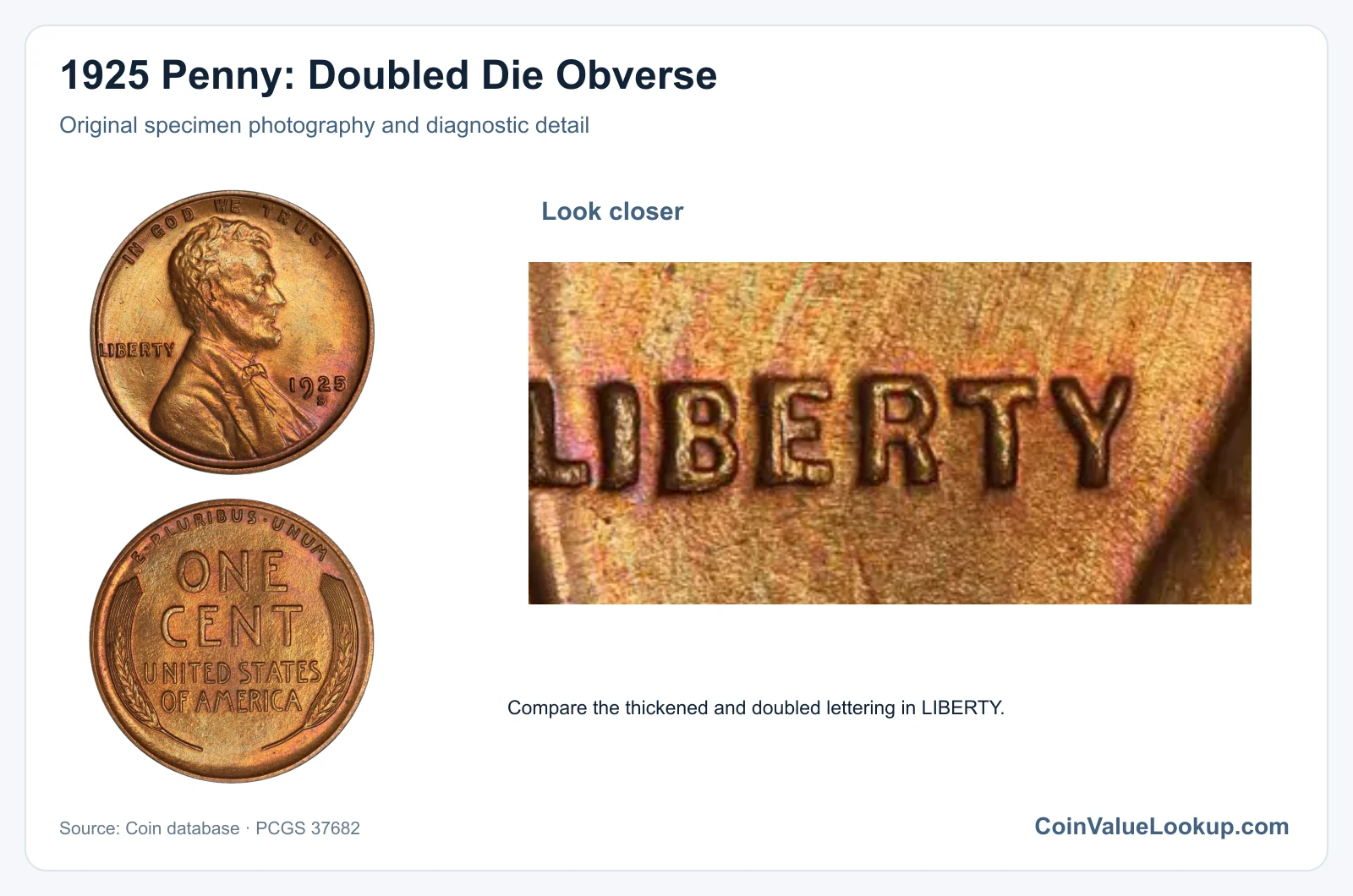
A doubled die obverse on a 1925 Wheat cent shows consistent doubling on the obverse lettering or design elements. Look at "LIBERTY," "IN GOD WE TRUST," and the date numerals under magnification.
Genuine doubling will appear as a secondary image with uniform separation or notching on the affected features.
The key word is consistent. Every affected letter should show the doubling in the same direction and to a similar degree.
If the separation is flat, shelf-like, and only on one side of the lettering, that pattern is more typical of machine doubling — a mechanical bounce during striking that carries little collector premium.
No specific price range has been adopted for 1925 doubled die obverse cents. Value depends on the severity of the doubling, the coin's overall condition, and authentication by a recognized grading service.
2. 1925 Wheat Penny — Repunched Mintmark
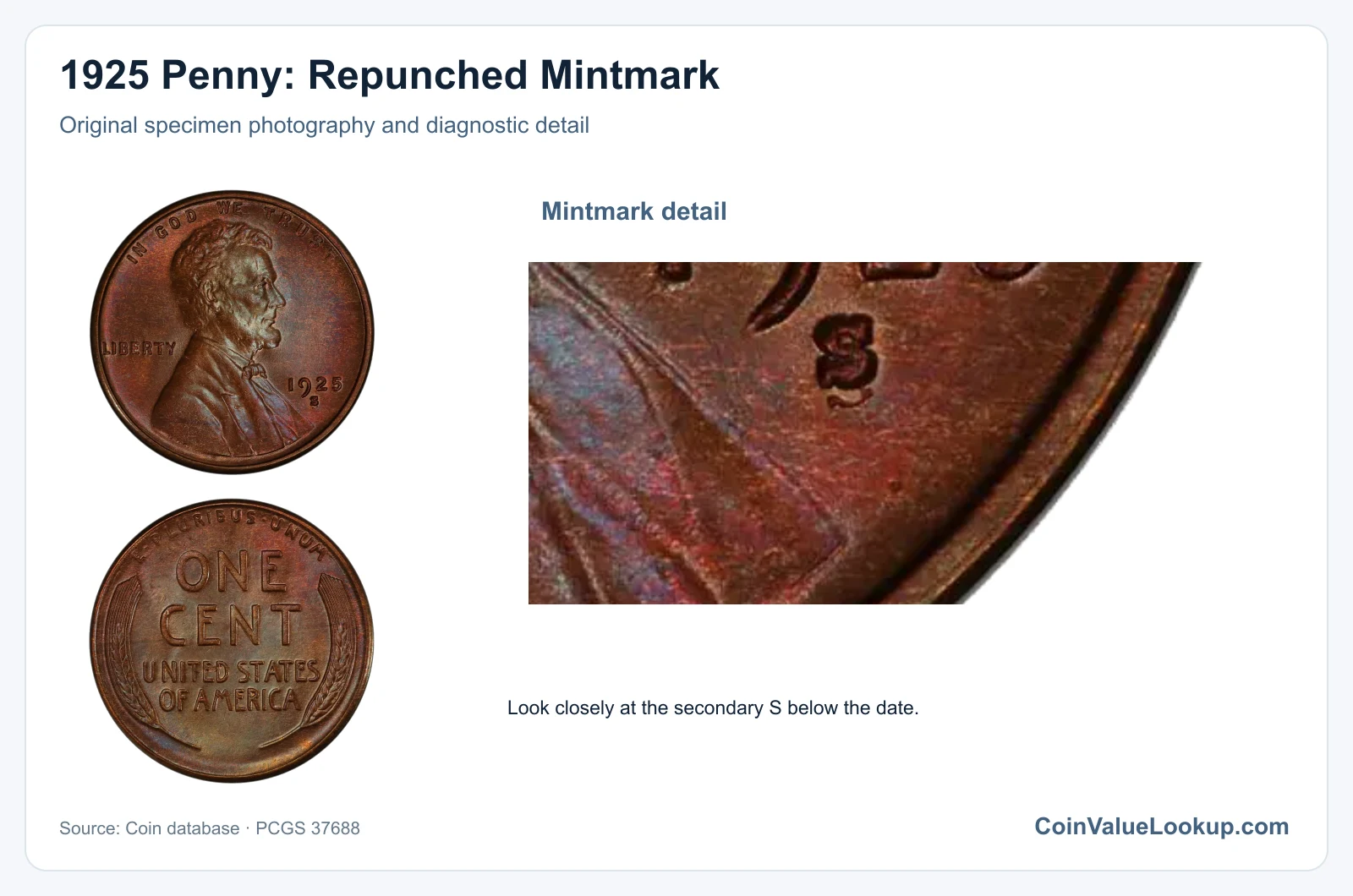
A repunched mintmark occurs when the mintmark punch was applied more than once in slightly different positions, leaving a visible trace of the earlier impression. On 1925-dated cents, this error applies only to the Denver and San Francisco issues — Philadelphia coins carry no mintmark to repunch.
Examine the "D" or "S" below the date with at least 5x to 10x magnification. You are looking for a secondary outline, a notch, or a partial second letter peeking out from behind the primary mintmark.
The remnant should be die-struck and crisp, not mushy or irregular.
Die chips, corrosion, or machine doubling near the mintmark can mimic this error. Compare your coin to a known normal example at the same magnification.
Value depends on the clarity of the repunching, overall coin condition, and third-party authentication.
3. 1925 Wheat Penny — Clashed Dies
Die clashes happen when the obverse and reverse dies strike each other without a planchet between them, transferring faint mirror-image impressions of the opposite design onto each die. When the next coin is struck, those ghost impressions show up on the finished coin.
On a 1925 Wheat cent, look in the open fields of both sides. The obverse might show faint traces of the wheat stalks or lettering from the reverse.
The reverse may carry a ghostly outline of Lincoln's profile. These impressions align with where the opposite design would sit during normal striking.
Do not confuse random scratches, tooling marks, or raised lines from a damaged die with a genuine clash. True clash marks are smooth, die-struck, and match the geometry of the opposing design.
No specific price range is adopted for this error on the 1925 cent; individual value hinges on the clash's visibility, the coin's grade, and authenticated confirmation.
4. 1925 Wheat Penny — Off-Center Strike
An off-center strike means the planchet was not properly seated between the dies, so the design is shifted to one side and a blank crescent of unstruck metal appears on the opposite edge. The percentage off-center and whether the date remains visible are the two biggest factors in collectibility.
For a 1925 Wheat cent, a coin struck maybe 5% to 10% off-center with the full date showing is a modest curiosity. Push that to 20% or more with the date still readable, and collector interest rises sharply.
Be careful not to mistake a clipped planchet or a coin that was simply flattened after leaving the mint for a true off-center strike. On a genuine example, the design itself is displaced — not just the edge.
No adopted price range exists for this error on 1925 cents; each piece is assessed individually based on the degree of displacement, date visibility, and authenticated condition.
5. 1925 Wheat Penny — Struck-Through Error
A struck-through error happens when foreign material — grease, thread, a metal fragment, or debris — sits between the die and the planchet during the strike. The result is a localized depression, an impression of the obstruction, or a patch of missing design detail on the finished coin.
On a 1925 Wheat cent, look for a smooth, recessed area that does not match normal wear. Grease-filled dies typically produce a soft, rounded absence of detail in one area, while a retained foreign object may leave a distinct shape pressed into the surface.
Ordinary wear, cleaning scratches, and weak strikes from tired dies can all look similar at first glance. The difference is that a struck-through area is sharply bounded and sits below the surrounding design.
No specific value range has been adopted for this error; pricing depends on the size and visual impact of the obstruction, overall grade, and professional authentication.
6. 1925 Wheat Penny — Die Crack / Die Chip
Die cracks and die chips appear as raised lines or small raised lumps on the coin's surface. They form when the steel die develops a fracture or loses a tiny piece of metal, and the resulting void fills with coin metal during striking.
On a 1925 Wheat cent, a die crack usually shows up as a thin raised line running across the design or from the rim inward. A die chip is a small raised blob, often found inside a letter or near a design element.
Both are genuinely die-struck features, meaning they are raised above the coin's surface.
Do not confuse these with incuse scratches or corrosion, which are recessed into the surface. A raised line that you can feel with a fingernail is a good candidate.
Value for die cracks and chips on 1925 cents is not covered by an adopted price range; each is assessed individually based on prominence, location, and the coin's authenticated condition.
7. 1925 Wheat Penny — Die Break / Cud
A cud is a specific type of die break where a piece of the die rim has broken away entirely. The result is a raised, featureless lump of metal connected to the rim of the coin, replacing whatever design was in that area.
It is essentially a large-scale die chip at the coin's edge.
On a 1925 Wheat cent, look along the entire rim on both sides. A genuine cud will be raised, smooth, and seamlessly connected to the rim.
The design underneath is completely obliterated in that zone.
A rim dent or post-mint damage will be recessed or distorted, not raised. An interior die chip that does not touch the rim is technically not a cud, though it is still a collectible die variety.
No price range has been adopted for cuds on 1925 cents; value is determined by the cud's size, location, the coin's overall grade, and confirmation through professional authentication.