1922 Wheat Penny Coin Value: How Much Is It Worth?
A 1922 Wheat Penny is one of the more unusual dates in the Lincoln cent series because Denver was the only mint that produced them. A guide estimate places a standard 1922-D around $25 in Good condition and up to $313 at MS63.
Those anchors shift significantly for the recognized die varieties, especially the scarce No D Strong Reverse, so correct identification matters before you price anything.
Fast Way to Identify Your 1922 Wheat Penny
The quickest way to figure out what you have is to upload clear photos of both sides of your coin. A sharp image of the mintmark area on the reverse is especially important for 1922 cents.
Submit your front and back photos for a preliminary identification, which can help you narrow down whether you hold a standard D, Weak D, or one of the No D varieties.
1922 Wheat Penny Value
Upload both sides of your 1922 Wheat Penny.
Front Obverse
Upload photo
Back Reverse
Upload photo
Which 1922 Wheat Penny Versions Are Worth Money?
- The 1922 No D Strong Reverse is the headline variety, with guide estimates from $556 in Good to $19,307 at MS63 — proper attribution by a grading service is essential.
- A standard 1922-D in MS63 condition is listed around $313, making even the common version worth attention in higher grades.
- The 1922 Weak D carries guide values of about $30 in Good up to $1,243 at MS63, a meaningful step above the standard D.
- The 1922 No D Weak Reverse is cataloged separately and requires individual assessment based on authenticated identity and condition.
- Error coins such as die cracks, doubled dies, and struck-through varieties exist for this date and can add value depending on severity and authentication.
Step 1: Identify Your 1922 Wheat Penny Mint Mark and Version
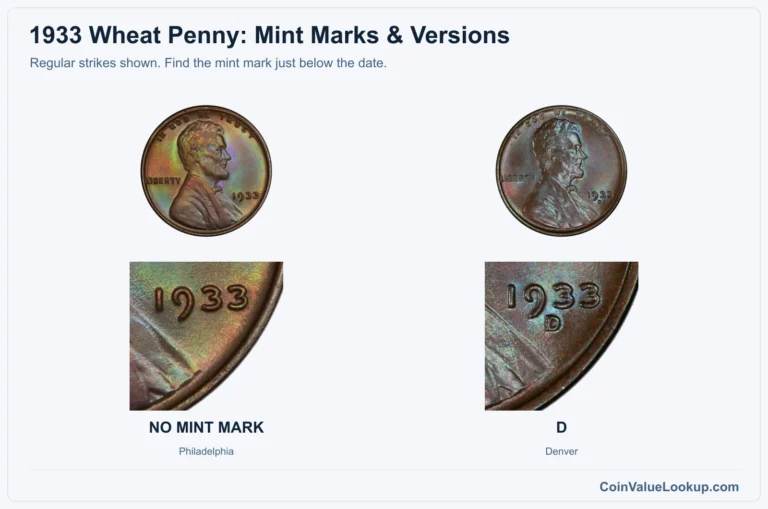
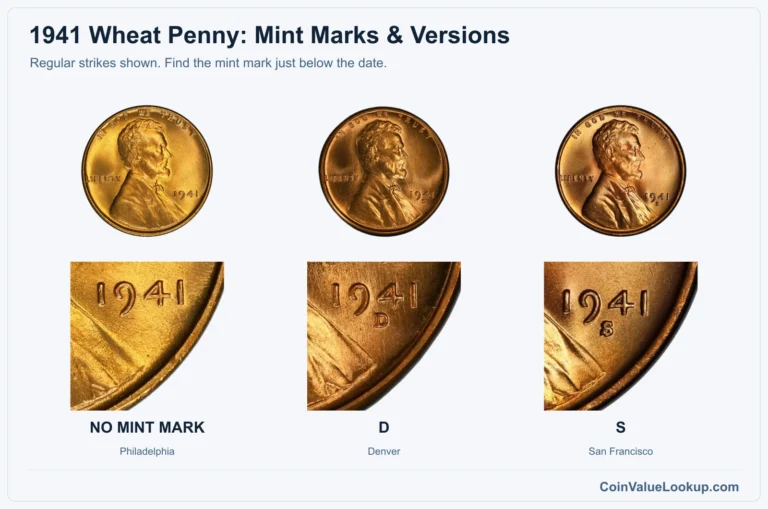
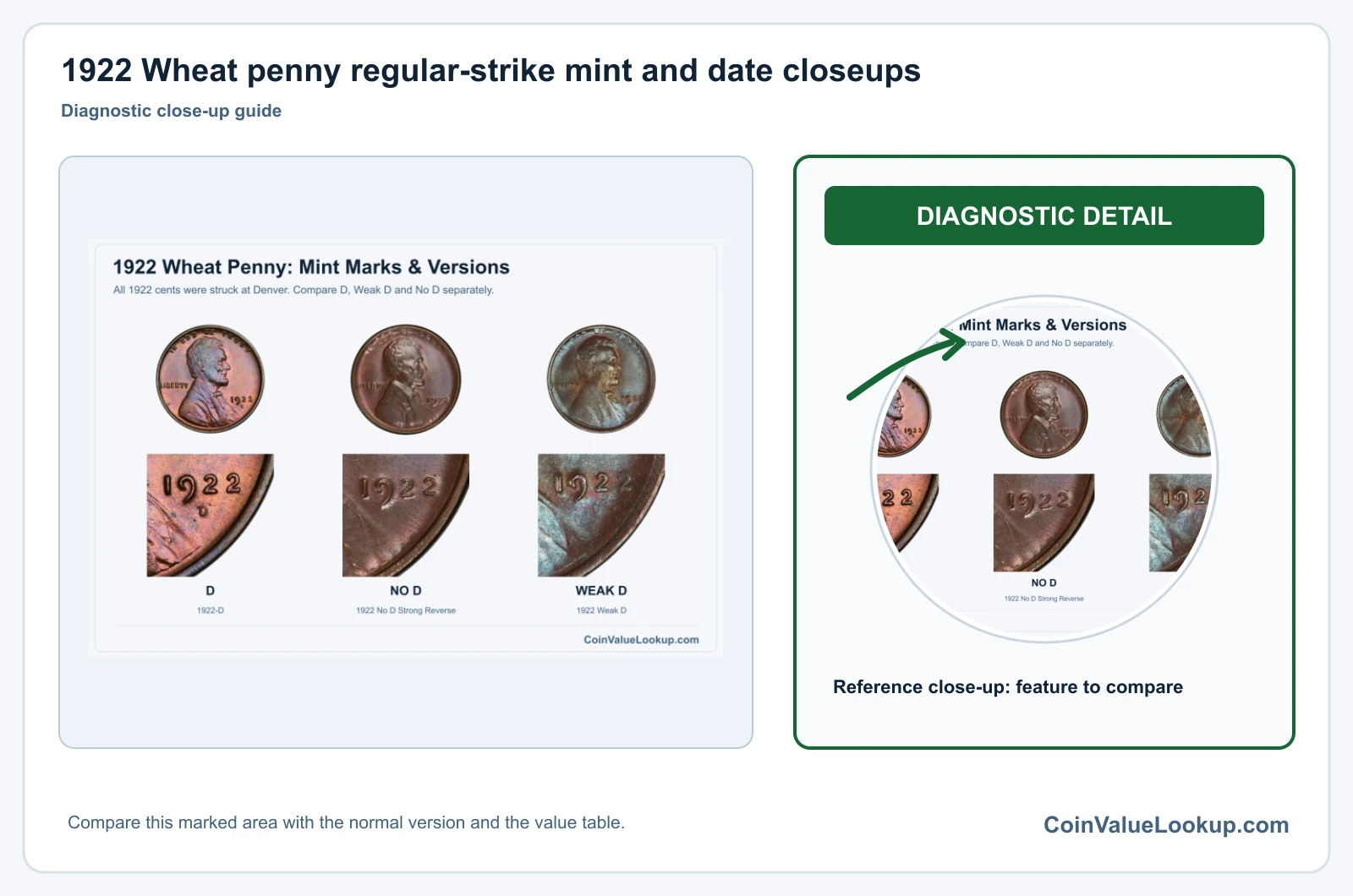
Every 1922 cent was struck at Denver. If your coin shows no D mintmark, that does not mean it was made in Philadelphia — it means the mintmark was weak or absent due to die wear or a filled die.
The standard version shows a clear D below the date on the reverse. A Weak D coin has a faint but still visible trace of the letter.
The No D Weak Reverse lacks both the mintmark and sharp reverse detail, while the No D Strong Reverse shows no mintmark yet retains comparatively crisp reverse features, including a strong second "2" in the date and clear lettering in TRUST.
All 1922 cents are copper-alloy composition at about 3.11 grams with a plain edge. Look at the Wheat reverse design — two wheat ears flanking ONE CENT and UNITED STATES OF AMERICA.
Color matters too: red, red-brown, and brown describe original surface toning, not grade levels.
Step 2: Check Your 1922 Wheat Penny Grade
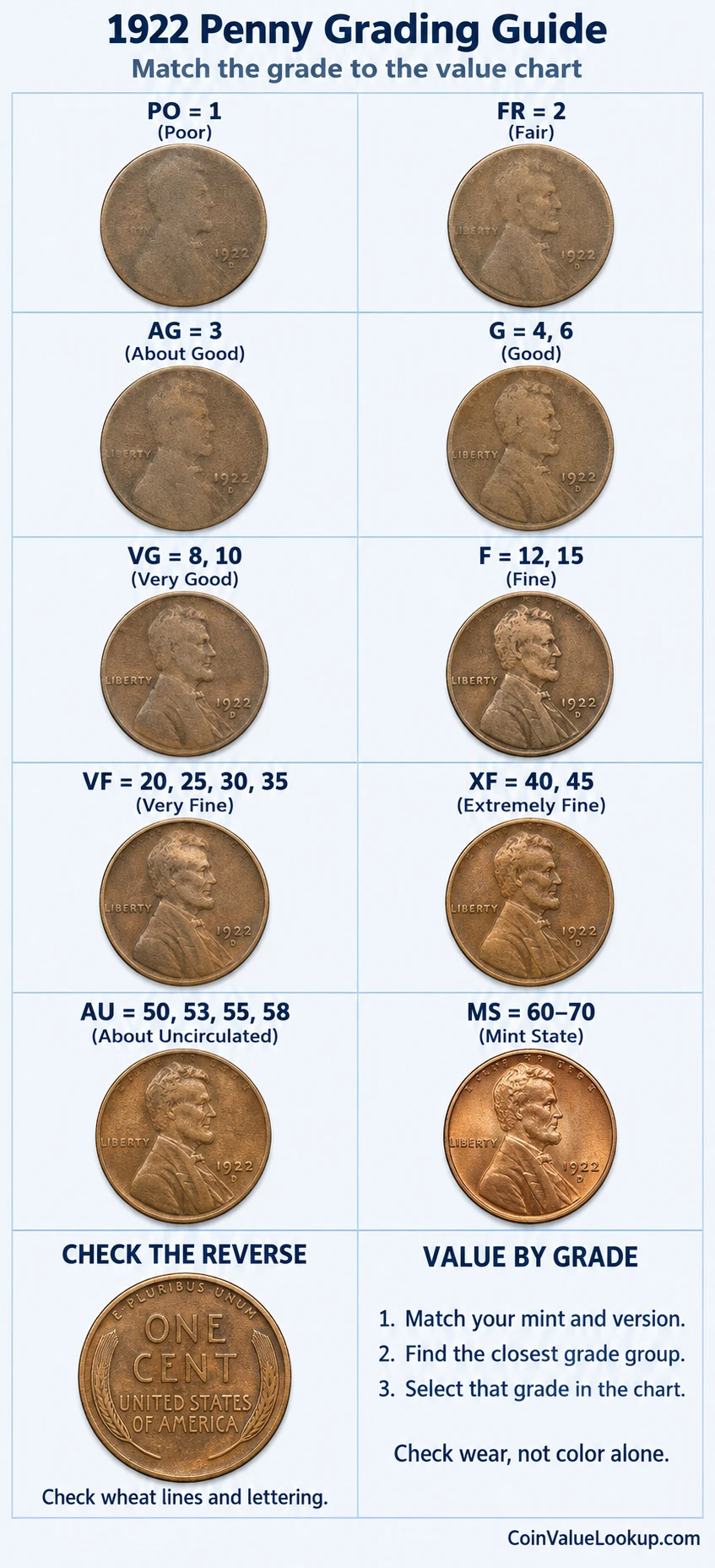
Start with Lincoln's cheekbone, jawline, and the hair detail above his ear. These are the highest relief points and the first to show wear.
On a well-struck coin in Good condition, the portrait outline is complete but most fine hair detail is gone.
Flip the coin over and check the wheat stalks. Individual grain lines and the horizontal lines between the stalks fade as wear increases.
Here is the tricky part with 1922 cents: some were weakly struck from the factory. A soft-looking coin is not necessarily worn — it may just have left the press that way.
Compare your coin to the reference image to see whether the softness is consistent with die weakness or actual circulation wear.
Luster is your friend. A coin that still shows original mint glow across the fields, even faintly, is likely a higher grade than one with uniform dullness.
Spots, corrosion, and evidence of cleaning are separate factors that reduce desirability regardless of the technical grade. Do not assume a bright coin is uncirculated; harsh cleaning can mimic luster to an untrained eye.
Step 3: Check 1922 Wheat Penny Value by Mint and Version
1922 Wheat Penny — D
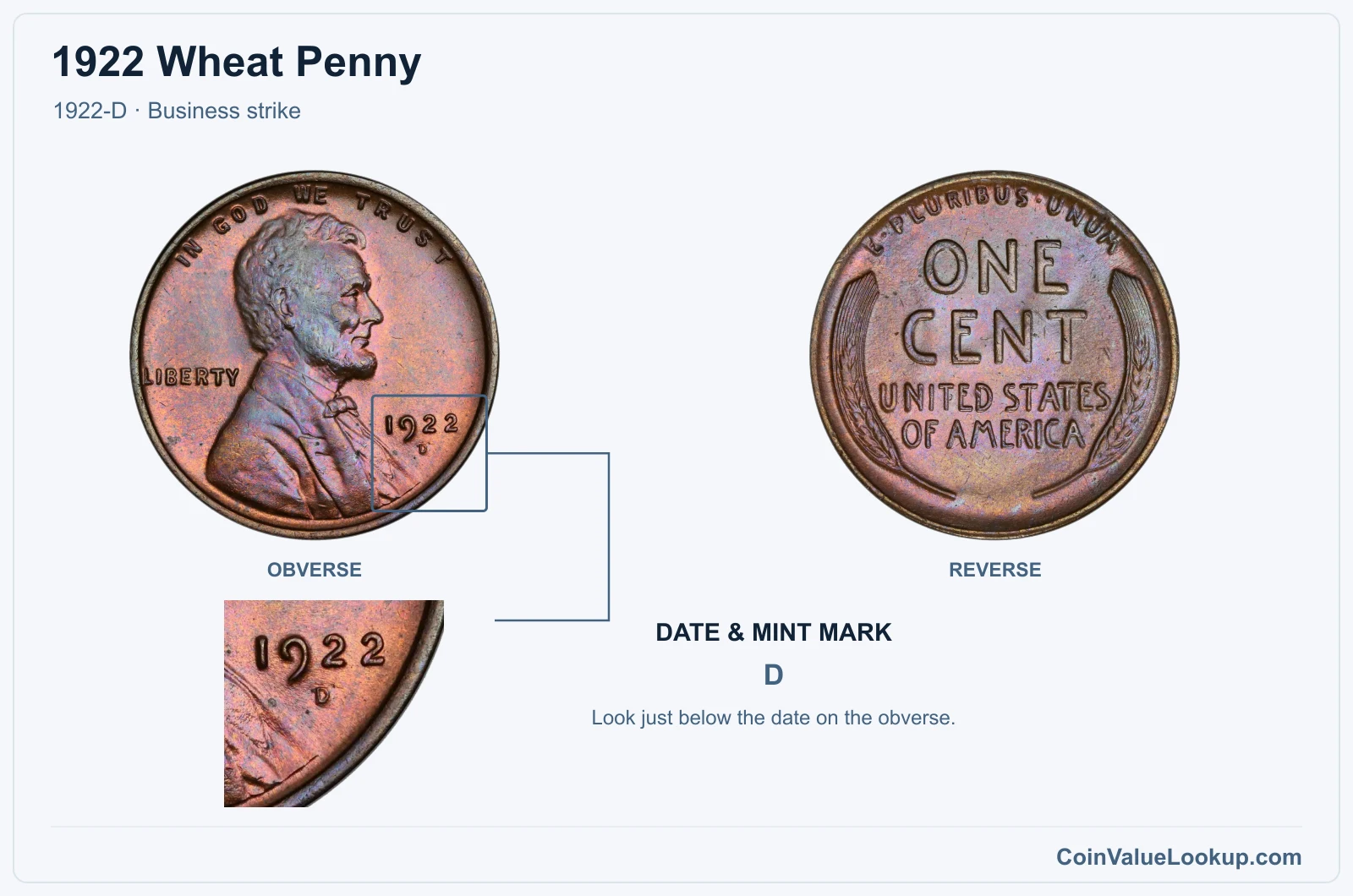
This is the standard 1922-D with a clearly visible D mintmark on the reverse below the date area. It is the most common branch of the year, struck in the usual 95% copper alloy at about 3.11 grams.
Guide estimates from USA Coin Book place this coin around $25 in G4 and approximately $313 in MS63. These are estimated retail figures for unspecified color, so a certified Red designation could command different money.
Check that the reverse shows normal detail and the D is full — a mushy mintmark might mean you actually have the Weak D variety instead.
| Range | Grade | Price | Auction Records | Appraisal |
|---|---|---|---|---|
| PO | PO 1 | — | Coin Identifier | |
| FR | FR 2 | Coin Identifier | ||
| AG | AG 3 | — | Coin Identifier | |
| G | G 4 | — | Coin Identifier | |
| G 6 | — | Coin Identifier | ||
| VG | VG 8 | Coin Identifier | ||
| VG 10 | Coin Identifier | |||
| F | F 12 | Coin Identifier | ||
| F 15 | Coin Identifier | |||
| VF | VF 20 | Coin Identifier | ||
| VF 25 | Coin Identifier | |||
| VF 30 | Coin Identifier | |||
| VF 35 | Coin Identifier | |||
| XF | XF 40 | Coin Identifier | ||
| XF 45 | Coin Identifier | |||
| AU | AU 50 | Coin Identifier | ||
| AU 53 | Coin Identifier | |||
| AU 55 | Coin Identifier | |||
| AU 58 | Coin Identifier | |||
| MS | MS 60 | — | Coin Identifier | |
| MS 61 | Coin Identifier | |||
| MS 62 | Coin Identifier | |||
| MS 63 | Coin Identifier | |||
| MS 64 | Coin Identifier | |||
| MS 65 | Coin Identifier | |||
| MS 66 | Coin Identifier | |||
| MS 67 | — | — | — | |
| MS 68 | — | — | — | |
| MS 69 | — | — | — | |
| MS 70 | — | — | — |
1922 Wheat Penny — No D Strong Reverse
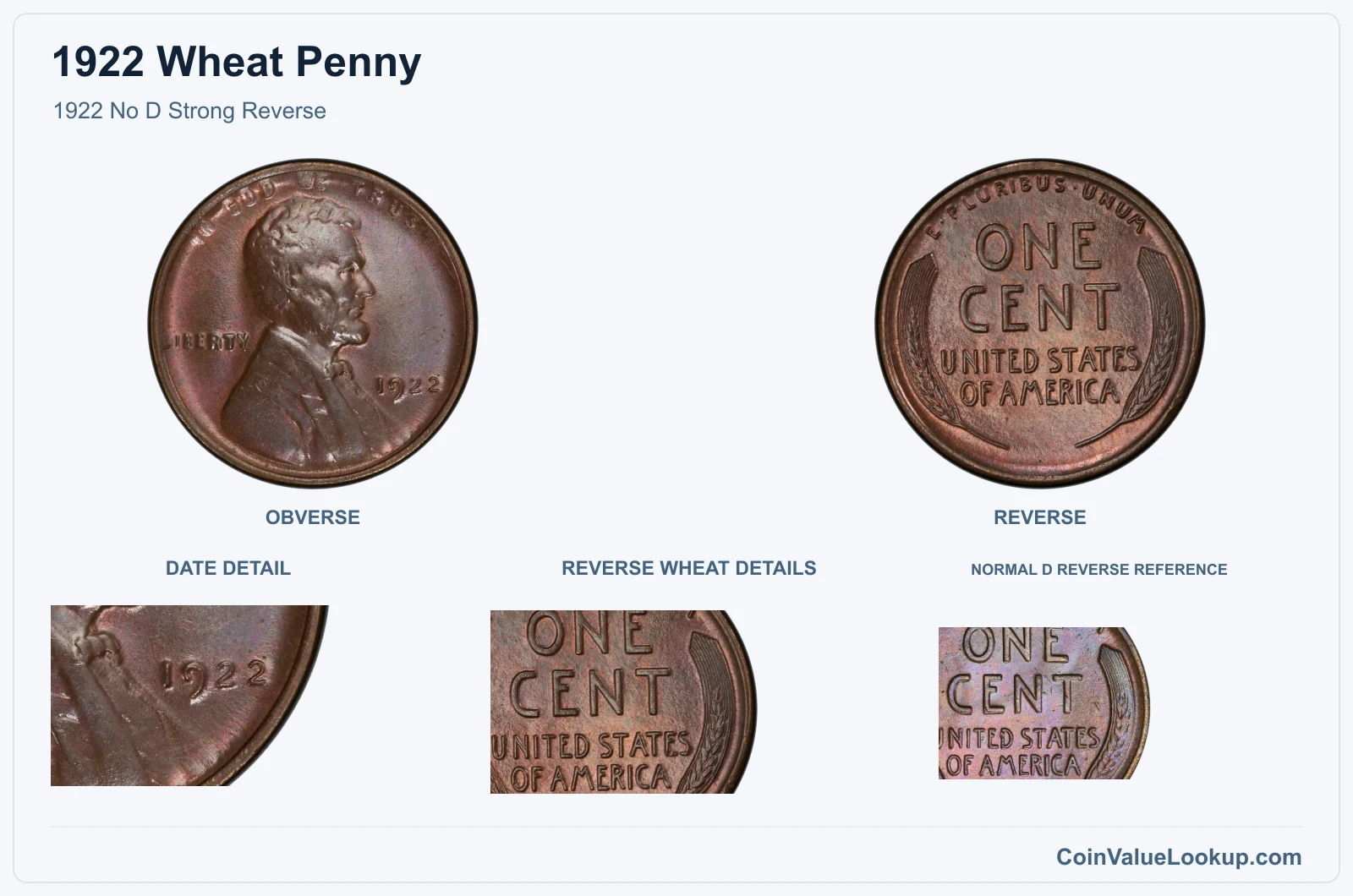
The 1922 No D Strong Reverse is the prize of the year. The mintmark is completely absent, yet the reverse retains strong die detail — sharp wheat lines, clear legends, and a well-defined second "2" in the date along with crisp TRUST lettering.
That combination of missing D and strong reverse is the diagnostic.
USA Coin Book guide estimates run from $556 in G4 to $19,307 at MS63. Those numbers reflect how seriously collectors pursue this variety.
A coin with no D but also weak reverse detail is a different variety entirely, so do not assume every missing-mintmark 1922 is this one. Third-party authentication from a recognized grading service is practically a requirement before buying or selling at these levels.
Coin Value Lookup is a good starting point if you want to look up guides for other dates and mints in the Wheat cent series.
| Range | Grade | Price | Auction Records | Appraisal |
|---|---|---|---|---|
| PO | PO 1 | — | Coin Identifier | |
| FR | FR 2 | — | Coin Identifier | |
| AG | AG 3 | — | Coin Identifier | |
| G | G 4 | Coin Identifier | ||
| G 6 | Coin Identifier | |||
| VG | VG 8 | Coin Identifier | ||
| VG 10 | Coin Identifier | |||
| F | F 12 | Coin Identifier | ||
| F 15 | Coin Identifier | |||
| VF | VF 20 | Coin Identifier | ||
| VF 25 | Coin Identifier | |||
| VF 30 | Coin Identifier | |||
| VF 35 | Coin Identifier | |||
| XF | XF 40 | Coin Identifier | ||
| XF 45 | Coin Identifier | |||
| AU | AU 50 | Coin Identifier | ||
| AU 53 | Coin Identifier | |||
| AU 55 | Coin Identifier | |||
| AU 58 | Coin Identifier | |||
| MS | MS 60 | Coin Identifier | ||
| MS 61 | Coin Identifier | |||
| MS 62 | Coin Identifier | |||
| MS 63 | Coin Identifier | |||
| MS 64 | Coin Identifier | |||
| MS 65 | — | Coin Identifier | ||
| MS 66 | — | — | — | |
| MS 67 | — | — | — | |
| MS 68 | — | — | — | |
| MS 69 | — | — | — | |
| MS 70 | — | — | — |
1922 Wheat Penny — Weak D
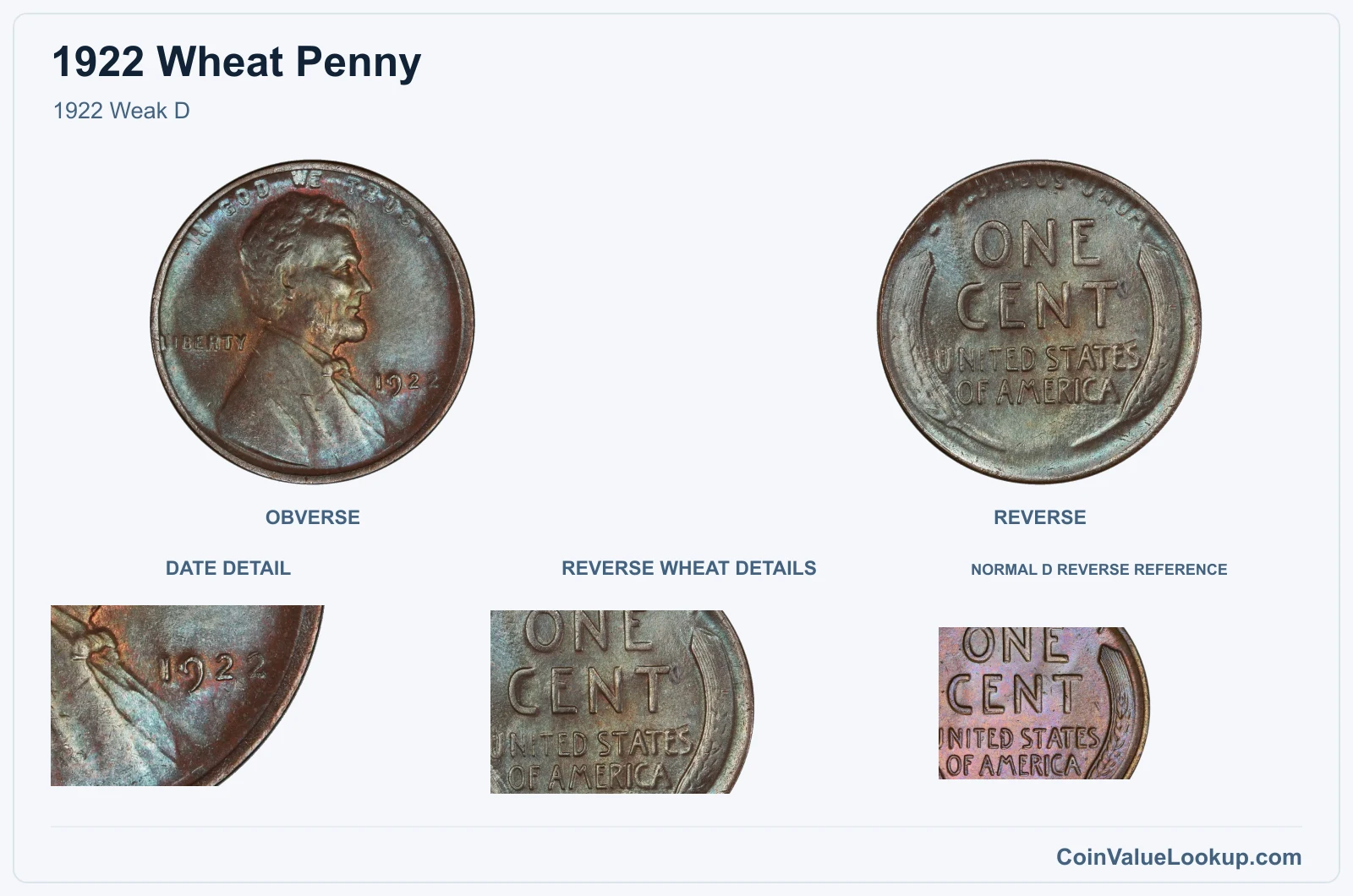
The 1922 Weak D shows a faint but still detectable trace of the mintmark. Under magnification you can usually see a partial outline or ghost of the letter D in the expected position.
This is not the premium No D Strong Reverse — the mintmark has not vanished entirely.
Guide values sit at roughly $30 in G4 and around $1,243 at MS63 per USA Coin Book, putting it well above the standard D but far below the No D Strong Reverse. Use a loupe or macro lens and compare your mintmark area carefully before deciding which branch you have.
Range Grade
Price1922 Weak D (BN) Price1922 Weak D (RB) Price1922 Weak D (RD) Auction Records Appraisal PO PO 1
—
Coin Identifier FR FR 2
—
Coin Identifier AG AG 3
—
Coin Identifier G G 4
Coin Identifier
G 6
Coin Identifier VG VG 8
Coin Identifier
VG 10
Coin Identifier F F 12
Coin Identifier
F 15
Coin Identifier VF VF 20
Coin Identifier
VF 25
Coin Identifier
VF 30
Coin Identifier
VF 35
Coin Identifier XF XF 40
Coin Identifier
XF 45
Coin Identifier AU AU 50
Coin Identifier
AU 53
Coin Identifier
AU 55
Coin Identifier
AU 58
Coin Identifier MS MS 60
—
Coin Identifier
MS 61
Coin Identifier
MS 62
Coin Identifier
MS 63
Coin Identifier
MS 64
Coin Identifier
MS 65
—
—
Coin Identifier
MS 66
—
—
—
—
—
MS 67
—
—
—
—
—
MS 68
—
—
—
—
—
MS 69
—
—
—
—
—
MS 70
—
—
—
—
—
1922 Wheat Penny — No D Weak Reverse
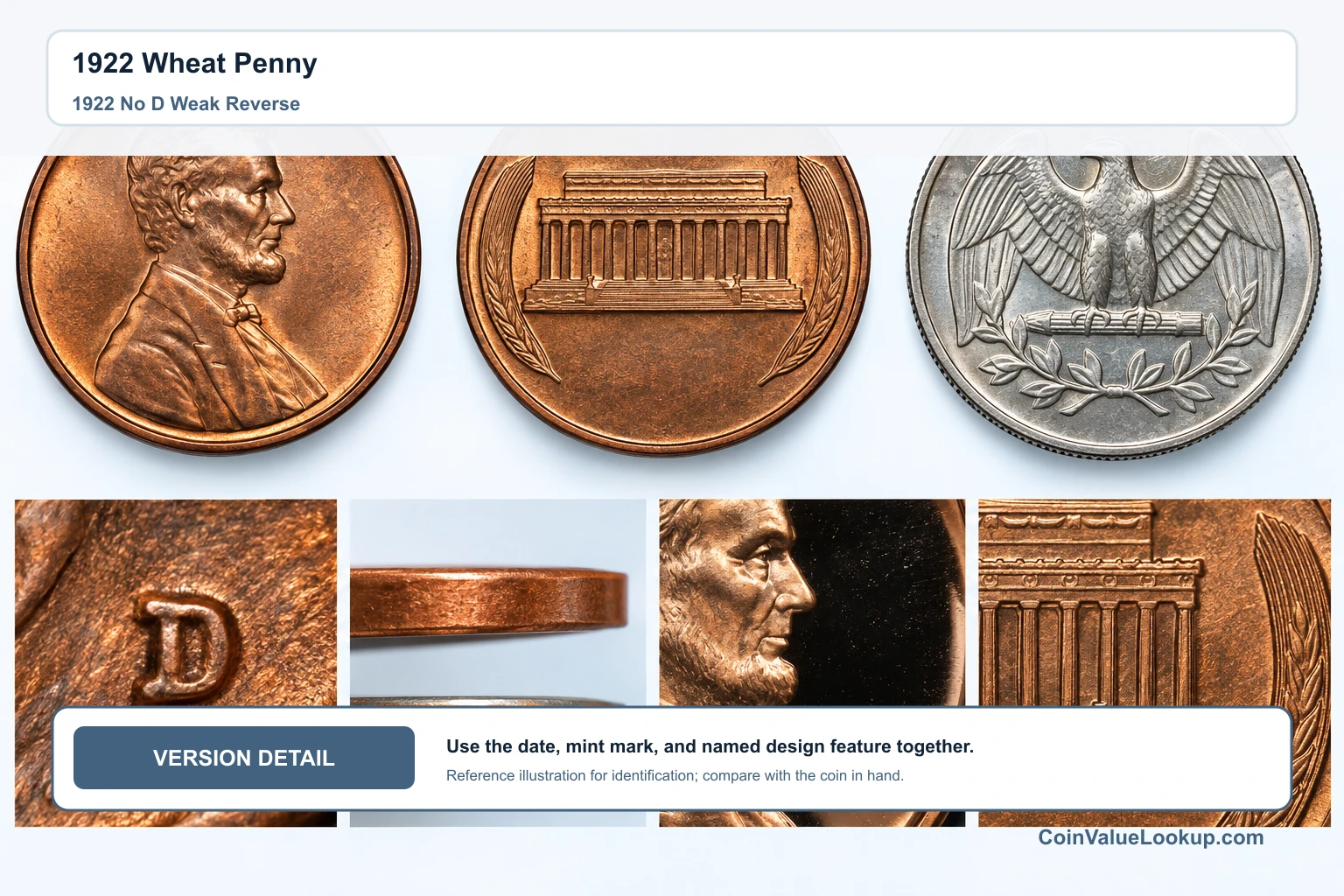
NGC catalogs the 1922 No D Weak Reverse as a separate variety from the No D Strong Reverse. On this version, the mintmark is absent and the reverse detail is also soft — mushy wheat lines, indistinct legends, and generally less definition across the entire coin.
Both sides suffered from a heavily worn die pair.
Because the full die characteristics matter here, not just the missing letter, attribution requires comparing the entire coin against known die markers. No specific guide range is adopted for this variety, so value depends on authenticated identity, the coin's actual condition, and the severity of the die characteristics.
Professional grading and attribution are the practical path to establishing what a given example is worth.
Ordinary-issue reference: Ordinary-issue reference only: The table below shows the related standard issue (1922-D BN). It does not represent the value of the specific 1922 No D Weak Reverse variety or its variety premium. The year, mint, metal and strike type are matched; the specific variety is not priced by this table.
Range Grade
Price1922 Lincoln Cent (Wheat Reverse) — Ordinary-Issue Reference (BN) Price1922 Lincoln Cent (Wheat Reverse) — Ordinary-Issue Reference (RB) Price1922 Lincoln Cent (Wheat Reverse) — Ordinary-Issue Reference (RD) Auction Records Appraisal PO PO 1
—
Coin Identifier FR FR 2
Coin Identifier AG AG 3
—
Coin Identifier G G 4
—
Coin Identifier
G 6
—
Coin Identifier VG VG 8
Coin Identifier
VG 10
Coin Identifier F F 12
Coin Identifier
F 15
Coin Identifier VF VF 20
Coin Identifier
VF 25
Coin Identifier
VF 30
Coin Identifier
VF 35
Coin Identifier XF XF 40
Coin Identifier
XF 45
Coin Identifier AU AU 50
Coin Identifier
AU 53
Coin Identifier
AU 55
Coin Identifier
AU 58
Coin Identifier MS MS 60
—
Coin Identifier
MS 61
Coin Identifier
MS 62
Coin Identifier
MS 63
Coin Identifier
MS 64
Coin Identifier
MS 65
Coin Identifier
MS 66
Coin Identifier
MS 67
—
—
—
—
—
MS 68
—
—
—
—
—
MS 69
—
—
—
—
—
MS 70
—
—
—
—
—
1922 Wheat Penny Error List
1. 1922 Wheat Penny — Die Crack / Die Chip
Die cracks appear as thin raised lines on the coin's surface, running from one design element toward another or connecting to the rim. Die chips show up as small raised blobs, usually within a letter or near a design feature.
Both result from a fractured die transferring its damage to every coin it strikes.
A large rim-connected crack that removes a chunk of design is called a cud, and those tend to draw more collector interest. To tell a genuine die crack from a scratch, remember that cracks are raised above the field while scratches are incised into it.
Corrosion or deposited material can also mimic raised lines, so examine the surface under magnification. Value depends on the size, location, and visual impact of the crack, along with the coin's authenticated condition.
2. 1922 Wheat Penny — Struck-Through Error
A struck-through error happens when foreign material — grease, a thread, a metal fragment — gets between the die and the planchet during striking. The result is a localized depression or incomplete area in the design where the obstruction blocked the metal from fully filling the die cavity.
Grease-filled dies tend to produce soft, rounded missing areas, while a retained foreign object may leave a sharper impression or even remain embedded in the coin. Do not confuse a struck-through with ordinary wear, post-mint scratches, or cleaning damage.
Wear removes detail gradually across high points, while a struck-through typically affects a specific isolated zone.
Pricing depends on the type and size of the obstruction, how dramatic the visual effect is, and third-party authentication confirming the error. Each example needs individual evaluation.
3. 1922 Wheat Penny — Doubled Die Obverse
A doubled die obverse on a 1922 cent shows consistent doubling in the obverse design — potentially in the date, IN GOD WE TRUST, or LIBERTY. The key word is consistent: true hub doubling produces uniform separation or notching on affected elements, visible at the same angle across the design.
Machine doubling, which is far more common, creates flat shelf-like distortions that lack the raised, rounded profile of genuine hub doubling. Reflections under certain lighting can also trick the eye.
Compare your coin's lettering to a known normal example under the same magnification and lighting conditions.
No specific price range is adopted for this error on the 1922 date. Value varies with the strength and location of the doubling, overall coin condition, and whether a recognized grading service has attributed the variety.
4. 1922 Wheat Penny — Doubled Die Reverse
A doubled die reverse affects the back of the coin — look at ONE CENT, UNITED STATES OF AMERICA, E PLURIBUS UNUM, or the wheat stalk details. Genuine doubling shows as consistent separation or notching in the affected lettering or design contours.
Compare the reverse legends against a normal 1922-D under matching light and magnification. Machine doubling is the most common lookalike and produces flat, shelf-like displacement rather than the rounded, raised separation of a true doubled die.
Random contact damage or worn die contours can also mimic doubling to an untrained eye.
No numerical price range is adopted for this error. Value depends on the specific die, the visibility and location of the doubling, the coin's condition, and attribution by a recognized third-party grading service.
5. 1922 Wheat Penny — Weak or Missing D
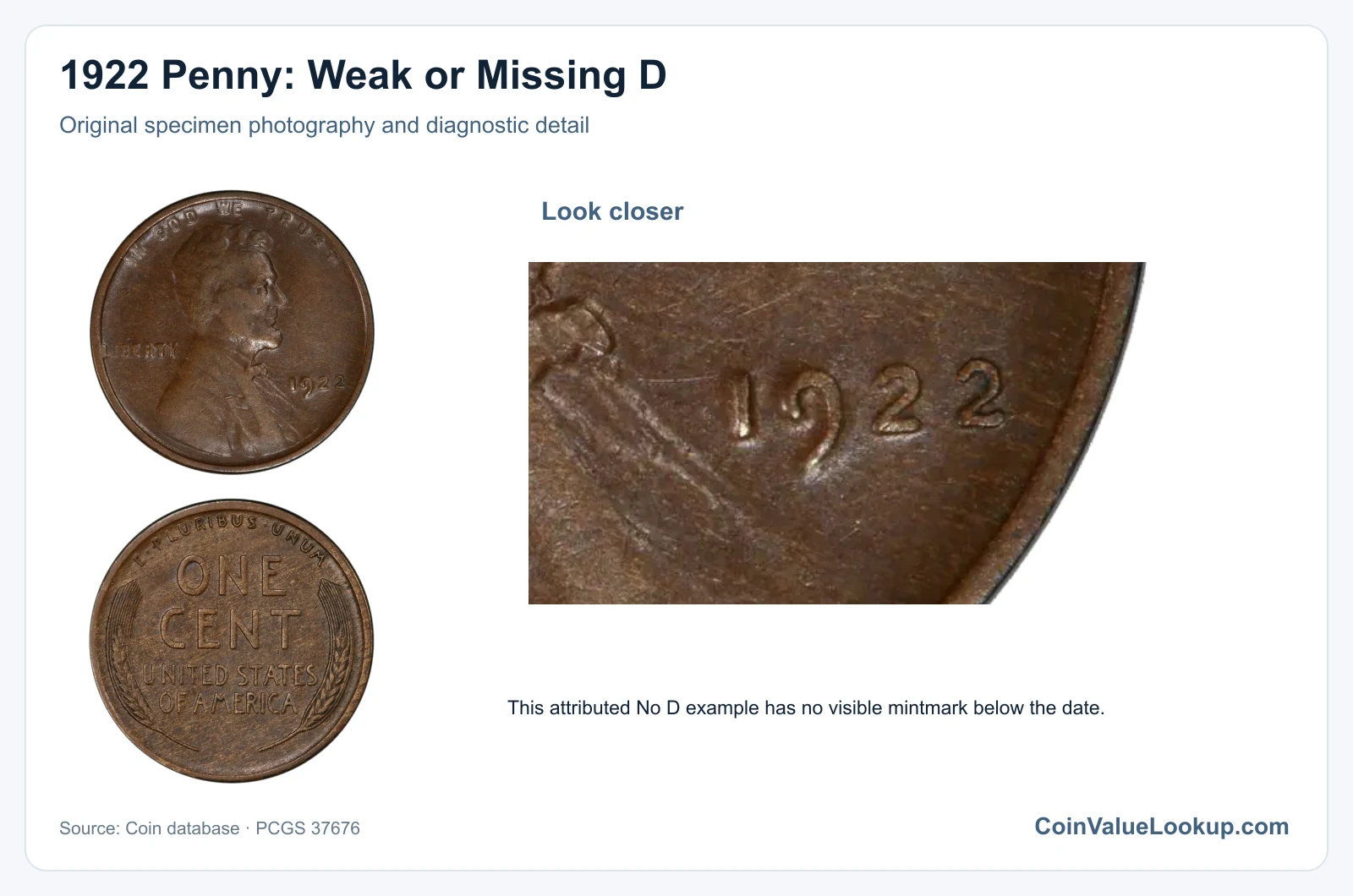
Because every 1922 cent came from Denver, a missing or weak D mintmark is a die variety, not evidence of a different mint. The genuine No D Strong Reverse — the most valuable form — pairs a completely absent mintmark with strong reverse detail, including a sharp second "2" in the date and clear TRUST lettering.
A coin with no visible D but also weak reverse detail falls into the No D Weak Reverse category instead. And a faintly visible partial D is the Weak D branch.
These distinctions matter enormously for value.
Watch out for coins where the mintmark was physically removed after striking. A tooled or altered surface near the mintmark area, visible under magnification as disturbed metal flow, is a red flag.
Wear alone or a grease-filled die can also obscure the D without making the coin a collectible variety. Authentication and attribution by a grading service are essential before assigning any premium.