1889 Indian Head Penny Coin Value: How Much Is It Worth?
The 1889 Indian Head penny is a common Philadelphia issue that still rewards a careful look. Guide values for a regular business strike run from about $3.62 in G4 (a well-worn but readable coin) up to around $100 in MS63 (a choice uncirculated example with original luster).
Proofs, recognized die varieties and mint errors each carry their own pricing and need individual evaluation.
Fast Way to Identify Your 1889 Indian Head Penny
Want a quick read on your 1889 Indian Head cent? Upload clear photos of the front and back, and the identifier can offer a preliminary identification of your coin's type and finish.
Good lighting and a steady shot help — get the full coin in frame, edge to edge, both sides.
1889 Indian Head Penny Value
Upload both sides of your 1889 Indian Head Penny.
Front Obverse
Upload photo
Back Reverse
Upload photo
Which 1889 Indian Head Penny Versions Are Worth Money?
- A business-strike 1889 in MS63 uncirculated condition lists around $100 in one guide — far above the $3.62 at G4, making original luster and surface preservation the biggest value driver.
- The 1889 proof carries a guide price near $313 at PR63; confirming true proof manufacture (not just a shiny coin) is critical before applying that figure.
- Recognized die errors such as doubled dies, cuds, repunched dates and off-center strikes can each affect value independently and require professional authentication for accurate pricing.
Step 1: Identify Your 1889 Indian Head Penny Mint Mark and Version
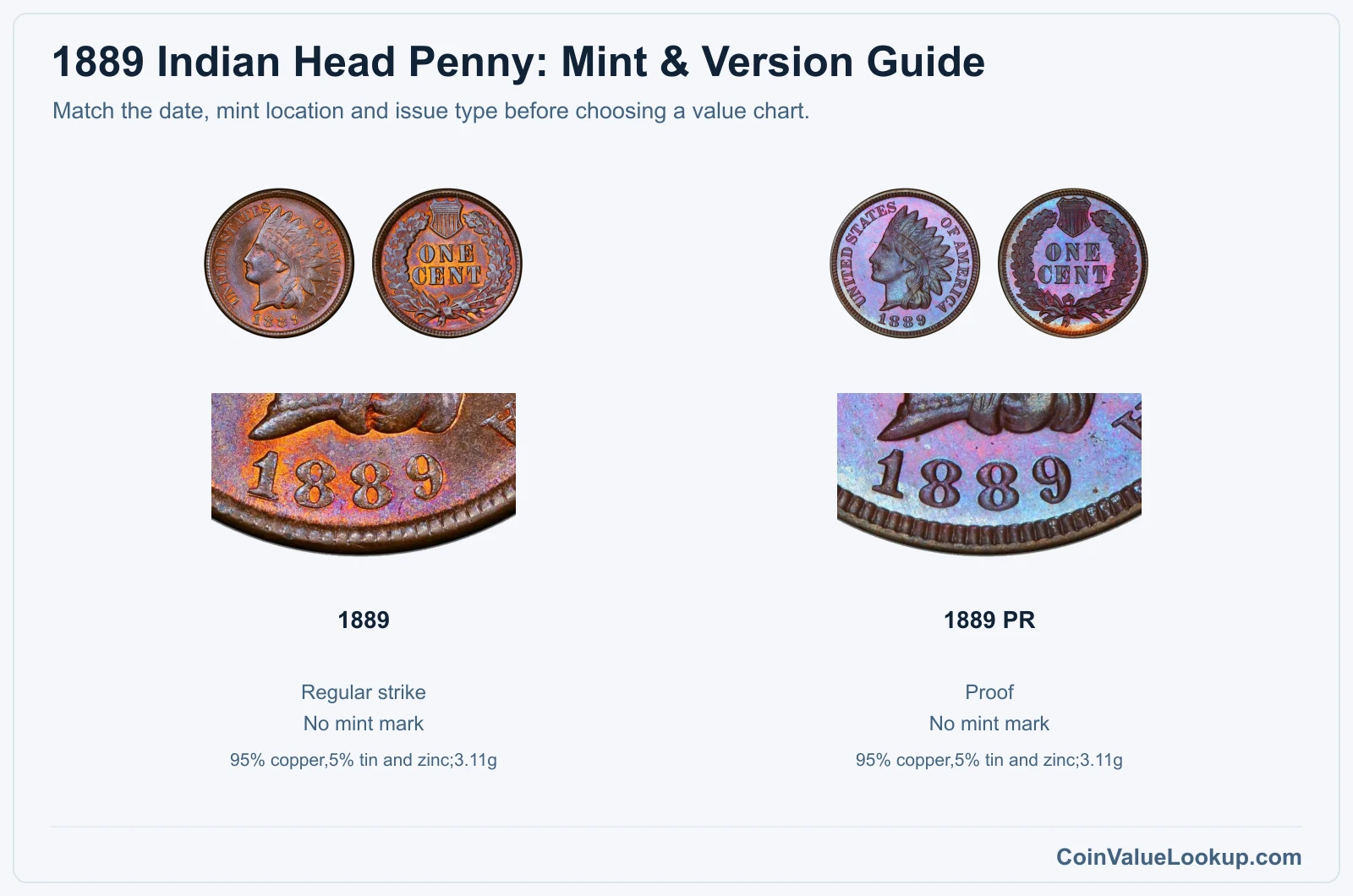
Every regular 1889 Indian Head cent was struck at the Philadelphia Mint. There is no mintmark on this coin, and the small "L" you may notice on the ribbon behind the portrait is the designer's initial, not a mint identifier.
The obverse shows a Liberty portrait wearing a feathered headdress with the word LIBERTY inscribed on the headband. The reverse features an oak wreath enclosing the denomination "ONE CENT," topped by a federal shield.
If your coin has a wheat-ear reverse or a plain wreath without the shield, you are looking at a different series.
Separate the two production types before checking any price. Business strikes were made for circulation and show varying degrees of wear.
Proofs were specially manufactured presentation pieces with mirrored surfaces and sharp rims. A polished circulated coin is not a proof — proof is a method of manufacture, not a condition grade.
Mirrored luster alone does not confirm proof origin; rim geometry and overall surface character matter.
The alloy is 95% copper with 5% tin and zinc, weighing 3.11 grams. Original bronze color — whether full red, red-brown or brown — affects desirability among collectors, so note the toning on your coin before comparing prices.
Step 2: Check Your 1889 Indian Head Penny Grade
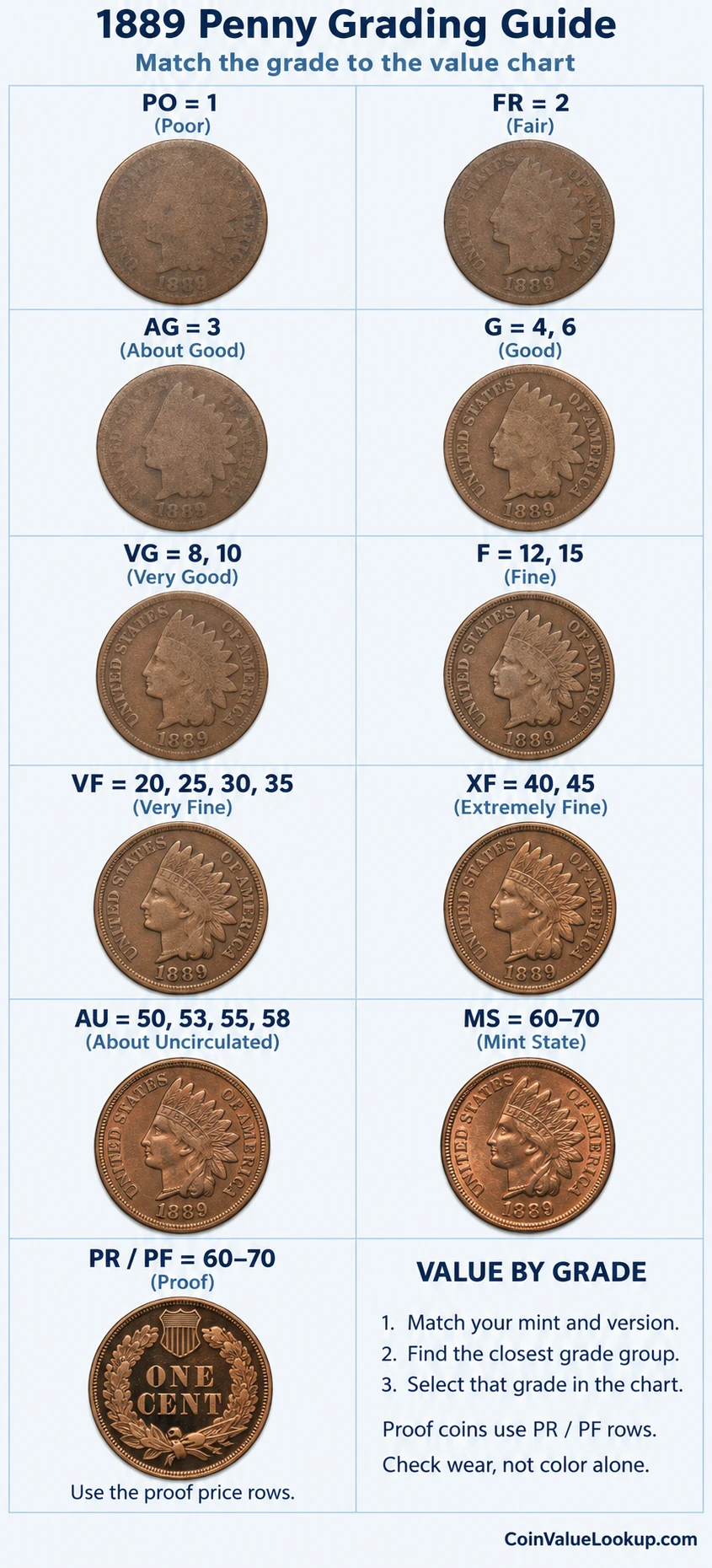
Start with the headband. On a well-struck example, the word LIBERTY should be fully legible in higher grades and progressively faded as the coin circulates.
By G4, the portrait outline and date are clear, but most interior detail is gone.
Check the feather tips above the headband and the hair curls below the ear. These are the first spots to flatten with wear.
On the reverse, the leaf tips and the shield detail soften early.
Here is the catch: the 1889 can come weakly struck at the feathers and hair even without any wear at all. A soft original strike reduces detail in the same zones that wear hits first, so do not grade from one feature alone.
Look at the overall luster, surface quality and contact marks together.
Use the comparison image to match your coin's wear pattern against known grade points. Bronze color designations — BN (brown), RB (red-brown) and RD (red) — describe how much original copper color remains, not a different alloy.
Full red coins at the same grade carry a premium, but cleaning or recoloring destroys that advantage.
Coin Value Lookup is a good starting point if you want to look up guides for other dates and denominations in your collection. The site covers a wide range of U.S. coin series in one place.
Step 3: Check 1889 Indian Head Penny Value by Mint and Version
1889 Indian Head Penny
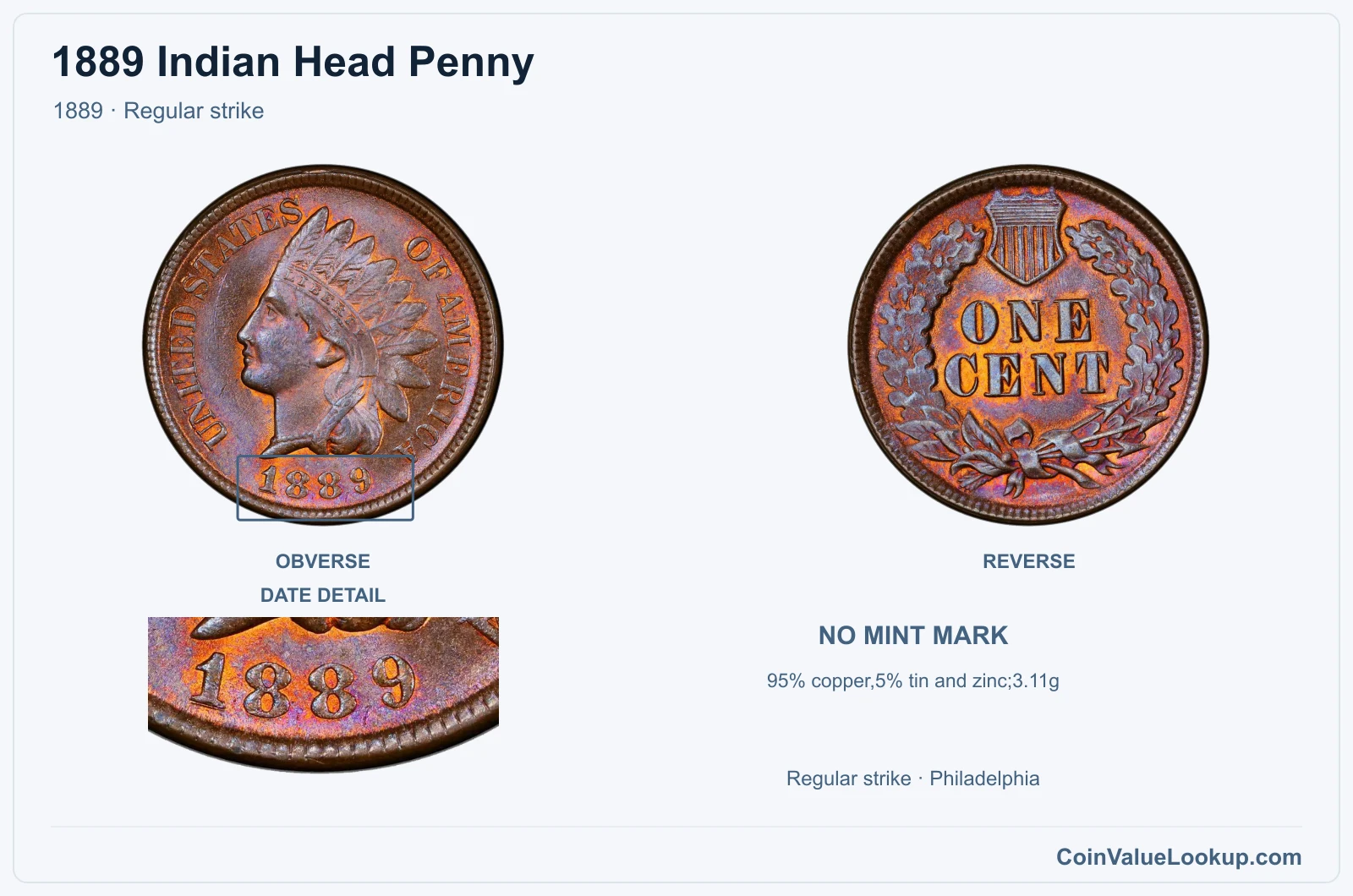
The standard 1889 Indian Head cent is a Philadelphia business strike with no mintmark. It weighs 3.11 grams and is composed of 95% copper with 5% tin and zinc.
One published guide lists it at roughly $3.62 in G4 and about $100 in MS63.
Condition matters enormously here. A worn example is a few-dollar coin; an uncirculated one with original surfaces sits in triple-digit territory.
Look for complete headband LIBERTY, sharp feather tips and undisturbed luster. Cleaned or corroded coins trade below guide figures even if structural wear is minimal.
Compare your coin to the same grade and surface quality before borrowing a price meant for a different condition.
| Range | Grade | Price | Auction Records | Appraisal |
|---|---|---|---|---|
| PO | PO 1 | — | Coin Identifier | |
| FR | FR 2 | — | Coin Identifier | |
| AG | AG 3 | — | Coin Identifier | |
| G | G 4 | — | Coin Identifier | |
| G 6 | — | Coin Identifier | ||
| VG | VG 8 | Coin Identifier | ||
| VG 10 | — | Coin Identifier | ||
| F | F 12 | — | Coin Identifier | |
| F 15 | — | Coin Identifier | ||
| VF | VF 20 | — | Coin Identifier | |
| VF 25 | — | Coin Identifier | ||
| VF 30 | — | Coin Identifier | ||
| VF 35 | — | Coin Identifier | ||
| XF | XF 40 | — | Coin Identifier | |
| XF 45 | Coin Identifier | |||
| AU | AU 50 | — | Coin Identifier | |
| AU 53 | — | Coin Identifier | ||
| AU 55 | Coin Identifier | |||
| AU 58 | Coin Identifier | |||
| MS | MS 60 | — | Coin Identifier | |
| MS 61 | — | Coin Identifier | ||
| MS 62 | Coin Identifier | |||
| MS 63 | Coin Identifier | |||
| MS 64 | Coin Identifier | |||
| MS 65 | Coin Identifier | |||
| MS 66 | — | — | — | |
| MS 67 | — | — | — | |
| MS 68 | — | — | — | |
| MS 69 | — | — | — | |
| MS 70 | — | — | — |
1889 Indian Head Penny — PR
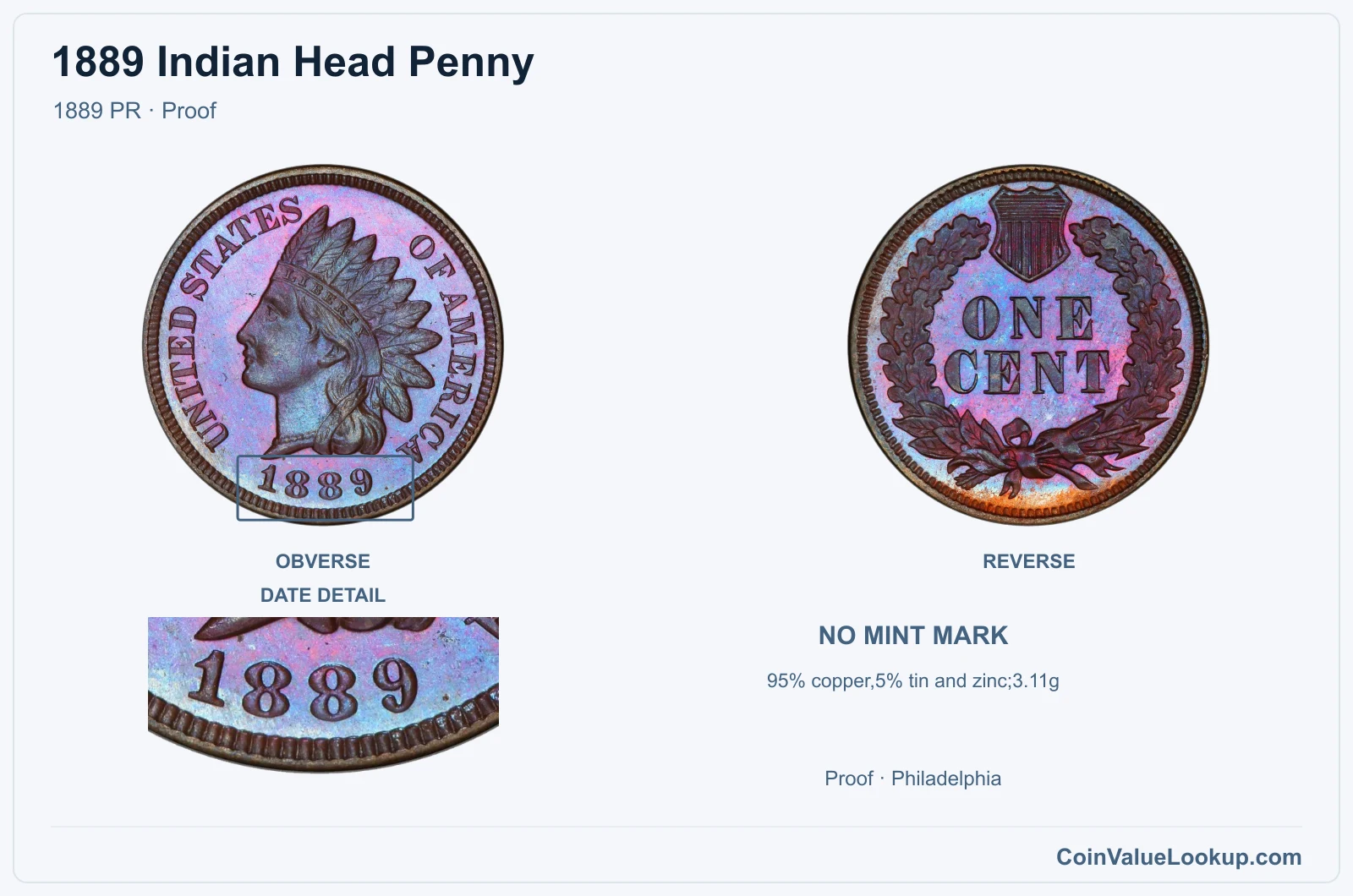
The 1889 proof Indian Head cent was a limited-production piece struck at Philadelphia using specially prepared dies and polished planchets. The alloy and weight match the business strike — 95% copper, 5% tin and zinc at 3.11 grams — but the surfaces are fundamentally different.
A genuine proof shows mirrored fields, sharp squared rims and full design detail that goes beyond what even the best business strike achieves. One guide places the PR63 value at approximately $313.
Do not assume your coin is a proof just because it looks shiny; polished or lightly circulated business strikes can mimic mirror surfaces to an untrained eye. Rim geometry and die characteristics need careful inspection, ideally confirmed by a professional grading service, before applying proof pricing.
| Range | Grade | Price | Auction Records | Appraisal |
|---|---|---|---|---|
| PR | PR 1 | — | Coin Identifier | |
| PR 2 | — | Coin Identifier | ||
| PR 3 | — | Coin Identifier | ||
| PR 4 | — | Coin Identifier | ||
| PR 6 | — | Coin Identifier | ||
| PR 8 | — | Coin Identifier | ||
| PR 10 | — | Coin Identifier | ||
| PR 12 | — | Coin Identifier | ||
| PR 15 | — | Coin Identifier | ||
| PR 20 | — | Coin Identifier | ||
| PR 25 | — | Coin Identifier | ||
| PR 30 | — | Coin Identifier | ||
| PR 35 | — | Coin Identifier | ||
| PR 40 | — | Coin Identifier | ||
| PR 45 | — | Coin Identifier | ||
| PR 50 | — | Coin Identifier | ||
| PR 53 | — | Coin Identifier | ||
| PR 55 | — | Coin Identifier | ||
| PR 58 | — | Coin Identifier | ||
| PR 60 | — | Coin Identifier | ||
| PR 61 | — | Coin Identifier | ||
| PR 62 | Coin Identifier | |||
| PR 63 | Coin Identifier | |||
| PR 64 | Coin Identifier | |||
| PR 65 | Coin Identifier | |||
| PR 66 | Coin Identifier | |||
| PR 67 | Coin Identifier | |||
| PR 68 | — | — | — | |
| PR 69 | — | — | — | |
| PR 70 | — | — | — |
1889 Indian Head Penny Error List
1. 1889 Indian Head Penny — Die Break / Cud
A die break or cud on an 1889 Indian Head cent appears as a raised, featureless blob on the coin's surface. When the break reaches the rim, the resulting cud replaces part of the normal design with a smooth, unstruck-looking lump.
To identify one, look along the rim for any area where the design simply stops and a raised irregular mass takes over. The boundary between normal design and the cud is usually sharp.
Compare both sides — a cud affects only the side struck by the broken die.
Do not confuse a cud with a rim dent (which is depressed, not raised), surface corrosion or a small interior die chip that does not connect to the rim. Value depends on the size, location and overall coin condition; each piece needs individual assessment by an authenticated example basis.
No standard price range applies across all specimens.
2. 1889 Indian Head Penny — Doubled Die Obverse
A doubled die obverse on the 1889 Indian Head cent results from a misaligned hub impression during die production, leaving a second offset image on the obverse design elements. You will see consistent doubling — separation or notching — on letters like LIBERTY, the date numerals, or profile details.
The key word is consistent. True hub doubling repeats in the same direction across multiple design elements.
Machine doubling, by contrast, tends to produce flat shelf-like distortion and often appears in only one area. Worn die contours and reflections under certain lighting can also fake the look.
Compare your coin to a known normal 1889 under the same magnification and lighting. If the doubling is real, its value depends on severity, visibility and the coin's overall grade.
Professional authentication is the safest route before assigning any premium.
3. 1889 Indian Head Penny — Doubled Die Reverse
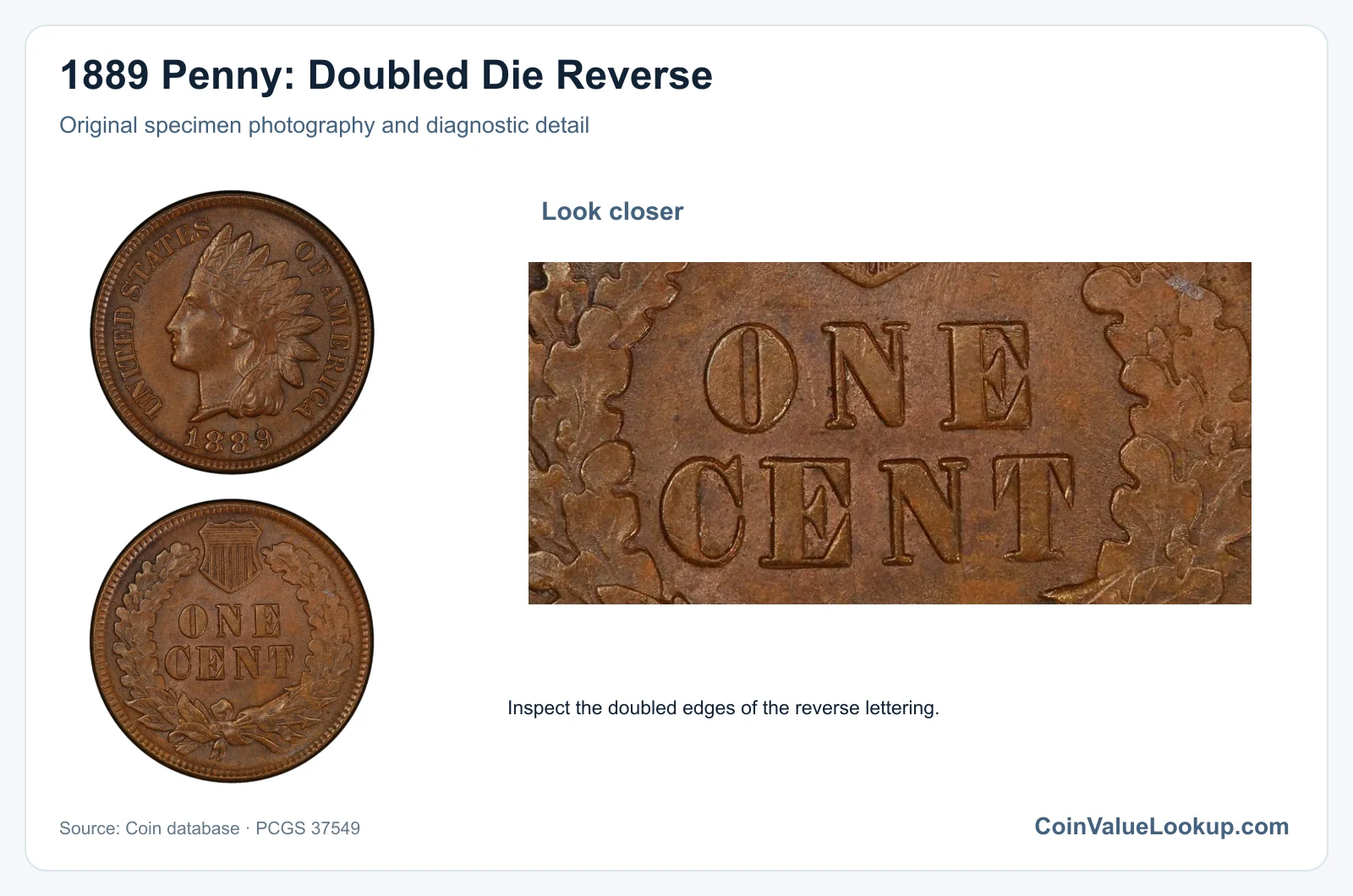
A doubled die reverse shows a second, offset impression on the back of the coin — look at the wreath leaves, the words ONE CENT and UNITED STATES OF AMERICA. True doubling from the hubbing process will be consistent across multiple letters or design elements in the same direction.
Machine doubling is the most common lookalike. It leaves flat, shelf-like distortion rather than the rounded, separated profiles of a genuine doubled die.
Random post-strike damage and odd reflections can also trick you under low magnification.
Compare your reverse carefully against a confirmed normal 1889 reverse under identical lighting. If you see clear, repeatable separation on multiple design features, the coin deserves professional evaluation.
Pricing depends on the specific die, the strength of the doubling and the coin's condition.
4. 1889 Indian Head Penny — Misplaced Date
A misplaced date on an 1889 Indian Head cent means partial remnants of date digits appear outside their intended position — typically embedded in the denticles near the bottom of the obverse or partially hidden by the portrait's neck.
These traces show up because the date punch was initially placed incorrectly, then corrected. The leftover impression is faint but follows the shape of a numeral.
Look carefully with magnification near the base of the bust and inside the denticle ring.
Die chips, scratches and random bumps can look similar, but they will not match the outline of an 1, 8 or 9. Compare any candidate mark against a reference image of the confirmed variety.
Each misplaced-date coin needs individual assessment for authentication and value, based on visibility and overall coin condition.
5. 1889 Indian Head Penny — Clashed Dies
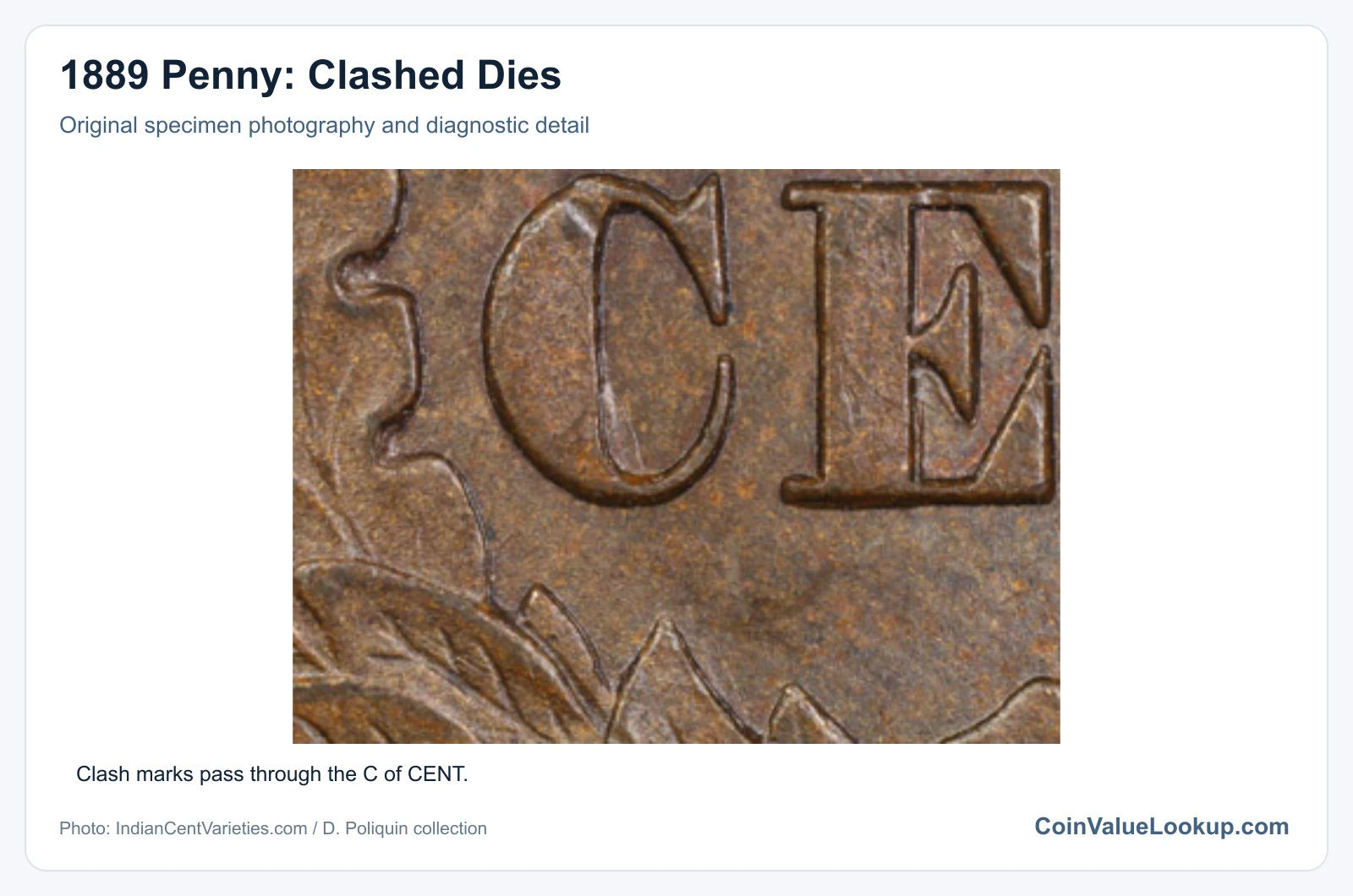
Clashed dies occur when the obverse and reverse dies strike each other without a planchet between them, transferring ghost images of the opposite design onto each die. On an 1889 Indian Head cent, you might spot faint traces of the wreath in the obverse field or a shadow of the portrait on the reverse.
These transferred features align with where the opposing design would sit during a normal strike. That alignment is your best diagnostic — random scratches and raised lines will not match the geometry of the opposite die.
Do not confuse a clash with a brockage, which involves a previously struck coin acting as a die. Clashes are subtle and often visible only under angled light with magnification.
Value varies by clash strength, visibility and coin grade; no blanket price range is supported.
6. 1889 Indian Head Penny — Repunched Date
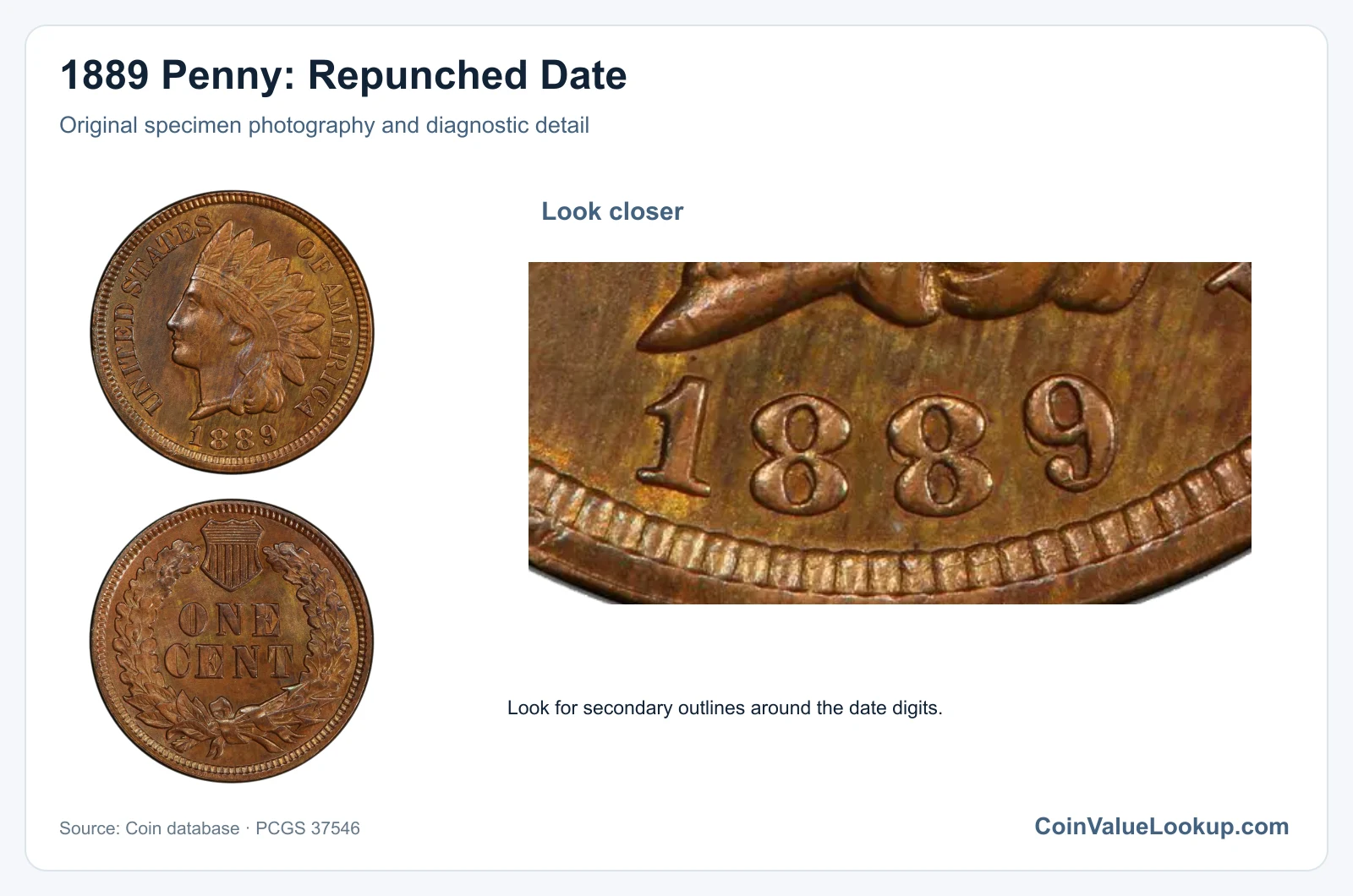
A repunched date on the 1889 Indian Head cent shows remnants of an earlier punch position next to the final date numerals. Dates on Indian cents were hand-punched into each working die, and sometimes the first strike of the punch landed slightly off before the engraver corrected it.
Look for a faint secondary outline or partial numeral beside the primary 1, 8 or 9. The remnant should follow the shape of the digit — that distinguishes it from a damaged date, which shows irregular distortion, or machine doubling, which creates flat shelving rather than a discrete second image.
Magnification of at least 5x helps. Each repunched-date variety needs individual authentication and assessment; pricing depends on the specific die, the clarity of the repunching and the coin's overall condition.
7. 1889 Indian Head Penny — Die Crack
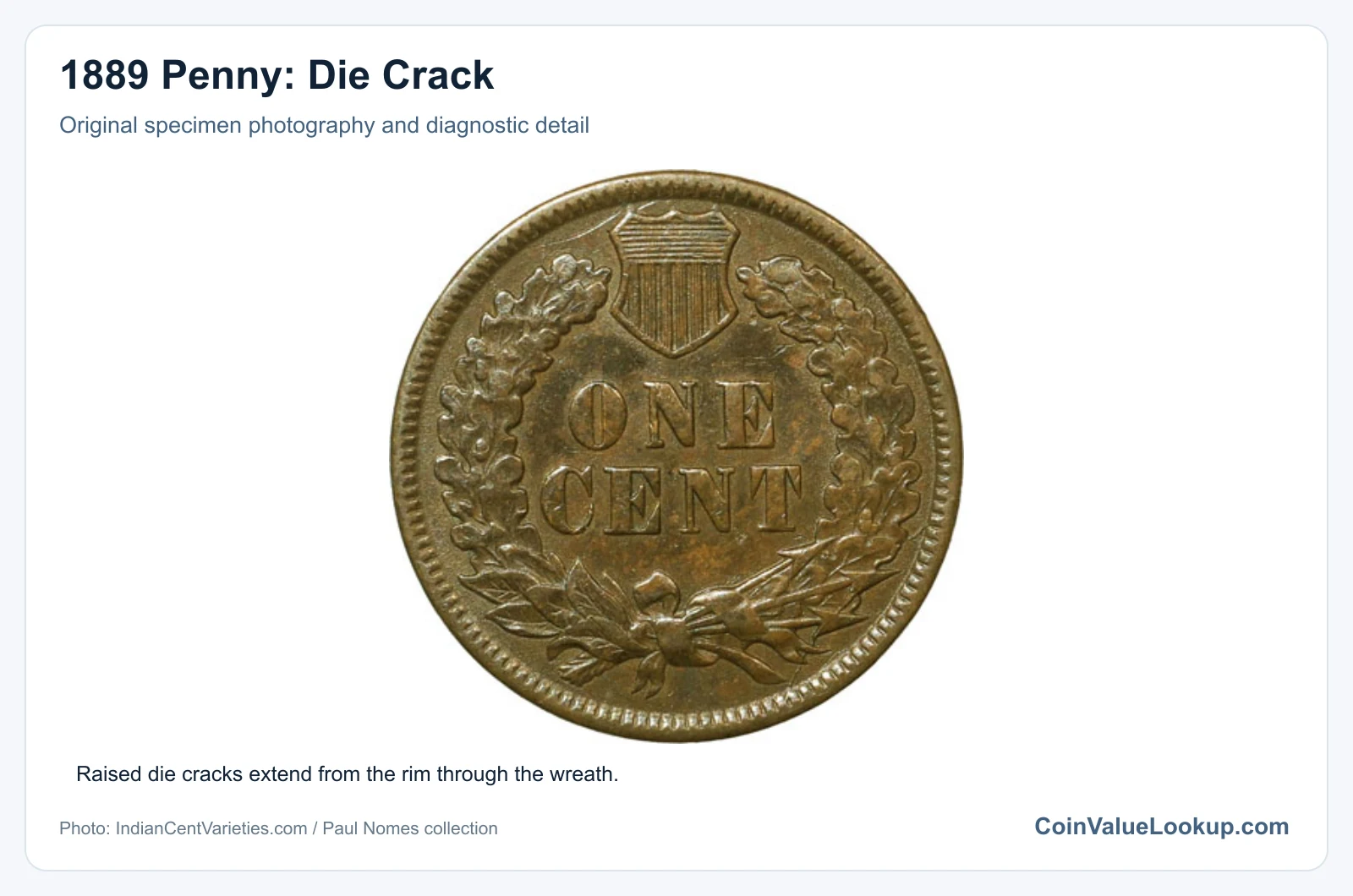
A die crack on an 1889 Indian Head cent appears as a thin, raised line running across the coin's surface. It forms when a working die develops a fracture, and metal flows into that fracture during striking.
The line may cross open fields, cut through lettering or run from the rim inward. Record where it starts and ends — location and length matter for identification and value.
The crack is raised above the surface, which separates it from an incuse scratch (pressed into the surface), a corrosion line or a displaced-metal scrape from post-mint contact.
Minor die cracks are common on 19th-century cents and carry modest premiums at best. Dramatic cracks affecting major design elements draw more collector interest.
Each example requires individual assessment based on crack severity, placement and the coin's overall grade.
8. 1889 Indian Head Penny — Off-Center Strike
An off-center strike happens when the planchet is not properly seated between the dies, resulting in a displaced design and an unstruck crescent of blank metal on one side of the coin. On an 1889 Indian Head cent, the percentage of off-center shift and whether the date remains visible are the two biggest factors for collectibility.
A coin with a modest 5–10% shift and a full date is interesting. One with a dramatic 30–50% shift and a readable date is far more desirable.
If the date is missing entirely, attributing the coin to 1889 becomes difficult or impossible without professional help.
Do not confuse an off-center strike with a straight-clipped planchet (which has a curved missing section but a centered design) or post-mint flattening. Value is assessed individually by authenticated identity, percentage of displacement and overall condition.