1978 Lincoln Penny Coin Value: How Much Is It Worth?
Most 1978 Lincoln pennies you pull from a jar are worth face value in circulated condition. A USA Coin Book guide estimate places an uncirculated MS65 example around $1.24, while a proof in PR65 runs about $3.08.
The real action comes from authenticated mint errors, where individual specimens have sold for meaningful premiums at auction.
Fast Way to Identify Your 1978 Lincoln Penny
Want a quick read on your 1978 penny? Upload clear photos of the front and back, and our identifier can offer a preliminary look at which version you have.
It checks for mintmarks, finish type, and obvious visual features. This is not a substitute for professional grading or authentication, but it gives you a solid starting point.
1978 Penny Value
Upload both sides of your 1978 Lincoln Penny.
Front Obverse
Upload photo
Back Reverse
Upload photo
Which 1978 Lincoln Penny Versions Are Worth Money?
- High-grade uncirculated examples with full original Red copper color (RD) carry a premium over brown or toned pieces in equivalent grades.
- Authenticated striking and planchet errors, such as off-center strikes or wrong-planchet coins, are individually valued and have sold at auction for $45 to $384 depending on type and grade.
Step 1: Identify Your 1978 Lincoln Penny Mint Mark and Version
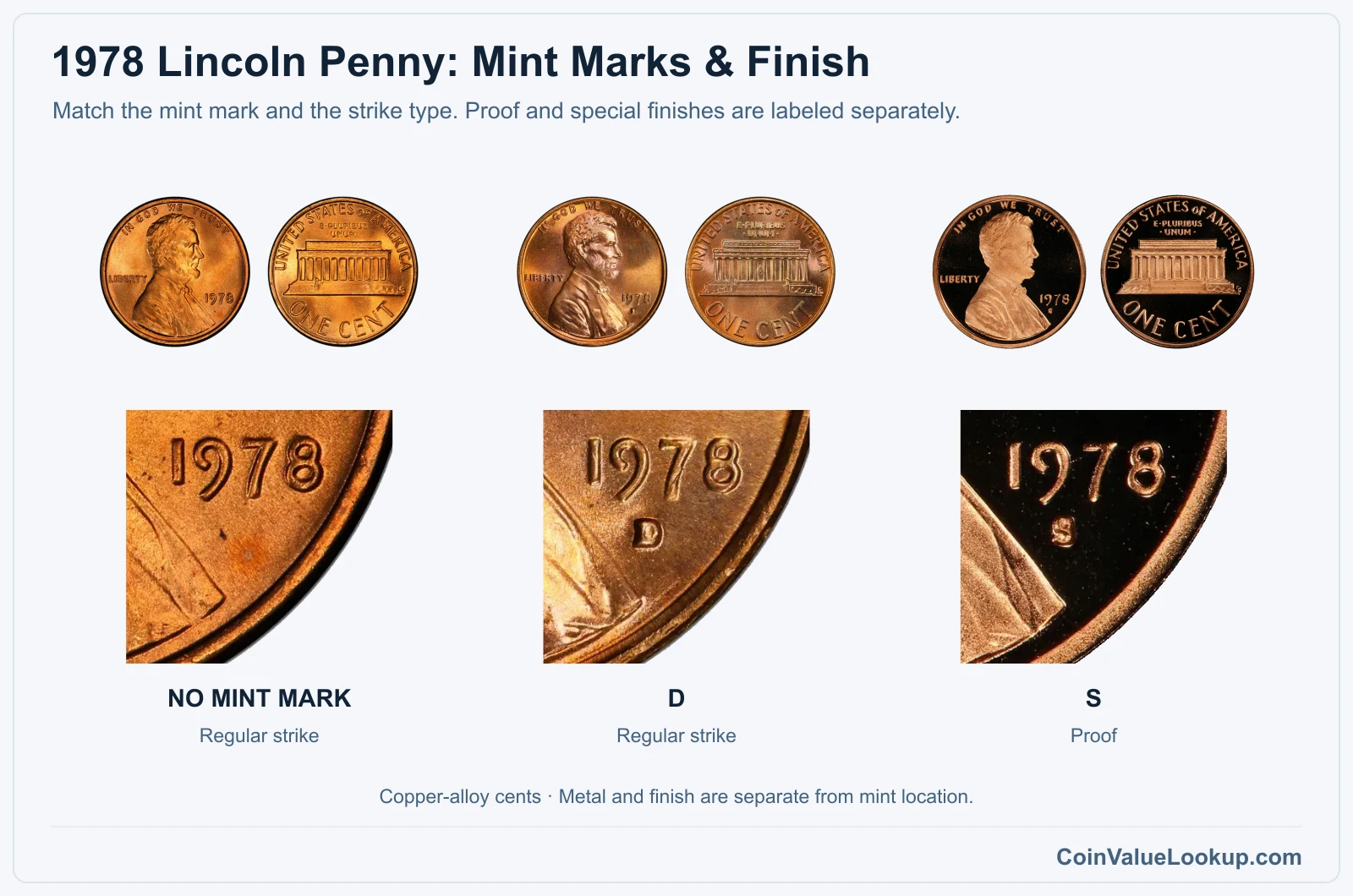
The 1978 Lincoln cent carries the familiar Lincoln portrait on the obverse and the Lincoln Memorial on the reverse, with a plain (smooth) edge. Normal composition is 95% copper and 5% zinc, weighing about 3.11 grams.
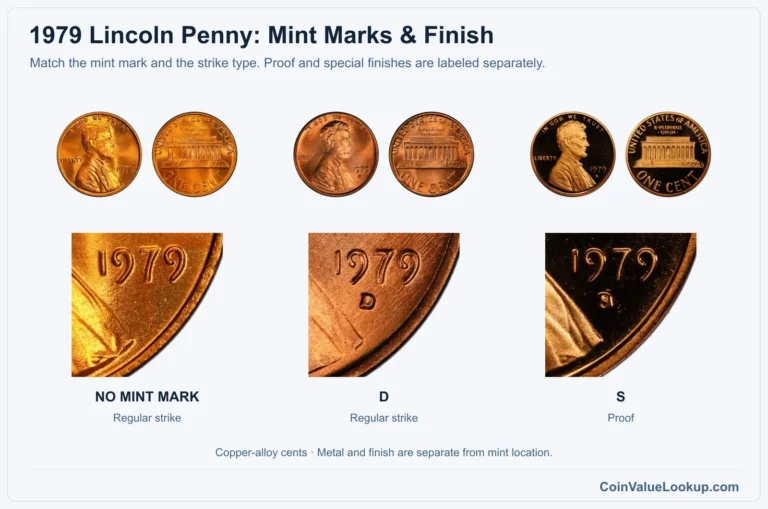
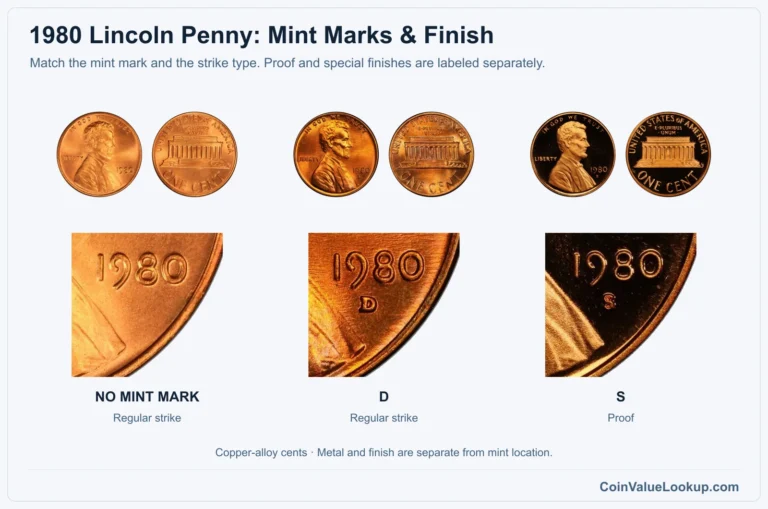
Three catalog branches exist. The no-mintmark version was struck for circulation.
The 1978-D, with a small "D" below the date, was produced at Denver. The 1978-S is a proof-only issue from San Francisco, never released for normal circulation.
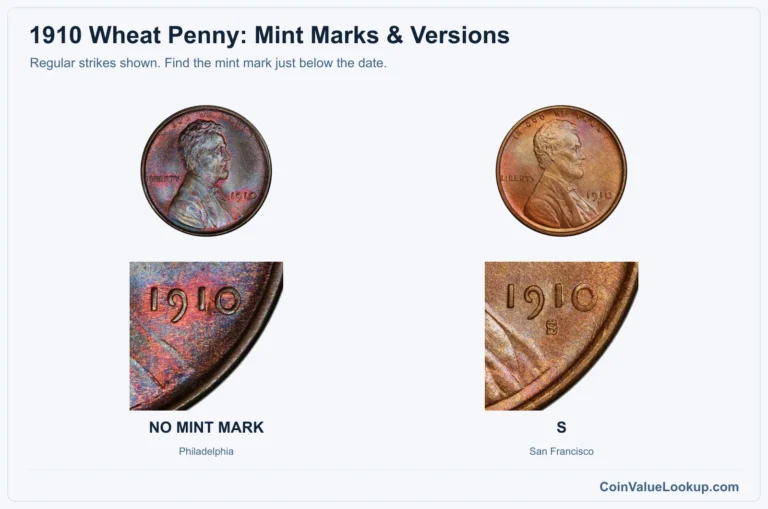
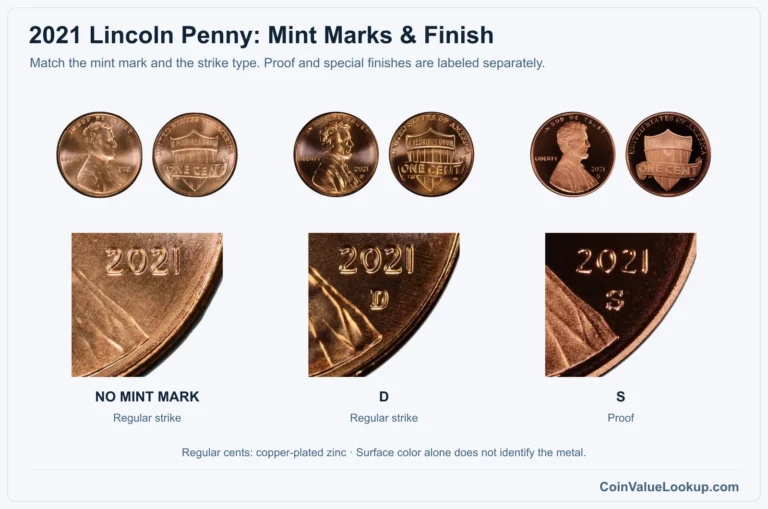
Mintmark location is just below the date on the obverse. If you see no mintmark at all, that is the Philadelphia-attributed branch.
A tiny "D" means Denver. An "S" means proof, so the coin should have mirror-like fields and sharp detail rather than the satiny look of a business strike.
Copper color designations you may see on certified holders, BN (Brown), RB (Red-Brown), and RD (Red), describe the toning state of the copper surface, not different alloys. Similarly, CAM and DCAM on proofs describe contrast between frosted devices and mirror fields.
These are surface filters, not separate metals or strikes.
Step 2: Check Your 1978 Lincoln Penny Grade
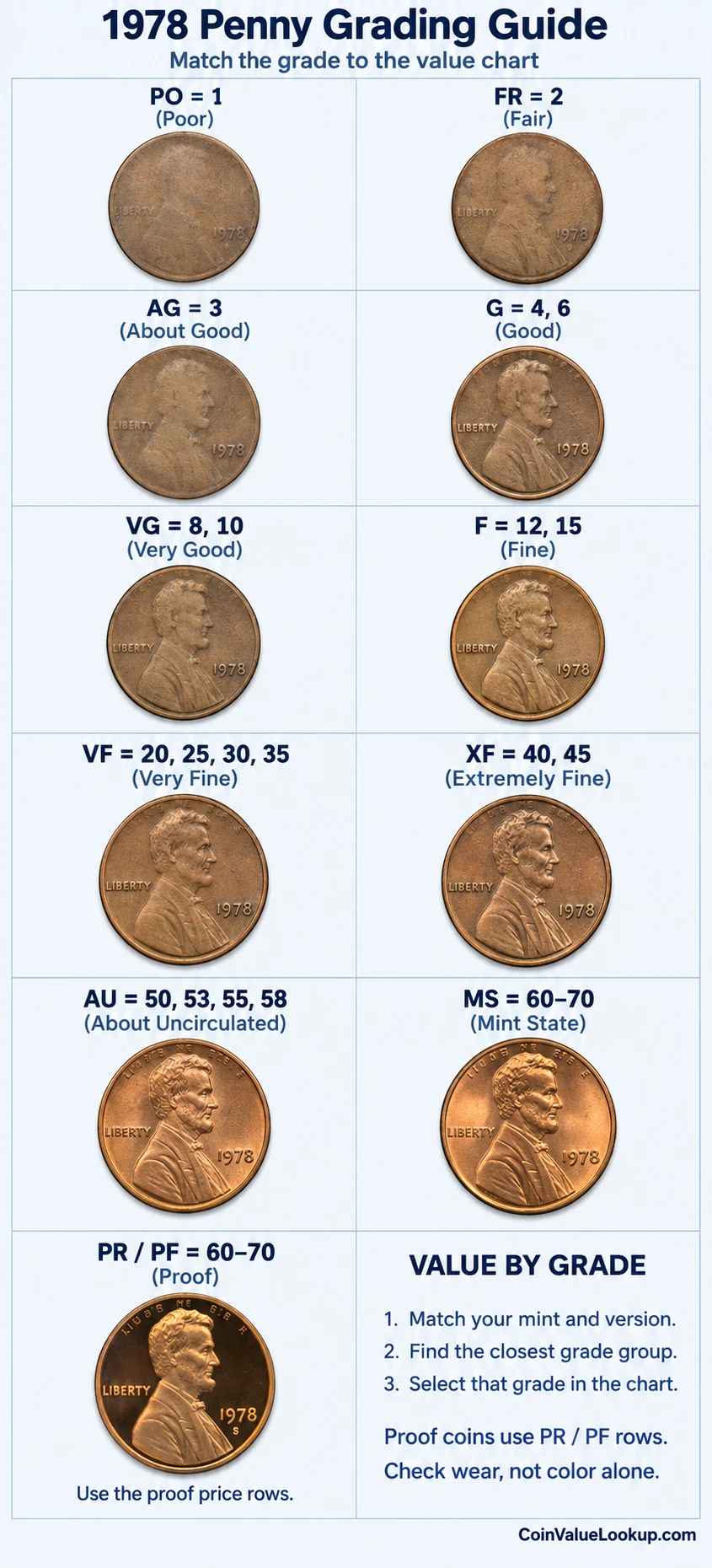
Check Lincoln's cheekbone, jaw, and the hair detail above the ear first. These are the highest points and show wear earliest.
On the reverse, the Memorial roof and the tops of the columns lose sharpness before the rest of the design.
The difference between About Uncirculated and Mint State comes down to luster. If light rolls smoothly across the surface without interruption, you are in MS territory.
A tiny flat spot on the cheek with broken luster means AU. Color alone does not decide grade.
For proofs, look under good light for hairlines, which are fine parallel scratches from handling or wiping. Spots, fingerprints, and haze also reduce the grade.
Never clean a copper coin or try to restore its color; you will damage the surface and destroy collector value.
Compare your coin to the grading reference image to gauge where it falls. Side-by-side comparison under the same lighting makes a big difference.
Step 3: Check 1978 Lincoln Penny Value by Mint and Version
1978 Lincoln Penny
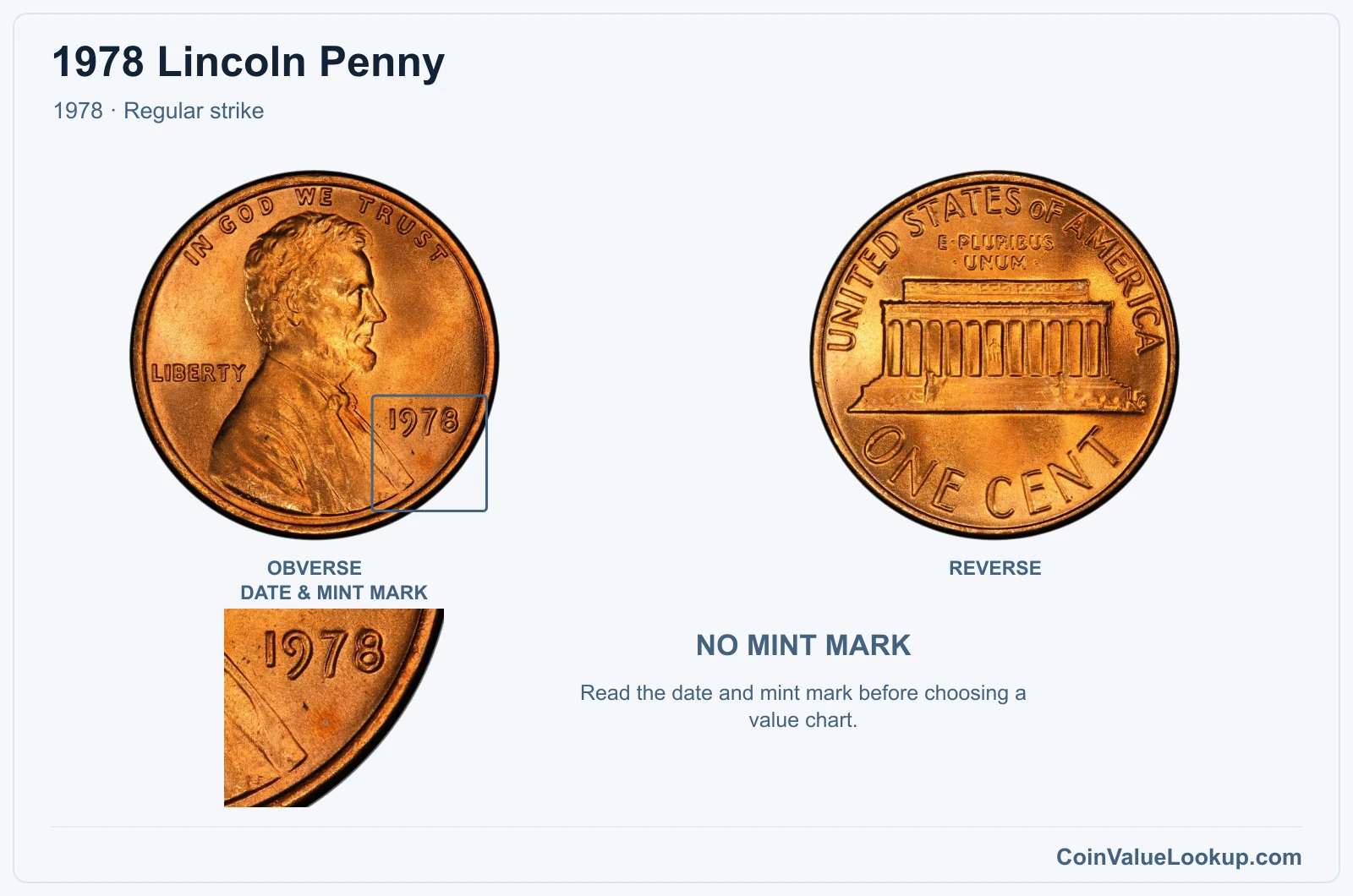
The 1978 no-mintmark Lincoln cent is the Philadelphia-attributed business strike. It is made of 95% copper and 5% zinc, weighing about 3.11 grams.
You will find no mintmark below the date.
A USA Coin Book guide estimate puts this version at roughly $1.24 in MS65 condition. That assumes full original surfaces and strong luster.
In circulated grades, these are common-date coins worth face value.
Copper color matters here. An MS65 with full Red surfaces (RD) will be more desirable than one graded MS65 Brown (BN).
Match finish and color when comparing values; proof mirrors are not a higher grade of business strike.
| Range | Grade | Price | Auction Records | Appraisal |
|---|---|---|---|---|
| PO | PO 1 | — | Coin Identifier | |
| FR | FR 2 | — | Coin Identifier | |
| AG | AG 3 | — | Coin Identifier | |
| G | G 4 | — | Coin Identifier | |
| G 6 | — | Coin Identifier | ||
| VG | VG 8 | — | Coin Identifier | |
| VG 10 | — | Coin Identifier | ||
| F | F 12 | — | Coin Identifier | |
| F 15 | — | Coin Identifier | ||
| VF | VF 20 | — | Coin Identifier | |
| VF 25 | — | Coin Identifier | ||
| VF 30 | — | Coin Identifier | ||
| VF 35 | — | Coin Identifier | ||
| XF | XF 40 | — | Coin Identifier | |
| XF 45 | — | Coin Identifier | ||
| AU | AU 50 | — | Coin Identifier | |
| AU 53 | — | Coin Identifier | ||
| AU 55 | — | Coin Identifier | ||
| AU 58 | — | Coin Identifier | ||
| MS | MS 60 | — | Coin Identifier | |
| MS 61 | — | Coin Identifier | ||
| MS 62 | — | Coin Identifier | ||
| MS 63 | — | Coin Identifier | ||
| MS 64 | — | Coin Identifier | ||
| MS 65 | Coin Identifier | |||
| MS 66 | Coin Identifier | |||
| MS 67 | Coin Identifier | |||
| MS 68 | — | Coin Identifier | ||
| MS 69 | — | — | — | |
| MS 70 | — | — | — |
1978 Lincoln Penny — D
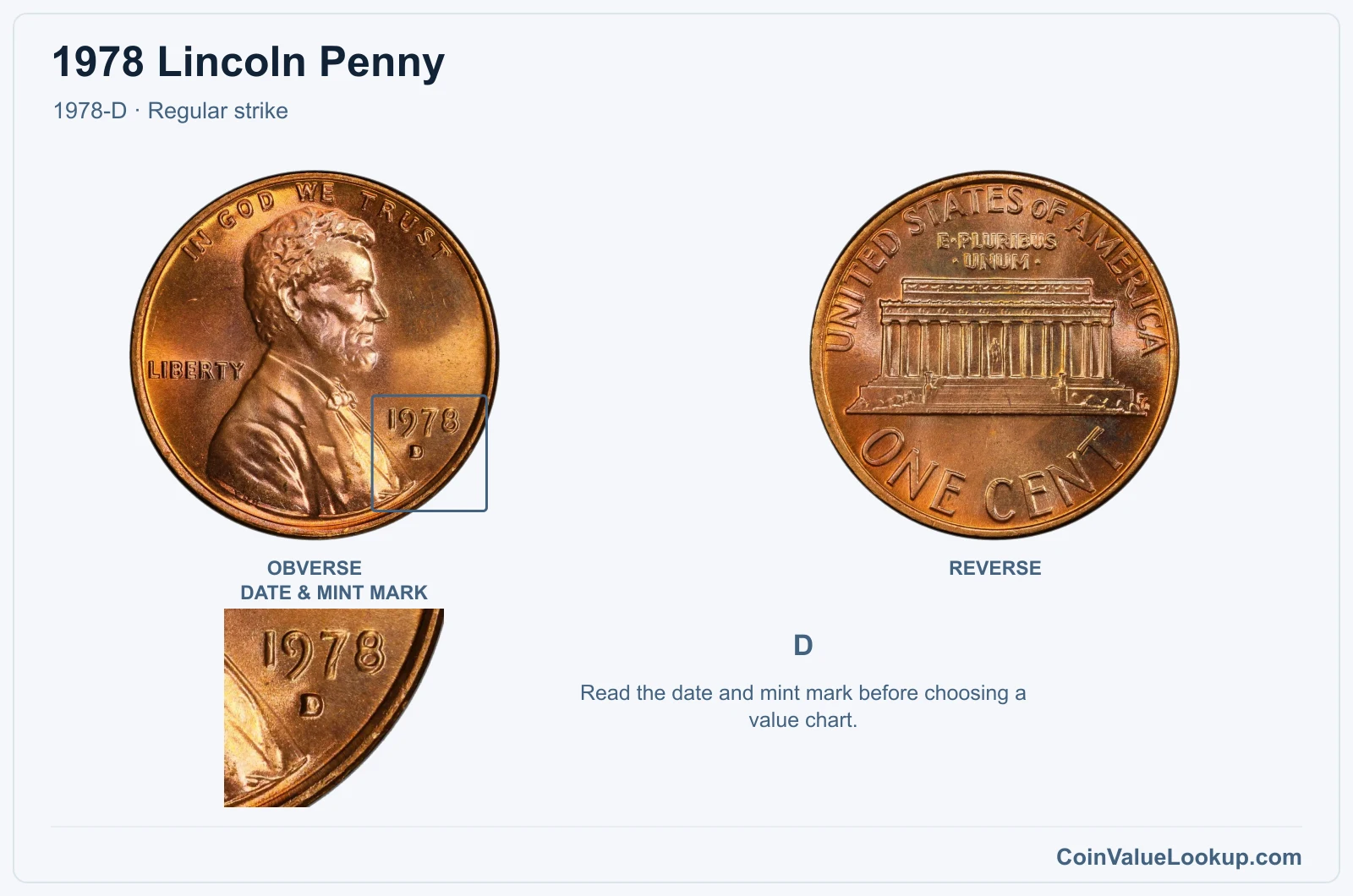
The 1978-D cent was struck at the Denver Mint and carries a small "D" mintmark below the date. Same composition as the Philadelphia issue: 95% copper, 5% zinc, roughly 3.11 grams.
The USA Coin Book guide estimate is about $1.24 at MS65. Like the no-mintmark version, these are extremely common in circulated condition and worth one cent until you reach uncirculated grades with clean surfaces.
Coin Value Lookup is a handy place to look up guides for other dates and denominations in the Lincoln cent series if you are working through a collection.
| Range | Grade | Price | Auction Records | Appraisal |
|---|---|---|---|---|
| PO | PO 1 | — | Coin Identifier | |
| FR | FR 2 | — | Coin Identifier | |
| AG | AG 3 | — | Coin Identifier | |
| G | G 4 | — | Coin Identifier | |
| G 6 | — | Coin Identifier | ||
| VG | VG 8 | — | Coin Identifier | |
| VG 10 | — | Coin Identifier | ||
| F | F 12 | — | Coin Identifier | |
| F 15 | — | Coin Identifier | ||
| VF | VF 20 | — | Coin Identifier | |
| VF 25 | — | Coin Identifier | ||
| VF 30 | — | Coin Identifier | ||
| VF 35 | — | Coin Identifier | ||
| XF | XF 40 | — | Coin Identifier | |
| XF 45 | — | Coin Identifier | ||
| AU | AU 50 | — | Coin Identifier | |
| AU 53 | — | Coin Identifier | ||
| AU 55 | — | Coin Identifier | ||
| AU 58 | — | Coin Identifier | ||
| MS | MS 60 | — | Coin Identifier | |
| MS 61 | — | Coin Identifier | ||
| MS 62 | — | Coin Identifier | ||
| MS 63 | — | Coin Identifier | ||
| MS 64 | — | Coin Identifier | ||
| MS 65 | Coin Identifier | |||
| MS 66 | Coin Identifier | |||
| MS 67 | Coin Identifier | |||
| MS 68 | — | — | — | |
| MS 69 | — | — | — | |
| MS 70 | — | — | — |
1978 Lincoln Penny — S PR
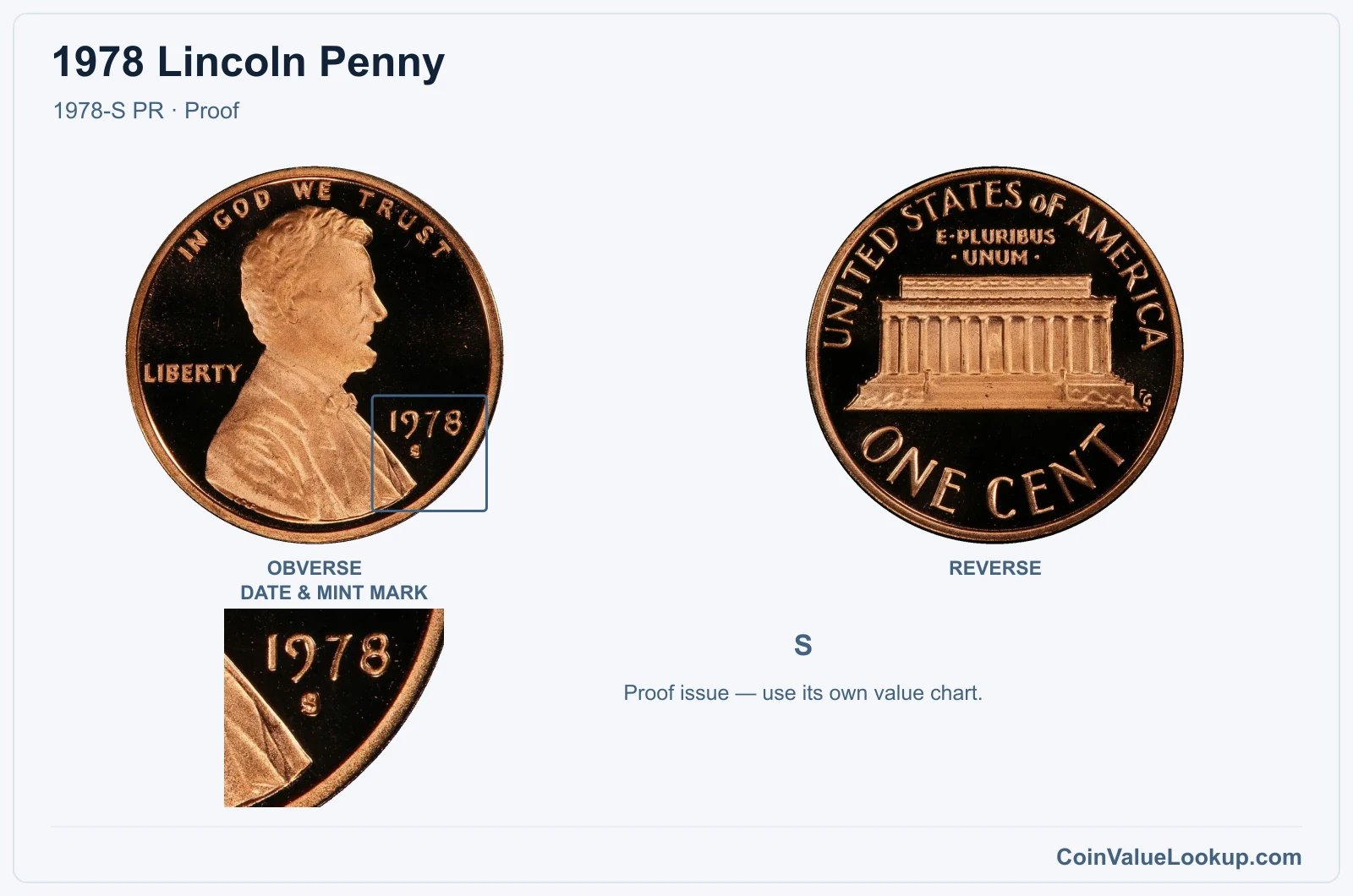
The 1978-S is a proof-only issue from San Francisco. These were sold in official Mint proof sets, not released into circulation.
If you find one in pocket change, someone broke open a set.
The USA Coin Book guide estimate is about $3.08 in PR65 condition. Proof coins show mirror-like fields and sharply struck devices.
Higher contrast between frosted design elements and reflective fields earns a Cameo (CAM) or Deep Cameo (DCAM) designation, which can add value beyond a standard proof.
Same 95% copper and 5% zinc composition as the business strikes. Handle proofs only by the edges; fingerprints on mirror surfaces are permanent without professional conservation.
| Range | Grade | Price | Auction Records | Appraisal |
|---|---|---|---|---|
| PR | PR 1 | — | Coin Identifier | |
| PR 2 | — | Coin Identifier | ||
| PR 3 | — | Coin Identifier | ||
| PR 4 | — | Coin Identifier | ||
| PR 6 | — | Coin Identifier | ||
| PR 8 | — | Coin Identifier | ||
| PR 10 | — | Coin Identifier | ||
| PR 12 | — | Coin Identifier | ||
| PR 15 | — | Coin Identifier | ||
| PR 20 | — | Coin Identifier | ||
| PR 25 | — | Coin Identifier | ||
| PR 30 | — | Coin Identifier | ||
| PR 35 | — | Coin Identifier | ||
| PR 40 | — | Coin Identifier | ||
| PR 45 | — | Coin Identifier | ||
| PR 50 | — | Coin Identifier | ||
| PR 53 | — | Coin Identifier | ||
| PR 55 | — | Coin Identifier | ||
| PR 58 | — | Coin Identifier | ||
| PR 60 | — | Coin Identifier | ||
| PR 61 | — | Coin Identifier | ||
| PR 62 | — | Coin Identifier | ||
| PR 63 | — | Coin Identifier | ||
| PR 64 | — | Coin Identifier | ||
| PR 65 | Coin Identifier | |||
| PR 66 | Coin Identifier | |||
| PR 67 | Coin Identifier | |||
| PR 68 | Coin Identifier | |||
| PR 69 | Coin Identifier | |||
| PR 70 | Coin Identifier |
1978 Lincoln Penny Error List
1. 1978 Lincoln Penny — Double Strike, Second Off Center
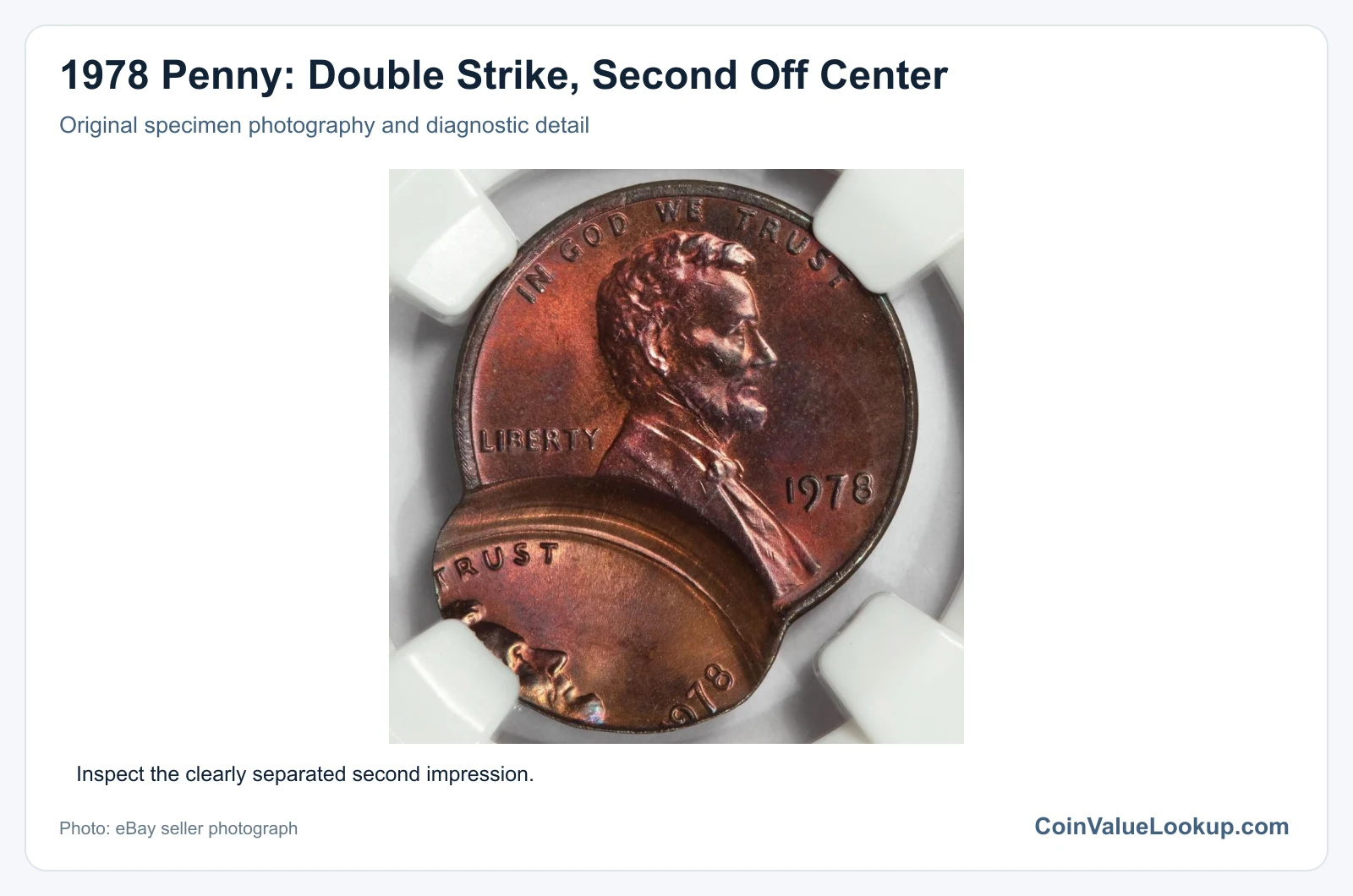
A double-struck 1978 cent shows two impressions of the design, with the second strike landing significantly off center from the first. On reported examples the second strike is about 90% off center, leaving only a small sliver of overlapping design at the edge of the coin.
To identify this, look for a second partial impression of Lincoln or the Memorial near the rim, along with a distorted or flattened edge where the two strikes overlap. Both sides will show evidence of the extra strike.
Do not confuse this with a doubled die, which is a different error entirely, or with rim damage from being hit after leaving the Mint. An ANACS MS60 Red-Brown example of this error sold for $50 in January 2022 at auction.
That is a single recorded sale, not a universal price.
2. 1978 Lincoln Penny — Off-Center Strike
An off-center strike happens when the blank is not properly seated in the striking chamber, so the dies impress only part of the design. The 1978 no-mintmark cent has been found with strikes roughly 60% off center, leaving a large blank crescent where the dies never touched.
The key to value is whether the date is still visible. A readable date on an off-center cent is essential for attribution and collector interest.
Compare the flat unstruck area to the design; the edge of the struck portion will show design elements fading rather than a sharp cut.
A misaligned die looks similar but leaves the opposite face properly centered, which is a different error. An ANACS MS62 Red-Brown example of the 60% off-center 1978 cent sold for $45 in January 2022.
3. 1978 Lincoln Penny — Struck on a Clad Dime Blank
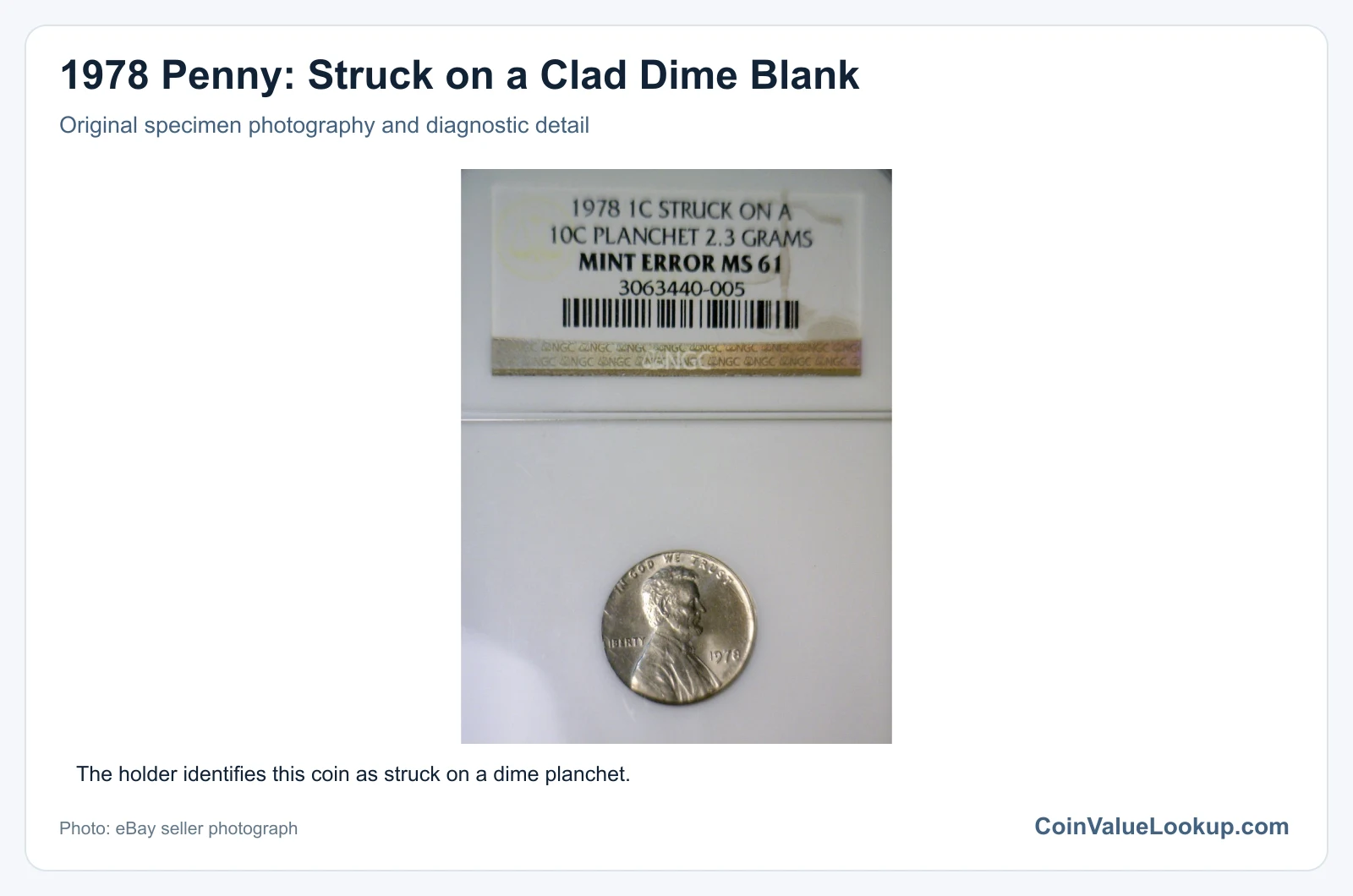
This is a wrong-planchet error: a 1978 cent struck on a blank intended for a clad Roosevelt dime. The result is a Lincoln cent design on a noticeably smaller, lighter, clad planchet rather than the normal copper blank.
Look at the edge. A clad dime blank will show a visible copper core sandwiched between nickel-clad layers, unlike the solid copper edge of a normal cent.
The diameter will be closer to a dime than a cent, and the design may be incomplete because the smaller blank did not fill the cent dies.
Do not confuse this with a copper-plated cent or with a dime struck over a cent, which is a completely different error. A PCGS MS64 example sold for $384 in July 2022 at Heritage Auctions.
Professional attribution is important here because visual differences can be subtle to an untrained eye.
4. 1978 Lincoln Penny — Doubled Die Obverse
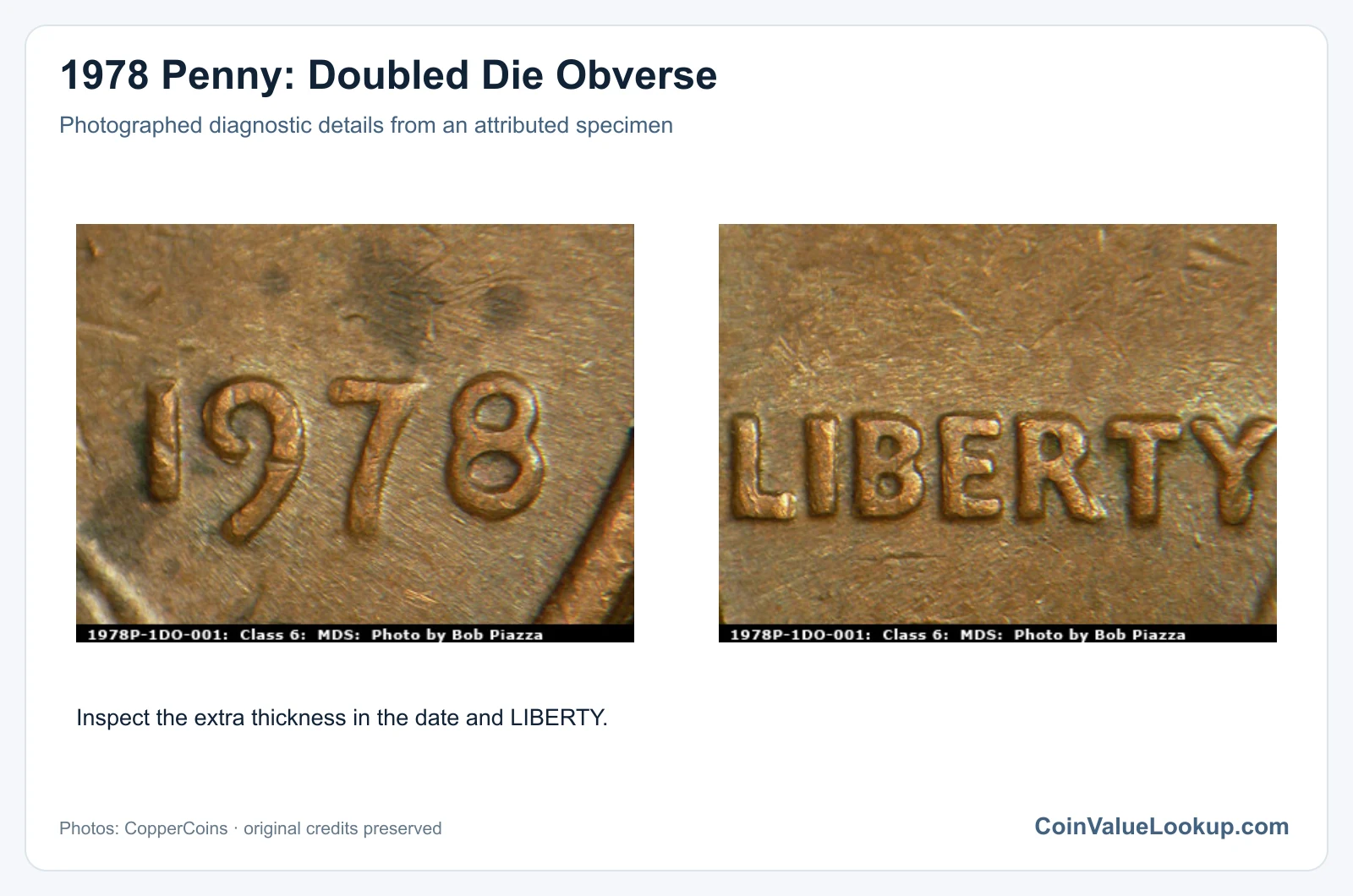
A doubled die obverse on a 1978 cent means the die itself carried a doubled impression, producing consistent doubling on every coin struck from that die. This is different from machine doubling, which is flat and shelf-like.
To check, examine the obverse lettering, the date, and Lincoln's profile under magnification. Genuine doubled die doubling shows separation or notching that is consistent across multiple design elements, not just one spot.
Compare directly against a normal 1978 cent under matching light.
Machine doubling, die wear, and reflections can all mimic a doubled die to the naked eye. Condition, the strength of the doubling, and professional authentication all affect what a doubled die specimen might bring.
No specific price is adopted for this variety.
5. 1978 Lincoln Penny — Repunched Mintmark
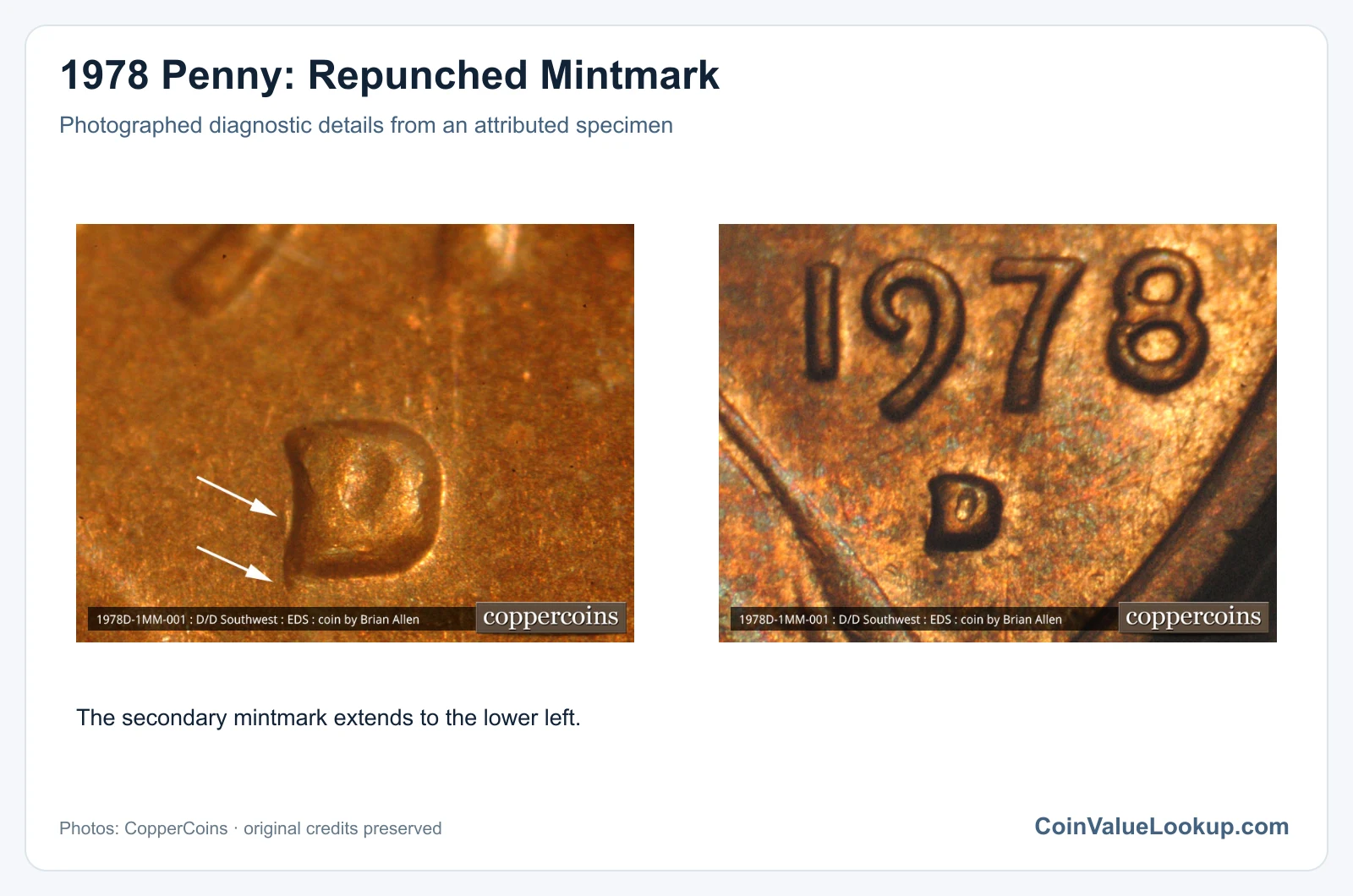
A repunched mintmark occurs when the mintmark punch was applied more than once in slightly different positions, leaving traces of the earlier placement. On a 1978 cent this would appear on the D mintmark below the date.
Inspect the mintmark under magnification for remnants of a second impression, a shadow, notch, or partial second letter beside the primary mark. The extra impression should be consistent in style and metal flow with the surrounding surface.
Die chips, corrosion, and machine doubling around the mintmark can look similar, so comparison with a known normal example at the same magnification is essential. Value depends on the visibility of the repunching and the coin's overall condition.
No specific price is adopted for this category.
6. 1978 Lincoln Penny — BIE Die Break
A BIE die break is a specific type of die crack that produces a raised vertical line between the letters B and E in LIBERTY, resembling a capital letter I. It happens when the die develops a crack in that area and metal fills the gap during striking.
To check, look closely at LIBERTY on the obverse. A genuine BIE will be a raised feature, the same color and texture as the surrounding design, connected to or sitting between B and E.
It should not look like surface debris or a scratch.
Dirt, scratches, and bits of foreign material can mimic a BIE. If the mark sits above the surface and can be wiped away, it is not a die break.
Value depends on the strength and clarity of the break and overall coin condition. No specific price is adopted for this variety.
7. 1978 Lincoln Penny — Clipped Planchet
A clipped planchet error means the coin blank was incompletely punched from the metal strip before striking. The result is a missing curved, straight, or irregular section of the coin's edge, depending on where the overlap or misfeed occurred.
Look for a smooth, curved absence along the rim that is consistent with the blank's original shape. A genuine clip often causes design weakness on the opposite side of the coin, called the Blakesley effect.
The edge in the clipped area will typically show a different texture than a filed or damaged edge.
Do not confuse clips with post-mint damage like filed edges, deliberate cuts, or corrosion eating into the rim. Value depends on the size and type of the clip and the coin's condition.
No specific price is adopted for this variety.