1836 Coronet Head Cent Coin Value: How Much Is It Worth?
The 1836 Coronet Head Cent is a copper large cent struck at Philadelphia, and guide estimates for ordinary business strikes range from about $34 in G4 to $997 in MS63 according to USA Coin Book. That is not the entire market range.
Rare proofs, restrikes, and major errors require separate pricing based on authenticated identity and condition.
Fast Way to Identify Your 1836 Coronet Head Cent
Upload clear photos of both the front and back of your coin for a preliminary identification. Good lighting and a steady shot help distinguish wear from weak strikes or surface problems.
This step is not a substitute for professional authentication, but it can point you toward the right variety and give you a starting place for further research.
1836 Coronet Head Cent Value
Upload both sides of your 1836 Coronet Head Cent.
Front Obverse
Upload photo
Back Reverse
Upload photo
Which 1836 Coronet Head Cent Versions Are Worth Money?
- Business strikes range from roughly $34 in G4 to $997 in MS63 per USA Coin Book; higher-grade or original-surface examples may exceed that range.
- Cataloged proofs of the 1836 Coronet Head Cent require authenticated attribution; no standard guide price is adopted, so each is assessed individually.
- Mint errors such as die cracks, cuds, off-center strikes, laminations, and rotated dies on this date deserve closer inspection and professional evaluation.
- Original, uncleaned surfaces with legible detail add significant appeal over cleaned or corroded examples at any grade level.
Step 1: Identify Your 1836 Coronet Head Cent Mint Mark and Version
All 1836 Coronet Head Cents were struck at Philadelphia, so there is no mintmark to hunt for. Do not let anyone tell you a branch-mint version exists for this date.
On the obverse, look for the Liberty portrait wearing a coronet inscribed LIBERTY, surrounded by thirteen stars and the date 1836. The reverse shows the denomination ONE CENT within a laurel wreath, with UNITED STATES OF AMERICA around the border.
The key split is between ordinary business strikes and cataloged proofs. A proof is a manufacturing method, not simply a high grade, so mirror-like surfaces alone do not confirm proof status.
Die characteristics, rim finish, and authenticated attribution matter. A polished business strike is still a business strike.
Weight should be close to the nominal 10.89 grams in copper, but wear, corrosion, and production tolerances of the era mean weight alone cannot prove authenticity. Use it as supporting evidence alongside design details and edge inspection.
Step 2: Check Your 1836 Coronet Head Cent Grade
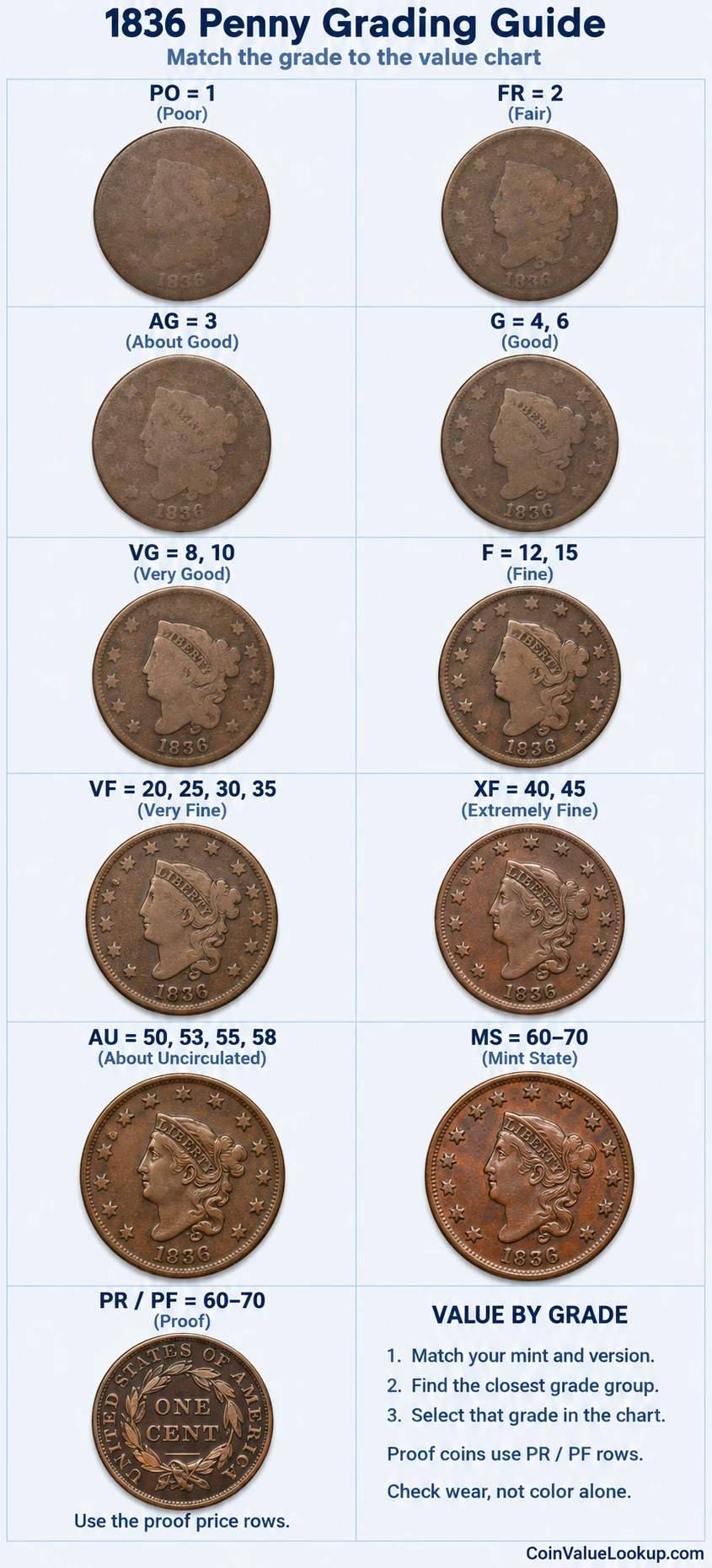
Start with the portrait. On a well-worn coin the hair curls above Liberty's ear flatten first, then the cheek loses its roundness.
Check the wreath leaves on the reverse for individual leaf detail versus smooth blobs.
Use the comparison image to match your coin against known grade examples of the same type. A coin grading G4 will show a visible outline of Liberty and a readable date, while an MS63 should have full hair and leaf detail with original mint luster and only minor contact marks.
Do not confuse detail lost from circulation with a weak strike or surface porosity. Early copper cents frequently show roughness from environmental exposure.
Corrosion, cleaning, or porous surfaces can lower a coin's market appeal well below what its remaining detail might suggest.
Color designations like BN (brown), RB (red-brown), and RD (red) describe the amount of original copper color remaining. They are not separate alloys or automatic upgrades.
Most survivors from 1836 will be brown.
Step 3: Check 1836 Coronet Head Cent Value by Mint and Version
1836 Coronet Head Cent
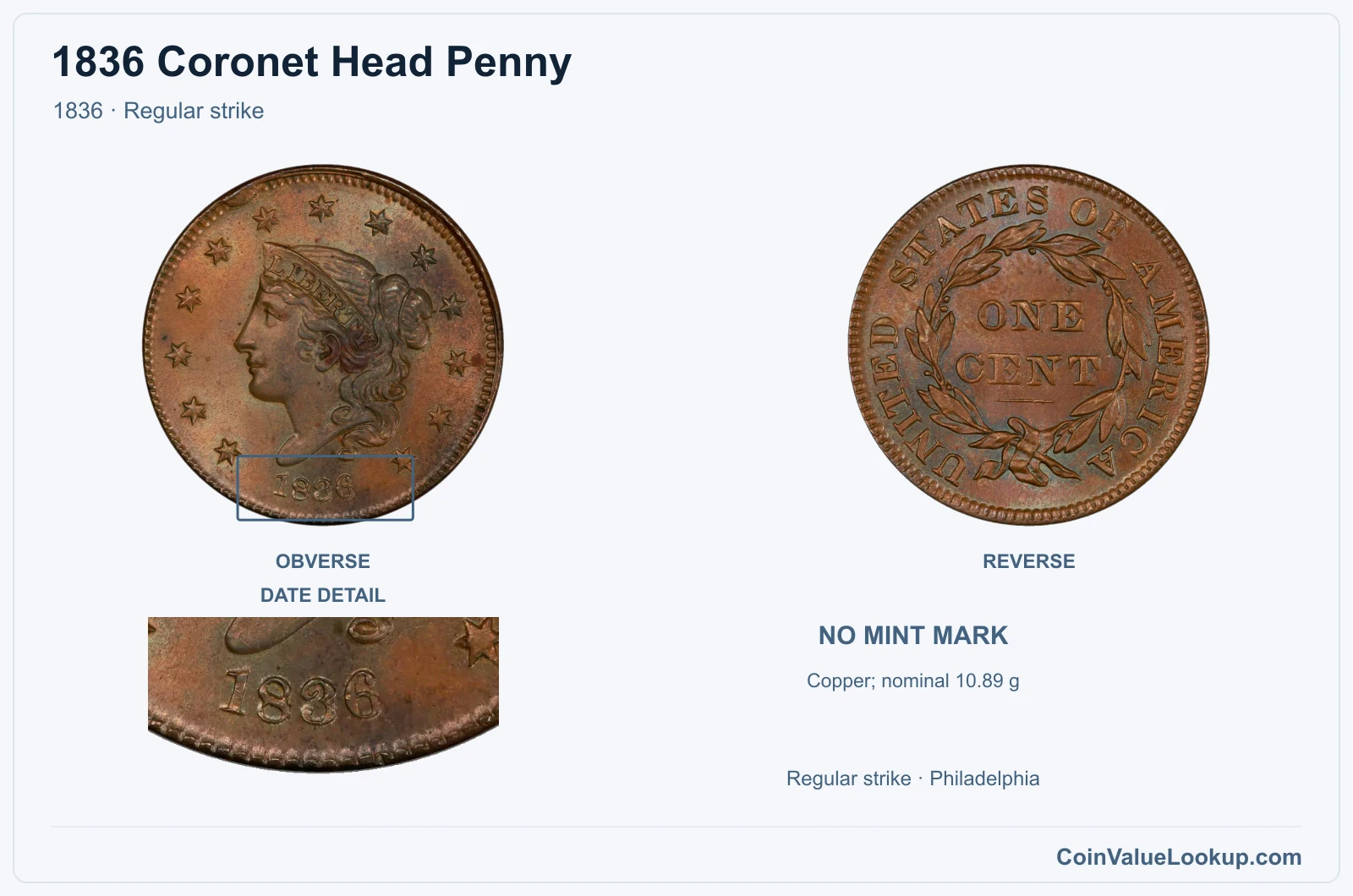
The standard 1836 Coronet Head Cent is a copper business strike from Philadelphia weighing about 10.89 grams. There is no mintmark.
USA Coin Book lists guide estimates from around $34 in G4 up to $997 in MS63.
When evaluating one of these, focus on the hair detail above Liberty's ear and the sharpness of the wreath leaves. Original brown surfaces with no signs of cleaning or tooling are what serious collectors prefer.
A coin that looks unusually bright for its age has probably been cleaned, which typically hurts its value.
Coin Value Lookup is a good starting point if you want to look up guides for other dates in the Coronet Head series or compare across denominations.
| Range | Grade | Price | Auction Records | Appraisal |
|---|---|---|---|---|
| PO | PO 1 | — | Coin Identifier | |
| FR | FR 2 | — | Coin Identifier | |
| AG | AG 3 | — | Coin Identifier | |
| G | G 4 | — | Coin Identifier | |
| G 6 | — | Coin Identifier | ||
| VG | VG 8 | — | Coin Identifier | |
| VG 10 | Coin Identifier | |||
| F | F 12 | — | Coin Identifier | |
| F 15 | Coin Identifier | |||
| VF | VF 20 | Coin Identifier | ||
| VF 25 | Coin Identifier | |||
| VF 30 | Coin Identifier | |||
| VF 35 | Coin Identifier | |||
| XF | XF 40 | Coin Identifier | ||
| XF 45 | Coin Identifier | |||
| AU | AU 50 | Coin Identifier | ||
| AU 53 | Coin Identifier | |||
| AU 55 | Coin Identifier | |||
| AU 58 | Coin Identifier | |||
| MS | MS 60 | Coin Identifier | ||
| MS 61 | Coin Identifier | |||
| MS 62 | Coin Identifier | |||
| MS 63 | Coin Identifier | |||
| MS 64 | Coin Identifier | |||
| MS 65 | Coin Identifier | |||
| MS 66 | Coin Identifier | |||
| MS 67 | — | — | — | |
| MS 68 | — | — | — | |
| MS 69 | — | — | — | |
| MS 70 | — | — | — |
1836 Coronet Head Cent — Proof
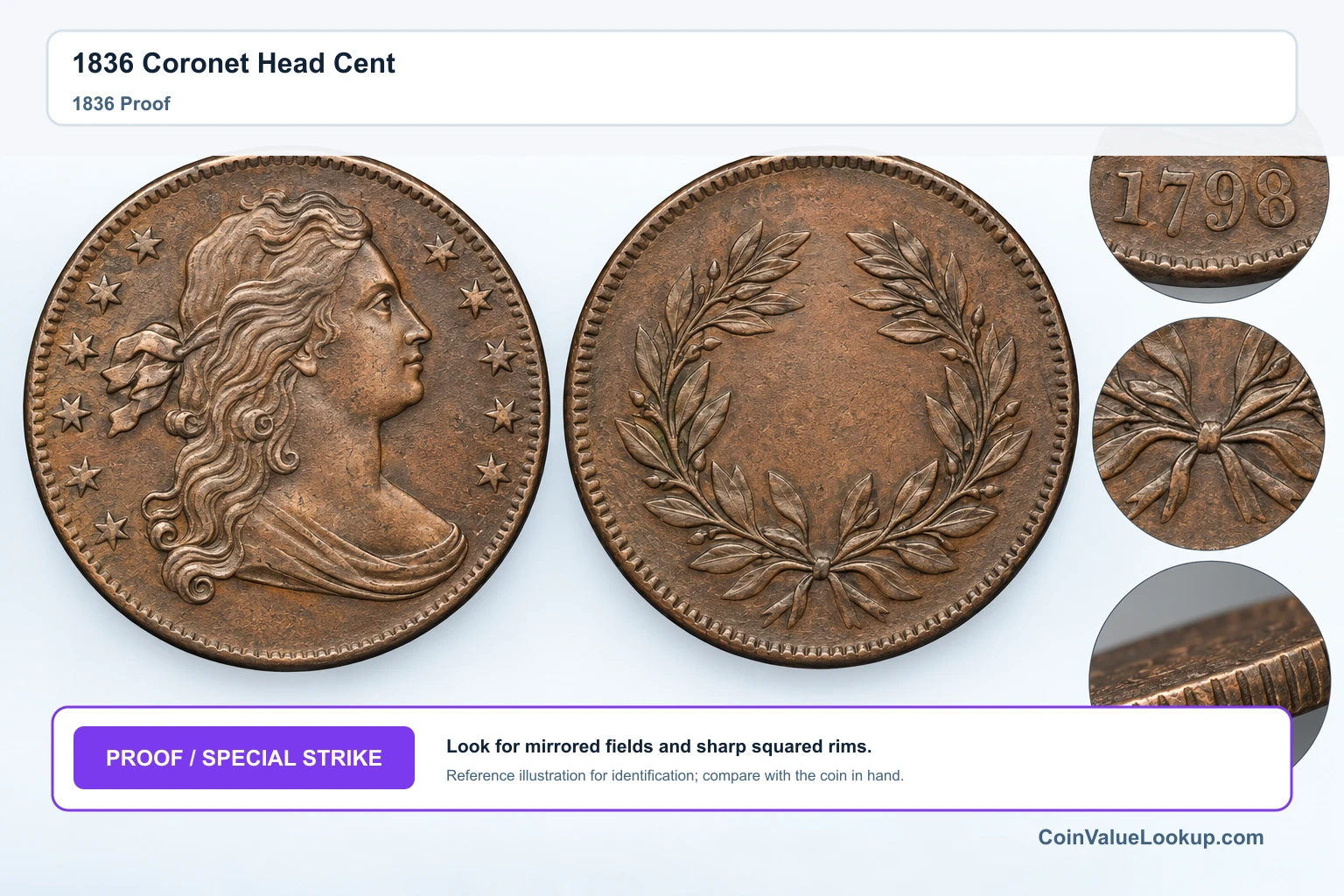
The 1836 Proof Coronet Head Cent is a cataloged proof striking, also from Philadelphia in copper at the same nominal 10.89-gram weight. No standard guide price is adopted for this variety, so each example needs individual assessment based on its authenticated identity, surface quality, and die characteristics.
Proof large cents of this era are genuinely rare. Attribution requires examining the die finish, rim sharpness, and strike quality under magnification.
Simply having reflective fields does not make a coin a proof; polished business strikes exist and can fool the unwary. If you suspect you have one, third-party authentication by a major grading service is the practical next step.
Do not transfer business-strike prices to a proof. The two categories serve different collector markets entirely.
| Range | Grade | Price | Auction Records | Appraisal |
|---|---|---|---|---|
| PR | PR 1 | — | Coin Identifier | |
| PR 2 | — | Coin Identifier | ||
| PR 3 | — | Coin Identifier | ||
| PR 4 | — | Coin Identifier | ||
| PR 6 | — | Coin Identifier | ||
| PR 8 | — | Coin Identifier | ||
| PR 10 | — | Coin Identifier | ||
| PR 12 | — | Coin Identifier | ||
| PR 15 | — | Coin Identifier | ||
| PR 20 | — | Coin Identifier | ||
| PR 25 | — | Coin Identifier | ||
| PR 30 | — | Coin Identifier | ||
| PR 35 | — | Coin Identifier | ||
| PR 40 | — | Coin Identifier | ||
| PR 45 | — | Coin Identifier | ||
| PR 50 | — | Coin Identifier | ||
| PR 53 | — | Coin Identifier | ||
| PR 55 | — | Coin Identifier | ||
| PR 58 | — | Coin Identifier | ||
| PR 60 | — | Coin Identifier | ||
| PR 61 | — | Coin Identifier | ||
| PR 62 | — | Coin Identifier | ||
| PR 63 | — | Coin Identifier | ||
| PR 64 | — | — | — | |
| PR 65 | — | — | — | |
| PR 66 | — | — | — | |
| PR 67 | — | — | — | |
| PR 68 | — | — | — | |
| PR 69 | — | — | — | |
| PR 70 | — | — | — |
1836 Coronet Head Cent Error List
1. 1836 Coronet Head Cent — Die Crack
A die crack on an 1836 Coronet Head Cent appears as a thin raised line running across the coin's surface. These lines follow the path of a fracture in the steel die, so they sit above the field rather than being cut into it.
Look carefully under magnification and trace the line from one point to another.
The most common lookalike is an incuse scratch, which is depressed into the surface rather than raised. Corrosion lines and tool marks can also mimic die cracks, but they lack the clean, consistent profile.
A genuine die crack will be the same height along its length and may connect devices or extend to the rim.
No standard price is adopted for this error on the 1836 date. Value depends on the crack's size, location, and the coin's overall condition.
2. 1836 Coronet Head Cent — Die Break / Cud
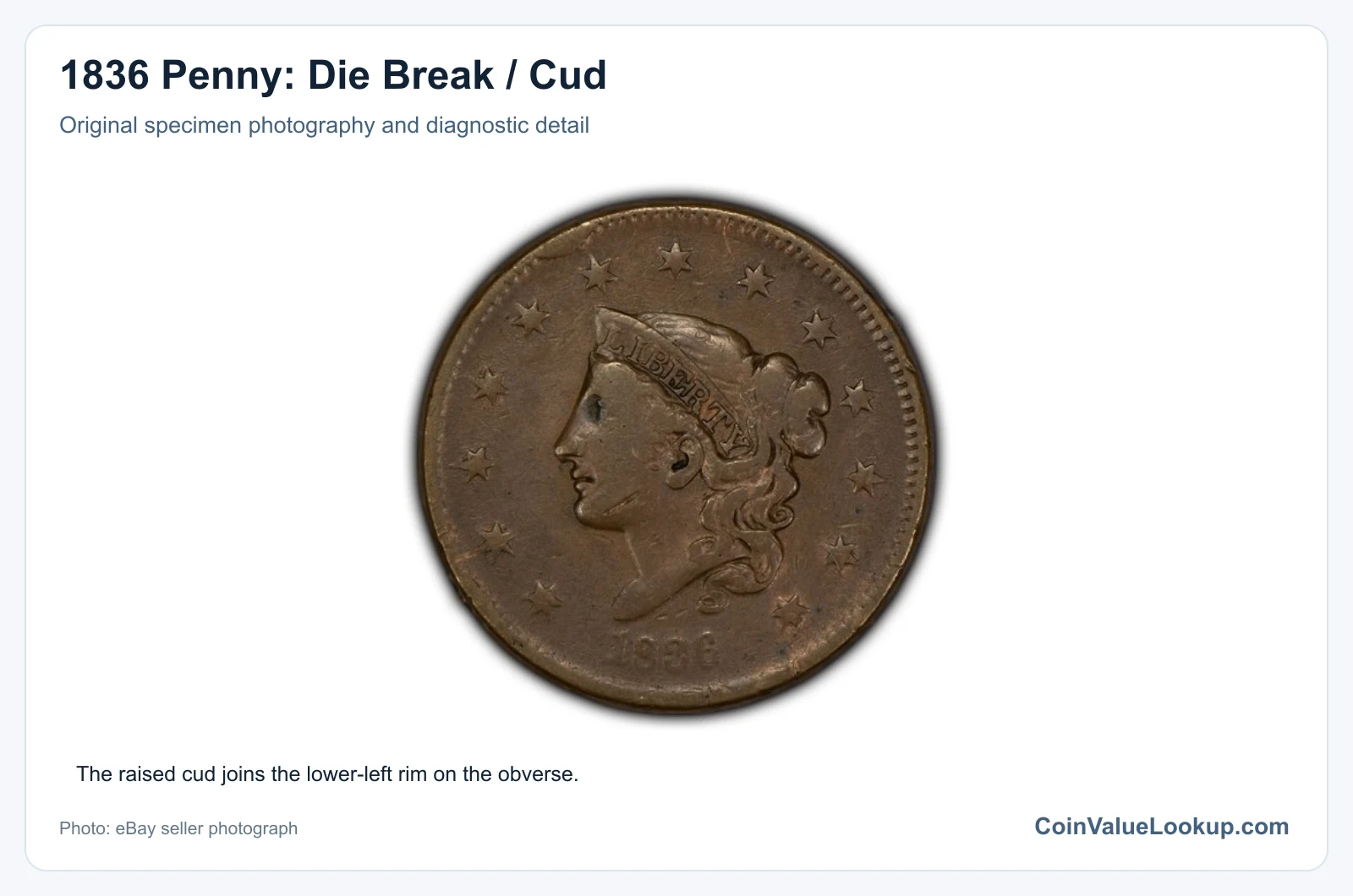
A cud is a raised, featureless blob of metal that connects to the rim, caused by a piece of the die breaking away entirely. On an 1836 Coronet Head Cent, you might see a portion of the legend or border replaced by this flat lump.
An interior die break is similar but does not reach the rim.
Do not confuse a cud with a rim dent or bump from post-mint damage. A genuine cud has a smooth, rounded boundary where the die steel was missing during the strike, and the displaced design will be absent in that area, not pushed aside.
Corrosion deposits can also look raised but will have irregular texture.
No standard price is adopted for cuds on this date. Assessment depends on the cud's size, position, and the coin's authenticated grade.
3. 1836 Coronet Head Cent — Off-Center Strike
An off-center strike happens when the planchet is not properly seated between the dies. The result is a crescent-shaped area of blank metal on one side and a shifted design on the other.
For collector interest, the date needs to remain visible.
On an 1836 Coronet Head Cent, check that the blank crescent is smooth and unstruck, not clipped or damaged after minting. A clipped planchet has a curved edge from a different production error, and post-mint flattening can push design elements to one side without leaving an unstruck area.
No standard price is adopted for off-center strikes on this date. The percentage of offset and whether the full date shows both influence desirability.
Professional authentication is recommended.
4. 1836 Coronet Head Cent — Lamination / Split Planchet
A lamination or split planchet error shows metal peeling, flaking, or separating within the copper itself. On an 1836 Coronet Head Cent, look for a retained flap of metal lifting from the surface or a visible layer split along the edge.
Photograph both the affected face and the edge together for documentation.
This differs from scraping or deliberate cutting because a lamination follows the internal structure of the metal. Corrosion can eat into copper and create flaky surfaces too, but a true lamination reveals a clean separation plane rather than pitted, rough decay.
The edge view is your best diagnostic tool here.
No standard price is adopted. Each example must be evaluated individually based on the severity of the separation, remaining detail, and authenticated attribution.
5. 1836 Coronet Head Cent — Rotated Dies
Rotated dies occur when one die shifts from its normal alignment relative to the other. On standard US coins, the obverse and reverse are oriented 180 degrees apart, so flipping top-to-bottom should show the reverse right-side up.
If yours doesn't line up, you may have a rotation error.
Before getting excited, make sure your photograph was not simply taken at an angle. Hold the coin with Liberty upright, flip it on a vertical axis, and check whether the wreath is properly oriented.
A coin turned sideways in a flip or holder can create a false impression of rotation.
No standard price is adopted for rotated dies on the 1836 date. Larger rotations generally attract more attention, but value depends on the degree of rotation and overall coin condition.
Authentication helps confirm the error is genuine.