1819 Coronet Head Cent Coin Value: How Much Is It Worth?
The 1819 Coronet Head Cent is a copper classic from the early Philadelphia Mint. Guide estimates for business strikes range from about $38 in G4 to $2,073 in MS63, depending on which variety you hold.
That spread matters. Identify your exact branch first, because Large Date, Small Date and the 1819/8 overdate each carry different premiums, and rare proof strikings require individual assessment rather than any standard price table.
Fast Way to Identify Your 1819 Coronet Head Cent
Want a quick read on what you have? Upload clear photos of the front and back of your 1819 cent and our identifier will provide a preliminary identification of the variety and approximate condition.
Good lighting and a sharp focus on the date digits help the most, since separating the Large Date from Small Date or spotting an overdate depends on those details.
1819 Coronet Head Cent Value
Upload both sides of your 1819 Coronet Head Cent.
Front Obverse
Upload photo
Back Reverse
Upload photo
Which 1819 Coronet Head Cent Versions Are Worth Money?
- The 1819/8 overdate in MS63 carries the highest listed guide estimate at $2,073, driven by the visible remnant of an earlier date beneath the 9.
- The 1819 Small Date reaches about $1,445 at MS63 according to USA Coin Book, making high-grade survivors well worth authenticating.
- The 1819/(8) Large Date lists around $1,344 at MS63; faint overdate traces on a Large Date punch distinguish this branch.
- Proof strikings of both the plain 1819 and 1819/8 exist in catalogs but have no adopted guide price; each requires individual professional assessment.
- Prominent mint errors such as die cracks, cuds or rotated dies on any 1819 cent deserve closer inspection, though values depend on severity and condition.
Step 1: Identify Your 1819 Coronet Head Cent Mint Mark and Version
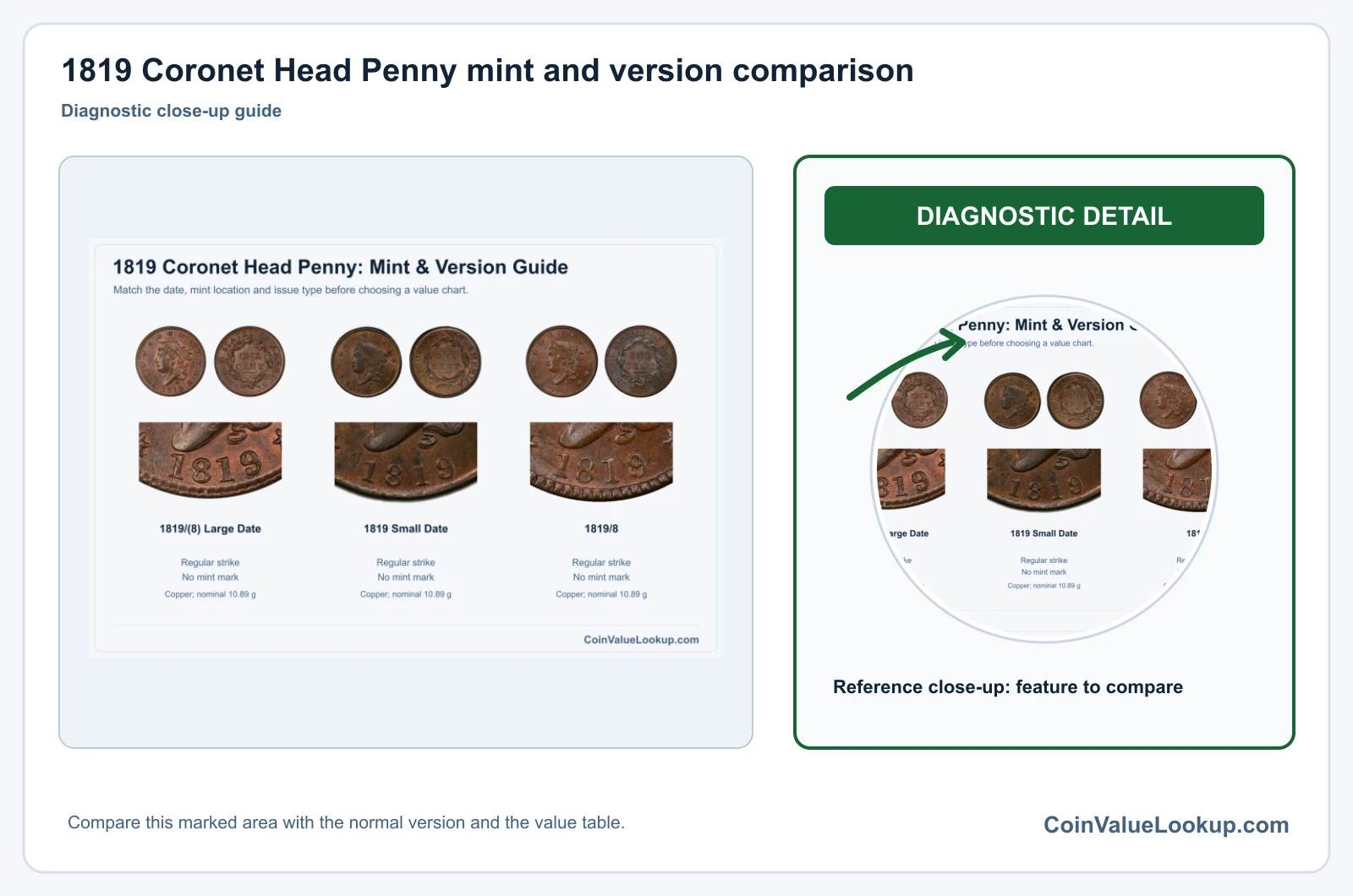
Every 1819 Coronet Head Cent was struck at Philadelphia, so there is no mintmark to hunt for. The three main business-strike branches are Large Date, Small Date and the 1819/8 overdate, and telling them apart comes down to the date punches.
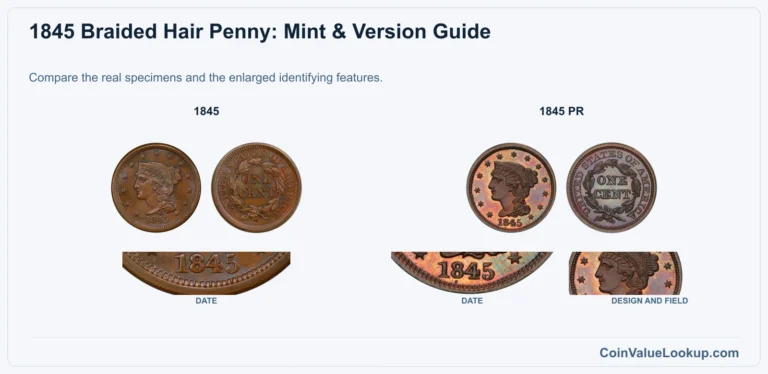
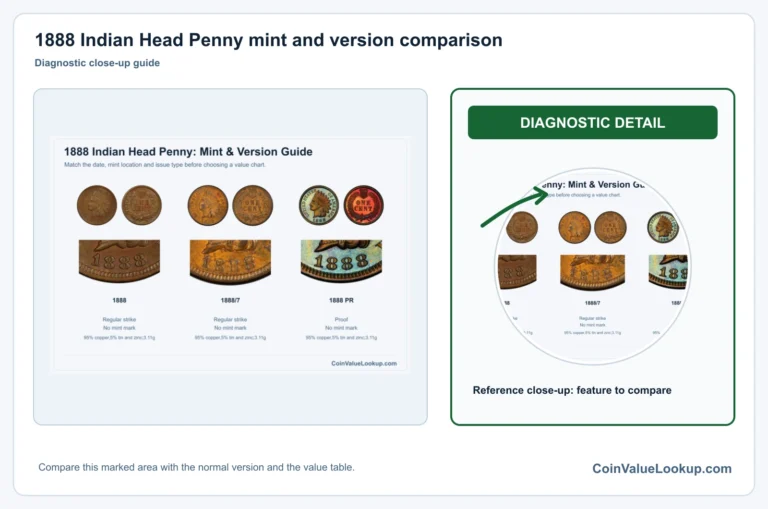
For the overdate, look at the final digit: remnants of an underlying "8" will show beneath or around the "9." Faint traces earn the parenthetical designation 1819/(8), while a bold, obvious underdigit is the full 1819/8. If you see no trace of an earlier numeral at all, move on to date size.
Large Date numerals are taller and wider than Small Date numerals on the same denomination. Compare the "1" and the "8" side by side with known reference images.
The difference is visible to the naked eye once you know what to look for.
Weight can help confirm the coin is genuine copper at the expected nominal 10.89 grams, but wear, corrosion and normal production tolerances mean weight alone does not prove authenticity. Check both faces and the edge for consistent design details, correct legend wording and proper wreath style.
Step 2: Check Your 1819 Coronet Head Cent Grade
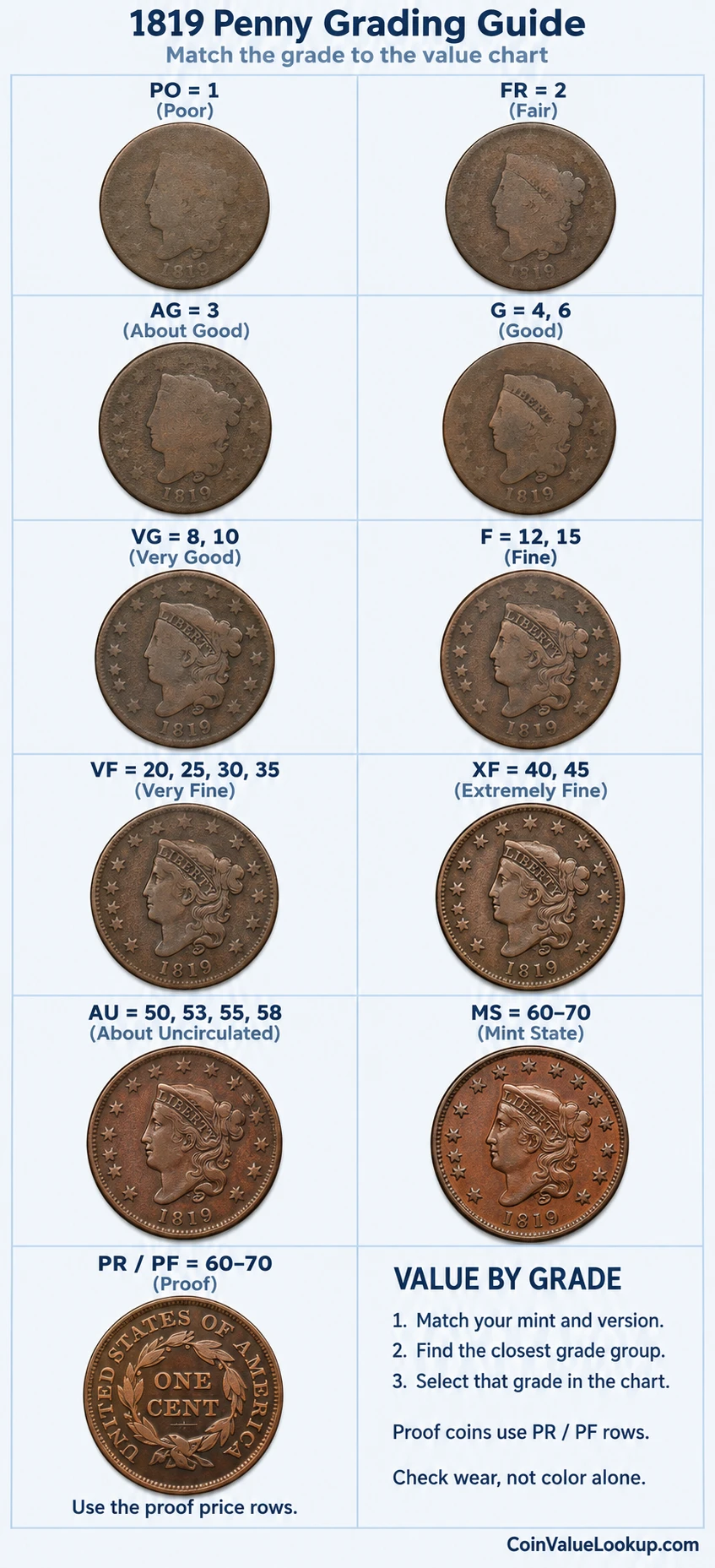
Start with Liberty's portrait. On a well-worn coin the hair above the forehead and behind the ear will merge into flat areas first, and the cheek loses its rounded contour.
A G4 coin shows a readable date and enough outline to identify the type, but most fine detail is gone.
Move to the reverse wreath. Individual leaf veins disappear before the leaf outlines do.
Letters in ONE CENT and UNITED STATES OF AMERICA wear from the tops down.
Use the comparison image to match your coin against like-type grade examples at several points on the scale. Pay attention to whether lost detail is from honest circulation or from something else entirely.
Weak strikes, porosity and old corrosion can mimic wear. A weakly struck coin may look lower-grade than it actually is, while a corroded surface can disguise remaining relief.
These surface problems reduce market appeal regardless of the technical wear grade.
On uncirculated copper, color matters. BN (brown), RB (red-brown) and RD (red) describe the remaining original color, not different metals.
Most surviving 1819 cents are fully brown by now. A coin with significant original red at the MS63 level commands a stronger premium than a brown example at the same grade.
Step 3: Check 1819 Coronet Head Cent Value by Mint and Version
1819 Coronet Head Cent — /(8) Large Date
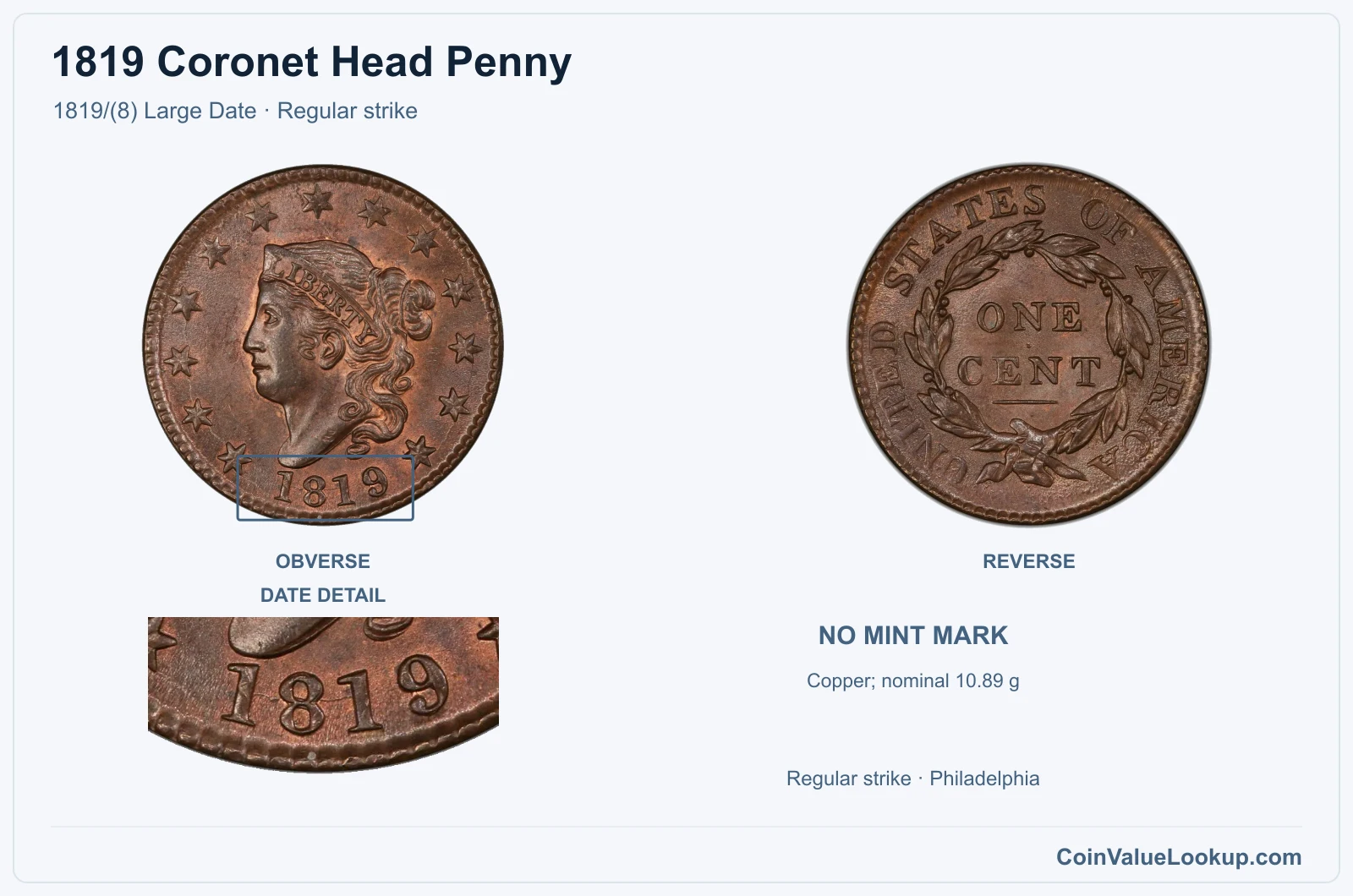
The 1819/(8) Large Date pairs a Large Date punch with faint evidence of an underlying "8" beneath the final "9." You need magnification and good light to spot those traces; they are subtle compared to the full 1819/8 overdate. USA Coin Book guide estimates place this variety at about $38 in G4 and around $1,344 in MS63.
All were struck in copper at Philadelphia with no mintmark. Confirm the large numeral style first, then examine the base and curves of the 9 for any remnant of the earlier digit.
| Range | Grade | Price | Auction Records | Appraisal |
|---|---|---|---|---|
| PO | PO 1 | — | Coin Identifier | |
| FR | FR 2 | — | Coin Identifier | |
| AG | AG 3 | — | Coin Identifier | |
| G | G 4 | Coin Identifier | ||
| G 6 | — | Coin Identifier | ||
| VG | VG 8 | Coin Identifier | ||
| VG 10 | Coin Identifier | |||
| F | F 12 | — | Coin Identifier | |
| F 15 | — | Coin Identifier | ||
| VF | VF 20 | Coin Identifier | ||
| VF 25 | — | Coin Identifier | ||
| VF 30 | Coin Identifier | |||
| VF 35 | Coin Identifier | |||
| XF | XF 40 | Coin Identifier | ||
| XF 45 | Coin Identifier | |||
| AU | AU 50 | Coin Identifier | ||
| AU 53 | Coin Identifier | |||
| AU 55 | Coin Identifier | |||
| AU 58 | Coin Identifier | |||
| MS | MS 60 | — | Coin Identifier | |
| MS 61 | Coin Identifier | |||
| MS 62 | Coin Identifier | |||
| MS 63 | Coin Identifier | |||
| MS 64 | Coin Identifier | |||
| MS 65 | Coin Identifier | |||
| MS 66 | Coin Identifier | |||
| MS 67 | — | — | — | |
| MS 68 | — | — | — | |
| MS 69 | — | — | — | |
| MS 70 | — | — | — |
1819 Coronet Head Cent — Small Date
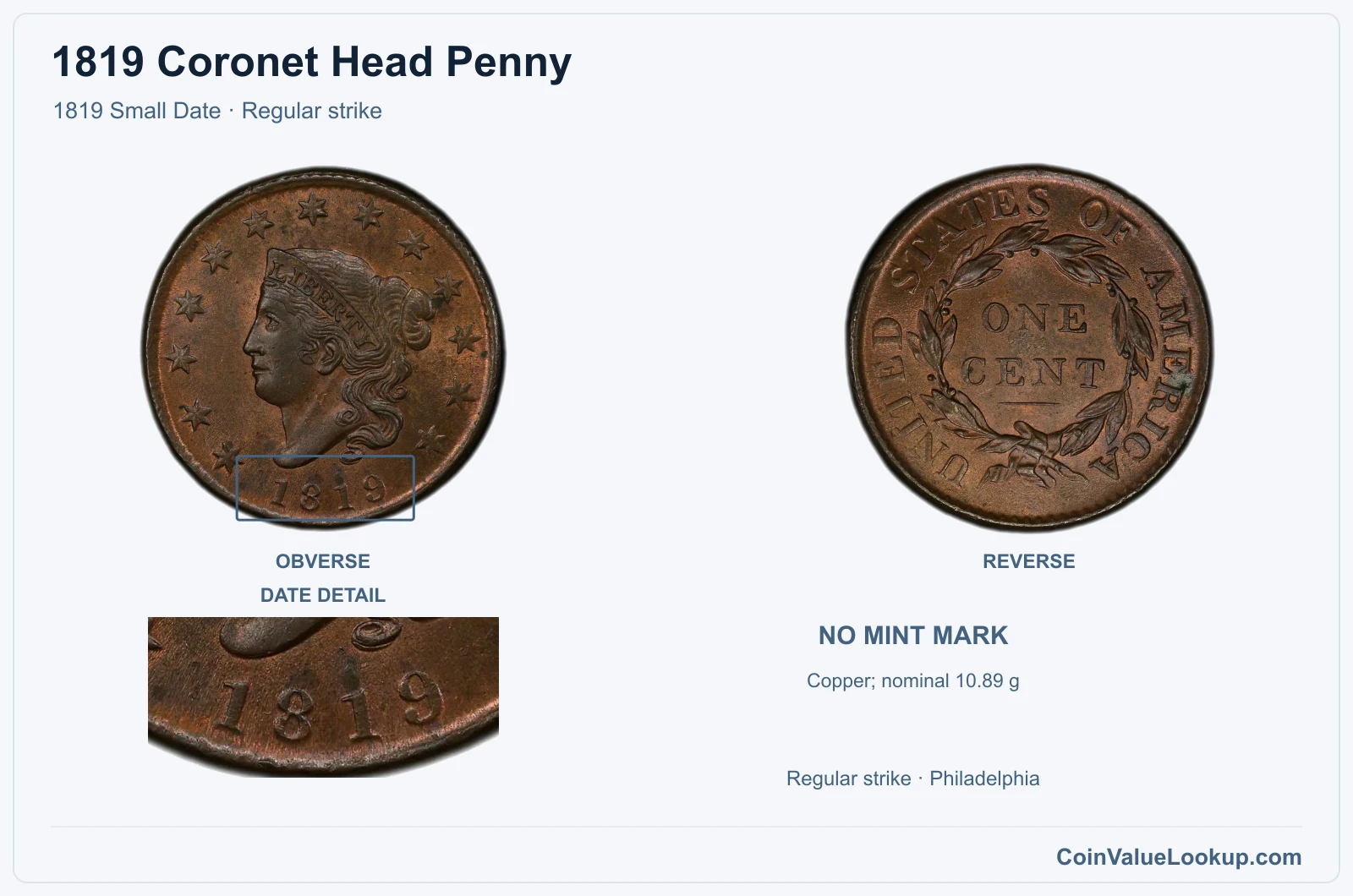
The 1819 Small Date uses noticeably smaller, more compact date numerals than the Large Date version. Hold both next to a reference photo and the difference in the height and width of the "1" and "8" is clear.
Guide estimates from USA Coin Book run from roughly $38 in G4 to about $1,445 in MS63. Like all 1819 cents, this is a copper issue from Philadelphia with no mintmark.
In lower circulated grades the two date sizes trade near identical money, but the gap widens as condition improves.
| Range | Grade | Price | Auction Records | Appraisal |
|---|---|---|---|---|
| PO | PO 1 | — | Coin Identifier | |
| FR | FR 2 | — | Coin Identifier | |
| AG | AG 3 | — | Coin Identifier | |
| G | G 4 | — | Coin Identifier | |
| G 6 | — | Coin Identifier | ||
| VG | VG 8 | Coin Identifier | ||
| VG 10 | — | Coin Identifier | ||
| F | F 12 | Coin Identifier | ||
| F 15 | — | Coin Identifier | ||
| VF | VF 20 | Coin Identifier | ||
| VF 25 | Coin Identifier | |||
| VF 30 | Coin Identifier | |||
| VF 35 | Coin Identifier | |||
| XF | XF 40 | Coin Identifier | ||
| XF 45 | Coin Identifier | |||
| AU | AU 50 | Coin Identifier | ||
| AU 53 | Coin Identifier | |||
| AU 55 | Coin Identifier | |||
| AU 58 | Coin Identifier | |||
| MS | MS 60 | — | Coin Identifier | |
| MS 61 | Coin Identifier | |||
| MS 62 | Coin Identifier | |||
| MS 63 | Coin Identifier | |||
| MS 64 | Coin Identifier | |||
| MS 65 | Coin Identifier | |||
| MS 66 | — | — | — | |
| MS 67 | — | — | — | |
| MS 68 | — | — | — | |
| MS 69 | — | — | — | |
| MS 70 | — | — | — |
1819 Coronet Head Cent — /8
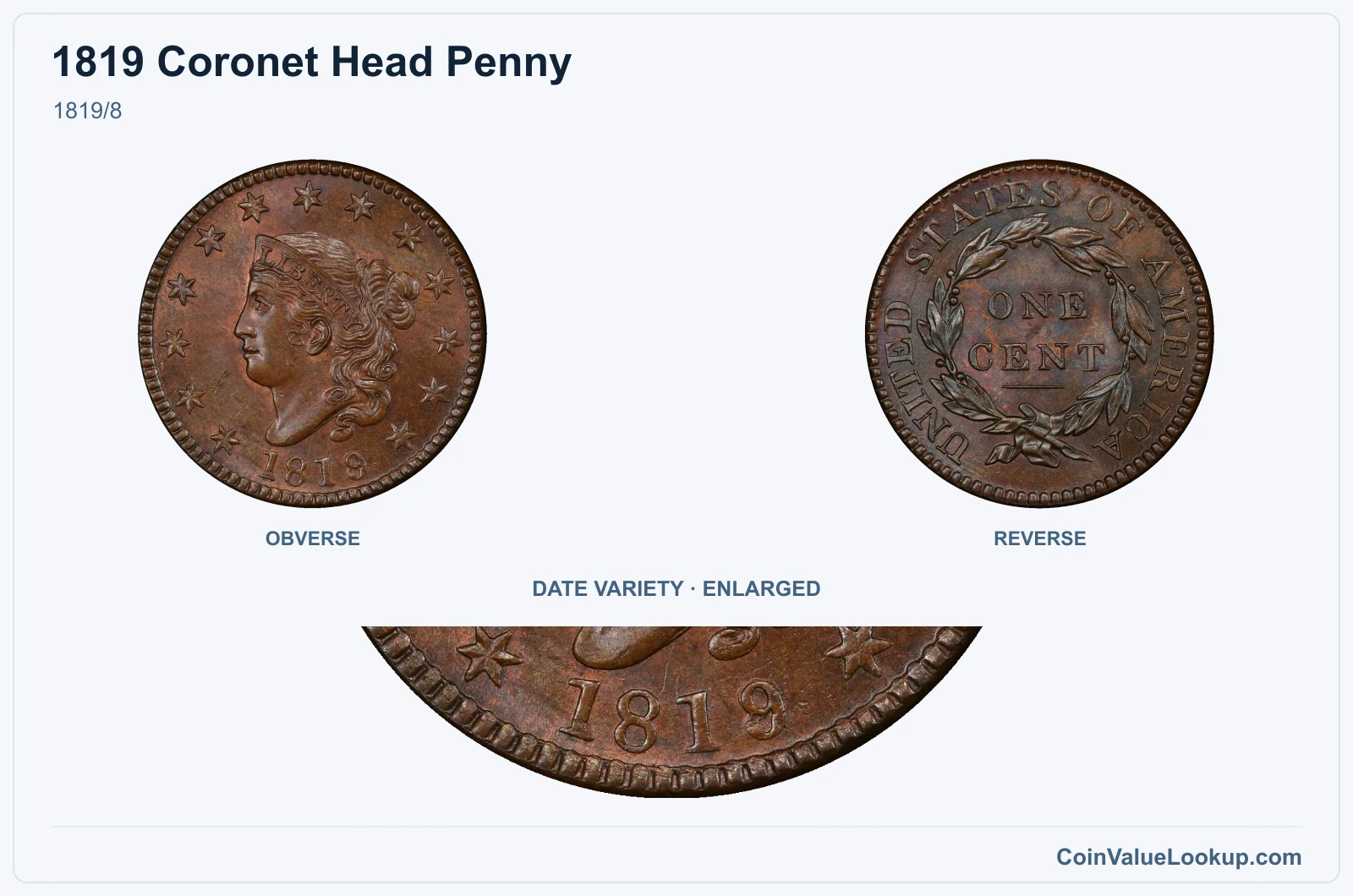
This is the headline variety for 1819. The 1819/8 overdate shows bold, unmistakable remnants of an "8" beneath the "9" in the date.
You do not need a loupe to see it on a decent example, though wear can soften the evidence on heavily circulated pieces. USA Coin Book lists this variety from about $38 in G4 up to approximately $2,073 at MS63, the highest guide figure among 1819 business strikes.
Philadelphia struck these in copper at the standard nominal weight of 10.89 grams. Because the overdate is dramatic and well-known, even low-grade examples attract specialist attention.
Confirm the underlying digit carefully: a damaged or corroded date is not the same thing as an overdate.
| Range | Grade | Price | Auction Records | Appraisal |
|---|---|---|---|---|
| PO | PO 1 | — | Coin Identifier | |
| FR | FR 2 | — | Coin Identifier | |
| AG | AG 3 | Coin Identifier | ||
| G | G 4 | Coin Identifier | ||
| G 6 | — | Coin Identifier | ||
| VG | VG 8 | — | Coin Identifier | |
| VG 10 | Coin Identifier | |||
| F | F 12 | — | Coin Identifier | |
| F 15 | — | Coin Identifier | ||
| VF | VF 20 | Coin Identifier | ||
| VF 25 | Coin Identifier | |||
| VF 30 | Coin Identifier | |||
| VF 35 | Coin Identifier | |||
| XF | XF 40 | Coin Identifier | ||
| XF 45 | Coin Identifier | |||
| AU | AU 50 | Coin Identifier | ||
| AU 53 | Coin Identifier | |||
| AU 55 | Coin Identifier | |||
| AU 58 | Coin Identifier | |||
| MS | MS 60 | Coin Identifier | ||
| MS 61 | Coin Identifier | |||
| MS 62 | Coin Identifier | |||
| MS 63 | Coin Identifier | |||
| MS 64 | Coin Identifier | |||
| MS 65 | Coin Identifier | |||
| MS 66 | — | — | — | |
| MS 67 | — | — | — | |
| MS 68 | — | — | — | |
| MS 69 | — | — | — | |
| MS 70 | — | — | — |
1819 Coronet Head Cent — Proof
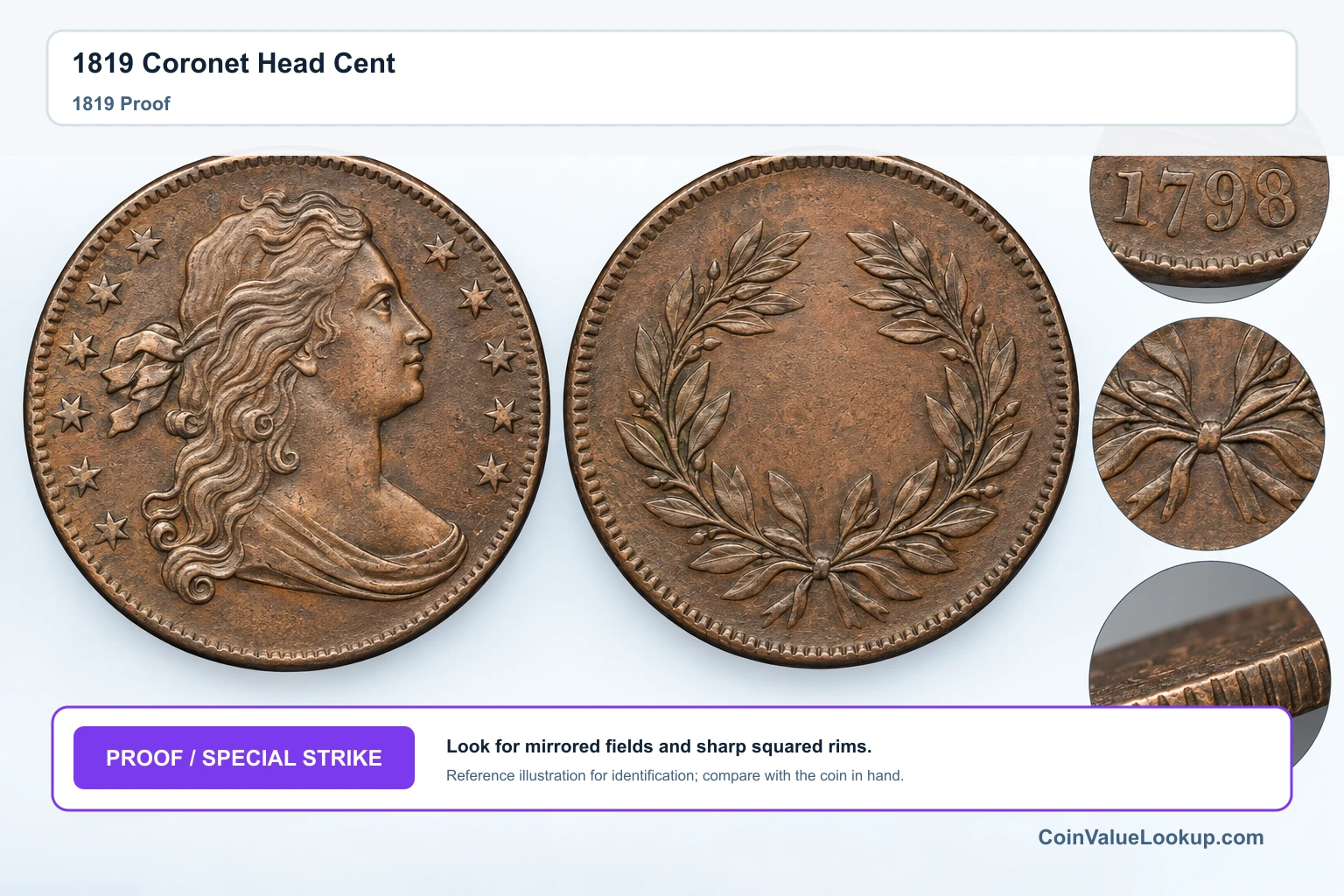
PCGS catalogs a proof striking of the 1819 Coronet Head Cent. These early proofs are exceptionally rare and were produced in tiny quantities, likely for presentation or collector purposes.
A proof is identified by its method of manufacture, including squared rims, fully struck devices and mirror-like fields, not simply by a shiny surface. Polishing a business strike does not create a proof.
Coin Value Lookup is a good starting point if you want to compare your coin against other Coronet Head Cent dates and varieties before seeking professional attribution.
No guide price is adopted for this branch. Each example requires individual assessment based on authenticated identity, surface quality and provenance.
Values by grade are not available for this coin yet.
1819 Coronet Head Cent — /8 Proof
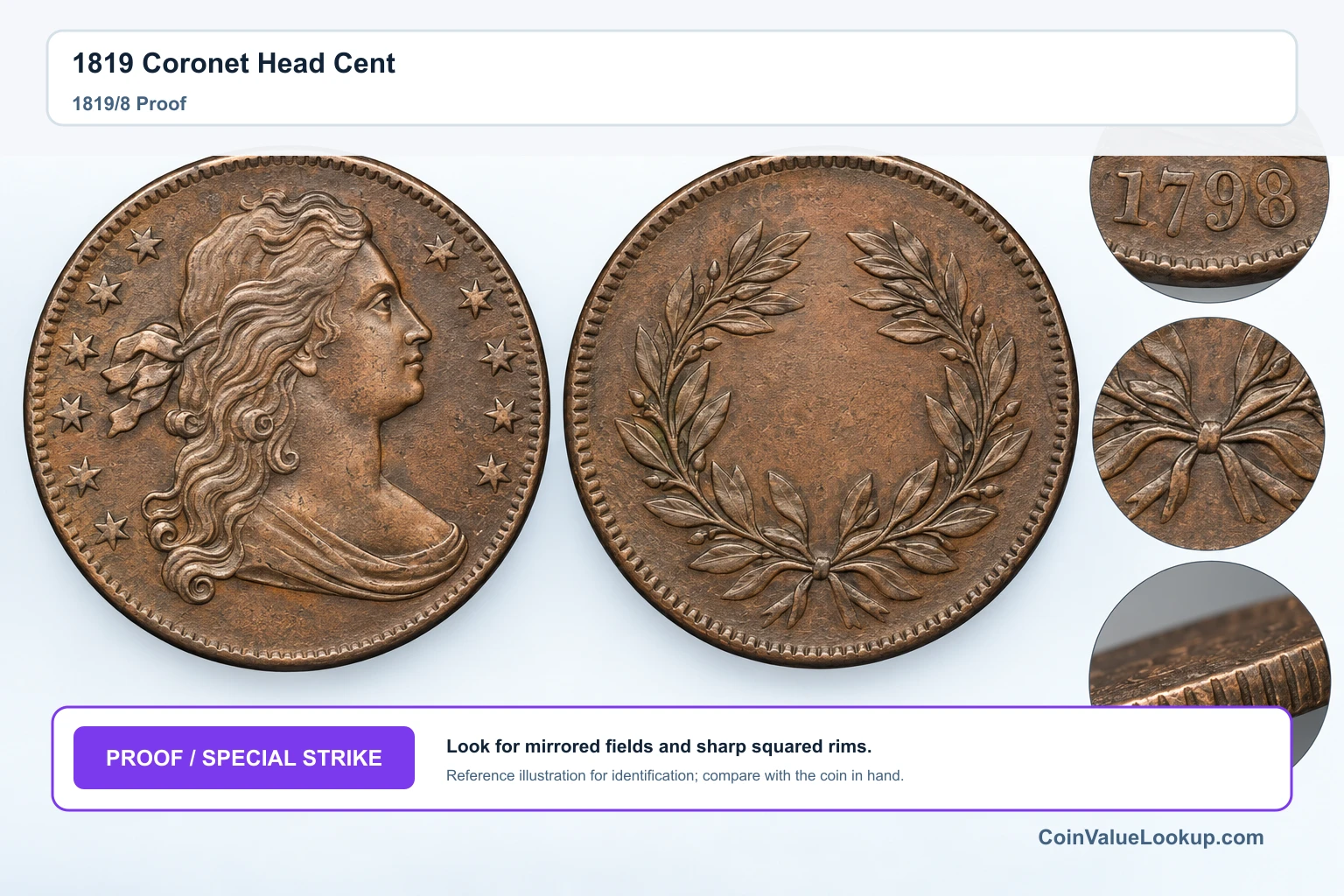
The 1819/8 Proof combines two layers of rarity: it is both an overdate and a proof striking. PCGS lists this branch in its catalog alongside the plain 1819 Proof.
To qualify, a coin must show the bold underlying "8" beneath the "9" and display proof manufacturing characteristics such as squared rims, full design definition and reflective fields.
Do not confuse a well-preserved business strike with a proof. The distinction is in how the coin was made, not how nice it looks.
No numeric guide price is adopted for this variety. Any example that surfaces would require professional authentication and individual valuation based on its condition, surfaces and documented history.
| Range | Grade | Price | Auction Records | Appraisal |
|---|---|---|---|---|
| PR | PR 1 | — | Coin Identifier | |
| PR 2 | — | Coin Identifier | ||
| PR 3 | — | Coin Identifier | ||
| PR 4 | — | Coin Identifier | ||
| PR 6 | — | Coin Identifier | ||
| PR 8 | — | Coin Identifier | ||
| PR 10 | — | Coin Identifier | ||
| PR 12 | — | Coin Identifier | ||
| PR 15 | — | Coin Identifier | ||
| PR 20 | — | Coin Identifier | ||
| PR 25 | — | Coin Identifier | ||
| PR 30 | — | Coin Identifier | ||
| PR 35 | — | Coin Identifier | ||
| PR 40 | — | Coin Identifier | ||
| PR 45 | — | Coin Identifier | ||
| PR 50 | — | Coin Identifier | ||
| PR 53 | — | Coin Identifier | ||
| PR 55 | — | Coin Identifier | ||
| PR 58 | — | Coin Identifier | ||
| PR 60 | — | Coin Identifier | ||
| PR 61 | — | Coin Identifier | ||
| PR 62 | — | Coin Identifier | ||
| PR 63 | — | Coin Identifier | ||
| PR 64 | Coin Identifier | |||
| PR 65 | — | — | — | |
| PR 66 | — | — | — | |
| PR 67 | — | — | — | |
| PR 68 | — | — | — | |
| PR 69 | — | — | — | |
| PR 70 | — | — | — |
1819 Coronet Head Cent Error List
1. 1819 Coronet Head Cent — Rotated Dies
On a normally aligned U.S. coin, if you hold the obverse upright and flip the coin top-to-bottom, the reverse should also appear upright but rotated 180 degrees (coin turn). A rotated-die error means the reverse is tilted away from that standard alignment by a measurable amount.
To check, hold your 1819 cent with Liberty facing you right-side up. Flip it along the vertical axis.
If the wreath side is noticeably crooked, you may have a rotation error. Slight rotations are more common than dramatic ones, and the premium generally increases with the degree of misalignment.
Be careful with photographs: a picture taken at an angle can fake a rotation that does not exist on the actual coin. Always verify in hand.
No adopted price range is available; value depends on the degree of rotation, the coin's condition and professional confirmation.
2. 1819 Coronet Head Cent — Lamination / Split Planchet
A lamination or split-planchet error on an 1819 cent appears as peeling, flaking or outright separation within the copper. You might see a thin retained flap still attached to the surface, or an area where metal has lifted away and exposed a rougher layer beneath.
Photograph the edge and the affected face together so the depth of the separation is visible. This helps distinguish a genuine lamination from surface corrosion, old scraping or a coin that someone deliberately cut or shaved.
Corrosion on early copper cents is extremely common and can look similar at first glance, so examine whether the flaw follows the metal's internal structure or whether it follows a random external pattern. No numeric price is adopted for this error; each piece is assessed individually based on the size and visual impact of the flaw, overall coin condition and authentication.
3. 1819 Coronet Head Cent — Die Crack
Die cracks show up as thin raised lines running across the coin's surface. They form when the steel die develops a fracture during use, and that crack transfers as a raised ridge onto every coin struck afterward.
On an 1819 cent, look for fine lines crossing the fields or cutting through letters and devices.
The key word is raised. A scratch or tool mark is incuse, pressed into the surface.
A die crack sits above the surrounding field. Use angled lighting to confirm whether the line casts a shadow consistent with raised metal.
Corrosion lines can also mimic cracks, but they tend to be irregular and follow surface pitting rather than a clean path. No adopted price is available for die-crack varieties on this date; value depends on crack prominence, location and the coin's overall condition.
4. 1819 Coronet Head Cent — Die Break / Cud
A cud is a specific type of die break where a piece of the die has broken away at the rim, leaving a raised blob of featureless metal on the struck coin. It connects to the rim, which distinguishes it from an interior die chip or a simple die crack.
On an 1819 cent, check the rim carefully for any area where normal design or lettering is replaced by a smooth, raised lump. The boundary between the cud and the remaining design should be relatively sharp.
Do not confuse a rim dent, which is damage to the coin after striking, with a cud. A dent pushes metal inward; a cud is raised and was part of the striking process.
Interior die chips, while related, do not touch the rim and are a separate category. No numeric price is adopted.
Each cud's premium depends on its size, location and the coin's preservation.
5. 1819 Coronet Head Cent — Overdate
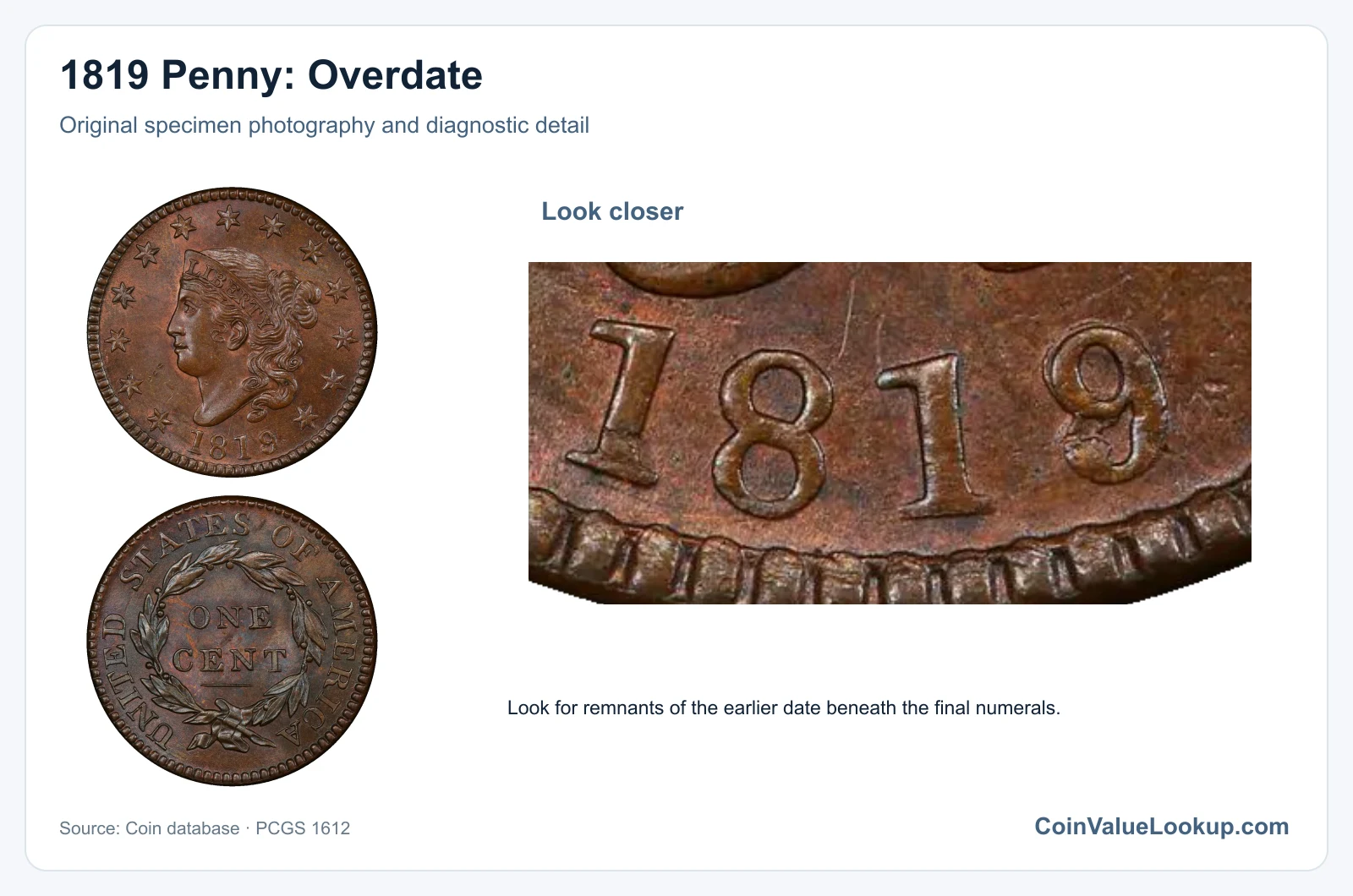
The overdate on 1819 cents is the well-known 1819/8, where the Mint punched a "9" over a previously entered "8" in the date logotype die. Surviving contours of the "8" are visible around and beneath the curves of the "9," particularly at the lower loop.
This is a die variety, not a post-strike alteration. The evidence should be consistent across the entire digit and match known die-state references.
A date that simply looks odd due to a hit, corrosion or machine doubling is not an overdate.
Ordinary differences in date-punch font style between the Large Date and Small Date are also not overdates. If you think you see a trace of an earlier digit, compare it against the specific 1819/8 branch listed in this guide.
No separate error-category price is adopted beyond the variety prices already listed for the 1819/8 and 1819/(8) Large Date business strikes.