2022 Lincoln Penny Coin Value: How Much Is It Worth?
A 2022 Lincoln cent in typical circulated condition is worth about one cent — face value, nothing more. In higher uncirculated grades, a guide estimate for an MS65 example runs around $0.36, while a standard 2022-S proof carries a PR65 guide estimate of roughly $6.26 from USA Coin Book.
Collector finishes, major varieties, and visible errors each represent separate markets with their own pricing.
Fast Way to Identify Your 2022 Lincoln Penny
The quickest way to start figuring out what your 2022 penny is worth is to upload clear photos of the front and back. That lets us offer a preliminary identification of your coin's mint, version, and condition.
Good lighting and a steady hand help — try to capture the full coin edge to edge, both sides.
2022 Penny Value
Upload both sides of your 2022 Lincoln Penny.
Front Obverse
Upload photo
Back Reverse
Upload photo
Which 2022 Lincoln Penny Versions Are Worth Money?
- Ordinary circulated 2022 pennies from Philadelphia or Denver are worth face value; original bright red surfaces and high uncirculated grades can bring a small premium above that.
- Separate any 2022-S proof from ordinary P and D business strikes before comparing grades and prices — proofs are a distinct collector product with a higher baseline value.
Step 1: Identify Your 2022 Lincoln Penny Mint Mark and Version
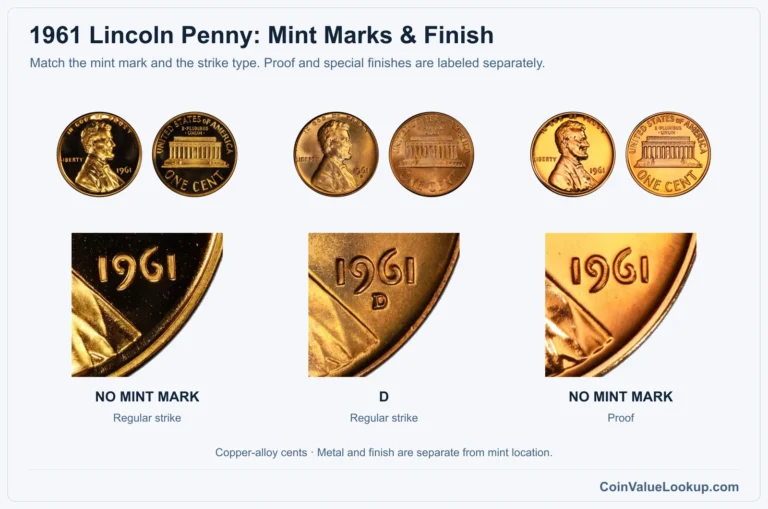
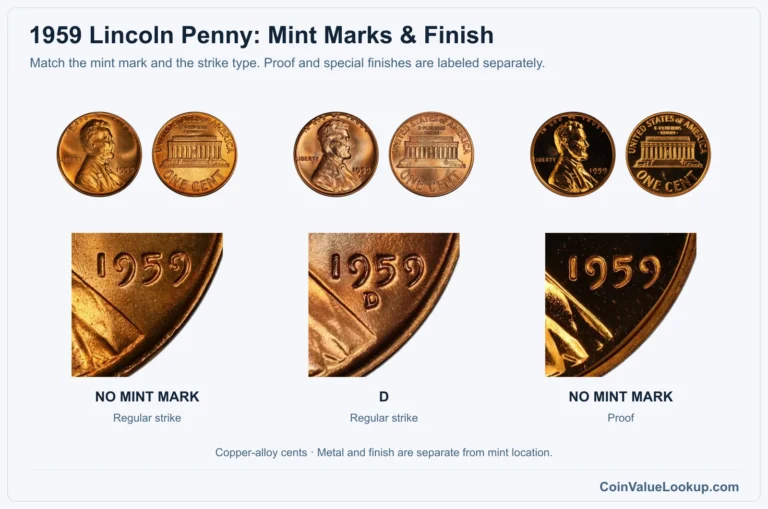
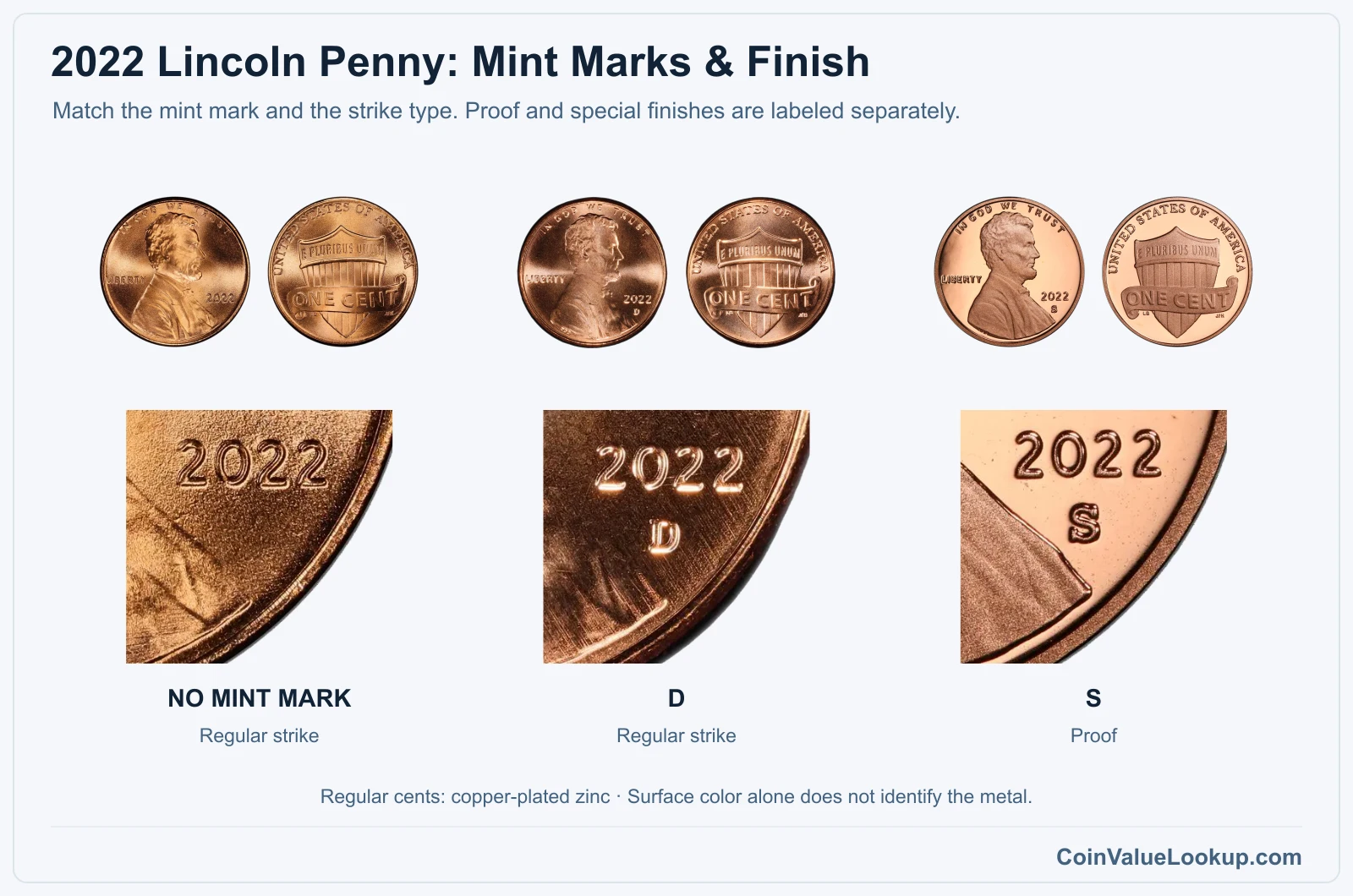
Flip your coin to the obverse (the Lincoln portrait side) and look just below the date. No letter at all means Philadelphia.
A small "D" means Denver. An "S" means San Francisco, and those are almost always proofs sold in collector sets — you won't find them in pocket change.
On the reverse, you should see the Union Shield design that has been used since 2010. If you see the Lincoln Memorial or one of the four 2009 commemorative reverses, you have a different coin entirely.
All standard 2022 cents are copper-plated zinc, weighing about 2.50 grams. The copper layer is thin; it is the plating over a zinc core.
You cannot identify an off-metal error by appearance alone — that requires precise weighing and sometimes additional testing.
Step 2: Check Your 2022 Lincoln Penny Grade
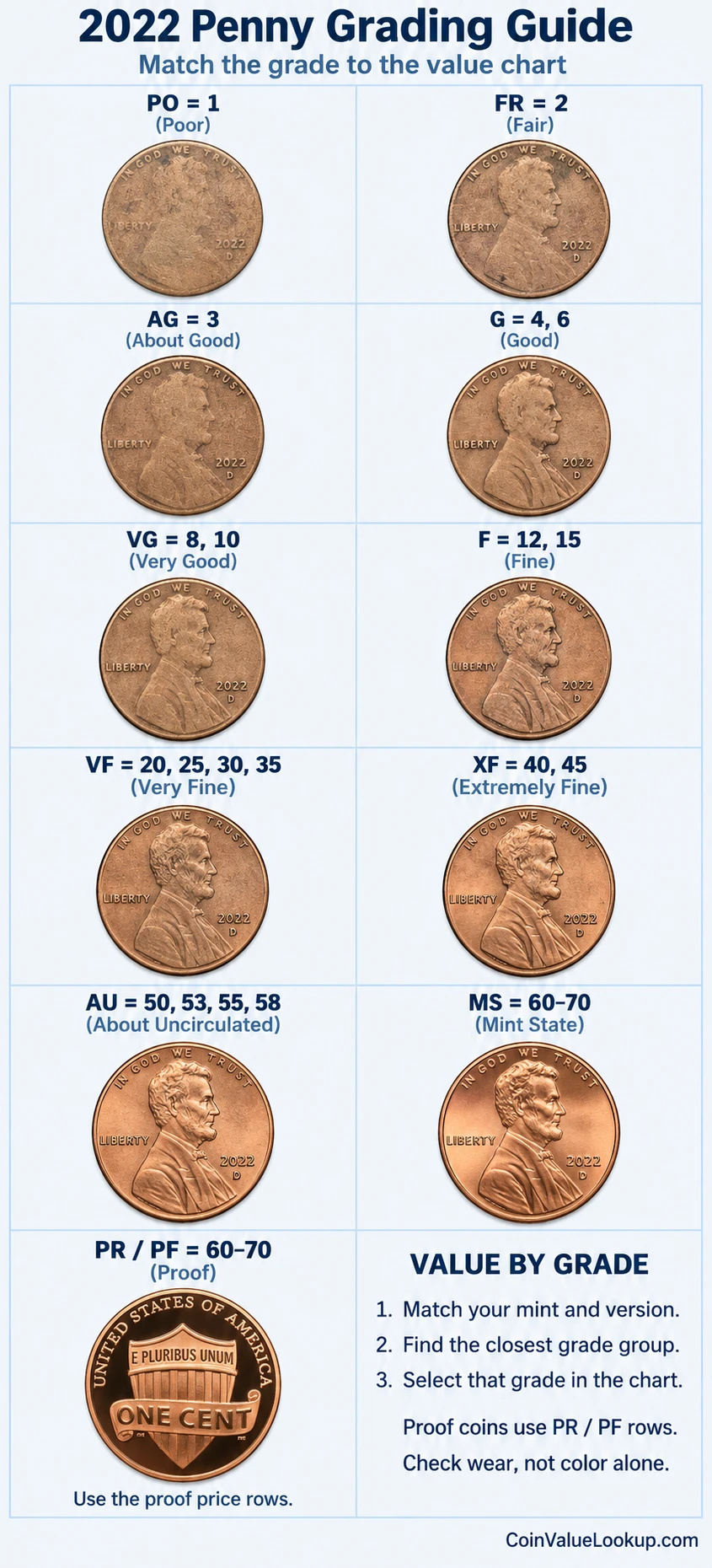
Start with Lincoln's cheek and jawline on the obverse. On a well-worn coin these areas flatten first, losing fine detail.
The hair above the ear is another early-wear checkpoint. On the reverse, look at the horizontal lines of the shield — they soften quickly in circulation.
Luster matters a lot. A coin that still has its original mint shine across the entire surface is in a different league from one that looks dull and flat, even if the design detail seems sharp.
Color designations — RD (red), RB (red-brown), and BN (brown) — describe the remaining original copper tone, not the amount of wear. A coin can be uncirculated and brown.
Proof is a manufacturing finish with mirror-like fields, not a grade above Mint State. Use the comparison image to match your coin's wear level before drawing conclusions about value.
Step 3: Check 2022 Lincoln Penny Value by Mint and Version
2022 Lincoln Penny — Shield
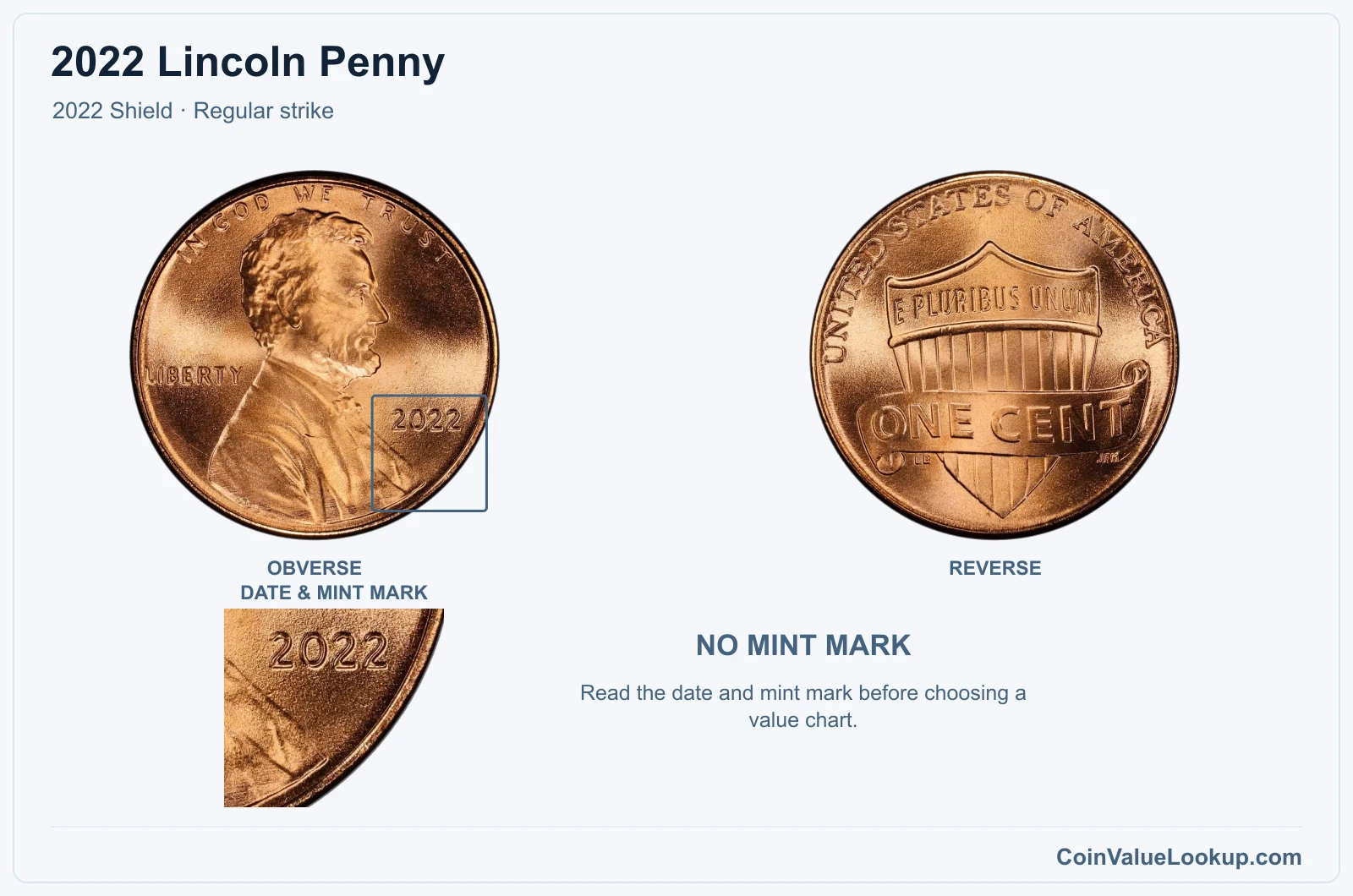
This is the Philadelphia-struck 2022 Shield cent — no mintmark below the date. It is a copper-plated zinc business strike weighing about 2.50 grams with the standard Lincoln portrait obverse and Union Shield reverse.
In circulated condition, it is worth one cent. A USA Coin Book guide estimate places an MS65 example at around $0.36.
To reach that level, the coin needs full design detail, strong original luster, and minimal contact marks. Bright red surfaces (the RD color designation) are preferred by registry collectors.
| Range | Grade | Price | Auction Records | Appraisal |
|---|---|---|---|---|
| PO | PO 1 | — | Coin Identifier | |
| FR | FR 2 | — | Coin Identifier | |
| AG | AG 3 | — | Coin Identifier | |
| G | G 4 | — | Coin Identifier | |
| G 6 | — | Coin Identifier | ||
| VG | VG 8 | — | Coin Identifier | |
| VG 10 | — | Coin Identifier | ||
| F | F 12 | — | Coin Identifier | |
| F 15 | — | Coin Identifier | ||
| VF | VF 20 | — | Coin Identifier | |
| VF 25 | — | Coin Identifier | ||
| VF 30 | — | Coin Identifier | ||
| VF 35 | — | Coin Identifier | ||
| XF | XF 40 | — | Coin Identifier | |
| XF 45 | — | Coin Identifier | ||
| AU | AU 50 | — | Coin Identifier | |
| AU 53 | — | Coin Identifier | ||
| AU 55 | — | Coin Identifier | ||
| AU 58 | — | Coin Identifier | ||
| MS | MS 60 | — | Coin Identifier | |
| MS 61 | — | Coin Identifier | ||
| MS 62 | — | Coin Identifier | ||
| MS 63 | — | Coin Identifier | ||
| MS 64 | — | Coin Identifier | ||
| MS 65 | — | Coin Identifier | ||
| MS 66 | — | Coin Identifier | ||
| MS 67 | — | Coin Identifier | ||
| MS 68 | Coin Identifier | |||
| MS 69 | — | — | — | |
| MS 70 | — | — | — |
2022 Lincoln Penny — D Shield
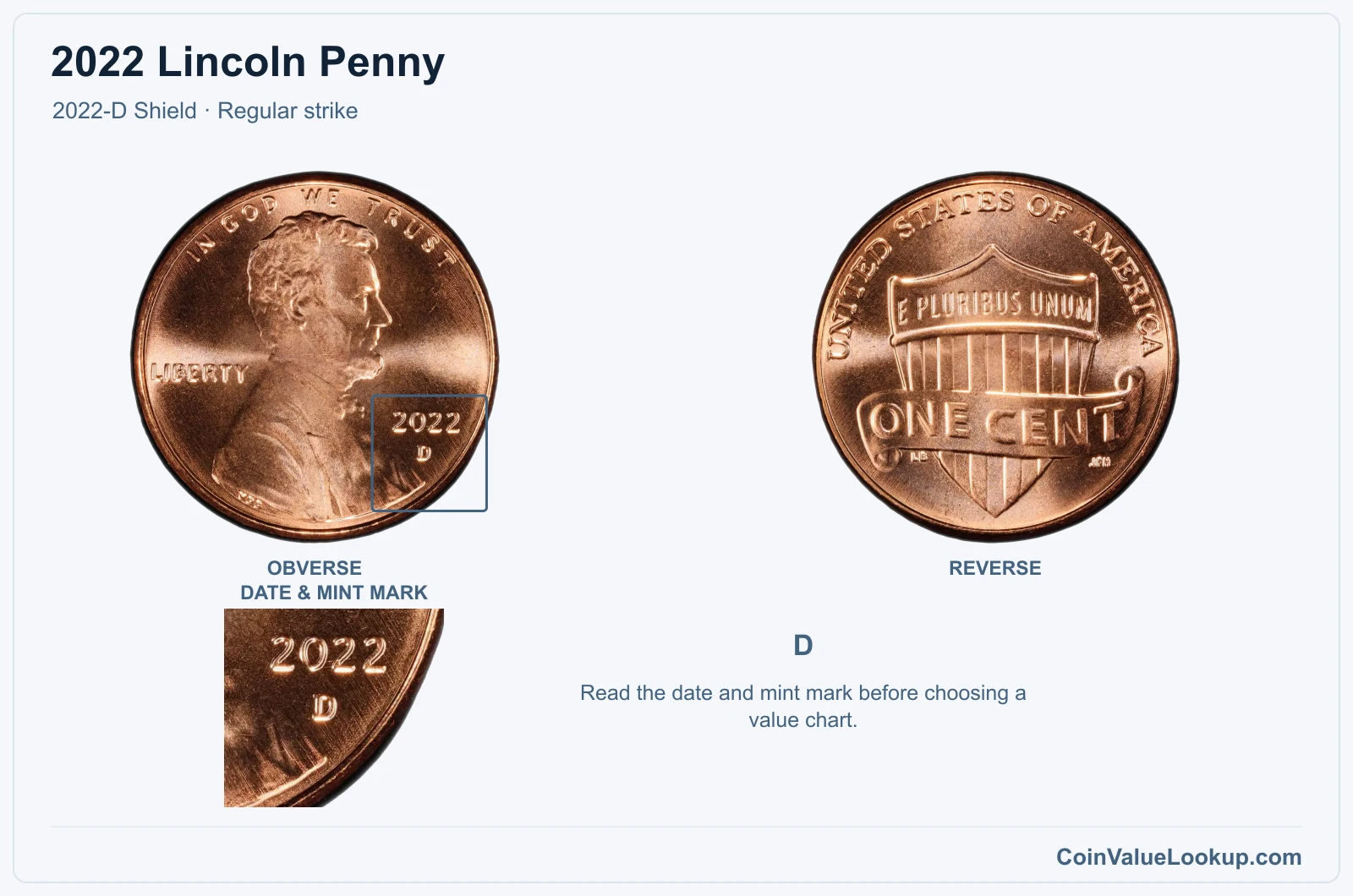
The 2022-D Shield cent was struck at Denver and carries a small "D" mintmark below the date. Same copper-plated zinc composition, same 2.50-gram weight, same Union Shield reverse.
Value-wise, it mirrors the Philadelphia issue. Circulated pieces sit at face value, and the USA Coin Book guide estimate for MS65 is about $0.36.
Look for clean fields, full shield lines, and unbroken luster when evaluating higher-grade candidates.
Coin Value Lookup is a handy starting point if you want to compare your 2022-D cent against other years and mints in the Lincoln series.
| Range | Grade | Price | Auction Records | Appraisal |
|---|---|---|---|---|
| PO | PO 1 | — | Coin Identifier | |
| FR | FR 2 | — | Coin Identifier | |
| AG | AG 3 | — | Coin Identifier | |
| G | G 4 | — | Coin Identifier | |
| G 6 | — | Coin Identifier | ||
| VG | VG 8 | — | Coin Identifier | |
| VG 10 | — | Coin Identifier | ||
| F | F 12 | — | Coin Identifier | |
| F 15 | — | Coin Identifier | ||
| VF | VF 20 | — | Coin Identifier | |
| VF 25 | — | Coin Identifier | ||
| VF 30 | — | Coin Identifier | ||
| VF 35 | — | Coin Identifier | ||
| XF | XF 40 | — | Coin Identifier | |
| XF 45 | — | Coin Identifier | ||
| AU | AU 50 | — | Coin Identifier | |
| AU 53 | — | Coin Identifier | ||
| AU 55 | — | Coin Identifier | ||
| AU 58 | — | Coin Identifier | ||
| MS | MS 60 | — | Coin Identifier | |
| MS 61 | — | Coin Identifier | ||
| MS 62 | — | Coin Identifier | ||
| MS 63 | — | Coin Identifier | ||
| MS 64 | — | Coin Identifier | ||
| MS 65 | — | Coin Identifier | ||
| MS 66 | — | Coin Identifier | ||
| MS 67 | — | — | — | |
| MS 68 | — | — | — | |
| MS 69 | — | — | — | |
| MS 70 | — | — | — |
2022 Lincoln Penny — S Shield PR
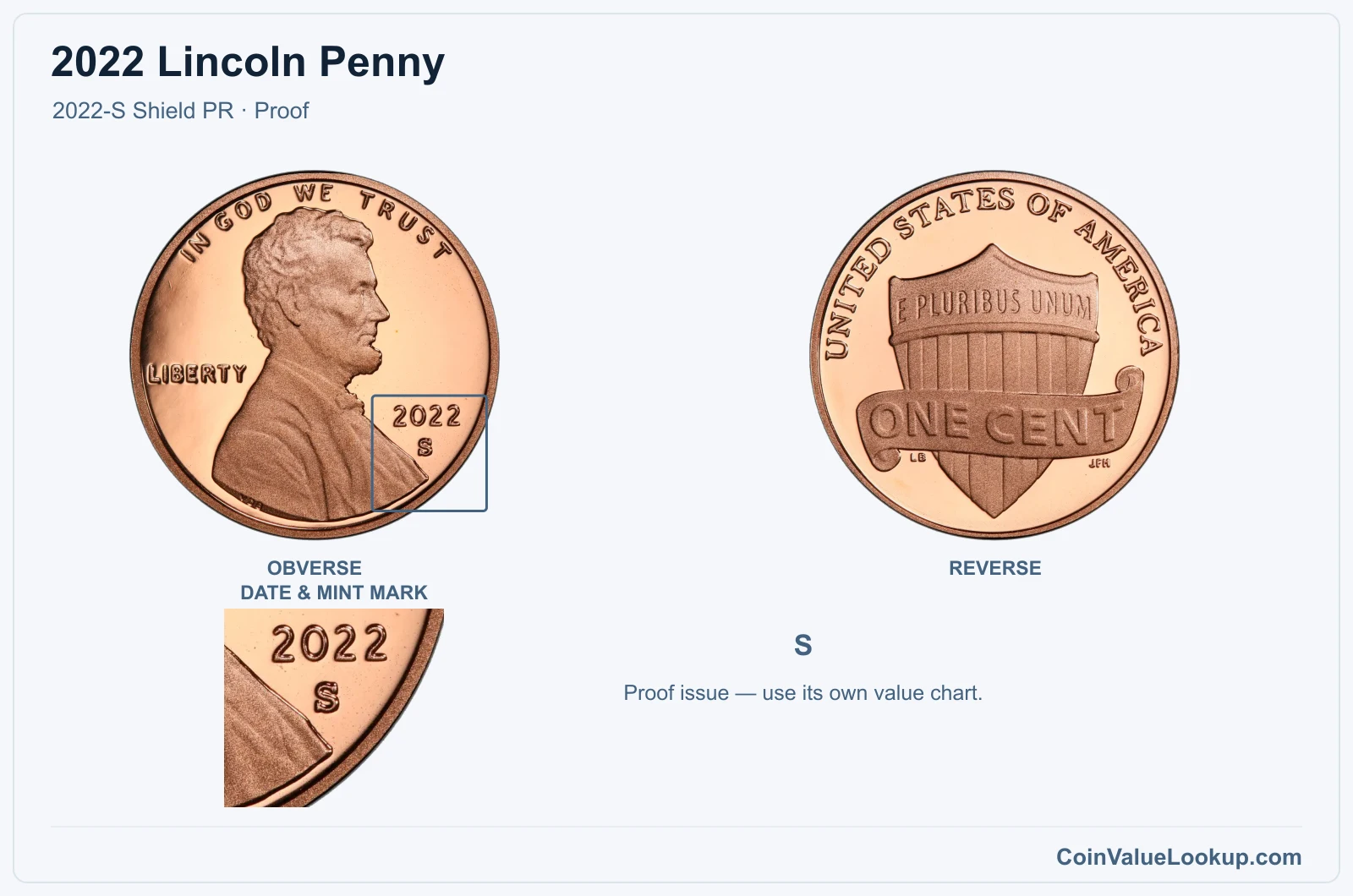
The 2022-S Shield cent is a proof struck at San Francisco. You will find the "S" mintmark below the date.
These were sold in collector proof sets — they did not enter general circulation.
Proofs have mirror-like fields and sharply struck design elements. Cameo and deep cameo contrast, where frosted devices stand out against glassy fields, are graded separately.
The USA Coin Book guide estimate for a standard PR65 is about $6.26.
Because these coins ship in sealed packaging, most surviving examples grade well above PR65. Condition and the degree of cameo contrast are the main variables that separate one proof from another in the marketplace.
| Range | Grade | Price | Auction Records | Appraisal |
|---|---|---|---|---|
| PR | PR 1 | — | Coin Identifier | |
| PR 2 | — | Coin Identifier | ||
| PR 3 | — | Coin Identifier | ||
| PR 4 | — | Coin Identifier | ||
| PR 6 | — | Coin Identifier | ||
| PR 8 | — | Coin Identifier | ||
| PR 10 | — | Coin Identifier | ||
| PR 12 | — | Coin Identifier | ||
| PR 15 | — | Coin Identifier | ||
| PR 20 | — | Coin Identifier | ||
| PR 25 | — | Coin Identifier | ||
| PR 30 | — | Coin Identifier | ||
| PR 35 | — | Coin Identifier | ||
| PR 40 | — | Coin Identifier | ||
| PR 45 | — | Coin Identifier | ||
| PR 50 | — | Coin Identifier | ||
| PR 53 | — | Coin Identifier | ||
| PR 55 | — | Coin Identifier | ||
| PR 58 | — | Coin Identifier | ||
| PR 60 | — | Coin Identifier | ||
| PR 61 | — | Coin Identifier | ||
| PR 62 | — | Coin Identifier | ||
| PR 63 | — | Coin Identifier | ||
| PR 64 | — | Coin Identifier | ||
| PR 65 | — | Coin Identifier | ||
| PR 66 | — | Coin Identifier | ||
| PR 67 | — | Coin Identifier | ||
| PR 68 | — | Coin Identifier | ||
| PR 69 | — | Coin Identifier | ||
| PR 70 | — | Coin Identifier |
2022 Lincoln Penny Error List
1. 2022 Lincoln Penny — BIE Die Break
A BIE die break shows up as a small raised vertical bar or blob between the letters B and E in LIBERTY on the obverse. It is caused by a crack or chip in the die surface that fills with metal during striking.
To check, look at LIBERTY under magnification. The extra raised element should sit between — not on — those two letters.
It will have a slightly irregular shape compared to the normal lettering.
Dirt lodged between the letters, a scratch running vertically, or added material after the coin left the mint can mimic this error. Genuine BIE breaks are raised and consistent with the surrounding surface metal.
No specific price range is established for this variety on 2022 cents; value depends on the authenticated identity, the clarity of the break, and overall coin condition.
2. 2022 Lincoln Penny — Struck-Through Error
A struck-through error happens when foreign material — grease, a fragment of metal, cloth, or debris — sits between the die and the planchet during striking. The result is a localized depression or incomplete design area on the finished coin.
Grease fill-ins tend to produce soft, shallow missing detail over a broad area. A retained struck-through, where part of the object stays embedded, is a different animal and usually more desirable.
Do not confuse this with ordinary wear, cleaning damage, or a weak strike. A struck-through area typically has sharp boundaries and undisturbed surfaces around it, while wear is gradual and cleaning leaves fine hairlines.
No established price range is adopted for 2022 struck-through cents. Each example is assessed individually based on the size, location, and nature of the obstruction, plus overall coin grade.
3. 2022 Lincoln Penny — Die Crack / Die Chip
Die cracks appear as raised lines on the coin's surface, following the path of a fracture in the steel die. Die chips are small raised blobs where a piece of the die face broke away.
Both are common on modern zinc cents because dies run at high volumes.
A crack that reaches the rim and produces a flat, shelf-like raised area is called a cud — that is a different level of severity. Interior cracks and small chips are far more common.
Look carefully: raised lines are the key diagnostic. An incuse scratch, corrosion trail, or foreign material stuck to the surface can look similar but will be recessed or sit on top rather than being part of the struck design.
No adopted price range exists for 2022 die cracks. Larger, more dramatic examples and cuds command more attention, but each coin needs individual assessment.
4. 2022 Lincoln Penny — Clipped Planchet
A clipped planchet error means a portion of the blank was missing before the coin was struck. Clips can be curved (from overlapping punch cuts), straight, or ragged.
The result is a coin with an incomplete edge and often some design weakness opposite the missing area, called the Blakesley effect.
Check the edge where the clip occurs — it should show the same metal flow and plating as the rest of the coin. A genuine clip will also lack the normal rim in the affected area.
Filed edges, deliberate cuts, and corrosion eating away the zinc core can all fake the look of a clip. Those tend to show tool marks or exposed zinc that looks different from a manufacturing absence.
No set price range is adopted for clipped 2022 cents. The size and type of the clip, plus whether the date remains visible, drive individual value.
5. 2022 Lincoln Penny — Clashed Dies
Clashed dies occur when the obverse and reverse dies strike each other without a planchet between them. The impact transfers faint impressions of each die's design onto the opposite die.
Every coin struck afterward carries those ghost images until the dies are replaced or resurfaced.
On a 2022 cent, look in the open fields for faint traces of the opposing design — the shield outline on the obverse side, or Lincoln's profile on the reverse side, aligned where you would expect the opposite die's features.
Random scratches, raised lines from die polishing, or a brockage (where another coin acts as a die) are common lookalikes. Clash marks follow predictable locations based on die alignment.
No specific price range is adopted for clashed 2022 cents. Severity and visibility are the main factors in individual assessment.
6. 2022 Lincoln Penny — Crying Lincoln Die Chip
The "Crying Lincoln" is a die chip error where a small raised blob appears near Lincoln's eye on the obverse, giving the portrait a teardrop-like appearance. It is a novelty name for what is technically just a die chip in an amusing location.
Under magnification, the chip should be raised metal — part of the struck surface, not something sitting on top. Compare it to a normal 2022 cent and you will see the extra material clearly.
Dirt, a spot of corrosion, or an incuse scratch near the eye can look similar at first glance. Genuine die chips are flush with the coin's surface and repeat on every coin struck by that damaged die.
No adopted price exists for this variety on 2022 cents. These attract attention because of the visual novelty, but each piece is valued individually based on chip size and overall condition.
7. 2022 Lincoln Penny — Doubled Die
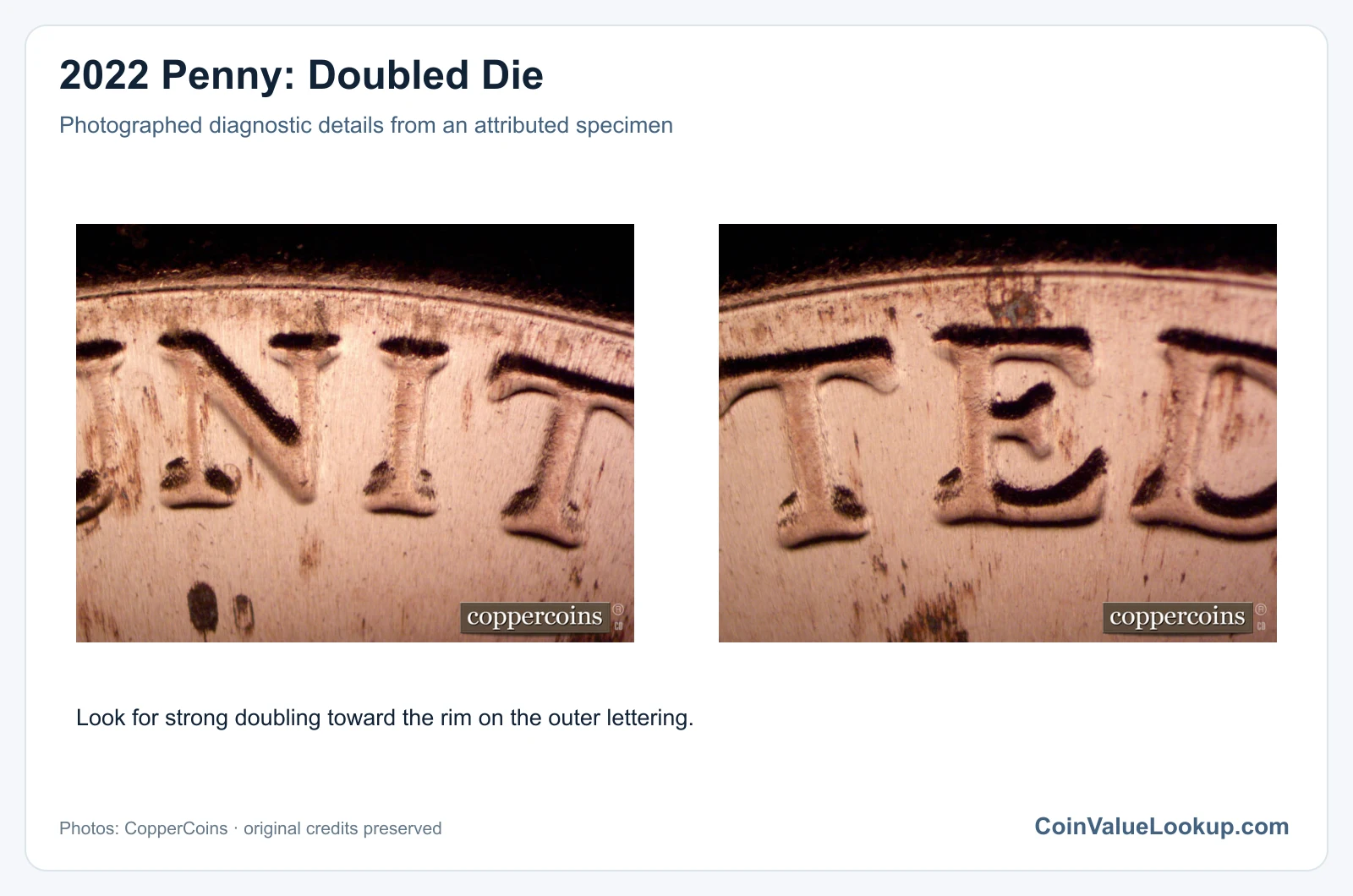
A doubled die shows consistent, repeatable doubling of design elements caused during the die manufacturing process. On a 2022 cent, look for separation or notching on lettering, the date digits, or Lincoln's profile details.
The doubling should appear in the same location and direction on every coin struck from that die.
The critical distinction is between a true doubled die and machine doubling. Machine doubling is flat, shelf-like, and reduces sharpness — it is caused by die bounce during striking, not a flaw in the die itself.
Machine-doubled coins carry little or no premium.
Reflections from lighting, post-mint contact marks, or digital camera artifacts can also mimic doubling in photos. Use magnification and compare both sides of the design element.
No specific price range is adopted for doubled die 2022 cents. Authentication and the degree of separation determine individual value.
8. 2022 Lincoln Penny — Off-Center Strike
An off-center strike happens when the planchet is not properly seated in the collar before the dies come together. The result is a coin with part of the design missing and a blank crescent where no metal was struck.
The percentage of off-center displacement matters. A 5% shift is barely noticeable; a 50% shift with the date still visible is the sweet spot most collectors look for.
Coins struck so far off that the date disappears lose much of their appeal.
Do not confuse a clip (missing metal from the blank stage) with an off-center strike (misaligned striking). A clipped coin still has a full design impression in the areas that remain; an off-center coin does not.
Post-mint flattening or vice damage can also create a misleading appearance. No adopted price range exists for off-center 2022 cents; each example is assessed on its percentage, date visibility, and condition.
9. 2022 Lincoln Penny — Copper Plating Defects
Modern zinc cents have a thin copper plating, and that plating can fail. Blisters, bubbles, peeling, and splits in the copper skin are all plating defects that originated during manufacturing.
Look for areas where the copper layer has lifted, cracked, or separated from the zinc underneath while the surrounding design remains undisturbed. The exposed zinc is typically dull gray or silvery compared to the copper surface.
Corrosion bubbles, chemical stripping, and environmental damage after the coin left the mint can produce similar-looking problems. Post-mint damage usually shows irregular patterns and often affects areas near the rim where moisture collects.
A plating defect from the mint tends to have smoother, more uniform edges.
An entirely unplated blank — where the copper layer was never applied — is a separate and more dramatic error. No adopted price range exists for 2022 plating defects; value depends on severity, location, and authenticated origin.