1959 Lincoln Penny Coin Value: How Much Is It Worth?
The 1959 Lincoln penny holds a special place as the first year of the Memorial reverse, replacing the familiar Wheat design. Most circulated examples trade near face value.
In uncirculated condition, USA Coin Book guide estimates place the Philadelphia and Denver issues around $1.24 at MS65, while a PR65 proof sits at roughly $3.62. Preservation and original copper color matter more than the date alone.
Fast Way to Identify Your 1959 Lincoln Penny
Want a quick read on your 1959 penny? Upload clear photos of the front and back, and our identifier can offer a preliminary look at which version you have.
It will not authenticate errors or assign an exact grade, but it is a solid first step before you dig deeper.
1959 Penny Value
Upload both sides of your 1959 Lincoln Penny.
Front Obverse
Upload photo
Back Reverse
Upload photo
Which 1959 Lincoln Penny Versions Are Worth Money?
- Uncirculated examples with full original red copper color (RD designation) command the strongest premiums among regular issues.
- Proofs should be inspected for hairlines, spots, and cameo contrast, all of which influence their value beyond the base PR65 guide estimate.
- A doubled die obverse variety exists for the Philadelphia business strike; authentication is essential before assigning any premium.
- A repunched D mintmark variety is recognized on the Denver issue; close-up comparison with an attributed specimen is the way to confirm it.
- A 1959-D cent struck on a silver dime planchet is a dramatic wrong-planchet error; one PCGS MS61 example sold for $1,050 in May 2022.
- A rotated double-struck 1959 no-mintmark cent is known; an NGC MS62 Brown specimen brought $576 in February 2018.
Step 1: Identify Your 1959 Lincoln Penny Mint Mark and Version
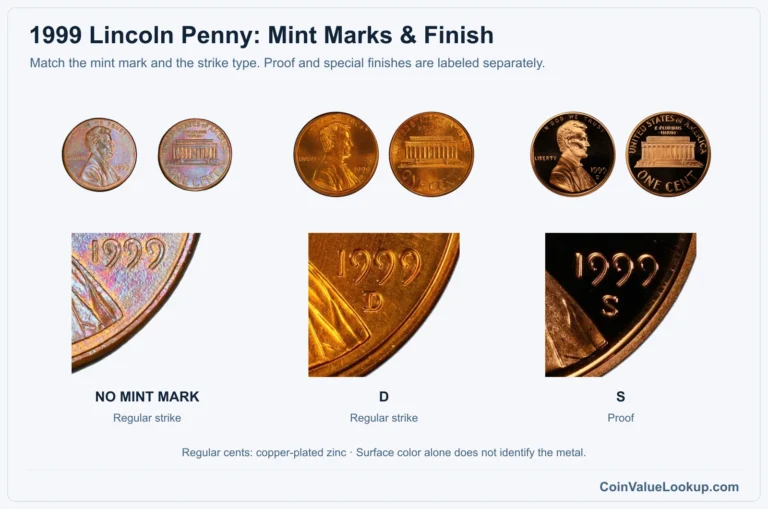
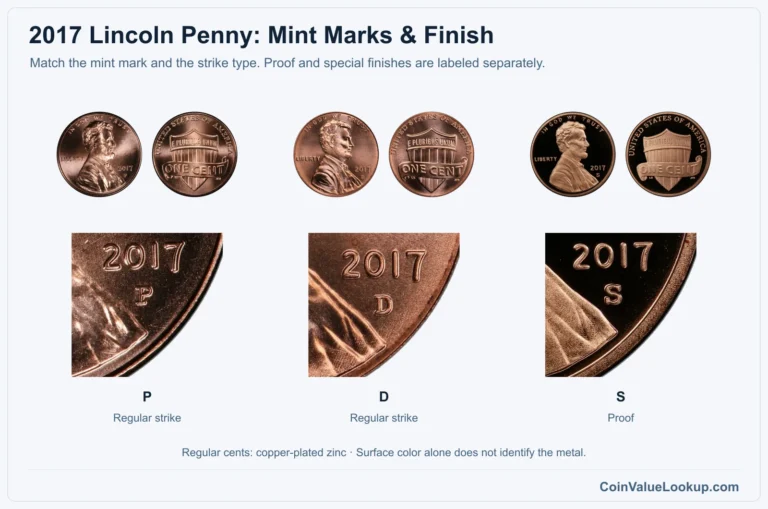
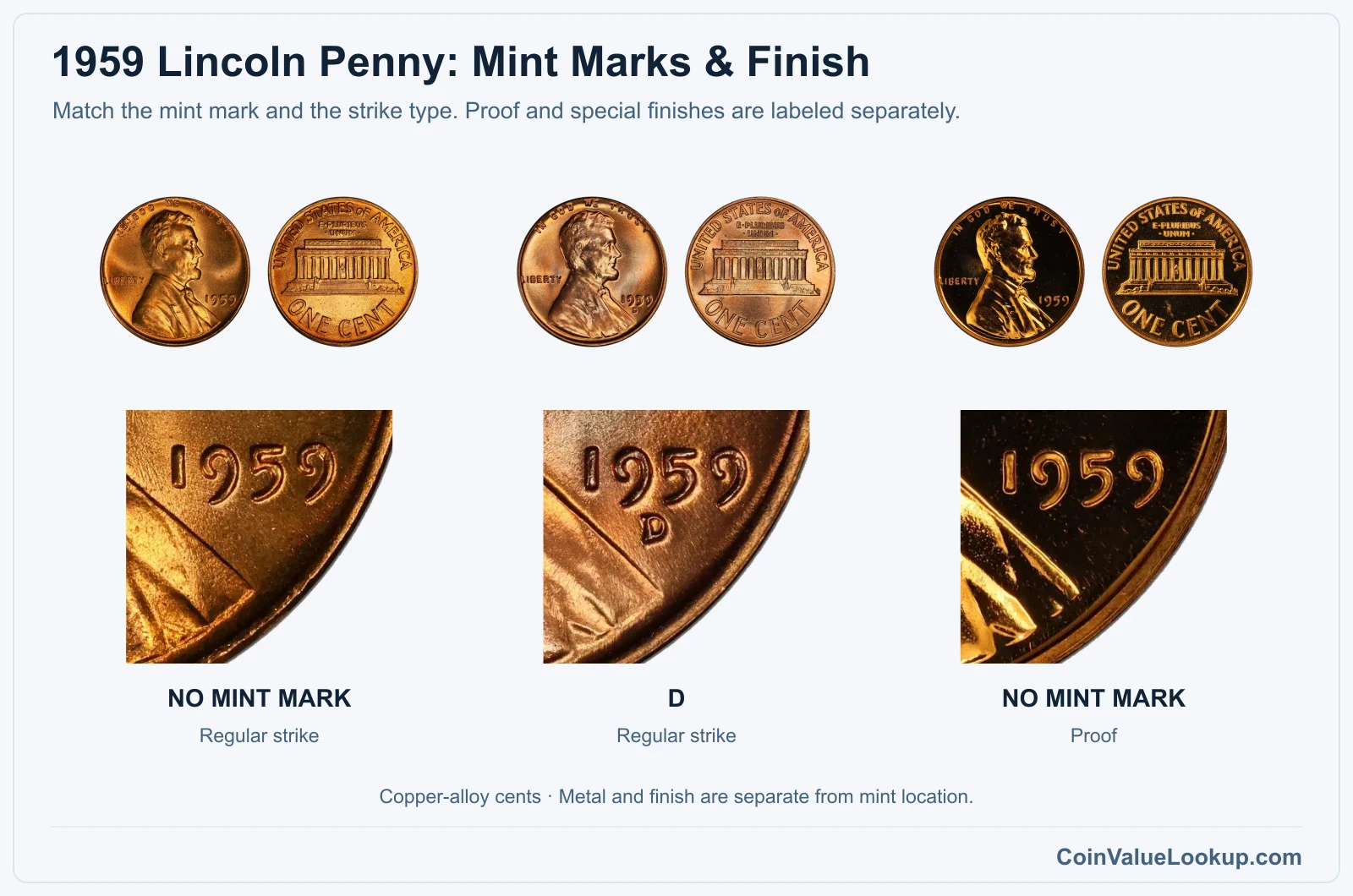
Start with the mintmark. Look just below the date on the obverse: no letter means Philadelphia, a small D means Denver.
There is no normal San Francisco issue for this year.
Every genuine 1959 cent is struck on a 95% copper blank (balance tin and zinc), weighs about 3.11 grams, and has a plain edge. These are not the zinc-core cents that came decades later.
Do not confuse a shiny business strike with a proof. Proofs were made at Philadelphia for collectors, with mirror-like fields and sharp detail produced by specially prepared dies.
A coin that simply looks nice is not automatically a proof; documented provenance and surface characteristics separate the two. Red, Red-Brown, and Brown are color designations describing how much original copper luster remains.
They are not different metals.
Step 2: Check Your 1959 Lincoln Penny Grade
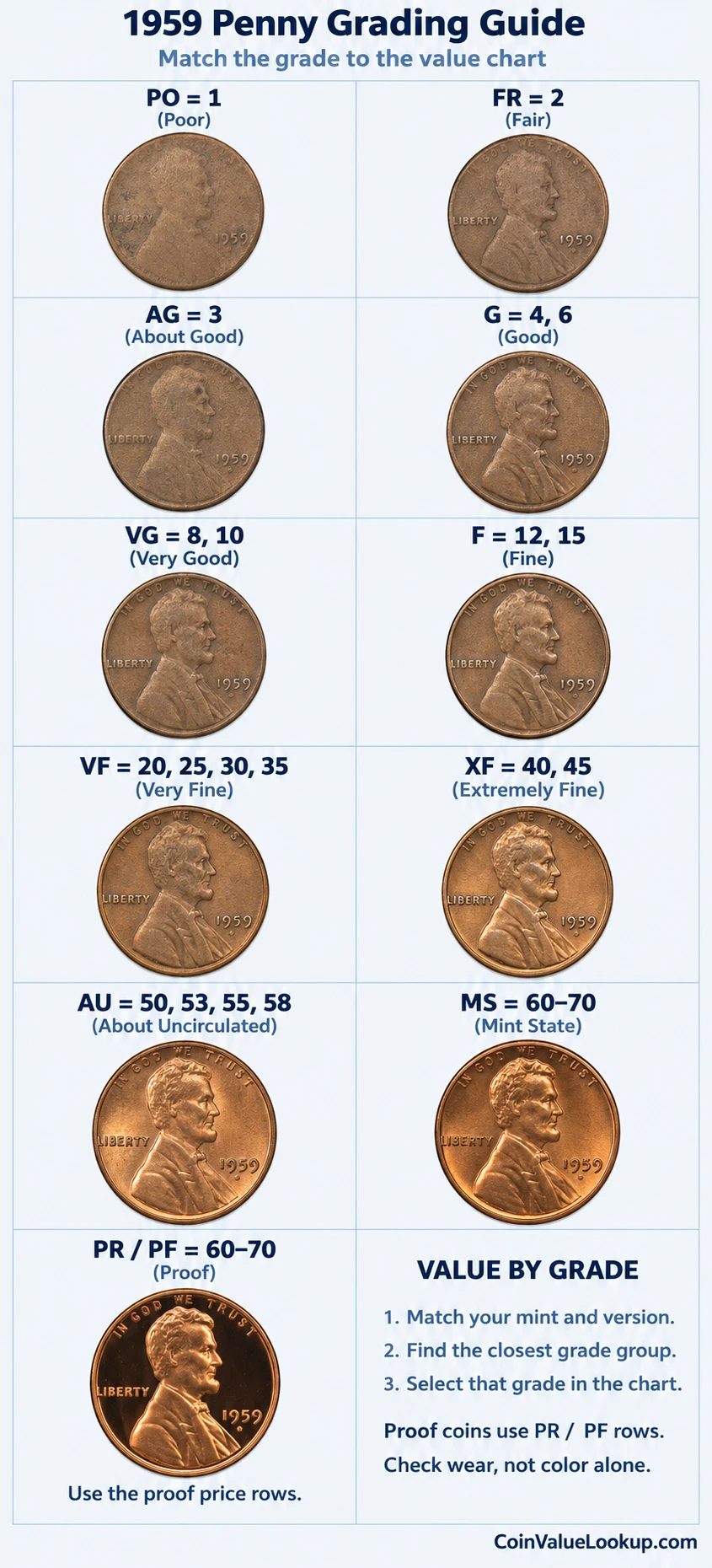
Check Lincoln's cheekbone, jaw, and the hair detail above his ear first. Those are the highest relief points on the obverse and the first to show wear.
On the reverse, look at the Memorial roof, the columns, and especially the steps at the base.
Luster continuity separates AU from true Mint State. A dark, original-toned coin can absolutely be uncirculated, while a bright, shiny coin may have been cleaned.
Compare your coin against the reference image to see how wear progresses across grades.
Color designations like RD, RB, and BN, along with cameo contrast on proofs, affect value within the same grade. Whatever you do, do not clean a coin hoping to restore red color.
That will damage the surfaces and reduce its appeal to collectors.
Step 3: Check 1959 Lincoln Penny Value by Mint and Version
1959 Lincoln Penny — No Mint Mark — Business Strike
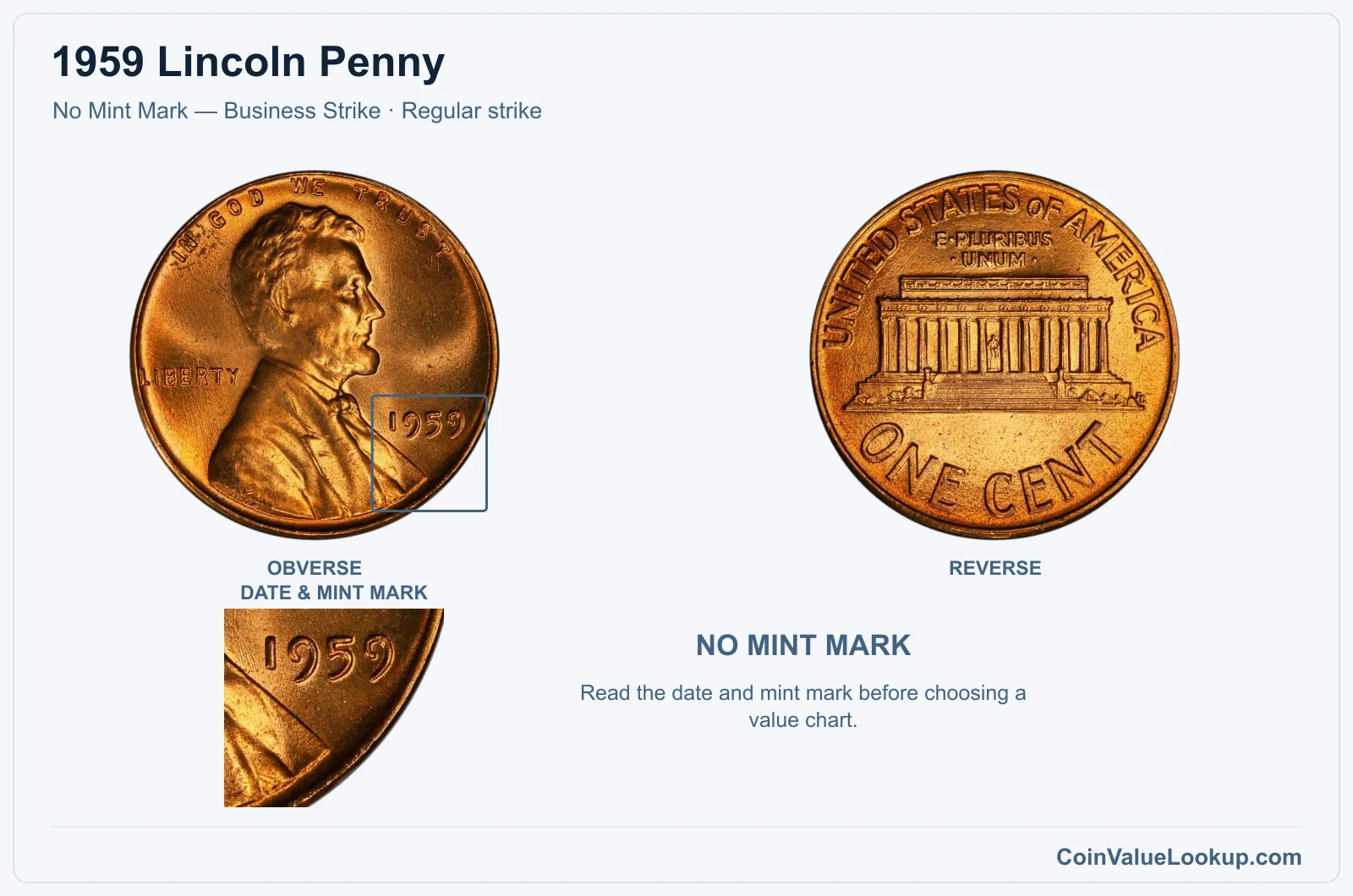
The Philadelphia 1959 cent carries no mintmark. It is the standard business strike in 95% copper alloy, weighing about 3.11 grams.
Circulated coins are worth little beyond face value. USA Coin Book estimates place an MS60 at around $0.24 and an MS65 at roughly $1.24.
Color designation matters at the uncirculated level. A coin with full original red surfaces will typically bring more than a brown example in the same technical grade.
Look for even luster across both sides and minimal contact marks on the cheek and Memorial columns.
Range Grade
Price1959 No Mint Mark — Business Strike (BN) Price1959 No Mint Mark — Business Strike (RB) Price1959 No Mint Mark — Business Strike (RD) Auction Records Appraisal PO PO 1
—
Coin Identifier FR FR 2
—
Coin Identifier AG AG 3
—
Coin Identifier G G 4
—
Coin Identifier
G 6
—
Coin Identifier VG VG 8
—
Coin Identifier
VG 10
—
Coin Identifier F F 12
—
Coin Identifier
F 15
—
Coin Identifier VF VF 20
—
Coin Identifier
VF 25
—
Coin Identifier
VF 30
—
Coin Identifier
VF 35
—
Coin Identifier XF XF 40
—
Coin Identifier
XF 45
—
Coin Identifier AU AU 50
—
Coin Identifier
AU 53
—
Coin Identifier
AU 55
—
Coin Identifier
AU 58
—
Coin Identifier MS MS 60
—
—
Coin Identifier
MS 61
—
—
Coin Identifier
MS 62
—
Coin Identifier
MS 63
Coin Identifier
MS 64
Coin Identifier
MS 65
Coin Identifier
MS 66
Coin Identifier
MS 67
Coin Identifier
MS 68
—
—
—
—
—
MS 69
—
—
—
—
—
MS 70
—
—
—
—
—
1959 Lincoln Penny — D — Business Strike
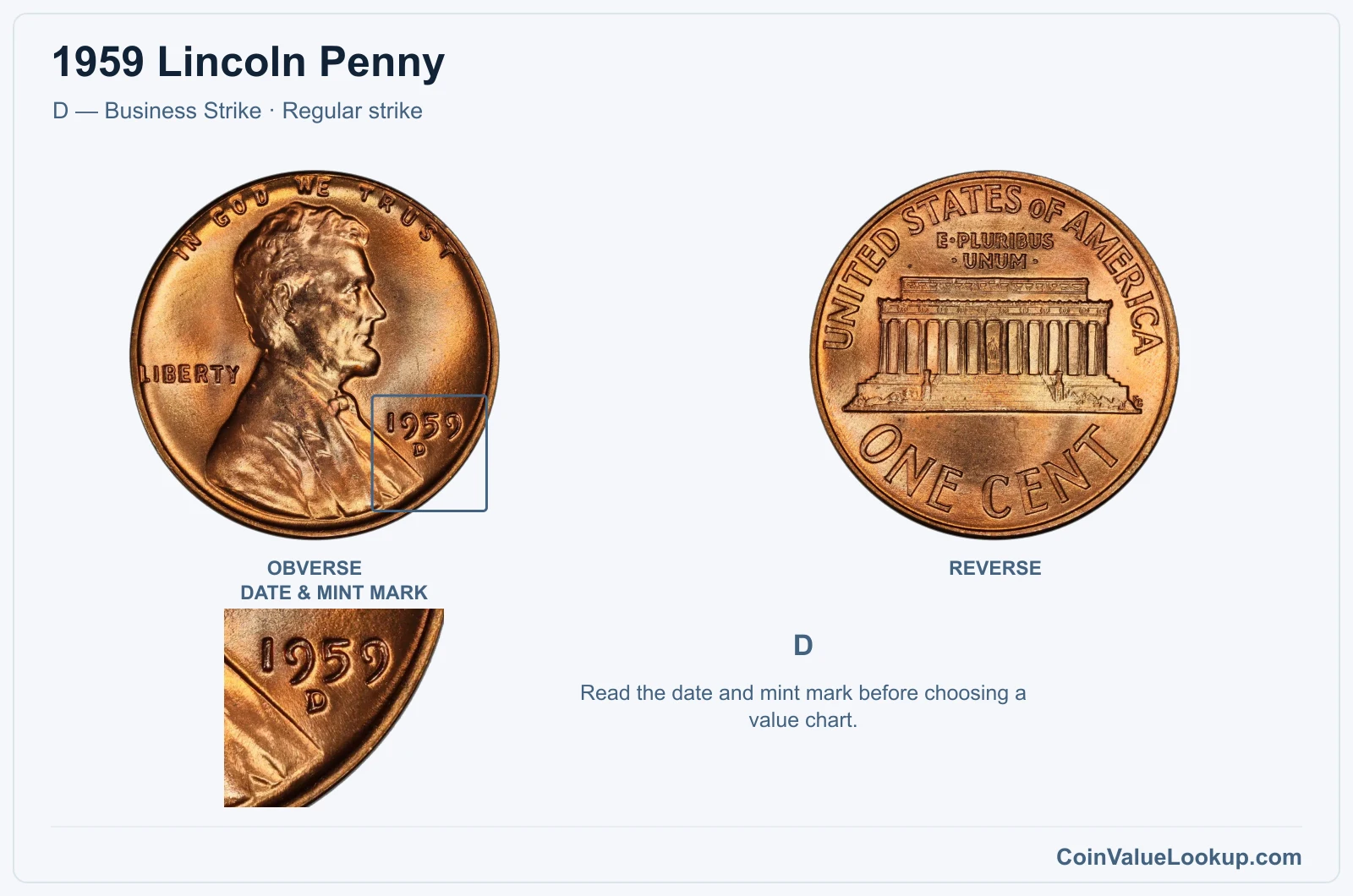
Denver struck its 1959 cents with a small D below the date. Same 95% copper alloy, same weight, same Memorial reverse.
Guide estimates from USA Coin Book put an MS60 at about $0.61 and an MS65 at $1.24.
Beyond the ordinary issue, examine the D mintmark closely. A recognized repunched mintmark variety exists on this date, so any odd remnants around the letter are worth investigating under magnification.
Worn or damaged examples are common and inexpensive, but a well-preserved Denver cent with strong original color is a solid type coin.
Range Grade
Price1959 D — Business Strike (BN) Price1959 D — Business Strike (RB) Price1959 D — Business Strike (RD) Auction Records Appraisal PO PO 1
—
Coin Identifier FR FR 2
—
Coin Identifier AG AG 3
—
Coin Identifier G G 4
—
Coin Identifier
G 6
—
Coin Identifier VG VG 8
—
Coin Identifier
VG 10
—
Coin Identifier F F 12
—
Coin Identifier
F 15
—
Coin Identifier VF VF 20
—
Coin Identifier
VF 25
—
Coin Identifier
VF 30
—
Coin Identifier
VF 35
—
Coin Identifier XF XF 40
—
Coin Identifier
XF 45
—
Coin Identifier AU AU 50
—
Coin Identifier
AU 53
—
Coin Identifier
AU 55
—
Coin Identifier
AU 58
—
Coin Identifier MS MS 60
—
—
Coin Identifier
MS 61
—
—
Coin Identifier
MS 62
—
Coin Identifier
MS 63
—
Coin Identifier
MS 64
Coin Identifier
MS 65
Coin Identifier
MS 66
—
Coin Identifier
MS 67
—
—
Coin Identifier
MS 68
—
—
—
Coin Identifier
MS 69
—
—
—
—
—
MS 70
—
—
—
—
—
1959 Lincoln Penny — No Mint Mark — Proof
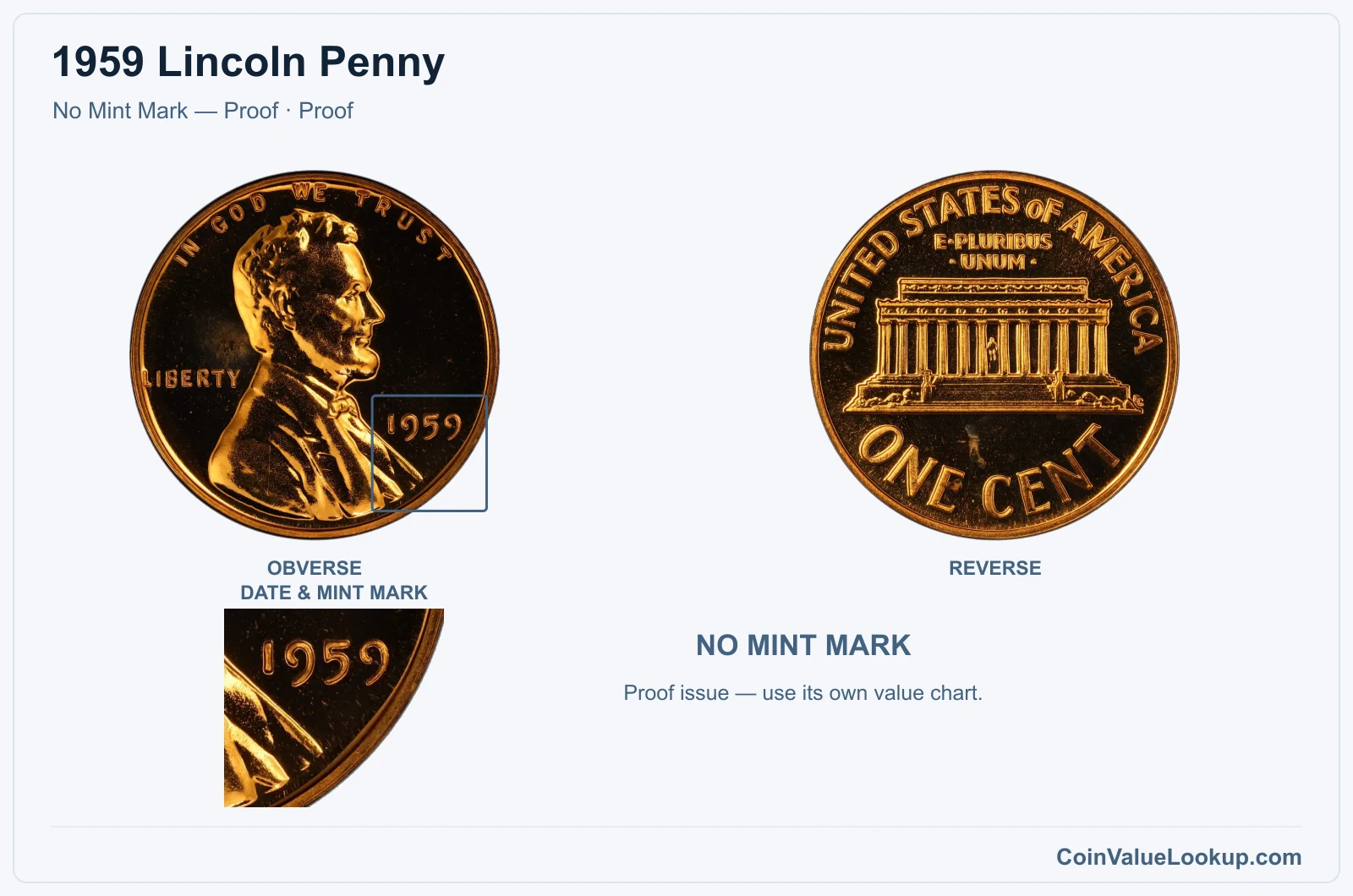
The 1959 proof was struck at Philadelphia with no mintmark, just like the business strike, so surfaces and provenance distinguish it. Proofs have mirror-like fields and sharply defined devices produced from polished dies and planchets struck multiple times.
Coin Value Lookup is a handy starting point if you are looking up other coin dates and denominations alongside your 1959 proof.
USA Coin Book guides a PR65 at about $3.62. Cameo and deep cameo contrast, original red color, and the absence of hairlines or spots all influence value within the proof category.
An impaired proof with handling marks or haze should not be compared directly to these guide figures.
Range Grade
Price1959 No Mint Mark — Proof (CAM) Price1959 No Mint Mark — Proof (DCAM) Auction Records Appraisal PR PR 1
—
Coin Identifier
PR 2
—
Coin Identifier
PR 3
—
Coin Identifier
PR 4
—
Coin Identifier
PR 6
—
Coin Identifier
PR 8
—
Coin Identifier
PR 10
—
Coin Identifier
PR 12
—
Coin Identifier
PR 15
—
Coin Identifier
PR 20
—
Coin Identifier
PR 25
—
Coin Identifier
PR 30
—
Coin Identifier
PR 35
—
Coin Identifier
PR 40
—
Coin Identifier
PR 45
—
Coin Identifier
PR 50
—
Coin Identifier
PR 53
—
Coin Identifier
PR 55
—
Coin Identifier
PR 58
—
Coin Identifier
PR 60
—
Coin Identifier
PR 61
—
Coin Identifier
PR 62
—
Coin Identifier
PR 63
—
Coin Identifier
PR 64
—
Coin Identifier
PR 65
Coin Identifier
PR 66
Coin Identifier
PR 67
Coin Identifier
PR 68
Coin Identifier
PR 69
Coin Identifier
PR 70
—
—
—
—
1959 Lincoln Penny Error List
1. 1959 Lincoln Penny — Doubled Die Obverse
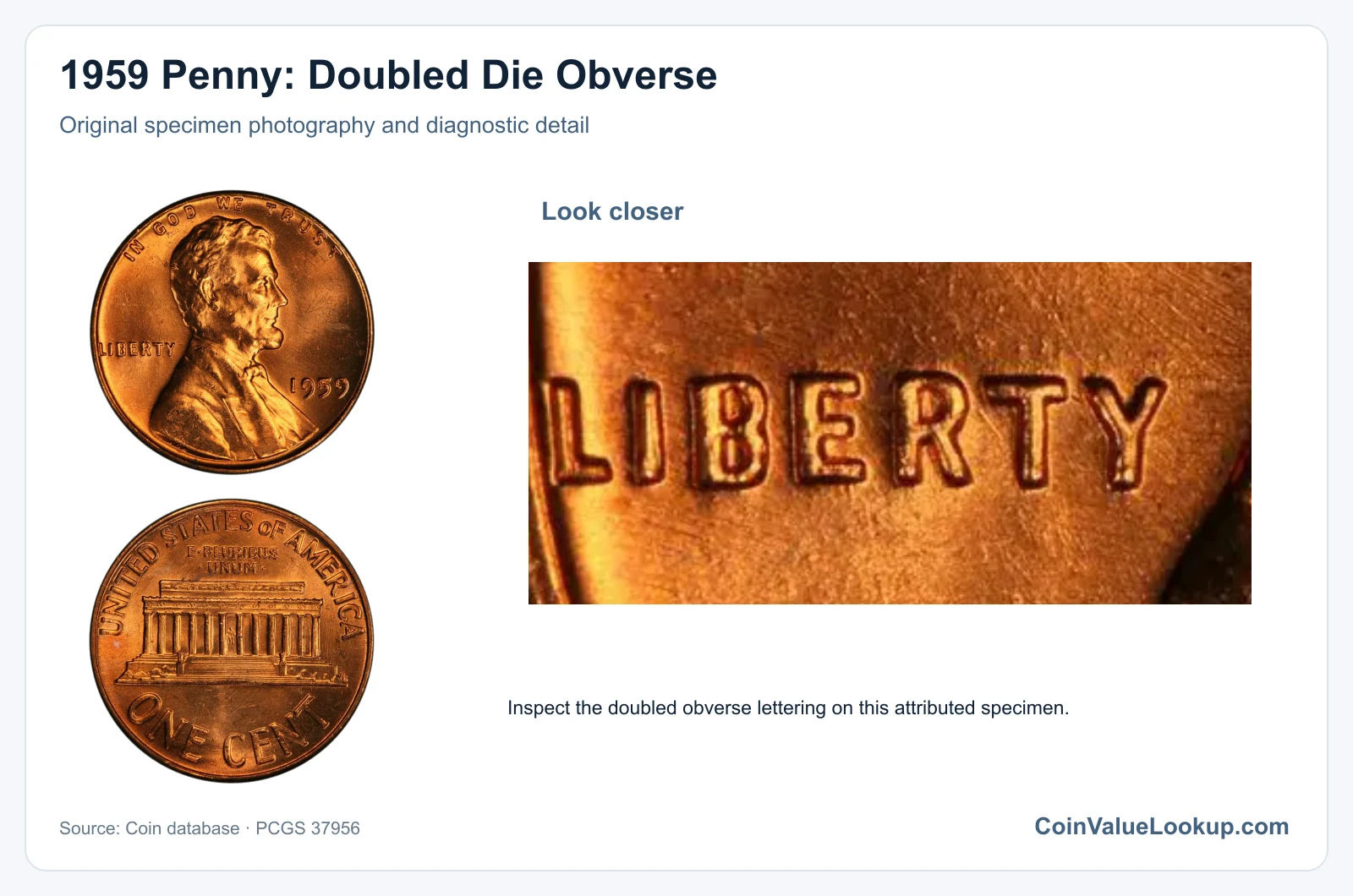
A doubled die obverse is documented on the 1959 Philadelphia business strike. Look for repeated raised contours or notching on the obverse lettering and date.
This doubling originates in the die itself, not from the coin being struck twice.
Under magnification, compare your coin to an attributed example. Genuine die doubling shows consistent, sharp extra contours that follow the letter profiles.
Machine doubling, by contrast, leaves flat, shelf-like outlines and is far more common. Worn or damaged lettering can also mimic doubling at a glance.
No specific price range is adopted for this variety. Value depends on the authenticated identity of the die pair, the severity of the doubling, and the coin's overall condition.
Third-party authentication is strongly recommended before assuming a premium.
2. 1959 Lincoln Penny — Repunched D Mintmark
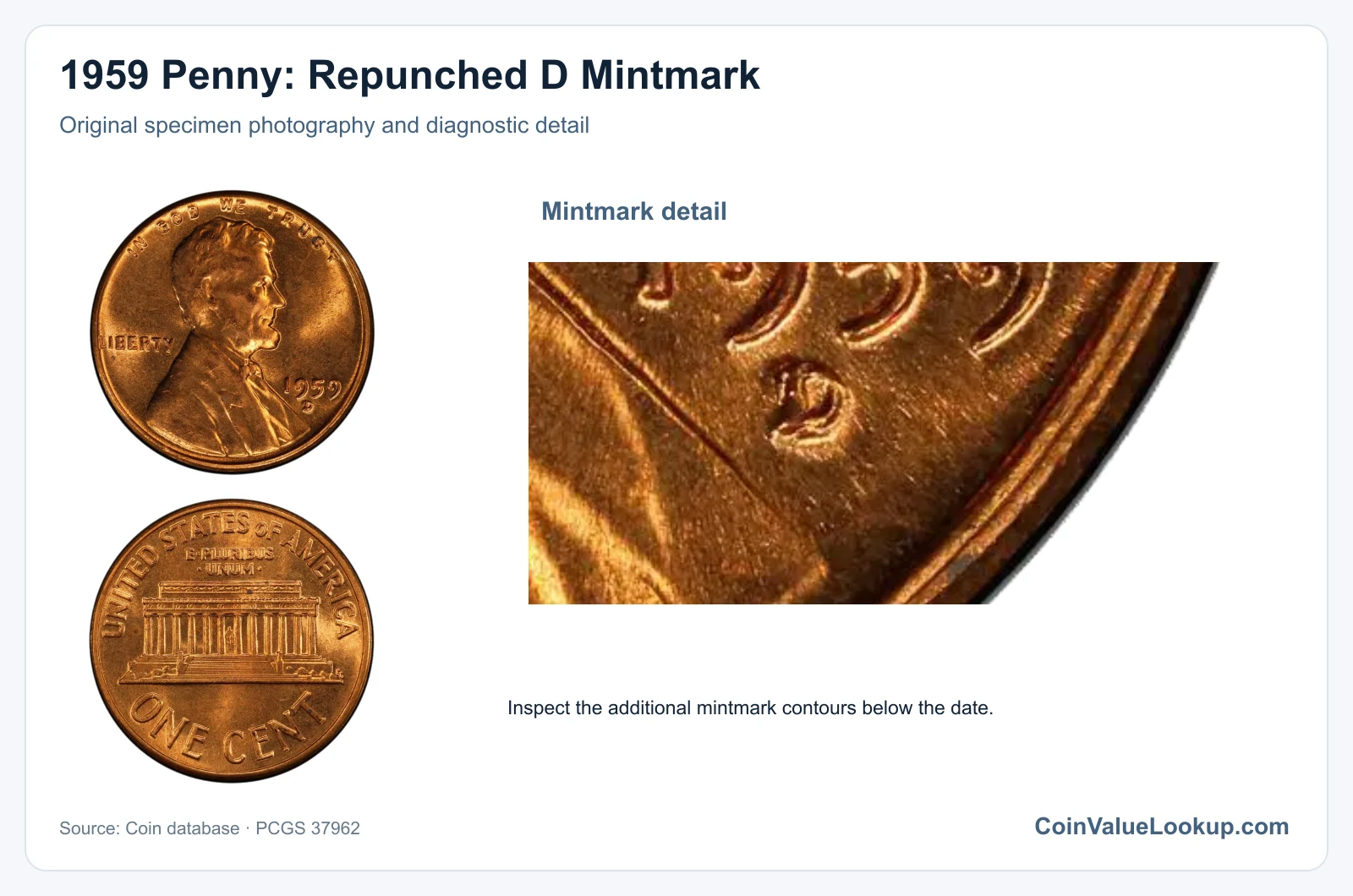
The 1959-D repunched mintmark variety shows remnants of an extra D punch around or inside the final mintmark. You will need good magnification and a close-up photo to spot the tell-tale extra serifs or shadow outlines of the secondary punch.
Compare what you see against an attributed specimen. Not every odd-looking D qualifies.
Machine doubling, die chips, and simple corrosion can all produce lumps or distortions near the mintmark that look similar at first glance.
No specific price range is adopted here. The value of a confirmed RPM depends on the specific die pair, the visibility of the repunching, and the coin's grade.
Get it authenticated before pricing.
3. 1959 Lincoln Penny — Struck on a Silver Dime Planchet
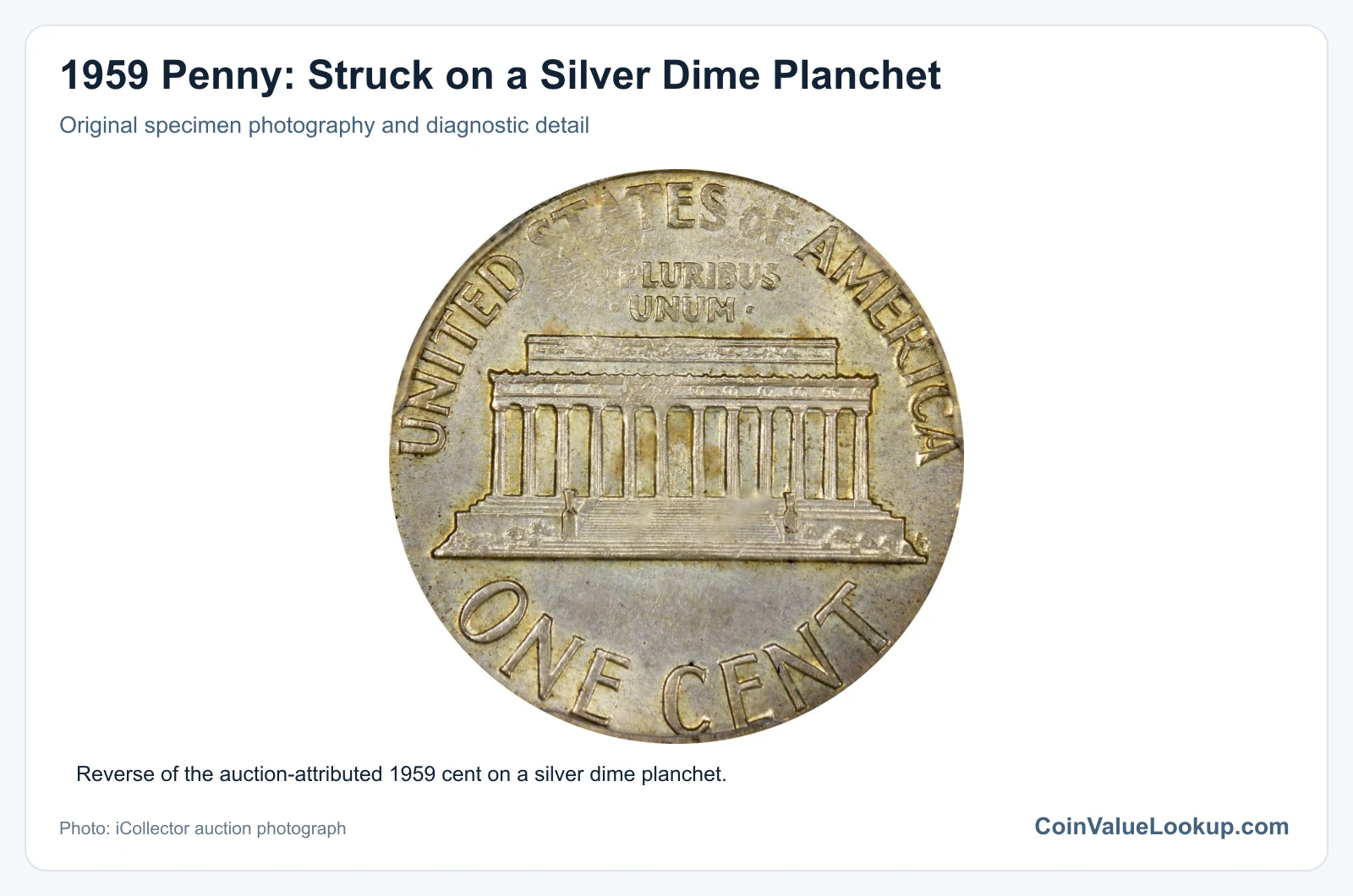
This is a wrong-planchet error: a 1959-D Lincoln cent struck on a silver dime blank. The coin will be noticeably smaller and thinner than a normal cent, with incomplete peripheral lettering or design stretching at the edges.
Weight and alloy composition, not color alone, confirm the blank's identity. A normal cent weighs about 3.11 grams; a silver dime planchet is different in both weight and metal content.
One PCGS MS61 example sold at Heritage Auctions for $1,050 in May 2022. That is a single documented sale, not a market range, so treat it as a reference point rather than a guarantee.
Be careful with lookalikes. A plated normal cent can appear silvery but will weigh and measure like a standard penny.
4. 1959 Lincoln Penny — Rotated Double Strike
A rotated double strike means the coin was struck twice with significant rotation between impacts. On the known 1959 Philadelphia cent, two distinct impressions of the Lincoln design overlap at roughly 135 degrees.
You can see two sets of lettering and portraits sharing the same planchet.
An NGC MS62 Brown specimen sold at Heritage Auctions for $576 in February 2018. Again, one sale does not define a market, but it shows the ballpark for a certified example.
Do not confuse this with a doubled die, which is a subtle die-manufacturing variety. A double strike produces two complete, visibly separated impressions.
Also watch out for vise-made or novelty impressions pressed after the coin left the Mint.
5. 1959 Lincoln Penny — Off-Center Strike
An off-center strike happens when the planchet is not seated properly between the dies, leaving part of the design missing and a blank crescent on one side. On a 1959 cent, the most collectible examples still show the full date within the struck portion.
The degree of off-center shift and whether the date is visible are the main value drivers. A 5% misalignment is barely interesting; 20% or more with a readable date gets collectors' attention.
No specific price range is adopted for this error. Condition, the percentage of the shift, and date visibility all matter.
Do not confuse an off-center strike with a clipped planchet, a one-sided misalignment, or post-mint damage like a hammered edge.
6. 1959 Lincoln Penny — Lamination / Split Planchet
A lamination or split planchet error occurs when the copper alloy separates into layers, leaving peeling metal, a retained flap, or a visible split through the coin's thickness. Photograph both the affected face and the edge together for the clearest documentation.
The size and location of the lamination determine collector interest. A large, dramatic peel across a major design element draws more attention than a tiny flake near the rim.
No specific price is adopted. Value depends on the extent, the coin's overall condition, and market demand.
Be sure to distinguish a genuine lamination from scraping, corrosion pitting, or a deliberately cut coin, all of which are post-mint damage rather than Mint errors.
7. 1959 Lincoln Penny — Die Break / Cud
A cud is a specific type of die break where a chunk of the die rim breaks away, leaving a raised, featureless blob connected to the coin's rim. Interior die breaks can also occur but are not technically cuds.
Either way, a piece of the die is missing and leaves a distinctive mark on every coin it strikes.
Look for a raised area that disrupts normal design elements and connects to the rim edge. Compare it against known examples if possible.
No price range is adopted for this category. Size, location, and the coin's grade influence value.
A rim dent, corrosion deposit, or small interior die chip can look similar but lacks the characteristic raised, smooth-topped profile of a true cud.
8. 1959 Lincoln Penny — Ragged Clipped Planchet
A ragged clipped planchet means a portion of the original blank was torn or incompletely punched before striking. The clip may be curved, straight, or ragged in outline.
Look for an irregular missing section along the rim, accompanied by metal flow weakness on the opposite side of the coin, a diagnostic called the Blakesley effect.
Compare the edge texture carefully. A genuine clip shows the raw metal of the original strip, not a filed or cut surface.
Post-mint damage like a notch or intentional trimming will look different under magnification.
No specific price is adopted. The clip's size, shape, and the coin's remaining design detail and grade all factor into value.
9. 1959 Lincoln Penny — BIE Die Break
The BIE die break is a well-known Lincoln cent quirk. A small crack develops in the die between the letters B and E of LIBERTY, and it leaves a raised vertical line on the struck coin that resembles a capital I.
Hence the nickname.
Inspect LIBERTY closely under magnification. The raised bridge or blob should sit between B and E and have the same surface texture as the surrounding design.
Dirt, scratches, or glued debris can mimic it but will look different under a loupe.
No price range is adopted. BIE breaks are fun to collect and relatively affordable, but value depends on the prominence of the break, overall condition, and collector demand for the specific die.
10. 1959 Lincoln Penny — Struck on a Foreign Planchet
A 1959 Lincoln cent struck on a Philippine 10-centavo planchet is a catalog-listed wrong-planchet error. The coin will look like a Lincoln cent but with dimensions and metal composition that do not match the standard 95% copper blank.
Incomplete peripheral design or unusual edge characteristics are typical signs.
Weight and precise measurement are essential. Copper color alone means nothing here because both blanks can appear similar.
Compare your coin's weight and diameter to published specifications for both the U.S. cent and the Philippine 10-centavo piece.
No specific price is adopted. Value depends on condition, visibility of the design, and the specific planchet identity, all confirmed through professional authentication.
A plated or altered normal cent is the most common lookalike.