1819 Capped Bust Half Dollar Coin Value: How Much Is It Worth?
The 1819 Capped Bust Half Dollar sits in a sweet spot for early silver collectors — old enough to feel historic, common enough that you can actually find one. Guide estimates for the Normal Date version range from about $111 in G4 to $809 in AU50, but the final number depends heavily on which variety you have and how much wear it has picked up over two centuries.
Overdate varieties and early Proofs occupy their own pricing lanes entirely.
Fast Way to Identify Your 1819 Capped Bust Half Dollar
Snap a clear photo of the front and back of your coin under even lighting — no flash glare. Upload both images here for a preliminary identification.
The tool can help sort out whether you are looking at a Normal Date or one of the overdate varieties, which is the first step toward understanding what your half dollar might be worth.
1819 Capped Bust Half Dollar Value
Upload both sides of your 1819 Capped Bust Half Dollar.
Front Obverse
Upload photo
Back Reverse
Upload photo
Which 1819 Capped Bust Half Dollar Versions Are Worth Money?
- Normal Date — The baseline variety. Guide values run $111 at G4 up to $809 at AU50, so even well-worn examples hold real silver-era value.
- 1819/8 Small 9 — An overdate where a small 9 punch was placed over an 8. Guide estimates start at $122 in G4 and climb to $1,262 at AU50, a meaningful premium over the Normal Date.
- 1819/8 Large 9 — Uses a visibly larger 9 punch over the 8. Guide values range from $111 at G4 to $948 at AU50; less of a jump than the Small 9 but still worth confirming.
- Early Proof — A rare specialist-attributed issue with no standard pricing curve. Individual assessment by authenticated identity and condition is essential for these.
Step 1: Identify Your 1819 Capped Bust Half Dollar Mint Mark and Version
Every 1819 Capped Bust Half Dollar was struck at Philadelphia. There is no mintmark to look for, so do not worry about checking below the eagle.
The obverse shows a left-facing Liberty wearing a cap, surrounded by stars, with the date at the bottom. Flip it over and you will see a heraldic eagle clutching arrows and an olive branch, a shield on its chest, and the denomination 50C.
The edge is lettered: FIFTY CENTS OR HALF A DOLLAR.
The coin is a silver-copper alloy, approximately 89.24 percent silver, with a nominal weight of 13.48 grams and a diameter of 32.5 mm. A correct weight helps but cannot authenticate a coin on its own.
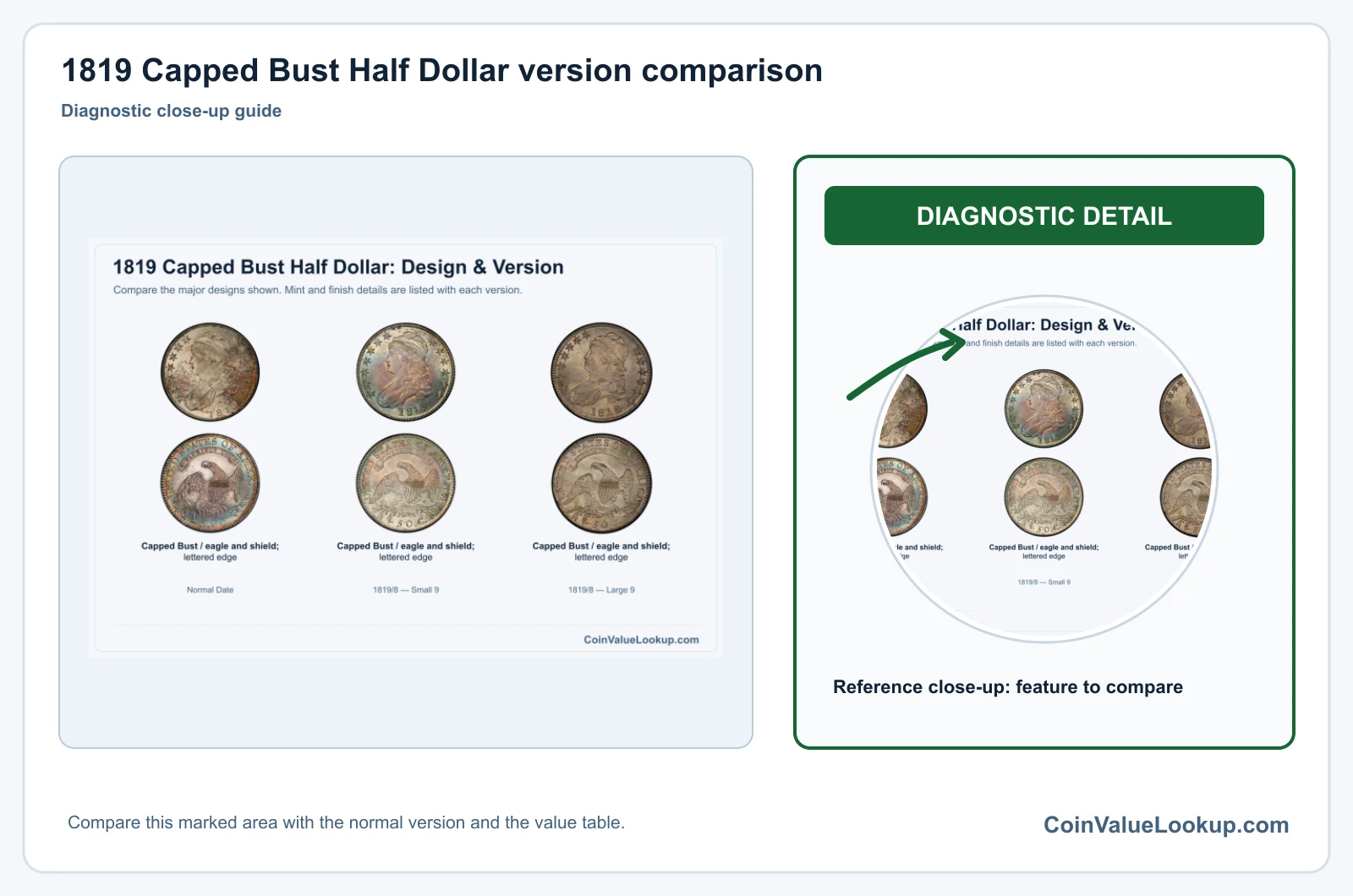
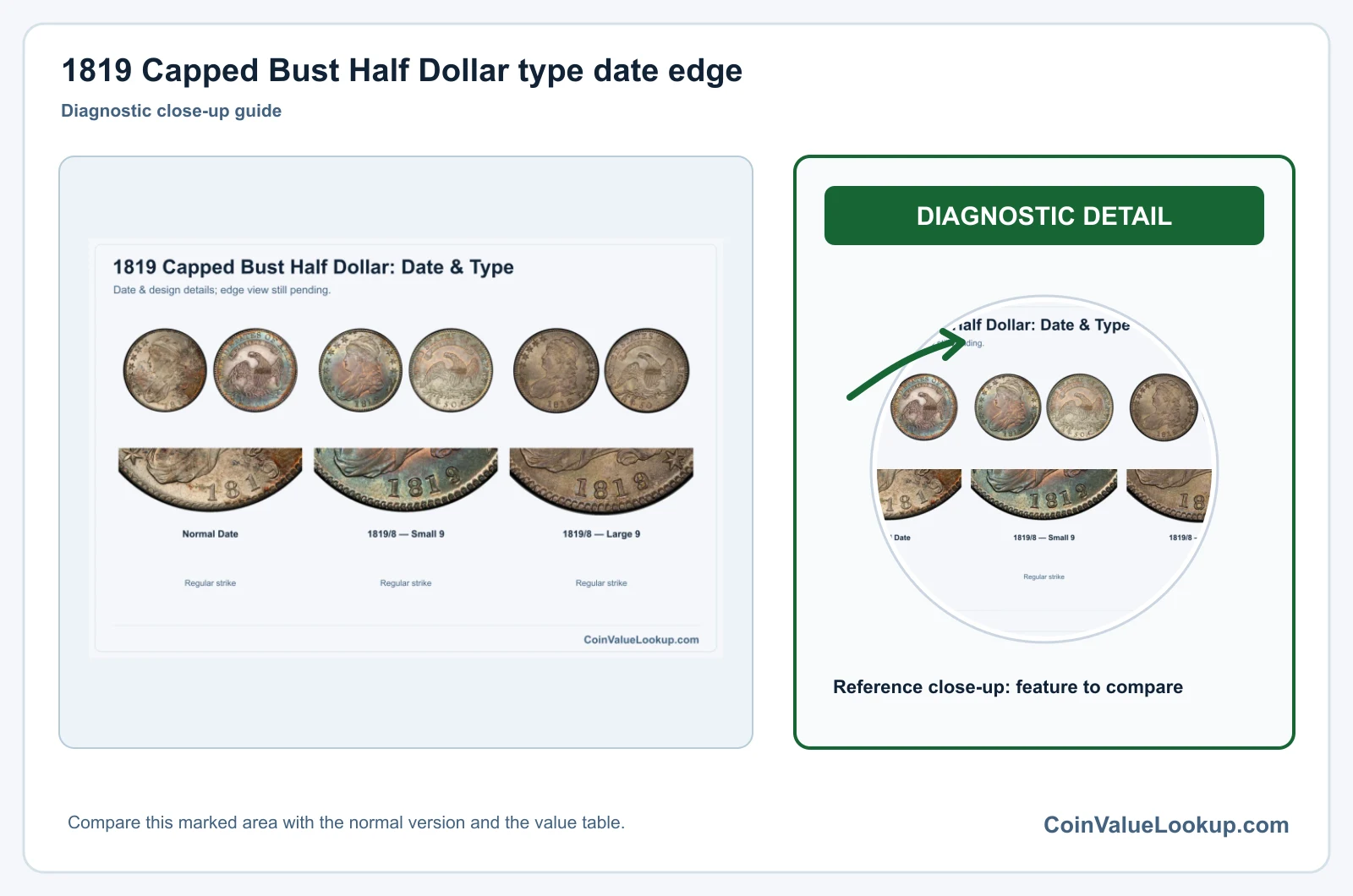
Three regular-strike identities matter here: Normal Date, 1819/8 Small 9, and 1819/8 Large 9. For the overdates, look carefully at the base of the 9 in the date — remnants of an underlying 8 will be visible.
The Small 9 and Large 9 use different-sized date punches, so compare the overall size of the 9 against known reference images rather than guessing.
A rare early Proof version also exists, but that attribution demands specialist die and surface analysis along with documented provenance. A coin that simply looks shiny or prooflike is not automatically a Proof.
Step 2: Check Your 1819 Capped Bust Half Dollar Grade
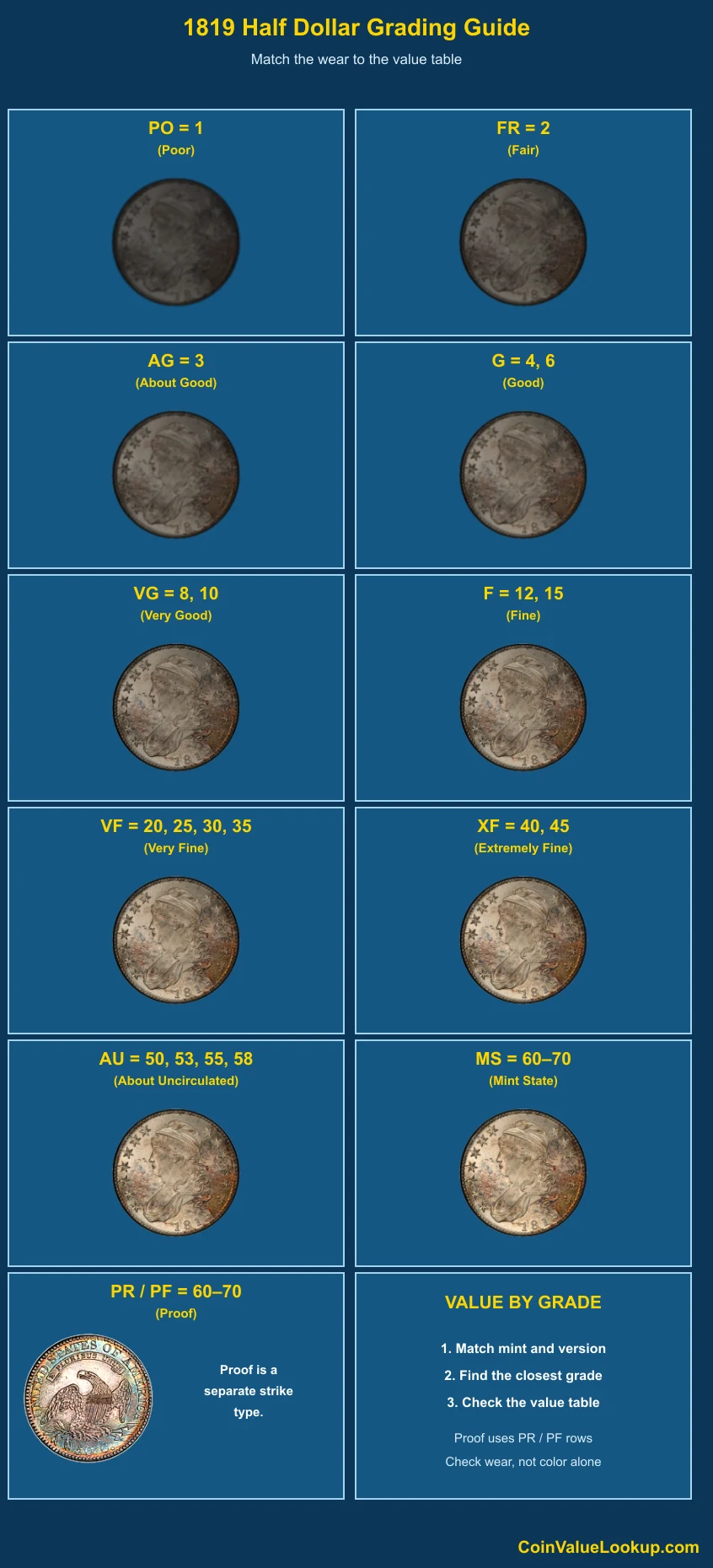
Start with the hair above Liberty's forehead and around her ear. On a well-worn coin these areas merge into flat, featureless patches.
In mid grades you can still trace individual curls, and the cap retains some texture.
The cheek and shoulder clasp are high points that show friction early. On the reverse, check the eagle's breast feathers and wing tips.
Be careful here — many 1819 halves were softly struck to begin with, so missing detail near the center of the eagle does not always mean heavy wear. Look for breaks in the original luster to confirm actual circulation.
Use the comparison image to match your coin against known grade benchmarks for this type. Coins that have been cleaned, holed, tooled, or scratched fall into a "Details" category and trade well below straight-graded examples at the same apparent wear level.
If your coin looks suspiciously bright or has hairline scratches running in one direction, someone probably cleaned it. Leave it alone — further cleaning only makes things worse.
Step 3: Check 1819 Capped Bust Half Dollar Value by Mint and Version
1819 Capped Bust Half Dollar — Normal Date
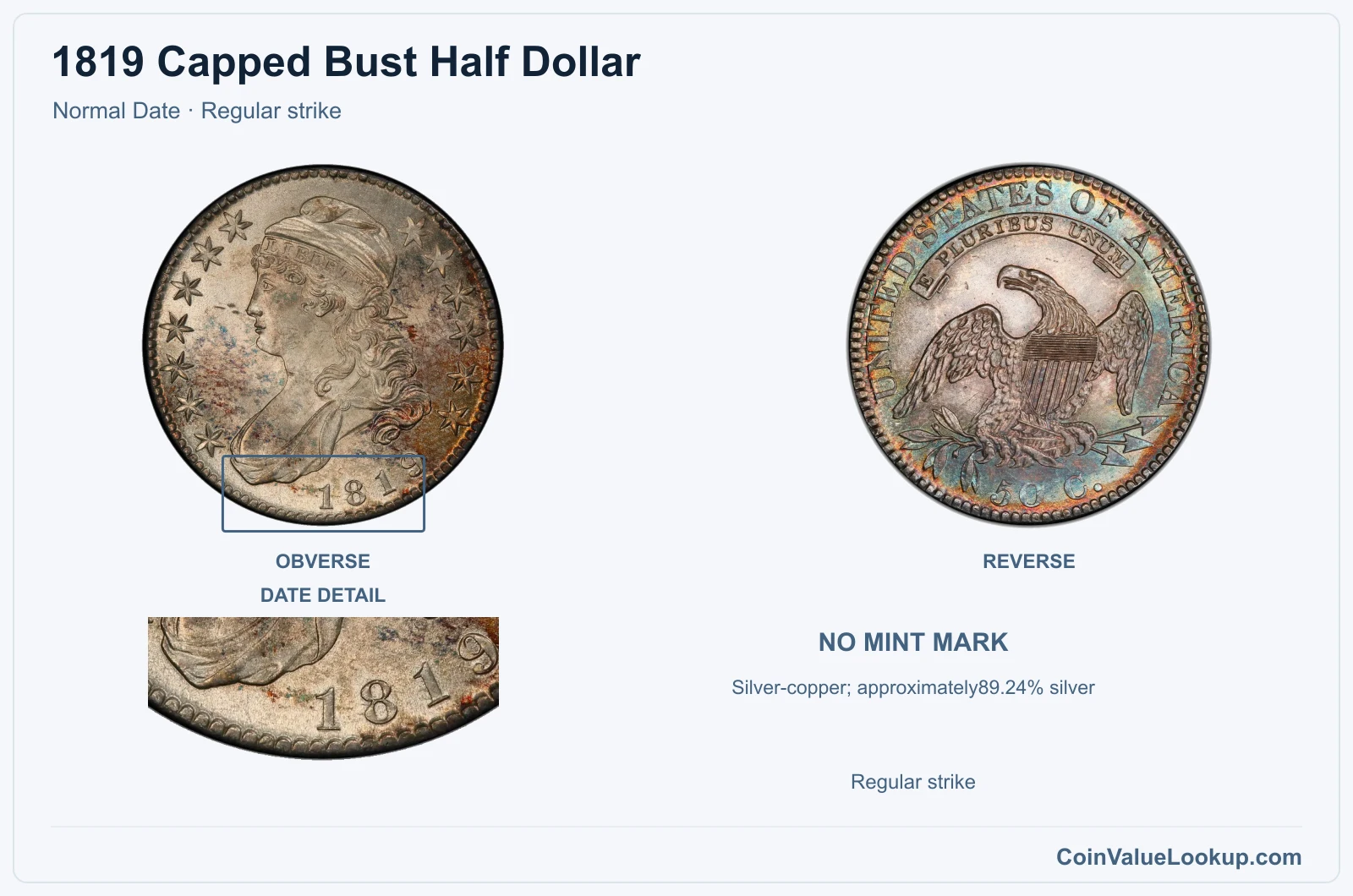
This is the standard 1819 Capped Bust Half Dollar with no overdate feature. The 9 in the date should be clean, with no trace of an underlying 8 at its base.
Philadelphia struck these without a mintmark in a silver-copper alloy of roughly 89.24 percent silver.
Guide estimates from USA Coin Book place the Normal Date at about $111 in G4, $205 in VF20, and $809 in AU50. Those are retail estimates, not guaranteed offers, and actual sale prices depend on eye appeal, strike quality, and whether the coin grades straight or falls into a Details holder.
If you are browsing Coin Value Lookup for other early half dollar years, the same variety-first approach applies — always pin down which version you have before checking prices.
Range Grade
Price Auction Records Appraisal PO PO 1
—
Coin Identifier FR FR 2
—
Coin Identifier AG AG 3
Coin Identifier G G 4
—
Coin Identifier
G 6
Coin Identifier VG VG 8
Coin Identifier
VG 10
Coin Identifier F F 12
Coin Identifier
F 15
Coin Identifier VF VF 20
Coin Identifier
VF 25
Coin Identifier
VF 30
Coin Identifier
VF 35
Coin Identifier XF XF 40
Coin Identifier
XF 45
Coin Identifier AU AU 50
Coin Identifier
AU 53
Coin Identifier
AU 55
Coin Identifier
AU 58
Coin Identifier MS MS 60
—
Coin Identifier
MS 61
Coin Identifier
MS 62
Coin Identifier
MS 63
Coin Identifier
MS 64
Coin Identifier
MS 65
Coin Identifier
MS 66
Coin Identifier
MS 67
—
—
—
MS 68
—
—
—
MS 69
—
—
—
MS 70
—
—
—
1819 Capped Bust Half Dollar — /8 — Small 9
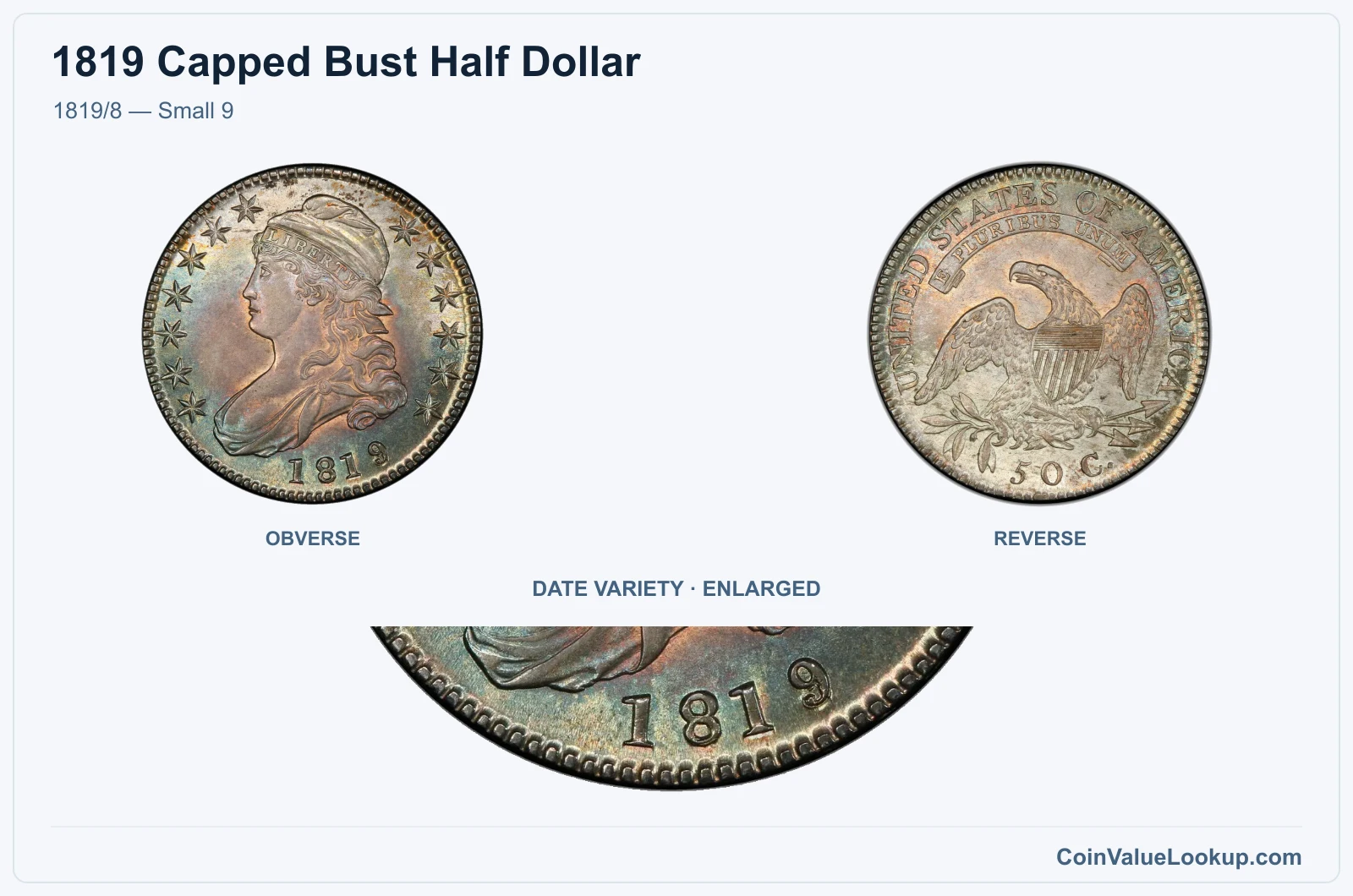
The 1819/8 Small 9 is an overdate variety where the Mint reused an 1818-dated die by punching a small 9 over the final 8. To confirm it, examine the lower loop of the 9 closely.
You should see curved remnants of the original 8 peeking out, and the 9 itself will appear noticeably smaller than the Large 9 variety.
This version carries a consistent premium. USA Coin Book guide estimates run $122 at G4, $300 at VF20, and $1,262 at AU50.
That AU50 figure is the highest among the three regular-strike varieties at that grade, which makes correct identification worthwhile. Photography alone can be tricky — compare your coin to certified reference images at matching magnification before committing to a variety call.
Range Grade
Price Auction Records Appraisal PO PO 1
—
Coin Identifier FR FR 2
—
Coin Identifier AG AG 3
—
Coin Identifier G G 4
—
Coin Identifier
G 6
—
Coin Identifier VG VG 8
Coin Identifier
VG 10
Coin Identifier F F 12
Coin Identifier
F 15
—
Coin Identifier VF VF 20
Coin Identifier
VF 25
Coin Identifier
VF 30
Coin Identifier
VF 35
Coin Identifier XF XF 40
Coin Identifier
XF 45
Coin Identifier AU AU 50
Coin Identifier
AU 53
Coin Identifier
AU 55
Coin Identifier
AU 58
Coin Identifier MS MS 60
—
Coin Identifier
MS 61
Coin Identifier
MS 62
Coin Identifier
MS 63
Coin Identifier
MS 64
Coin Identifier
MS 65
Coin Identifier
MS 66
—
Coin Identifier
MS 67
—
—
—
MS 68
—
—
—
MS 69
—
—
—
MS 70
—
—
—
1819 Capped Bust Half Dollar — /8 — Large 9
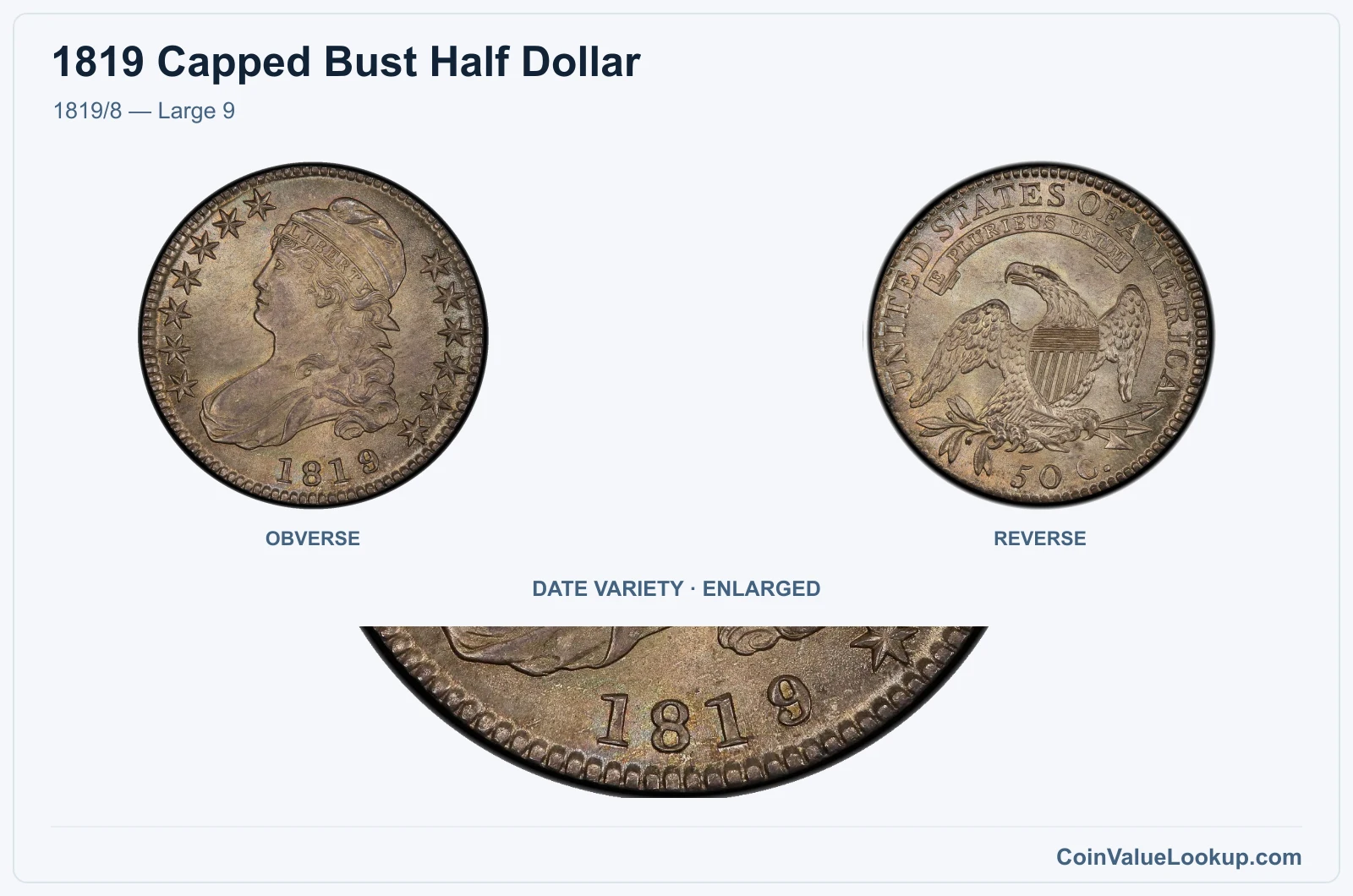
Same overdate concept as the Small 9, but the Mint used a larger 9 punch this time. You still need to see both the bigger 9 and the underlying 8 remnants to call it correctly.
A 9 that merely looks large without any trace of an 8 beneath it is just a Normal Date.
Guide estimates from USA Coin Book come in at $111 for G4, $237 for VF20, and $948 at AU50. The premium over the Normal Date is moderate in lower grades and grows as condition improves.
Apparent size differences between the Small 9 and Large 9 can be deceiving in photos taken at different distances or angles, so side-by-side comparison with authenticated examples is the safest route.
Range Grade
Price Auction Records Appraisal PO PO 1
—
Coin Identifier FR FR 2
—
Coin Identifier AG AG 3
—
Coin Identifier G G 4
—
Coin Identifier
G 6
—
Coin Identifier VG VG 8
Coin Identifier
VG 10
Coin Identifier F F 12
—
Coin Identifier
F 15
Coin Identifier VF VF 20
Coin Identifier
VF 25
Coin Identifier
VF 30
Coin Identifier
VF 35
Coin Identifier XF XF 40
Coin Identifier
XF 45
Coin Identifier AU AU 50
Coin Identifier
AU 53
Coin Identifier
AU 55
Coin Identifier
AU 58
Coin Identifier MS MS 60
—
Coin Identifier
MS 61
Coin Identifier
MS 62
Coin Identifier
MS 63
Coin Identifier
MS 64
Coin Identifier
MS 65
Coin Identifier
MS 66
Coin Identifier
MS 67
—
—
—
MS 68
—
—
—
MS 69
—
—
—
MS 70
—
—
—
1819 Capped Bust Half Dollar — Early Proof — Normal Date
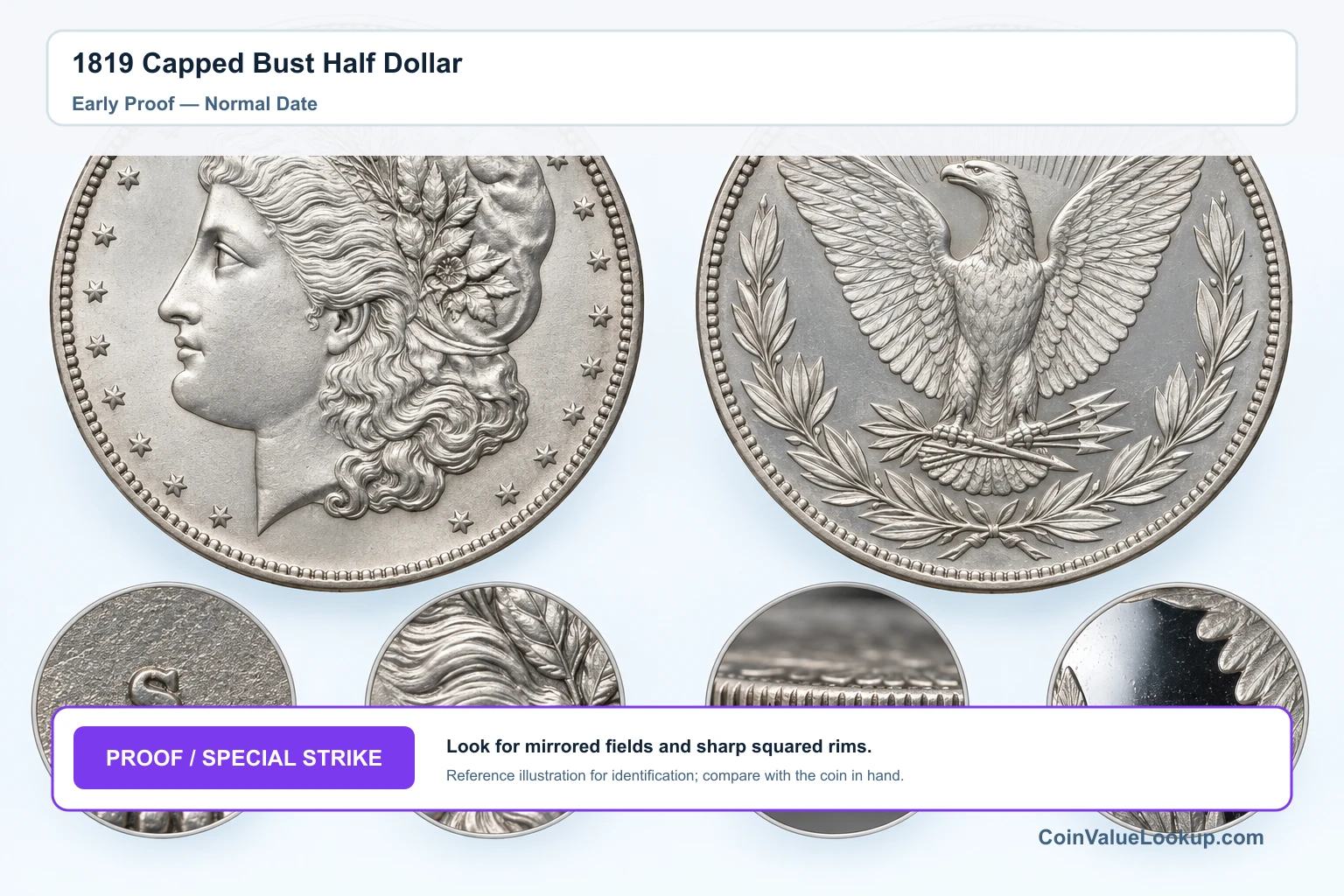
Early Proof Capped Bust Half Dollars from 1819 are genuinely rare collector pieces, not something you stumble across in a junk box. Proof here refers to a specific manufacturing process — specially prepared dies and planchets, hand-fed strikes — not simply a coin that grades above Mint State.
No standard numeric price range is adopted for these. Each one trades on its own merits: authenticated identity, die characteristics, surface preservation, and documented provenance all factor in.
A coin that looks reflective or prooflike is not necessarily a Proof; many regular strikes can appear mirror-like after light cleaning or favorable die state. Proper attribution requires specialist examination, and major grading services catalog this issue separately for good reason.
If you suspect you have one, professional authentication is the only responsible next step.
1819 Capped Bust Half Dollar Proof Value by Grade
Reliable grade-by-grade prices are not currently available. The confirmed Proof catalogue entry has no usable grade-by-grade values in the current price feed. Individual authenticated specimens need specialist assessment.
1819 Capped Bust Half Dollar Error List
1. 1819 Capped Bust Half Dollar — Double / Multiple Strike
A double or multiple strike on an 1819 Half Dollar occurs when the coin is struck more than once with the obverse die shifting between impressions. The result is a visible duplication of design elements — LIBERTY and the surrounding stars may appear ghosted or doubled, while the reverse can remain relatively aligned if the coin stayed seated in the collar.
Do not confuse this with a doubled die, which is a different category caused by a misaligned hub impression on the die itself. Also watch out for post-mint damage where someone has pressed or struck a coin after it left the Mint — the distortion patterns differ.
On a genuine multiple strike the duplicated images will follow a consistent angular shift.
If your 1819/8 overdate also shows this error, the overdate and the striking error are separate features that both contribute to the coin's character. No specific price range is adopted for this error.
Value depends on how dramatic the doubling is, the coin's overall condition, and buyer demand at the time of sale.