1814 Capped Bust Half Dollar Coin Value: How Much Is It Worth?
An 1814 Capped Bust Half Dollar in well-worn G4 condition starts around $142 for the normal date version, climbing to roughly $1,016 near AU50. Collector value shifts considerably depending on which die variety you have.
The 1814/3 overdate and the E over A in STATES correction both carry meaningful premiums, so identification matters before you estimate value.
Fast Way to Identify Your 1814 Capped Bust Half Dollar
Snap a clear photo of both sides of your coin and upload them to our identification tool. This gives you a preliminary read on which 1814 variety you might be holding, whether it is a normal date, an overdate, or one of the lettering and leaf variants.
It is not a substitute for professional authentication, but it is a solid starting point.
1814 Capped Bust Half Dollar Value
Upload both sides of your 1814 Capped Bust Half Dollar.
Front Obverse
Upload photo
Back Reverse
Upload photo
Which 1814 Capped Bust Half Dollar Versions Are Worth Money?
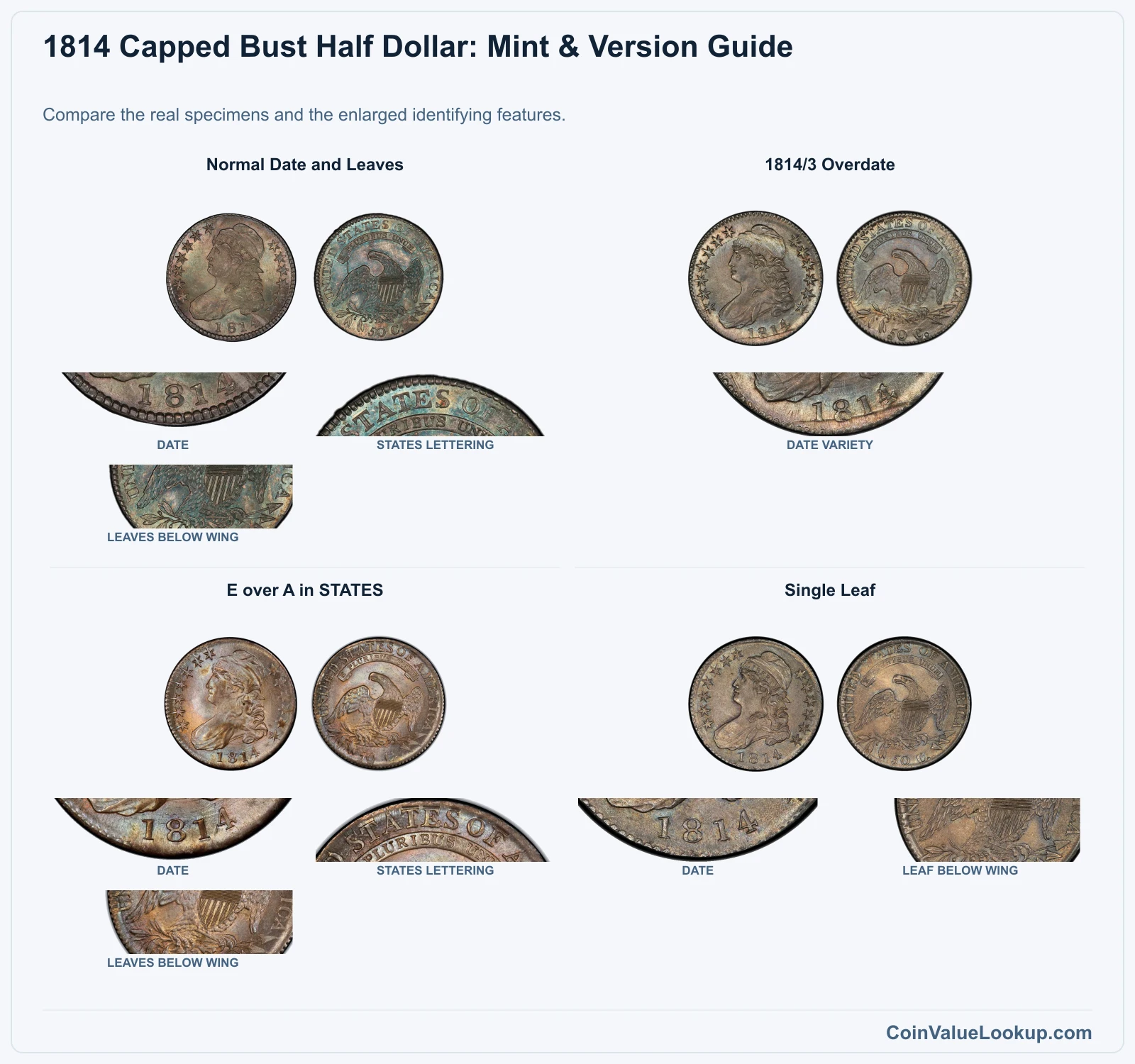
- 1814/3 Overdate: Look for remnants of a 3 beneath the 4 in the date. Guide estimates run from about $237 at G4 to $2,516 at AU50.
- E over A in STATES: Check the reverse for traces of an A under the E in STATES. Guide values range from roughly $268 at G4 to $3,447 at AU50.
- Single Leaf: The upper olive leaf on the reverse is absent. Estimated values reach approximately $3,447 at AU50, comparable to the E over A variety at the top end.
- Normal Date and Leaves: The most available version, but still a 200-plus-year-old silver coin. Guide estimates range from about $142 at G4 to $1,016 at AU50.
Step 1: Identify Your 1814 Capped Bust Half Dollar Mint Mark and Version
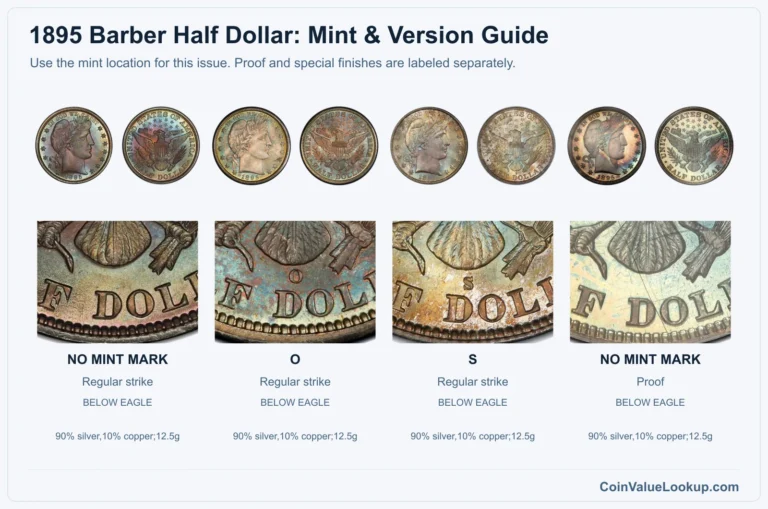
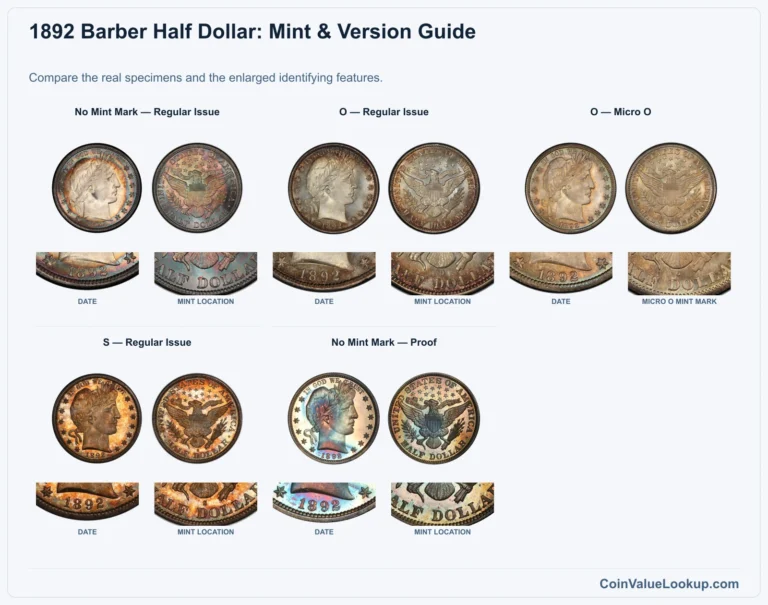
Every 1814 Capped Bust Half Dollar was struck at Philadelphia. There is no mintmark, and that is completely normal for this issue.
Look for the left-facing Liberty wearing a cloth cap on the obverse, with an eagle clutching arrows and an olive branch on the reverse, plus a shield on the eagle's breast. The denomination reads 50C.
If you see a different bust style, you may have the earlier 1807 Draped Bust type, which is a separate coin entirely.
The coin is a silver-copper alloy, approximately 89.24 percent silver, weighing about 13.48 grams and measuring roughly 32.5 mm across. Check the edge: it should read FIFTY CENTS OR HALF A DOLLAR in raised lettering.
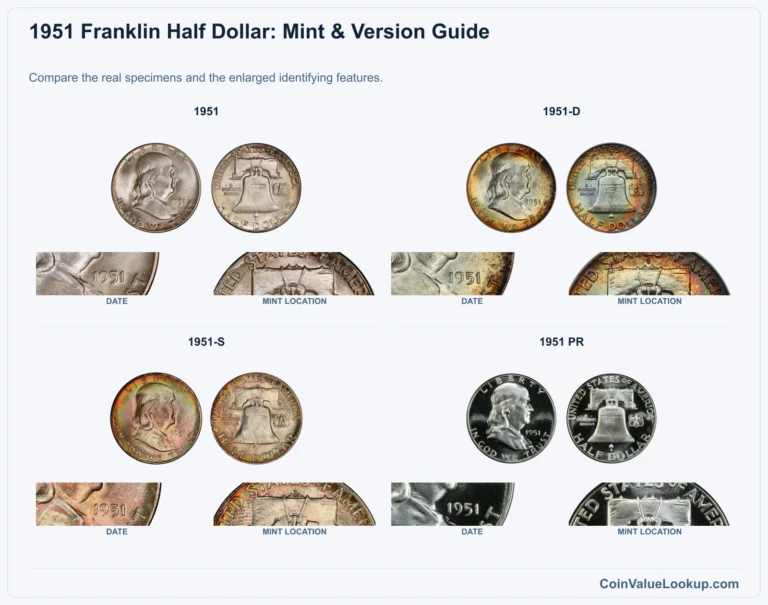
Four recognized versions exist for this date. The Normal Date and Leaves is the baseline.
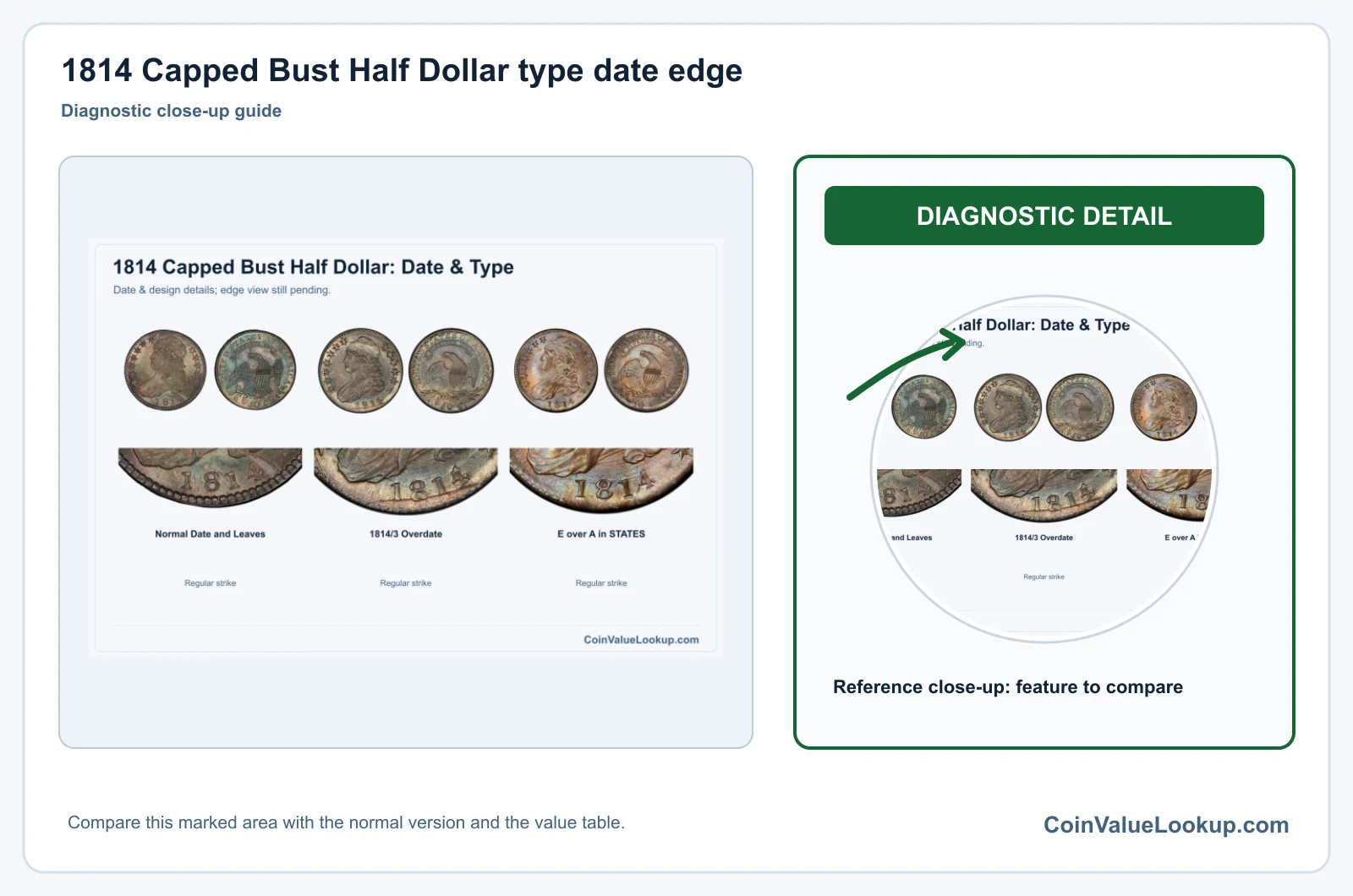
The 1814/3 Overdate shows traces of a 3 underneath the final 4 in the date. The E over A in STATES shows remnants of an underlying A at the E position in the word STATES on the reverse.
The Single Leaf variety is missing the upper olive leaf on the reverse. Each version has a different value range, so narrowing down which one you have is the critical first step.
Step 2: Check Your 1814 Capped Bust Half Dollar Grade
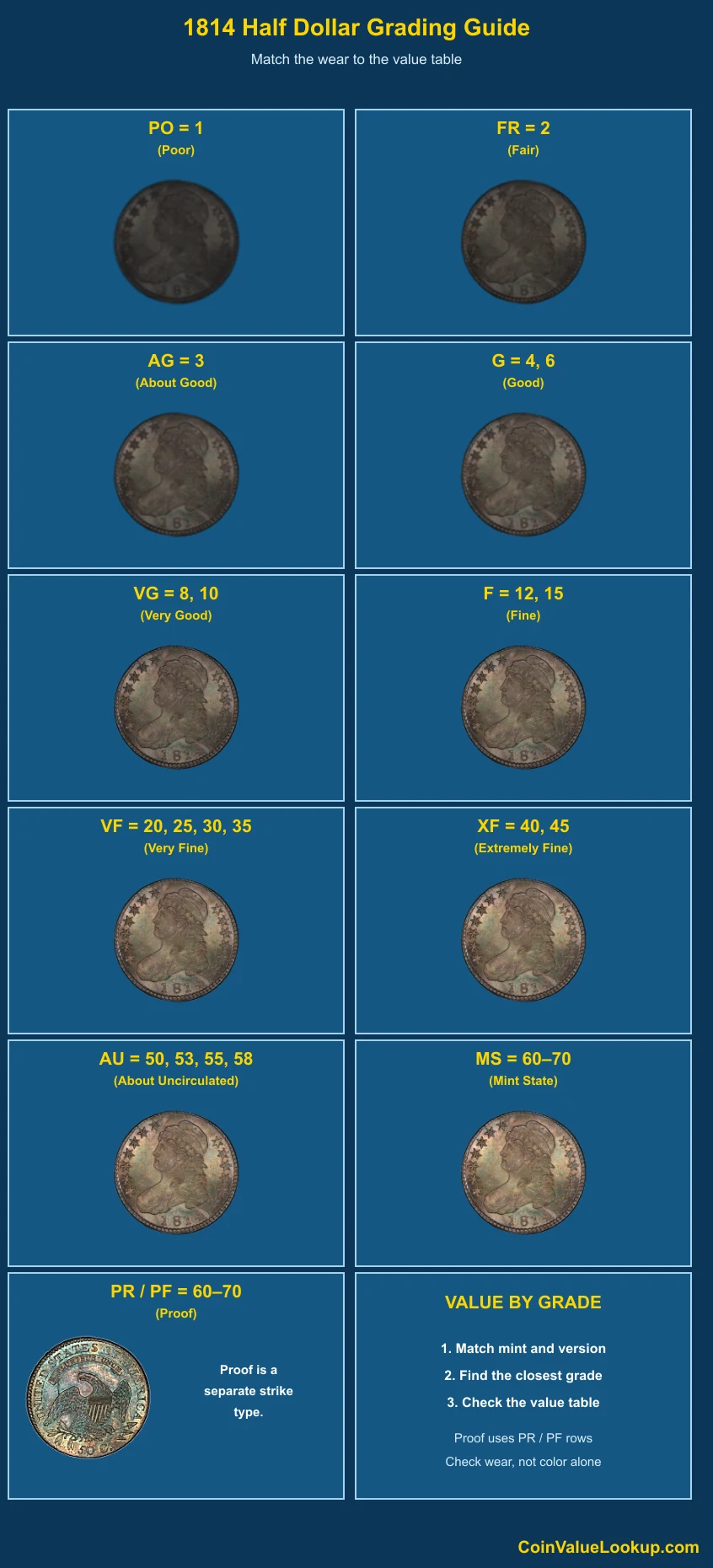
Start at the obverse. Hair detail above the forehead and around the ear wears first, followed by the cheek and the clasp area of the cap.
A coin grading G4 will show a full outline of Liberty with major design elements visible but most fine hair detail gone. By VF20, you should see moderate hair detail remaining above the ear and partial cap lines.
Flip the coin over. Eagle breast feathers and wing tips tell the same story on the reverse.
A weak strike can mimic wear here, so compare your coin's sharpness against known examples at the same grade rather than assuming flat feathers always mean heavy circulation.
Luster is your friend at upper grades. An AU50 coin retains some original mint sheen in protected areas, with only light friction on the highest points.
If the surfaces look unnaturally bright or show fine hairlines, the coin may have been cleaned. Cleaning, holes, tooling or heavy scratches place a coin into a details-grade category, and those coins should not be priced along the same scale as problem-free examples.
Step 3: Check 1814 Capped Bust Half Dollar Value by Mint and Version
1814 Capped Bust Half Dollar — Normal Date and Leaves
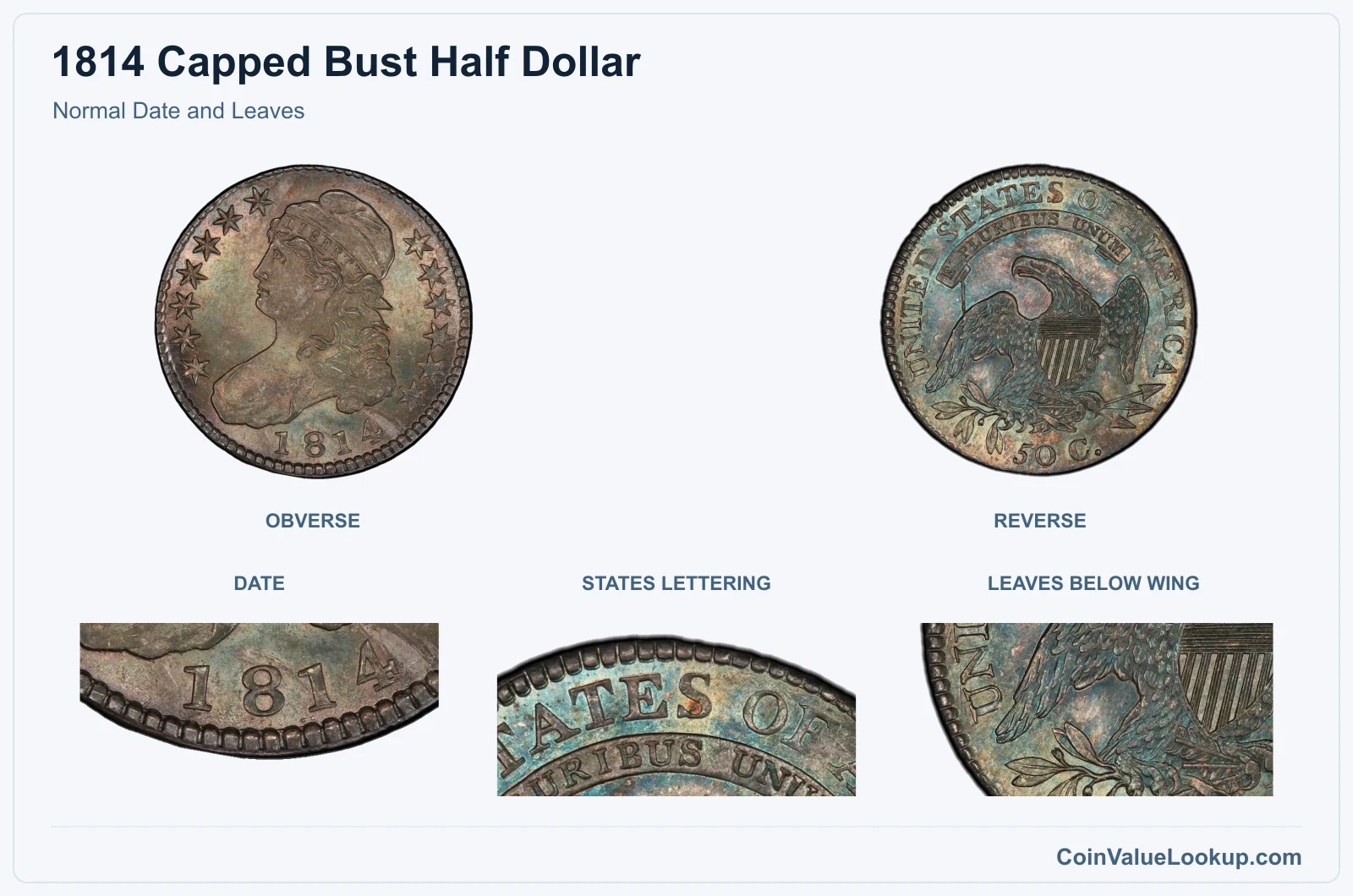
This is the standard 1814 half dollar with a normal date, correct reverse lettering, and both olive leaves present above the branch. Before defaulting to this version, confirm that no trace of a 3 sits beneath the 4 in the date, that the E in STATES shows no underlying A, and that the upper olive leaf is clearly visible.
Guide estimates place the Normal Date and Leaves at roughly $142 in G4, $332 in VF20, and $1,016 in AU50. These are retail guide figures from USA Coin Book and reflect typical collector pricing, not guaranteed sale amounts.
If you are just getting started with early half dollars, Coin Value Lookup is a useful place to look up guides for other dates and denominations in the Capped Bust series.
Range Grade
Price Auction Records Appraisal PO PO 1
—
Coin Identifier FR FR 2
—
Coin Identifier AG AG 3
—
Coin Identifier G G 4
—
Coin Identifier
G 6
—
Coin Identifier VG VG 8
Coin Identifier
VG 10
—
Coin Identifier F F 12
Coin Identifier
F 15
Coin Identifier VF VF 20
Coin Identifier
VF 25
Coin Identifier
VF 30
Coin Identifier
VF 35
Coin Identifier XF XF 40
Coin Identifier
XF 45
Coin Identifier AU AU 50
Coin Identifier
AU 53
Coin Identifier
AU 55
Coin Identifier
AU 58
Coin Identifier MS MS 60
Coin Identifier
MS 61
Coin Identifier
MS 62
Coin Identifier
MS 63
Coin Identifier
MS 64
Coin Identifier
MS 65
Coin Identifier
MS 66
Coin Identifier
MS 67
Coin Identifier
MS 68
—
—
—
MS 69
—
—
—
MS 70
—
—
—
1814 Capped Bust Half Dollar — /3 Overdate
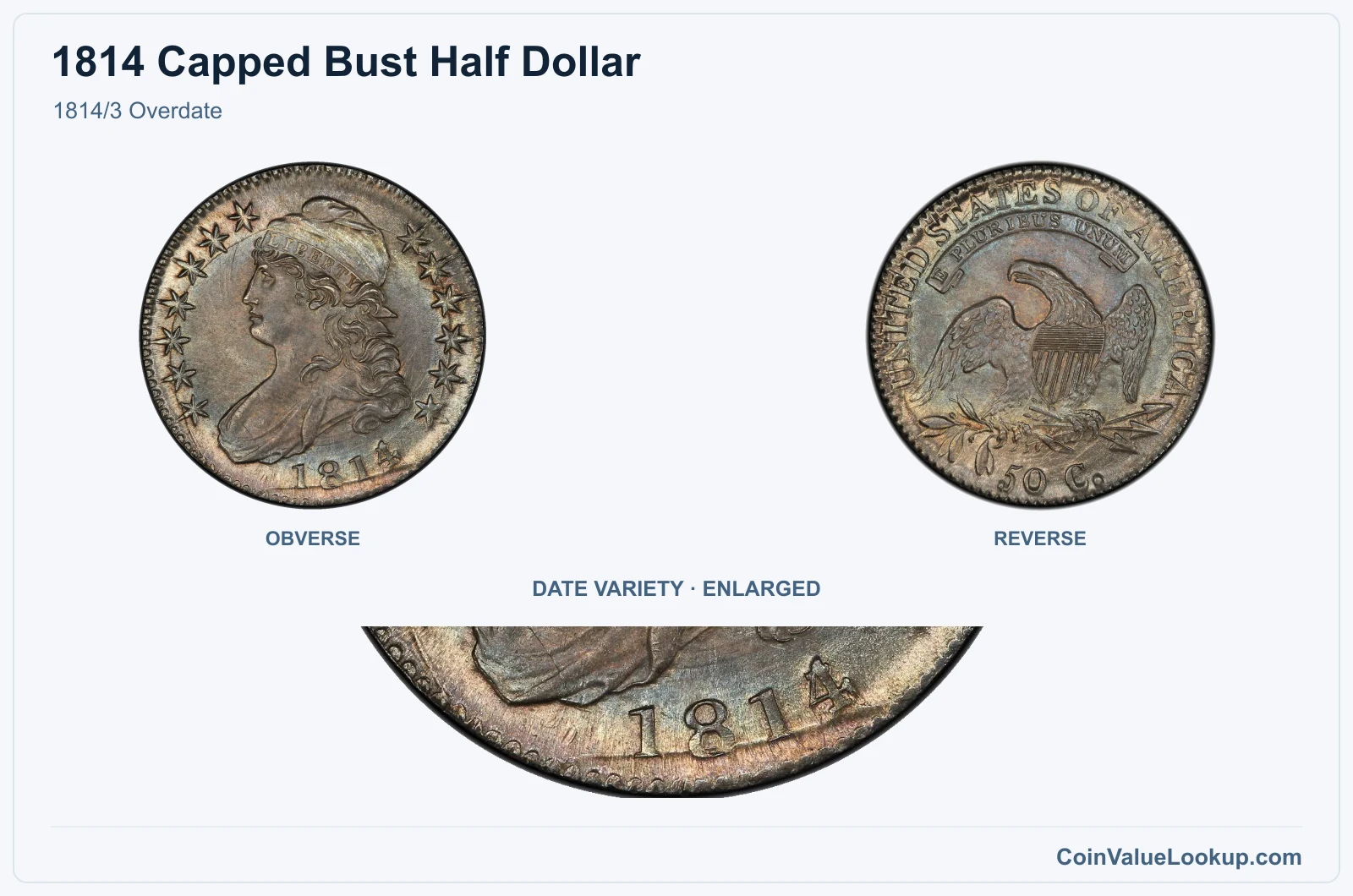
The 1814/3 overdate was created when a die originally dated 1813 had its final digit re-engraved as a 4. Under magnification, you can see the curved lower portion of a 3 peeking out beneath the 4.
This is a die-preparation artifact, not an error in the usual sense.
Do not confuse die cracks or clash marks on the same coin with the overdate itself. Those are separate conditions.
The overdate identity comes solely from the remnant numeral in the date.
Guide estimates from USA Coin Book put the 1814/3 at about $237 in G4, $658 in VF20, and $2,516 in AU50. That is a meaningful jump over the normal date, especially in mid-to-upper grades.
Heavy wear can obscure the overdate feature, so a loupe and good lighting are essential when checking well-circulated pieces.
Range Grade
Price Auction Records Appraisal PO PO 1
—
Coin Identifier FR FR 2
—
Coin Identifier AG AG 3
—
Coin Identifier G G 4
—
Coin Identifier
G 6
—
Coin Identifier VG VG 8
Coin Identifier
VG 10
Coin Identifier F F 12
Coin Identifier
F 15
Coin Identifier VF VF 20
Coin Identifier
VF 25
Coin Identifier
VF 30
Coin Identifier
VF 35
Coin Identifier XF XF 40
Coin Identifier
XF 45
Coin Identifier AU AU 50
Coin Identifier
AU 53
Coin Identifier
AU 55
Coin Identifier
AU 58
Coin Identifier MS MS 60
—
Coin Identifier
MS 61
—
Coin Identifier
MS 62
Coin Identifier
MS 63
Coin Identifier
MS 64
Coin Identifier
MS 65
Coin Identifier
MS 66
—
—
—
MS 67
—
—
—
MS 68
—
—
—
MS 69
—
—
—
MS 70
—
—
—
1814 Capped Bust Half Dollar — E over A in STATES
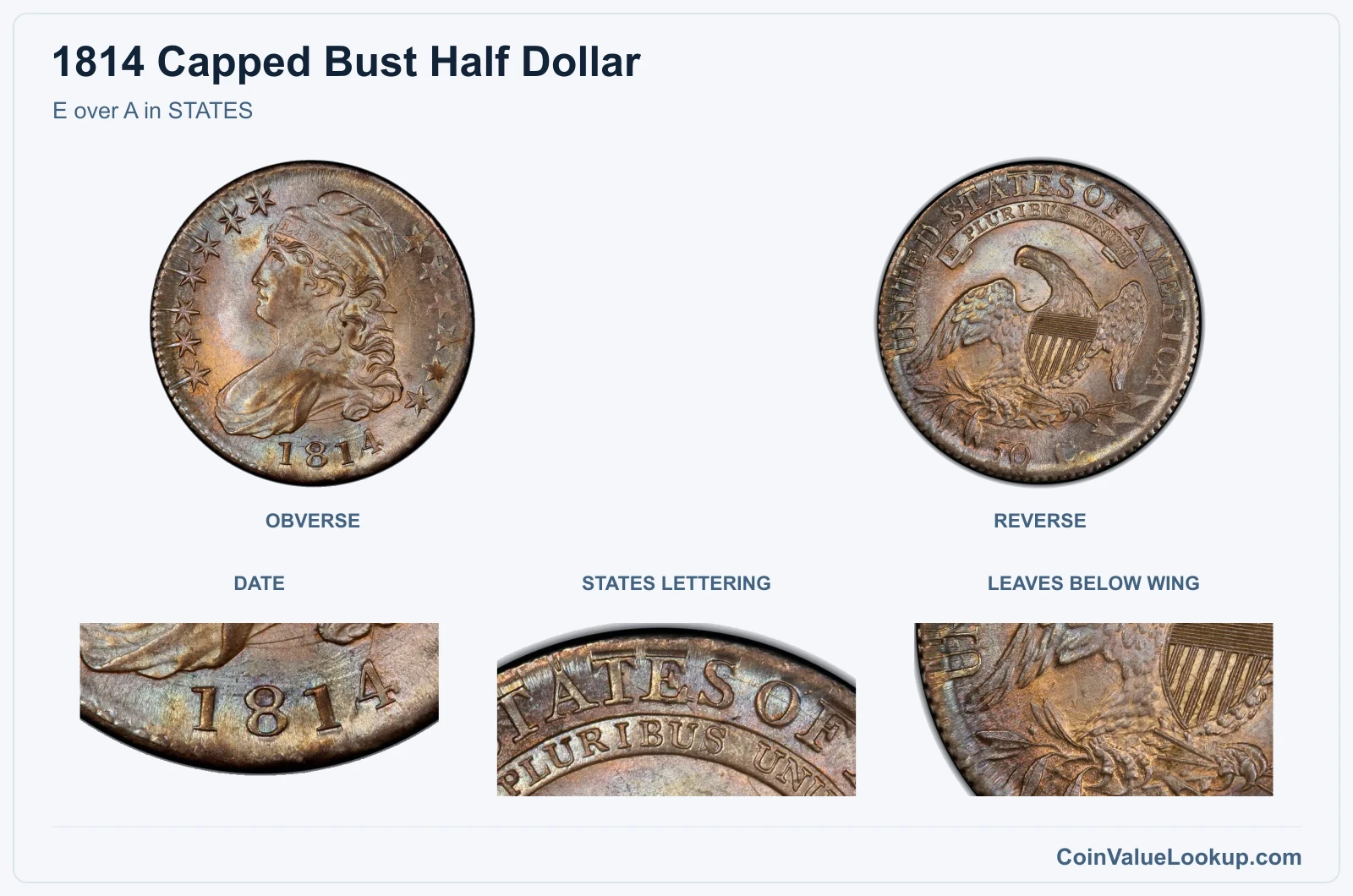
On this variety, the engraver initially cut an A where the second E in STATES belongs on the reverse, then corrected it to an E. Look carefully at that letter under magnification: you should see traces of the A's angled legs beneath the horizontal bars of the E.
This is specific to the 1814 issue and should not be confused with the well-known 1795 Flowing Hair variety that involves the reverse letters in a different arrangement. Match the exact letter position in STATES before attributing this one.
USA Coin Book guide values run approximately $268 at G4, $631 at VF20, and $3,447 at AU50. The premium over the normal date grows substantially in higher grades, making accurate attribution worth the effort even on a moderately worn coin.
Range Grade
Price Auction Records Appraisal PO PO 1
—
Coin Identifier FR FR 2
—
Coin Identifier AG AG 3
—
Coin Identifier G G 4
—
Coin Identifier
G 6
—
Coin Identifier VG VG 8
—
Coin Identifier
VG 10
—
Coin Identifier F F 12
—
Coin Identifier
F 15
Coin Identifier VF VF 20
Coin Identifier
VF 25
Coin Identifier
VF 30
Coin Identifier
VF 35
Coin Identifier XF XF 40
Coin Identifier
XF 45
Coin Identifier AU AU 50
Coin Identifier
AU 53
Coin Identifier
AU 55
Coin Identifier
AU 58
Coin Identifier MS MS 60
—
Coin Identifier
MS 61
—
Coin Identifier
MS 62
—
Coin Identifier
MS 63
—
Coin Identifier
MS 64
—
Coin Identifier
MS 65
—
—
—
MS 66
—
—
—
MS 67
—
—
—
MS 68
—
—
—
MS 69
—
—
—
MS 70
—
—
—
1814 Capped Bust Half Dollar — Single Leaf
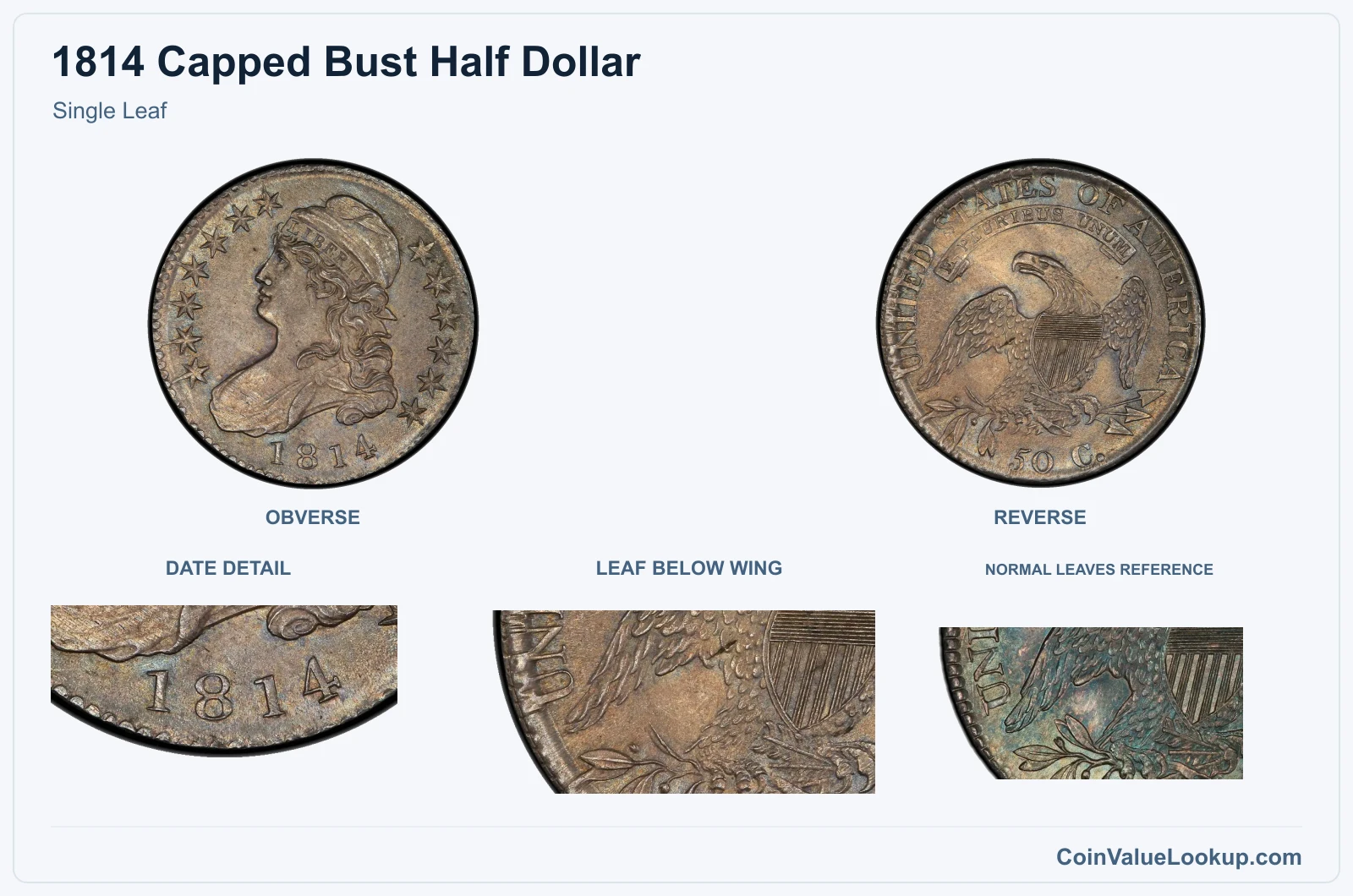
The Single Leaf variety is missing the upper olive leaf that normally appears on the reverse branch near the eagle's talon. On a standard 1814 half dollar, two distinct leaves are visible in this area.
On the Single Leaf die, only the lower leaf is present.
Be careful here. A weakly struck or heavily worn coin can appear to be missing a leaf when the detail has simply been lost to strike softness or circulation.
Attribution requires a clearly defined reverse where surrounding design elements are sharp enough to confirm the leaf was never struck, not just worn away.
Guide estimates from USA Coin Book place the Single Leaf at roughly $173 in G4, $575 in VF20, and $3,447 at AU50. At the top end, values match the E over A variety, reflecting genuine collector demand for this recognized die marriage.
Ordinary-issue reference: Ordinary-issue reference only: The table below shows prices for the 1814 Capped Bust Half Dollar (regular strike). It does not represent the value of the specific Single Leaf variety or its variety premium. Year, mint, metal and strike type are matched; the specific variety is not priced by this table.
Range Grade
Price Auction Records Appraisal PO PO 1
—
Coin Identifier FR FR 2
—
Coin Identifier AG AG 3
—
Coin Identifier G G 4
—
Coin Identifier
G 6
—
Coin Identifier VG VG 8
Coin Identifier
VG 10
—
Coin Identifier F F 12
Coin Identifier
F 15
Coin Identifier VF VF 20
Coin Identifier
VF 25
Coin Identifier
VF 30
Coin Identifier
VF 35
Coin Identifier XF XF 40
Coin Identifier
XF 45
Coin Identifier AU AU 50
Coin Identifier
AU 53
Coin Identifier
AU 55
Coin Identifier
AU 58
Coin Identifier MS MS 60
Coin Identifier
MS 61
Coin Identifier
MS 62
Coin Identifier
MS 63
Coin Identifier
MS 64
Coin Identifier
MS 65
Coin Identifier
MS 66
Coin Identifier
MS 67
Coin Identifier
MS 68
—
—
—
MS 69
—
—
—
MS 70
—
—
—
1814 Capped Bust Half Dollar Error List
1. 1814 Capped Bust Half Dollar — Off-Center Strike
An off-center strike occurs when the planchet is not properly seated between the dies at the moment of impact, shifting the design away from center. On the reported 1814 Half Dollar specimen, the displacement is about 5 percent, which is modest but enough to show an uneven rim and slightly shifted design elements.
Do not confuse this with a clipped planchet, a one-sided die misalignment, or post-mint flattening from damage. An off-center strike affects the entire design uniformly in one direction, and the blank area (if visible) will correspond to the opposite side of the shift.
The reported specimen also shows multiple-strike evidence, meaning these two error categories overlap on the same coin. Value depends on the degree of displacement, overall condition, and visibility of the error.
No specific price range is established for this category on 1814 half dollars, so individual assessment is necessary.
2. 1814 Capped Bust Half Dollar — Multiple Strike
A multiple-strike coin was fed through the press more than once, producing overlapping impressions of the design. On the reported 1814 specimen, at least three strikes occurred, with dentils (the small tooth-like border elements) visibly impressed across the top of Liberty's head where they do not belong.
This is distinct from a doubled die, which is a single-strike phenomenon created by a defective die. It also differs from machine doubling, which produces flat shelf-like doubling, and from ordinary die clashes, which transfer partial opposite-die designs without a full second strike.
Look for clearly duplicated, shifted design elements rather than vague doubling.
The same coin also exhibits the off-center displacement described separately. No adopted price range exists for multiple-strike 1814 half dollars, so value depends on the clarity and drama of the repeated impressions, combined with overall preservation.
3. 1814 Capped Bust Half Dollar — Defective Planchet
A defective planchet means the blank metal disc had a flaw before it was struck. On a reported 1814/3 half dollar, a reverse planchet flaw was documented as a visible irregularity in the metal surface, surrounded by otherwise normal design detail.
This tells you the defect was present in the silver blank, not introduced after the coin entered circulation.
The key distinction is separating a planchet flaw from post-mint damage. Gouges, corrosion pitting, and deliberate removal of metal all happen after striking and look different under magnification.
A genuine planchet flaw typically has design detail struck over or around it, confirming it predates the strike.
Note that the reported specimen is also an 1814/3 overdate, so the planchet flaw and the overdate are independent features. No specific price data is adopted for this error on the 1814 date, and individual assessment would be needed.
4. 1814 Capped Bust Half Dollar — Clashed Dies
Clashed dies result when the obverse and reverse dies strike each other without a planchet between them. This transfers faint ghost impressions of one die's design onto the face of the other.
On a reported 1814 half dollar, die-clash traces were documented on the coin's surfaces.
To spot a clash, look for faint outlines of the eagle or shield appearing in the obverse fields, or traces of Liberty's profile showing up on the reverse. These transferred images will mirror the opposite die's design and appear in areas that should be flat and featureless.
Do not mistake random scratches, raised lines from die polish, or brockage impressions for clash marks. Genuine clashes follow the contour of the opposing die design and can often be confirmed by overlaying images of each side.
No adopted price is available for clashed-die 1814 half dollars, so each coin's value depends on the prominence of the clash evidence and overall condition.