1809 Capped Bust Half Dollar Coin Value: How Much Is It Worth?
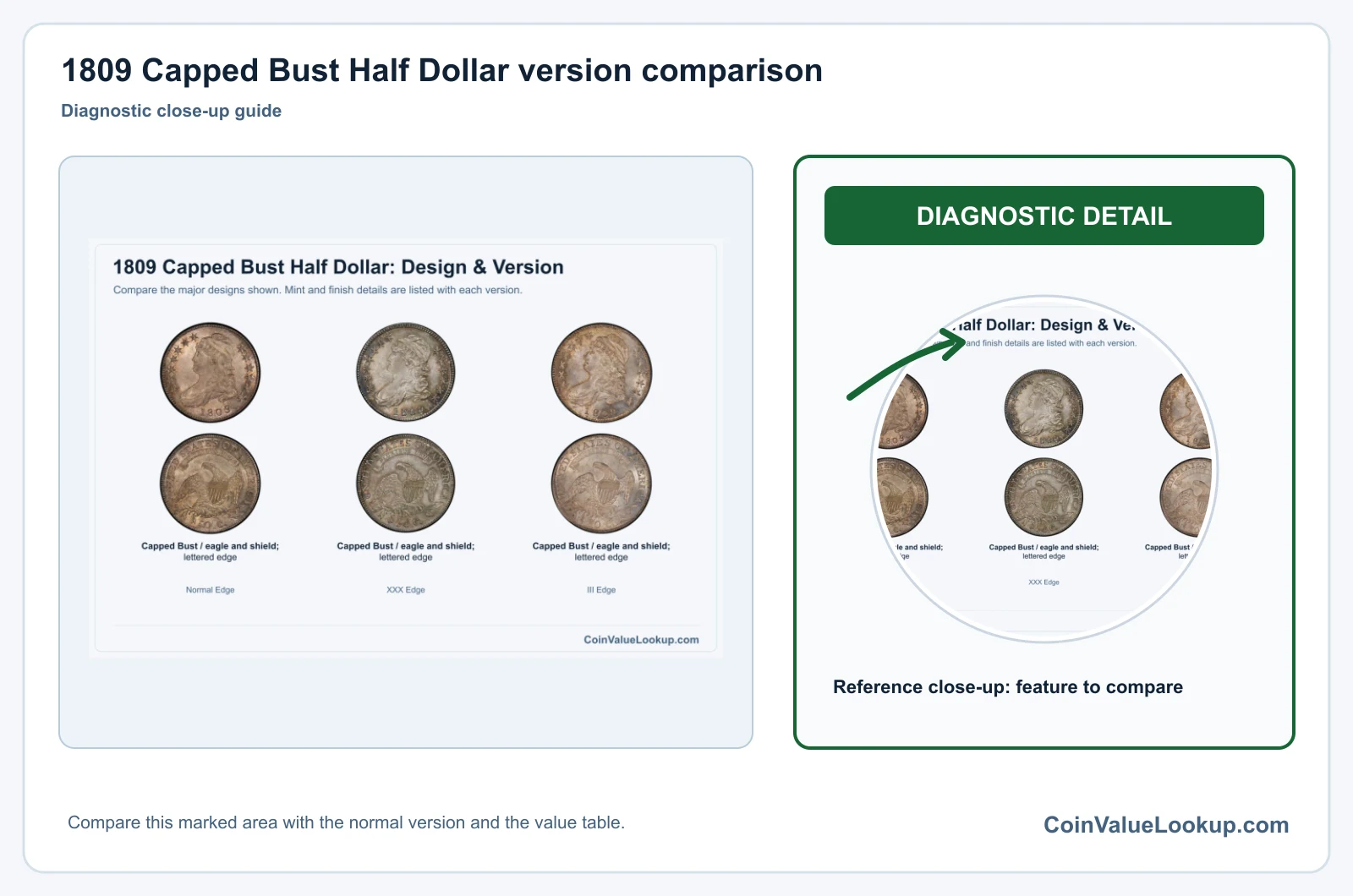
The 1809 Capped Bust Half Dollar starts around $142 in well-worn G4 condition and climbs to roughly $1,146 near AU50 for the Normal Edge version, based on USA Coin Book guide estimates. Collector value shifts considerably depending on which edge ornament variety you have and the coin's surfaces.
Rare edge types can push prices significantly higher.
Fast Way to Identify Your 1809 Capped Bust Half Dollar
Want a quick read on your 1809 half dollar? Upload clear photos of the front and back, and our identifier can offer a preliminary take on which version you may have.
Edge photos are critical for this date, so try to capture the lettered edge as well. This is preliminary identification from photos, not a certified authentication or exact grade assignment.
1809 Capped Bust Half Dollar Value
Upload both sides of your 1809 Capped Bust Half Dollar.
Front Obverse
Upload photo
Back Reverse
Upload photo
Which 1809 Capped Bust Half Dollar Versions Are Worth Money?
- Normal Edge: The baseline 1809 variety. Guide estimates range from about $142 at G4 to $1,146 at AU50. Confirm by checking the edge for the absence of X-shaped or vertical-bar ornaments.
- XXX Edge: The priciest standard variety for 1809. Guide estimates run from roughly $205 at G4 to $2,516 at AU50. Look for X-shaped ornaments between words on the lettered edge.
- III Edge: Guide values start around $142 at G4 and reach approximately $1,464 at AU50. Identified by vertical-bar ornaments on the edge between words. Catalog naming may vary between III and IIII for the same variety.
Step 1: Identify Your 1809 Capped Bust Half Dollar Mint Mark and Version
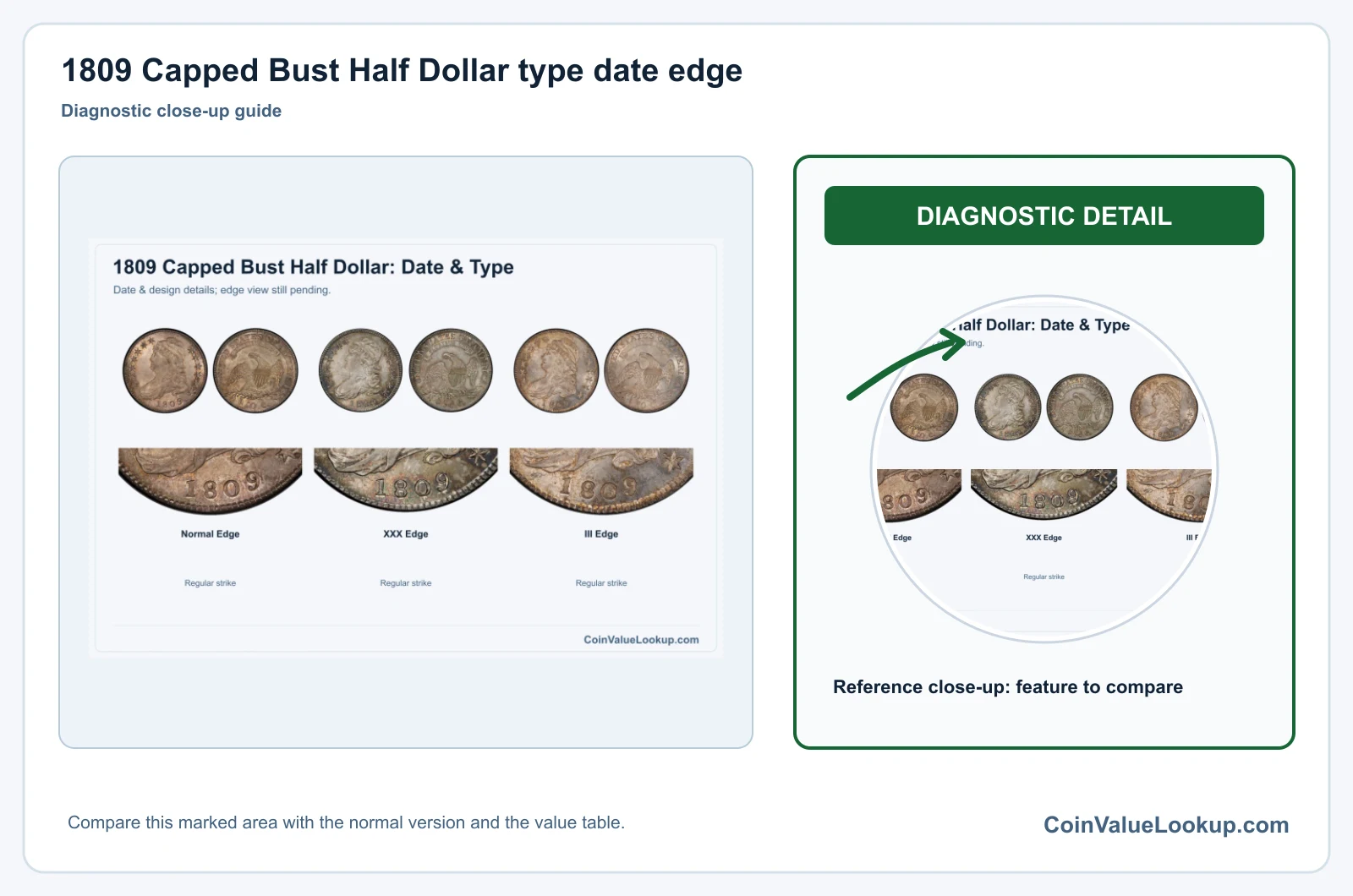
Every 1809 Capped Bust Half Dollar was struck at Philadelphia. There is no mintmark, and that is perfectly normal for this issue.
The obverse shows a left-facing Liberty wearing a cap, surrounded by stars. The reverse features an eagle with a shield, plus the denomination 50C.
The edge is lettered: FIFTY CENTS OR HALF A DOLLAR.
This is a silver-copper alloy coin, approximately 89.24% silver, weighing about 13.48 grams and measuring roughly 32.5 mm. Do not confuse it with the earlier 1807 Draped Bust design, which is a completely different type.
The key distinction for 1809 is the edge ornament pattern between the words. Three versions exist: Normal Edge (no distinctive ornament pattern), XXX Edge (X-shaped ornaments), and III Edge (vertical-bar ornaments).
You absolutely need to inspect the edge to know which one you hold.
Step 2: Check Your 1809 Capped Bust Half Dollar Grade
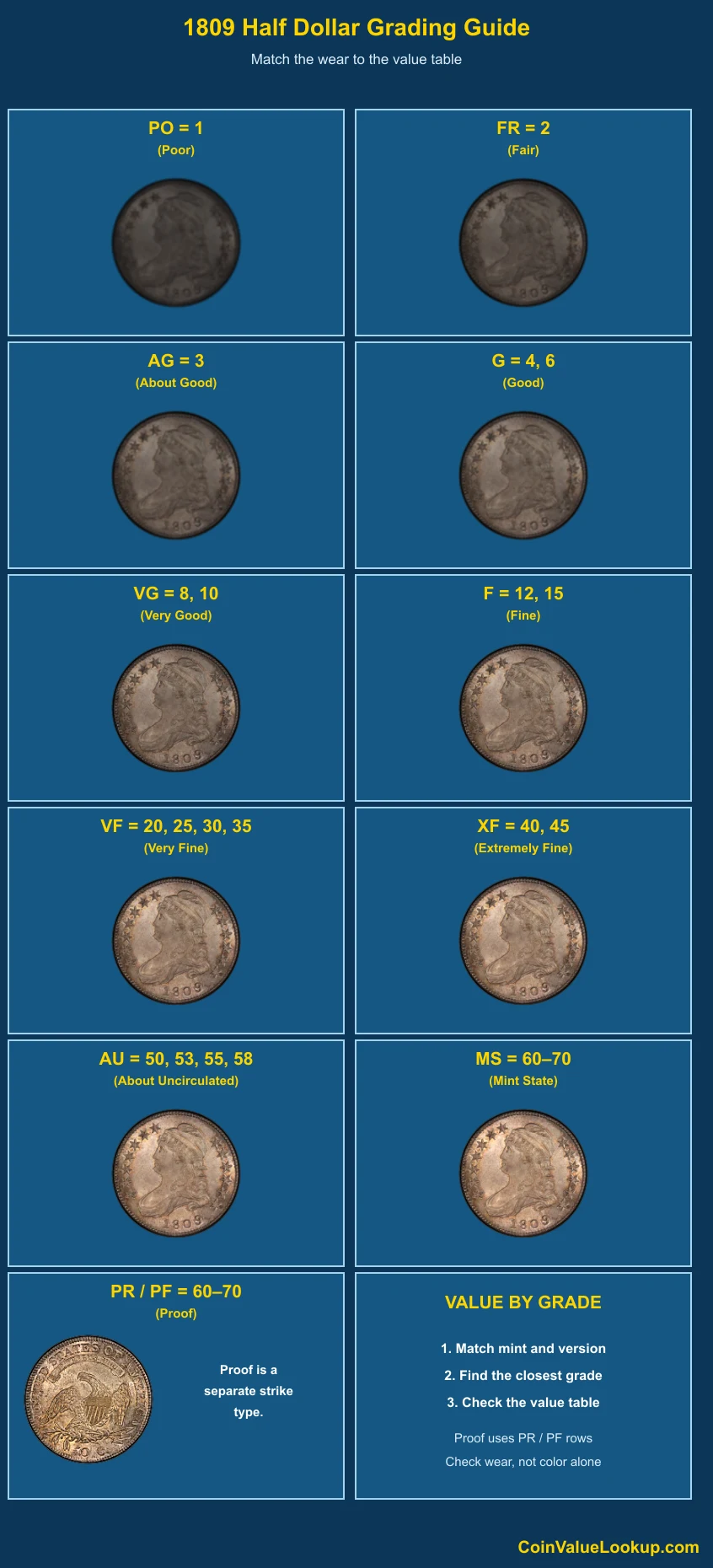
Start with the hair above Liberty's forehead and ear. In lower grades, that area blends into a flat mass.
A coin with clear individual curls and sharp cap detail is heading toward AU territory.
Check Liberty's cheek for friction. Even light rubbing dulls the original luster there first.
On the reverse, examine the eagle's breast feathers and wing tips for the same wear versus sharpness tradeoff.
Some 1809 halves came weakly struck, so a soft spot is not always wear. Compare your coin to the grading image above to see the difference between a flat strike and genuine friction.
Lost cartwheel luster across high points usually confirms actual circulation.
Cleaned, tooled, holed, or scratched coins fall into a "Details" category and should not be priced on a straight-grade scale. Those problems reduce value below what any grade number alone would suggest.
Step 3: Check 1809 Capped Bust Half Dollar Value by Mint and Version
1809 Capped Bust Half Dollar — Normal Edge
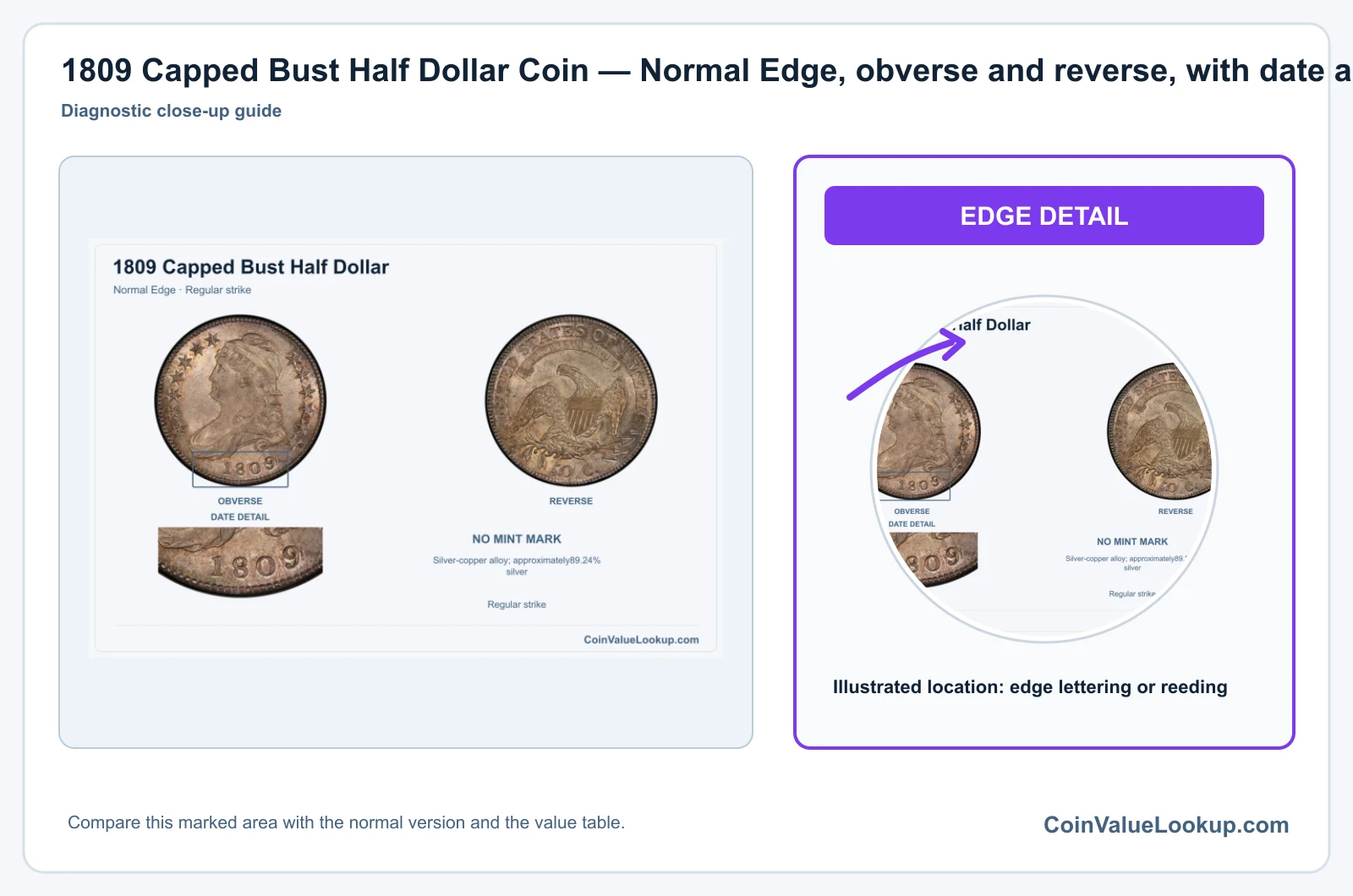
The Normal Edge is the version most 1809 half dollar owners will find. It has the standard lettered edge reading FIFTY CENTS OR HALF A DOLLAR without the distinctive X-shaped or vertical-bar ornaments seen on the other two varieties.
USA Coin Book guide estimates place this version at about $142 in G4, around $364 in VF20, and near $1,146 in AU50. These are retail guide estimates, not guaranteed sale prices.
To confirm you have the Normal Edge, photograph the entire edge under good light. You are looking for the absence of any repeating decorative pattern between the words.
If the edge is worn smooth, identification becomes trickier, and a closer comparison may be needed.
Range Grade
Price Auction Records Appraisal PO PO 1
—
Coin Identifier FR FR 2
—
Coin Identifier AG AG 3
—
Coin Identifier G G 4
Coin Identifier
G 6
Coin Identifier VG VG 8
Coin Identifier
VG 10
Coin Identifier F F 12
Coin Identifier
F 15
Coin Identifier VF VF 20
Coin Identifier
VF 25
Coin Identifier
VF 30
Coin Identifier
VF 35
Coin Identifier XF XF 40
Coin Identifier
XF 45
Coin Identifier AU AU 50
Coin Identifier
AU 53
Coin Identifier
AU 55
Coin Identifier
AU 58
Coin Identifier MS MS 60
Coin Identifier
MS 61
Coin Identifier
MS 62
Coin Identifier
MS 63
Coin Identifier
MS 64
Coin Identifier
MS 65
Coin Identifier
MS 66
Coin Identifier
MS 67
—
—
—
MS 68
—
—
—
MS 69
—
—
—
MS 70
—
—
—
1809 Capped Bust Half Dollar — XXX Edge
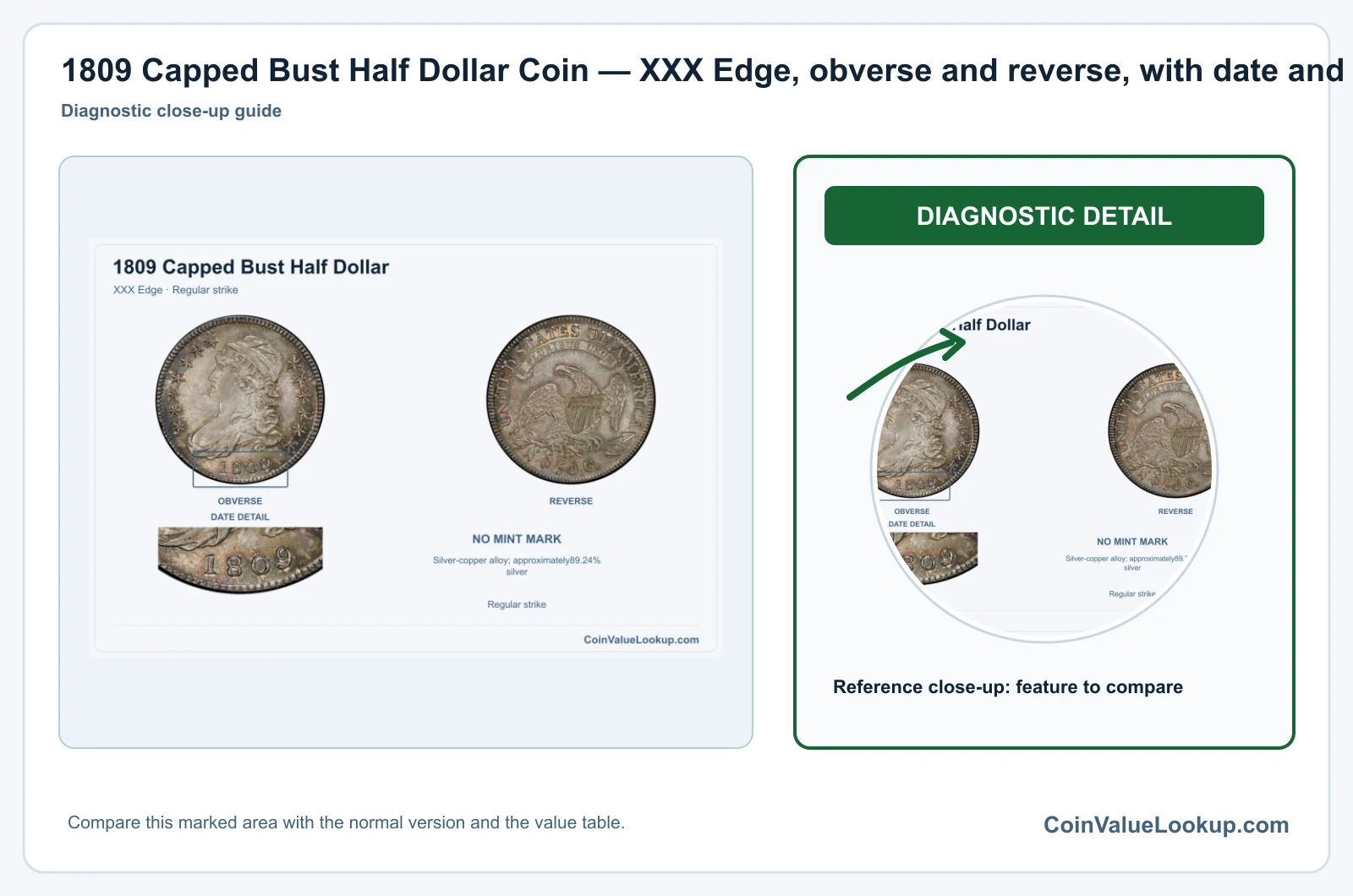
The XXX Edge variety is distinguished by X-shaped ornaments placed between the words on the lettered edge. Some references label this XXXX rather than XXX; the difference is catalog convention, not a separate coin.
Match the actual ornament shape on your edge, not the letter count in a catalog name.
This version carries a noticeable premium. USA Coin Book guide estimates put it at roughly $205 in G4, about $546 in VF20, and around $2,516 at AU50.
That AU50 figure is more than double the Normal Edge at the same grade, which tells you why checking the edge matters.
Coin Value Lookup is a good starting point if you want to look up other Capped Bust half dollar dates and compare values across the series.
All 1809 halves were struck at Philadelphia in silver-copper alloy, so the edge ornament is the primary identifier separating this from the other varieties.
Range Grade
Price Auction Records Appraisal PO PO 1
—
Coin Identifier FR FR 2
—
Coin Identifier AG AG 3
—
Coin Identifier G G 4
—
Coin Identifier
G 6
Coin Identifier VG VG 8
Coin Identifier
VG 10
Coin Identifier F F 12
Coin Identifier
F 15
Coin Identifier VF VF 20
Coin Identifier
VF 25
Coin Identifier
VF 30
Coin Identifier
VF 35
Coin Identifier XF XF 40
Coin Identifier
XF 45
Coin Identifier AU AU 50
Coin Identifier
AU 53
Coin Identifier
AU 55
Coin Identifier
AU 58
Coin Identifier MS MS 60
—
Coin Identifier
MS 61
Coin Identifier
MS 62
Coin Identifier
MS 63
Coin Identifier
MS 64
—
Coin Identifier
MS 65
—
—
—
MS 66
—
—
—
MS 67
—
—
—
MS 68
—
—
—
MS 69
—
—
—
MS 70
—
—
—
1809 Capped Bust Half Dollar — III Edge
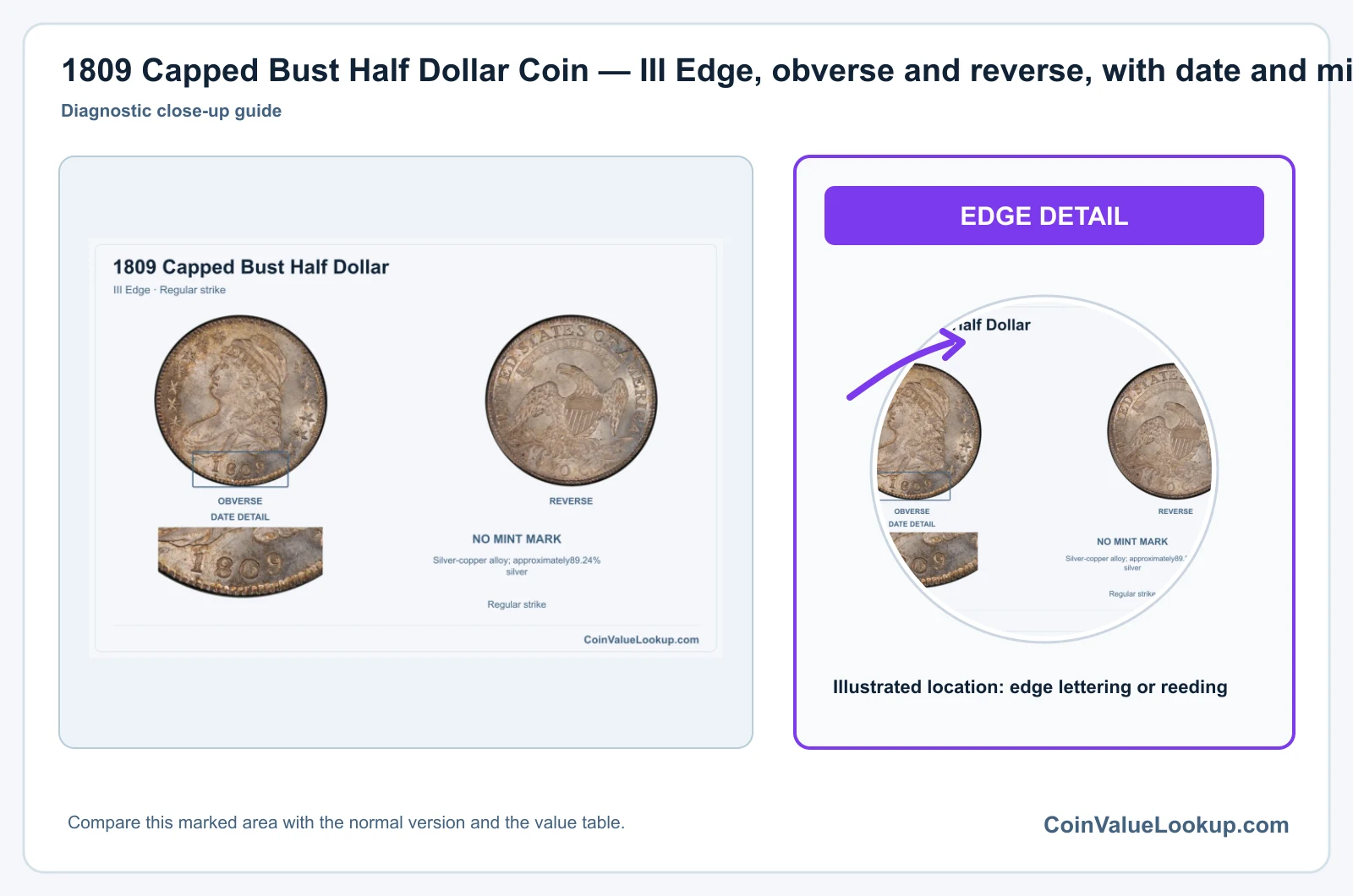
The III Edge version has vertical-bar ornaments between words on the lettered edge. These small decorative elements look like short parallel lines.
Different catalogs may call this III or IIII for the same variety, so do not assume two separate coins exist.
These edge decorations were intentional at the mint. They are not damage, not an error, and not post-mint additions.
USA Coin Book guide estimates place the III Edge at about $142 in G4, approximately $364 in VF20, and around $1,464 near AU50. It sits between the Normal Edge and XXX Edge in higher grades.
As always, actual transaction prices depend on the individual coin's surfaces, eye appeal, and market timing.
Range Grade
Price Auction Records Appraisal PO PO 1
—
Coin Identifier FR FR 2
—
Coin Identifier AG AG 3
—
Coin Identifier G G 4
—
Coin Identifier
G 6
—
Coin Identifier VG VG 8
Coin Identifier
VG 10
Coin Identifier F F 12
Coin Identifier
F 15
Coin Identifier VF VF 20
Coin Identifier
VF 25
Coin Identifier
VF 30
Coin Identifier
VF 35
Coin Identifier XF XF 40
Coin Identifier
XF 45
Coin Identifier AU AU 50
Coin Identifier
AU 53
Coin Identifier
AU 55
Coin Identifier
AU 58
Coin Identifier MS MS 60
—
Coin Identifier
MS 61
Coin Identifier
MS 62
Coin Identifier
MS 63
Coin Identifier
MS 64
Coin Identifier
MS 65
Coin Identifier
MS 66
—
—
—
MS 67
—
—
—
MS 68
—
—
—
MS 69
—
—
—
MS 70
—
—
—
1809 Capped Bust Half Dollar Error List
1. 1809 Capped Bust Half Dollar — Off-Center Strike
An off-center strike occurs when the planchet is not properly seated between the dies at the moment of striking. On an 1809 half dollar, this produces a blank crescent along one side where no design was impressed, while the opposite side shows the design shifted inward.
One documented example was struck roughly 15% off center, enough to create a visible crescent but still leaving the date legible. That legible date is important for collectibility.
Do not confuse an off-center strike with a clipped planchet, which has a different edge profile, or with one-sided die misalignment, which shifts one face relative to the other rather than leaving a blank area. Post-mint flattening can also mimic a shift but lacks the telltale unstruck crescent.
Exact value depends on the degree of the error, the coin's condition, and collector demand for the specific piece.
2. 1809 Capped Bust Half Dollar — Double / Multiple Strike
A double or multiple strike happens when a coin receives more than one blow from the dies, with the planchet slightly shifted between impacts. On one documented 1809 III Edge half dollar, duplicated and incuse design segments appear across Liberty's cap area, created by that second impression.
This feature was historically misidentified as a die-state characteristic rather than a striking error. It is genuinely a result of the coin being struck more than once.
Do not confuse a double strike with a doubled die, which is a defect on the die itself and produces uniform doubling across every coin struck by that die. Also rule out post-mint impressions, where something pressed into the coin's surface after it left the press.
The condition of the coin, the visibility of the doubled elements, and overall surfaces all affect value. No specific price range is available for this error on the 1809 date.
3. 1809 Capped Bust Half Dollar — Die Crack / Die Chip
Die cracks appear as thin, raised lines on the coin's surface, following the path where the steel die fractured from repeated use. On one documented 1809 half dollar, a crack runs through stars 1 through 7 on the obverse, forming a connected raised path across that area.
Look for a continuous, slightly raised line. It should follow a natural path rather than appearing random or incuse.
If the line is sunk into the surface rather than raised, you are probably looking at a scratch or corrosion track, not a die crack.
Foreign material stuck to the surface can also mimic a raised line but will not connect logically between design elements the way a die crack does. Value depends on the prominence and location of the crack, the coin's overall grade, and collector interest.
No adopted price data is available for this particular error on the 1809 issue.
4. 1809 Capped Bust Half Dollar — Clashed Dies
Clashed dies result when the obverse and reverse dies strike each other without a planchet between them. The impact transfers faint design elements from one die onto the other.
Subsequent coins then show ghostly incuse impressions of the opposite side's design in the fields.
One documented example is an 1809 XXX Edge half dollar showing incuse transferred segments from the clash event. These transferred elements appear as subtle, misplaced design outlines in open field areas where nothing should be.
Be careful not to confuse die clash marks with random scratches, raised lines from debris, or a brockage, which involves a previously struck coin acting as a die. Clash impressions are symmetrical relative to the opposing die's design.
The value of a clashed-die 1809 half dollar depends on how visible the transferred elements are and the coin's overall condition.
5. 1809 Capped Bust Half Dollar — Defective Planchet
A defective planchet error means something was wrong with the metal blank before the coin was struck. On one documented 1809 half dollar, a mint-made drift mark appears behind the eagle on the reverse.
This is a linear defect in the alloy or blank itself, present before striking, and it gets flattened into the design during the press.
Not every dark streak or line on an old silver coin is a planchet defect. Post-mint gouges cut into the surface with sharper edges.
Corrosion follows a different texture. Deliberate metal removal, such as from a jeweler's test, leaves tool marks.
A genuine planchet flaw tends to have a smooth, rolled-in appearance that flows with the coin's surface rather than disrupting it. Condition, visibility, and proper attribution all affect how collectors value this type of error.
No specific price data is available for this error on the 1809 date.