1815 Capped Bust Half Dollar Coin Value: How Much Is It Worth?
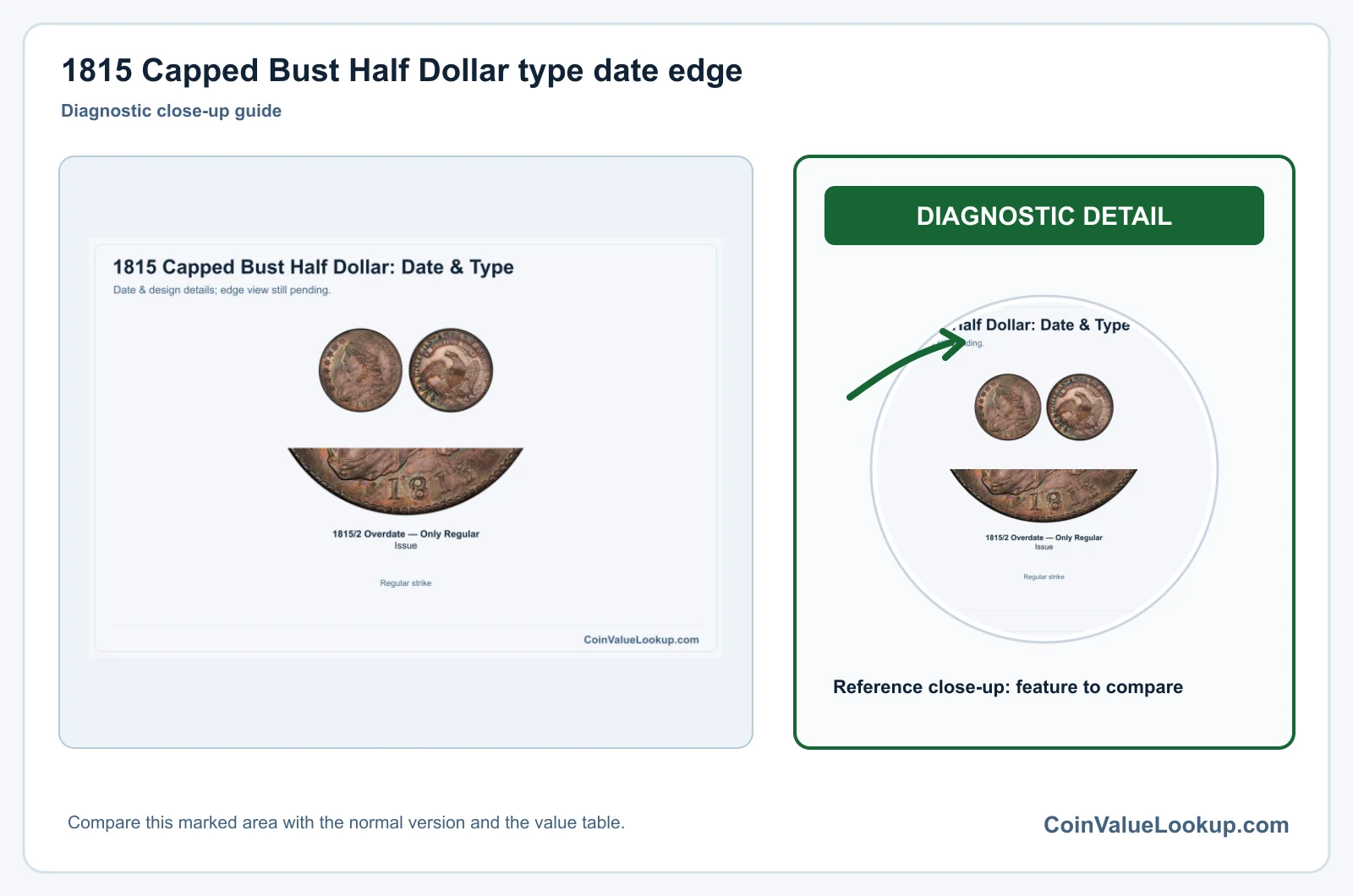
An 1815 Capped Bust Half Dollar is one of the scarcer early American silver coins you can encounter. Every genuine regular-issue 1815 half is actually an 1815/2 overdate.
Guide estimates from USA Coin Book place this coin at roughly $2,190 in G4, $6,276 in VF20, and $12,172 in AU50. Actual value depends heavily on version, surfaces, and overall condition.
Fast Way to Identify Your 1815 Capped Bust Half Dollar
Want a quick read on your coin? Upload clear photos of the front and back, and our identifier can offer a preliminary identification of your 1815 Half Dollar.
This is not a substitute for professional authentication or grading, but it can help point you in the right direction before you pursue further evaluation.
1815 Capped Bust Half Dollar Value
Upload both sides of your 1815 Capped Bust Half Dollar.
Front Obverse
Upload photo
Back Reverse
Upload photo
Which 1815 Capped Bust Half Dollar Versions Are Worth Money?
- 1815/2 Overdate — the only regular issue for this date — carries guide estimates of approximately $2,190 at G4 up to $12,172 at AU50, making even well-worn survivors worth serious money.
- Because every genuine 1815 half is an overdate, the key is confirming authenticity; altered dates from other years do exist, and professional assessment is recommended for uncertain pieces.
Step 1: Identify Your 1815 Capped Bust Half Dollar Mint Mark and Version
All genuine 1815 Capped Bust Half Dollars were struck at Philadelphia. No mintmark is expected or normal.
The obverse shows a left-facing Liberty wearing a cap, while the reverse features an eagle clutching arrows and an olive branch behind a shield, with 50C below. The edge is lettered: FIFTY CENTS OR HALF A DOLLAR.
If your coin has a plain edge or a different design, you may have a different type entirely.
This is a silver-copper alloy coin, approximately 89.24% silver. It should weigh about 13.48 grams and measure roughly 32.5 mm in diameter.
Significant deviations from those specs warrant suspicion.
The critical identification point: every legitimate 1815 regular-issue half dollar is an 1815/2 overdate. Look carefully at the final digit in the date.
Under magnification, remnants of an underlying "2" should be visible beneath the "5." If you see a clean, unambiguous "1815" with zero trace of overdating, consider having the coin professionally examined, because altered dates are a known concern for this issue.
Step 2: Check Your 1815 Capped Bust Half Dollar Grade
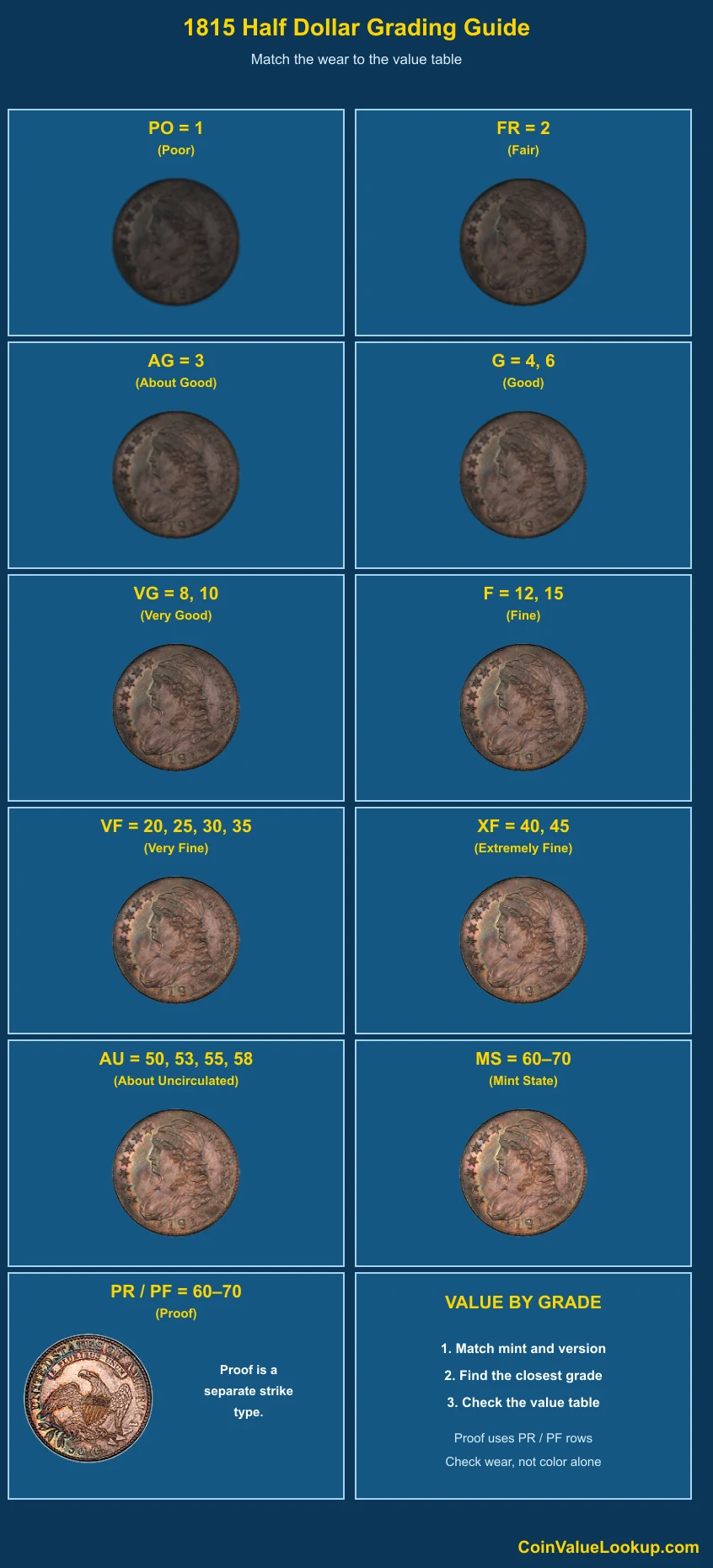
Start by examining the hair above Liberty's forehead and around the ear. In lower grades, this area flattens first, and the individual curls merge into a smooth surface.
The cap and shoulder clasp lose definition next. Compare your coin against the reference image to gauge where it falls on that wear spectrum.
Flip to the reverse and check the eagle's breast feathers and wing tips. Weak strikes were common for early half dollars, so a soft breast does not automatically mean heavy wear.
Look instead at the overall luster and whether high points show friction versus simply incomplete detail from the press.
Cleaning, tooling, plugged holes, and scratches all matter. A coin with any of those problems is typically graded as "Details" by third-party services and should not be priced on a straight-grade value curve.
If you see unnatural shine, hairlines from polishing, or evidence of re-engraving, note those separately from normal circulation wear.
Step 3: Check 1815 Capped Bust Half Dollar Value by Mint and Version
1815 Capped Bust Half Dollar — /2 Overdate — Only Regular Issue
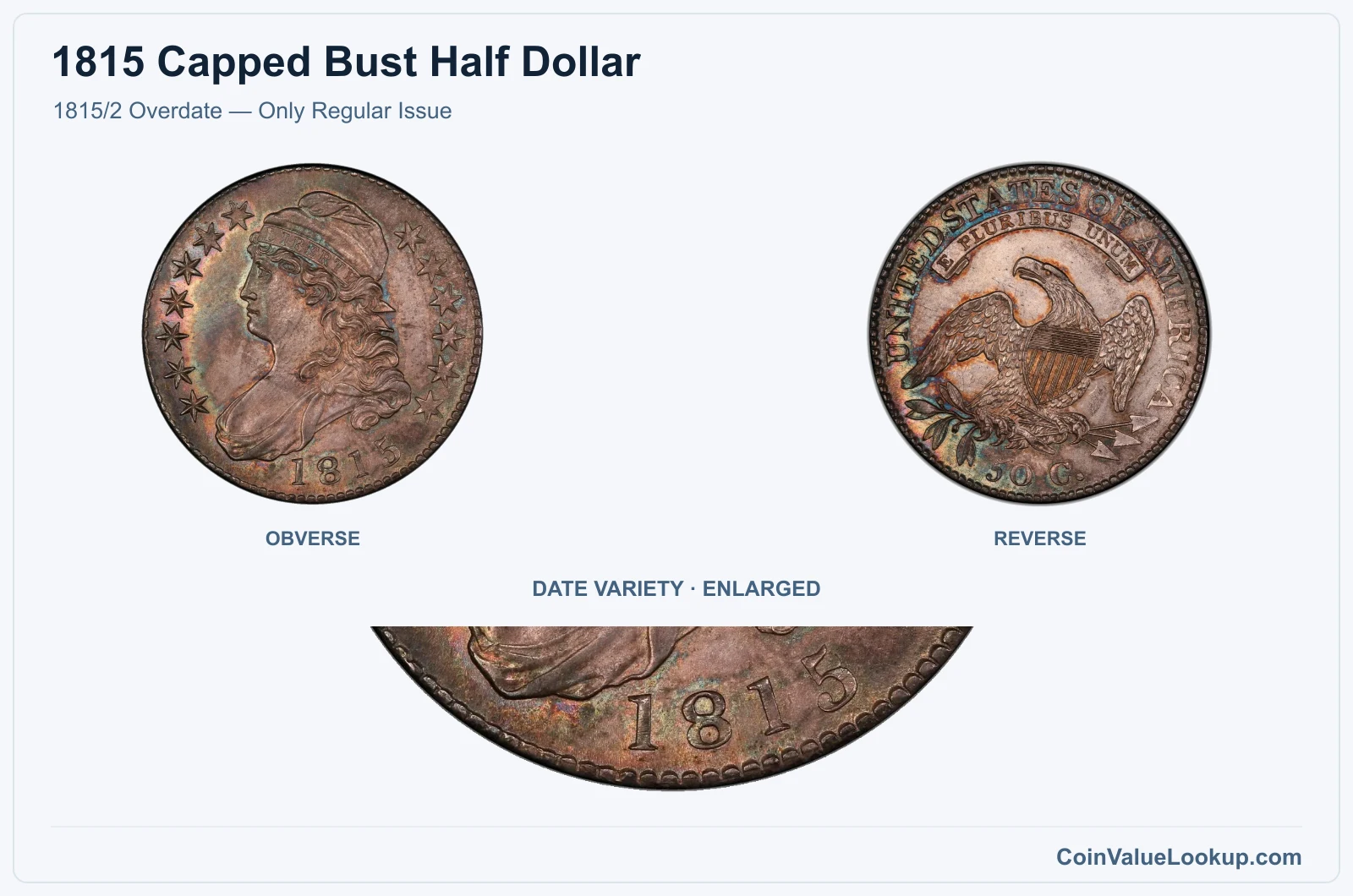
Every regular-issue 1815 Capped Bust Half Dollar is an 1815/2 overdate. The Philadelphia Mint punched a new "5" over a leftover "2" in the date, and under magnification you can see traces of the curved top of the "2" peeking from beneath the "5." That remnant is the single most important authentication feature for this date.
USA Coin Book guide estimates place this coin at approximately $2,190 in G4, $6,276 in VF20, and $12,172 in AU50. These are retail guide estimates, not guaranteed offers.
The 1815/2 is a genuinely scarce date in the Capped Bust series, so even heavily worn examples command strong prices.
Coin Value Lookup is a good starting point if you want to look up values for other dates in this series or other denominations. It offers coin guides across a wide range of U.S. issues.
Be aware that altered dates exist. Someone can modify digits on a more common year to mimic an 1815 overdate.
If the underlying "2" is absent or the date just looks wrong, professional authentication is the smart move.
Range Grade
Price Auction Records Appraisal PO PO 1
—
Coin Identifier FR FR 2
—
Coin Identifier AG AG 3
Coin Identifier G G 4
—
Coin Identifier
G 6
—
Coin Identifier VG VG 8
—
Coin Identifier
VG 10
Coin Identifier F F 12
Coin Identifier
F 15
Coin Identifier VF VF 20
Coin Identifier
VF 25
Coin Identifier
VF 30
Coin Identifier
VF 35
Coin Identifier XF XF 40
Coin Identifier
XF 45
Coin Identifier AU AU 50
Coin Identifier
AU 53
Coin Identifier
AU 55
Coin Identifier
AU 58
Coin Identifier MS MS 60
—
Coin Identifier
MS 61
Coin Identifier
MS 62
Coin Identifier
MS 63
Coin Identifier
MS 64
Coin Identifier
MS 65
—
Coin Identifier
MS 66
Coin Identifier
MS 67
—
—
—
MS 68
—
—
—
MS 69
—
—
—
MS 70
—
—
—
1815 Capped Bust Half Dollar Error List
1. 1815 Capped Bust Half Dollar — Clashed Dies
A die clash happens when the obverse and reverse dies strike each other without a planchet between them, leaving ghost impressions of the opposite design in the fields. On an 1815/2 Half Dollar, look for faint outlines of the eagle or shield appearing in the open areas around Liberty's portrait, and vice versa on the reverse.
These traces are most visible under angled light and magnification. They appear as raised, mirror-image design elements embedded in otherwise empty fields.
Do not confuse clash marks with random scratches, raised lines from a damaged die, or surface disturbances from corrosion. Scratches are typically incuse and irregular, while clash impressions follow the contour of the opposing die's design elements.
No specific price data is available for clashed-die examples of this date; the value depends on the visibility of the clash, overall coin condition, and buyer interest.
2. 1815 Capped Bust Half Dollar — Die Crack / Die Chip
Die cracks occur when the steel die develops fractures from repeated use, leaving thin raised lines on the struck coin. On the 1815/2 Half Dollar, reported examples show faint peripheral die cracks on the reverse.
These are separate from the overdate feature on the obverse date.
To spot them, look for slightly raised, irregular lines running through or along the rim area of the reverse. They follow no design element and may extend from the rim inward toward lettering or devices.
Do not mistake incuse scratches, corrosion trails, or foreign material sitting on the surface for die cracks. A genuine die crack is raised above the field, not pressed into it.
No adopted price range exists for cracked-die examples of this issue. Value depends on the prominence of the crack, overall grade, and the specific die pairing involved.
3. 1815 Capped Bust Half Dollar — Rotated Dies
Normal U.S. coin alignment means flipping the coin on a vertical axis should show the reverse upside down relative to the obverse. A rotated die error means the reverse is turned away from that standard orientation.
One reported 1815 Half Dollar example shows the reverse rotated approximately 30 degrees counterclockwise.
To check, hold the obverse upright, then flip the coin top to bottom. If the reverse eagle is tilted rather than perfectly inverted, you may have a rotation error.
Make sure your camera or hand position is not creating the illusion.
Early 19th-century production tolerances were looser than modern standards, so minor rotations were more common and may not carry the same premium that a dramatic rotation on a modern coin would. No specific price data is available for rotated examples of this date.
The degree of rotation, overall coin condition, and collector demand all influence what such a piece might bring.