1834 Capped Bust Half Dollar Coin Value: How Much Is It Worth?
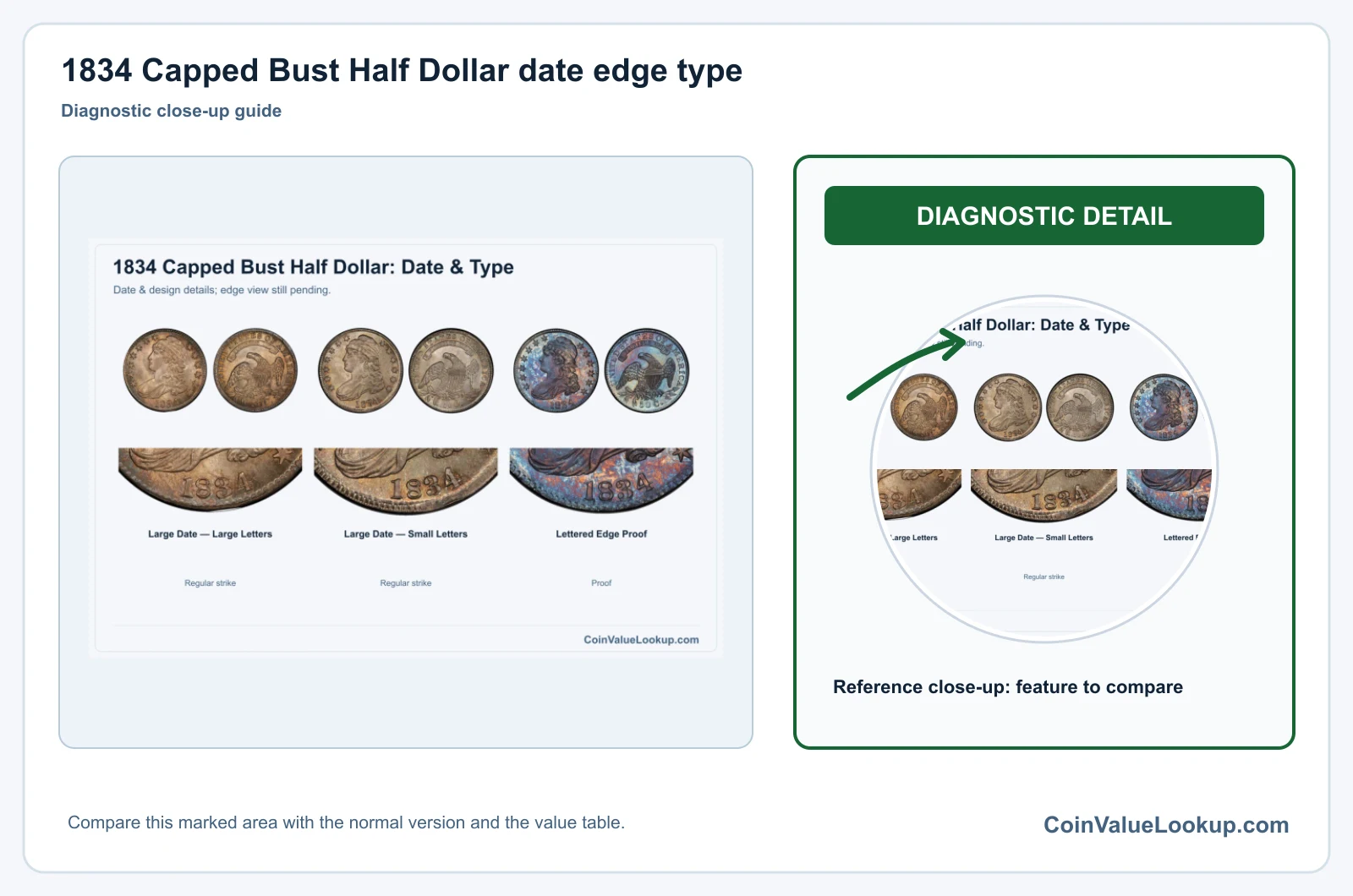
A regular 1834 Capped Bust Half Dollar in collectible condition ranges from roughly $92 in Good-4 to about $487 in About Uncirculated-50, based on guide estimates from USA Coin Book. Your actual value depends heavily on the exact variety — large date versus small date, large letters versus small letters — and the coin's grade.
Rare Proof examples occupy an entirely different price tier and require professional attribution.
Fast Way to Identify Your 1834 Capped Bust Half Dollar
Snap clear photos of both sides of your 1834 half dollar and upload them here for a preliminary identification. Good lighting and a steady hand help — try to capture the date size, the reverse lettering, and any wear on the high points.
This step can help you figure out which variety branch your coin falls into before you dig deeper.
1834 Capped Bust Half Dollar Value
Upload both sides of your 1834 Capped Bust Half Dollar.
Front Obverse
Upload photo
Back Reverse
Upload photo
Which 1834 Capped Bust Half Dollar Versions Are Worth Money?
- Large Date, Large Letters — the baseline variety; guide values run $92 (G4) to $487 (AU50).
- Large Date, Small Letters — same date punch but noticeably smaller reverse lettering; compare both features carefully.
- Small Date, Small Letters, Large Stars — requires matching the small date and small reverse letters, then verifying larger obverse star punches.
- Small Date, Small Letters, Small Stars — shares the small-date/small-letters combination but uses a smaller star punch; a side-by-side star comparison is essential.
- Lettered Edge Proof — a single PR67 sold for $103,500 at Heritage in January 2007; professional attribution is required.
- Crushed Lettered Edge Proof — a separate Proof variety with partly flattened edge inscription; values require individual assessment of authenticated examples.
Step 1: Identify Your 1834 Capped Bust Half Dollar Mint Mark and Version
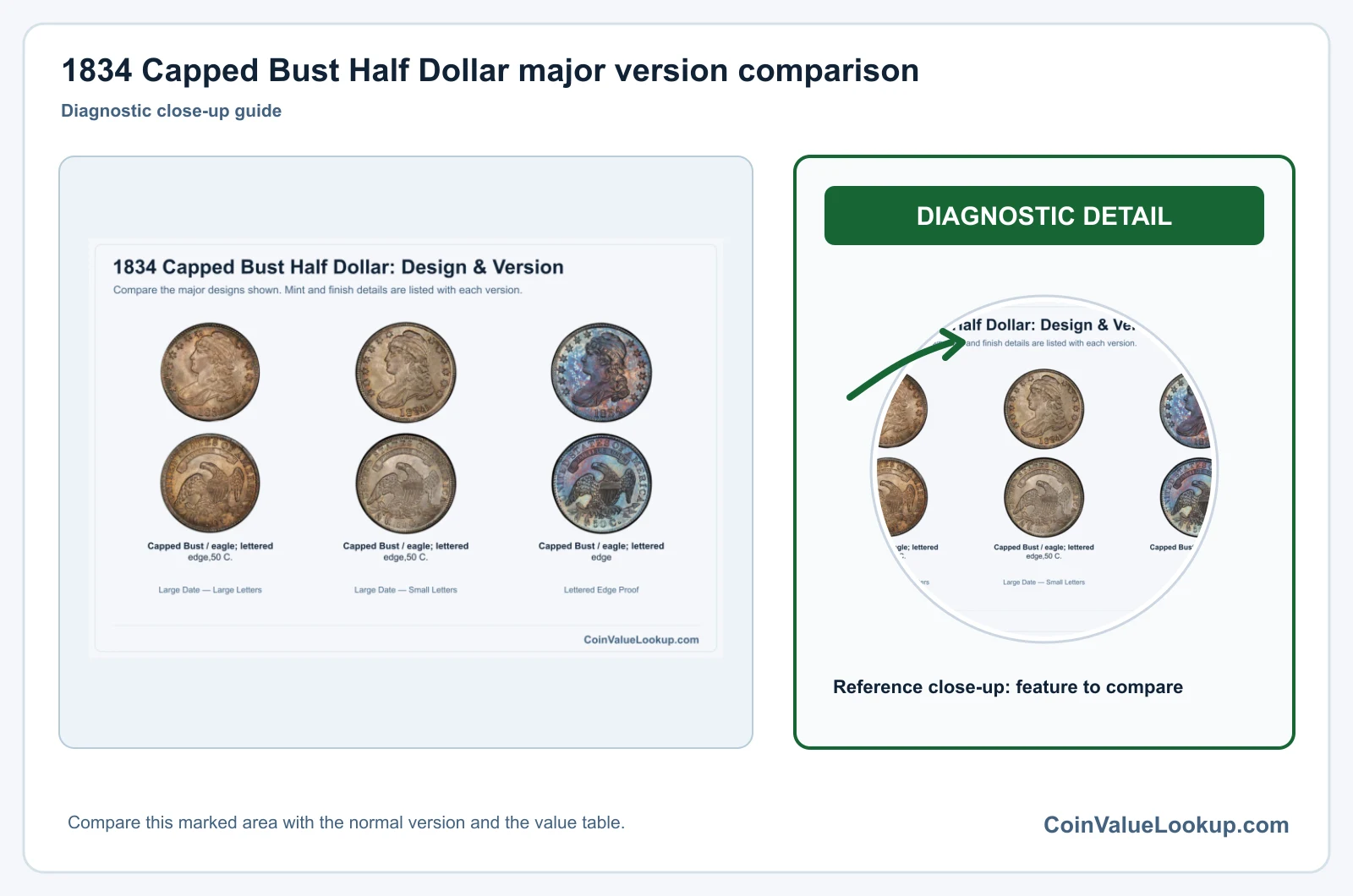
Every 1834 Capped Bust Half Dollar was struck at Philadelphia. There is no mintmark to look for.
The coin measures 32.5 mm, weighs approximately 13.48 grams, and is composed of silver and copper — roughly 89.24% silver. The edge is lettered: FIFTY CENTS OR HALF A DOLLAR.
To sort your coin into the right value branch, you need to check two things at minimum. First, look at the date.
A large date has taller, wider numerals; a small date is noticeably more compact. Hold the coin at a consistent distance or compare against a known reference image at the same scale.
Second, flip the coin over and examine the reverse legend. Large letters are visibly bolder and taller than small letters.
Some small-letter varieties also differ in star punch size on the obverse, so check those too.
If your coin has deeply mirrored fields, squared rims, and sharp details beyond what a normal strike shows, it could be a Proof — but polished or prooflike circulation strikes look shiny too. Proof status for an 1834 half dollar must be confirmed by professional attribution.
Do not assume a bright coin is a Proof.
Step 2: Check Your 1834 Capped Bust Half Dollar Grade
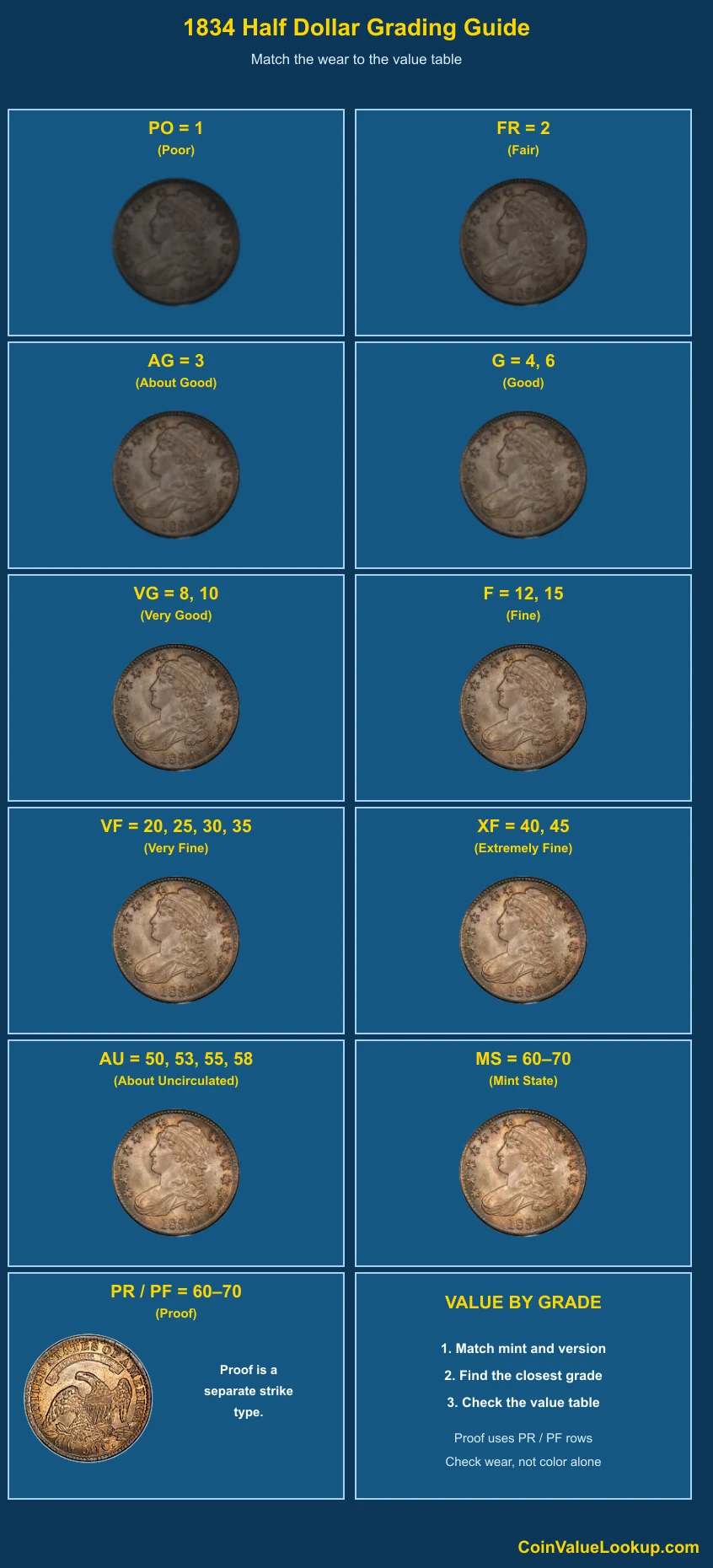
Start by examining the highest points on both sides. On the obverse, check the hair above Liberty's forehead, the cheek, and the cap.
These are the first areas to lose detail.
On the reverse, the eagle's breast feathers and the tops of the wings wear down earliest. A coin in Good-4 will show a clear outline but most fine detail is gone.
By VF-20, you should see moderate detail in the hair curls and wing feathers with some flatness on the high points.
At AU-50, only the slightest friction appears on the highest areas, and most original luster remains. Look carefully under angled light to separate genuine wear from a weak original strike — some Bust halves simply came off the press soft in spots.
Also note any cleaning, scratches, or holes. A cleaned coin with AU sharpness does not grade the same as an original AU coin.
Compare your piece against the type-matched grading images to see where it falls on the wear scale. Proof coins are graded on a separate PR scale because Proof is a manufacturing finish, not a grade above Mint State.
Step 3: Check 1834 Capped Bust Half Dollar Value by Mint and Version
1834 Capped Bust Half Dollar — Large Date — Large Letters
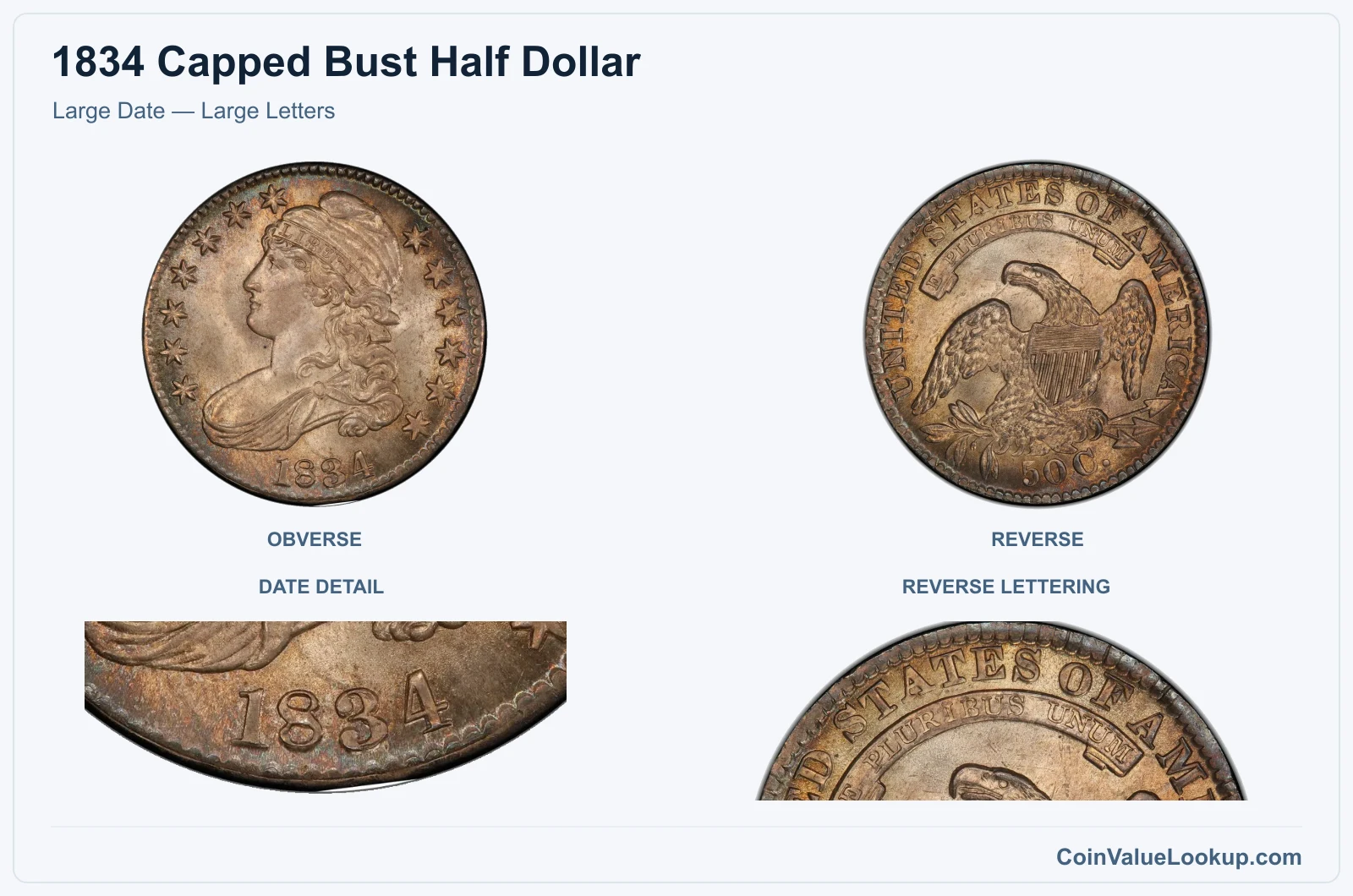
This is the combination most collectors encounter first: large date numerals on the obverse paired with large letters in the reverse legend. Both features need to be confirmed together — a large date alone does not place the coin here.
All 1834 regular strikes come from Philadelphia with no mintmark, are silver-copper at approximately 89.24% silver, and carry a lettered edge reading FIFTY CENTS OR HALF A DOLLAR. Guide estimates from USA Coin Book put this variety at about $92 in G4, $152 in VF20, and $487 in AU50.
These are retail guide figures, not guaranteed sale prices.
Range Grade
Price Auction Records Appraisal PO PO 1
—
Coin Identifier FR FR 2
—
Coin Identifier AG AG 3
—
Coin Identifier G G 4
—
Coin Identifier
G 6
—
Coin Identifier VG VG 8
Coin Identifier
VG 10
Coin Identifier F F 12
Coin Identifier
F 15
Coin Identifier VF VF 20
Coin Identifier
VF 25
Coin Identifier
VF 30
Coin Identifier
VF 35
Coin Identifier XF XF 40
Coin Identifier
XF 45
Coin Identifier AU AU 50
Coin Identifier
AU 53
Coin Identifier
AU 55
Coin Identifier
AU 58
Coin Identifier MS MS 60
Coin Identifier
MS 61
Coin Identifier
MS 62
Coin Identifier
MS 63
Coin Identifier
MS 64
Coin Identifier
MS 65
Coin Identifier
MS 66
Coin Identifier
MS 67
—
Coin Identifier
MS 68
—
—
—
MS 69
—
—
—
MS 70
—
—
—
1834 Capped Bust Half Dollar — Large Date — Small Letters
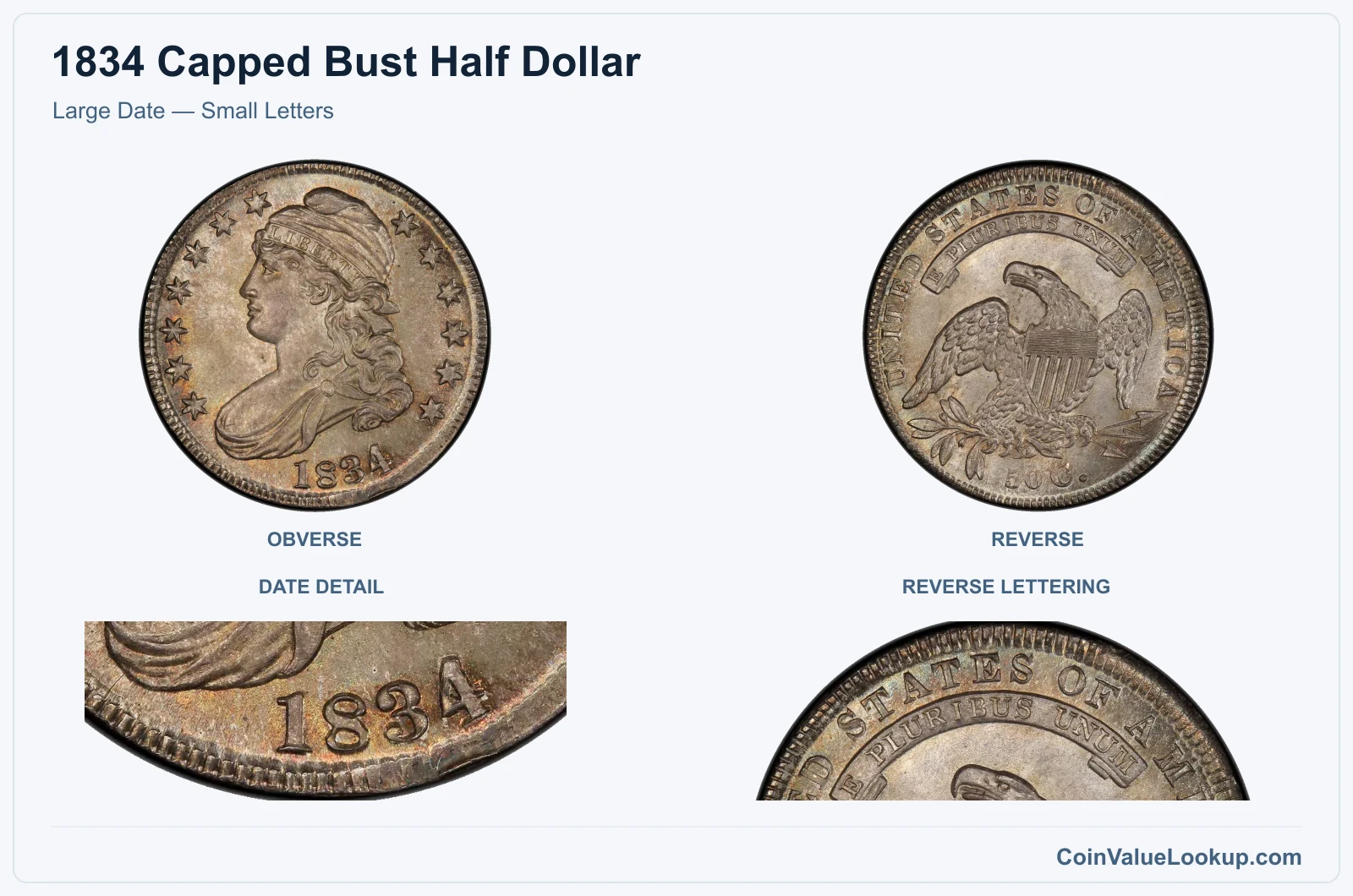
Same large date punch as the previous variety, but the reverse legend letters are smaller. You really do need to compare both coins at the same magnification to see the difference — it is subtle until you know what to look for.
This variety shares the same guide estimates: roughly $92 at G4, $152 at VF20, and $487 at AU50 per USA Coin Book. The silver content, weight, and lettered edge are identical across all regular-strike 1834 varieties.
Condition matters more than which letter-size variety you hold, but proper attribution is still good practice.
Coin Value Lookup is a convenient place to look up value guides for half dollars and other series when you want a quick reference point for your collection.
Range Grade
Price Auction Records Appraisal PO PO 1
—
Coin Identifier FR FR 2
—
Coin Identifier AG AG 3
—
Coin Identifier G G 4
—
Coin Identifier
G 6
—
Coin Identifier VG VG 8
—
Coin Identifier
VG 10
Coin Identifier F F 12
Coin Identifier
F 15
Coin Identifier VF VF 20
—
Coin Identifier
VF 25
Coin Identifier
VF 30
Coin Identifier
VF 35
Coin Identifier XF XF 40
Coin Identifier
XF 45
Coin Identifier AU AU 50
Coin Identifier
AU 53
Coin Identifier
AU 55
Coin Identifier
AU 58
Coin Identifier MS MS 60
—
Coin Identifier
MS 61
Coin Identifier
MS 62
Coin Identifier
MS 63
Coin Identifier
MS 64
Coin Identifier
MS 65
Coin Identifier
MS 66
Coin Identifier
MS 67
Coin Identifier
MS 68
—
—
—
MS 69
—
—
—
MS 70
—
—
—
1834 Capped Bust Half Dollar — Small Date — Small Letters, Large Stars
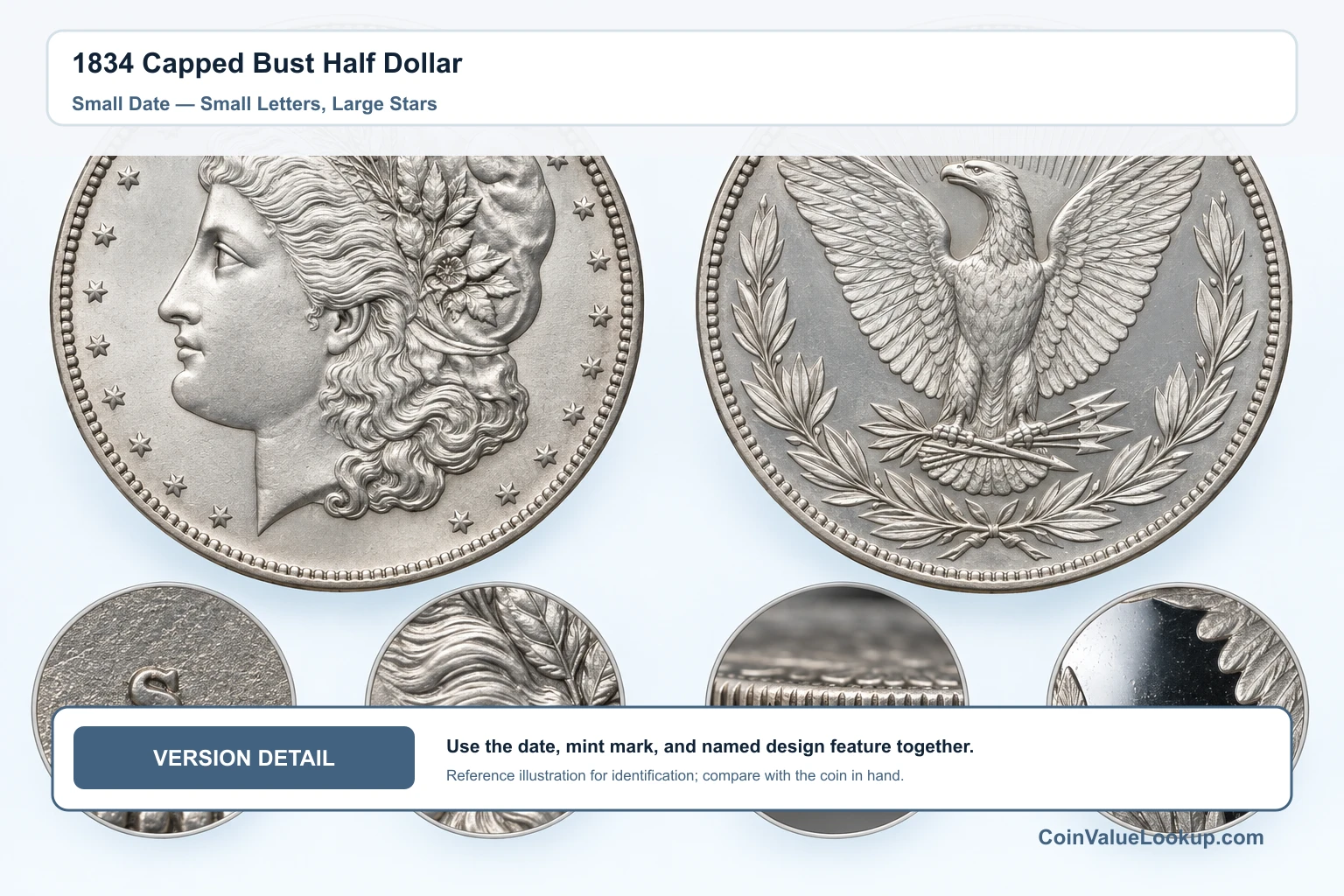
Here the date numerals are smaller and more compact than the large-date varieties. The reverse also uses small letters.
What sets this branch apart from the next one is the obverse star punches — they are noticeably larger.
Comparing star size requires either a side-by-side reference or an overlay. Do not eyeball it casually; the difference is real but not dramatic.
Guide estimates again sit at about $92 (G4), $152 (VF20), and $487 (AU50). The coin is the same Philadelphia-struck, lettered-edge, silver-copper half dollar at roughly 89.24% silver.
Ordinary-issue reference: Ordinary-issue reference only: The table below shows the related standard issue (1834 Sm Date, Sm Letters). It does not represent the value of the specific Small Date — Small Letters, Large Stars variety or its variety premium. The year, mint, metal and strike type are matched; the specific variety is not priced by this table.
Range Grade
Price Auction Records Appraisal PO PO 1
—
Coin Identifier FR FR 2
—
Coin Identifier AG AG 3
—
Coin Identifier G G 4
—
Coin Identifier
G 6
—
Coin Identifier VG VG 8
Coin Identifier
VG 10
—
Coin Identifier F F 12
Coin Identifier
F 15
Coin Identifier VF VF 20
Coin Identifier
VF 25
Coin Identifier
VF 30
Coin Identifier
VF 35
Coin Identifier XF XF 40
Coin Identifier
XF 45
Coin Identifier AU AU 50
Coin Identifier
AU 53
Coin Identifier
AU 55
Coin Identifier
AU 58
Coin Identifier MS MS 60
Coin Identifier
MS 61
Coin Identifier
MS 62
Coin Identifier
MS 63
Coin Identifier
MS 64
Coin Identifier
MS 65
Coin Identifier
MS 66
Coin Identifier
MS 67
Coin Identifier
MS 68
—
—
—
MS 69
—
—
—
MS 70
—
—
—
1834 Capped Bust Half Dollar — Small Date — Small Letters, Small Stars
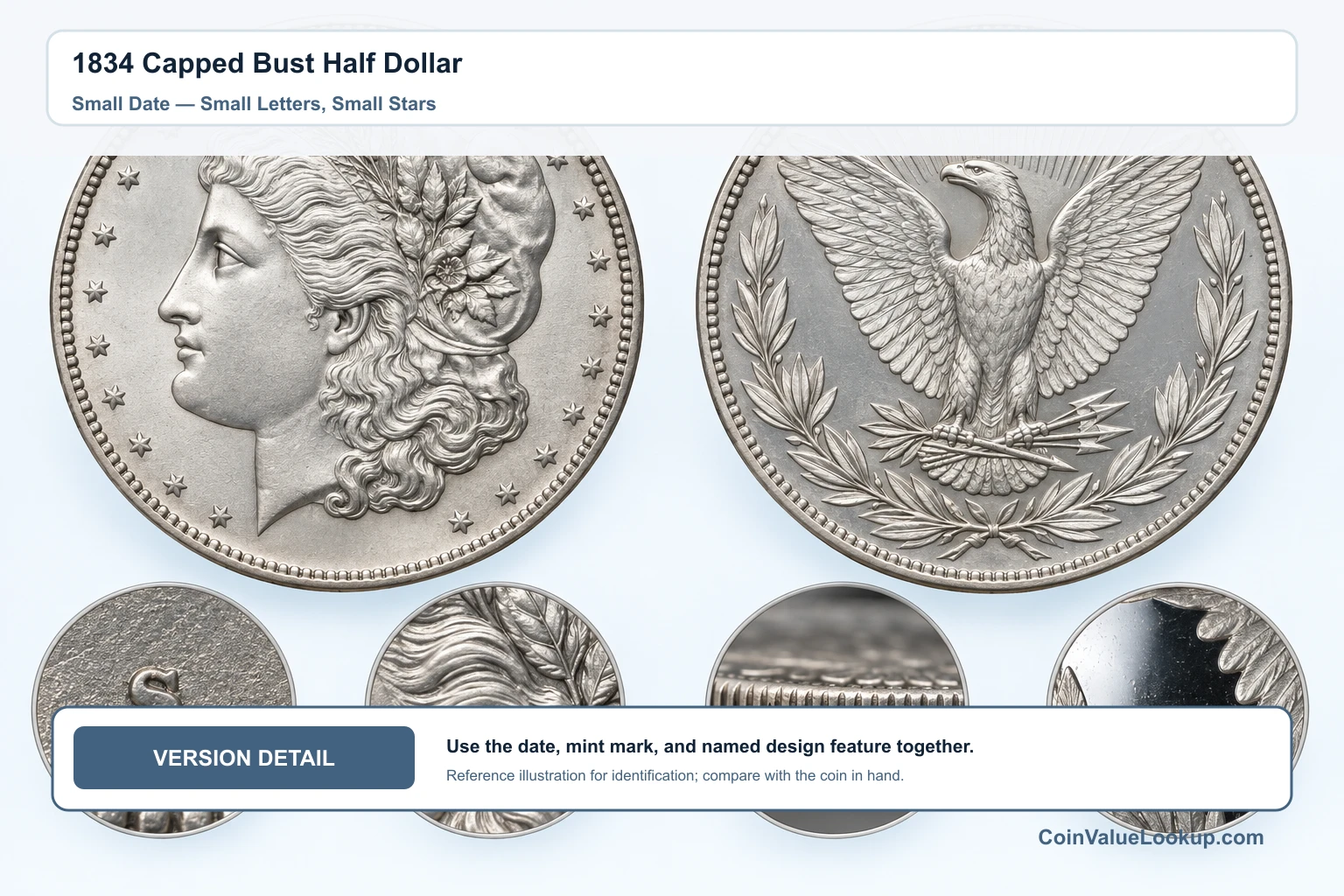
This variety shares the small date and small reverse letters of the previous branch but uses a smaller star punch on the obverse. The stars appear slightly thinner and less spread.
If you have a small-date coin and you have already confirmed the small reverse lettering, the final sorting step is the star comparison. Place your coin next to a confirmed large-stars example or reference image at the same scale.
Guide estimates from USA Coin Book are approximately $92 at G4, $152 at VF20, and $487 at AU50. Same Philadelphia mint, same silver-copper composition, same lettered edge.
Ordinary-issue reference: Ordinary-issue reference only: The table below shows the related standard issue (1834 Sm Date, Sm Letters). It does not represent the value of the specific Small Date — Small Letters, Small Stars variety or its variety premium. The year, mint, metal and strike type are matched; the specific variety is not priced by this table.
Range Grade
Price Auction Records Appraisal PO PO 1
—
Coin Identifier FR FR 2
—
Coin Identifier AG AG 3
—
Coin Identifier G G 4
—
Coin Identifier
G 6
—
Coin Identifier VG VG 8
Coin Identifier
VG 10
—
Coin Identifier F F 12
Coin Identifier
F 15
Coin Identifier VF VF 20
Coin Identifier
VF 25
Coin Identifier
VF 30
Coin Identifier
VF 35
Coin Identifier XF XF 40
Coin Identifier
XF 45
Coin Identifier AU AU 50
Coin Identifier
AU 53
Coin Identifier
AU 55
Coin Identifier
AU 58
Coin Identifier MS MS 60
Coin Identifier
MS 61
Coin Identifier
MS 62
Coin Identifier
MS 63
Coin Identifier
MS 64
Coin Identifier
MS 65
Coin Identifier
MS 66
Coin Identifier
MS 67
Coin Identifier
MS 68
—
—
—
MS 69
—
—
—
MS 70
—
—
—
1834 Capped Bust Half Dollar — Lettered Edge Proof
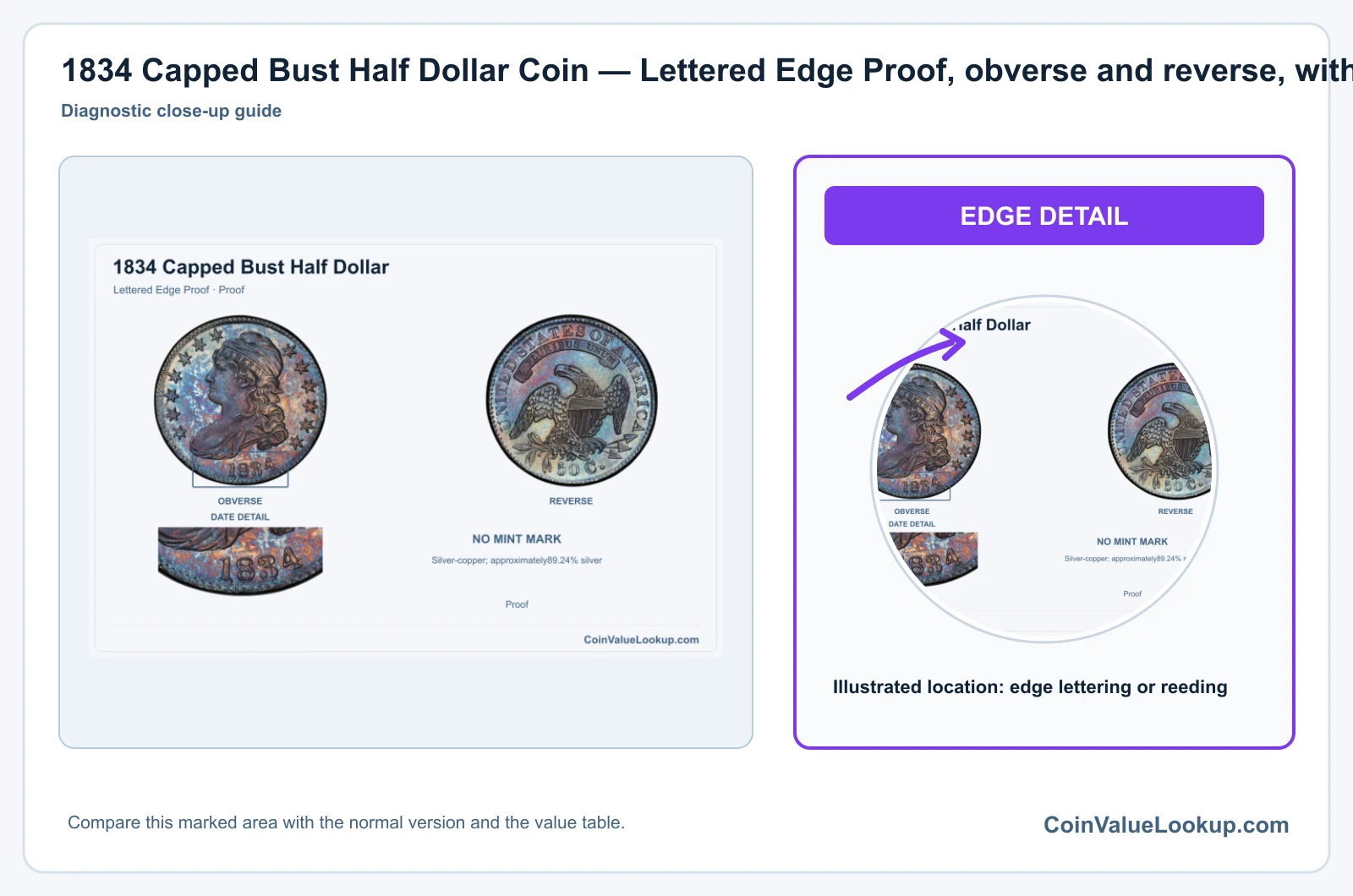
Early Proof half dollars from the 1830s are genuinely rare. The 1834 Lettered Edge Proof features deeply mirrored fields, crisp squared rims, and full detail that goes beyond even the best regular strike.
These were made for presentation or collector purposes, not commerce.
A single example graded PR67 sold at Heritage Auctions in January 2007 for $103,500. That is one historical sale, not a current market range — Proof values for coins this scarce depend on the individual piece, its condition, and auction timing.
Do not assume your coin is a Proof because it looks shiny. Polished or prooflike regular strikes exist and are fundamentally different.
Professional attribution from a recognized grading service is necessary to establish Proof status for an 1834 half dollar.
Range Grade
Price Auction Records Appraisal PR PR 1
—
Coin Identifier
PR 2
—
Coin Identifier
PR 3
—
Coin Identifier
PR 4
—
Coin Identifier
PR 6
—
Coin Identifier
PR 8
—
Coin Identifier
PR 10
—
Coin Identifier
PR 12
—
Coin Identifier
PR 15
—
Coin Identifier
PR 20
—
Coin Identifier
PR 25
—
Coin Identifier
PR 30
—
Coin Identifier
PR 35
—
Coin Identifier
PR 40
—
Coin Identifier
PR 45
—
Coin Identifier
PR 50
—
Coin Identifier
PR 53
—
Coin Identifier
PR 55
—
Coin Identifier
PR 58
—
Coin Identifier
PR 60
—
Coin Identifier
PR 61
—
Coin Identifier
PR 62
—
Coin Identifier
PR 63
Coin Identifier
PR 64
—
Coin Identifier
PR 65
Coin Identifier
PR 66
—
Coin Identifier
PR 67
—
—
—
PR 68
—
—
—
PR 69
—
—
—
PR 70
—
—
—
1834 Capped Bust Half Dollar — Crushed Lettered Edge Proof
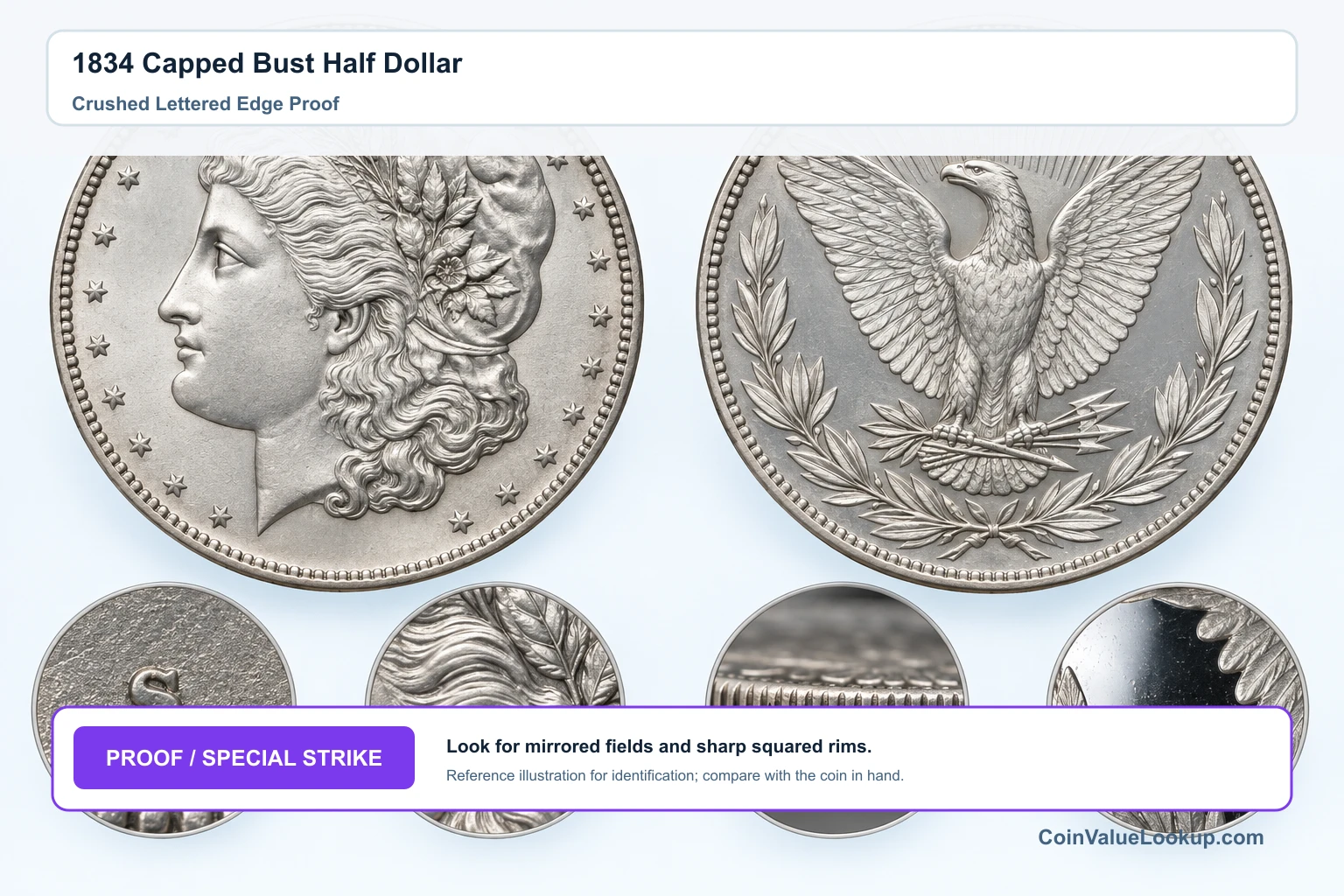
The Crushed Lettered Edge Proof is a distinct variety where the edge inscription appears partly flattened rather than sharply impressed. This is attributed to close-collar manufacture.
The exact production timing of these pieces is debated among specialists, so the coin is identified by its 1834 date without assuming a specific restrike year.
Compare the edge carefully against an ordinary Lettered Edge Proof — on the crushed version, portions of FIFTY CENTS OR HALF A DOLLAR will look compressed or smoothed in a way that differs from simple circulation wear.
No supported price range is available for this variety. Value depends entirely on the authenticated identity, the coin's condition, and any associated characteristics.
Each example needs individual assessment by a specialist or grading service.
Range Grade
Price Auction Records Appraisal PR PR 1
—
Coin Identifier
PR 2
—
Coin Identifier
PR 3
—
Coin Identifier
PR 4
—
Coin Identifier
PR 6
—
Coin Identifier
PR 8
—
Coin Identifier
PR 10
—
Coin Identifier
PR 12
—
Coin Identifier
PR 15
—
Coin Identifier
PR 20
—
Coin Identifier
PR 25
—
Coin Identifier
PR 30
—
Coin Identifier
PR 35
—
Coin Identifier
PR 40
—
Coin Identifier
PR 45
—
Coin Identifier
PR 50
—
Coin Identifier
PR 53
—
Coin Identifier
PR 55
—
Coin Identifier
PR 58
—
Coin Identifier
PR 60
—
Coin Identifier
PR 61
—
Coin Identifier
PR 62
—
Coin Identifier
PR 63
—
Coin Identifier
PR 64
—
Coin Identifier
PR 65
—
Coin Identifier
PR 66
—
Coin Identifier
PR 67
—
—
—
PR 68
—
—
—
PR 69
—
—
—
PR 70
—
—
—
1834 Capped Bust Half Dollar Error List
1. 1834 Capped Bust Half Dollar — Clipped Planchet
A clipped planchet occurs when the blank metal disc fed into the press was cut incompletely, leaving a curved bite out of the rim. On a reported 1834 half dollar graded XF40 by ANACS, the clip is visible as a missing arc at the rim with adjacent metal flow where the strike pushed material toward the gap.
Look at the blank edge section — it should appear smooth and slightly curved inward, following the arc of the planchet sheet. This is different from a post-mint filed notch or saw cut, which leave straight edges, tool marks, or sharp angles.
Corrosion can also eat away a rim, but it leaves pitting and an irregular surface rather than the clean contour of a clip.
No specific price range is adopted for this error. Value depends on the clip's size, visibility, and the coin's overall condition.
2. 1834 Capped Bust Half Dollar — Doubled Edge Lettering
Doubled edge lettering shows repeated or overlapping letter impressions around the coin's edge. On an 1834 half dollar, this has been reported where the edge inscription was applied more than once before striking.
The result is continuous doubled text — whole letters appear twice, slightly offset.
To check, rotate the coin slowly under good light and look for shadowed or doubled outlines within the lettered edge. Compare against a normal 1834 half dollar under the same lighting.
Post-mint damage, ordinary wear, or even a normal design feature can mimic doubling if you squint hard enough, so careful comparison is key.
No numerical price range is available for this error. The value depends on how clear the doubling is, the coin's grade, and collector demand for the specific variety.
3. 1834 Capped Bust Half Dollar — Clashed Dies
Clashed dies happen when the obverse and reverse dies strike each other without a planchet between them, transferring ghostly outlines of one face onto the other. On the 1834 half dollar, a clashed-die example has been reported in year-specific sources.
What you are looking for is faint, raised design elements that belong to the opposite side of the coin — for instance, traces of the eagle's outline on the obverse or Liberty's portrait lines on the reverse. Compare your coin against a normal 1834 half dollar overlay to see if the extra lines match the opposite die's design.
Do not confuse clashed-die traces with random scratches, raised contact marks, or brockage impressions. Scratches are incused and irregular; clash marks follow recognizable design contours.
No specific price data is available for this error on an 1834 half dollar — value depends on clarity, grade, and collector interest.