1834 Capped Bust Quarter Coin Value: How Much Is It Worth?
The 1834 Capped Bust Quarter is a nearly 200-year-old silver coin struck at the Philadelphia Mint. Guide estimates for this date range from $132.00 to $5,228.00 depending on the version and grade, according to USA Coin Book.
That spread reflects the difference between a well-worn business strike and a choice uncirculated example, so condition and version matter enormously here.
Fast Way to Identify Your 1834 Capped Bust Quarter
If you have an 1834 quarter and want a starting point, snap clear photos of both the front and back and upload them to our identifier. It can provide a preliminary identification of your coin's version based on design details visible in your images.
From there you can compare condition and narrow down where your piece fits.
1834 Capped Bust Quarter Value
Upload both sides of your 1834 Capped Bust Quarter.
Front Obverse
Upload photo
Back Reverse
Upload photo
Which 1834 Capped Bust Quarter Versions Are Worth Money?
- The 1834 business strike in MS63 carries a USA Coin Book guide estimate of $5,228.00, making high-grade survivors the ones to watch.
- Check whether your coin is a proof (1834 PR) — authenticated proofs from this era are extremely scarce and require individual assessment for value.
Step 1: Identify Your 1834 Capped Bust Quarter Mint Mark and Version
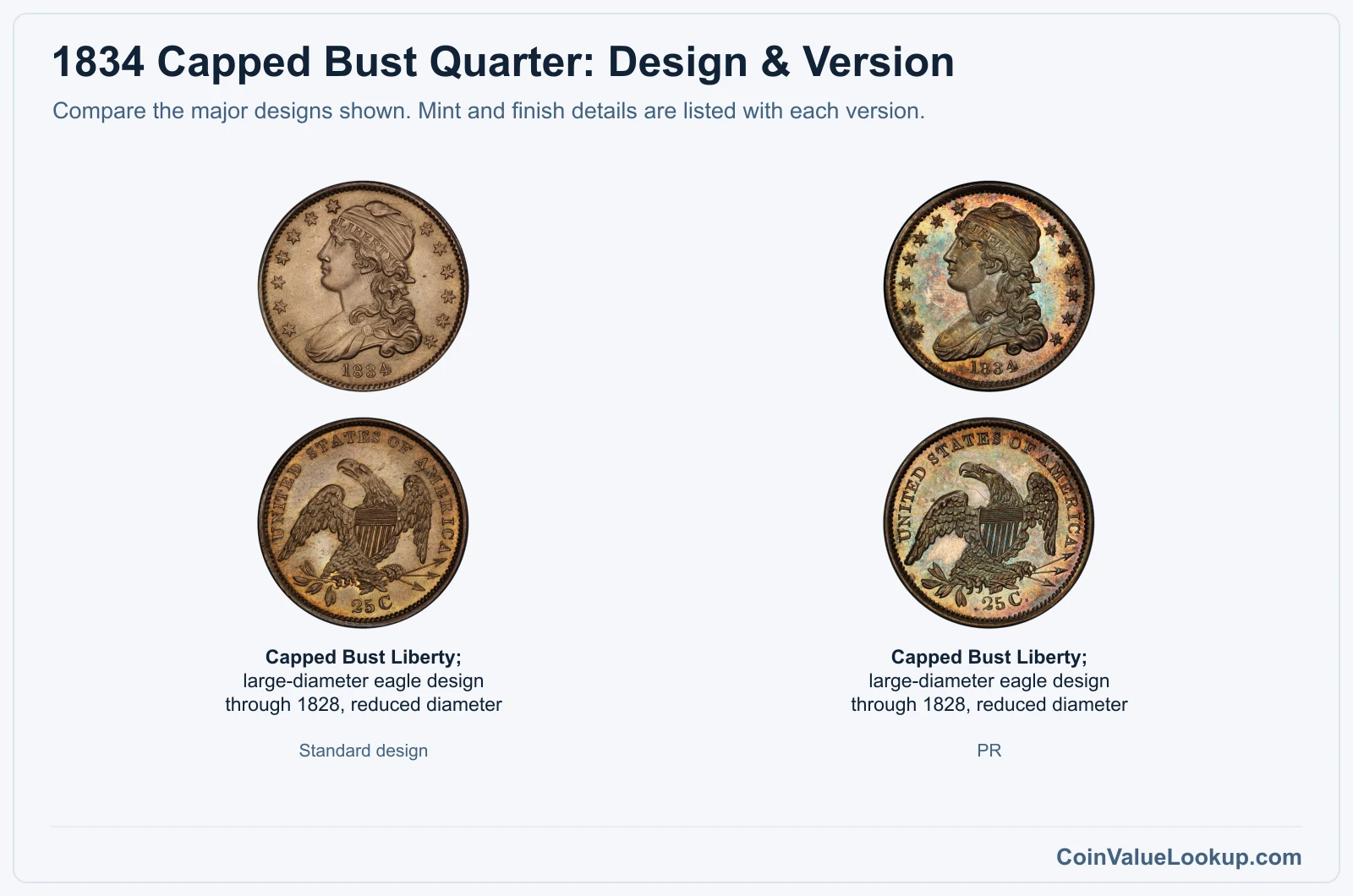
Every 1834 Capped Bust Quarter was struck at Philadelphia, so there is no mintmark to hunt for. The design is the reduced-diameter Capped Bust type introduced in 1831, which dropped the E PLURIBUS UNUM motto from the reverse.
The coin is a silver-copper alloy, approximately 89.24% silver. It should weigh about 6.7 grams and measure roughly 24.3 mm across.
If yours is noticeably lighter or a different size, that is a red flag.
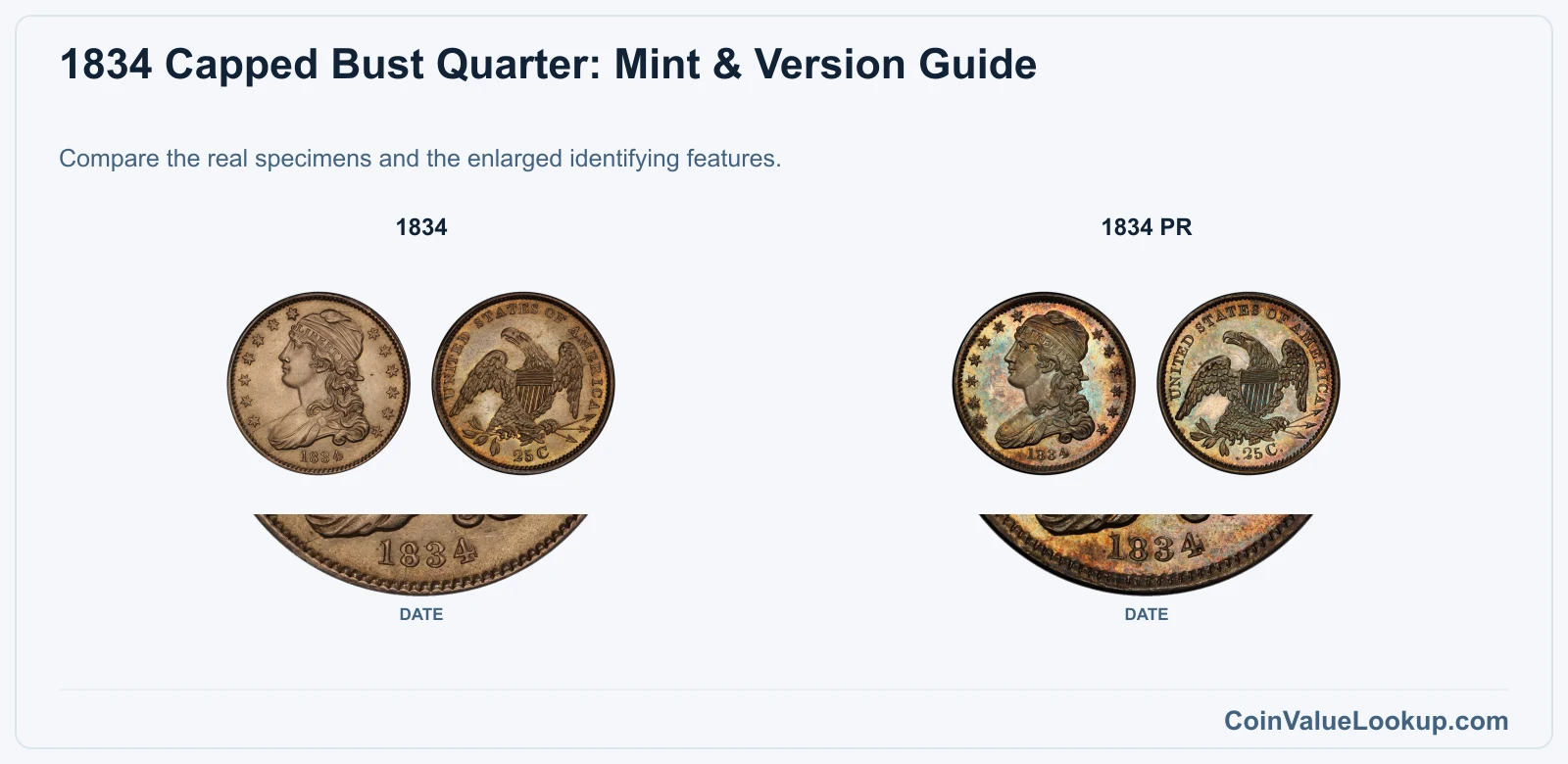
Two branches exist for this date: a regular business strike (1834) and a proof (1834 PR). Proofs were made in tiny numbers using polished dies and planchets, resulting in mirrored fields.
A shiny coin is not automatically a proof. Cleaning and wear can mimic or destroy the telltale surface, so authenticated examples are the only safe comparison.
Coin Value Lookup is a good starting point if you want to look up value guides for other dates or denominations in this series. You can browse by year and type to see where your coins stand.
Step 2: Check Your 1834 Capped Bust Quarter Grade
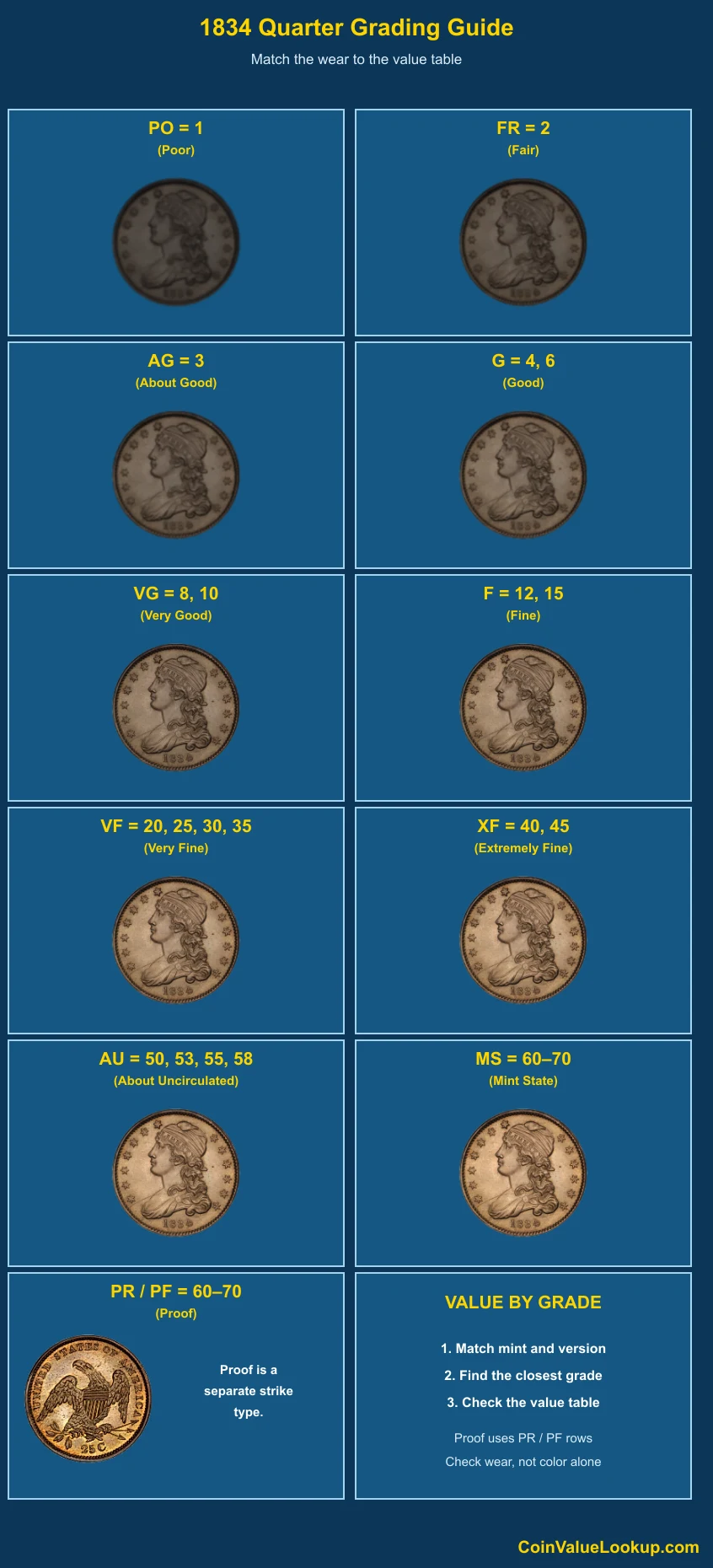
Focus on the hair above Liberty's ear first. On a lightly circulated coin, the individual strands start to merge into a flat patch.
The cap folds and the cheek are the next checkpoints: a coin grading Very Fine will still show some texture in the cap, while in Good the cap is mostly smooth.
Flip it over and examine the eagle's breast feathers and wing tips. These high points wear quickly, so they track nicely with obverse wear.
Compare your coin against the reference image to judge where it falls.
Strike quality can fool you. A weakly struck coin may look worn even if it never circulated, because the details were never fully brought up.
Look at the fields and luster instead. An uncirculated coin will show cartwheel luster when tilted under a light, even if some design elements appear soft.
Cleaning is a value killer. Bright, unnaturally white surfaces with fine hairlines under magnification usually mean someone went after it with polish.
That does not make it a rare version; it makes it a damaged one.
Step 3: Check 1834 Capped Bust Quarter Value by Mint and Version
1834 Capped Bust Quarter
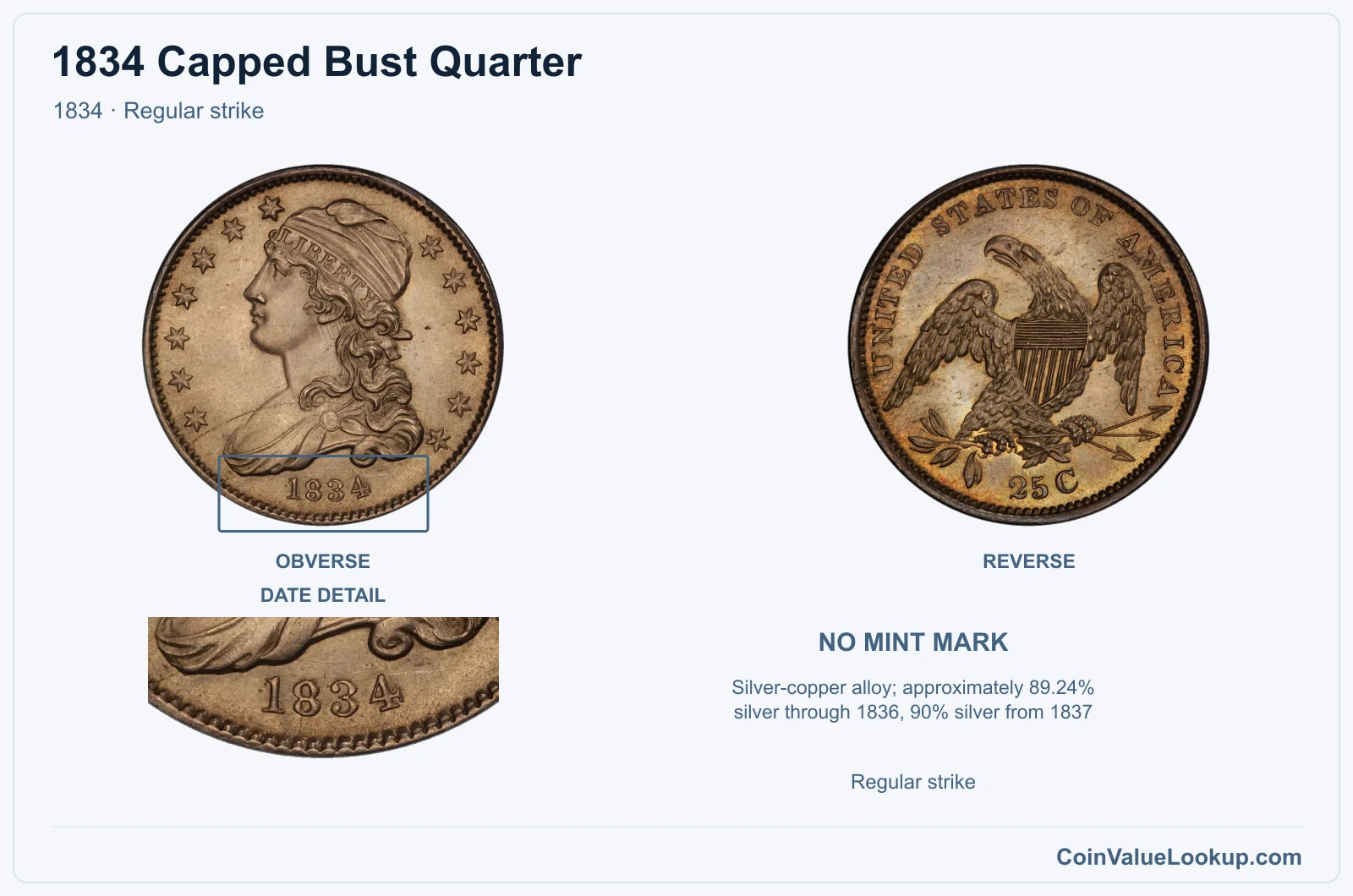
The 1834 business strike is the coin most collectors will encounter. It was produced at Philadelphia with no mintmark, struck in a silver-copper alloy of approximately 89.24% silver.
USA Coin Book lists guide estimates of $132.00 in G4, $2,506.00 in MS60, and $5,228.00 in MS63. Those are retail guide figures, not guaranteed sale prices.
Original surfaces matter. A coin with natural gray or golden toning and no signs of cleaning will command stronger interest than one that has been scrubbed bright.
Match your coin's wear to known grade benchmarks before assuming a high value.
Range Grade
Price Auction Records Appraisal PO PO 1
—
Coin Identifier FR FR 2
—
Coin Identifier AG AG 3
—
Coin Identifier G G 4
Coin Identifier
G 6
—
Coin Identifier VG VG 8
Coin Identifier
VG 10
Coin Identifier F F 12
Coin Identifier
F 15
Coin Identifier VF VF 20
Coin Identifier
VF 25
Coin Identifier
VF 30
Coin Identifier
VF 35
Coin Identifier XF XF 40
Coin Identifier
XF 45
Coin Identifier AU AU 50
Coin Identifier
AU 53
Coin Identifier
AU 55
Coin Identifier
AU 58
Coin Identifier MS MS 60
Coin Identifier
MS 61
Coin Identifier
MS 62
Coin Identifier
MS 63
Coin Identifier
MS 64
Coin Identifier
MS 65
Coin Identifier
MS 66
Coin Identifier
MS 67
Coin Identifier
MS 68
—
—
—
MS 69
—
—
—
MS 70
—
—
—
1834 Capped Bust Quarter — PR
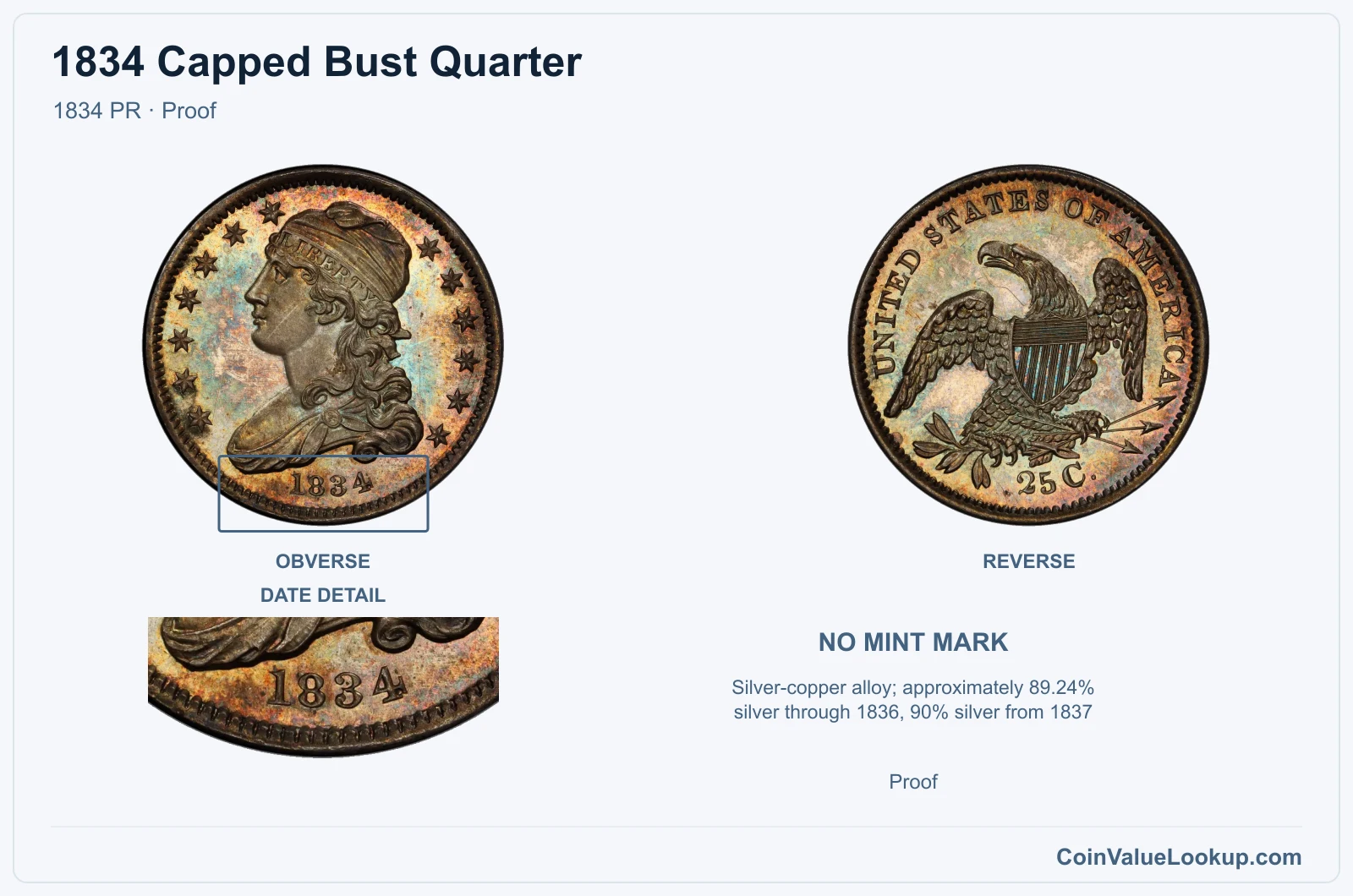
The 1834 PR is the proof version, struck with specially prepared dies and planchets to produce mirror-like fields. Very few were made, and survivors are genuinely rare.
Do not assume your coin is a proof just because it looks shiny — cleaning, cabinet friction, and natural toning can all create misleading appearances on business strikes.
No supported numeric price range is available for this version in the current guide data. Because so few exist, each one is evaluated individually based on its authenticated identity, surface preservation, and any hairlines or haze present.
Third-party certification from a major grading service is essentially a prerequisite for buying or selling a coin claimed to be an 1834 proof quarter.
Range Grade
Price Auction Records Appraisal PR PR 1
—
Coin Identifier
PR 2
—
Coin Identifier
PR 3
—
Coin Identifier
PR 4
—
Coin Identifier
PR 6
—
Coin Identifier
PR 8
—
Coin Identifier
PR 10
—
Coin Identifier
PR 12
—
Coin Identifier
PR 15
—
Coin Identifier
PR 20
—
Coin Identifier
PR 25
—
Coin Identifier
PR 30
—
Coin Identifier
PR 35
—
Coin Identifier
PR 40
—
Coin Identifier
PR 45
—
Coin Identifier
PR 50
—
Coin Identifier
PR 53
—
Coin Identifier
PR 55
—
Coin Identifier
PR 58
—
Coin Identifier
PR 60
—
Coin Identifier
PR 61
—
Coin Identifier
PR 62
—
Coin Identifier
PR 63
—
Coin Identifier
PR 64
Coin Identifier
PR 65
Coin Identifier
PR 66
—
—
—
PR 67
—
—
—
PR 68
—
—
—
PR 69
—
—
—
PR 70
—
—
—
1834 Capped Bust Quarter Error List
1. 1834 Capped Bust Quarter — Die Crack / Die Chip
Die cracks and die chips have been reported on 1834 Capped Bust Quarters. A die crack appears as a thin raised line on the coin's surface, created when the steel die itself fractured during use.
A die chip shows up as a small raised blob where a piece of the die broke away, leaving a void that filled with metal during striking. If a crack reaches the rim and produces a larger raised area, that is sometimes called a cud.
Do not confuse these with scratches or corrosion. Die cracks are raised above the field because they represent metal pushed into the crack in the die.
Scratches are incuse — cut into the surface. Foreign material stuck to the coin can also mimic a chip but will not have the same sharp, metallic profile.
No specific price data is available for this error on the 1834 quarter. Value depends on the crack's size, location, and visibility, along with the coin's overall condition.