2004 Quarter Coin Value: How Much Is It Worth?
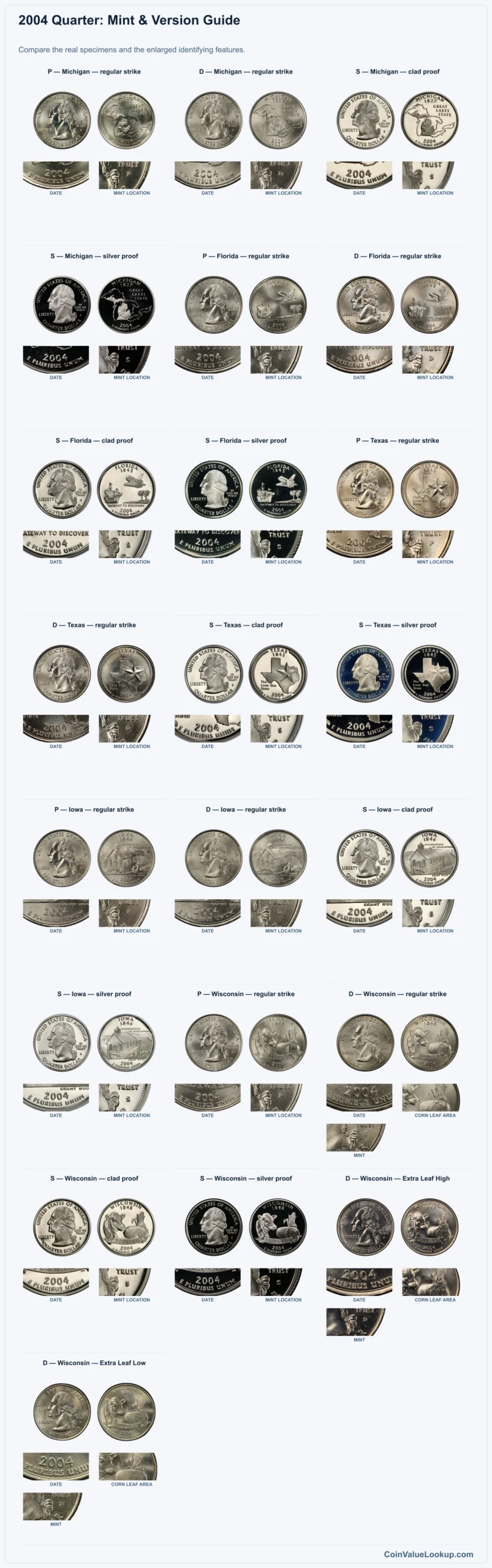
The 2004 quarter belongs to the Washington 50 States Quarters series, and five different state reverse designs were issued that year: Michigan, Florida, Texas, Iowa and Wisconsin. Guide estimates for the various versions range from about $0.74 at MS60 for common business strikes up to $281.00 at MS65 for the D-mint Wisconsin Extra Leaf High variety.
Your coin's actual position in that range depends on which mint produced it, which reverse design it carries, its finish (business strike or proof) and its condition.
Fast Way to Identify Your 2004 Quarter
Upload clear photos of both the front and back of your 2004 quarter for a preliminary identification. The obverse photo helps confirm the mintmark and date, while the reverse photo pins down which of the five state designs you have.
This quick step narrows down which version and value guide applies to your specific coin before you dig deeper.
2004 Quarter Value
Upload both sides of your 2004 Quarter.
Front Obverse
Upload photo
Back Reverse
Upload photo
Which 2004 Quarter Versions Are Worth Money?
- D — Wisconsin — Extra Leaf High: an extra raised leaf on the corn stalk, positioned high; guide estimate around $281.00 at MS65.
- D — Wisconsin — Extra Leaf Low: similar extra leaf positioned lower on the corn stalk; guide estimate around $217.00 at MS65.
- S — Wisconsin — silver proof: the 90% silver San Francisco proof with Wisconsin reverse; guide estimate around $23.00 at PR65.
- Identify your mintmark and reverse design first — most circulated 2004 quarters without a recognized variety trade near face value.
Step 1: Identify Your 2004 Quarter Mint Mark and Version
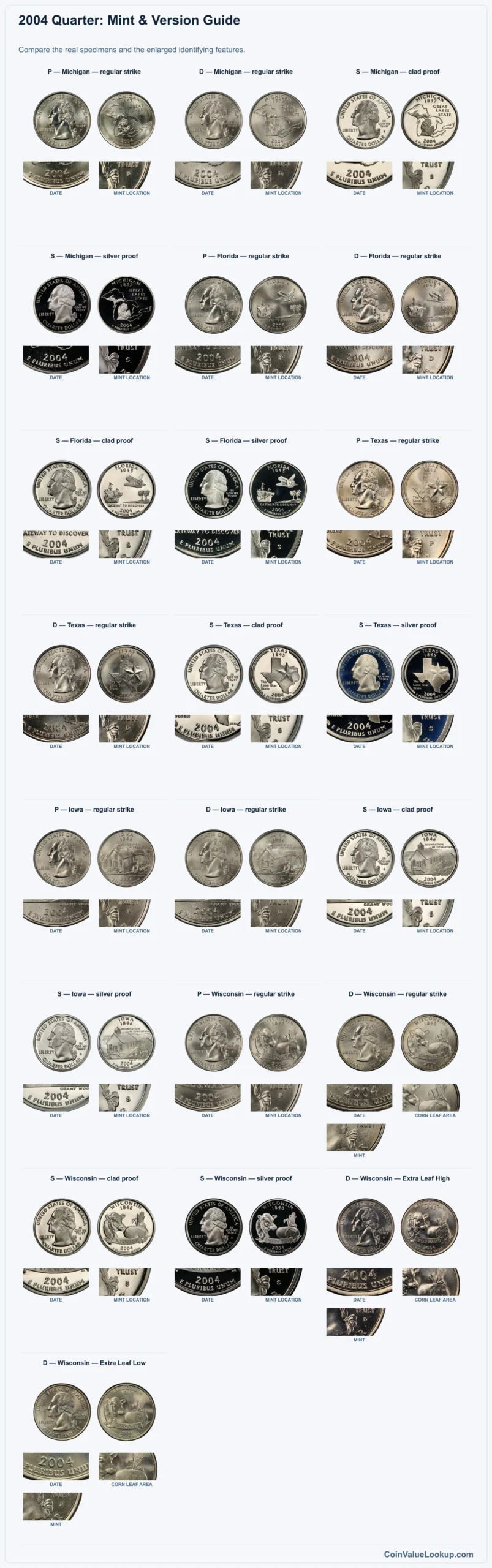
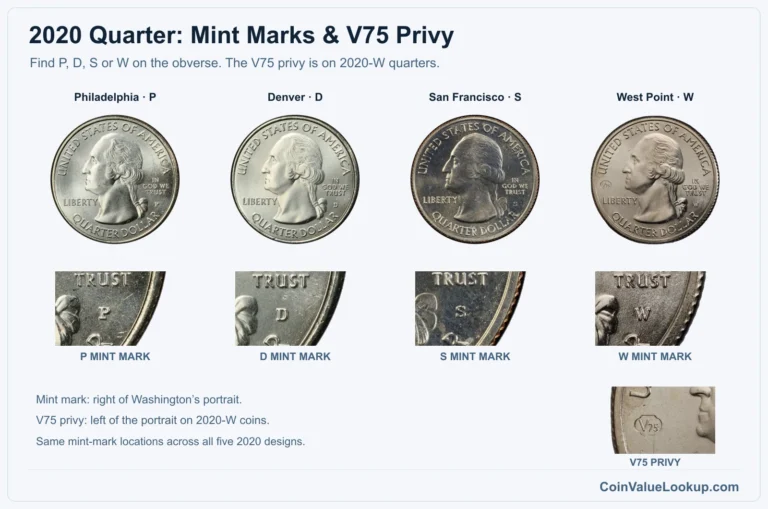
Start on the obverse. The mintmark sits near Washington's portrait — P for Philadelphia, D for Denver, S for San Francisco.
Then flip the coin and identify the reverse design: Michigan, Florida, Texas, Iowa or Wisconsin. Each state design is distinct, so matching the image is straightforward.
All regular business strikes and clad proofs are copper-nickel clad over a copper core, weighing about 5.67 grams at 24.26 mm diameter. Silver proofs, struck only at San Francisco, are 90% silver and 10% copper, weighing roughly 6.25 grams.
You can tell them apart by the edge — silver proofs show a uniform silver edge, while clad coins reveal visible layering.
The date on the obverse is the minting year, 2004. Any date shown within the reverse design refers to the state's history, not the coin's production year.
A proof finish — mirror fields with frosted devices — is an intentional manufacturing method, not a grade or error. Check all of these features before looking at prices.
Step 2: Check Your 2004 Quarter Grade
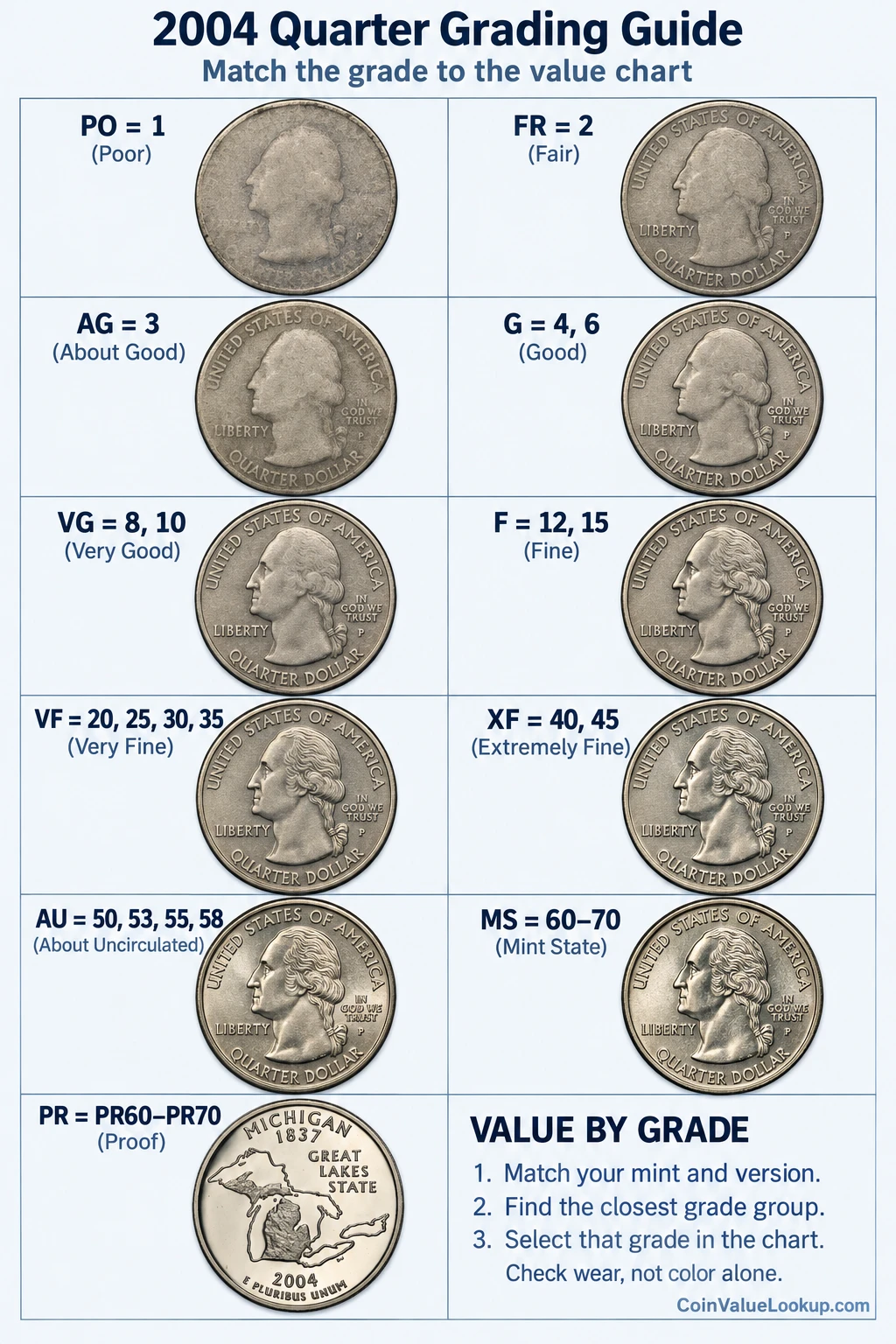
Focus on Washington's cheek and the hair detail above his ear — these are the first places to lose definition as the coin circulates. On the reverse, check the highest relief areas of whichever state design you have.
Compare your coin's wear and luster side by side using the comparison image. A coin can look weak in spots from a soft strike without actually being worn, so look at the fields for contact marks and luster breaks rather than just the high points.
For proofs, tilt the coin under a light and examine the mirror fields for hairlines and haze. Light hairlines from handling drop a proof's grade quickly.
A bright, cleaned surface does not equal a high grade — in fact, cleaning usually lowers a coin's desirability and value.
Step 3: Check 2004 Quarter Value by Mint and Version
2004 Quarter — P — Michigan — regular strike
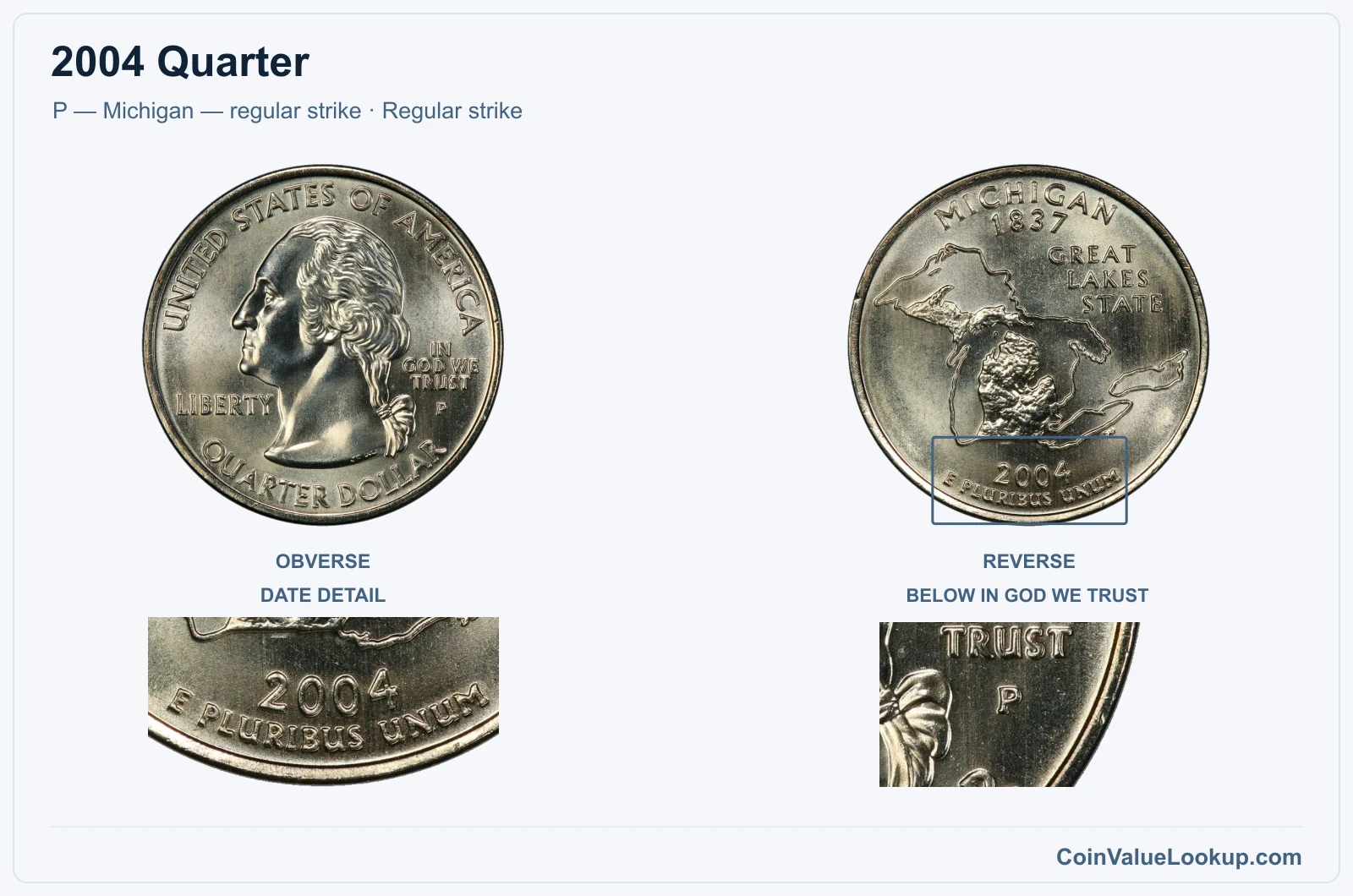
The 2004-P Michigan quarter is a copper-nickel clad business strike from the Philadelphia Mint. The reverse shows the Michigan state design.
Worn examples from circulation typically trade near face value.
USA Coin Book estimates place this version at about $0.74 in MS60 and $3.62 in MS65. To command the higher end, you need original mint luster with minimal bag marks.
Confirm the P mintmark and Michigan reverse before comparing your coin's grade to the chart.
Range Grade
Price Auction Records Appraisal PO PO 1
—
Coin Identifier FR FR 2
—
Coin Identifier AG AG 3
—
Coin Identifier G G 4
—
Coin Identifier
G 6
—
Coin Identifier VG VG 8
—
Coin Identifier
VG 10
—
Coin Identifier F F 12
—
Coin Identifier
F 15
—
Coin Identifier VF VF 20
—
Coin Identifier
VF 25
—
Coin Identifier
VF 30
—
Coin Identifier
VF 35
—
Coin Identifier XF XF 40
—
Coin Identifier
XF 45
—
Coin Identifier AU AU 50
—
Coin Identifier
AU 53
—
Coin Identifier
AU 55
—
Coin Identifier
AU 58
—
Coin Identifier MS MS 60
—
Coin Identifier
MS 61
—
Coin Identifier
MS 62
—
Coin Identifier
MS 63
—
Coin Identifier
MS 64
—
Coin Identifier
MS 65
—
Coin Identifier
MS 66
—
Coin Identifier
MS 67
Coin Identifier
MS 68
Coin Identifier
MS 69
—
—
—
MS 70
—
—
—
2004 Quarter — D — Michigan — regular strike
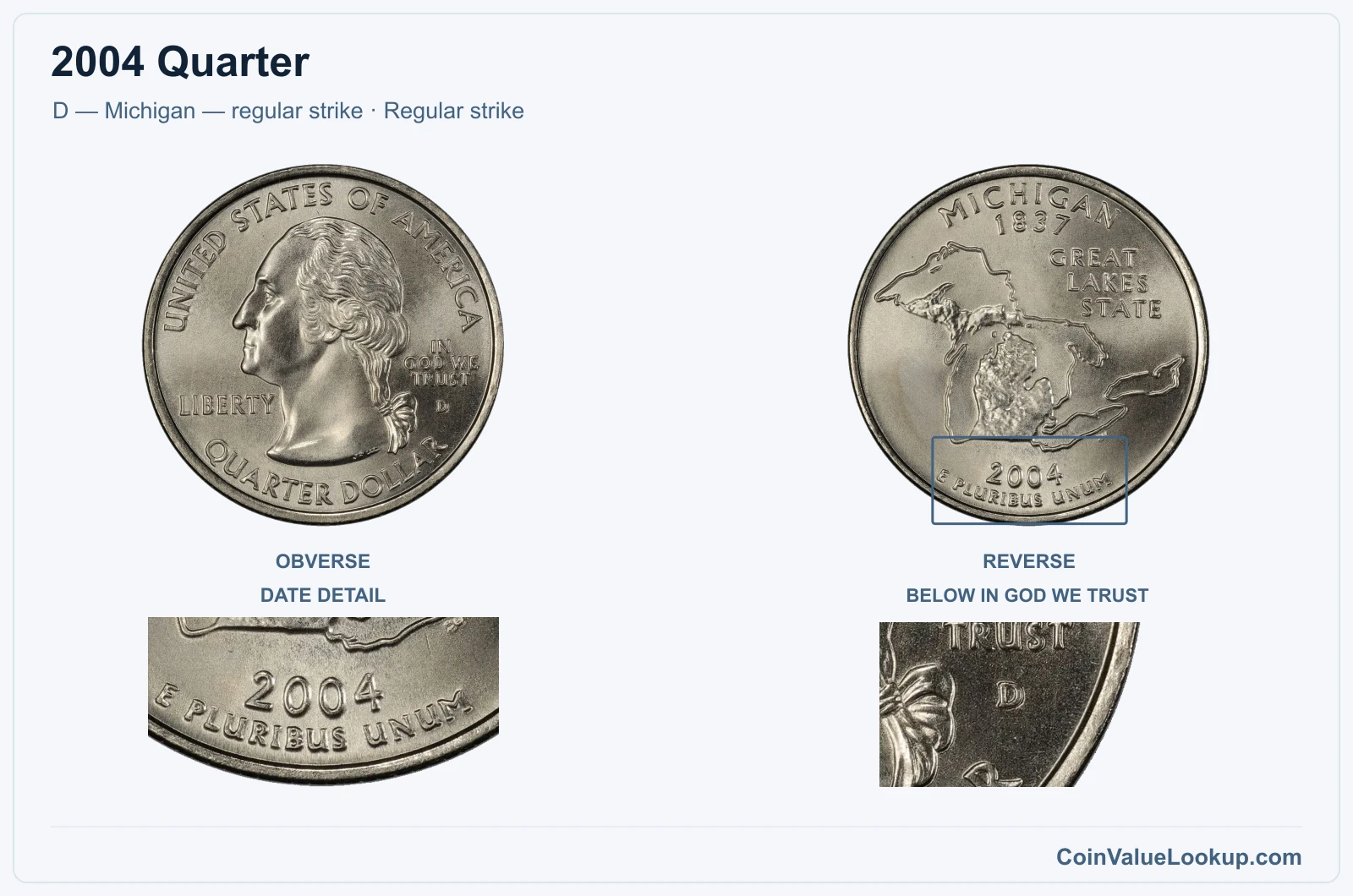
Denver struck the same Michigan design, so this 2004-D version is copper-nickel clad at 5.67 grams and 24.26 mm. In hand, it looks identical to the Philadelphia version except for the D mintmark.
Guide estimates from USA Coin Book list MS60 at about $0.74 and MS65 at $3.62. Circulated pieces are worth face value.
Only well-preserved, original-luster examples attract a premium.
Range Grade
Price Auction Records Appraisal PO PO 1
—
Coin Identifier FR FR 2
—
Coin Identifier AG AG 3
—
Coin Identifier G G 4
—
Coin Identifier
G 6
—
Coin Identifier VG VG 8
—
Coin Identifier
VG 10
—
Coin Identifier F F 12
—
Coin Identifier
F 15
—
Coin Identifier VF VF 20
—
Coin Identifier
VF 25
—
Coin Identifier
VF 30
—
Coin Identifier
VF 35
—
Coin Identifier XF XF 40
—
Coin Identifier
XF 45
—
Coin Identifier AU AU 50
—
Coin Identifier
AU 53
—
Coin Identifier
AU 55
—
Coin Identifier
AU 58
—
Coin Identifier MS MS 60
—
Coin Identifier
MS 61
—
Coin Identifier
MS 62
—
Coin Identifier
MS 63
—
Coin Identifier
MS 64
—
Coin Identifier
MS 65
—
Coin Identifier
MS 66
Coin Identifier
MS 67
—
Coin Identifier
MS 68
Coin Identifier
MS 69
Coin Identifier
MS 70
—
—
—
2004 Quarter — S — Michigan — clad proof
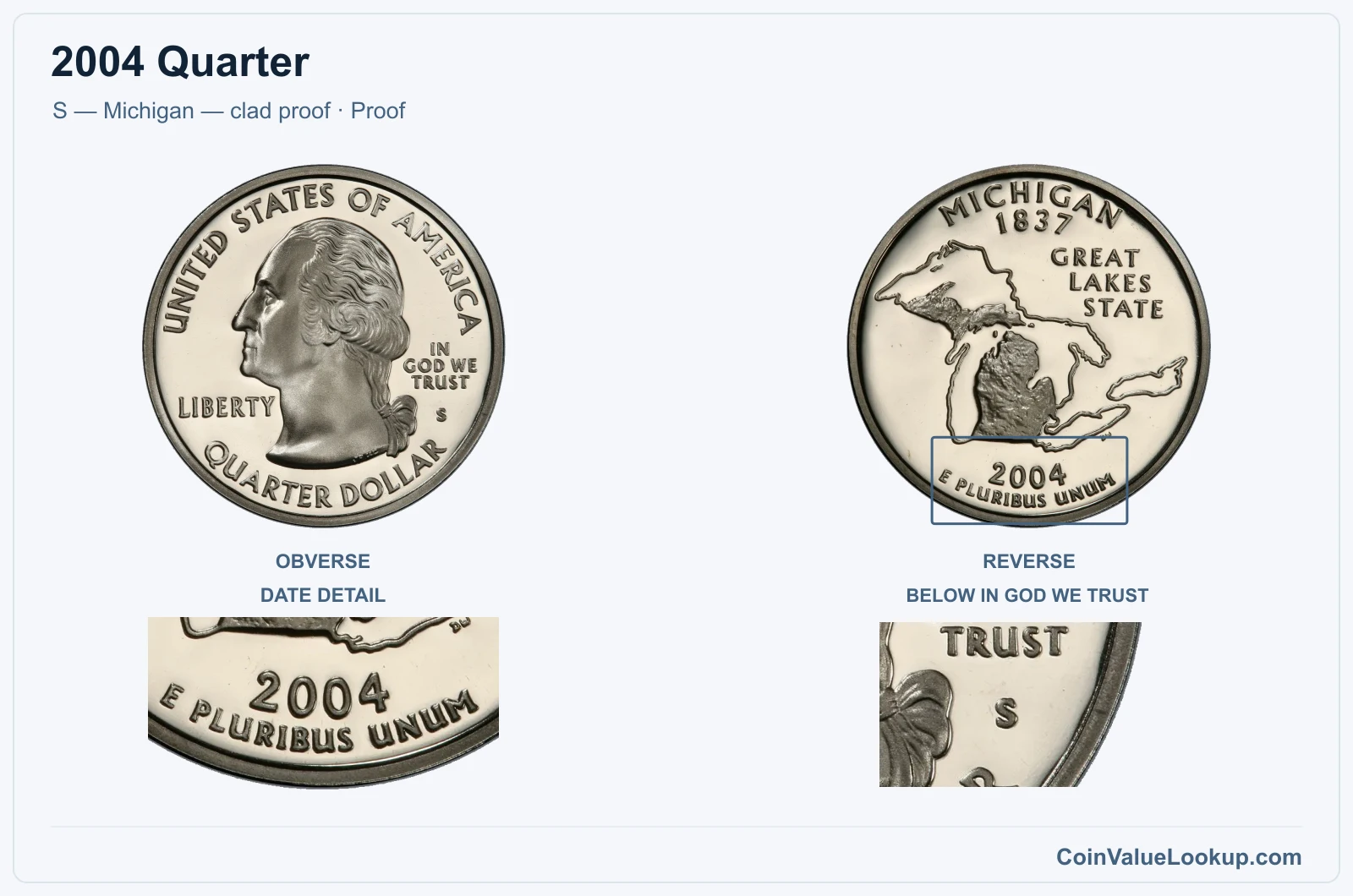
The 2004-S Michigan clad proof was struck at San Francisco on a standard copper-nickel clad planchet. Proofs have mirror-like fields and frosted raised devices — they were sold in collector sets, not released into circulation.
USA Coin Book estimates about $6.25 at PR65. Keep the clad and silver proof values separate; the clad version weighs roughly 5.67 grams, matching a regular quarter, and the edge shows visible copper-nickel layering.
Range Grade
Price Auction Records Appraisal PR PR 1
—
Coin Identifier
PR 2
—
Coin Identifier
PR 3
—
Coin Identifier
PR 4
—
Coin Identifier
PR 6
—
Coin Identifier
PR 8
—
Coin Identifier
PR 10
—
Coin Identifier
PR 12
—
Coin Identifier
PR 15
—
Coin Identifier
PR 20
—
Coin Identifier
PR 25
—
Coin Identifier
PR 30
—
Coin Identifier
PR 35
—
Coin Identifier
PR 40
—
Coin Identifier
PR 45
—
Coin Identifier
PR 50
—
Coin Identifier
PR 53
—
Coin Identifier
PR 55
—
Coin Identifier
PR 58
—
Coin Identifier
PR 60
—
Coin Identifier
PR 61
—
Coin Identifier
PR 62
—
Coin Identifier
PR 63
—
Coin Identifier
PR 64
—
Coin Identifier
PR 65
—
Coin Identifier
PR 66
—
Coin Identifier
PR 67
—
Coin Identifier
PR 68
—
Coin Identifier
PR 69
Coin Identifier
PR 70
Coin Identifier
2004 Quarter — S — Michigan — silver proof
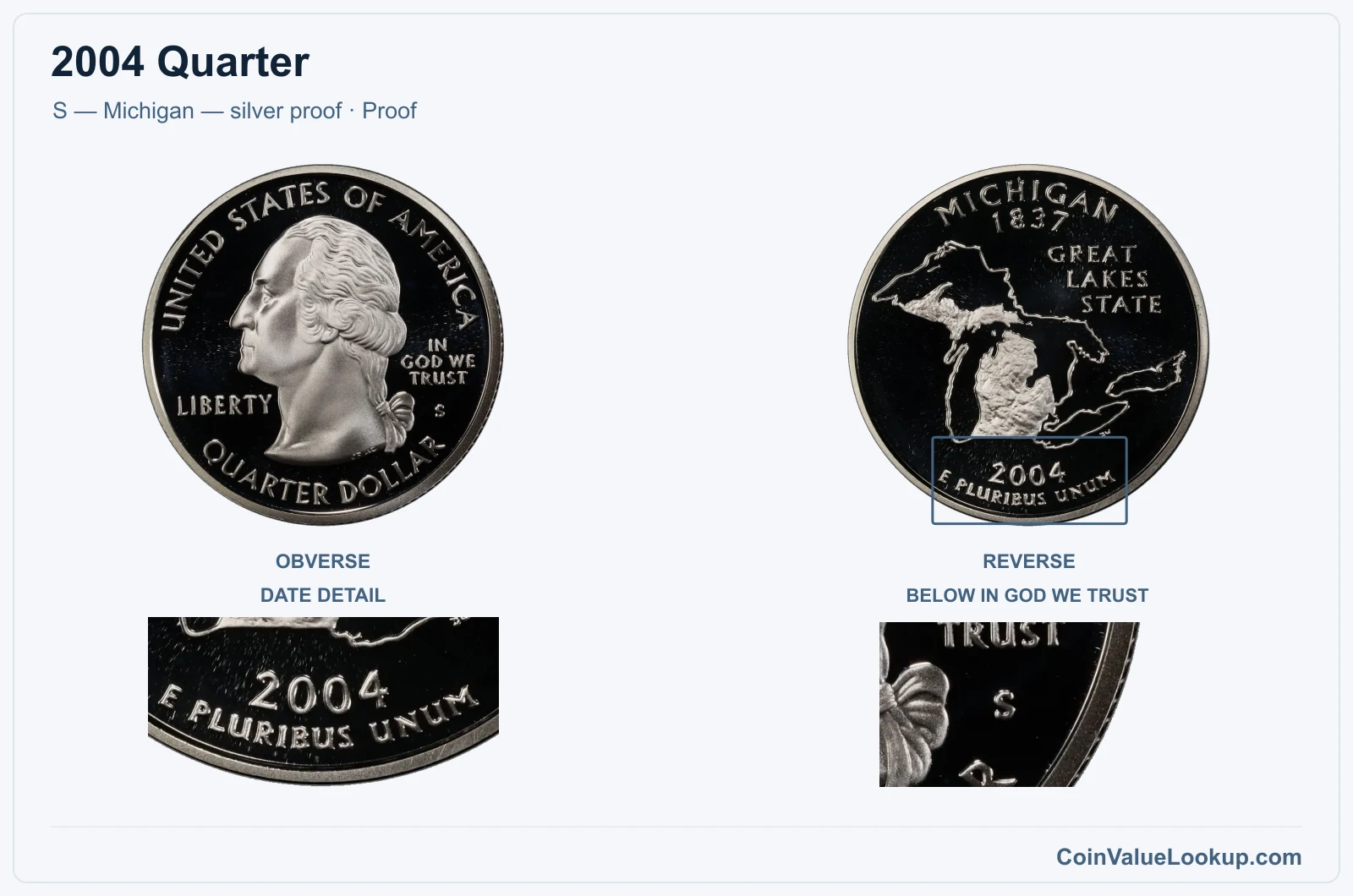
This is the silver proof version of the 2004-S Michigan quarter, struck on a 90% silver planchet weighing about 6.25 grams. Its edge appears uniformly silver-colored with no visible clad layers.
USA Coin Book estimates about $23.00 at PR65. That premium over the clad proof reflects the silver content and collector demand.
Confirm composition by weight or original packaging before assuming you hold the silver version — the two S-mint proofs look similar at a glance.
Range Grade
Price Auction Records Appraisal PR PR 1
—
Coin Identifier
PR 2
—
Coin Identifier
PR 3
—
Coin Identifier
PR 4
—
Coin Identifier
PR 6
—
Coin Identifier
PR 8
—
Coin Identifier
PR 10
—
Coin Identifier
PR 12
—
Coin Identifier
PR 15
—
Coin Identifier
PR 20
—
Coin Identifier
PR 25
—
Coin Identifier
PR 30
—
Coin Identifier
PR 35
—
Coin Identifier
PR 40
—
Coin Identifier
PR 45
—
Coin Identifier
PR 50
—
Coin Identifier
PR 53
—
Coin Identifier
PR 55
—
Coin Identifier
PR 58
—
Coin Identifier
PR 60
—
Coin Identifier
PR 61
—
Coin Identifier
PR 62
—
Coin Identifier
PR 63
—
Coin Identifier
PR 64
—
Coin Identifier
PR 65
—
Coin Identifier
PR 66
—
Coin Identifier
PR 67
—
Coin Identifier
PR 68
—
Coin Identifier
PR 69
Coin Identifier
PR 70
Coin Identifier
2004 Quarter — P — Florida — regular strike
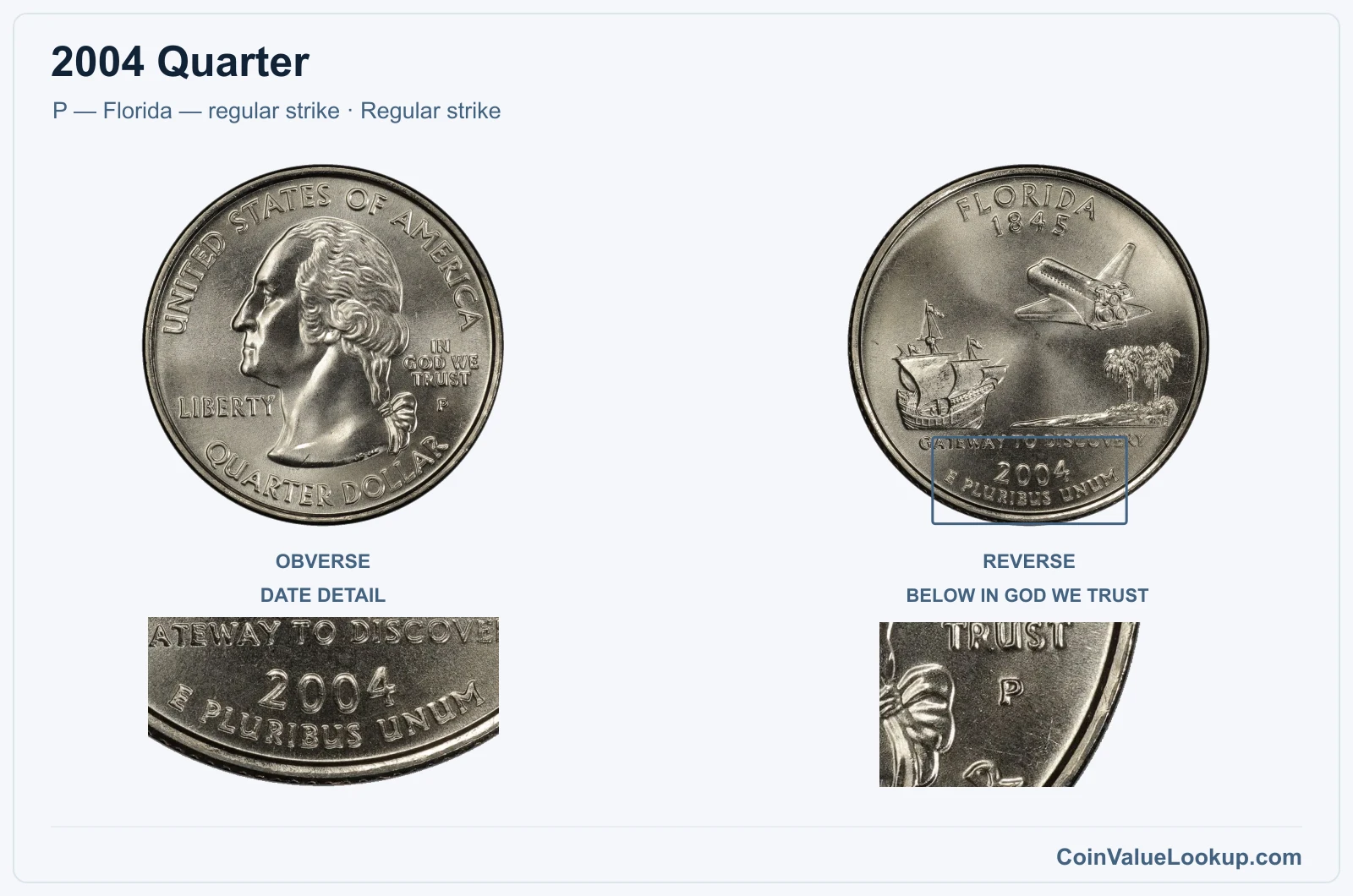
Philadelphia's 2004-P Florida quarter is a copper-nickel clad business strike showing the Florida state design on the reverse. Like most P-mint state quarters, huge mintages keep circulated values at face.
Guide estimates from USA Coin Book run about $0.74 at MS60 and $3.62 at MS65. Only coins with full original luster and few contact marks reach that upper number.
Check the P mintmark and confirm the Florida reverse before grading.
Range Grade
Price Auction Records Appraisal PO PO 1
—
Coin Identifier FR FR 2
—
Coin Identifier AG AG 3
—
Coin Identifier G G 4
—
Coin Identifier
G 6
—
Coin Identifier VG VG 8
—
Coin Identifier
VG 10
—
Coin Identifier F F 12
—
Coin Identifier
F 15
—
Coin Identifier VF VF 20
—
Coin Identifier
VF 25
—
Coin Identifier
VF 30
—
Coin Identifier
VF 35
—
Coin Identifier XF XF 40
—
Coin Identifier
XF 45
—
Coin Identifier AU AU 50
—
Coin Identifier
AU 53
—
Coin Identifier
AU 55
—
Coin Identifier
AU 58
—
Coin Identifier MS MS 60
—
Coin Identifier
MS 61
—
Coin Identifier
MS 62
—
Coin Identifier
MS 63
—
Coin Identifier
MS 64
—
Coin Identifier
MS 65
—
Coin Identifier
MS 66
Coin Identifier
MS 67
Coin Identifier
MS 68
Coin Identifier
MS 69
—
—
—
MS 70
—
—
—
2004 Quarter — D — Florida — regular strike
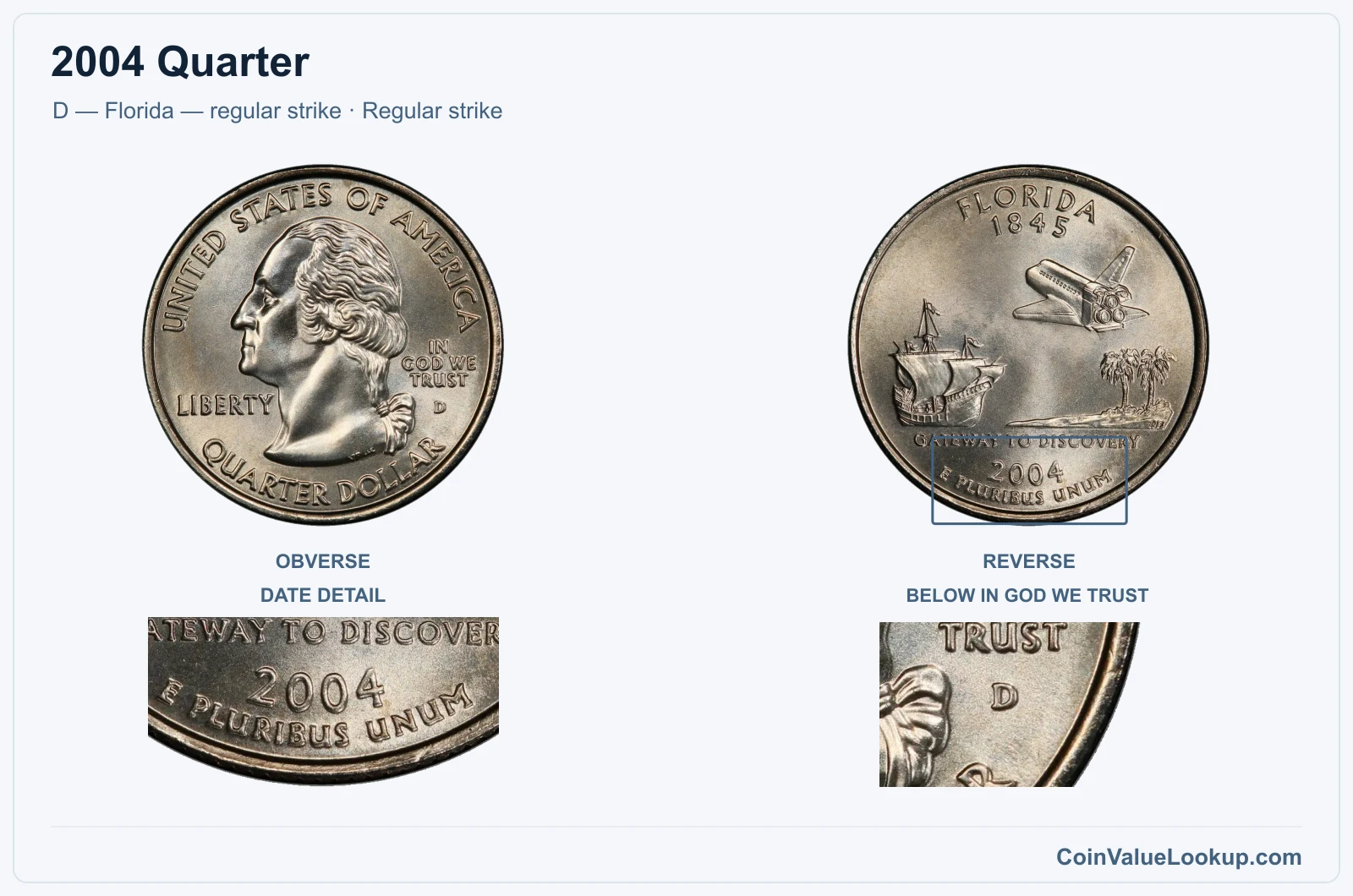
The 2004-D Florida quarter matches its Philadelphia sibling in every respect except the D mintmark. Same copper-nickel clad composition, same 5.67-gram weight, same Florida reverse design.
USA Coin Book estimates $0.74 at MS60 and $3.62 at MS65. Worn pieces are spenders.
If yours looks fresh from a roll with bright, undisturbed luster, it may be worth pulling aside for a closer grade check.
Range Grade
Price Auction Records Appraisal PO PO 1
—
Coin Identifier FR FR 2
—
Coin Identifier AG AG 3
—
Coin Identifier G G 4
—
Coin Identifier
G 6
—
Coin Identifier VG VG 8
—
Coin Identifier
VG 10
—
Coin Identifier F F 12
—
Coin Identifier
F 15
—
Coin Identifier VF VF 20
—
Coin Identifier
VF 25
—
Coin Identifier
VF 30
—
Coin Identifier
VF 35
—
Coin Identifier XF XF 40
—
Coin Identifier
XF 45
—
Coin Identifier AU AU 50
—
Coin Identifier
AU 53
—
Coin Identifier
AU 55
—
Coin Identifier
AU 58
—
Coin Identifier MS MS 60
—
Coin Identifier
MS 61
—
Coin Identifier
MS 62
—
Coin Identifier
MS 63
—
Coin Identifier
MS 64
—
Coin Identifier
MS 65
—
Coin Identifier
MS 66
Coin Identifier
MS 67
Coin Identifier
MS 68
Coin Identifier
MS 69
Coin Identifier
MS 70
—
—
—
2004 Quarter — S — Florida — clad proof
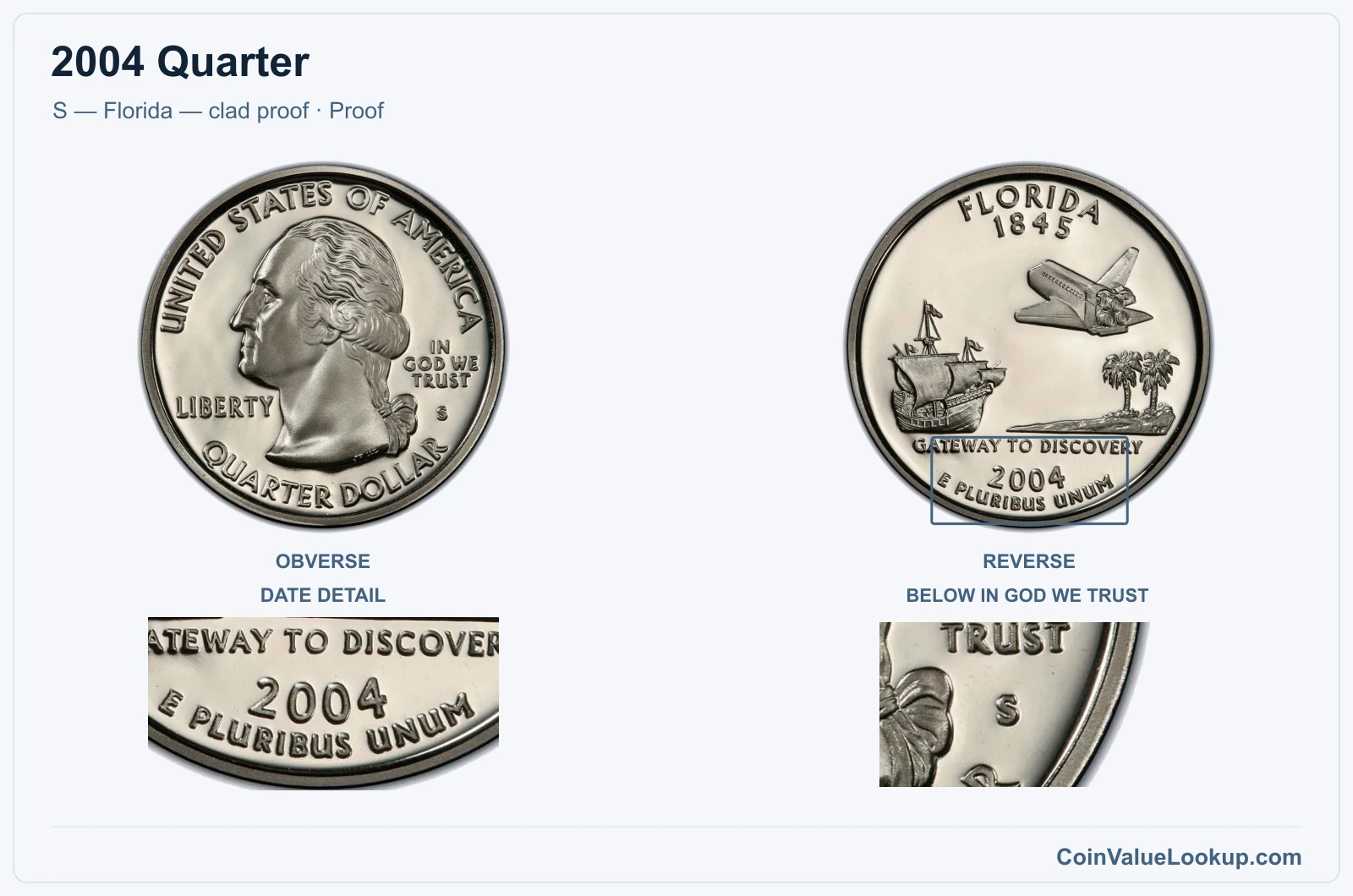
San Francisco produced the 2004-S Florida clad proof on a standard copper-nickel clad planchet. The proof finish means mirror fields and frosted devices, struck with extra care for collector sets.
At PR65, USA Coin Book estimates about $6.25. Inspect the mirror fields under angled light for hairlines and haze — these lower the grade fast.
The clad edge layering distinguishes this from the silver proof.
Range Grade
Price Auction Records Appraisal PR PR 1
—
Coin Identifier
PR 2
—
Coin Identifier
PR 3
—
Coin Identifier
PR 4
—
Coin Identifier
PR 6
—
Coin Identifier
PR 8
—
Coin Identifier
PR 10
—
Coin Identifier
PR 12
—
Coin Identifier
PR 15
—
Coin Identifier
PR 20
—
Coin Identifier
PR 25
—
Coin Identifier
PR 30
—
Coin Identifier
PR 35
—
Coin Identifier
PR 40
—
Coin Identifier
PR 45
—
Coin Identifier
PR 50
—
Coin Identifier
PR 53
—
Coin Identifier
PR 55
—
Coin Identifier
PR 58
—
Coin Identifier
PR 60
—
Coin Identifier
PR 61
—
Coin Identifier
PR 62
—
Coin Identifier
PR 63
—
Coin Identifier
PR 64
—
Coin Identifier
PR 65
—
Coin Identifier
PR 66
—
Coin Identifier
PR 67
—
Coin Identifier
PR 68
Coin Identifier
PR 69
Coin Identifier
PR 70
Coin Identifier
2004 Quarter — S — Florida — silver proof
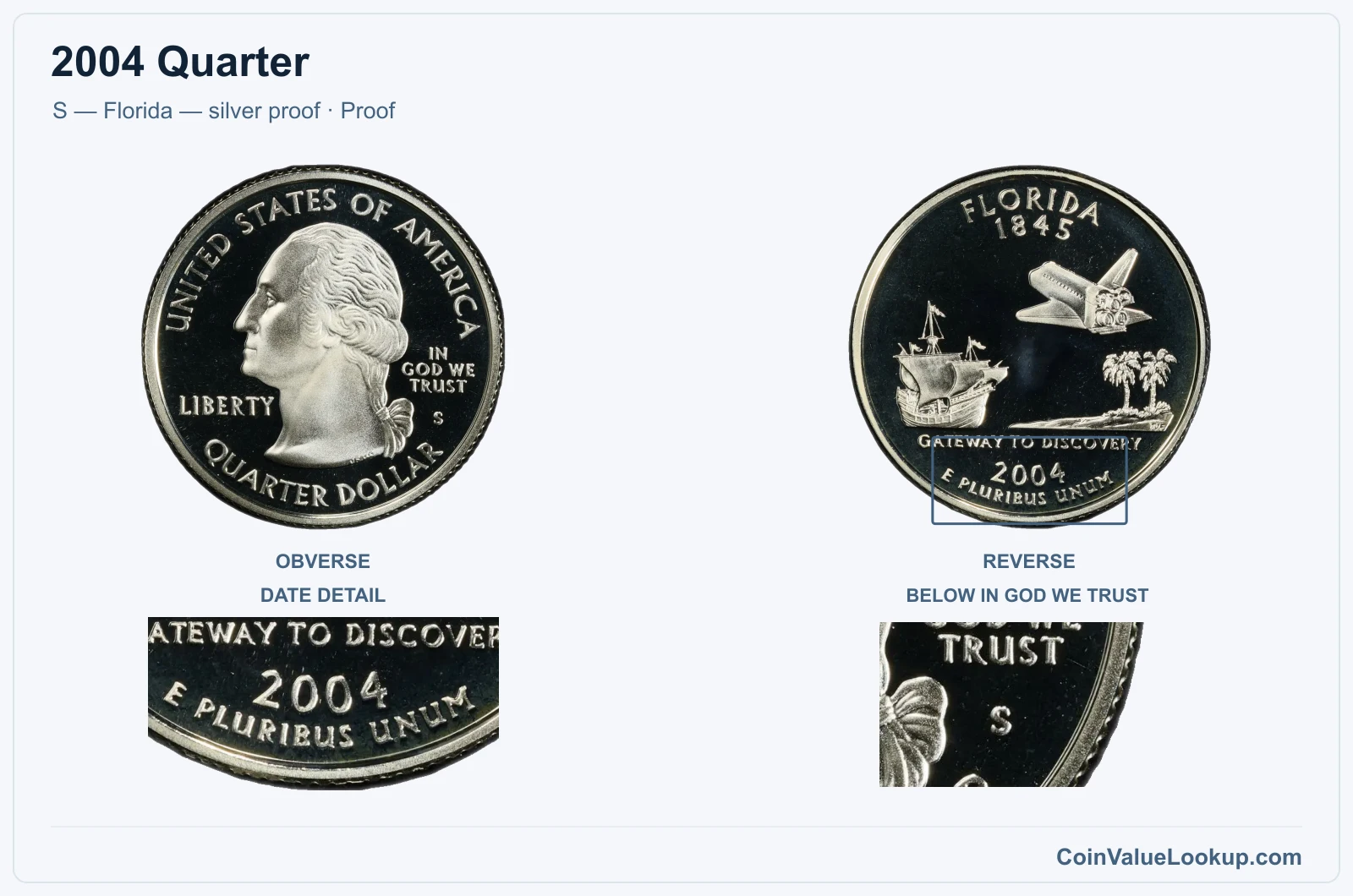
The 2004-S Florida silver proof is struck on a 90% silver planchet, weighing approximately 6.25 grams. Its edge is solid silver-colored without visible clad layers.
USA Coin Book estimates about $23.00 at PR65. The silver content and lower production numbers for silver proof sets push this version's value well above the clad proof.
Weight or original packaging is the surest way to confirm you have silver rather than clad.
Range Grade
Price Auction Records Appraisal PR PR 1
—
Coin Identifier
PR 2
—
Coin Identifier
PR 3
—
Coin Identifier
PR 4
—
Coin Identifier
PR 6
—
Coin Identifier
PR 8
—
Coin Identifier
PR 10
—
Coin Identifier
PR 12
—
Coin Identifier
PR 15
—
Coin Identifier
PR 20
—
Coin Identifier
PR 25
—
Coin Identifier
PR 30
—
Coin Identifier
PR 35
—
Coin Identifier
PR 40
—
Coin Identifier
PR 45
—
Coin Identifier
PR 50
—
Coin Identifier
PR 53
—
Coin Identifier
PR 55
—
Coin Identifier
PR 58
—
Coin Identifier
PR 60
—
Coin Identifier
PR 61
—
Coin Identifier
PR 62
—
Coin Identifier
PR 63
—
Coin Identifier
PR 64
—
Coin Identifier
PR 65
—
Coin Identifier
PR 66
—
Coin Identifier
PR 67
—
Coin Identifier
PR 68
Coin Identifier
PR 69
Coin Identifier
PR 70
Coin Identifier
2004 Quarter — P — Texas — regular strike
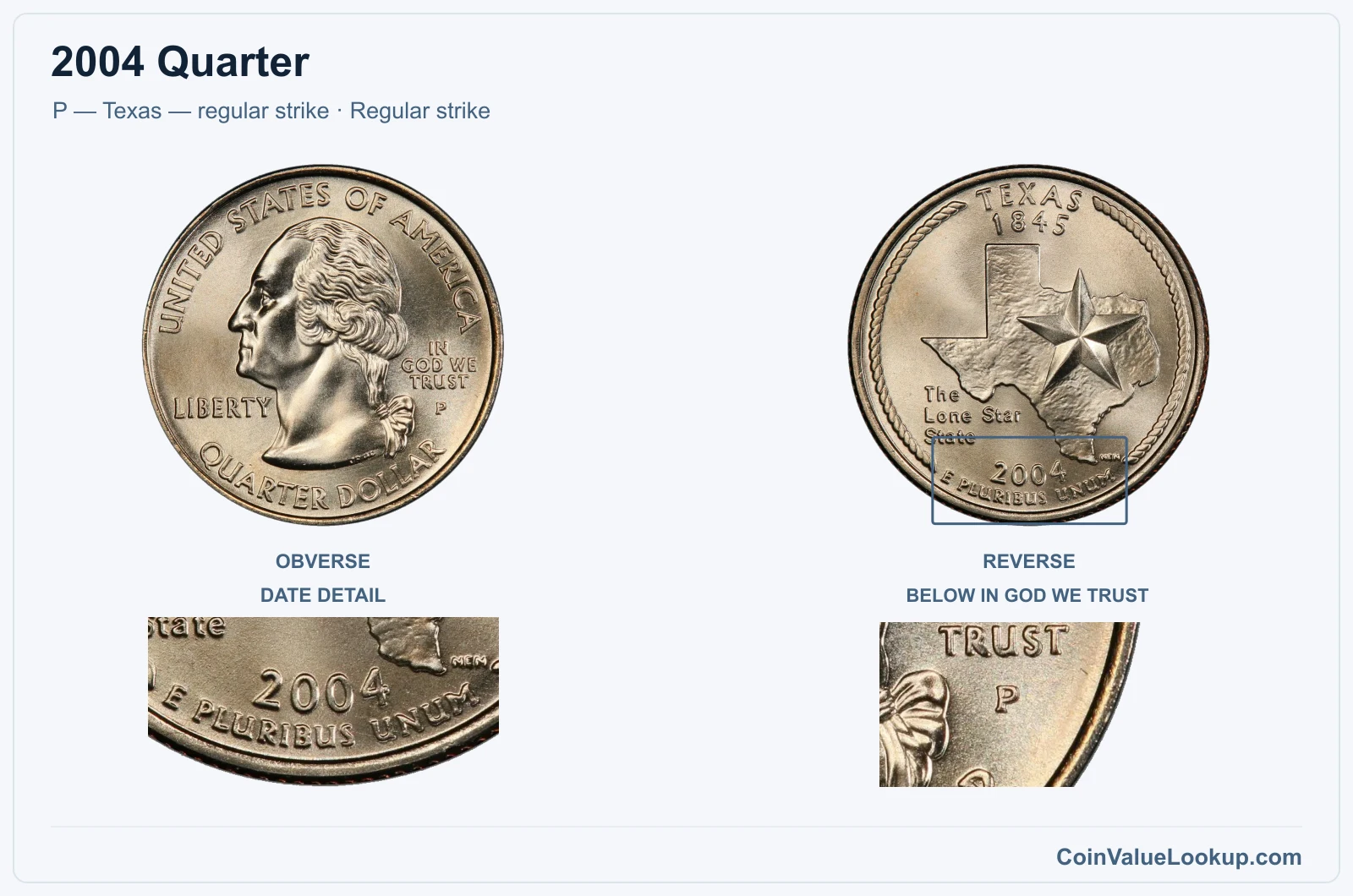
The 2004-P Texas quarter is a copper-nickel clad business strike featuring the Texas state design — the familiar star and state outline. Philadelphia produced large quantities, so circulated examples sit at face value.
USA Coin Book guide estimates come in at about $0.74 for MS60 and $3.62 for MS65. Verify the P mintmark on the obverse and confirm the Texas reverse before comparing condition.
Range Grade
Price Auction Records Appraisal PO PO 1
—
Coin Identifier FR FR 2
—
Coin Identifier AG AG 3
—
Coin Identifier G G 4
—
Coin Identifier
G 6
—
Coin Identifier VG VG 8
—
Coin Identifier
VG 10
—
Coin Identifier F F 12
—
Coin Identifier
F 15
—
Coin Identifier VF VF 20
—
Coin Identifier
VF 25
—
Coin Identifier
VF 30
—
Coin Identifier
VF 35
—
Coin Identifier XF XF 40
—
Coin Identifier
XF 45
—
Coin Identifier AU AU 50
—
Coin Identifier
AU 53
—
Coin Identifier
AU 55
—
Coin Identifier
AU 58
—
Coin Identifier MS MS 60
—
Coin Identifier
MS 61
—
Coin Identifier
MS 62
—
Coin Identifier
MS 63
—
Coin Identifier
MS 64
—
Coin Identifier
MS 65
—
Coin Identifier
MS 66
Coin Identifier
MS 67
Coin Identifier
MS 68
Coin Identifier
MS 69
Coin Identifier
MS 70
—
—
—
2004 Quarter — D — Texas — regular strike
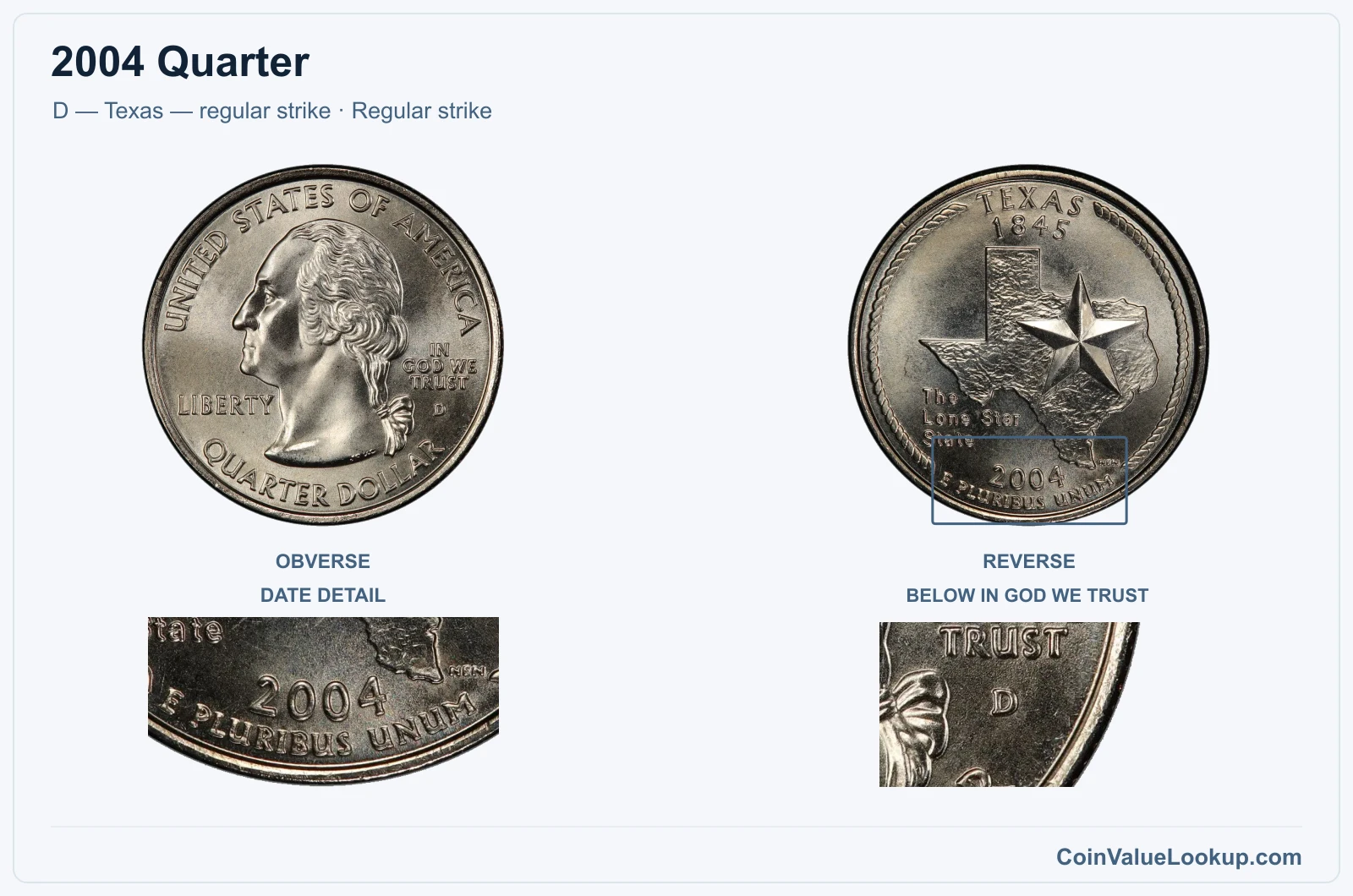
Denver's version of the 2004 Texas quarter carries a D mintmark but is otherwise identical in design and composition — copper-nickel clad, 5.67 grams, 24.26 mm.
USA Coin Book estimates $0.74 at MS60 and $3.62 at MS65. As with the P-mint, only uncirculated coins with clean fields and full luster have a shot at the upper guide value.
Anything showing wear trades at twenty-five cents.
Range Grade
Price Auction Records Appraisal PO PO 1
—
Coin Identifier FR FR 2
—
Coin Identifier AG AG 3
—
Coin Identifier G G 4
—
Coin Identifier
G 6
—
Coin Identifier VG VG 8
—
Coin Identifier
VG 10
—
Coin Identifier F F 12
—
Coin Identifier
F 15
—
Coin Identifier VF VF 20
—
Coin Identifier
VF 25
—
Coin Identifier
VF 30
—
Coin Identifier
VF 35
—
Coin Identifier XF XF 40
—
Coin Identifier
XF 45
—
Coin Identifier AU AU 50
—
Coin Identifier
AU 53
—
Coin Identifier
AU 55
—
Coin Identifier
AU 58
—
Coin Identifier MS MS 60
—
Coin Identifier
MS 61
—
Coin Identifier
MS 62
—
Coin Identifier
MS 63
—
Coin Identifier
MS 64
—
Coin Identifier
MS 65
—
Coin Identifier
MS 66
—
Coin Identifier
MS 67
Coin Identifier
MS 68
Coin Identifier
MS 69
Coin Identifier
MS 70
—
—
—
2004 Quarter — S — Texas — clad proof
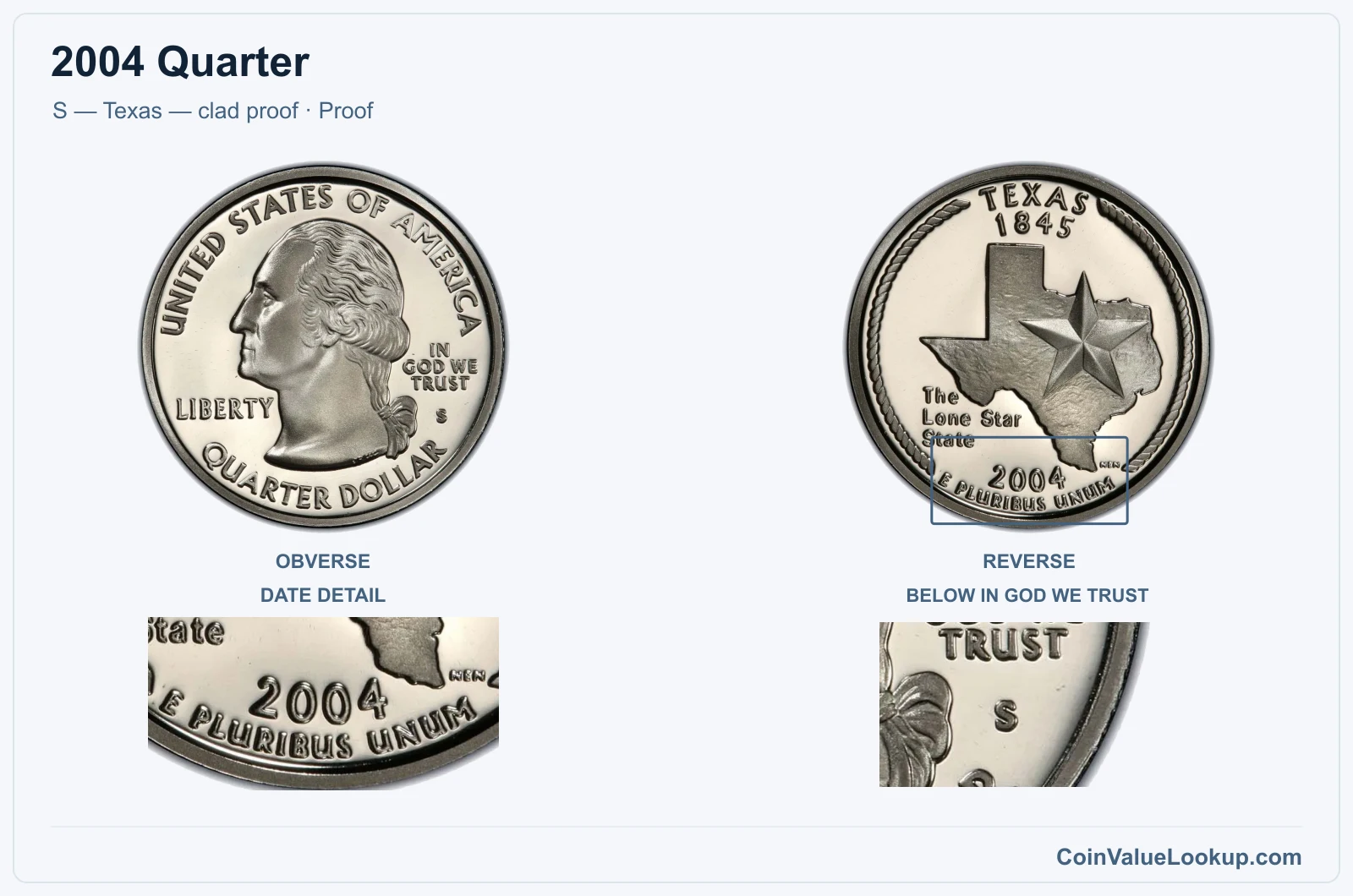
The 2004-S Texas clad proof was struck on a copper-nickel clad planchet at the San Francisco Mint for inclusion in proof sets. Expect mirror surfaces and frosted devices.
USA Coin Book estimates about $6.25 at PR65. Separate this from the silver proof by checking the edge for clad layering or weighing it — the clad proof weighs about 5.67 grams versus 6.25 grams for silver.
Range Grade
Price Auction Records Appraisal PR PR 1
—
Coin Identifier
PR 2
—
Coin Identifier
PR 3
—
Coin Identifier
PR 4
—
Coin Identifier
PR 6
—
Coin Identifier
PR 8
—
Coin Identifier
PR 10
—
Coin Identifier
PR 12
—
Coin Identifier
PR 15
—
Coin Identifier
PR 20
—
Coin Identifier
PR 25
—
Coin Identifier
PR 30
—
Coin Identifier
PR 35
—
Coin Identifier
PR 40
—
Coin Identifier
PR 45
—
Coin Identifier
PR 50
—
Coin Identifier
PR 53
—
Coin Identifier
PR 55
—
Coin Identifier
PR 58
—
Coin Identifier
PR 60
—
Coin Identifier
PR 61
—
Coin Identifier
PR 62
—
Coin Identifier
PR 63
—
Coin Identifier
PR 64
—
Coin Identifier
PR 65
—
Coin Identifier
PR 66
—
Coin Identifier
PR 67
—
Coin Identifier
PR 68
—
Coin Identifier
PR 69
Coin Identifier
PR 70
Coin Identifier
2004 Quarter — S — Texas — silver proof
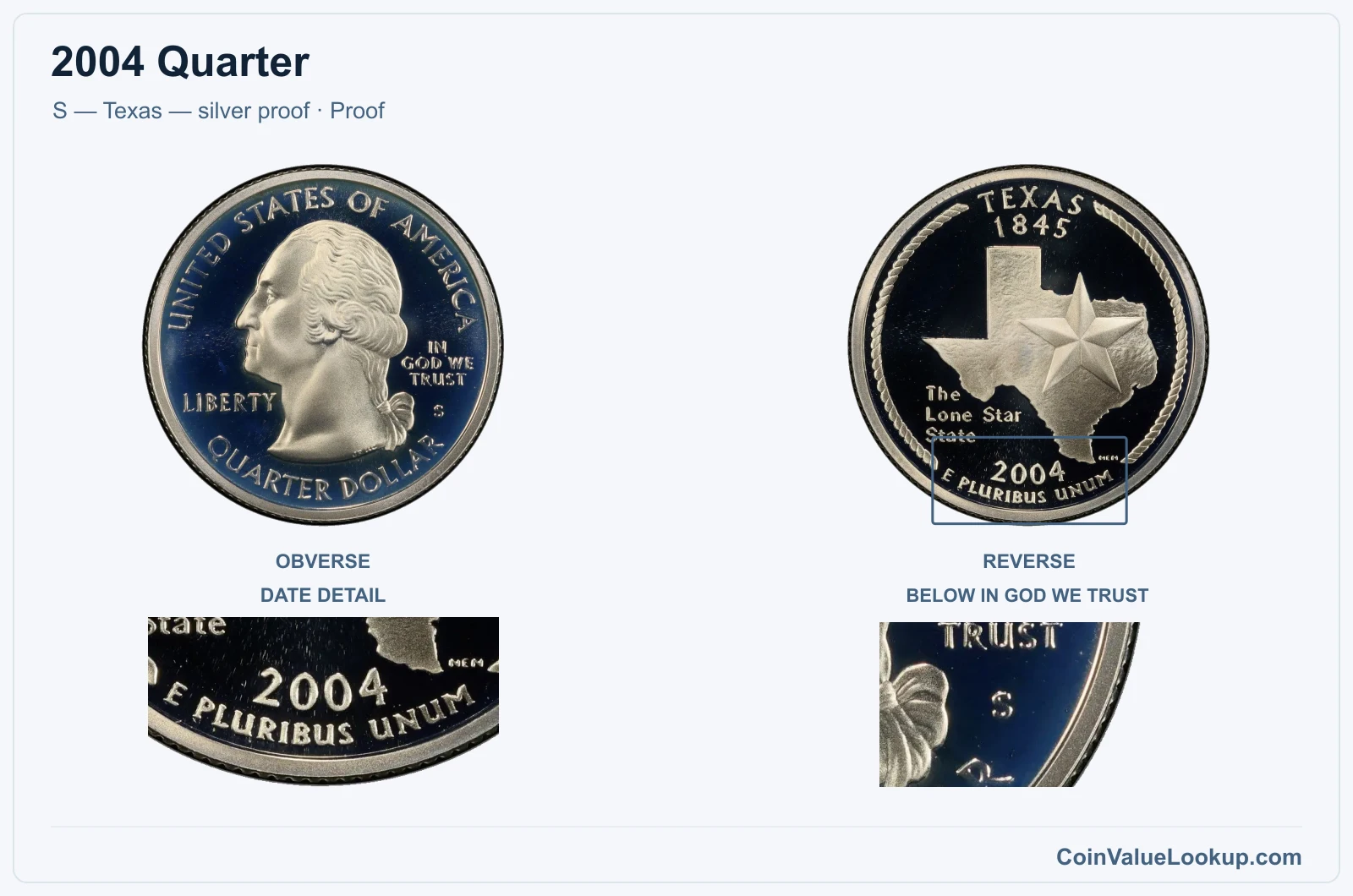
This is the 90% silver proof of the 2004-S Texas quarter, weighing approximately 6.25 grams. The edge appears uniformly silver.
USA Coin Book estimates about $23.00 at PR65. The silver content gives it meaningful melt value on top of collector appeal.
Confirm composition through weight, edge examination, or original mint packaging before assigning the silver proof value.
Range Grade
Price Auction Records Appraisal PR PR 1
—
Coin Identifier
PR 2
—
Coin Identifier
PR 3
—
Coin Identifier
PR 4
—
Coin Identifier
PR 6
—
Coin Identifier
PR 8
—
Coin Identifier
PR 10
—
Coin Identifier
PR 12
—
Coin Identifier
PR 15
—
Coin Identifier
PR 20
—
Coin Identifier
PR 25
—
Coin Identifier
PR 30
—
Coin Identifier
PR 35
—
Coin Identifier
PR 40
—
Coin Identifier
PR 45
—
Coin Identifier
PR 50
—
Coin Identifier
PR 53
—
Coin Identifier
PR 55
—
Coin Identifier
PR 58
—
Coin Identifier
PR 60
—
Coin Identifier
PR 61
—
Coin Identifier
PR 62
—
Coin Identifier
PR 63
—
Coin Identifier
PR 64
—
Coin Identifier
PR 65
—
Coin Identifier
PR 66
—
Coin Identifier
PR 67
—
Coin Identifier
PR 68
—
Coin Identifier
PR 69
Coin Identifier
PR 70
Coin Identifier
2004 Quarter — P — Iowa — regular strike
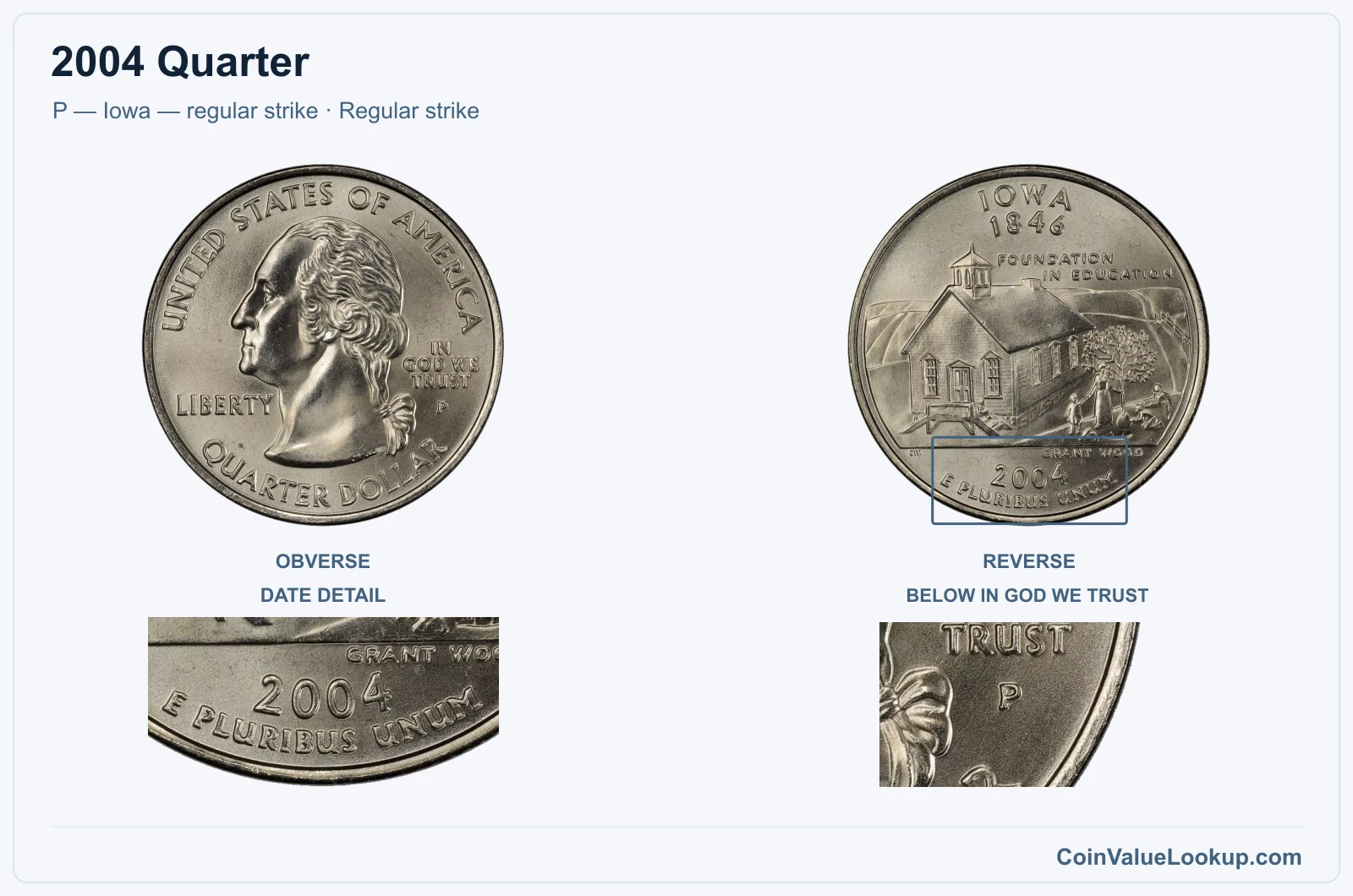
Philadelphia struck the 2004-P Iowa quarter on a copper-nickel clad planchet with the Iowa state design reverse. Heavy production means circulated coins are worth face value.
USA Coin Book estimates roughly $0.74 at MS60 and $3.62 at MS65. A well-preserved roll coin with strong luster and few marks is what you need to approach the upper figure.
Confirm the P mintmark and the Iowa reverse.
Range Grade
Price Auction Records Appraisal PO PO 1
—
Coin Identifier FR FR 2
—
Coin Identifier AG AG 3
—
Coin Identifier G G 4
—
Coin Identifier
G 6
—
Coin Identifier VG VG 8
—
Coin Identifier
VG 10
—
Coin Identifier F F 12
—
Coin Identifier
F 15
—
Coin Identifier VF VF 20
—
Coin Identifier
VF 25
—
Coin Identifier
VF 30
—
Coin Identifier
VF 35
—
Coin Identifier XF XF 40
—
Coin Identifier
XF 45
—
Coin Identifier AU AU 50
—
Coin Identifier
AU 53
—
Coin Identifier
AU 55
—
Coin Identifier
AU 58
—
Coin Identifier MS MS 60
—
Coin Identifier
MS 61
—
Coin Identifier
MS 62
—
Coin Identifier
MS 63
—
Coin Identifier
MS 64
Coin Identifier
MS 65
—
Coin Identifier
MS 66
Coin Identifier
MS 67
Coin Identifier
MS 68
Coin Identifier
MS 69
—
—
—
MS 70
—
—
—
2004 Quarter — D — Iowa — regular strike
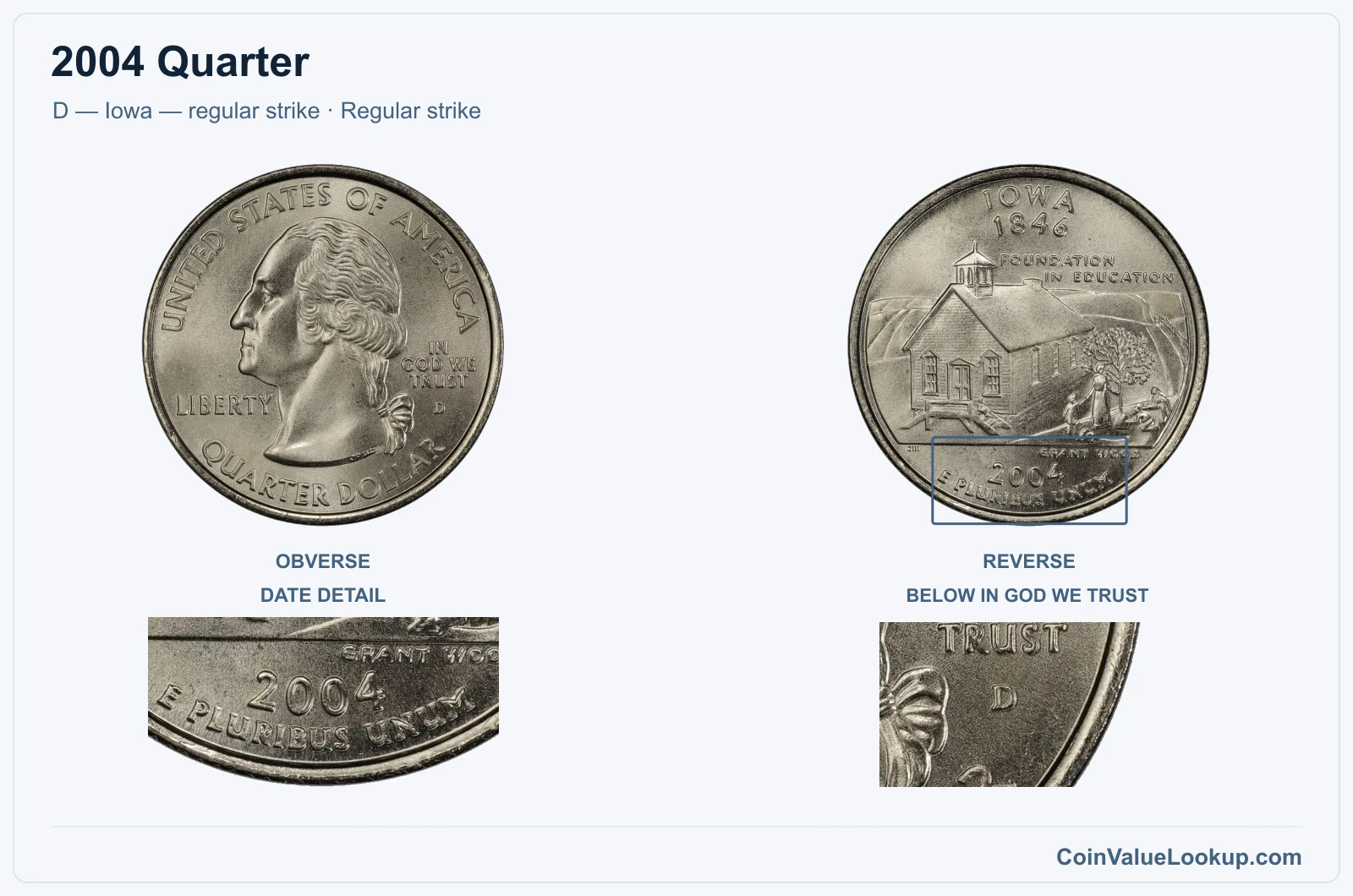
The 2004-D Iowa quarter is the Denver-struck version, copper-nickel clad at 5.67 grams. The D mintmark near Washington's portrait is the distinguishing feature from the P-mint.
Guide estimates from USA Coin Book place MS60 at $0.74 and MS65 at $3.62. Nothing unusual about this issue — it is a common coin in high grades and a face-value spender when worn.
Range Grade
Price Auction Records Appraisal PO PO 1
—
Coin Identifier FR FR 2
—
Coin Identifier AG AG 3
—
Coin Identifier G G 4
—
Coin Identifier
G 6
—
Coin Identifier VG VG 8
—
Coin Identifier
VG 10
—
Coin Identifier F F 12
—
Coin Identifier
F 15
—
Coin Identifier VF VF 20
—
Coin Identifier
VF 25
—
Coin Identifier
VF 30
—
Coin Identifier
VF 35
—
Coin Identifier XF XF 40
—
Coin Identifier
XF 45
—
Coin Identifier AU AU 50
—
Coin Identifier
AU 53
—
Coin Identifier
AU 55
—
Coin Identifier
AU 58
—
Coin Identifier MS MS 60
—
Coin Identifier
MS 61
—
Coin Identifier
MS 62
—
Coin Identifier
MS 63
—
Coin Identifier
MS 64
—
Coin Identifier
MS 65
—
Coin Identifier
MS 66
—
Coin Identifier
MS 67
Coin Identifier
MS 68
Coin Identifier
MS 69
Coin Identifier
MS 70
—
—
—
2004 Quarter — S — Iowa — clad proof
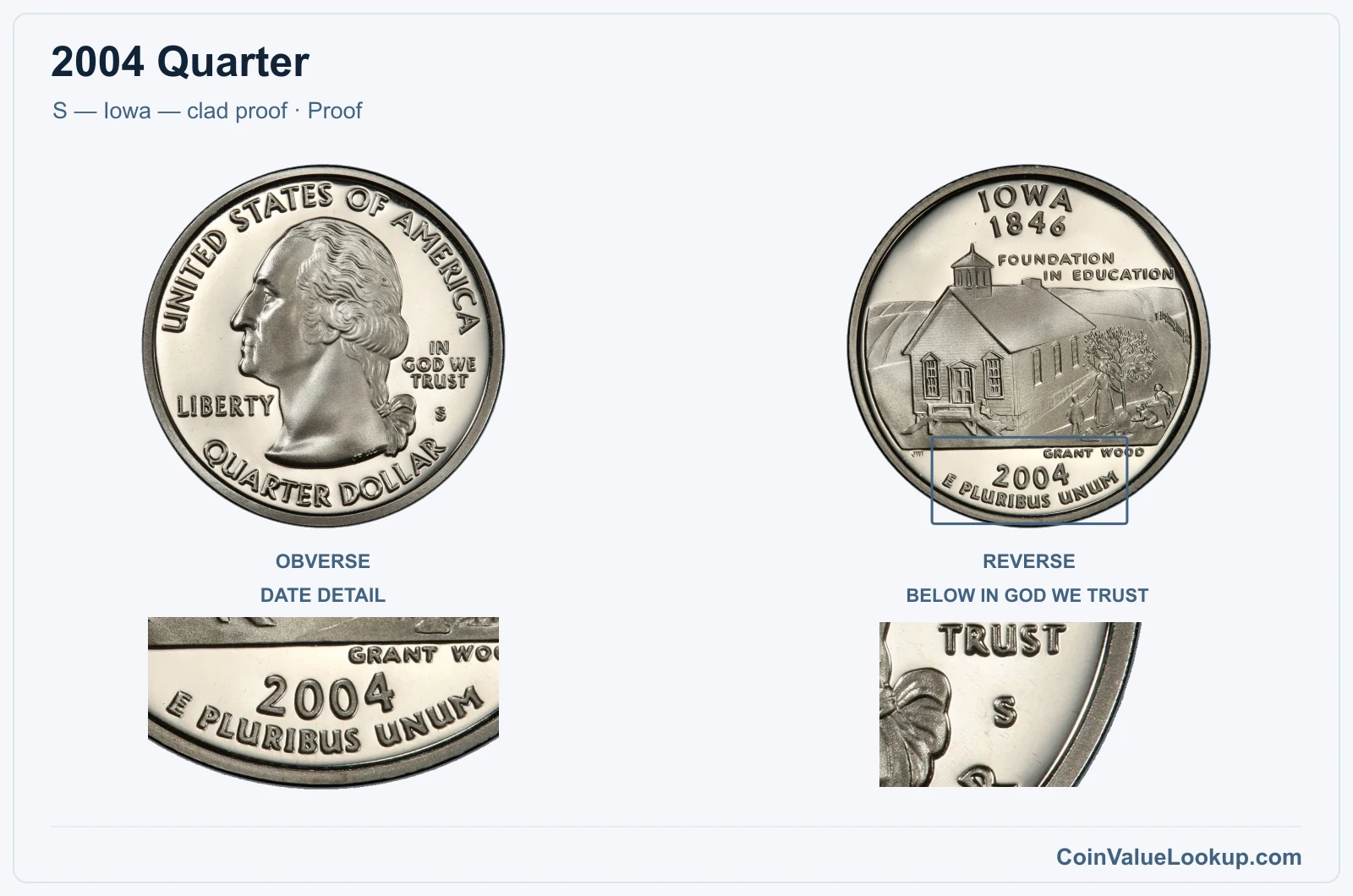
San Francisco's 2004-S Iowa clad proof uses the standard copper-nickel clad composition. Like all proof quarters, it features mirror fields and frosted devices, produced for collector proof sets.
USA Coin Book estimates about $6.25 at PR65. Check for hairlines and handling marks in the fields.
Edge inspection or weighing the coin will confirm whether you have the clad or silver version.
Range Grade
Price Auction Records Appraisal PR PR 1
—
Coin Identifier
PR 2
—
Coin Identifier
PR 3
—
Coin Identifier
PR 4
—
Coin Identifier
PR 6
—
Coin Identifier
PR 8
—
Coin Identifier
PR 10
—
Coin Identifier
PR 12
—
Coin Identifier
PR 15
—
Coin Identifier
PR 20
—
Coin Identifier
PR 25
—
Coin Identifier
PR 30
—
Coin Identifier
PR 35
—
Coin Identifier
PR 40
—
Coin Identifier
PR 45
—
Coin Identifier
PR 50
—
Coin Identifier
PR 53
—
Coin Identifier
PR 55
—
Coin Identifier
PR 58
—
Coin Identifier
PR 60
—
Coin Identifier
PR 61
—
Coin Identifier
PR 62
—
Coin Identifier
PR 63
—
Coin Identifier
PR 64
—
Coin Identifier
PR 65
—
Coin Identifier
PR 66
—
Coin Identifier
PR 67
—
Coin Identifier
PR 68
—
Coin Identifier
PR 69
Coin Identifier
PR 70
Coin Identifier
2004 Quarter — S — Iowa — silver proof
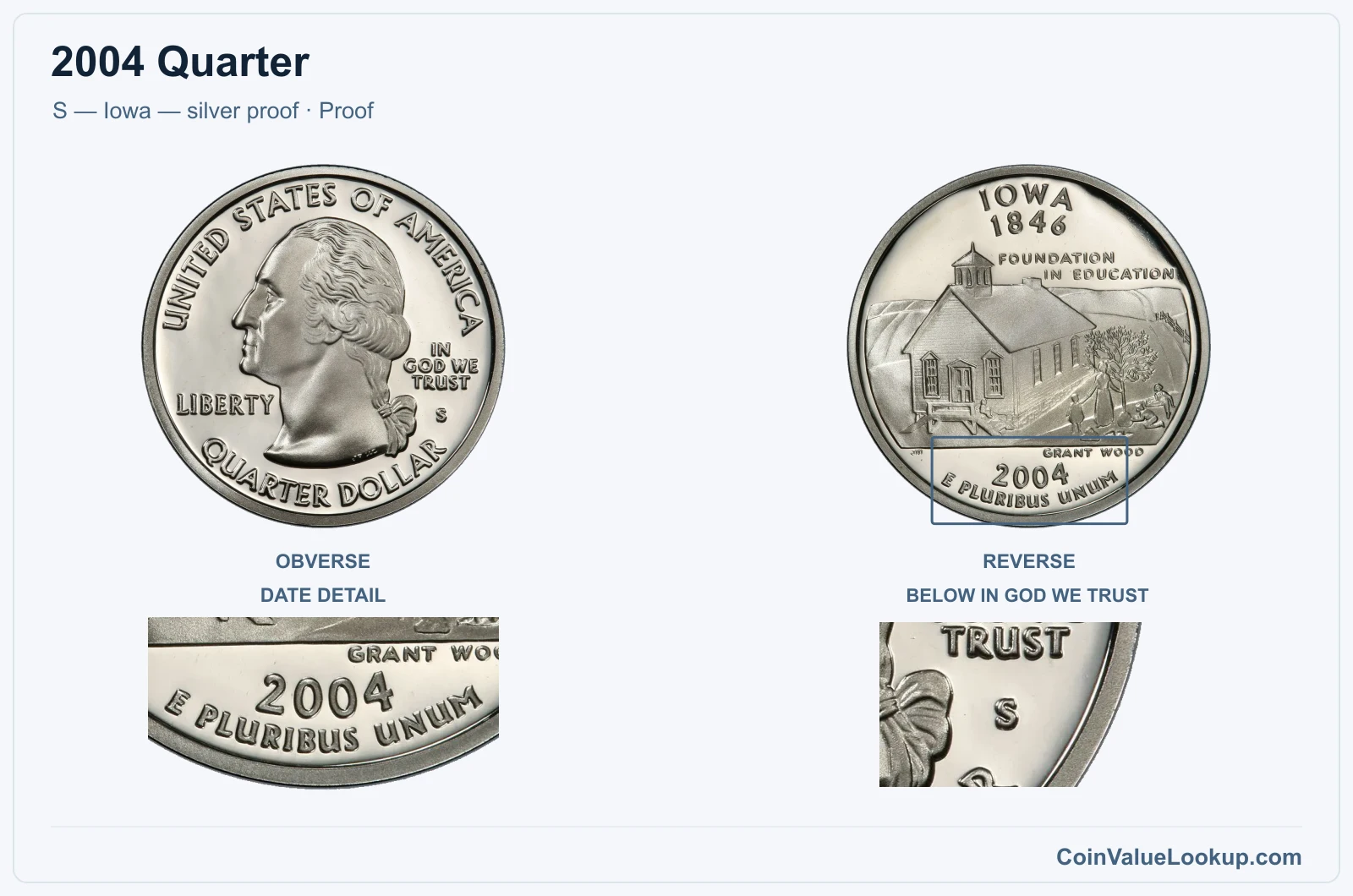
The 2004-S Iowa silver proof is struck on a 90% silver planchet weighing about 6.25 grams. Its solid silver edge is the fastest visual tell versus the clad proof.
USA Coin Book estimates about $23.00 at PR65. Silver proof sets were produced in smaller quantities than the clad sets, and the precious-metal content supports a higher value floor.
Original packaging is the easiest confirmation method.
Range Grade
Price Auction Records Appraisal PR PR 1
—
Coin Identifier
PR 2
—
Coin Identifier
PR 3
—
Coin Identifier
PR 4
—
Coin Identifier
PR 6
—
Coin Identifier
PR 8
—
Coin Identifier
PR 10
—
Coin Identifier
PR 12
—
Coin Identifier
PR 15
—
Coin Identifier
PR 20
—
Coin Identifier
PR 25
—
Coin Identifier
PR 30
—
Coin Identifier
PR 35
—
Coin Identifier
PR 40
—
Coin Identifier
PR 45
—
Coin Identifier
PR 50
—
Coin Identifier
PR 53
—
Coin Identifier
PR 55
—
Coin Identifier
PR 58
—
Coin Identifier
PR 60
—
Coin Identifier
PR 61
—
Coin Identifier
PR 62
—
Coin Identifier
PR 63
—
Coin Identifier
PR 64
—
Coin Identifier
PR 65
—
Coin Identifier
PR 66
—
Coin Identifier
PR 67
—
Coin Identifier
PR 68
—
Coin Identifier
PR 69
Coin Identifier
PR 70
Coin Identifier
2004 Quarter — P — Wisconsin — regular strike
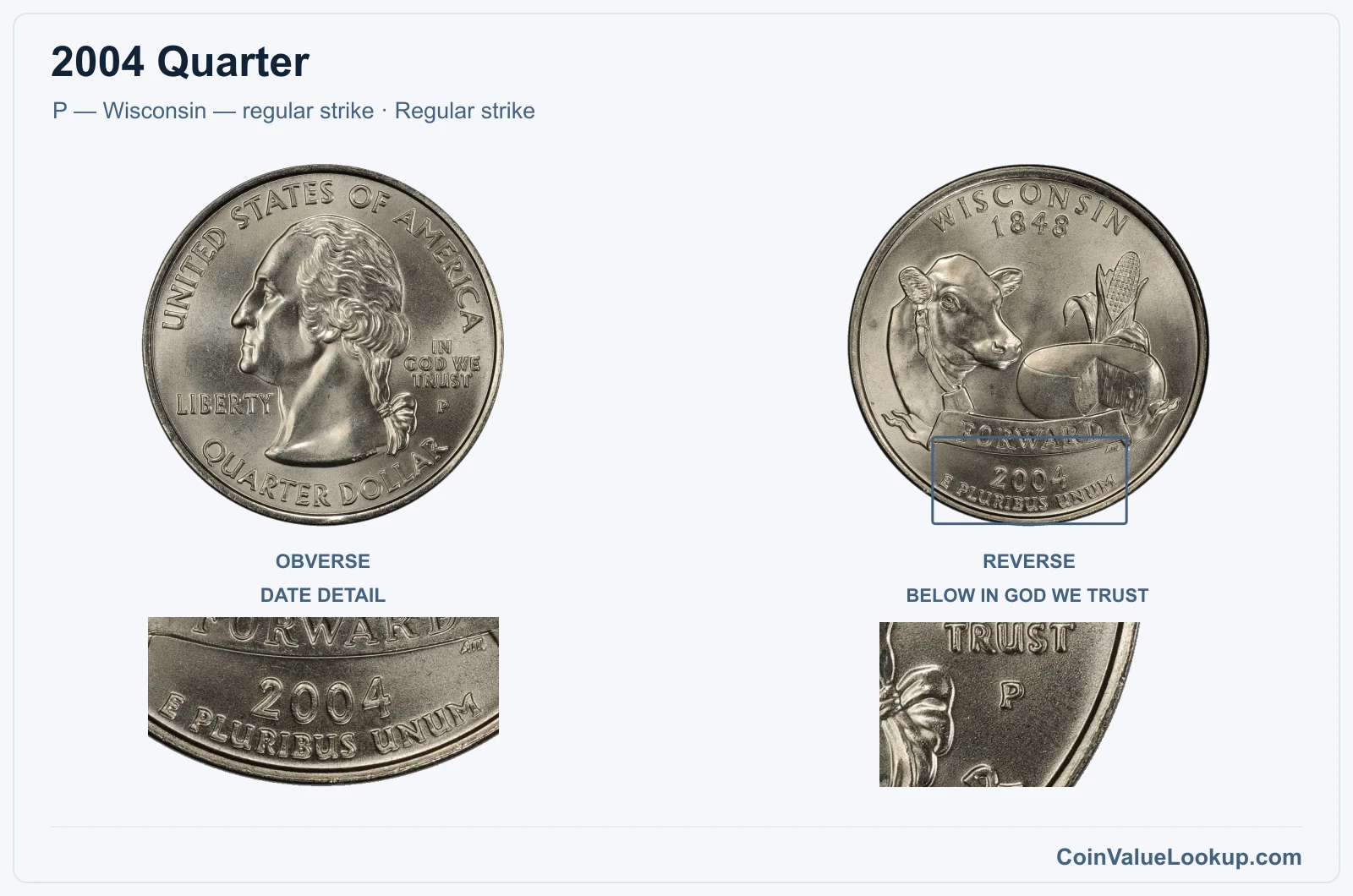
The 2004-P Wisconsin quarter is a copper-nickel clad business strike with the Wisconsin state design reverse — featuring a cow, a round of cheese and an ear of corn. Large Philadelphia mintages keep circulated values at face.
USA Coin Book estimates about $0.74 at MS60 and $3.62 at MS65. The Wisconsin reverse is also where the famous Extra Leaf varieties appear, but those are specific to the D mint.
Do not confuse a normal P-mint Wisconsin reverse with a variety.
Range Grade
Price Auction Records Appraisal PO PO 1
—
Coin Identifier FR FR 2
—
Coin Identifier AG AG 3
—
Coin Identifier G G 4
—
Coin Identifier
G 6
—
Coin Identifier VG VG 8
—
Coin Identifier
VG 10
—
Coin Identifier F F 12
—
Coin Identifier
F 15
—
Coin Identifier VF VF 20
—
Coin Identifier
VF 25
—
Coin Identifier
VF 30
—
Coin Identifier
VF 35
—
Coin Identifier XF XF 40
—
Coin Identifier
XF 45
—
Coin Identifier AU AU 50
—
Coin Identifier
AU 53
—
Coin Identifier
AU 55
—
Coin Identifier
AU 58
—
Coin Identifier MS MS 60
—
Coin Identifier
MS 61
—
Coin Identifier
MS 62
—
Coin Identifier
MS 63
—
Coin Identifier
MS 64
—
Coin Identifier
MS 65
—
Coin Identifier
MS 66
—
Coin Identifier
MS 67
Coin Identifier
MS 68
Coin Identifier
MS 69
—
—
—
MS 70
—
—
—
2004 Quarter — D — Wisconsin — regular strike
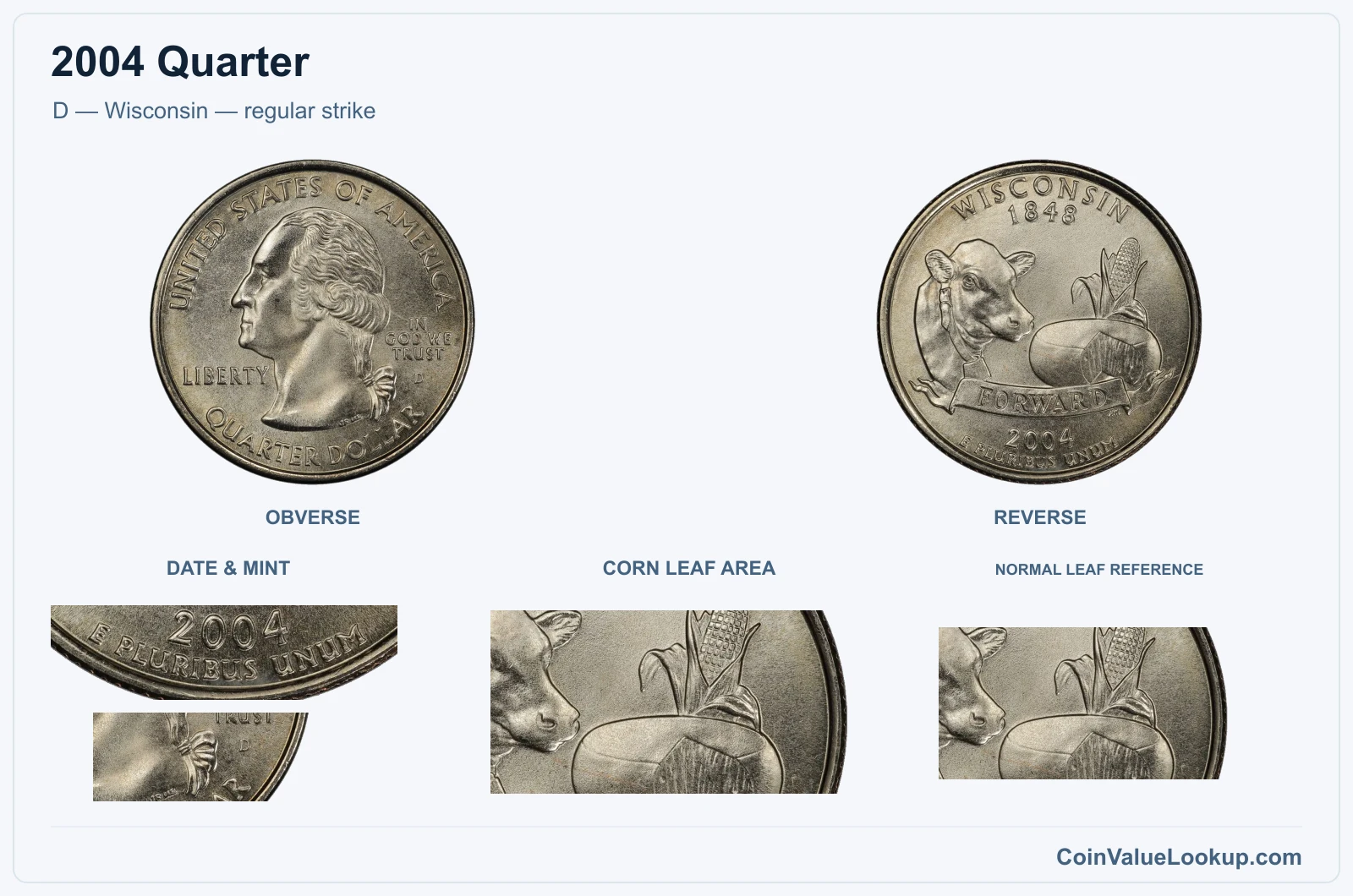
Denver's regular 2004-D Wisconsin quarter is copper-nickel clad, 5.67 grams, 24.26 mm. This is the normal version — no extra leaf on the corn stalk.
USA Coin Book estimates $0.74 at MS60 and $12.00 at MS65. That MS65 figure is higher than most other regular 2004 quarters, so a well-preserved D-mint Wisconsin in original condition has a bit more upside.
Examine the corn stalk carefully; if you see an extra leaf, you may have one of the recognized varieties instead.
Coin Value Lookup is a useful starting point if you want to look up guides for other dates, mints and denominations in the State Quarters series.
Range Grade
Price Auction Records Appraisal PO PO 1
—
Coin Identifier FR FR 2
—
Coin Identifier AG AG 3
—
Coin Identifier G G 4
—
Coin Identifier
G 6
—
Coin Identifier VG VG 8
—
Coin Identifier
VG 10
—
Coin Identifier F F 12
—
Coin Identifier
F 15
—
Coin Identifier VF VF 20
—
Coin Identifier
VF 25
—
Coin Identifier
VF 30
—
Coin Identifier
VF 35
—
Coin Identifier XF XF 40
—
Coin Identifier
XF 45
—
Coin Identifier AU AU 50
—
Coin Identifier
AU 53
—
Coin Identifier
AU 55
—
Coin Identifier
AU 58
—
Coin Identifier MS MS 60
—
Coin Identifier
MS 61
—
Coin Identifier
MS 62
—
Coin Identifier
MS 63
—
Coin Identifier
MS 64
—
Coin Identifier
MS 65
—
Coin Identifier
MS 66
Coin Identifier
MS 67
Coin Identifier
MS 68
Coin Identifier
MS 69
Coin Identifier
MS 70
—
—
—
2004 Quarter — S — Wisconsin — clad proof
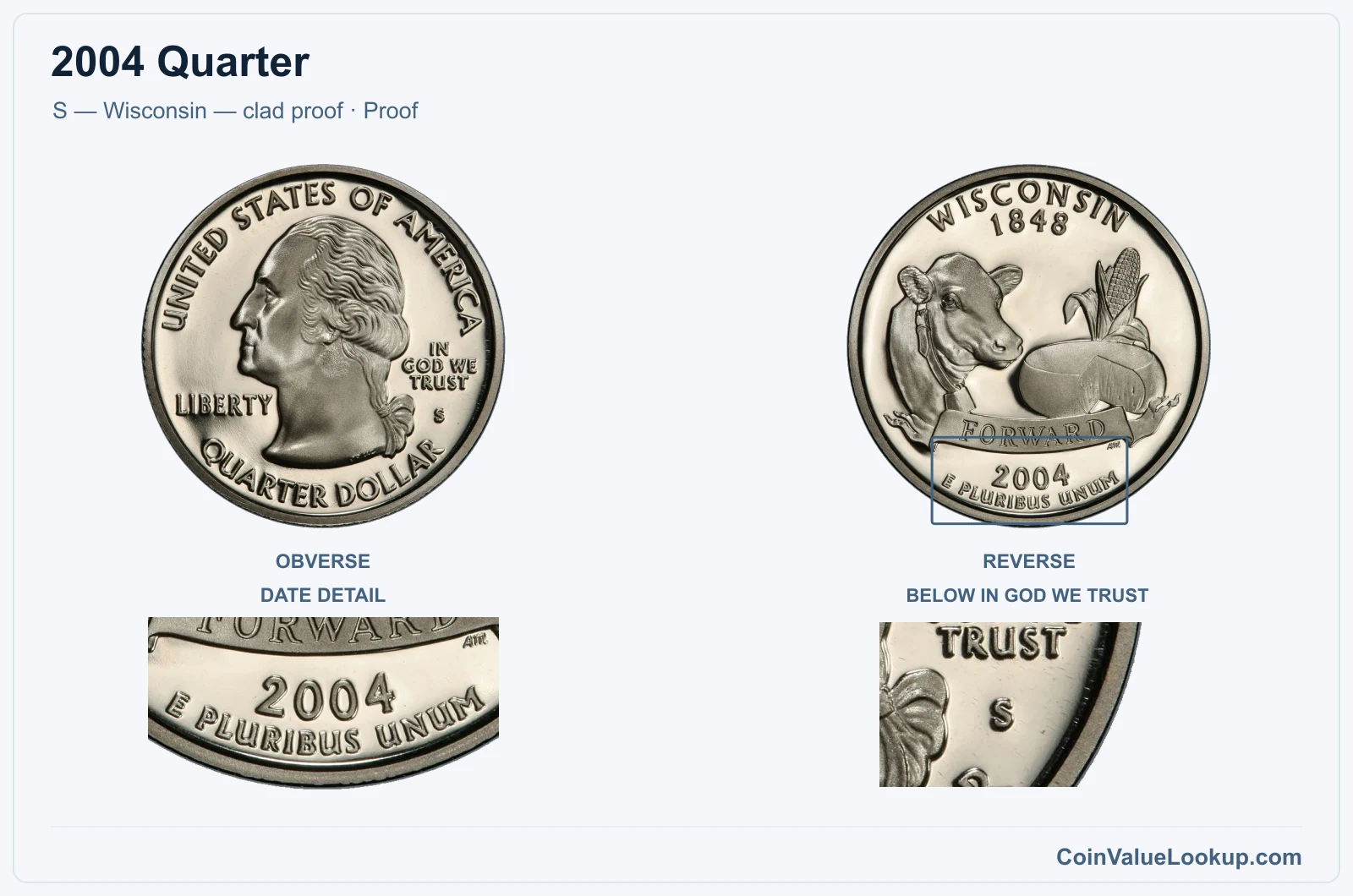
The 2004-S Wisconsin clad proof was struck at San Francisco on a copper-nickel clad planchet. Mirror fields and frosted devices mark it as a proof, sold in collector sets.
USA Coin Book estimates about $6.25 at PR65. Confirm clad composition by checking the edge for visible layering or weighing the coin at roughly 5.67 grams.
Keep this value separate from the silver proof.
Range Grade
Price Auction Records Appraisal PR PR 1
—
Coin Identifier
PR 2
—
Coin Identifier
PR 3
—
Coin Identifier
PR 4
—
Coin Identifier
PR 6
—
Coin Identifier
PR 8
—
Coin Identifier
PR 10
—
Coin Identifier
PR 12
—
Coin Identifier
PR 15
—
Coin Identifier
PR 20
—
Coin Identifier
PR 25
—
Coin Identifier
PR 30
—
Coin Identifier
PR 35
—
Coin Identifier
PR 40
—
Coin Identifier
PR 45
—
Coin Identifier
PR 50
—
Coin Identifier
PR 53
—
Coin Identifier
PR 55
—
Coin Identifier
PR 58
—
Coin Identifier
PR 60
—
Coin Identifier
PR 61
—
Coin Identifier
PR 62
—
Coin Identifier
PR 63
—
Coin Identifier
PR 64
—
Coin Identifier
PR 65
—
Coin Identifier
PR 66
—
Coin Identifier
PR 67
—
Coin Identifier
PR 68
—
Coin Identifier
PR 69
Coin Identifier
PR 70
Coin Identifier
2004 Quarter — S — Wisconsin — silver proof
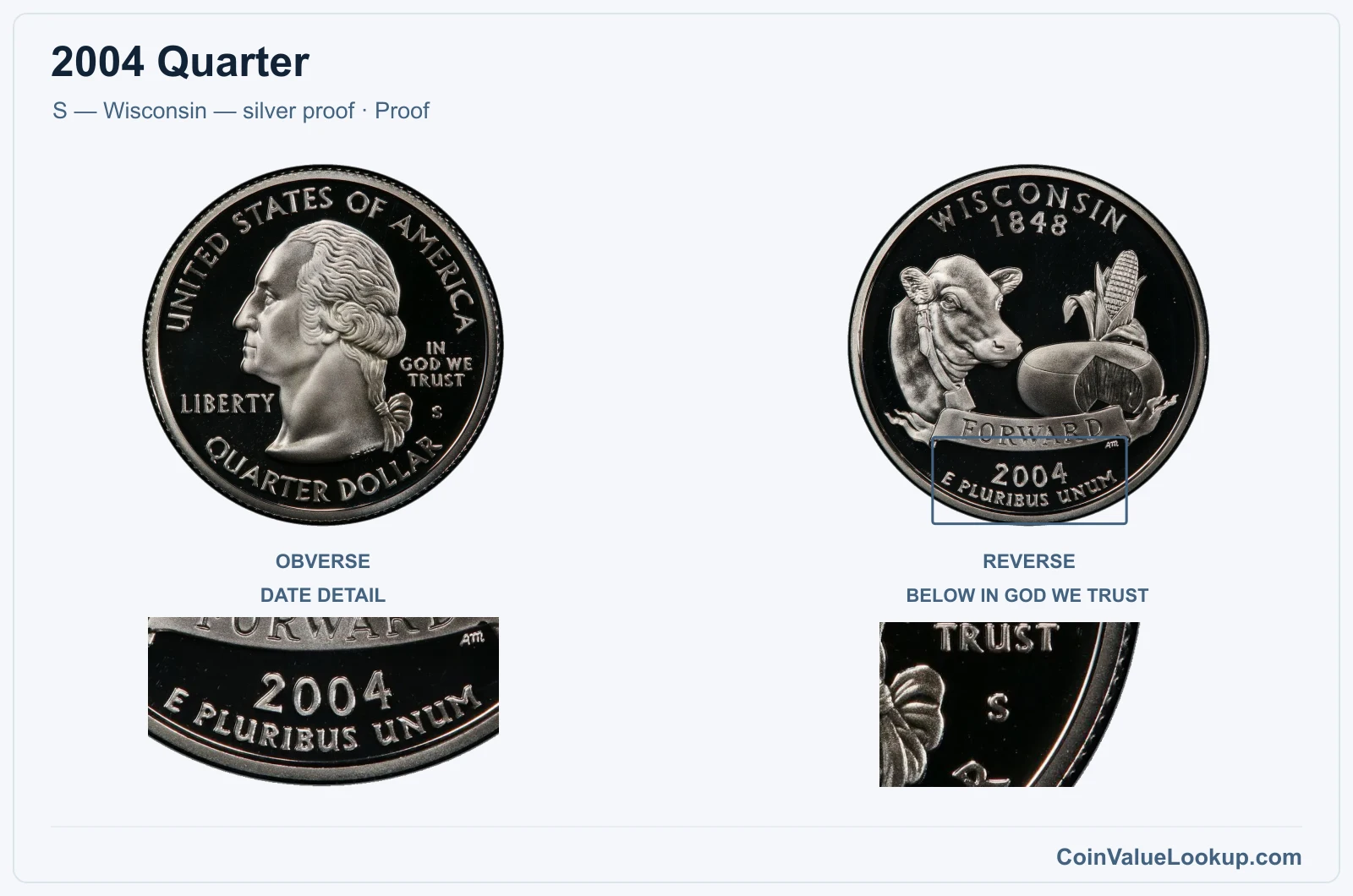
The 2004-S Wisconsin silver proof is a 90% silver coin weighing approximately 6.25 grams. Its solid silver edge distinguishes it from the clad proof.
USA Coin Book estimates about $23.00 at PR65. Silver proof Wisconsin quarters attract collectors who want a complete silver proof set of the 2004 state designs.
Original mint packaging or a precise scale reading confirms the composition.
Range Grade
Price Auction Records Appraisal PR PR 1
—
Coin Identifier
PR 2
—
Coin Identifier
PR 3
—
Coin Identifier
PR 4
—
Coin Identifier
PR 6
—
Coin Identifier
PR 8
—
Coin Identifier
PR 10
—
Coin Identifier
PR 12
—
Coin Identifier
PR 15
—
Coin Identifier
PR 20
—
Coin Identifier
PR 25
—
Coin Identifier
PR 30
—
Coin Identifier
PR 35
—
Coin Identifier
PR 40
—
Coin Identifier
PR 45
—
Coin Identifier
PR 50
—
Coin Identifier
PR 53
—
Coin Identifier
PR 55
—
Coin Identifier
PR 58
—
Coin Identifier
PR 60
—
Coin Identifier
PR 61
—
Coin Identifier
PR 62
—
Coin Identifier
PR 63
—
Coin Identifier
PR 64
—
Coin Identifier
PR 65
—
Coin Identifier
PR 66
—
Coin Identifier
PR 67
—
Coin Identifier
PR 68
—
Coin Identifier
PR 69
Coin Identifier
PR 70
Coin Identifier
2004 Quarter — D — Wisconsin — Extra Leaf High
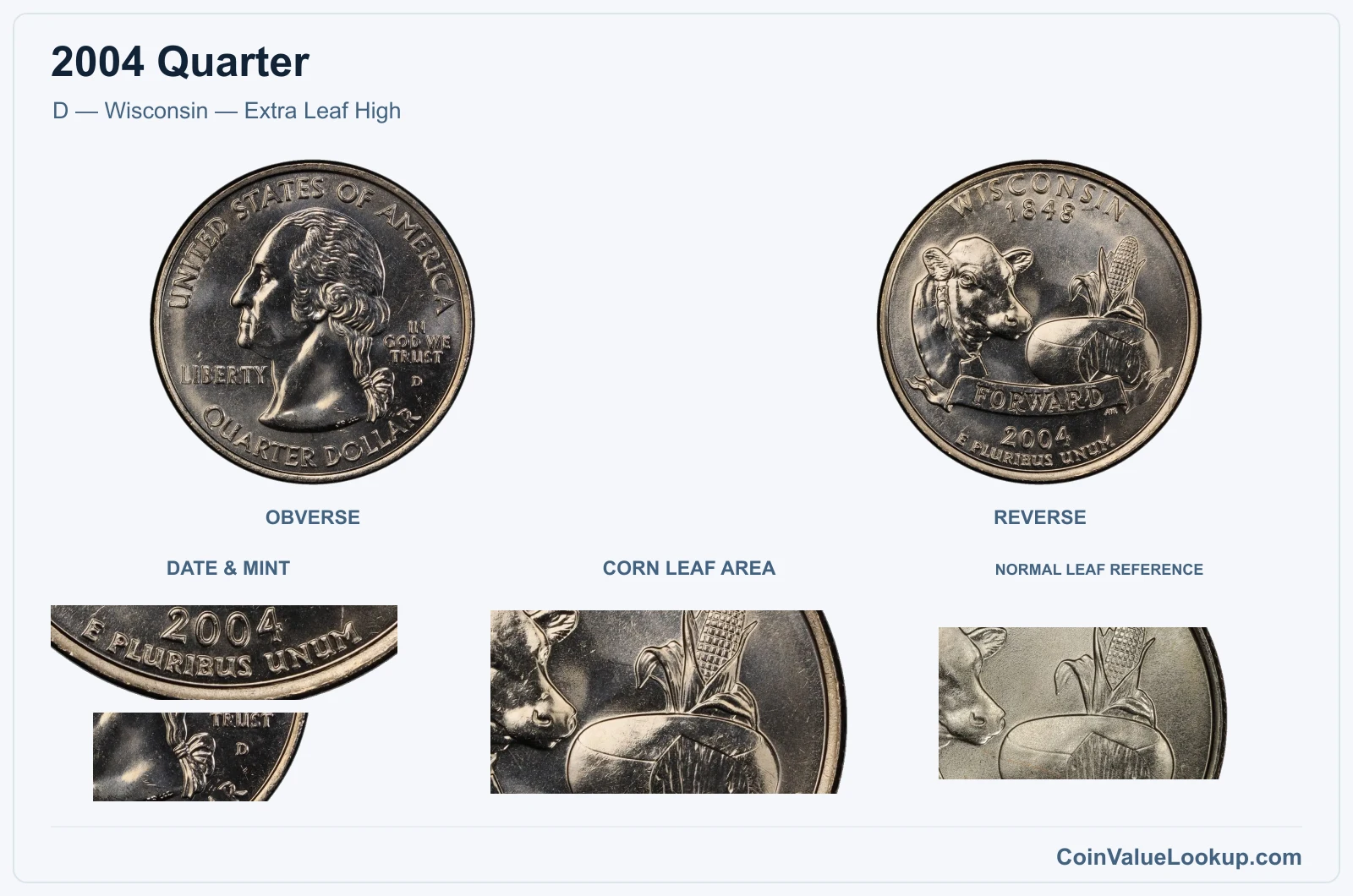
The 2004-D Wisconsin Extra Leaf High is a recognized variety where an extra raised leaf appears on the corn stalk, positioned relatively high — curving upward toward the ear of corn. This occurs only on D-mint Wisconsin quarters and is not a separate design issued for every mint.
Compare the area beside the corn ear on your coin with a normal Wisconsin reverse. The extra leaf should be clearly raised and consistent across the stalk area, not a scratch or random lump.
USA Coin Book guide estimates place this variety at about $207.00 in MS60 and $281.00 in MS65. That makes it the highest-valued regular version in the entire 2004 quarter lineup at the MS65 level.
Authentication by a grading service is strongly recommended before selling.
Ordinary-issue reference: Ordinary-issue reference only: The table below shows prices for the 2004-D Washington 50 States Quarters (regular strike). It does not represent the value of the specific D — Wisconsin — Extra Leaf High variety or its variety premium. Year, mint, metal and strike type are matched; the specific variety is not priced by this table.
Range Grade
Price Auction Records Appraisal PO PO 1
—
Coin Identifier FR FR 2
—
Coin Identifier AG AG 3
—
Coin Identifier G G 4
—
Coin Identifier
G 6
—
Coin Identifier VG VG 8
—
Coin Identifier
VG 10
—
Coin Identifier F F 12
—
Coin Identifier
F 15
—
Coin Identifier VF VF 20
—
Coin Identifier
VF 25
—
Coin Identifier
VF 30
—
Coin Identifier
VF 35
—
Coin Identifier XF XF 40
—
Coin Identifier
XF 45
—
Coin Identifier AU AU 50
—
Coin Identifier
AU 53
—
Coin Identifier
AU 55
—
Coin Identifier
AU 58
—
Coin Identifier MS MS 60
—
Coin Identifier
MS 61
—
Coin Identifier
MS 62
—
Coin Identifier
MS 63
—
Coin Identifier
MS 64
—
Coin Identifier
MS 65
—
Coin Identifier
MS 66
Coin Identifier
MS 67
Coin Identifier
MS 68
Coin Identifier
MS 69
Coin Identifier
MS 70
—
—
—
2004 Quarter — D — Wisconsin — Extra Leaf Low
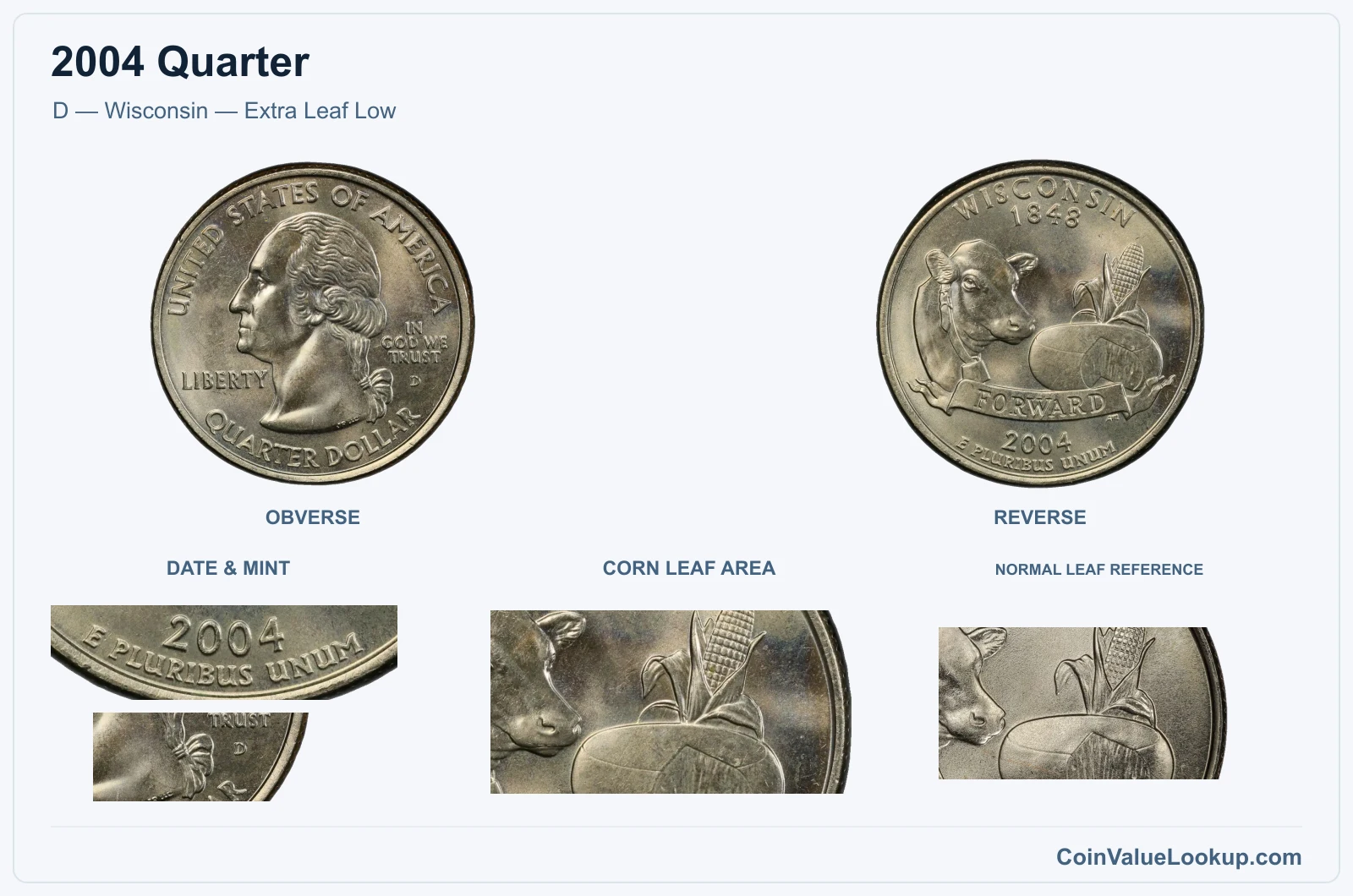
The 2004-D Wisconsin Extra Leaf Low is the companion variety where the extra raised leaf sits lower on the corn stalk, curving downward. Like the High version, this is exclusive to D-mint Wisconsin quarters.
Look closely at the left side of the corn ear. The low leaf should be a distinct, raised feature — not a scratch, die crack or random mark.
Side-by-side comparison with a normal Wisconsin reverse makes the difference obvious.
USA Coin Book estimates about $148.00 at MS60 and $217.00 at MS65. While slightly below the Extra Leaf High in guide value, this is still a significant premium over a normal Wisconsin quarter.
Professional grading and attribution add confidence for buyers.
Ordinary-issue reference: Ordinary-issue reference only: The table below shows prices for the 2004-D Washington 50 States Quarters (regular strike). It does not represent the value of the specific D — Wisconsin — Extra Leaf Low variety or its variety premium. Year, mint, metal and strike type are matched; the specific variety is not priced by this table.
Range Grade
Price Auction Records Appraisal PO PO 1
—
Coin Identifier FR FR 2
—
Coin Identifier AG AG 3
—
Coin Identifier G G 4
—
Coin Identifier
G 6
—
Coin Identifier VG VG 8
—
Coin Identifier
VG 10
—
Coin Identifier F F 12
—
Coin Identifier
F 15
—
Coin Identifier VF VF 20
—
Coin Identifier
VF 25
—
Coin Identifier
VF 30
—
Coin Identifier
VF 35
—
Coin Identifier XF XF 40
—
Coin Identifier
XF 45
—
Coin Identifier AU AU 50
—
Coin Identifier
AU 53
—
Coin Identifier
AU 55
—
Coin Identifier
AU 58
—
Coin Identifier MS MS 60
—
Coin Identifier
MS 61
—
Coin Identifier
MS 62
—
Coin Identifier
MS 63
—
Coin Identifier
MS 64
—
Coin Identifier
MS 65
—
Coin Identifier
MS 66
Coin Identifier
MS 67
Coin Identifier
MS 68
Coin Identifier
MS 69
Coin Identifier
MS 70
—
—
—
2004 Quarter Error List
1. 2004 Quarter — Florida — Doubled Die
Doubled die varieties have been reported on the 2004 Florida state quarter. On an affected coin, you would see consistent doubling — separation or notching — in the design elements, particularly in lettering or design contours on the obverse or reverse.
Compare your coin closely with a normal 2004 Florida quarter. Genuine doubling from a doubled die shows the same displacement pattern across affected areas of the coin, because the doubling occurred in the die itself.
Do not confuse this with machine doubling, which tends to produce flat, shelf-like displacement rather than the rounded, separated profiles of a true doubled die. Reflections and post-mint impressions can also mimic doubling.
Condition, visibility of the doubling and the specific die involved all affect value; individual assessment is recommended.
2. 2004 Quarter — Florida — Off-Center Strike
Off-center strikes on the 2004-P Florida quarter have been reported. An off-center coin was not properly seated between the dies during striking, producing a displaced design with an unstruck crescent of blank metal along one edge.
The degree of off-center shift matters enormously. A 5% shift is barely noticeable; a 70% shift, which has been documented on this issue, is dramatic.
Coins that retain a visible date despite a large shift tend to be more desirable to collectors.
Do not confuse an off-center strike with a clipped planchet, a die misalignment that affects only one side, or post-mint flattening from damage. Condition and the percentage of displacement affect value, so each coin needs individual evaluation.
3. 2004 Quarter — Florida — Wrong Planchet / Off-Metal Strike
A wrong-planchet error has been reported on the 2004-P Florida quarter — specifically, a Florida design struck on a planchet intended for another denomination. The coin would have the wrong weight, diameter or edge characteristics compared to a standard quarter.
To check, weigh your coin precisely and measure the diameter. Compare these to the normal 24.26 mm and 5.67 g specifications for a clad quarter.
A wrong-planchet strike typically shows incomplete design coverage because the blank is the wrong size.
Be careful with lookalikes. Plating loss, acid treatment, corrosion or deliberate alteration can make a normal quarter look odd.
A genuine wrong-planchet error is confirmed by measurable physical differences. Condition and the specific planchet type affect value; professional authentication is advisable.
4. 2004 Quarter — Double / Multiple Strike
Double-strike or multiple-strike errors have been reported on 2004 Washington State Quarters. A double strike occurs when the coin is hit by the dies more than once, and if the coin shifted between strikes, you will see two separate, overlapping impressions of the design.
Look for displaced or rotated design elements that clearly show a second strike. The two images will be offset from each other, creating an unmistakable visual effect on one or both sides.
This is different from a doubled die, where the doubling is in the die itself and appears identical on every coin struck by that die. Post-mint damage or deliberate alterations can also create misleading double images.
The degree of displacement and the coin's overall condition determine value.
5. 2004 Quarter — Missing Clad Layer
Missing clad layer errors have been reported on 2004 State Quarters. A normal quarter is copper-nickel clad over a copper core.
If one clad layer was missing from the planchet before striking, the affected side may appear a different color and the coin will weigh less than the standard 5.67 grams.
Check the edge of the coin. On a normal clad quarter, you can see the copper core sandwiched between two outer layers.
A missing clad error will show an abnormal edge profile. The affected face may show copper tones or a slightly mushy design from the softer metal.
Toning, corrosion, environmental damage, or chemical stripping of the surface layer after minting can imitate this error. Weighing the coin is a simple first test — a genuinely missing layer produces a measurable weight deficit.
6. 2004 Quarter — Michigan — Wrong Planchet / Off-Metal Strike
A wrong-planchet error has been reported on the 2004 Michigan quarter. This means the Michigan design was struck on a blank intended for a different denomination or purpose, resulting in incorrect weight, diameter or edge characteristics.
Compare your coin's measured weight and diameter to the standard quarter specs of 5.67 grams and 24.26 mm. A wrong-planchet coin will show measurable deviations, and the design may not fill out completely if the blank was smaller.
Plating damage, corrosion, acid thinning or deliberate alteration can make a normal coin look unusual. A genuine wrong-planchet error is a manufacturing mistake confirmed by physical measurements.
Condition, the specific planchet involved and authentication all affect how such a coin is valued.
7. 2004 Quarter — Texas — Doubled Die Reverse
A doubled die reverse has been reported on the 2004 Texas quarter. On an affected coin, reverse design elements — such as lettering, the state outline or the star — show consistent doubling with separation or notching visible under magnification.
Compare the reverse of your coin with a normal 2004 Texas quarter, focusing on areas where the doubling has been reported. The key trait of a genuine doubled die is that the separation pattern is uniform and repeatable across the affected design elements.
Machine doubling creates flat, shelf-like distortion and is far more common but much less collectible. Random damage and reflections can also fool the eye.
Condition, the strength of visible doubling and the specific die determine value.
8. 2004 Quarter — Texas — Clashed Dies
Die clash errors have been reported on the 2004 Texas quarter. A die clash happens when the obverse and reverse dies strike each other without a planchet between them.
The impact transfers faint traces of each die's design onto the opposing die, and those ghost impressions then appear on subsequently struck coins.
Look for faint outlines of Washington's portrait in the reverse fields, or traces of the Texas design on the obverse. These transferred elements should align with where the opposite die would have made contact.
Do not confuse clash marks with random scratches, raised lines from other damage, or brockage errors. Clash impressions are consistent, aligned and typically faint.
The strength and visibility of the clash affect collector interest.
9. 2004 Quarter — Wisconsin Extra Leaf — Low
The 2004-D Wisconsin Extra Leaf Low is a well-known variety featuring an extra raised element on the reverse corn stalk, positioned low and curving downward. This listing addresses it from the error or die-gouge perspective.
On the coin, look at the left side of the ear of corn. The extra leaf is a distinct raised feature below the normal leaves.
Compare this area against a normal 2004-D Wisconsin reverse where no such leaf exists.
An incuse scratch, post-mint damage or an unrelated die crack can look vaguely similar but will not match the consistent raised profile and specific position of the recognized Extra Leaf Low. Condition and the clarity of the feature both affect value, and professional attribution is recommended for any coin you believe shows this variety.
10. 2004 Quarter — Texas — Off-Center Strike
Off-center strikes have been reported on the 2004 Texas quarter. When the planchet is not properly centered between the dies, the resulting coin shows a displaced design with a blank crescent on one side.
The percentage of displacement is the main value driver. A small shift of a few percent may be hard to notice, while a large shift creates a visually dramatic coin.
Retaining the date despite a significant off-center shift makes the coin more collectible.
Do not confuse this with a clipped planchet, which has a curved or straight cut in the blank before striking, or with one-sided die misalignment. Post-mint flattening can also create misleading shapes.
Each off-center coin needs individual evaluation based on condition and the degree of shift.
11. 2004 Quarter — Texas — Die Crack / Die Chip
Die cracks and die chips have been reported on the 2004 Texas quarter. A die crack appears as a fine raised line on the coin's surface, created when the die itself develops a fracture.
A die chip shows up as a small raised blob where a tiny piece of the die face has broken away.
These are raised features — that is the key diagnostic. Incuse scratches, corrosion pits or foreign material stuck to the surface are recessed or sitting on top, not part of the struck design.
Small die chips and thin cracks are common on high-volume issues and typically generate modest collector interest. Larger, more dramatic examples or those in interesting positions attract more attention.
Condition and the size of the feature determine value.
12. 2004 Quarter — Texas — Die Break / Cud
Die breaks, sometimes called cuds, have been reported on the 2004 Texas quarter. A cud is a specific type of die break where a piece of the die breaks away at the rim, leaving a raised, featureless blob of metal on the finished coin that connects to the rim edge.
Look for a raised area along the rim where normal design detail is missing, replaced by a smooth or slightly irregular lump. The boundary between the cud and the remaining design should be fairly sharp.
Do not confuse this with a rim dent or ding from post-mint damage, corrosion buildup, or an interior die chip that does not connect to the rim. Cuds are struck-in features and should appear on both the affected area and through the coin's cross-section.
Size and location affect collector interest.
13. 2004 Quarter — Texas — Struck-Through Error
Struck-through errors have been reported on the 2004 Texas quarter. This happens when foreign material — such as grease, a thread, a piece of metal or other debris — gets between the die and the planchet during striking.
The result is a localized depression or obscured area in the design.
Look for a spot where detail is missing or a distinct impression of the intervening object is visible. A grease-filled die produces a smooth, featureless area, while a retained foreign object may leave a textured or shaped impression.
Ordinary wear, cleaning scratches or weak strikes from worn dies are the common lookalikes. A genuine struck-through error has defined edges and does not match normal wear patterns.
Condition and the size or distinctiveness of the obstruction impression affect value.
14. 2004 Quarter — Broadstrike
Broadstrike errors have been reported on 2004 State Quarters. A broadstrike occurs when the coin is struck without the restraining collar that normally contains the metal and forms the reeded edge.
The result is a coin that spreads outward, appearing wider than normal with a smooth or distorted edge.
The design is still centered — this distinguishes a broadstrike from an off-center strike where the design shifts to one side. The entire design is present but may appear slightly spread or distorted near the rim.
A coin that was simply flattened after minting, or one with filed edges, can look similar. Check for a uniform metal flow pattern and the absence of normal reeding.
Condition and the degree of spread affect collector interest and value.
15. 2004 Quarter — Defective Planchet
Defective planchet errors have been reported on 2004 State Quarters. A defective planchet is a blank that had a flaw — such as a void, crack, lamination, clip or irregular shape — before the coin was struck.
The striking process presses the design over and around the flaw, so the defect becomes part of the finished coin.
Examine both faces and the edge for areas where metal is missing, split, peeled or otherwise irregular, with struck design visible around the defect. The flaw should interact with the struck design, not sit on top of it.
Post-mint gouges, corrosion, environmental damage or deliberate metal removal can create similar-looking defects. The key difference is that a genuine planchet flaw is present before striking and will show design elements conforming to or flowing around it.
Condition and the nature of the flaw determine value.