2004 Sacagawea Dollar Coin Value: How Much Is It Worth?
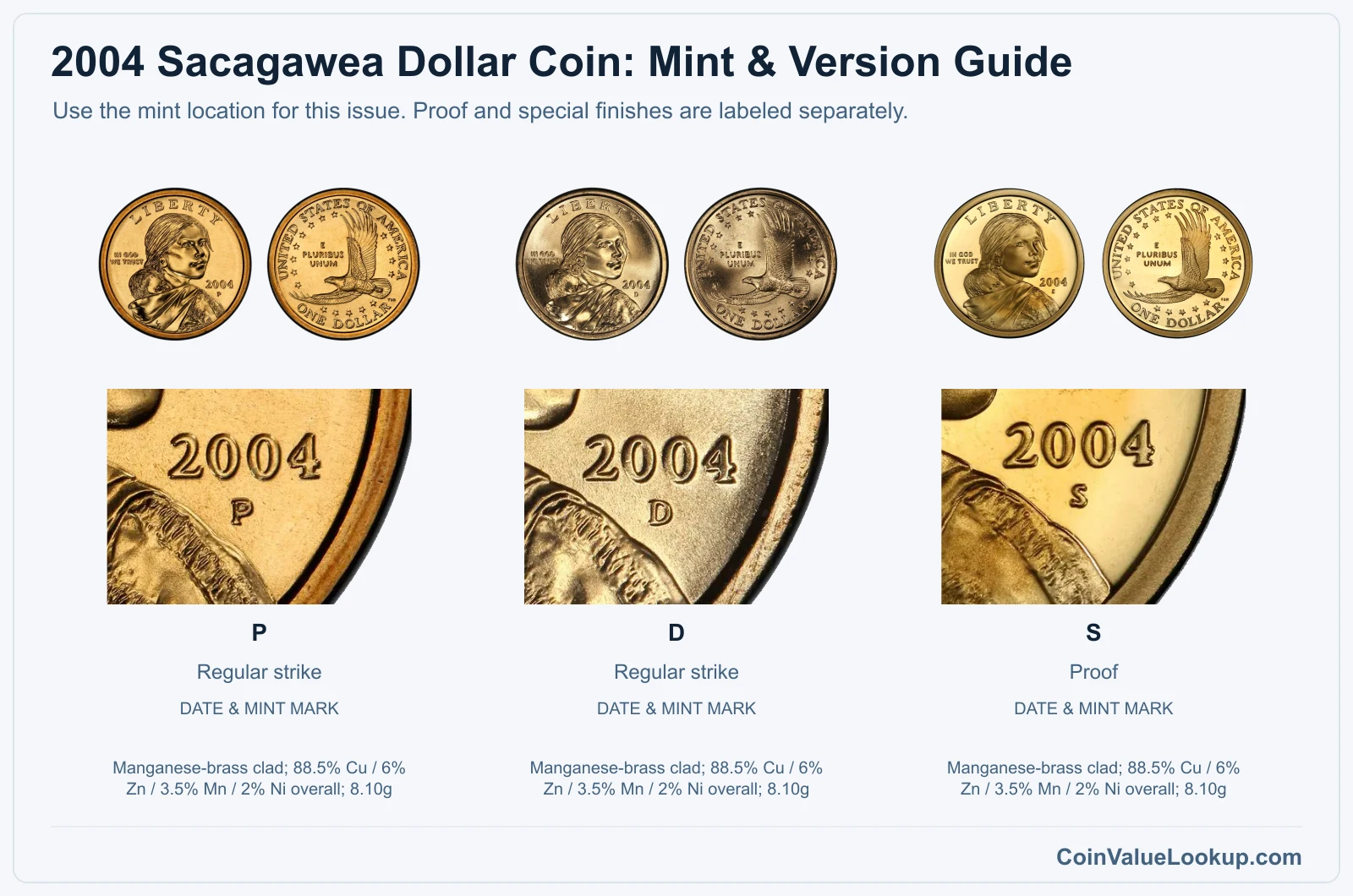
The 2004 Sacagawea Dollar is a manganese-brass clad coin struck at up to three mints. Most circulated examples trade near face value.
Guide estimates for graded pieces range from about $6.25 in MS65 to $7.29 in PR65, depending on mint and finish — these are not guaranteed offers. Before assuming yours is special, figure out which mint produced it, whether it is a business strike or proof, and whether any genuine errors are present.
Fast Way to Identify Your 2004 Sacagawea Dollar
Upload clear photos of the front and back of your 2004 Sacagawea Dollar for a preliminary identification. This helps narrow down the mint, finish and any visible variety or error.
Good lighting and a straight-on angle make the biggest difference — blurry phone shots from across the room do not cut it.
2004 Sacagawea Dollar Value
Upload both sides of your 2004 Sacagawea Dollar.
Front Obverse
Upload photo
Back Reverse
Upload photo
Which 2004 Sacagawea Dollar Versions Are Worth Money?
- S-mint proof (PR65 guide estimate about $7.29) — the only 2004 Sacagawea struck as a proof; look for the S mintmark and mirror-like fields.
- Before paying a premium for any 2004 Sacagawea Dollar, confirm the mintmark, finish and condition — ordinary wear, cleaning, plating or unverified error claims do not add value.
Step 1: Identify Your 2004 Sacagawea Dollar Mint Mark and Version
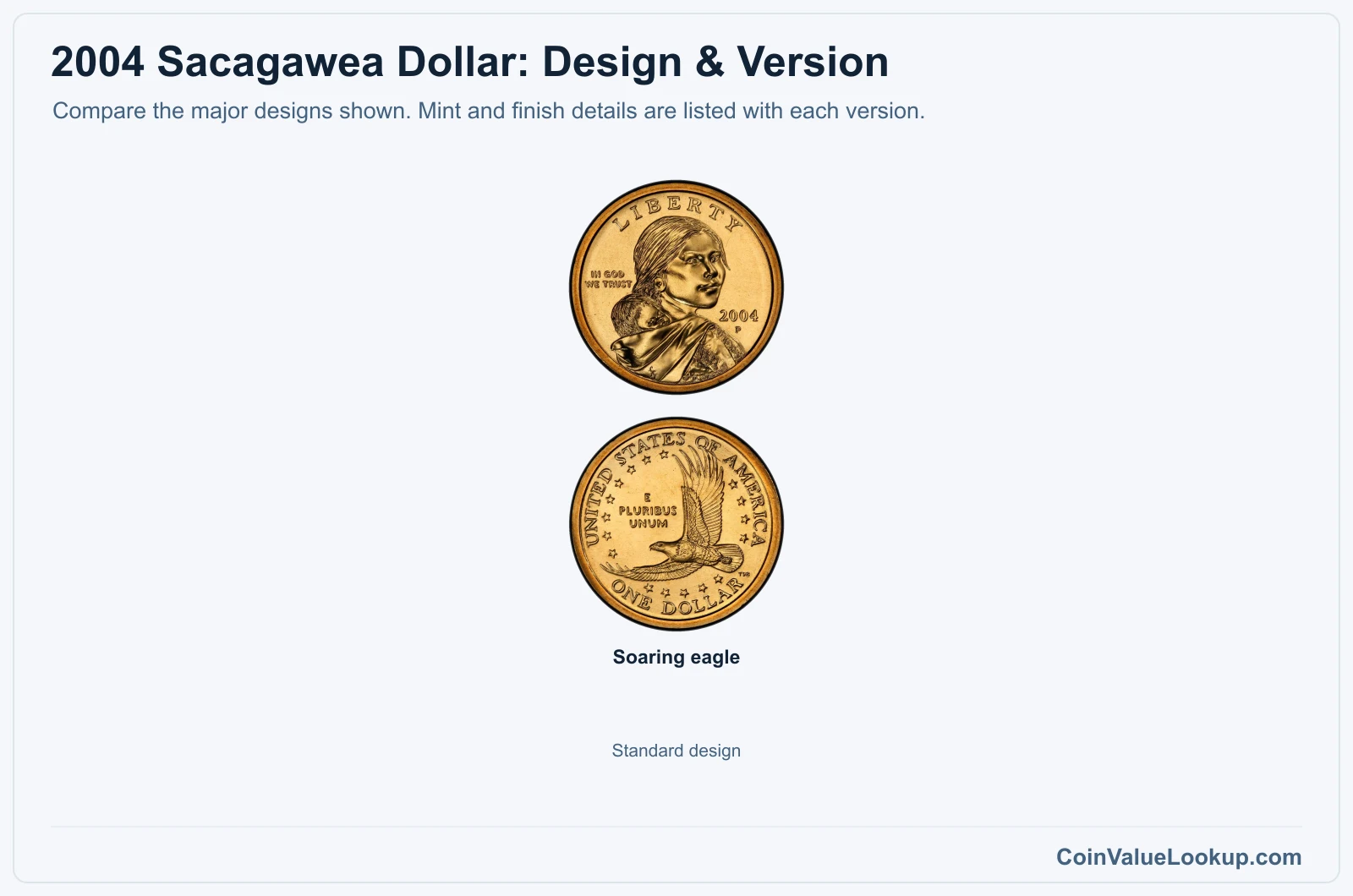
On the 2004 Sacagawea Dollar the mintmark sits on the obverse just below the date. Look for a small "P" (Philadelphia), "D" (Denver), or "S" (San Francisco).
The S-mint version was made only as a proof for collectors and was never released into circulation.
The golden color comes from manganese brass, not gold. The coin's overall composition is 88.5% copper, 6% zinc, 3.5% manganese, and 2% nickel, weighing 8.10 grams.
All three mints share the same Sacagawea-with-child obverse and soaring eagle reverse for 2004.
Do not assume a shiny surface means proof. A proof has sharply squared rims and mirror-like fields from a special striking process.
Business strikes from P and D can look bright when uncirculated, but the surface texture is different under magnification.
Step 2: Check Your 2004 Sacagawea Dollar Grade
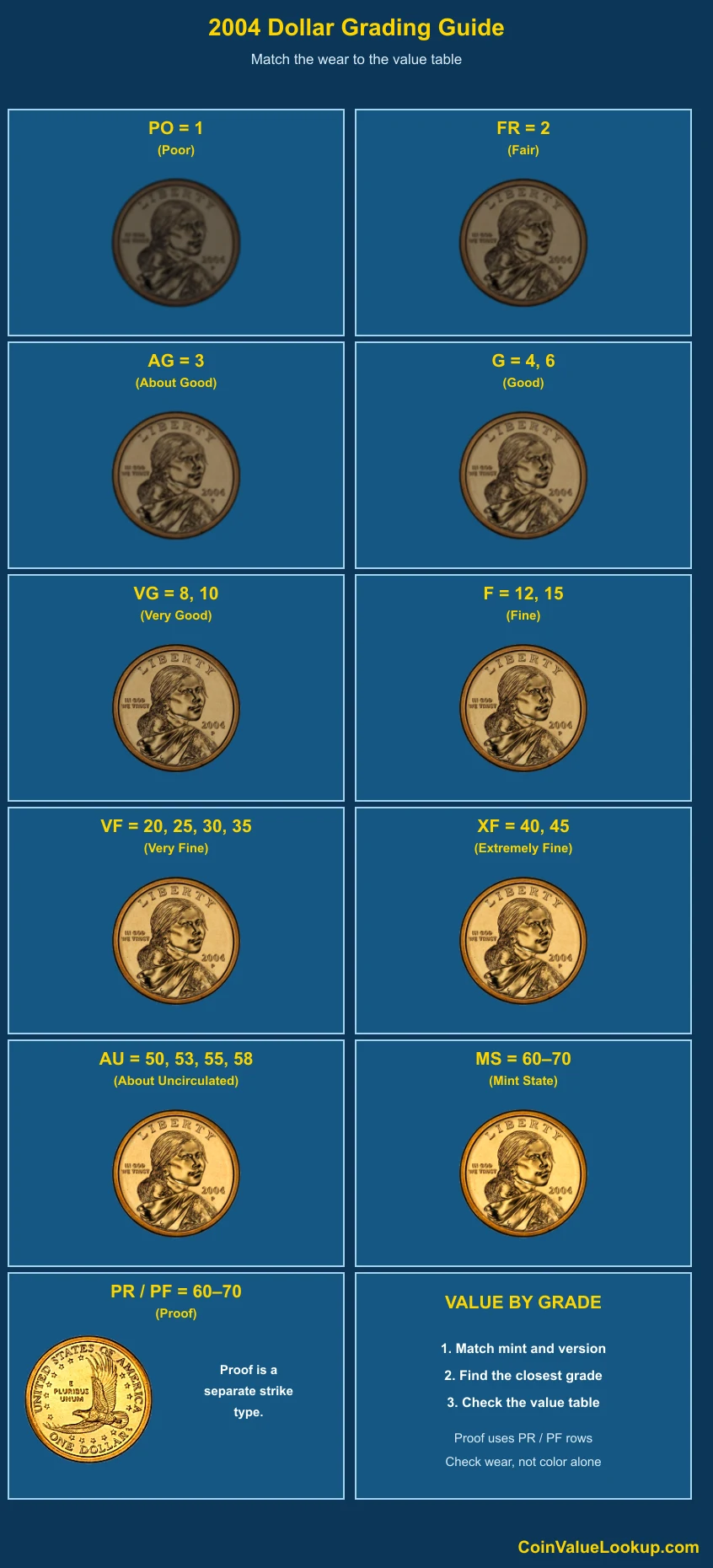
Focus first on Sacagawea's cheek and the high points of her hair. These are the first areas to show friction.
The child on her back and the feather detail on the eagle reverse also lose sharpness early in circulation.
An AU coin still has most luster but shows slight rub on the cheek and hair braid. By the time it grades VF, those high points are noticeably flat.
A true Mint State piece has no wear at all, though contact marks from rolling around in bags are normal and expected.
For the S-mint proof, grading is different. You compare the sharpness of the mirrored fields and the contrast of the raised devices rather than looking for circulation wear.
Hairlines from mishandling drop the grade fast. Use the comparison image to see circulated, AU, Mint State and proof examples side by side — matching finish type to finish type.
Step 3: Check 2004 Sacagawea Dollar Value by Mint and Version
2004 Sacagawea Dollar — P — Soaring eagle
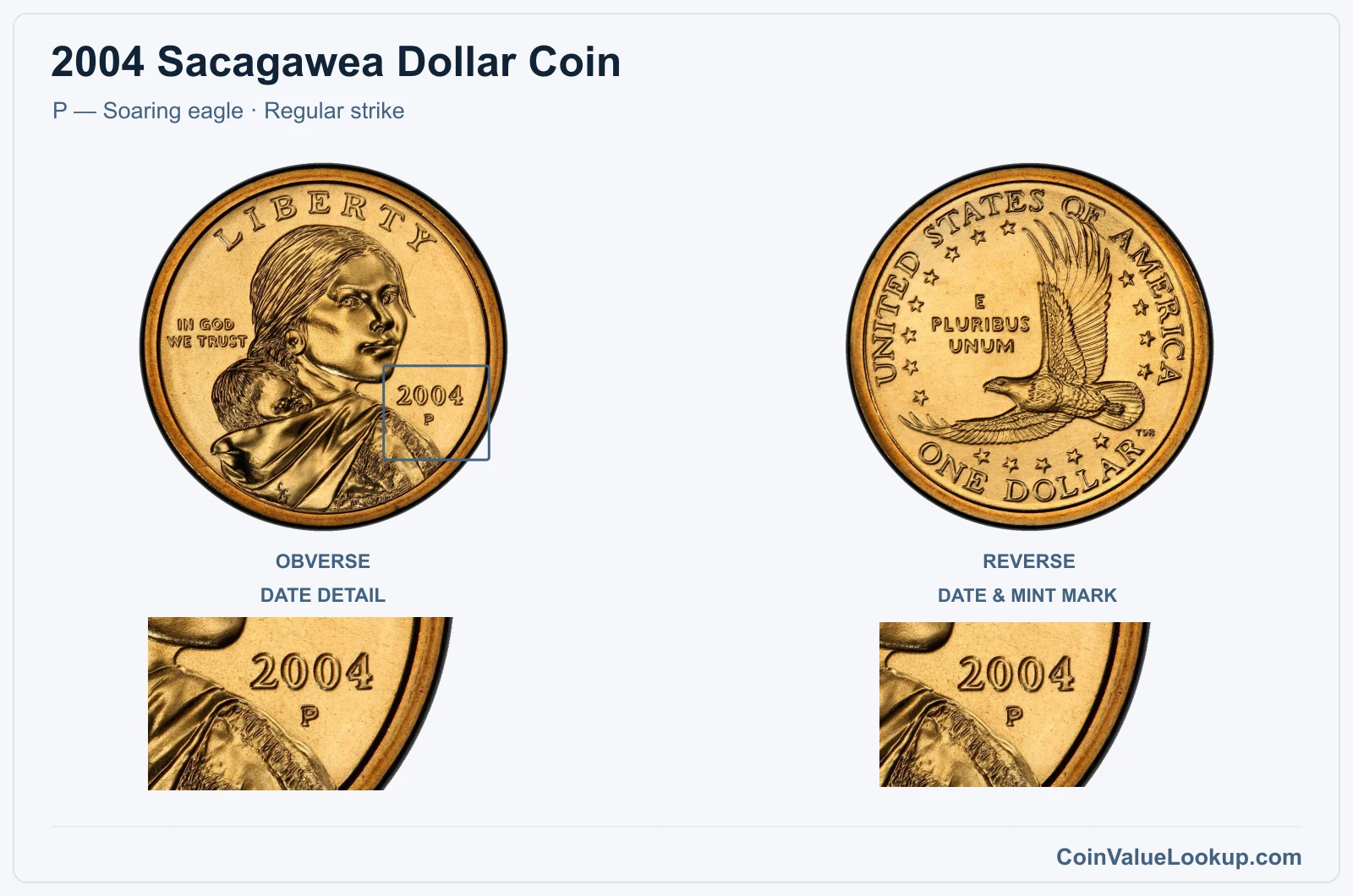
The 2004-P Sacagawea Dollar is a standard business strike from Philadelphia. You will find a small "P" mintmark on the obverse below the date.
Millions were made, so circulated examples are worth face value.
A USA Coin Book guide estimate places an MS65 example at around $6.25. That is a specific grade — a coin with full luster and only minor contact marks.
Lower grades bring less, and most pocket-found pieces grade well below MS65.
Coin Value Lookup is a handy starting point if you want to check values on other years or denominations in this series.
Range Grade
Price Auction Records Appraisal PO PO 1
—
Coin Identifier FR FR 2
—
Coin Identifier AG AG 3
—
Coin Identifier G G 4
—
Coin Identifier
G 6
—
Coin Identifier VG VG 8
—
Coin Identifier
VG 10
—
Coin Identifier F F 12
—
Coin Identifier
F 15
—
Coin Identifier VF VF 20
—
Coin Identifier
VF 25
—
Coin Identifier
VF 30
—
Coin Identifier
VF 35
—
Coin Identifier XF XF 40
—
Coin Identifier
XF 45
—
Coin Identifier AU AU 50
—
Coin Identifier
AU 53
—
Coin Identifier
AU 55
—
Coin Identifier
AU 58
—
Coin Identifier MS MS 60
—
Coin Identifier
MS 61
—
Coin Identifier
MS 62
—
Coin Identifier
MS 63
—
Coin Identifier
MS 64
—
Coin Identifier
MS 65
Coin Identifier
MS 66
Coin Identifier
MS 67
Coin Identifier
MS 68
Coin Identifier
MS 69
Coin Identifier
MS 70
—
—
—
2004 Sacagawea Dollar — D — Soaring eagle
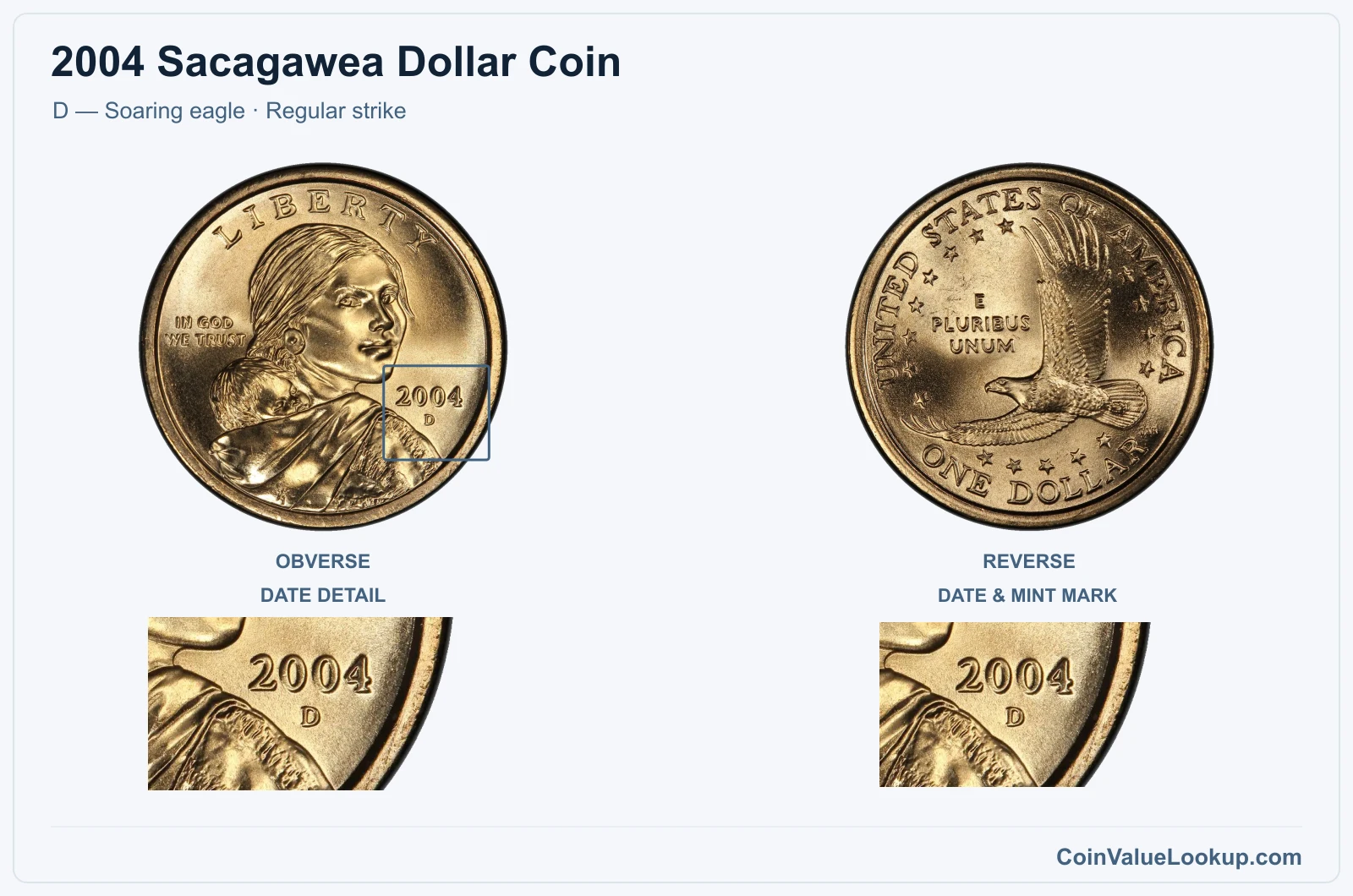
The 2004-D Sacagawea Dollar was struck at Denver. Its "D" mintmark sits on the obverse just below the date, in the same spot as the Philadelphia version.
Production was similarly large, so finding one in change is easy.
A guide estimate from USA Coin Book puts an MS65 at roughly $6.25. That means a coin with no wear and only light bag marks.
Circulated pieces are a dollar, plain and simple. High-grade rolls pulled from original bags occasionally surface and are worth checking.
Range Grade
Price Auction Records Appraisal PO PO 1
—
Coin Identifier FR FR 2
—
Coin Identifier AG AG 3
—
Coin Identifier G G 4
—
Coin Identifier
G 6
—
Coin Identifier VG VG 8
—
Coin Identifier
VG 10
—
Coin Identifier F F 12
—
Coin Identifier
F 15
—
Coin Identifier VF VF 20
—
Coin Identifier
VF 25
—
Coin Identifier
VF 30
—
Coin Identifier
VF 35
—
Coin Identifier XF XF 40
—
Coin Identifier
XF 45
—
Coin Identifier AU AU 50
—
Coin Identifier
AU 53
—
Coin Identifier
AU 55
—
Coin Identifier
AU 58
—
Coin Identifier MS MS 60
—
Coin Identifier
MS 61
—
Coin Identifier
MS 62
—
Coin Identifier
MS 63
—
Coin Identifier
MS 64
—
Coin Identifier
MS 65
Coin Identifier
MS 66
Coin Identifier
MS 67
Coin Identifier
MS 68
Coin Identifier
MS 69
Coin Identifier
MS 70
—
—
—
2004 Sacagawea Dollar — S — Soaring eagle — proof
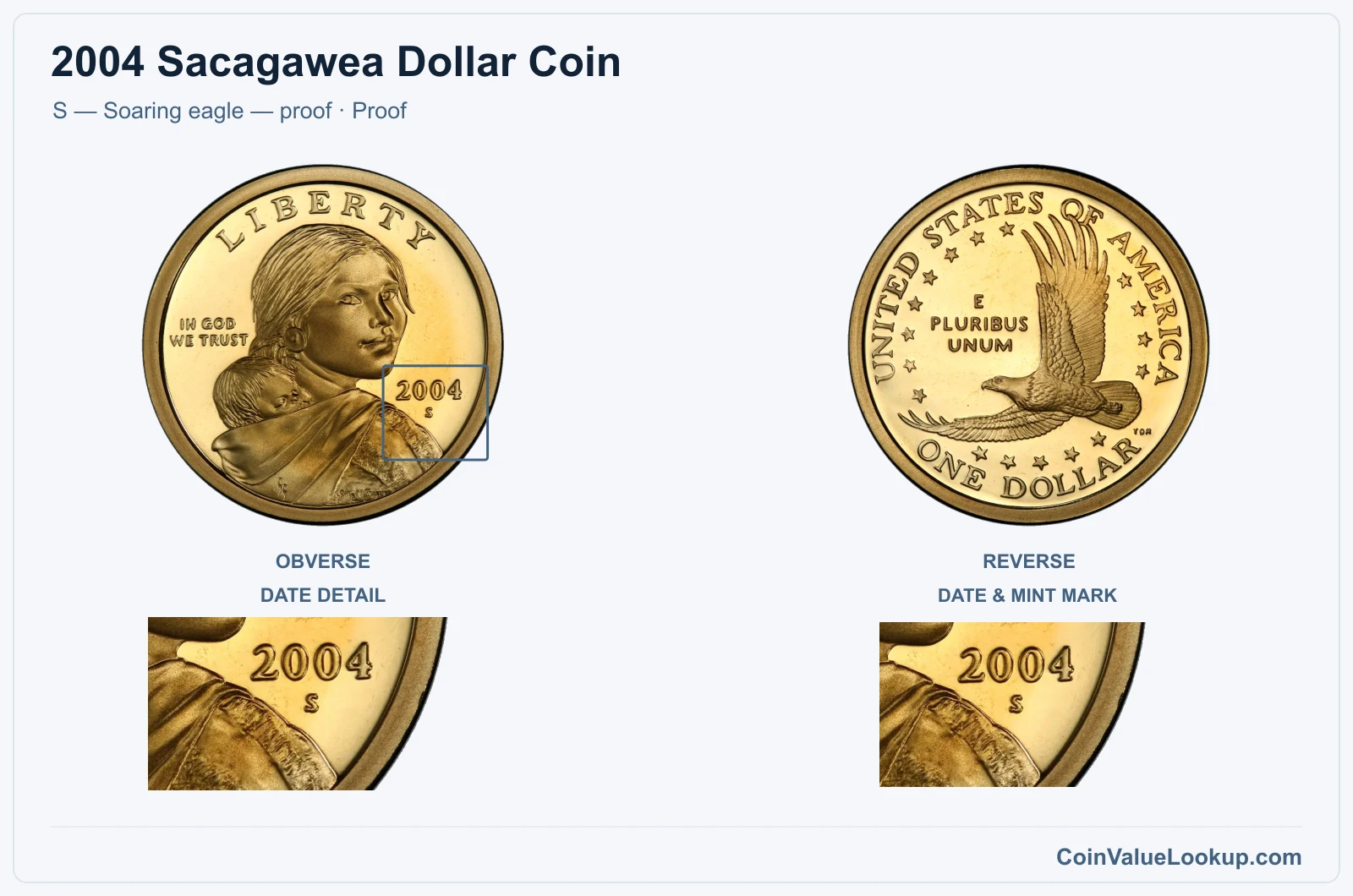
The 2004-S Sacagawea Dollar is a proof struck at San Francisco exclusively for collector sets. It was never meant for circulation.
Look for the "S" mintmark and mirror-like fields with frosted raised devices — that contrast is the hallmark of a proof coin.
A USA Coin Book guide estimate places a PR65 at about $7.29. Proof grading revolves around surface preservation: hairlines from handling or haze from improper storage lower the grade quickly.
A coin purchased inside a sealed set and never touched will almost always outgrade a loose one.
Despite sometimes being sold alongside silver proof coins, this dollar is manganese-brass clad, not silver. Same alloy as the P and D issues.
Range Grade
Price Auction Records Appraisal PR PR 1
—
Coin Identifier
PR 2
—
Coin Identifier
PR 3
—
Coin Identifier
PR 4
—
Coin Identifier
PR 6
—
Coin Identifier
PR 8
—
Coin Identifier
PR 10
—
Coin Identifier
PR 12
—
Coin Identifier
PR 15
—
Coin Identifier
PR 20
—
Coin Identifier
PR 25
—
Coin Identifier
PR 30
—
Coin Identifier
PR 35
—
Coin Identifier
PR 40
—
Coin Identifier
PR 45
—
Coin Identifier
PR 50
—
Coin Identifier
PR 53
—
Coin Identifier
PR 55
—
Coin Identifier
PR 58
—
Coin Identifier
PR 60
—
Coin Identifier
PR 61
—
Coin Identifier
PR 62
—
Coin Identifier
PR 63
—
Coin Identifier
PR 64
—
Coin Identifier
PR 65
—
Coin Identifier
PR 66
—
Coin Identifier
PR 67
—
Coin Identifier
PR 68
Coin Identifier
PR 69
Coin Identifier
PR 70
Coin Identifier
2004 Sacagawea Dollar Error List
1. 2004 Sacagawea Dollar — Die Crack / Die Chip
Die cracks and die chips have been reported on 2004 Sacagawea Dollars. A die crack appears as a thin raised line on the coin's surface, following where the steel die fractured during use.
A die chip is a small raised blob where a piece of the die broke away, leaving a void that fills with metal during striking.
If the raised line connects to the rim and creates a flat, shelf-like area, that is sometimes called a cud — a more dramatic form of die damage. Look carefully with magnification; these features are raised above the normal surface.
Do not confuse incuse scratches, corrosion pitting or foreign material stuck to the surface with a genuine die crack. Scratches sit into the metal rather than above it.
Value depends on the size, location and visibility of the crack, plus the coin's overall condition — there is no single price for every example.
2. 2004 Sacagawea Dollar — Struck-Through Error
Struck-through errors occur when foreign material — grease, cloth fiber, a metal fragment — gets between the die and the planchet during striking. On a 2004 Sacagawea Dollar this shows up as a localized depression or an incomplete area of design where the obstruction blocked the metal from filling the die cavity.
Grease-filled dies tend to produce a smooth, shallow missing area, often on lettering or fine detail. A retained struck-through, where the object is still embedded in the surface, is a different animal and usually more desirable.
Ordinary wear, cleaning marks and weak strikes from a tired die can mimic a struck-through at first glance. The key difference is that a struck-through has a distinct boundary and an impression pattern, not gradual smoothing.
Pricing depends on the size of the affected area, sharpness of the impression and overall coin condition.
3. 2004 Sacagawea Dollar — Lamination / Split Planchet
Lamination errors on 2004 Sacagawea Dollars appear as peeling metal, a retained flap, or a visible split within the manganese-brass clad layers. The separation happens during the planchet preparation process, before or during striking.
When examining a suspect coin, photograph both the affected face and the edge together. The edge view often reveals the layer separation most clearly.
A retained flap — still attached but partially lifted — is generally more collectible than a missing chunk.
Scraping damage, surface corrosion and deliberately altered coins can look similar. Corrosion tends to be rough and irregular rather than a clean peel following the metal's internal structure.
A deliberate cut usually shows tool marks. Condition, size and location of the lamination all factor into value, so no single price applies to every piece.
4. 2004 Sacagawea Dollar — Rotated Dies
A rotated die error means one die was misaligned relative to the other when the coin was struck, so the obverse and reverse are not oriented correctly. Normal United States coins use "coin turn" alignment: hold the obverse upright, flip the coin top-to-bottom, and the reverse should also appear upright.
If the reverse is tilted — say 15, 45 or 90 degrees off — you may have a rotation error. Larger rotations are scarcer and typically more sought after than slight ones.
Be careful with photographs. A coin photographed at an angle, or placed carelessly on a scanner, can appear rotated when it is perfectly normal.
Always check the physical coin in hand. The degree of rotation, combined with overall condition, determines value; no single adopted price covers every rotation.
5. 2004 Sacagawea Dollar — Improper Annealing
Improper annealing errors on 2004 Sacagawea Dollars result from the planchet not being heat-treated correctly before striking. This can produce unusual surface discoloration, an odd texture, or a different-than-expected color — sometimes darker, sometimes streaky.
To evaluate a suspect coin, compare its surface and edge to a known normal example under the same lighting. Photograph both together if possible.
Discoloration alone is a screening clue, not definitive proof of the cause.
Environmental toning from years in a drawer, corrosion from moisture, or heat applied after minting can all mimic improper annealing. True annealing issues tend to be consistent with the coin's strike quality, while post-mint damage often sits on top of otherwise normal surfaces.
Value depends on how dramatic and clearly attributable the error is, along with overall condition.