2000 Sacagawea Dollar Coin Value: How Much Is It Worth?
Most 2000 Sacagawea golden dollars are worth face value in circulated condition. A guide lists the Philadelphia coin at about $7.29 in MS65, the Denver at $11 in MS65, and the San Francisco proof at $7.29 in PR65.
The real action is in the special varieties and errors, where authenticated examples can reach thousands or even six figures.
Fast Way to Identify Your 2000 Sacagawea Dollar
Snap clear, well-lit photos of both sides of your coin and upload them here. Our identifier can give you a preliminary read on mintmark, variety branch, and general condition.
It is not a substitute for professional authentication or certified grading, but it is a solid first step before you dig deeper.
2000 Sacagawea Dollar Value
Upload both sides of your 2000 Sacagawea Dollar.
Front Obverse
Upload photo
Back Reverse
Upload photo
Which 2000 Sacagawea Dollar Versions Are Worth Money?
- The Cheerios enhanced tail-feather reverse on a 2000-P dollar is listed at roughly $4,250 in MS65; confirm the actual diagnostic reverse, not just cereal-box provenance.
- A Goodacre Presentation 2000-P special strike realized $5,288 in SP69 at a Heritage auction in April 2013; only 5,000 were issued as designer compensation.
- Denver VIP special strikes have reported private sales of $10,000 and $13,000 at the SP68 level in 2025, making them among the highest-value Sacagawea issues.
- The Washington quarter obverse / Sacagawea dollar reverse mule brought $120,000 in NGC MS67 at Heritage in January 2019.
- A 2000-P struck on a Susan B. Anthony dollar planchet sold for $6,037.50 in AU58 at Heritage in July 2002.
Step 1: Identify Your 2000 Sacagawea Dollar Mint Mark and Version
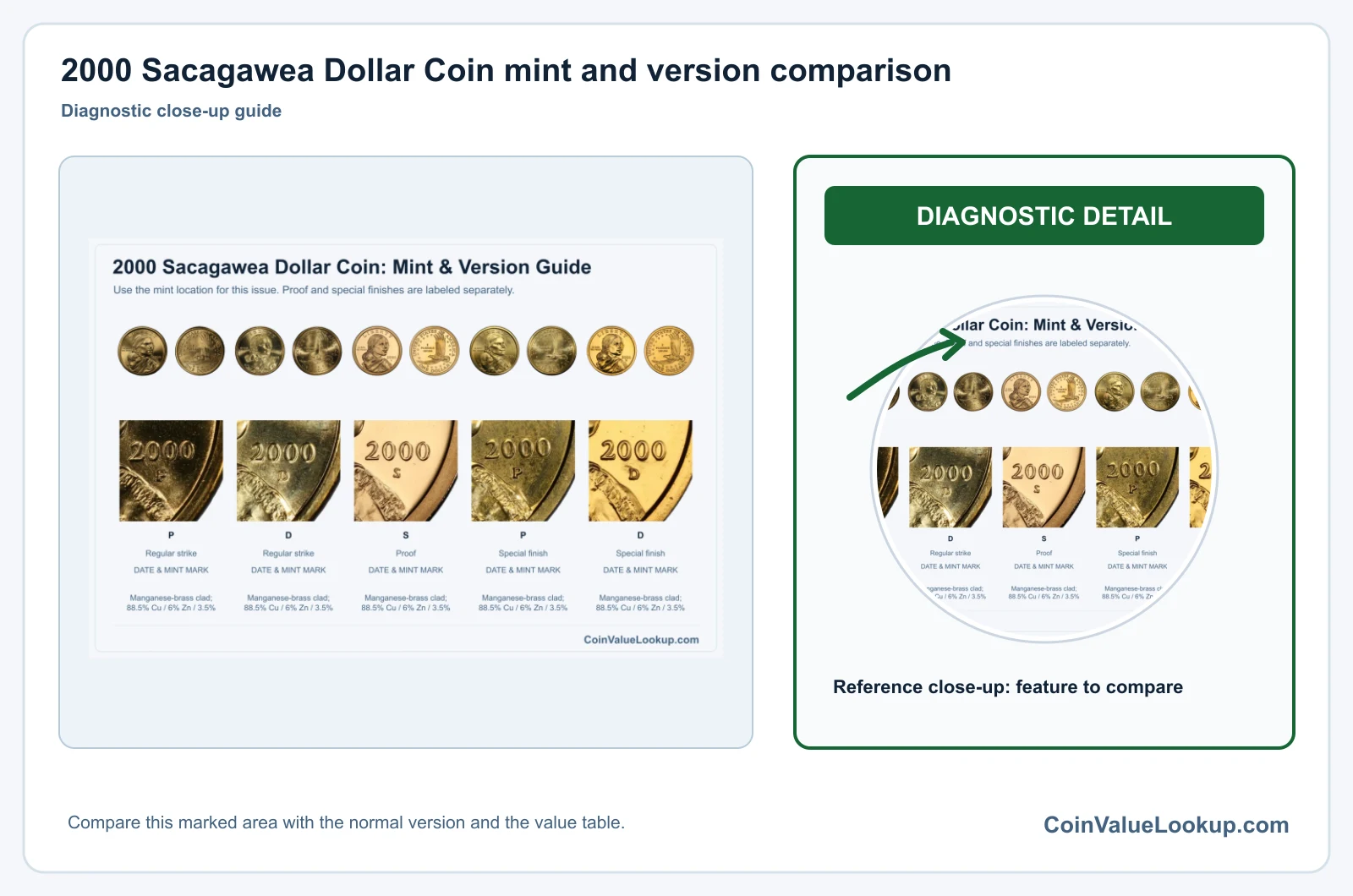
The 2000 Sacagawea dollar shows Sacagawea carrying her child on the obverse and a soaring eagle on the reverse. The mintmark sits on the obverse near the date: P for Philadelphia, D for Denver, S for San Francisco proofs.
These coins are manganese-brass clad, not gold. The composition is 88.5% copper, 6% zinc, 3.5% manganese, and 2% nickel, weighing 8.10 grams.
That golden color is engineered, and darkening over time is normal, not a sign of a wrong alloy or special rarity.
The plain edge is correct for this year. If someone tells you your 2000 dollar is missing edge lettering, that feature was not introduced until later in the series.
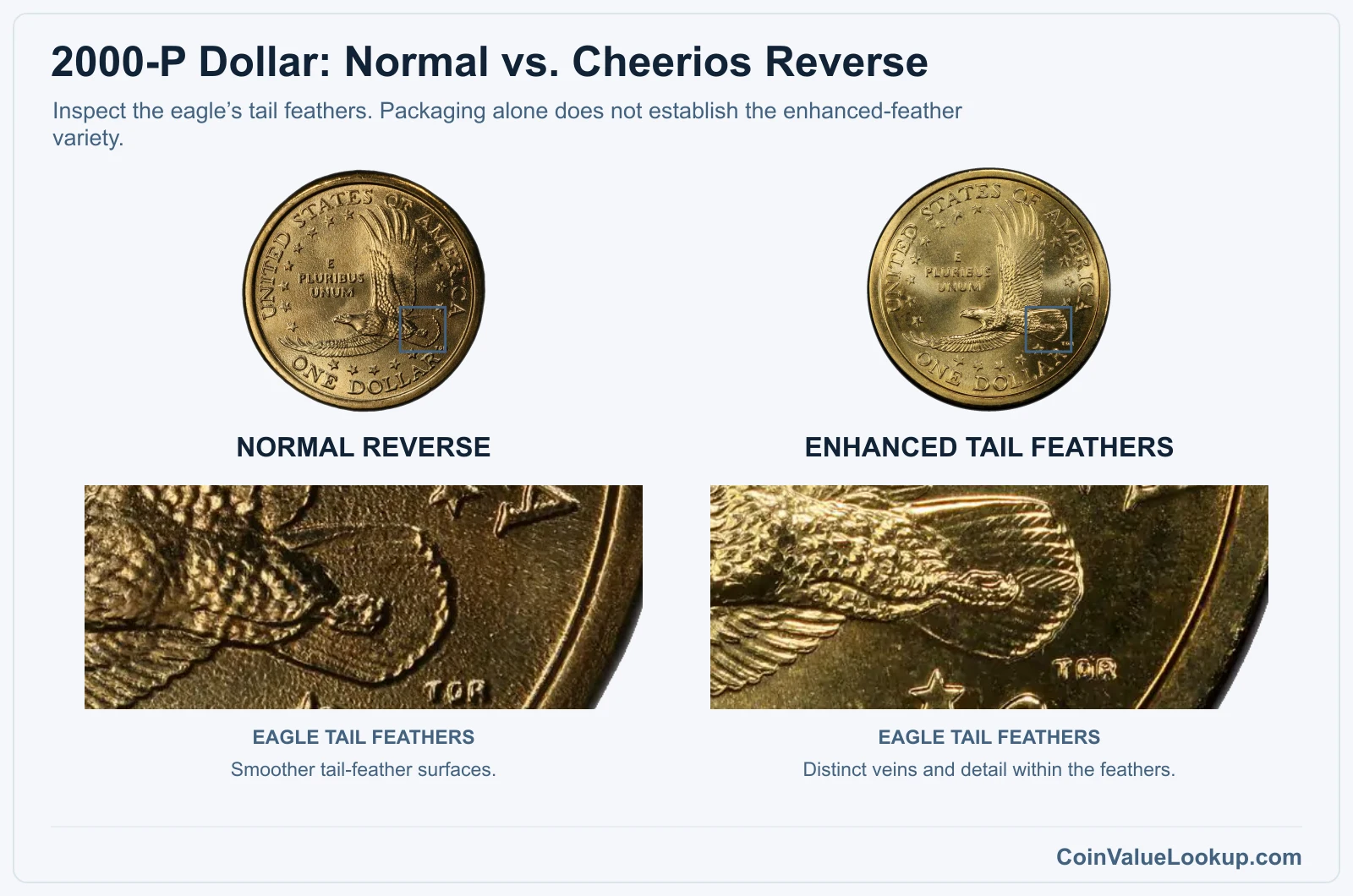
Several distinct versions exist beyond the ordinary P, D, and S proof. The Cheerios variety has enhanced prototype tail feathers on the eagle reverse, visible under magnification when compared side by side with a standard reverse.
Not every coin that once sat inside a Cheerios cereal box has this reverse, so look at the feathers, not the packaging.
The Wounded Eagle is a 2000-P with a raised diagonal die flaw across the eagle's belly. A scratch is recessed into the metal; the Wounded Eagle mark is raised.
The Goodacre Presentation and VIP special strikes from both mints require documented provenance and professional attribution, not a home-made luster test.
Step 2: Check Your 2000 Sacagawea Dollar Grade
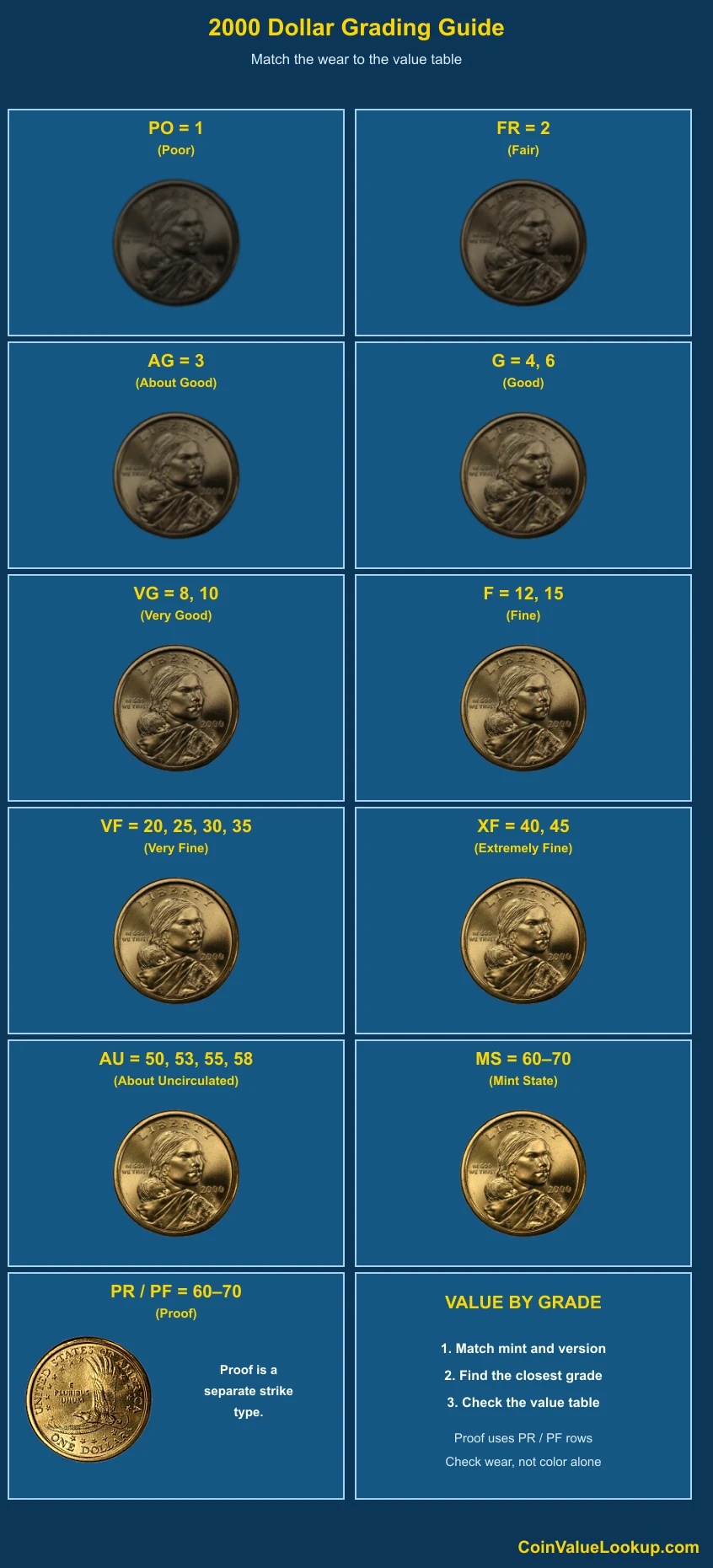
Check Sacagawea's cheek and the child's details on the obverse first. On a coin that has seen circulation, the cheek flattens and the child's features soften.
Flip it over and examine the eagle's breast and wing feathers for smoothing.
Original mint luster should have a satiny cartwheel effect when you tilt the coin under a single light source. A polished coin may look shiny, but the luster is artificial and the surfaces show fine hairlines.
That difference matters a lot for value.
Use the comparison image to match your coin's wear level. A coin grading around MS63 will have full luster but some visible contact marks, while MS65 and above will be clean with minimal bag marks.
Proofs are graded on a separate scale starting at PR, so do not mix up the two systems.
Step 3: Check 2000 Sacagawea Dollar Value by Mint and Version
2000 Sacagawea Dollar — P — Normal Eagle Reverse
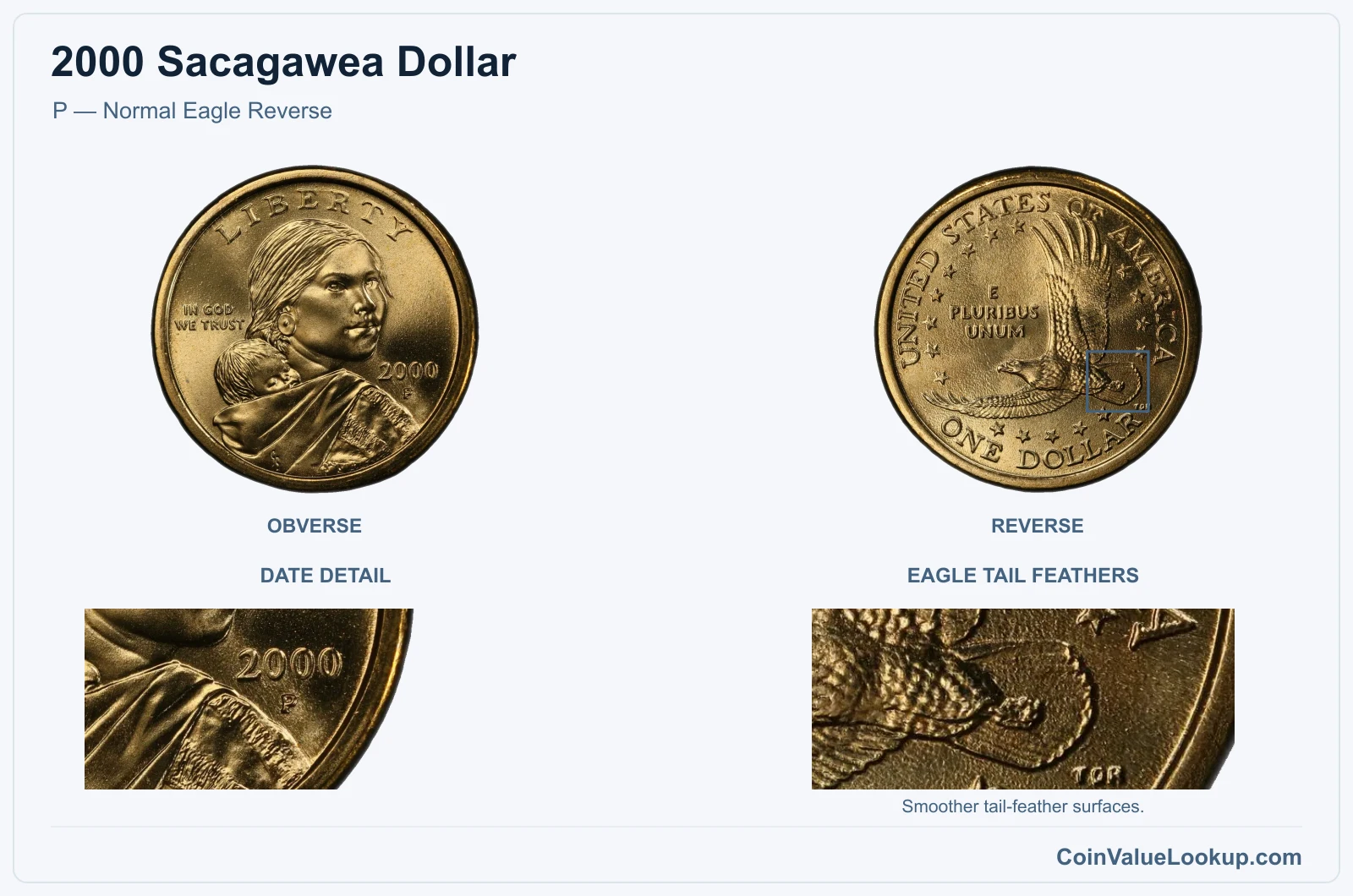
The standard 2000-P is by far the most common Sacagawea dollar you will encounter. Hundreds of millions were struck.
In typical circulated grades, these trade at face value.
A guide estimate for MS65 is about $7.29. There is no intrinsic precious-metal value here; the coin is manganese-brass clad.
Look for original luster and minimal bag marks if you want a nice example, but do not expect a windfall from a standard Philadelphia strike.
Range Grade
Price Auction Records Appraisal PO PO 1
—
Coin Identifier FR FR 2
—
Coin Identifier AG AG 3
—
Coin Identifier G G 4
—
Coin Identifier
G 6
—
Coin Identifier VG VG 8
—
Coin Identifier
VG 10
—
Coin Identifier F F 12
—
Coin Identifier
F 15
—
Coin Identifier VF VF 20
—
Coin Identifier
VF 25
—
Coin Identifier
VF 30
Coin Identifier
VF 35
—
Coin Identifier XF XF 40
—
Coin Identifier
XF 45
—
Coin Identifier AU AU 50
Coin Identifier
AU 53
—
Coin Identifier
AU 55
Coin Identifier
AU 58
Coin Identifier MS MS 60
Coin Identifier
MS 61
Coin Identifier
MS 62
Coin Identifier
MS 63
Coin Identifier
MS 64
Coin Identifier
MS 65
Coin Identifier
MS 66
Coin Identifier
MS 67
Coin Identifier
MS 68
Coin Identifier
MS 69
Coin Identifier
MS 70
—
—
—
2000 Sacagawea Dollar — D — Normal Eagle Reverse
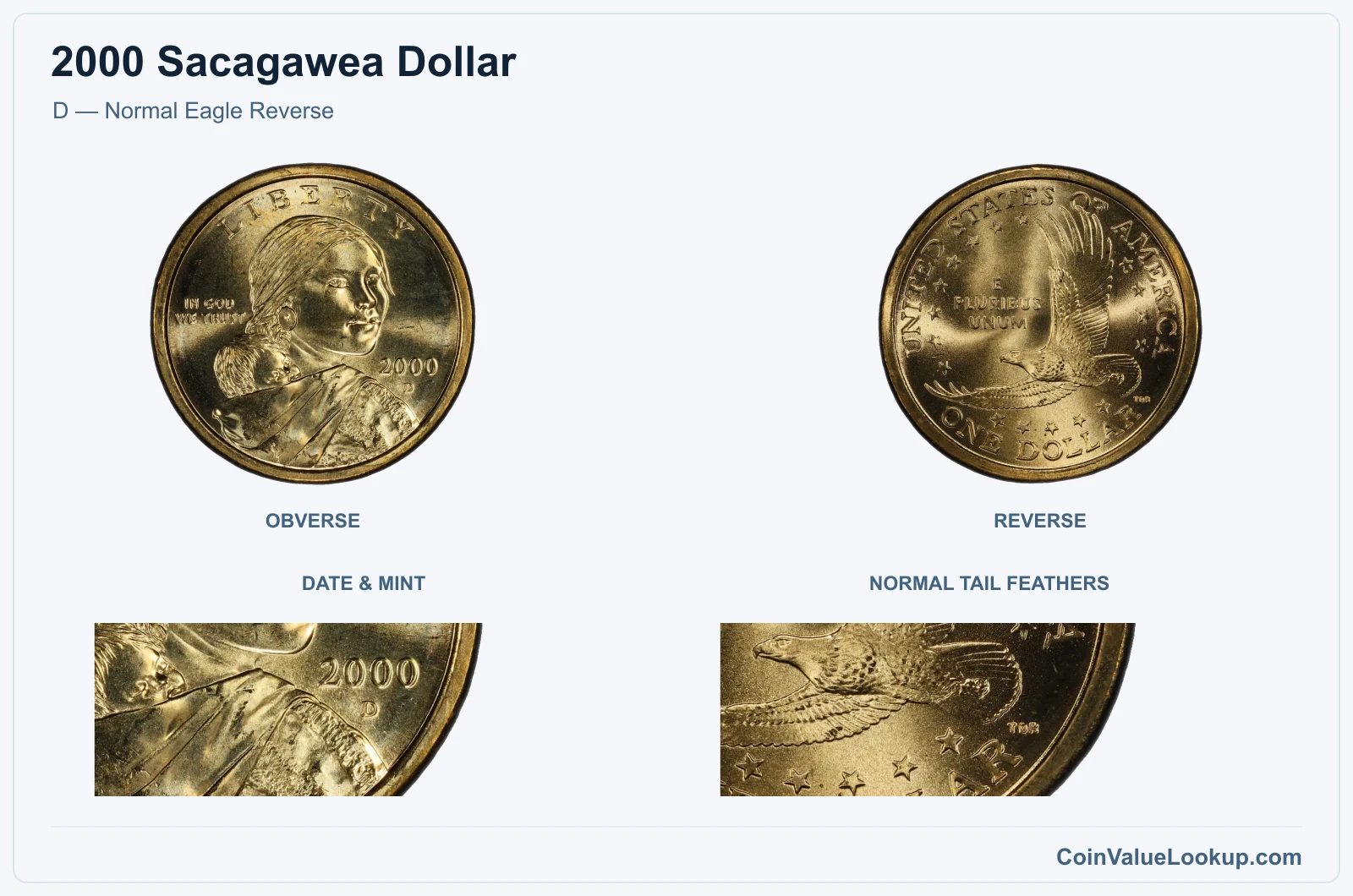
Denver's 2000-D Sacagawea dollar is the other high-mintage business strike. It carries a small D mintmark on the obverse near the date.
A guide lists the MS65 value at about $11, a slight premium over the Philadelphia issue. Like the P, circulated examples are worth a dollar.
Focus on surface quality and luster if you are trying to find a higher-grade piece worth setting aside.
Coin Value Lookup is a good starting point if you want to compare this coin's value against other years and denominations in the series.
Range Grade
Price Auction Records Appraisal PO PO 1
—
Coin Identifier FR FR 2
—
Coin Identifier AG AG 3
—
Coin Identifier G G 4
—
Coin Identifier
G 6
—
Coin Identifier VG VG 8
—
Coin Identifier
VG 10
—
Coin Identifier F F 12
—
Coin Identifier
F 15
—
Coin Identifier VF VF 20
—
Coin Identifier
VF 25
—
Coin Identifier
VF 30
—
Coin Identifier
VF 35
—
Coin Identifier XF XF 40
—
Coin Identifier
XF 45
—
Coin Identifier AU AU 50
—
Coin Identifier
AU 53
—
Coin Identifier
AU 55
—
Coin Identifier
AU 58
Coin Identifier MS MS 60
—
Coin Identifier
MS 61
—
Coin Identifier
MS 62
—
Coin Identifier
MS 63
Coin Identifier
MS 64
Coin Identifier
MS 65
Coin Identifier
MS 66
Coin Identifier
MS 67
Coin Identifier
MS 68
Coin Identifier
MS 69
Coin Identifier
MS 70
—
—
—
2000 Sacagawea Dollar — S — Proof
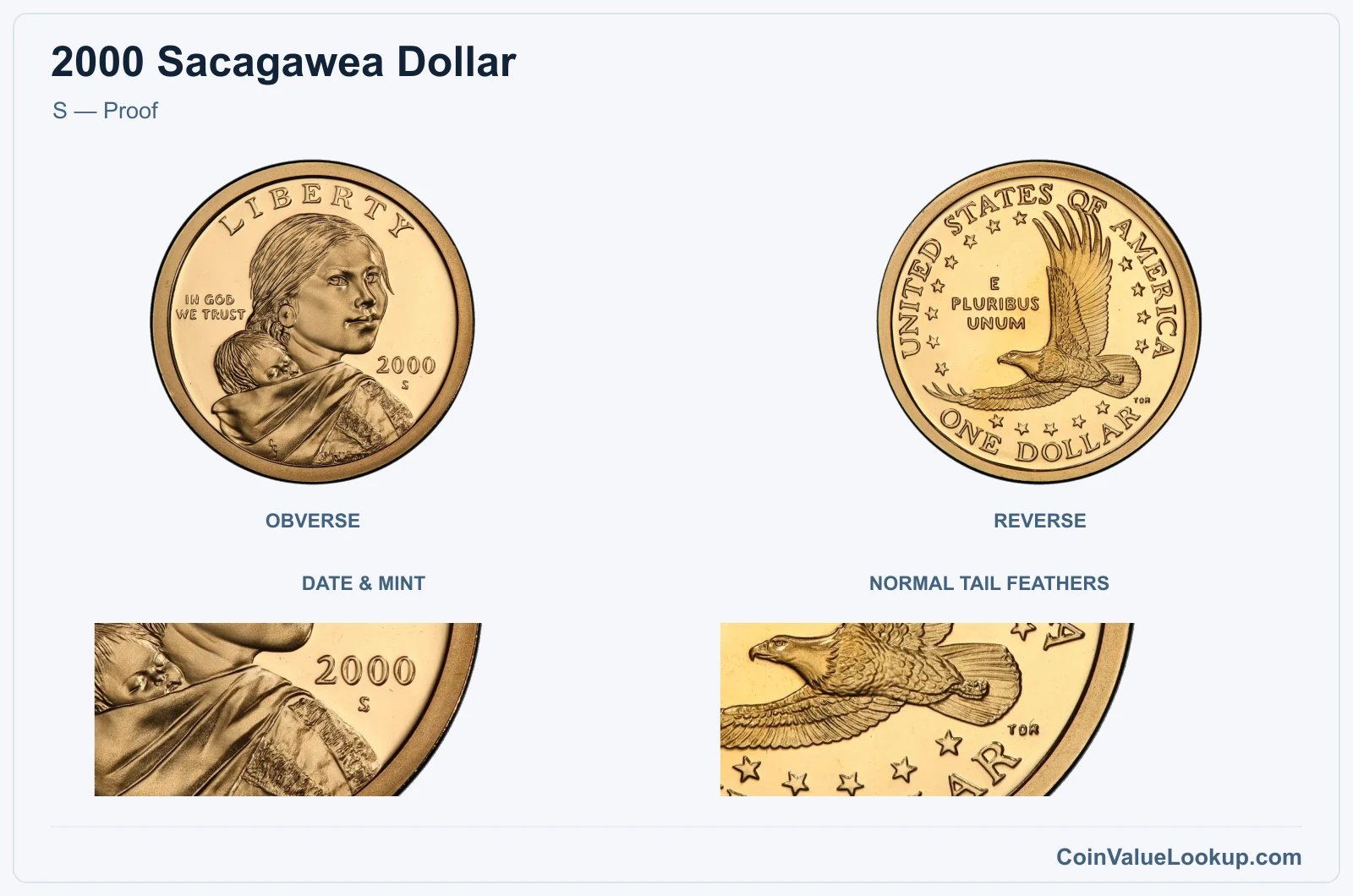
San Francisco produced proof Sacagawea dollars in 2000, sold in collector sets rather than released into circulation. These carry an S mintmark and show mirrored fields with sharp detail.
A guide puts the PR65 value at roughly $7.29. Most surviving proofs grade well above that baseline since they were handled carefully from the start.
If yours has haze or fingerprints on the mirror surface, that will hurt the grade more than you might expect.
Range Grade
Price Auction Records Appraisal PR PR 1
—
Coin Identifier
PR 2
—
Coin Identifier
PR 3
—
Coin Identifier
PR 4
—
Coin Identifier
PR 6
—
Coin Identifier
PR 8
—
Coin Identifier
PR 10
—
Coin Identifier
PR 12
—
Coin Identifier
PR 15
—
Coin Identifier
PR 20
—
Coin Identifier
PR 25
—
Coin Identifier
PR 30
—
Coin Identifier
PR 35
—
Coin Identifier
PR 40
—
Coin Identifier
PR 45
—
Coin Identifier
PR 50
—
Coin Identifier
PR 53
—
Coin Identifier
PR 55
—
Coin Identifier
PR 58
—
Coin Identifier
PR 60
—
Coin Identifier
PR 61
—
Coin Identifier
PR 62
—
Coin Identifier
PR 63
—
Coin Identifier
PR 64
Coin Identifier
PR 65
—
Coin Identifier
PR 66
—
Coin Identifier
PR 67
Coin Identifier
PR 68
Coin Identifier
PR 69
Coin Identifier
PR 70
Coin Identifier
2000 Sacagawea Dollar — P — Cheerios Enhanced Tail Feathers
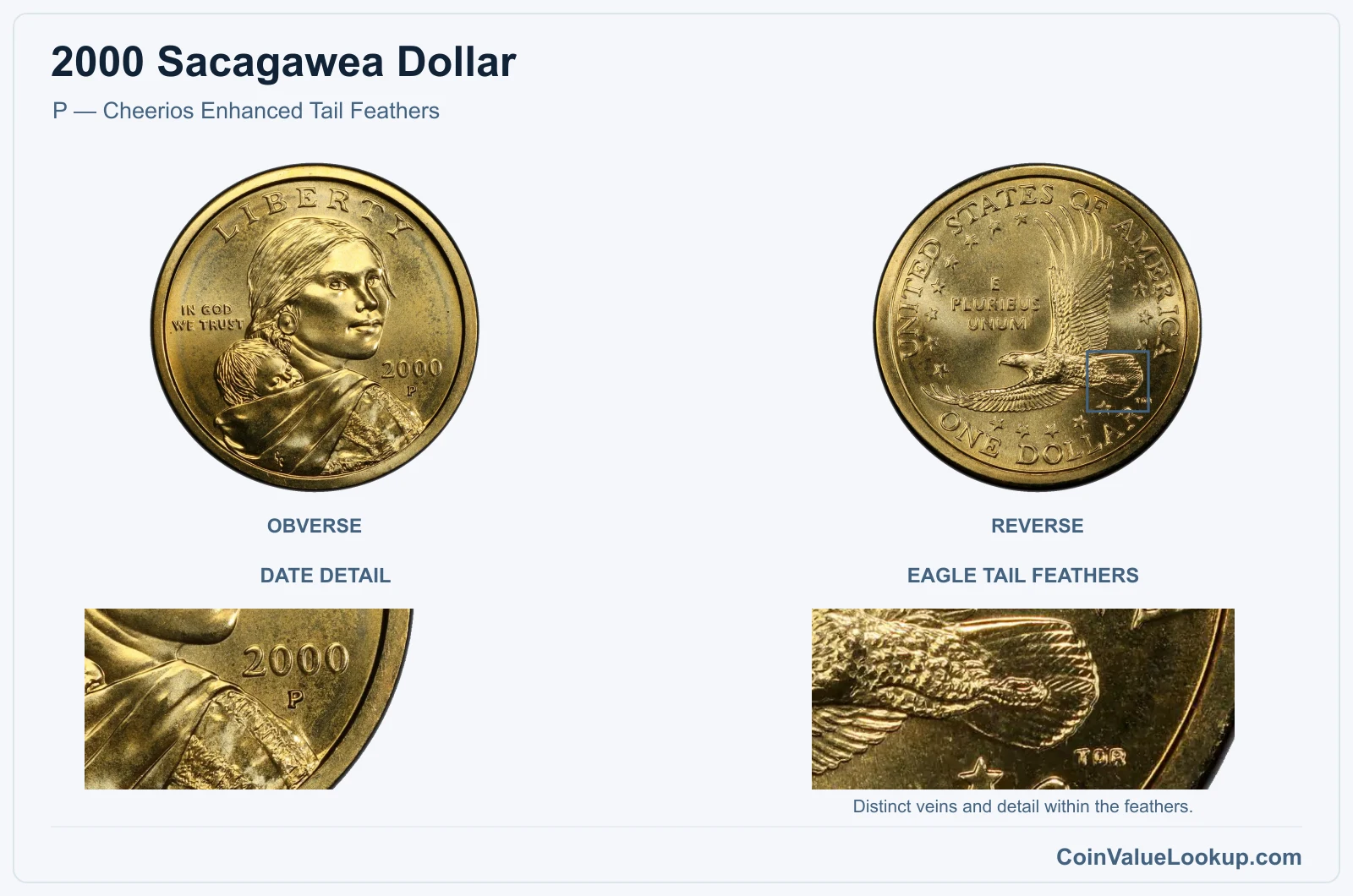
In a 2000 promotional campaign, specially packaged Sacagawea dollars were inserted into boxes of Cheerios cereal. Some of those coins carry an enhanced prototype eagle reverse with more detailed, sharply defined tail feathers compared to the production reverse.
This is the key point: not every cereal-box dollar has the enhanced reverse. You need to compare the tail feathers directly against a known standard reverse under magnification.
The enhanced version shows finer, more pronounced feather detail.
A guide lists the Cheerios enhanced reverse at approximately $4,250 in MS65. That price applies only to coins with the confirmed prototype reverse, not to any golden dollar that once lived next to breakfast cereal.
Professional attribution is strongly recommended before assuming you have this variety.
Range Grade
Price Auction Records Appraisal PO PO 1
—
Coin Identifier FR FR 2
—
Coin Identifier AG AG 3
—
Coin Identifier G G 4
—
Coin Identifier
G 6
—
Coin Identifier VG VG 8
—
Coin Identifier
VG 10
—
Coin Identifier F F 12
—
Coin Identifier
F 15
—
Coin Identifier VF VF 20
—
Coin Identifier
VF 25
—
Coin Identifier
VF 30
—
Coin Identifier
VF 35
—
Coin Identifier XF XF 40
—
Coin Identifier
XF 45
—
Coin Identifier AU AU 50
—
Coin Identifier
AU 53
—
Coin Identifier
AU 55
—
Coin Identifier
AU 58
—
Coin Identifier MS MS 60
—
Coin Identifier
MS 61
—
Coin Identifier
MS 62
—
Coin Identifier
MS 63
—
Coin Identifier
MS 64
Coin Identifier
MS 65
—
Coin Identifier
MS 66
Coin Identifier
MS 67
Coin Identifier
MS 68
Coin Identifier
MS 69
—
—
—
MS 70
—
—
—
2000 Sacagawea Dollar — P — Wounded Eagle
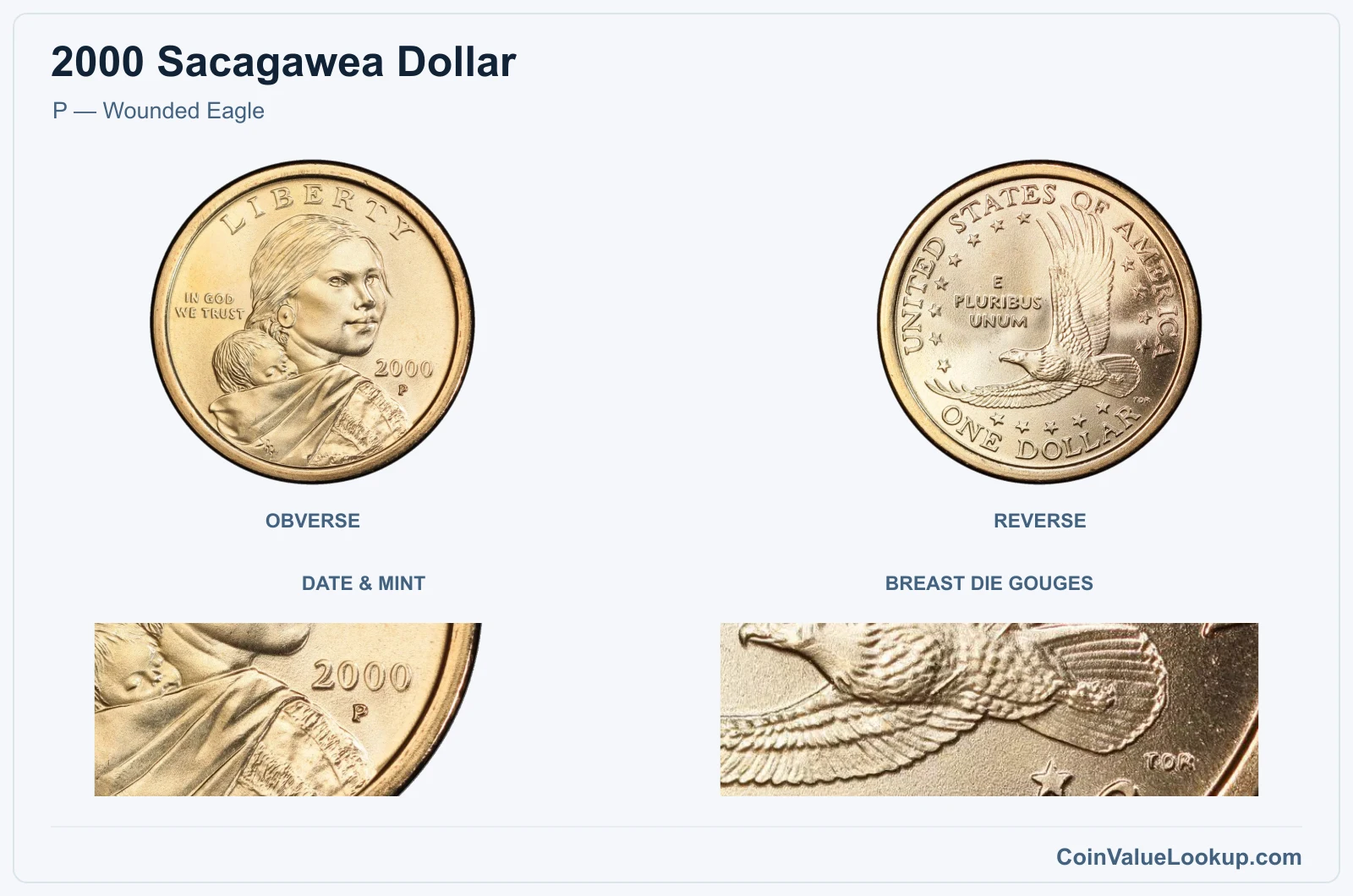
The Wounded Eagle is a 2000-P variety caused by a die flaw that left a raised diagonal line running across the eagle's belly on the reverse. The critical word is raised.
If you tilt the coin under light, the mark should stand up from the surface.
A scratch or bag mark does the opposite: it is recessed, cutting into the metal. That distinction is the single most important diagnostic.
Position and angle also matter, so compare against known attributed examples.
No general price range is available for this variety. Value depends on authenticated identity and the coin's individual condition, so professional grading and attribution are the way to establish what yours is worth.
Range Grade
Price Auction Records Appraisal PO PO 1
—
Coin Identifier FR FR 2
—
Coin Identifier AG AG 3
—
Coin Identifier G G 4
—
Coin Identifier
G 6
—
Coin Identifier VG VG 8
—
Coin Identifier
VG 10
—
Coin Identifier F F 12
—
Coin Identifier
F 15
—
Coin Identifier VF VF 20
—
Coin Identifier
VF 25
—
Coin Identifier
VF 30
—
Coin Identifier
VF 35
—
Coin Identifier XF XF 40
—
Coin Identifier
XF 45
—
Coin Identifier AU AU 50
—
Coin Identifier
AU 53
—
Coin Identifier
AU 55
—
Coin Identifier
AU 58
—
Coin Identifier MS MS 60
—
Coin Identifier
MS 61
—
Coin Identifier
MS 62
Coin Identifier
MS 63
—
Coin Identifier
MS 64
—
Coin Identifier
MS 65
—
Coin Identifier
MS 66
—
Coin Identifier
MS 67
Coin Identifier
MS 68
—
Coin Identifier
MS 69
—
—
—
MS 70
—
—
—
2000 Sacagawea Dollar — P — Goodacre Presentation
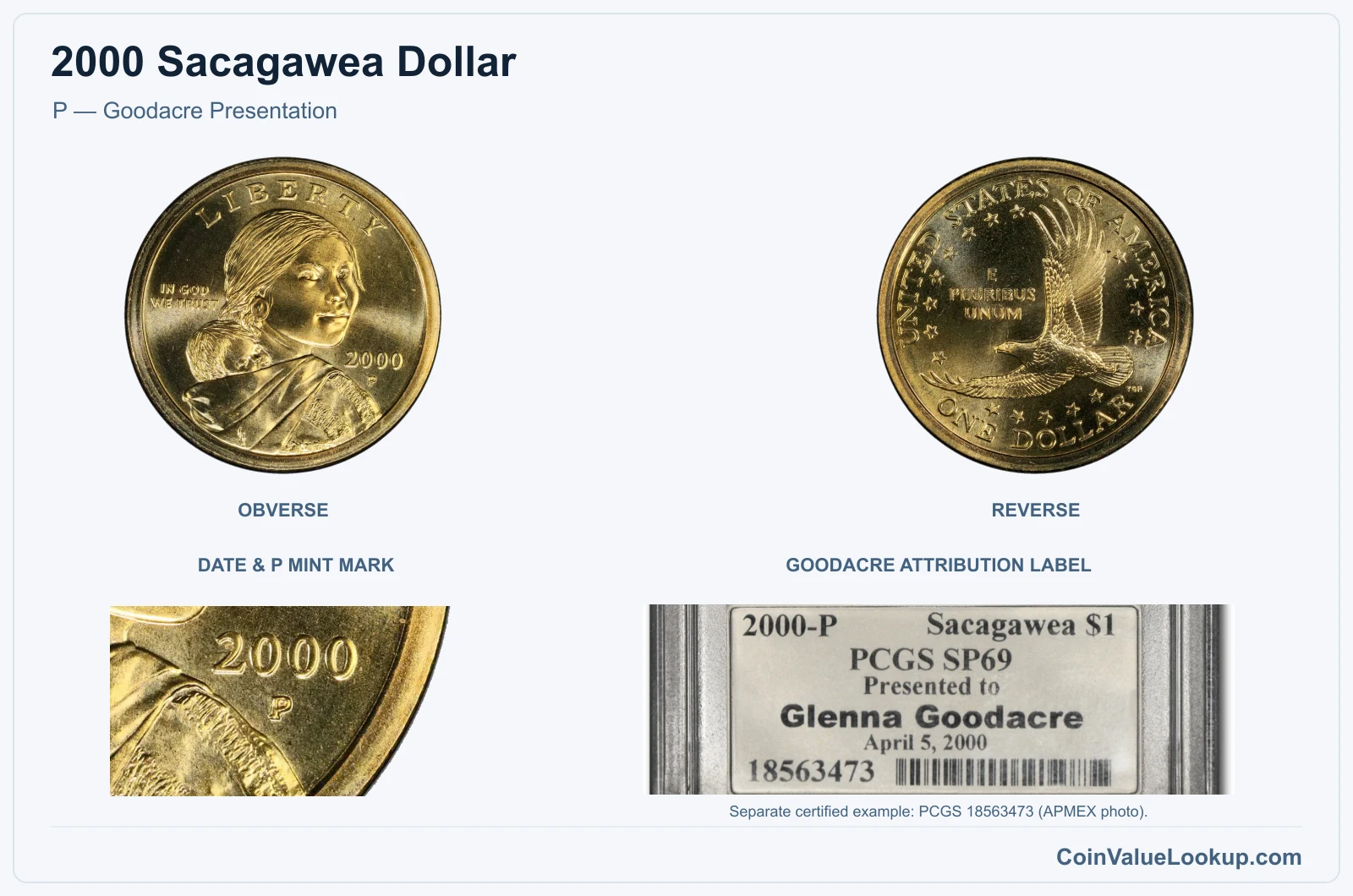
Glenna Goodacre, who designed the Sacagawea obverse, received 5,000 specially struck 2000-P dollars as part of her compensation. These Goodacre Presentation pieces have a distinctive finish that differs from ordinary business strikes.
A PCGS-graded SP69 example sold for $5,288 at Heritage Auctions in April 2013. That is one historical upper-condition result, not a blanket price for every Goodacre piece.
Provenance and professional attribution are essential. A polished or unusually lustrous regular Philadelphia dollar is not a Goodacre.
These need a credible chain of ownership or a third-party slab confirming the special-strike designation.
Range Grade
Price Auction Records Appraisal SP SP 1
—
Coin Identifier
SP 2
—
Coin Identifier
SP 3
—
Coin Identifier
SP 4
—
Coin Identifier
SP 6
—
Coin Identifier
SP 8
—
Coin Identifier
SP 10
—
Coin Identifier
SP 12
—
Coin Identifier
SP 15
—
Coin Identifier
SP 20
—
Coin Identifier
SP 25
—
Coin Identifier
SP 30
—
Coin Identifier
SP 35
—
Coin Identifier
SP 40
—
Coin Identifier
SP 60
—
Coin Identifier
SP 61
—
Coin Identifier
SP 62
—
Coin Identifier
SP 63
—
Coin Identifier
SP 64
—
Coin Identifier
SP 65
—
Coin Identifier
SP 66
Coin Identifier
SP 67
Coin Identifier
SP 68
Coin Identifier
SP 69
Coin Identifier
SP 70
—
—
—
2000 Sacagawea Dollar — P — VIP Special Strike
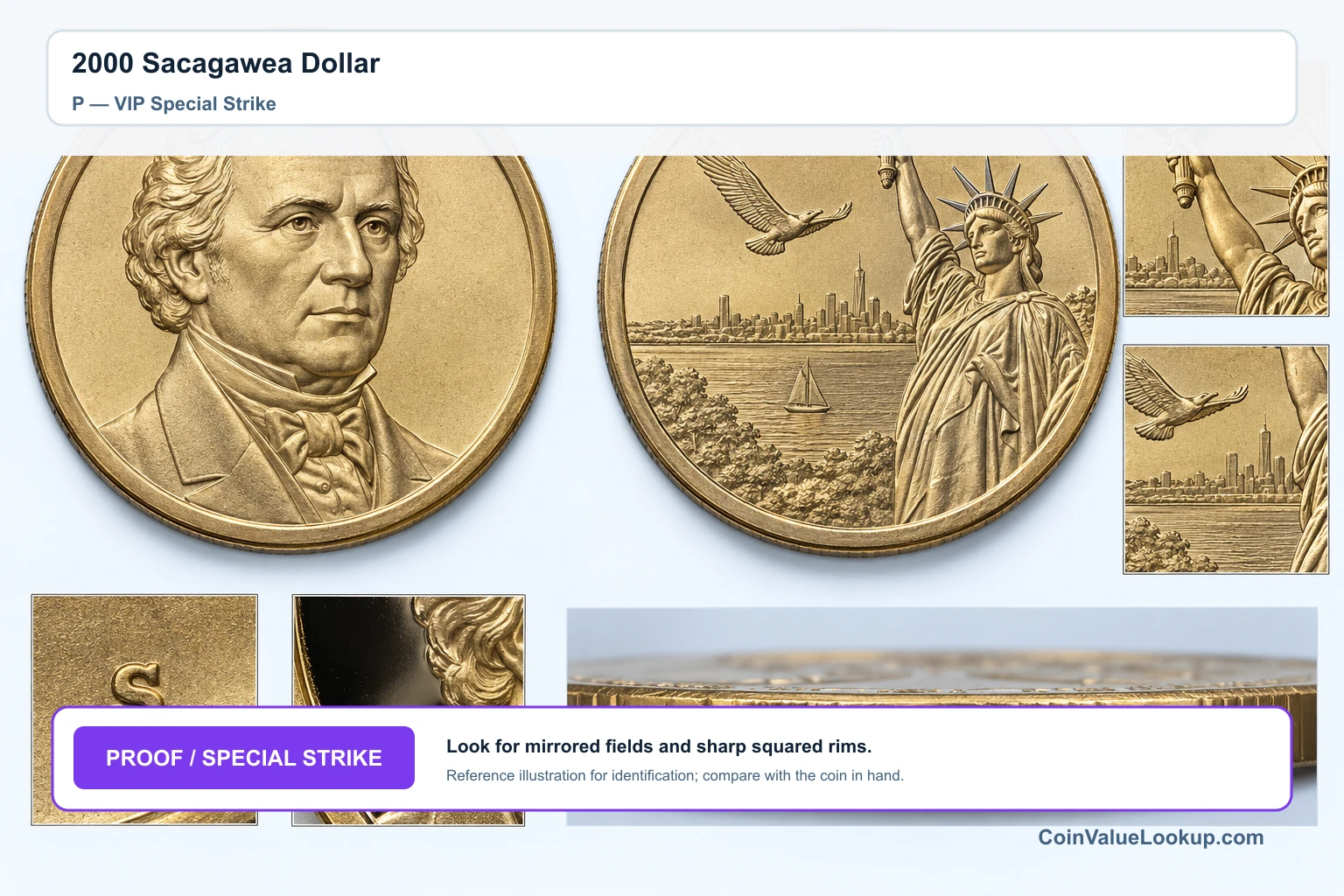
The 2000-P VIP special strike was produced for ceremony purposes and is recognized by PCGS. These are not ordinary business strikes, and identifying one requires documented provenance and professional attribution rather than a visual guess.
No numeric price range is available for this issue. Each coin's value depends on its authenticated identity and condition.
If you believe you have one, submitting it to a grading service with the correct attribution request is the appropriate next step.
2000-P Sacagawea Dollar VIP Special Strike Value by Grade
Reliable grade-by-grade prices are not currently available. The confirmed Philadelphia VIP Strike catalogue entry has no usable grade-by-grade values in the current price feed. Denver VIP and Goodacre Presentation coins are separately attributed issues.
2000 Sacagawea Dollar — D — VIP Special Strike
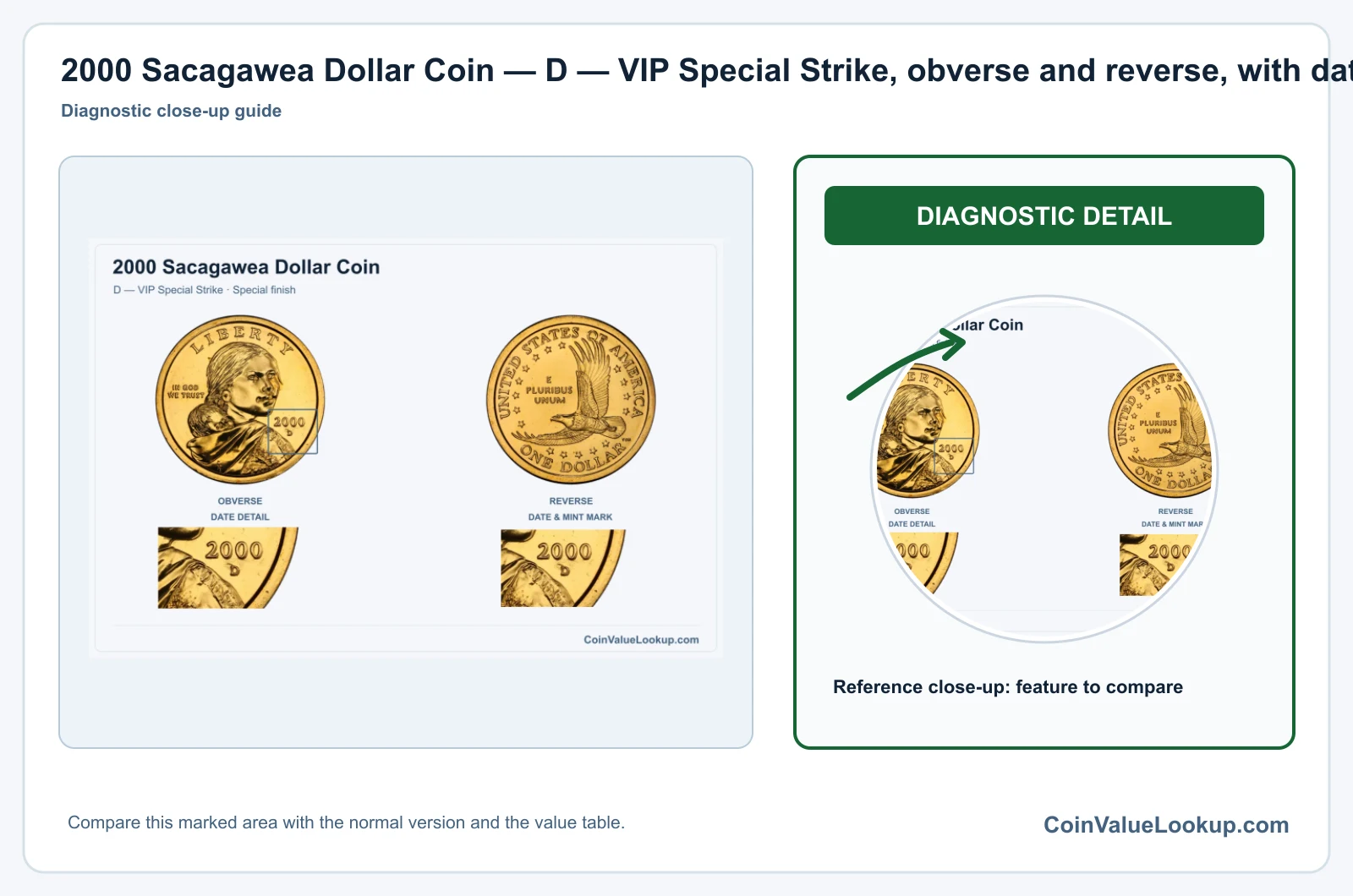
Denver also produced VIP special strikes in 2000, and PCGS recognizes them as a distinct issue. Like the Philadelphia VIP, these require provenance and professional attribution to confirm.
Two individual private sales of SP68-graded examples have been reported by PCGS at $10,000 and $13,000 in 2025. Those are specific transactions for top-condition specimens, not a general price range for all Denver VIP strikes.
The ordinary Denver mintage figure has nothing to do with how many VIP pieces exist, so do not confuse the two.
Range Grade
Price Auction Records Appraisal SP SP 1
—
Coin Identifier
SP 2
—
Coin Identifier
SP 3
—
Coin Identifier
SP 4
—
Coin Identifier
SP 6
—
Coin Identifier
SP 8
—
Coin Identifier
SP 10
—
Coin Identifier
SP 12
—
Coin Identifier
SP 15
—
Coin Identifier
SP 20
—
Coin Identifier
SP 25
—
Coin Identifier
SP 30
—
Coin Identifier
SP 35
—
Coin Identifier
SP 40
—
Coin Identifier
SP 45
—
Coin Identifier
SP 50
—
Coin Identifier
SP 53
—
Coin Identifier
SP 55
—
Coin Identifier
SP 58
—
Coin Identifier
SP 60
—
Coin Identifier
SP 61
—
Coin Identifier
SP 62
—
Coin Identifier
SP 63
—
Coin Identifier
SP 64
—
Coin Identifier
SP 65
—
Coin Identifier
SP 66
—
Coin Identifier
SP 67
—
Coin Identifier
SP 68
—
Coin Identifier
SP 69
—
—
—
SP 70
—
—
—
2000 Sacagawea Dollar Error List
1. 2000 Sacagawea Dollar — Wounded Eagle Die Gouge
The Wounded Eagle die gouge appears on 2000-P Sacagawea dollars as a raised diagonal line crossing the eagle's belly. Under good lighting, you can see the mark stands above the coin's surface, which is the defining characteristic.
The most common lookalike is an ordinary scratch or contact mark, which cuts into the metal and sits below the surface. A ding or invented extra feather line is also not the same thing.
Check the relief carefully and compare against known attributed images before drawing conclusions.
No general price range is established for Wounded Eagle dollars. Each coin's value depends on professional authentication confirming the die gouge and on the coin's overall condition.
A grading service attribution is the reliable path to knowing what you have.
2. 2000 Sacagawea Dollar — Washington Quarter / Dollar Mule
This is the famous mule error: a Washington state-quarter obverse paired with a Sacagawea dollar eagle reverse, struck on a golden-dollar-sized planchet. The Sacagawea portrait is completely absent; instead, you see George Washington on the front.
An NGC MS67 example sold for $120,000 at Heritage Auctions in January 2019. That is one extraordinary result for an authenticated, high-grade specimen.
The coin carries no visible 2000 date on the obverse. Beware novelty two-headed coins or pieces where someone has glued or altered surfaces to simulate a mule.
Genuine examples require professional authentication because the stakes and the counterfeiting incentives are both very high.
3. 2000 Sacagawea Dollar — Struck on a Susan B. Anthony Dollar Planchet
A small number of 2000-P Sacagawea dollars were struck on leftover Susan B. Anthony dollar planchets.
These wrong-planchet errors display the full Sacagawea design but in a silver-colored copper-nickel-clad appearance rather than the expected golden tone.
A PCGS AU58 example sold for $6,037.50 at Heritage Auctions in July 2002. That is a single documented sale for one specific grade.
Lookalikes include normal golden dollars that have been plated or chemically stripped to appear silver. Authentication requires verifying the alloy, edge characteristics, and weight together.
Do not rely on color alone; a professional service can confirm whether the planchet is genuinely wrong.
4. 2000 Sacagawea Dollar — Multiple Strike
A multiple-strike error occurs when the coin receives more than one blow from the dies without being properly ejected. One documented 2000-P example was struck four times, with the third and fourth strikes landing about 50% off-center, creating overlapping displaced impressions of the design.
You will see repeated outlines of Sacagawea's portrait and shifted lettering. The displaced designs are distinct separate impressions, not the shelf-like doubling from a doubled die or mechanical doubling.
No general price range is adopted for multiple-strike Sacagawea dollars. Value depends on the number of strikes, the degree of displacement, and the coin's condition.
Professional grading and clear documentation of the error are essential for establishing value.
5. 2000 Sacagawea Dollar — Clipped Planchet with Off-Center Strike
This combined error involves a straight-clipped planchet that was also struck off-center and received multiple impressions. One documented 2000-P example with a 20% straight clip, off-center positioning, and multiple strikes graded NGC MS65 and sold for $1,840 at Heritage in October 2006.
That price reflects the combination of three error features on one coin, not a clip alone. A straight clip shows a flat missing section of the rim from a blank-preparation malfunction, distinct from a sawed or filed edge.
Lookalikes include coins with post-mint damage along the edge or ordinary off-center strikes without a genuine clip. Authenticating a combined error like this means confirming each feature independently, so professional grading is the right move.