1800 Draped Bust Dollar Coin Value: How Much Is It Worth?
The 1800 Draped Bust Dollar is one of the earliest silver dollars struck by the United States Mint in Philadelphia. Several distinct die varieties exist for this year, and each one — combined with the coin's authenticated condition and surface quality — drives its collector value.
Because this is such an unusual early federal issue, individual assessment by a professional grading service is the practical path to understanding what your specific coin is worth.
Fast Way to Identify Your 1800 Draped Bust Dollar
If you have an 1800 Draped Bust Dollar and want a preliminary identification, upload clear photos of both the front and back of your coin. Close-up images help distinguish the date style, arrow count on the eagle, and letter spacing that separate this year's varieties.
That first look can point you toward the right branch before seeking professional authentication.
1800 Draped Bust Dollar Value
Upload both sides of your 1800 Draped Bust Dollar.
Front Obverse
Upload photo
Back Reverse
Upload photo
Which 1800 Draped Bust Dollar Versions Are Worth Money?
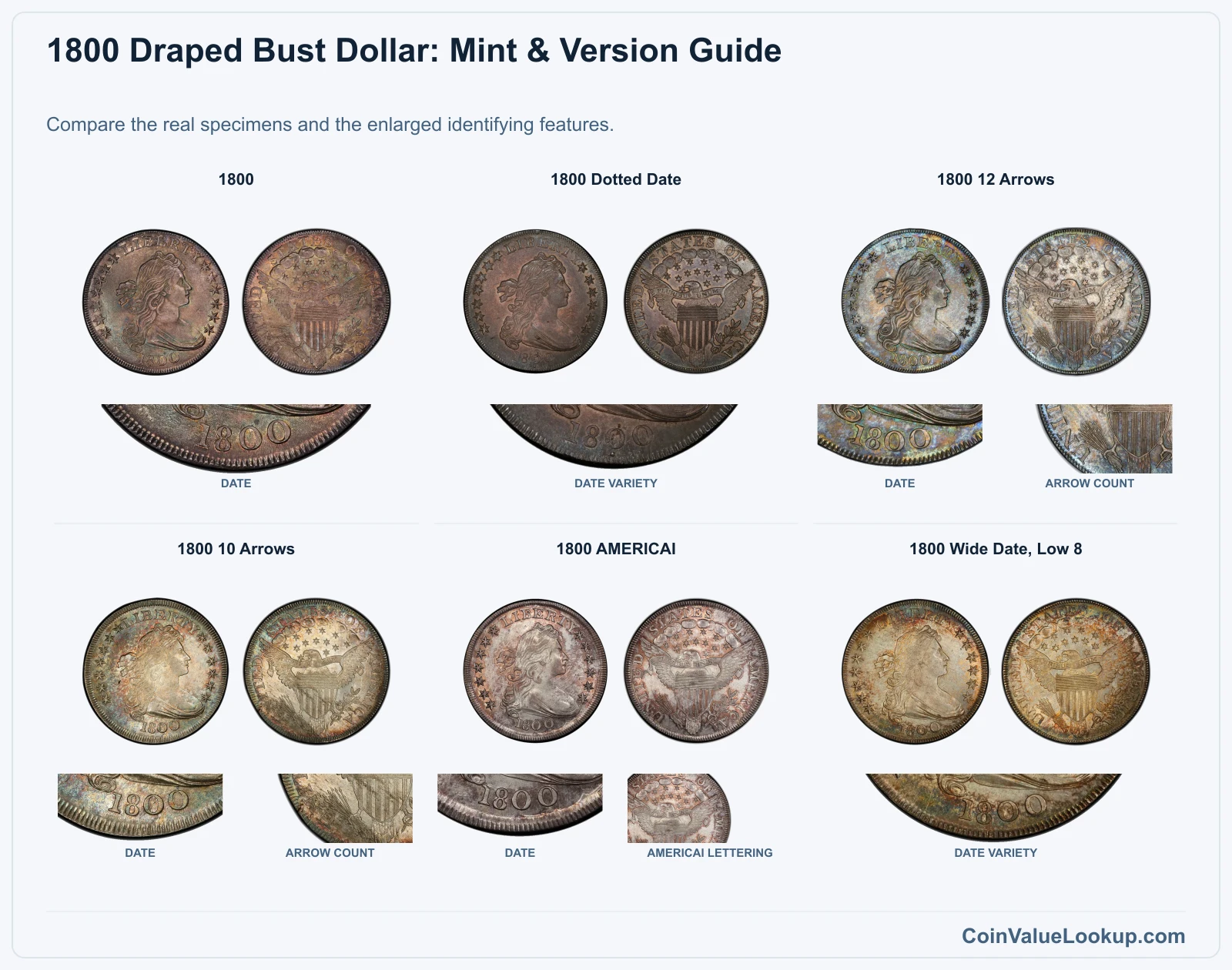
- 1800 Dotted Date — tiny raised dots in or near the date digits make this a distinct and recognized die variety worth confirming under magnification.
- 1800 12 Arrows — the eagle holds 12 arrows instead of the usual count; check the talon carefully with a loupe.
- 1800 10 Arrows — only 10 arrows in the eagle's claw, the lowest count among 1800 die pairs.
- 1800 AMERICAI — the final letter in AMERICA appears as an "I" due to a die anomaly, creating a sought-after variety.
- 1800 Wide Date, Low 8 — wider numeral spacing and a distinctly lower-positioned "8" separate this from the normal date layout.
Step 1: Identify Your 1800 Draped Bust Dollar Mint Mark and Version
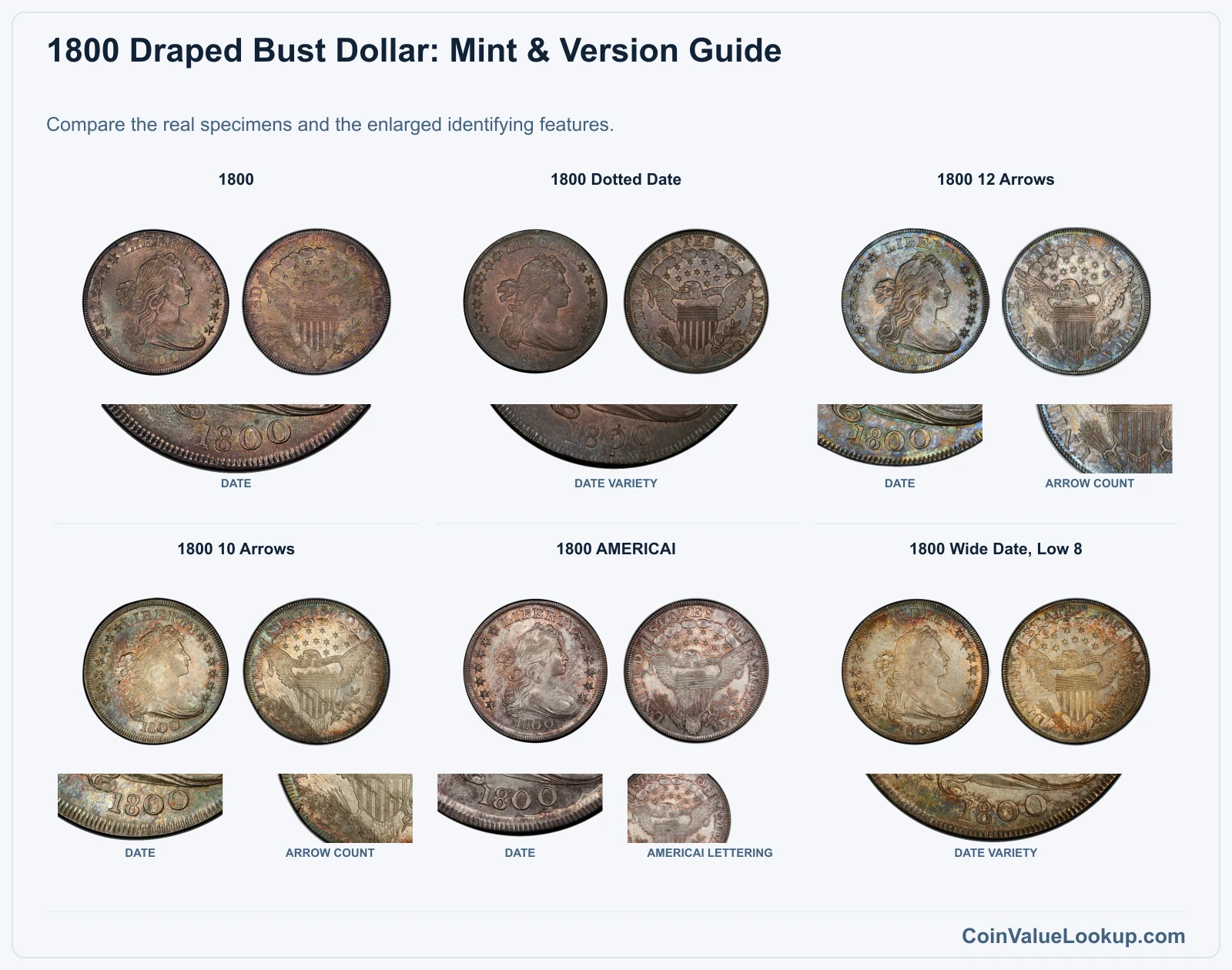
All 1800 Draped Bust Dollars were struck at Philadelphia — there is no mintmark to look for. The obverse shows Liberty facing right with draped cloth at her shoulder, surrounded by stars and the date.
The reverse features a Heraldic Eagle design with a shield on its breast, arrows in its talons, and the legend UNITED STATES OF AMERICA.
The coin is a silver-copper alloy at a nominal weight of 26.96 grams, with a lettered edge. What separates one variety from another comes down to specific die details you can check with a loupe.
Start with the date numerals. The Dotted Date variety shows tiny raised dots between or near the digits — a die anomaly visible under magnification.
The Wide Date, Low 8 has noticeably wider spacing between the numerals and the final "8" sits lower than the other digits.
Next, flip the coin over. Count the arrows in the eagle's talon: most 1800 dollars have 13 arrows, but dedicated die pairs used either 12 or 10 arrows, creating the 12 Arrows and 10 Arrows varieties.
Finally, examine the word AMERICA on the reverse. On the AMERICAI variety, the final letter appears to read "I" instead of a clean "A," caused by a filled or re-engraved die.
Getting the variety right matters before you compare your coin to any value reference.
Step 2: Check Your 1800 Draped Bust Dollar Grade
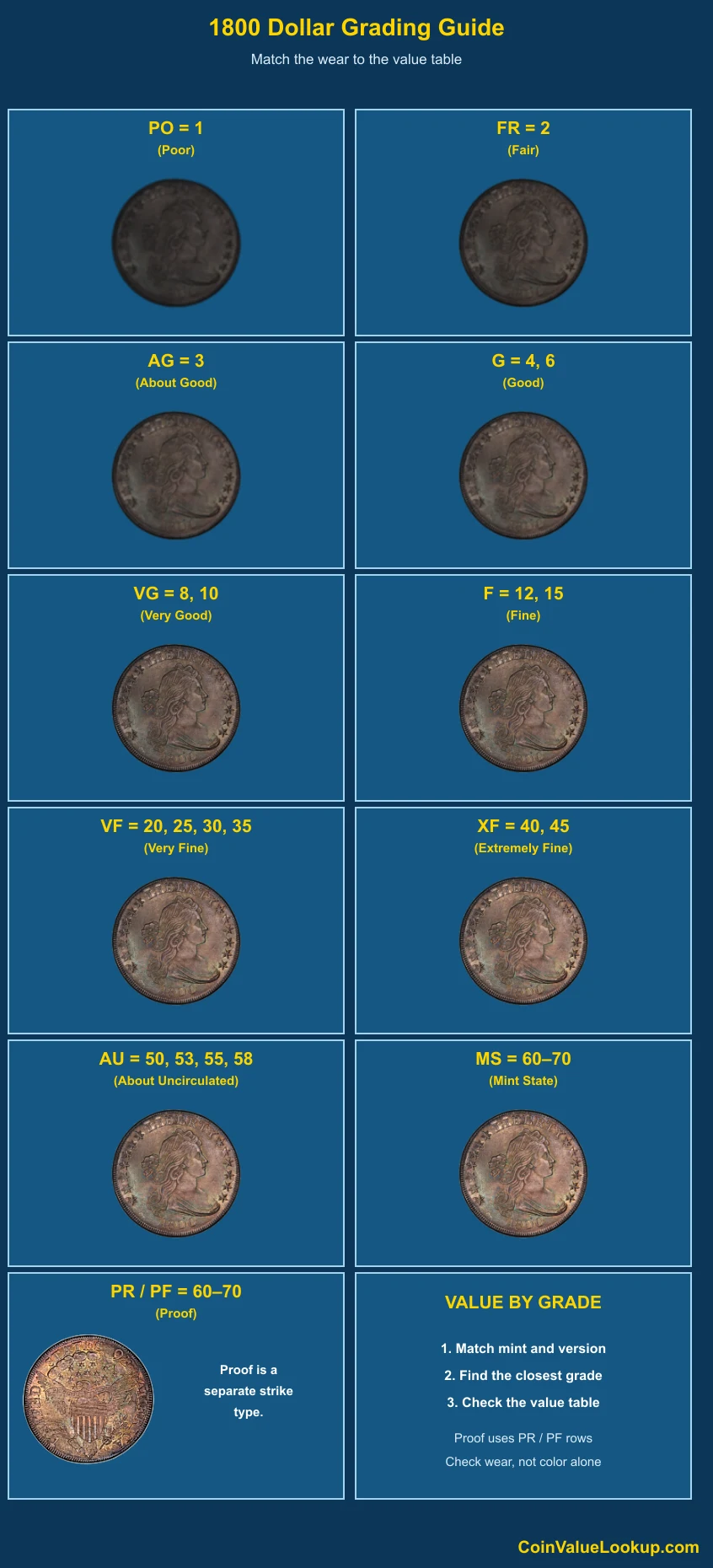
On an 1800 Draped Bust Dollar, wear shows up first in predictable places. Look at Liberty's hair above her forehead and just behind her ear — on a well-circulated coin those strands merge into a flat, featureless area.
The drapery across her bust loses its fine folds next.
On the reverse, the eagle's breast feathers flatten early. A moderately worn coin will still show the shield lines clearly but lose the soft detail in the wings.
One trap with these early dollars: weak strikes are common. A coin can be technically uncirculated yet still lack sharp detail because the dies didn't fully impress the planchet.
Compare the high points against the fields — luster in the protected areas around the stars and letters is the giveaway for a coin that simply wasn't struck hard versus one that actually circulated.
Use the comparison image to see how a circulated example, an About Uncirculated piece, and a Mint State coin differ in these specific zones. Cleaning, polishing, or artificial toning will hurt a coin's grade and reduce its comparability to published references, so original surfaces matter a great deal on a coin this old.
Step 3: Check 1800 Draped Bust Dollar Value by Mint and Version
1800 Draped Bust Dollar
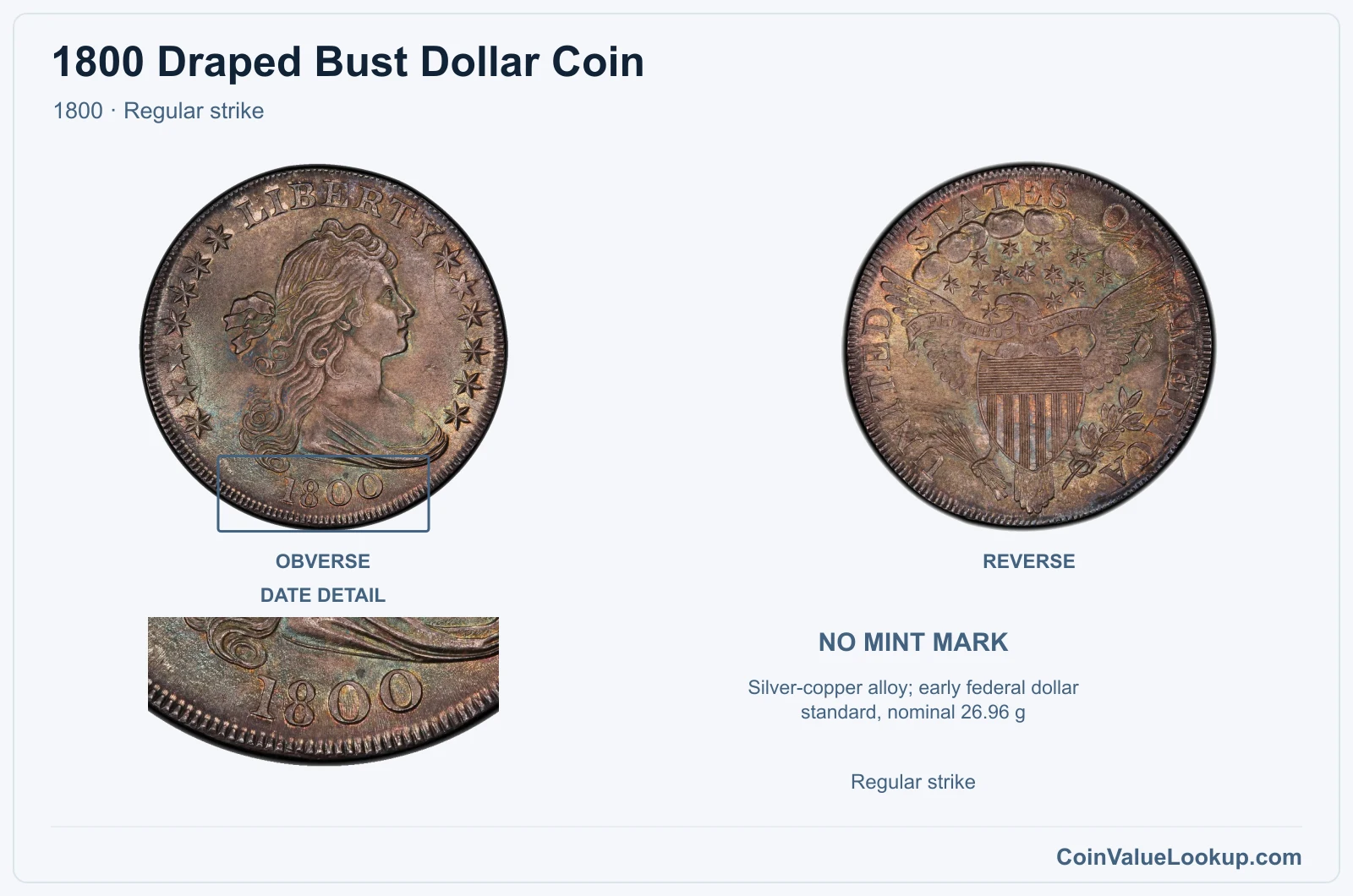
The baseline 1800 Draped Bust Dollar carries the standard Heraldic Eagle reverse without any of the recognized die peculiarities found on the named varieties. Liberty faces right on the obverse with stars and the date; the reverse eagle holds arrows and an olive branch beneath a constellation of stars and the motto.
Because this is an early federal silver dollar, its value depends entirely on authenticated identity and preservation. Coins with original, uncleaned surfaces command stronger interest than examples that have been polished or harshly cleaned.
There is no single reliable price range to quote here — professional grading and authentication are the practical first steps for any 1800 dollar.
Range Grade
Price Auction Records Appraisal PO PO 1
—
Coin Identifier FR FR 2
Coin Identifier AG AG 3
Coin Identifier G G 4
Coin Identifier
G 6
Coin Identifier VG VG 8
Coin Identifier
VG 10
Coin Identifier F F 12
Coin Identifier
F 15
Coin Identifier VF VF 20
Coin Identifier
VF 25
Coin Identifier
VF 30
Coin Identifier
VF 35
Coin Identifier XF XF 40
Coin Identifier
XF 45
Coin Identifier AU AU 50
Coin Identifier
AU 53
Coin Identifier
AU 55
Coin Identifier
AU 58
Coin Identifier MS MS 60
—
Coin Identifier
MS 61
Coin Identifier
MS 62
Coin Identifier
MS 63
Coin Identifier
MS 64
Coin Identifier
MS 65
Coin Identifier
MS 66
—
—
—
MS 67
—
—
—
MS 68
—
—
—
MS 69
—
—
—
MS 70
—
—
—
1800 Draped Bust Dollar — Dotted Date
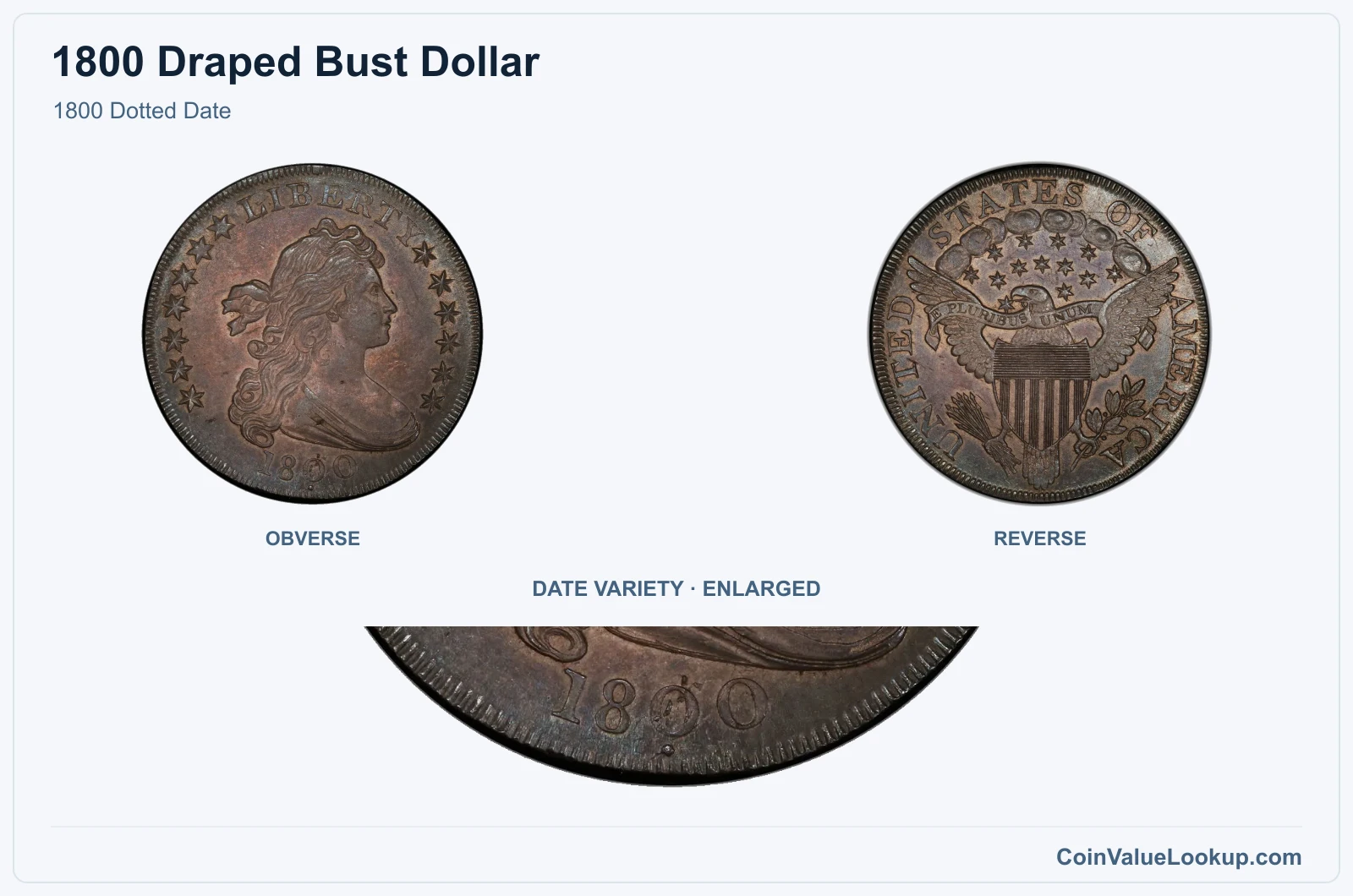
The 1800 Dotted Date variety is identified by small raised dots that appear in or near the date numerals. These dots resulted from a die anomaly during production and are visible under moderate magnification.
You will want a loupe or a good macro photo to confirm them.
This variety shares the same Draped Bust obverse and Heraldic Eagle reverse as the standard 1800 dollar. The silver-copper alloy and nominal 26.96-gram weight are identical.
What sets it apart is purely the die state.
Coin Value Lookup is a good starting point if you want to look up guides for other early dollar dates and varieties while researching your coin.
Value depends on the coin's authenticated condition and the quality of its original surfaces. No standard price range applies across the board — each piece needs individual professional evaluation.
Range Grade
Price Auction Records Appraisal PO PO 1
—
Coin Identifier FR FR 2
—
Coin Identifier AG AG 3
—
Coin Identifier G G 4
—
Coin Identifier
G 6
Coin Identifier VG VG 8
Coin Identifier
VG 10
—
Coin Identifier F F 12
Coin Identifier
F 15
Coin Identifier VF VF 20
Coin Identifier
VF 25
Coin Identifier
VF 30
Coin Identifier
VF 35
Coin Identifier XF XF 40
Coin Identifier
XF 45
Coin Identifier AU AU 50
Coin Identifier
AU 53
Coin Identifier
AU 55
Coin Identifier
AU 58
Coin Identifier MS MS 60
—
Coin Identifier
MS 61
—
Coin Identifier
MS 62
Coin Identifier
MS 63
Coin Identifier
MS 64
Coin Identifier
MS 65
—
—
—
MS 66
—
—
—
MS 67
—
—
—
MS 68
—
—
—
MS 69
—
—
—
MS 70
—
—
—
1800 Draped Bust Dollar — 12 Arrows
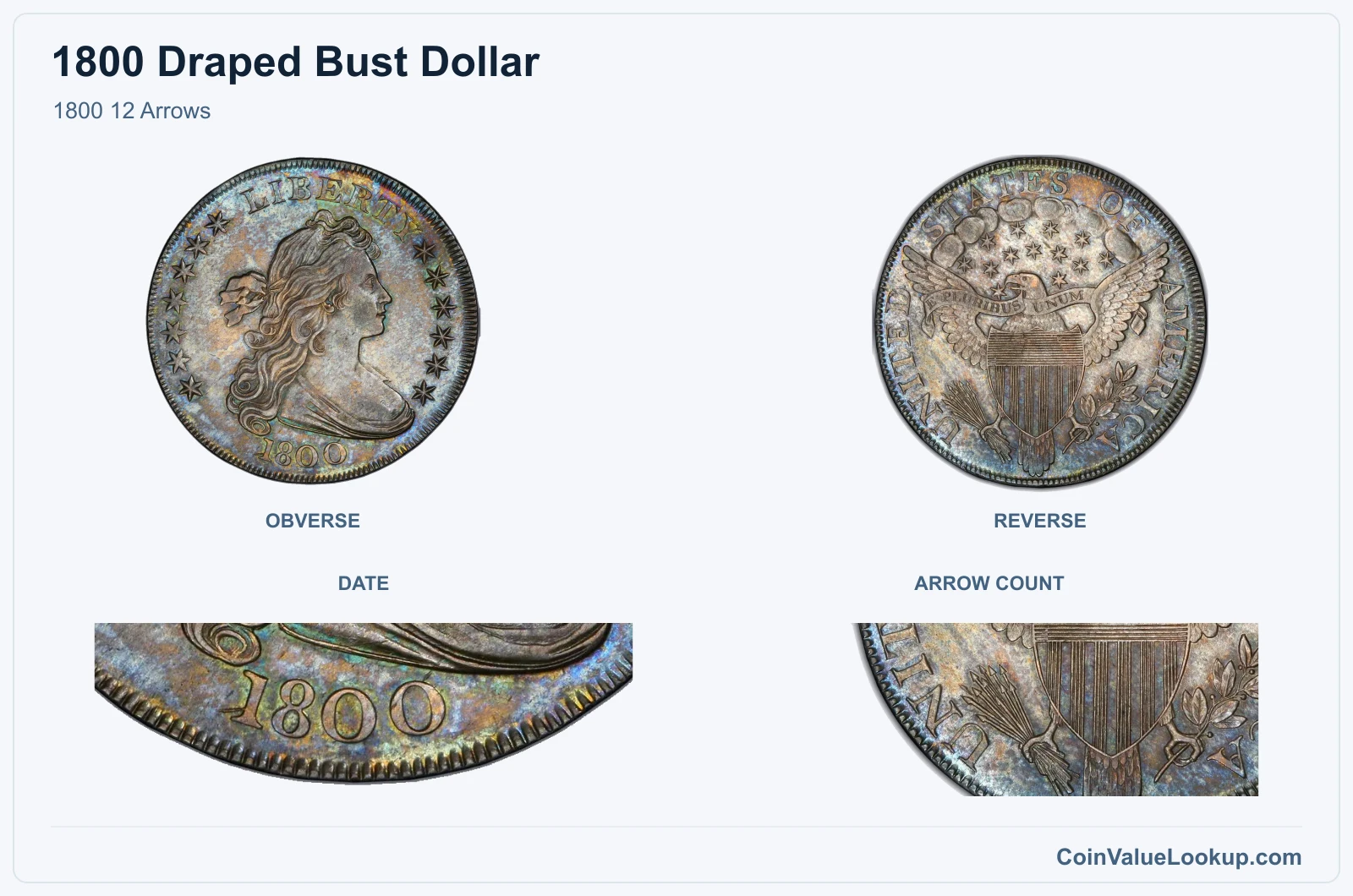
On most 1800 Draped Bust Dollars the eagle clutches 13 arrows, but the 12 Arrows variety uses a die with one fewer arrow in the talon. You need to count carefully, ideally with magnification, because the arrows can overlap and a quick glance might mislead you.
The rest of the design is the standard Heraldic Eagle reverse paired with the Draped Bust obverse. All were struck in Philadelphia from the same silver-copper alloy at the nominal 26.96-gram weight.
As with every 1800 dollar, value hinges on confirmed identity and grade. Cleaning or tooling reduces any premium the variety might otherwise carry.
Professional authentication and grading are the reliable way to establish what a specific 12 Arrows example is worth.
Range Grade
Price Auction Records Appraisal PO PO 1
—
Coin Identifier FR FR 2
—
Coin Identifier AG AG 3
—
Coin Identifier G G 4
—
Coin Identifier
G 6
Coin Identifier VG VG 8
Coin Identifier
VG 10
Coin Identifier F F 12
Coin Identifier
F 15
Coin Identifier VF VF 20
Coin Identifier
VF 25
Coin Identifier
VF 30
Coin Identifier
VF 35
Coin Identifier XF XF 40
Coin Identifier
XF 45
Coin Identifier AU AU 50
Coin Identifier
AU 53
Coin Identifier
AU 55
Coin Identifier
AU 58
Coin Identifier MS MS 60
—
Coin Identifier
MS 61
Coin Identifier
MS 62
Coin Identifier
MS 63
Coin Identifier
MS 64
—
—
—
MS 65
—
—
—
MS 66
—
—
—
MS 67
—
—
—
MS 68
—
—
—
MS 69
—
—
—
MS 70
—
—
—
1800 Draped Bust Dollar — 10 Arrows
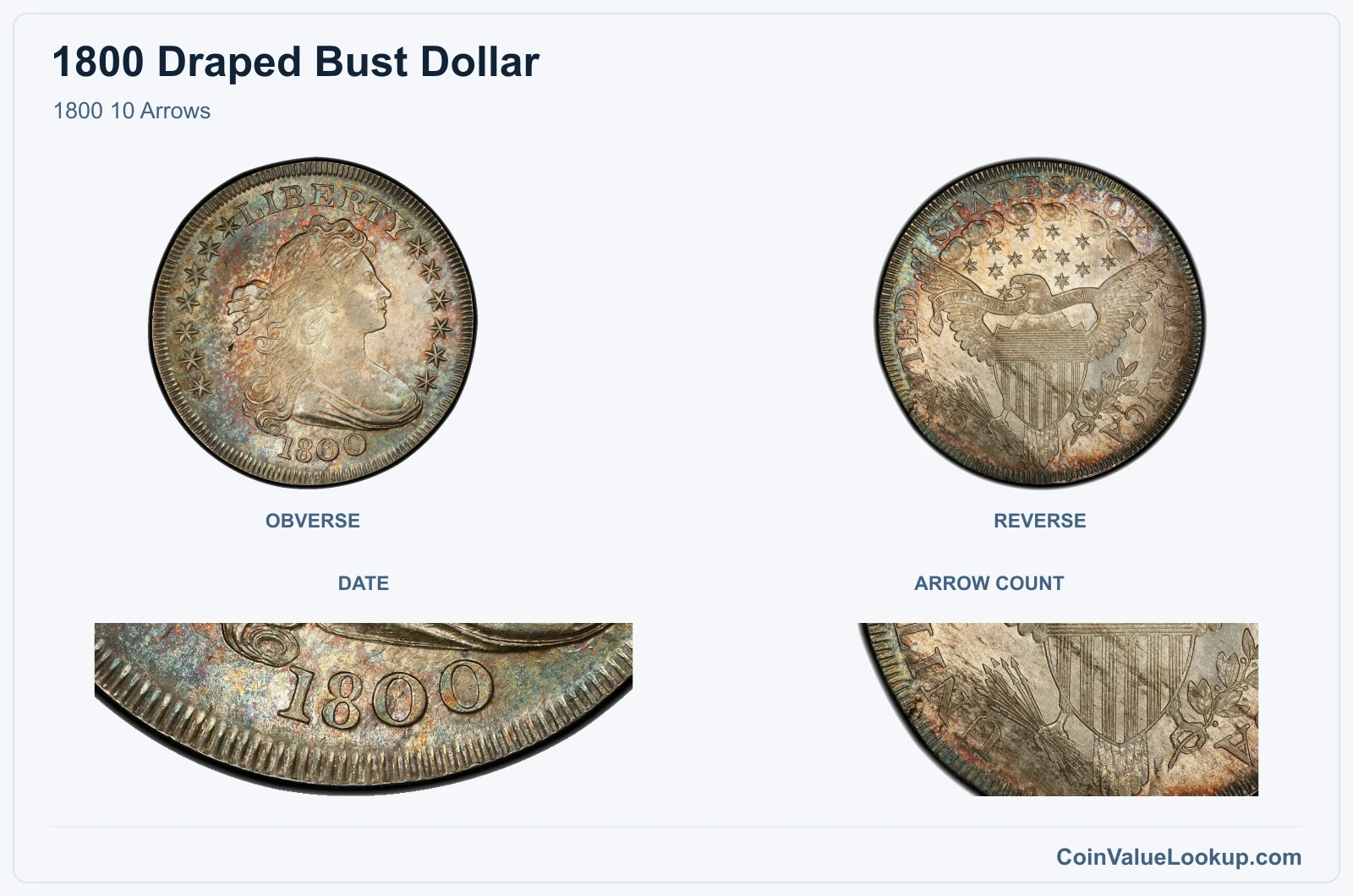
The 10 Arrows variety is the lowest arrow count among 1800 Draped Bust Dollars. Instead of the typical cluster, the eagle holds just 10 arrows in its talon.
Counting them requires patience — the engraving is small and the arrows bunch together, especially on worn coins.
This variety uses the same Heraldic Eagle reverse design and Draped Bust obverse as the rest of the 1800 series. Philadelphia struck all of them from the standard silver-copper alloy at a nominal 26.96 grams.
Because no supported price range exists for a blanket quote, the practical advice is to have the coin authenticated and graded individually. Original surfaces and the degree of remaining detail are what move the needle on any early dollar.
Range Grade
Price Auction Records Appraisal PO PO 1
—
Coin Identifier FR FR 2
—
Coin Identifier AG AG 3
—
Coin Identifier G G 4
—
Coin Identifier
G 6
—
Coin Identifier VG VG 8
Coin Identifier
VG 10
Coin Identifier F F 12
Coin Identifier
F 15
Coin Identifier VF VF 20
Coin Identifier
VF 25
Coin Identifier
VF 30
Coin Identifier
VF 35
Coin Identifier XF XF 40
Coin Identifier
XF 45
Coin Identifier AU AU 50
Coin Identifier
AU 53
Coin Identifier
AU 55
Coin Identifier
AU 58
Coin Identifier MS MS 60
—
Coin Identifier
MS 61
—
Coin Identifier
MS 62
—
Coin Identifier
MS 63
—
—
—
MS 64
—
—
—
MS 65
—
—
—
MS 66
—
—
—
MS 67
—
—
—
MS 68
—
—
—
MS 69
—
—
—
MS 70
—
—
—
1800 Draped Bust Dollar — AMERICAI
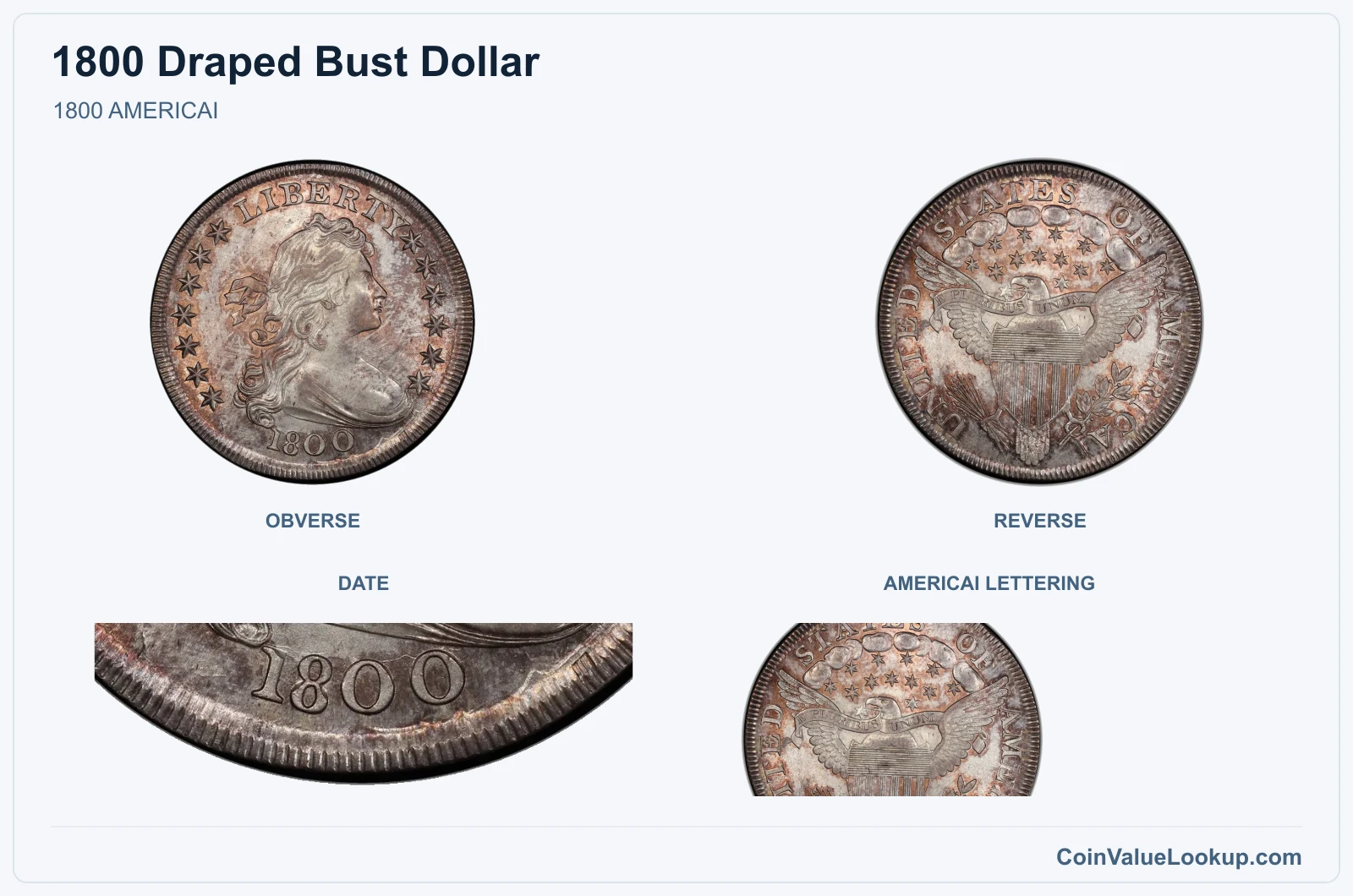
The AMERICAI variety gets its name from a die defect that makes the final "A" in AMERICA look like the letter "I." The vertical strokes of the "A" either merged or the crossbar filled in during die use, leaving what reads as AMERICAI on the reverse legend. A loupe makes confirmation straightforward.
Everything else matches the standard 1800 issue: Draped Bust obverse, Heraldic Eagle reverse, Philadelphia mint, silver-copper alloy at 26.96 grams, and a lettered edge. The die anomaly is the entire distinction.
Collector interest in this variety comes from the visible, easy-to-describe oddity in the inscription. That said, value still rests on authenticated identity and the coin's actual grade.
Polished or cleaned examples lose much of the variety premium that an original-surface coin would carry.
Range Grade
Price Auction Records Appraisal PO PO 1
—
Coin Identifier FR FR 2
—
Coin Identifier AG AG 3
—
Coin Identifier G G 4
—
Coin Identifier
G 6
Coin Identifier VG VG 8
Coin Identifier
VG 10
Coin Identifier F F 12
Coin Identifier
F 15
Coin Identifier VF VF 20
Coin Identifier
VF 25
Coin Identifier
VF 30
Coin Identifier
VF 35
Coin Identifier XF XF 40
Coin Identifier
XF 45
Coin Identifier AU AU 50
Coin Identifier
AU 53
Coin Identifier
AU 55
Coin Identifier
AU 58
Coin Identifier MS MS 60
—
Coin Identifier
MS 61
Coin Identifier
MS 62
Coin Identifier
MS 63
Coin Identifier
MS 64
Coin Identifier
MS 65
—
—
—
MS 66
—
—
—
MS 67
—
—
—
MS 68
—
—
—
MS 69
—
—
—
MS 70
—
—
—
1800 Draped Bust Dollar — Wide Date, Low 8
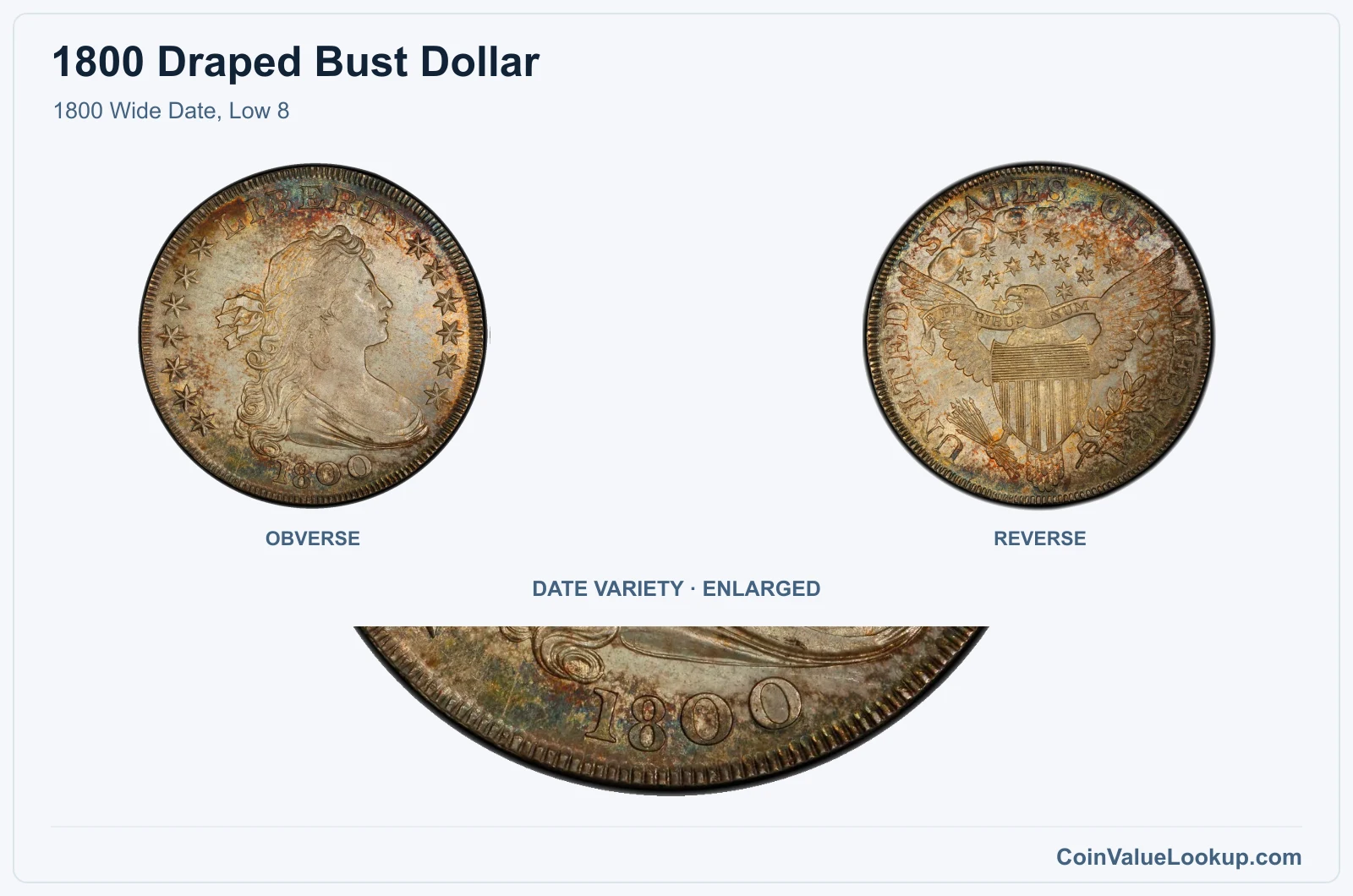
On the Wide Date, Low 8 variety, the four digits of the date are spaced farther apart than on the normal 1800 die, and the final "8" drops noticeably below the baseline of the other three numerals. You can often spot this with the naked eye once you know what to look for, but magnification confirms it quickly.
The design is otherwise standard: Draped Bust obverse, Heraldic Eagle reverse, lettered edge, struck in Philadelphia from the silver-copper alloy at 26.96 grams.
Like every 1800 dollar variety, this coin's value depends on its authenticated condition and surface originality. No blanket price range can be applied — individual professional assessment is the way to go.
Range Grade
Price Auction Records Appraisal PO PO 1
—
Coin Identifier FR FR 2
—
Coin Identifier AG AG 3
—
Coin Identifier G G 4
—
Coin Identifier
G 6
—
Coin Identifier VG VG 8
Coin Identifier
VG 10
—
Coin Identifier F F 12
Coin Identifier
F 15
Coin Identifier VF VF 20
Coin Identifier
VF 25
Coin Identifier
VF 30
Coin Identifier
VF 35
Coin Identifier XF XF 40
Coin Identifier
XF 45
Coin Identifier AU AU 50
Coin Identifier
AU 53
Coin Identifier
AU 55
Coin Identifier
AU 58
Coin Identifier MS MS 60
—
Coin Identifier
MS 61
—
Coin Identifier
MS 62
Coin Identifier
MS 63
Coin Identifier
MS 64
Coin Identifier
MS 65
—
—
—
MS 66
—
—
—
MS 67
—
—
—
MS 68
—
—
—
MS 69
—
—
—
MS 70
—
—
—