1795 Flowing Hair Dollar Coin Value: How Much Is It Worth?
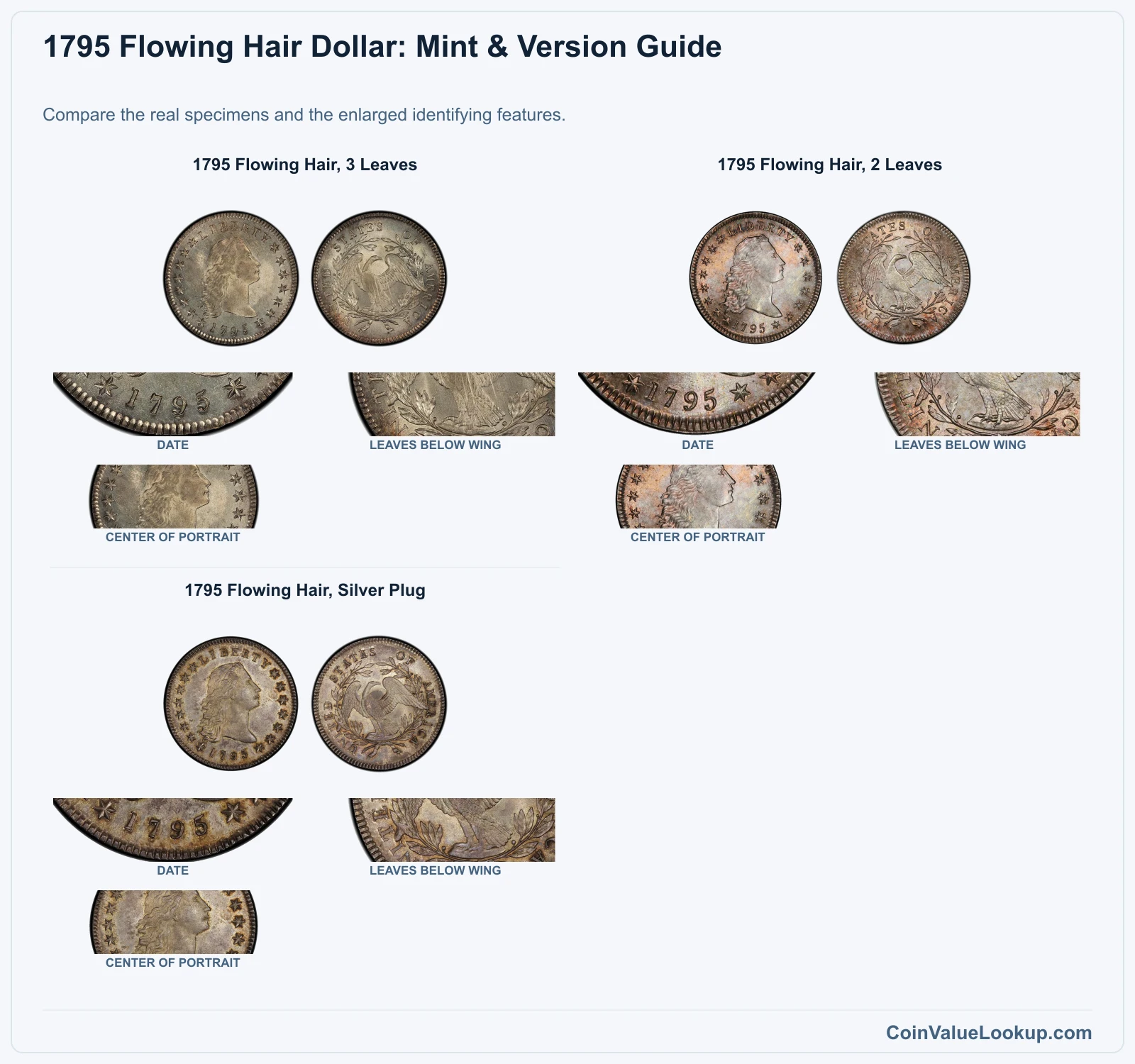
The 1795 Flowing Hair Dollar is one of the earliest silver dollars struck by the United States Mint. Guide estimates from USA Coin Book range from roughly $2,809 in well-worn Good-4 condition up to $1,838,941 for the rarest version in gem Mint State 65 — though these are reference anchors, not guaranteed offers for every coin.
Three distinct branches exist for this date: the 3 Leaves variety, the 2 Leaves variety, and the scarce Silver Plug. Identifying which version you hold, and whether the surfaces are original, matters far more than wishful thinking about grade.
Fast Way to Identify Your 1795 Flowing Hair Dollar
Upload clear photos of both the front and back of your coin for a preliminary identification. This helps narrow down the variety (leaf count, possible silver plug) and gives a starting point for condition assessment.
Good lighting at a slight angle reveals surface detail better than a direct flash, which can wash out the very wear patterns that matter most.
1795 Flowing Hair Dollar Value
Upload both sides of your 1795 Flowing Hair Dollar.
Front Obverse
Upload photo
Back Reverse
Upload photo
Which 1795 Flowing Hair Dollar Versions Are Worth Money?
- The Silver Plug variety commands the highest guide estimates, starting at $6,298 in G4 and reaching $1,838,941 in MS65, because it reflects a specific and scarce Mint production method.
- The 2 Leaves variety carries slightly higher top-end estimates than the 3 Leaves, with an MS65 guide value of $1,094,134 versus $971,128 for the 3 Leaves, both from USA Coin Book.
- Count the leaves beneath the eagle's wings carefully — the difference between the 2 Leaves and 3 Leaves varieties directly affects which price column applies to your coin.
- Original, uncleaned surfaces matter enormously at this level; a cleaned or polished example will not compare favorably to guide estimates for problem-free coins.
Step 1: Identify Your 1795 Flowing Hair Dollar Mint Mark and Version
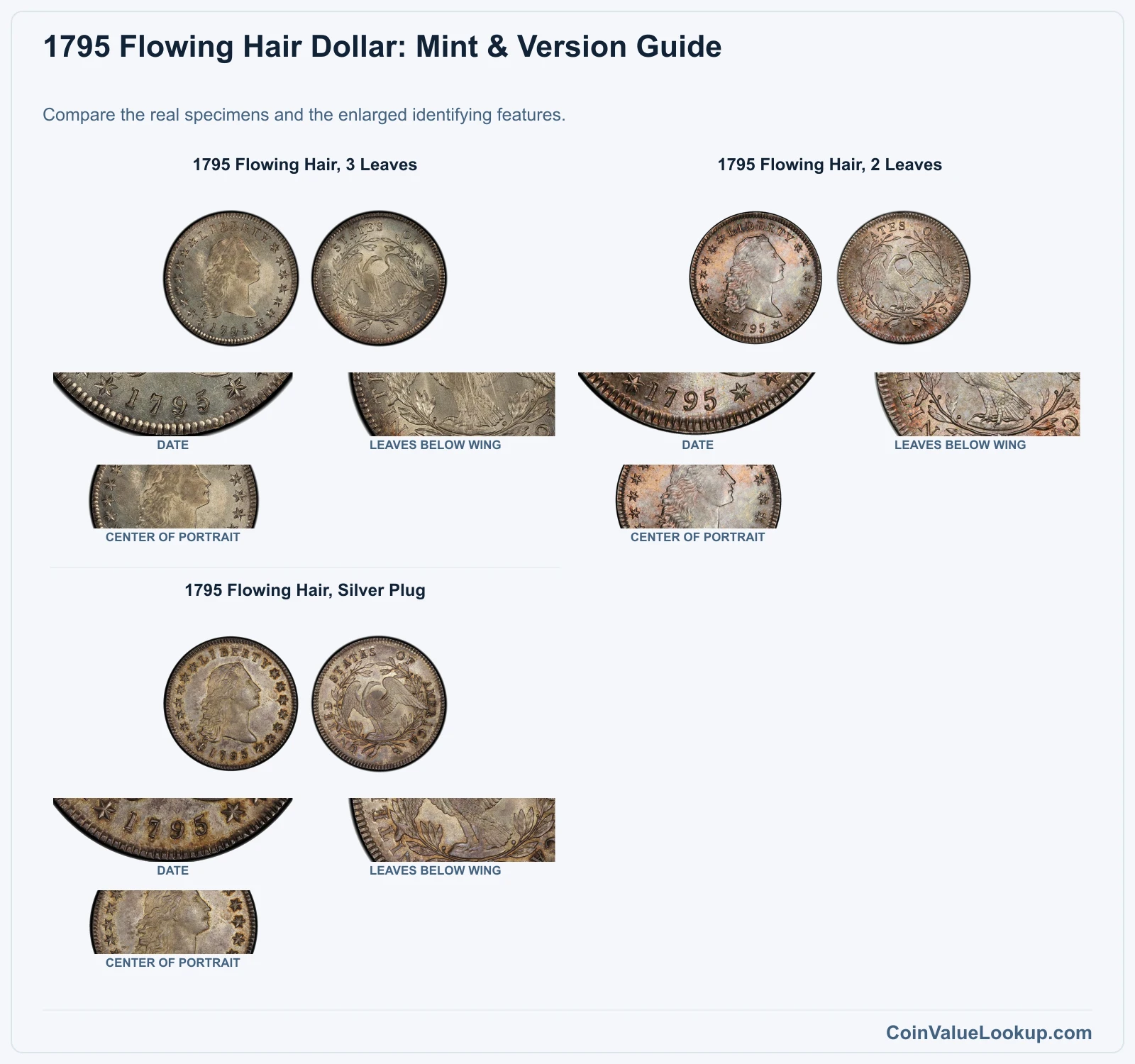
Every 1795 Flowing Hair Dollar was struck at Philadelphia — there is no mintmark to hunt for. The obverse shows Liberty facing right with hair flowing behind her, the date below.
The reverse features a small eagle perched within a wreath, surrounded by the words UNITED STATES OF AMERICA. The edge is lettered, not reeded, so check it carefully.
The material is a silver-copper alloy at the early federal standard, with a nominal weight of 26.96 grams. If your coin is noticeably light or the wrong color, that is a red flag worth investigating before you go further.
Three versions exist for 1795. The 3 Leaves variety has three leaves visible beneath each wing of the eagle in the wreath.
The 2 Leaves variety shows only two in the same area. Count them against a correctly attributed reference image — the difference is small but real.
The Silver Plug variety is entirely different: the Mint inserted a small silver plug into underweight planchets before striking to bring the coin up to the correct weight. This is a deliberate Mint adjustment, not a later hole repair, and it is visible as a circular area near the center of the coin.
Step 2: Check Your 1795 Flowing Hair Dollar Grade
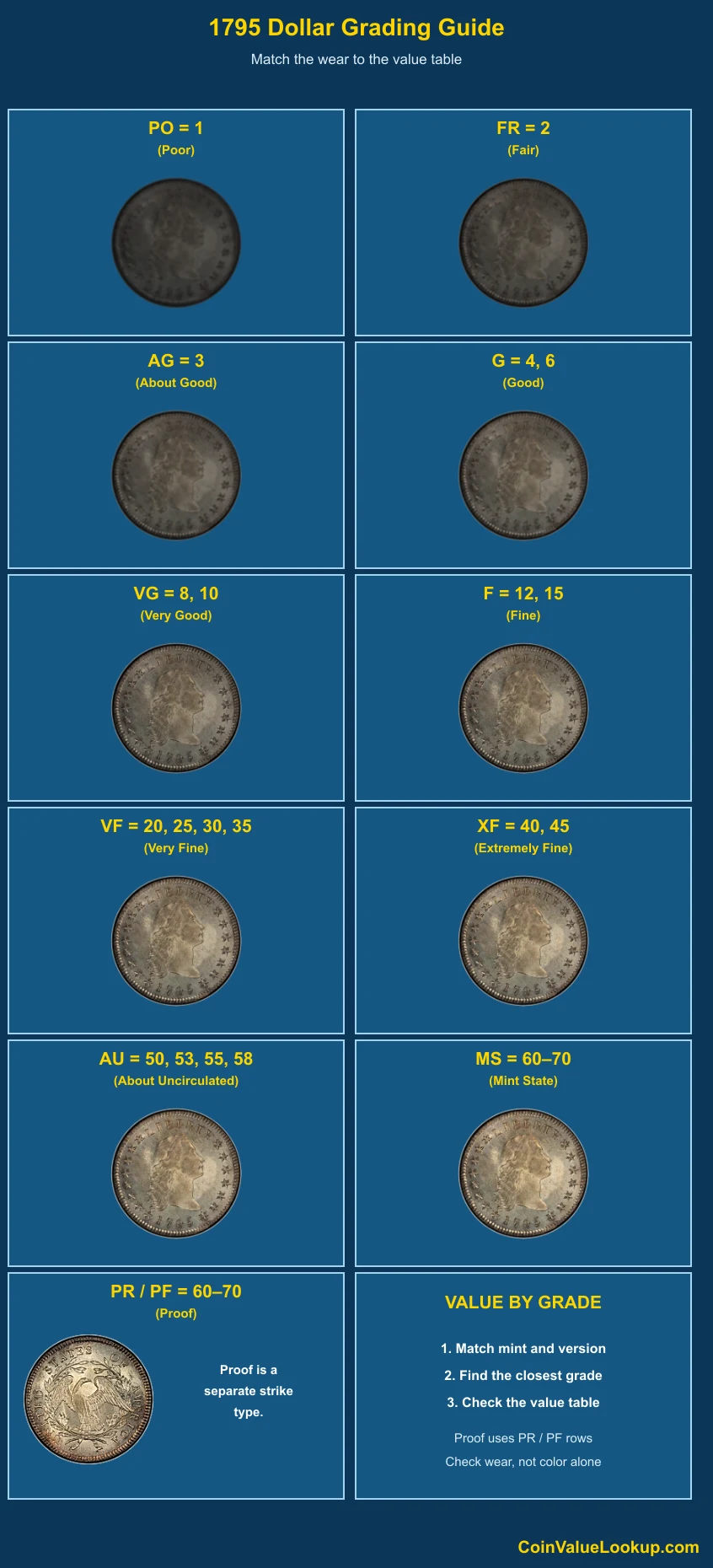
Focus on Liberty's hair detail first. On a well-worn example, the hair strands above and behind the ear merge into a flat area, and Liberty's cheek loses its roundness.
The higher the grade, the more individual strands remain visible, with luster still present in the protected areas between curls.
On the reverse, the eagle's breast feathers are the first to go. A coin in About Uncirculated condition will show only the slightest friction on the eagle's breast and the highest hair curls, with most original luster intact.
A true Mint State piece retains full luster across both sides, though early-date dollars were often weakly struck, so do not confuse a soft strike for wear.
Use the comparison image to see these wear differences side by side across circulated, AU, and Mint State grades. Early dollars also frequently show adjustment marks — file lines from the Mint reducing overweight planchets — which are original to the coin and should not be confused with post-strike damage.
Cleaning and polishing are common on coins this old and will reduce a coin's desirability and comparability to guide estimates.
Step 3: Check 1795 Flowing Hair Dollar Value by Mint and Version
1795 Flowing Hair Dollar — Flowing Hair, 3 Leaves
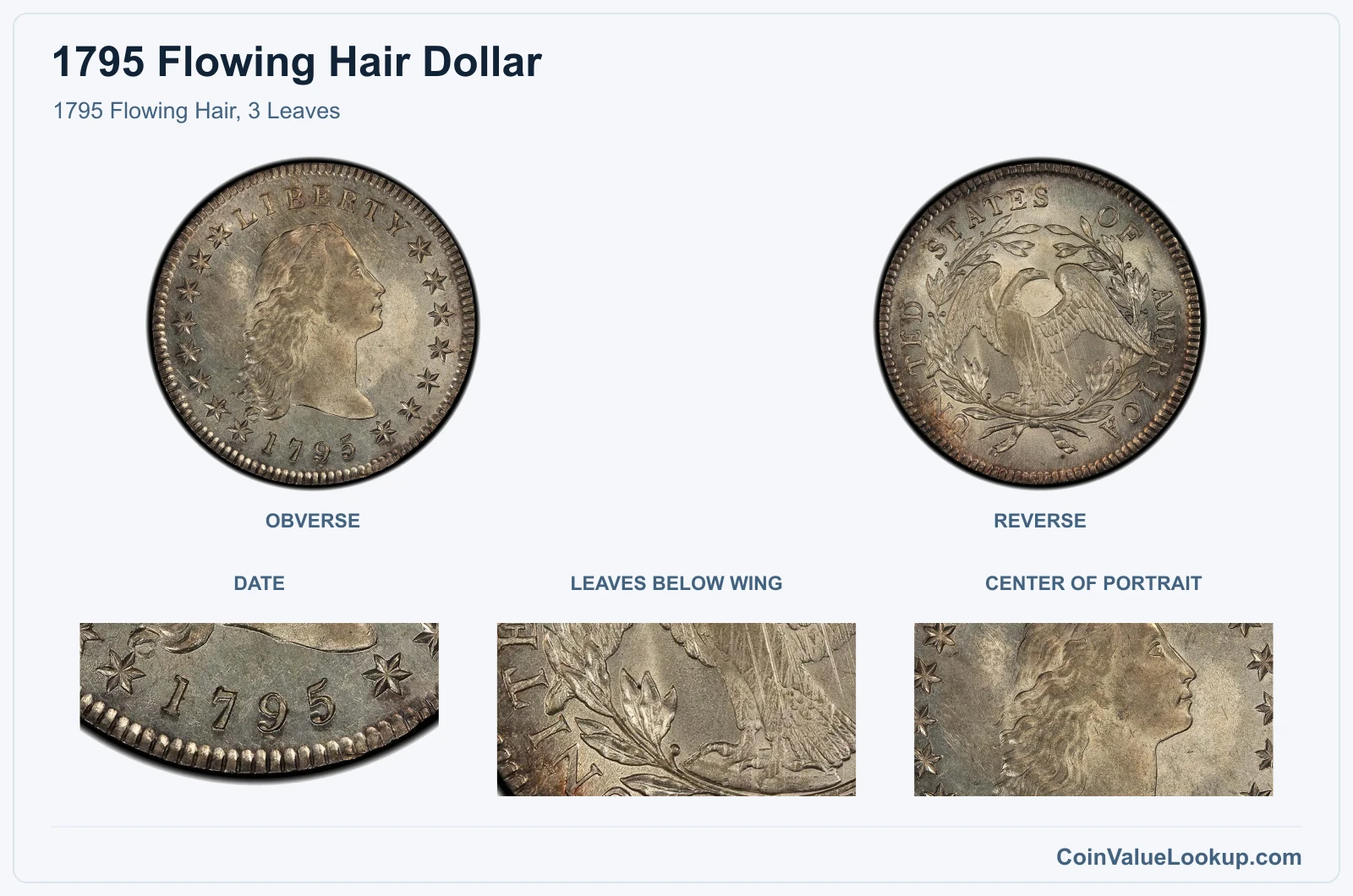
The 1795 Flowing Hair Dollar with 3 Leaves is identified by counting the leaves visible beneath each wing of the eagle within the wreath on the reverse. Three distinct leaves should be present on each side.
This is the more commonly encountered variety of the two leaf-count types.
USA Coin Book guide estimates place this version at approximately $2,809 in Good-4 and up to $971,128 in MS65. These are reference estimates, not purchase offers.
Original surfaces and accurate grading are essential before comparing your coin to these figures — a cleaned or damaged example will fall well below guide values regardless of its wear level.
Range Grade
Price Auction Records Appraisal PO PO 1
—
Coin Identifier FR FR 2
Coin Identifier AG AG 3
Coin Identifier G G 4
Coin Identifier
G 6
Coin Identifier VG VG 8
Coin Identifier
VG 10
Coin Identifier F F 12
Coin Identifier
F 15
Coin Identifier VF VF 20
Coin Identifier
VF 25
Coin Identifier
VF 30
Coin Identifier
VF 35
Coin Identifier XF XF 40
Coin Identifier
XF 45
Coin Identifier AU AU 50
Coin Identifier
AU 53
Coin Identifier
AU 55
Coin Identifier
AU 58
Coin Identifier MS MS 60
—
Coin Identifier
MS 61
Coin Identifier
MS 62
Coin Identifier
MS 63
Coin Identifier
MS 64
Coin Identifier
MS 65
—
Coin Identifier
MS 66
—
Coin Identifier
MS 67
—
—
—
MS 68
—
—
—
MS 69
—
—
—
MS 70
—
—
—
1795 Flowing Hair Dollar — Flowing Hair, 2 Leaves
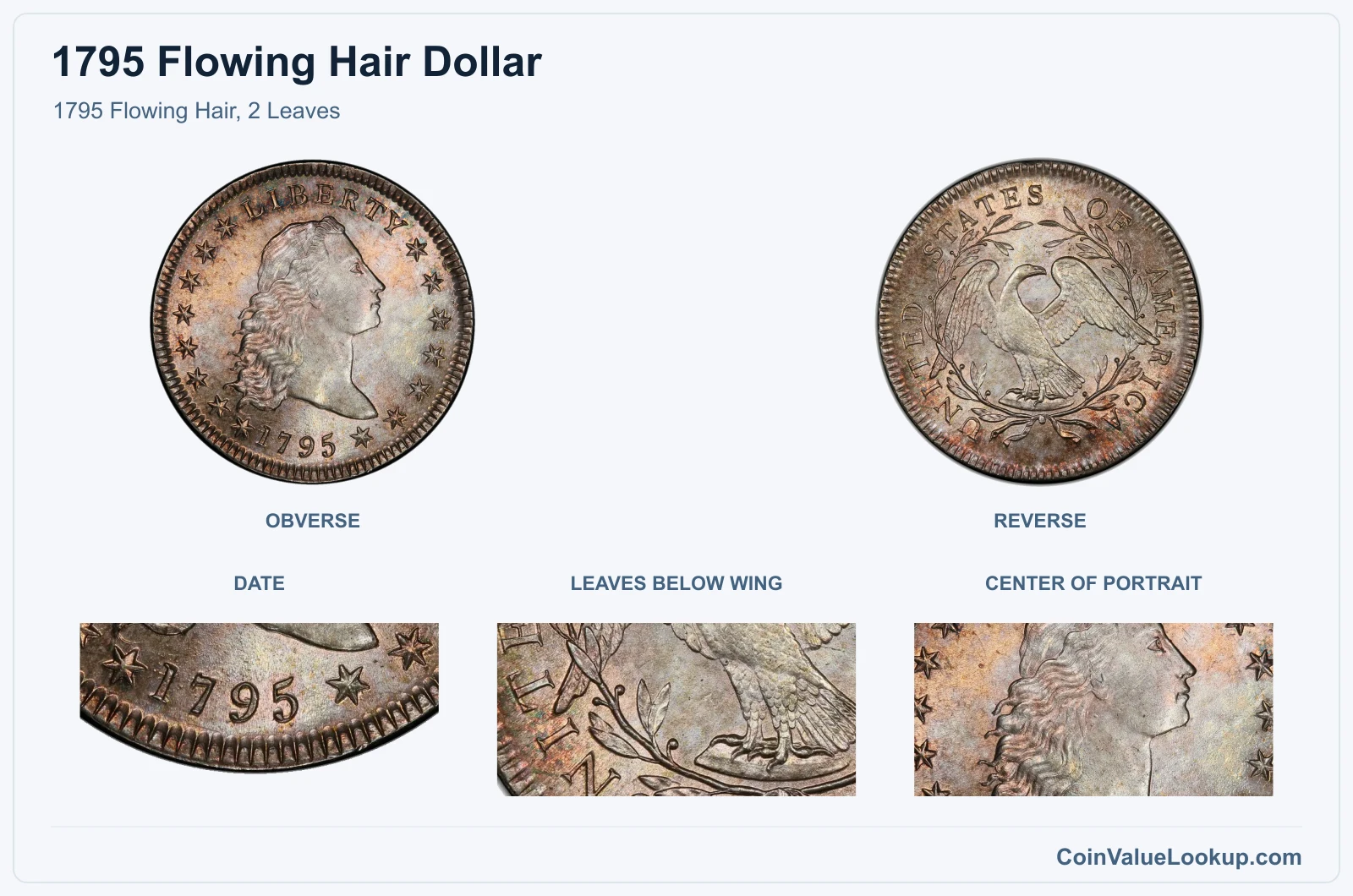
The 2 Leaves variety shows only two leaves beneath each wing on the reverse wreath, one fewer than the 3 Leaves version. The difference is subtle and easy to miss under poor lighting, so compare your coin directly against a confirmed attribution image.
Coin Value Lookup is a useful starting point when you want to look up guides for early American coinage like this one. Bookmark it for quick reference across different denominations and dates.
USA Coin Book estimates range from $2,809 in G4 to $1,094,134 in MS65. The slightly higher top-end estimate compared to the 3 Leaves reflects relative scarcity in upper grades, though both varieties are genuinely rare coins in any condition.
Range Grade
Price Auction Records Appraisal PO PO 1
Coin Identifier FR FR 2
—
Coin Identifier AG AG 3
—
Coin Identifier G G 4
Coin Identifier
G 6
Coin Identifier VG VG 8
Coin Identifier
VG 10
Coin Identifier F F 12
Coin Identifier
F 15
Coin Identifier VF VF 20
Coin Identifier
VF 25
Coin Identifier
VF 30
Coin Identifier
VF 35
Coin Identifier XF XF 40
Coin Identifier
XF 45
Coin Identifier AU AU 50
Coin Identifier
AU 53
Coin Identifier
AU 55
Coin Identifier
AU 58
Coin Identifier MS MS 60
—
Coin Identifier
MS 61
Coin Identifier
MS 62
Coin Identifier
MS 63
Coin Identifier
MS 64
—
Coin Identifier
MS 65
—
Coin Identifier
MS 66
—
—
—
MS 67
—
—
—
MS 68
—
—
—
MS 69
—
—
—
MS 70
—
—
—
1795 Flowing Hair Dollar — Flowing Hair, Silver Plug
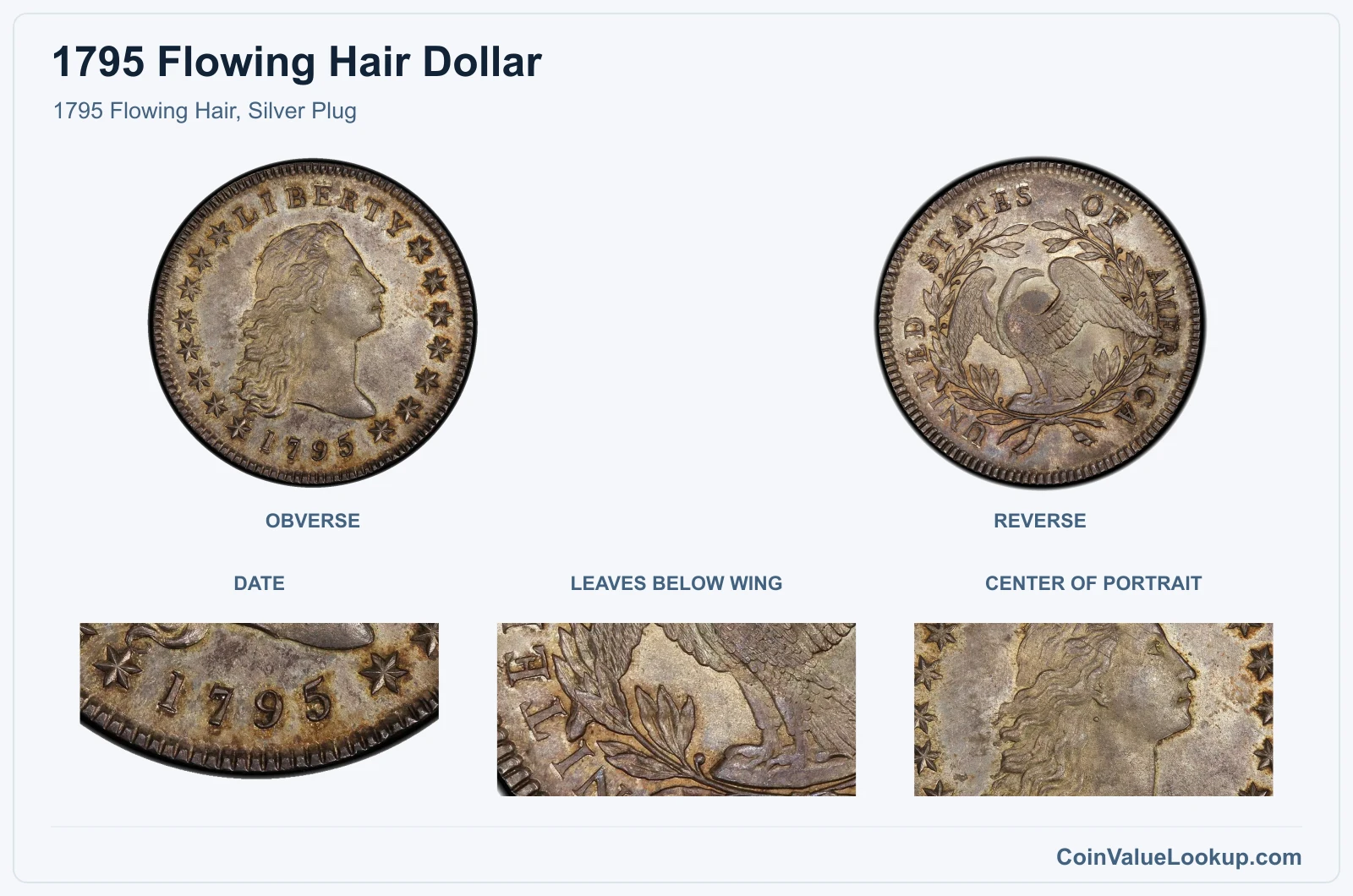
The Silver Plug variety is the most distinctive of the three 1795 branches. Before striking, the Philadelphia Mint inserted a small circular silver plug into underweight planchets to bring them up to the required 26.96-gram standard.
This plug is visible as a round area near the center of one or both sides. It is absolutely not a later hole repair — it is a deliberate, period-correct Mint adjustment.
Because this production method was used on only a fraction of the total mintage, surviving examples are scarce and highly prized. USA Coin Book guide estimates start at $6,298 in Good-4 and reach $1,838,941 in MS65.
Both central surfaces and clear evidence of the plug should be documented when seeking attribution. Be cautious of coins with plugged holes being misrepresented as Mint silver plugs — professional authentication is strongly recommended for this variety.
Range Grade
Price Auction Records Appraisal PO PO 1
—
Coin Identifier FR FR 2
—
Coin Identifier AG AG 3
—
Coin Identifier G G 4
—
Coin Identifier
G 6
—
Coin Identifier VG VG 8
—
Coin Identifier
VG 10
Coin Identifier F F 12
—
Coin Identifier
F 15
Coin Identifier VF VF 20
Coin Identifier
VF 25
Coin Identifier
VF 30
Coin Identifier
VF 35
Coin Identifier XF XF 40
—
Coin Identifier
XF 45
Coin Identifier AU AU 50
Coin Identifier
AU 53
—
Coin Identifier
AU 55
Coin Identifier
AU 58
—
Coin Identifier MS MS 60
—
Coin Identifier
MS 61
Coin Identifier
MS 62
—
Coin Identifier
MS 63
—
Coin Identifier
MS 64
—
Coin Identifier
MS 65
—
Coin Identifier
MS 66
—
—
—
MS 67
—
—
—
MS 68
—
—
—
MS 69
—
—
—
MS 70
—
—
—
1795 Flowing Hair Dollar Error List
1. 1795 Flowing Hair Dollar — Die Crack / Die Chip
Die cracks appear as thin raised lines on the coin's surface, caused by fractures in the steel die during striking. On a 1795 Flowing Hair Dollar, look for these raised lines running across design elements or connecting to the rim.
A die chip — a small raised blob — occurs when a piece of the die breaks away entirely, leaving a bump on the struck coin. A rim-connected break large enough to obliterate part of the design is sometimes called a cud.
Do not confuse die cracks with incuse scratches, surface corrosion, or foreign material stuck to the coin. Scratches are recessed into the surface, while die cracks are raised.
The value of a die crack or chip depends on its size, location, and visibility, as well as the overall condition of the coin. No specific price range is adopted here, so individual assessment by a knowledgeable dealer or grading service is the practical path forward.
2. 1795 Flowing Hair Dollar — Clashed Dies
Clashed dies occur when the obverse and reverse dies strike each other without a planchet between them. This transfers ghost-like impressions of one design onto the opposing die, which then appear as faint extra design elements on subsequently struck coins.
On a 1795 Flowing Hair Dollar, you might see traces of the wreath or eagle faintly impressed in the obverse fields, or hints of Liberty's hair in the reverse fields.
These clash marks align with where the opposing design would naturally fall during a normal strike. That alignment is the key diagnostic — random scratches, raised lines from other causes, or brockage errors will not match the expected position of the opposite die's features.
The value impact depends on how visible the clash is and the coin's overall condition. No adopted price range exists for this error on this date, so professional evaluation is recommended.