1869 Liberty Seated Dollar Coin Value: How Much Is It Worth?
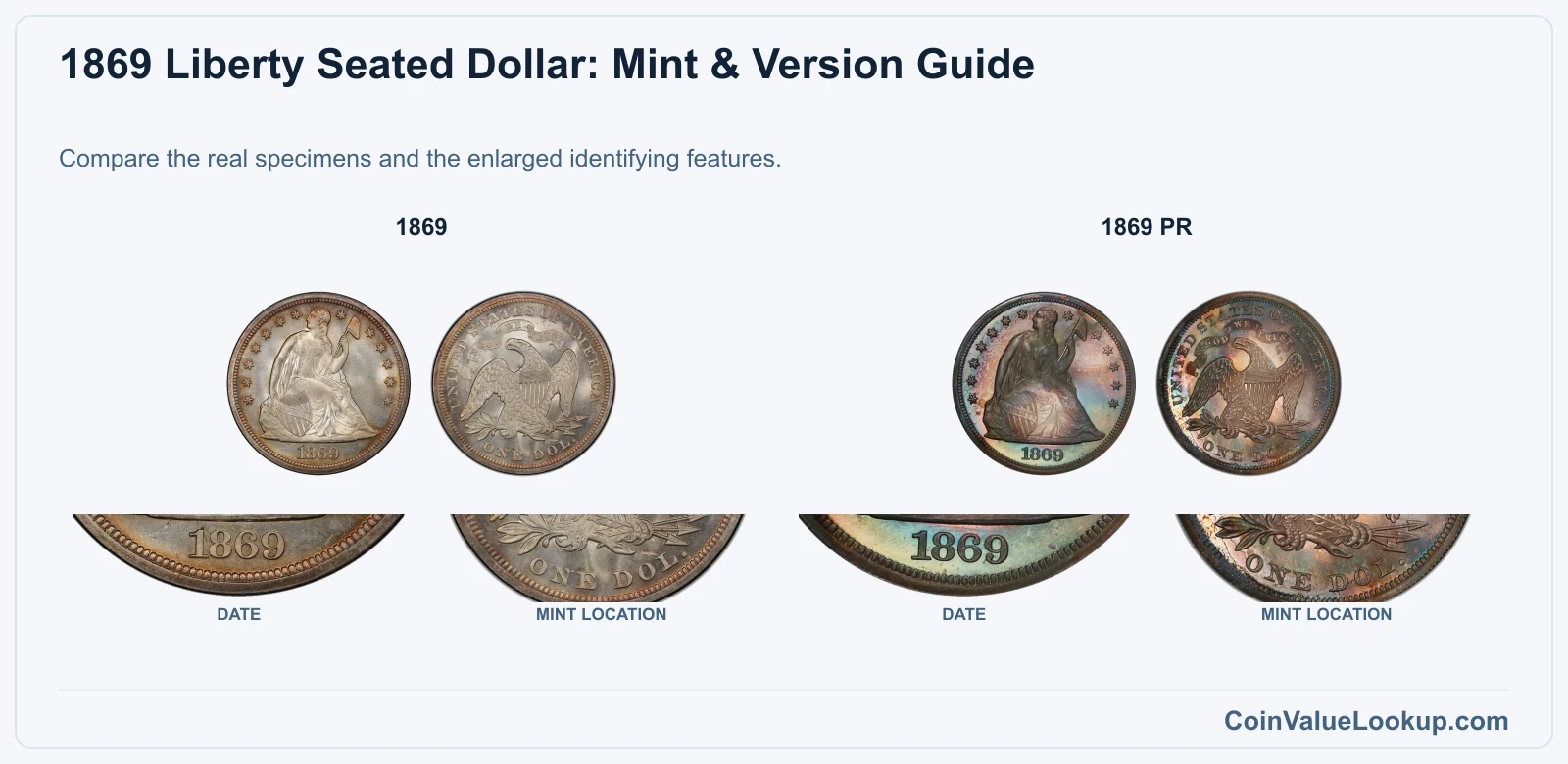
The 1869 Liberty Seated Dollar is a low-mintage silver dollar that draws steady collector interest. Guide estimates for business strikes range from about $478 in Good-4 condition to $6,445 in MS63, according to USA Coin Book.
Proof versions also exist and require individual assessment. Before assigning any value, confirm the mint, finish and specific version you hold — the difference matters more than a guess based on appearance alone.
Fast Way to Identify Your 1869 Liberty Seated Dollar
The quickest way to start identifying your 1869 Liberty Seated Dollar is to upload clear photos of both the front and back of your coin. Our identifier can offer a preliminary read on which version you may have based on design details, mintmark presence and overall condition.
Sharp, well-lit images help distinguish a business strike from a proof finish.
1869 Liberty Seated Dollar Value
Upload both sides of your 1869 Liberty Seated Dollar.
Front Obverse
Upload photo
Back Reverse
Upload photo
Which 1869 Liberty Seated Dollar Versions Are Worth Money?
- The 1869 Proof is a distinct manufacturing finish worth confirming through authentication, as proofs carry separate collector demand from business strikes.
- A business strike in MS63 condition carries a guide estimate around $6,445, making high-grade survivors the ones to watch for.
Step 1: Identify Your 1869 Liberty Seated Dollar Mint Mark and Version
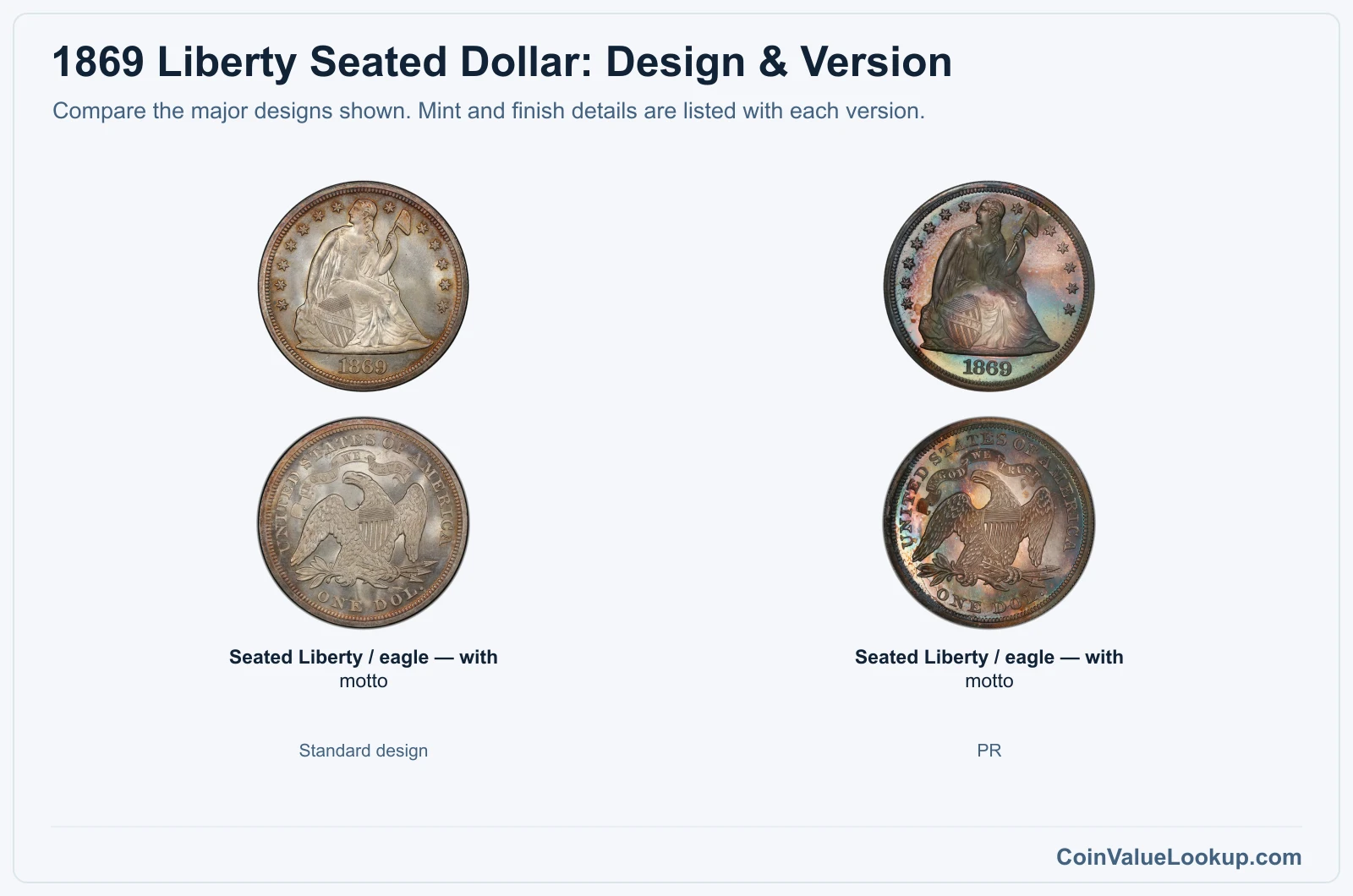
All 1869 Liberty Seated Dollars were struck at Philadelphia, so there is no mintmark to look for. On branch-mint Seated Dollars from other years, a small letter appears on the reverse below the eagle and above the ONE DOL.
denomination — but for 1869, its absence is expected, not special.
The coin is 90% silver and 10% copper, with a nominal weight of 26.73 grams. The obverse shows Liberty seated on a rock, holding a pole topped with a liberty cap, with a shield at her side.
The reverse features an eagle with the motto IN GOD WE TRUST on a banner above.
Two distinct versions exist for this date: the regular 1869 business strike and the 1869 Proof. These are fundamentally different products.
A proof is a specific manufacturing finish involving specially prepared dies and planchets — it is not simply a well-preserved or shiny regular coin. Telling them apart requires careful examination of the surfaces and strike characteristics, ideally with the help of experienced eyes or a grading service.
Step 2: Check Your 1869 Liberty Seated Dollar Grade
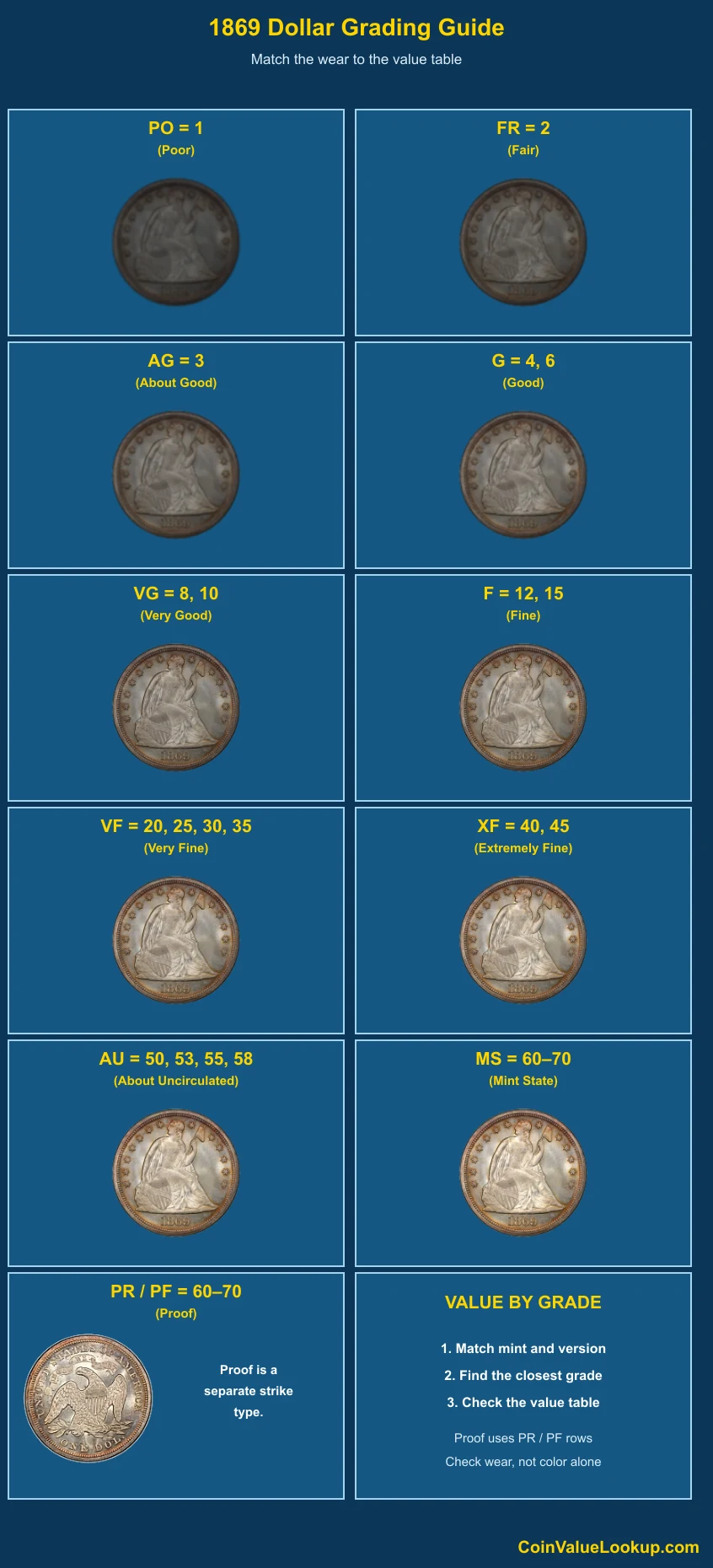
When grading your 1869 Liberty Seated Dollar, focus on the high points that wear first. On the obverse, check Liberty's head, breast, knee and the lines of the shield.
These areas lose detail in a predictable sequence as a coin circulates. On the reverse, examine the eagle's breast feathers and wing tips for softness or flatness.
Don't judge a single area in isolation. Some dies struck certain features weakly from the start, so a flat head does not automatically mean heavy wear if the rest of the coin is sharp.
Look at the overall picture.
The comparison image shows circulated, About Uncirculated and Mint State examples side by side. Use it to gauge where your coin falls.
Proof coins should be evaluated separately — their mirrored fields and sharp rims are manufacturing features, not evidence of a higher grade than Mint State.
Original surfaces matter a great deal. Cleaning, polishing or artificial toning reduces a coin's desirability and grade.
A lightly worn coin with original toning is often more collectible than a harshly cleaned example that looks superficially brighter.
Step 3: Check 1869 Liberty Seated Dollar Value by Mint and Version
1869 Liberty Seated Dollar
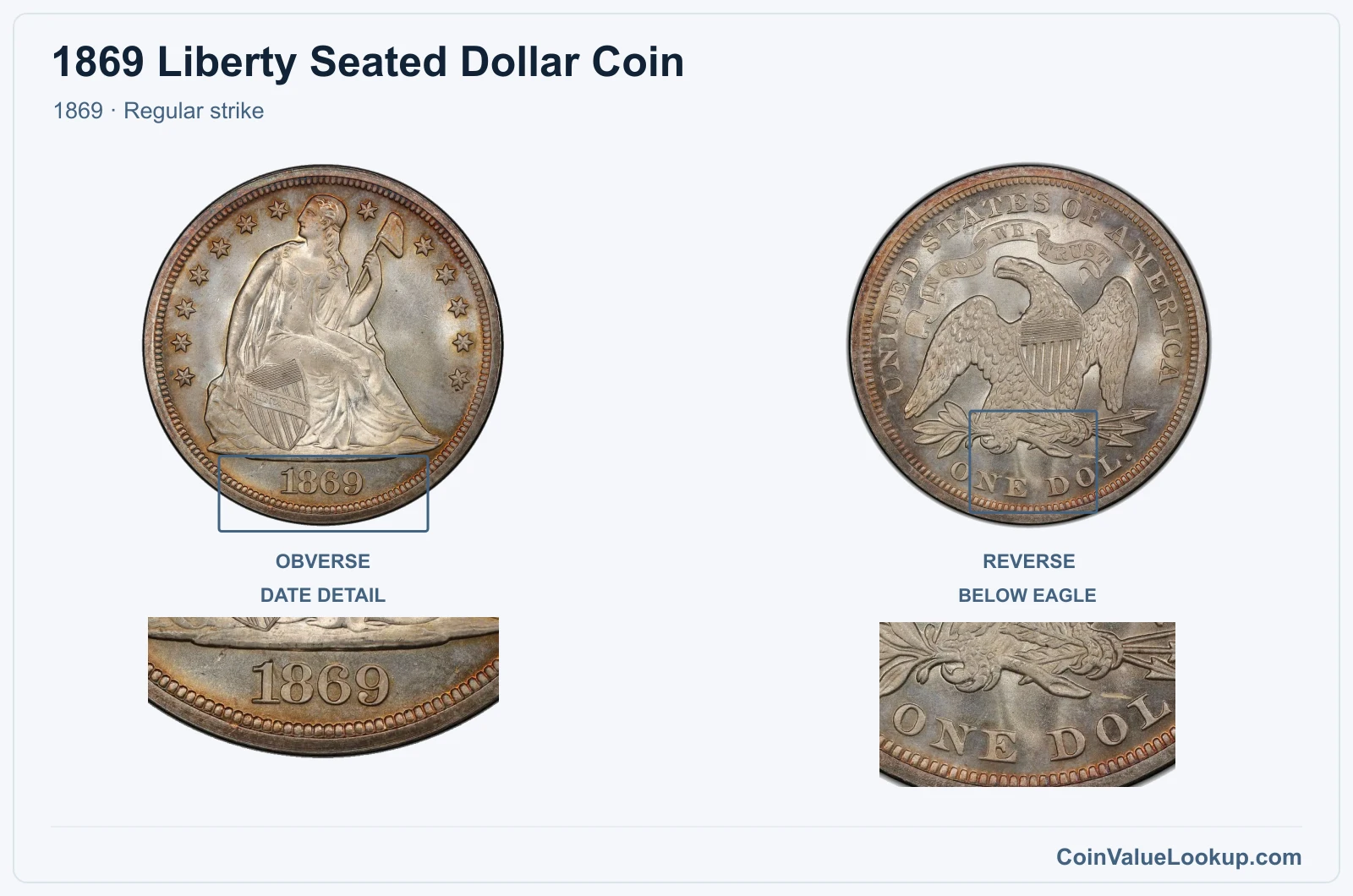
The 1869 business strike was produced at Philadelphia with no mintmark. It features the Seated Liberty obverse and eagle reverse with the IN GOD WE TRUST motto.
In well-worn Good-4 condition, USA Coin Book estimates the value at roughly $478. At the high end, an MS63 example carries a guide estimate of about $6,445.
These are guide figures, not guaranteed sale prices. Actual value depends on originality, surface quality and eye appeal.
Cleaned or damaged coins trade well below these benchmarks. Confirm your coin has original surfaces and matches this specific date and design before comparing grades.
Coin Value Lookup is a good starting point if you want to look up guides for other dates and denominations in the Seated Dollar series or beyond.
Range Grade
Price Auction Records Appraisal PO PO 1
—
Coin Identifier FR FR 2
—
Coin Identifier AG AG 3
—
Coin Identifier G G 4
Coin Identifier
G 6
Coin Identifier VG VG 8
Coin Identifier
VG 10
Coin Identifier F F 12
Coin Identifier
F 15
Coin Identifier VF VF 20
Coin Identifier
VF 25
Coin Identifier
VF 30
Coin Identifier
VF 35
Coin Identifier XF XF 40
Coin Identifier
XF 45
Coin Identifier AU AU 50
Coin Identifier
AU 53
Coin Identifier
AU 55
Coin Identifier
AU 58
Coin Identifier MS MS 60
Coin Identifier
MS 61
Coin Identifier
MS 62
Coin Identifier
MS 63
Coin Identifier
MS 64
Coin Identifier
MS 65
Coin Identifier
MS 66
Coin Identifier
MS 67
—
—
—
MS 68
—
—
—
MS 69
—
—
—
MS 70
—
—
—
1869 Liberty Seated Dollar — PR
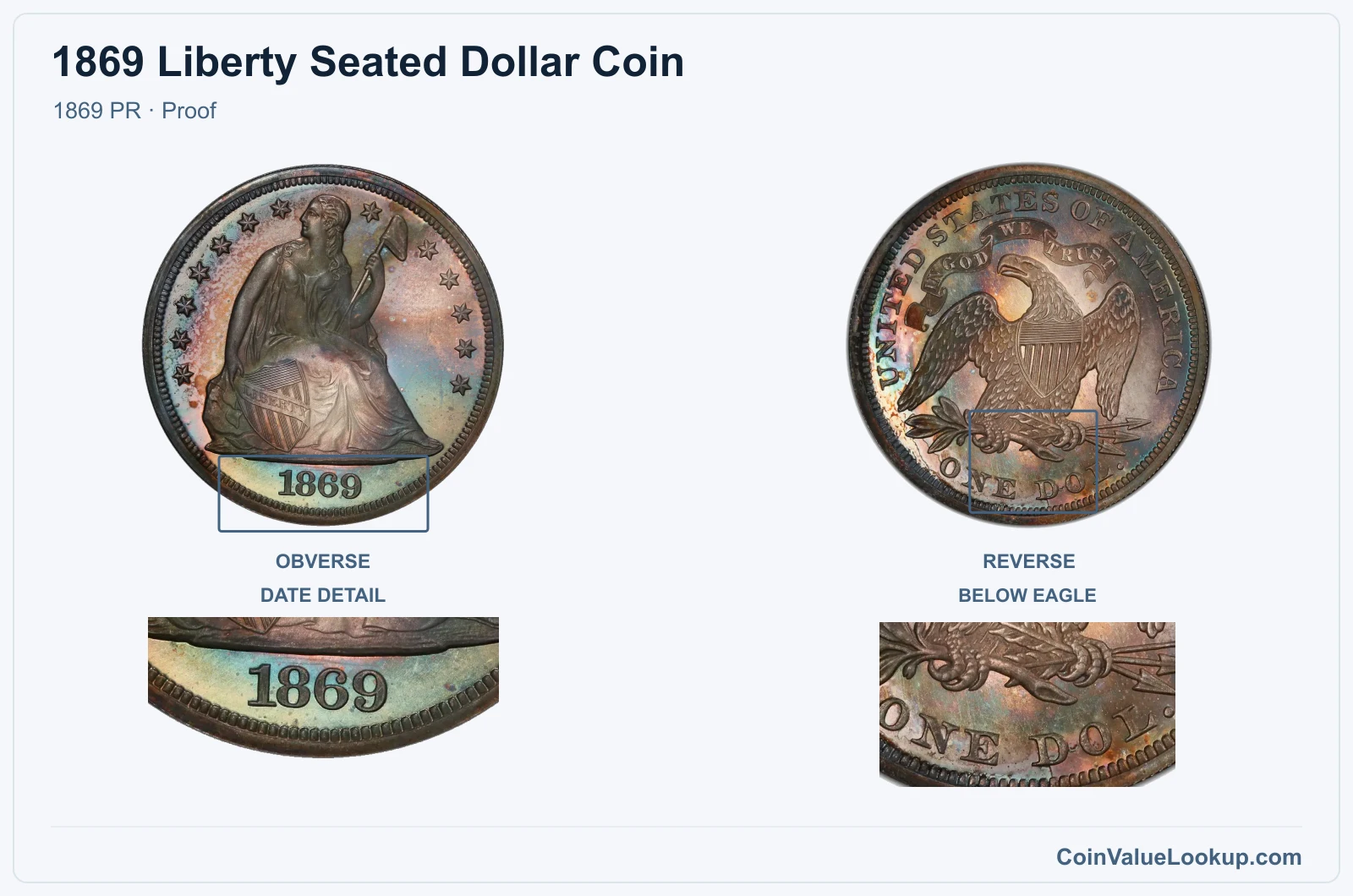
The 1869 Proof was struck at Philadelphia using specially prepared dies, producing mirrored fields and sharp detail from the moment it left the press. A proof is a manufacturing finish, not simply a shiny or high-grade regular coin.
Distinguishing a genuine proof from a prooflike business strike or a polished coin takes practice and often professional authentication.
No specific numeric price range is adopted for this version. Value depends on the coin's authenticated identity, its condition within the proof grading scale, and the presence or absence of problems like hairlines, haze or spots.
If you suspect you have a proof, a third-party grading service is the most reliable path to confirming it.
Range Grade
Price Auction Records Appraisal PR PR 1
—
Coin Identifier
PR 2
—
Coin Identifier
PR 3
—
Coin Identifier
PR 4
—
Coin Identifier
PR 6
—
Coin Identifier
PR 8
—
Coin Identifier
PR 10
—
Coin Identifier
PR 12
—
Coin Identifier
PR 15
—
Coin Identifier
PR 20
—
Coin Identifier
PR 25
—
Coin Identifier
PR 30
—
Coin Identifier
PR 35
—
Coin Identifier
PR 40
—
Coin Identifier
PR 45
—
Coin Identifier
PR 50
Coin Identifier
PR 53
—
Coin Identifier
PR 55
—
Coin Identifier
PR 58
Coin Identifier
PR 60
Coin Identifier
PR 61
Coin Identifier
PR 62
Coin Identifier
PR 63
Coin Identifier
PR 64
Coin Identifier
PR 65
Coin Identifier
PR 66
Coin Identifier
PR 67
Coin Identifier
PR 68
—
—
—
PR 69
—
—
—
PR 70
—
—
—
1869 Liberty Seated Dollar Error List
1. 1869 Liberty Seated Dollar — Doubled Die Obverse
A Doubled Die Obverse has been reported for the 1869 Liberty Seated Dollar, cataloged as OC-6. This variety shows doubling on obverse design elements — typically visible as consistent separation or notching on letters or other raised features.
The key word is consistent: the doubling follows a predictable pattern across multiple points of the design.
To check, compare your coin's obverse lettering and details against a known normal example under the same lighting. Look for clean, repeated separation rather than a flat shelf of displaced metal.
Machine doubling, die wear and reflections from the coin's surface can all mimic a genuine doubled die to the untrained eye, so proceed carefully.
No specific price range is adopted for this variety. Its value depends on the visibility of the doubling, the coin's overall condition and professional confirmation.
A source-reported listing is not the same as independent authentication of your specific coin.
2. 1869 Liberty Seated Dollar — Misplaced Date
A Misplaced Date variety, combined with a Repunched Date, has been reported for the 1869 Liberty Seated Dollar. A misplaced date occurs when part of a date digit was initially punched into an unintended area of the die — often within the denticles, a nearby design element, or the field near the normal date position.
A repunched date shows evidence of the date numerals being entered more than once, slightly offset.
Look for faint remnants of digit shapes in unexpected locations near or around the date, with the normal date clearly visible for comparison. Scratches, die cracks and random contact marks can resemble a misplaced digit, so compare carefully against documented examples before drawing conclusions.
No numerical price range is adopted for this variety. Value hinges on the clarity of the misplacement, the coin's grade and condition, and whether the attribution is confirmed by a qualified specialist or grading service.