1794 Flowing Hair Dollar Coin Value: How Much Is It Worth?
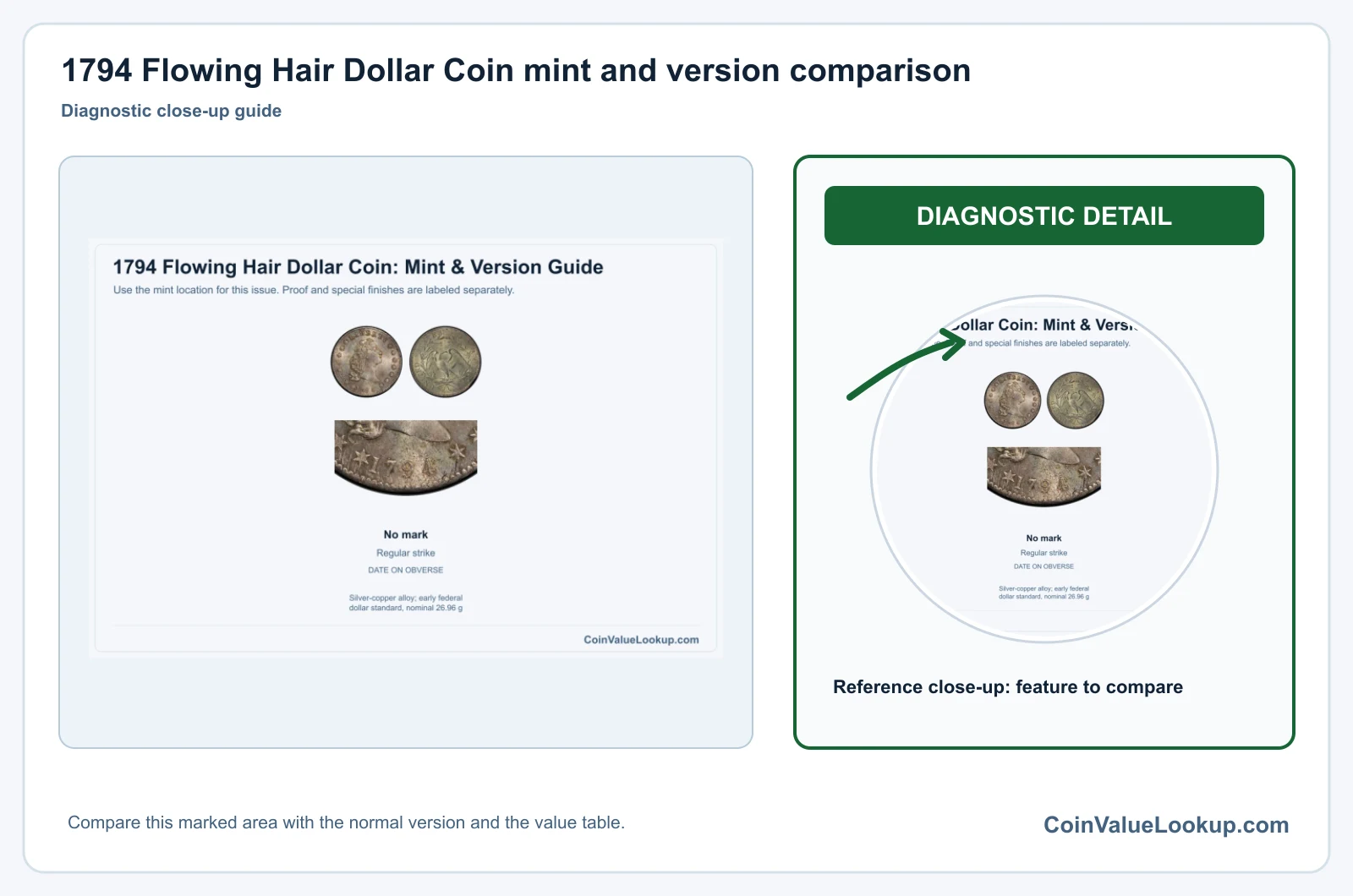
The 1794 Flowing Hair Dollar is one of the most storied coins in American numismatics — the first silver dollar struck by the United States Mint. Guide estimates from USA Coin Book range from $87,012.00 in G4 to $6,252,500.00 in MS65 for the standard business-strike version, though these are not guaranteed offers.
A separate Specimen (SP) finish also exists, requiring individual assessment rather than a simple price-chart lookup. Identifying your coin's exact version, condition, and originality matters enormously before drawing any value conclusions.
Fast Way to Identify Your 1794 Flowing Hair Dollar
Upload clear photos of your coin's front (obverse), back (reverse), and edge, and our identifier can help with a preliminary identification of your 1794 Flowing Hair Dollar. This step is not authentication or exact grading — it is a starting point for figuring out which version you might have and what to look for next.
1794 Flowing Hair Dollar Value
Upload both sides of your 1794 Flowing Hair Dollar.
Front Obverse
Upload photo
Back Reverse
Upload photo
Which 1794 Flowing Hair Dollar Versions Are Worth Money?
- The standard 1794 business strike carries USA Coin Book guide estimates from $87,012.00 in G4 to $6,252,500.00 in MS65 — grade and original surfaces drive enormous value differences.
- The 1794 Flowing Hair SP (Specimen strike) has no adopted numeric range; its value depends on authenticated identity and individual condition, making professional assessment essential.
Step 1: Identify Your 1794 Flowing Hair Dollar Mint Mark and Version
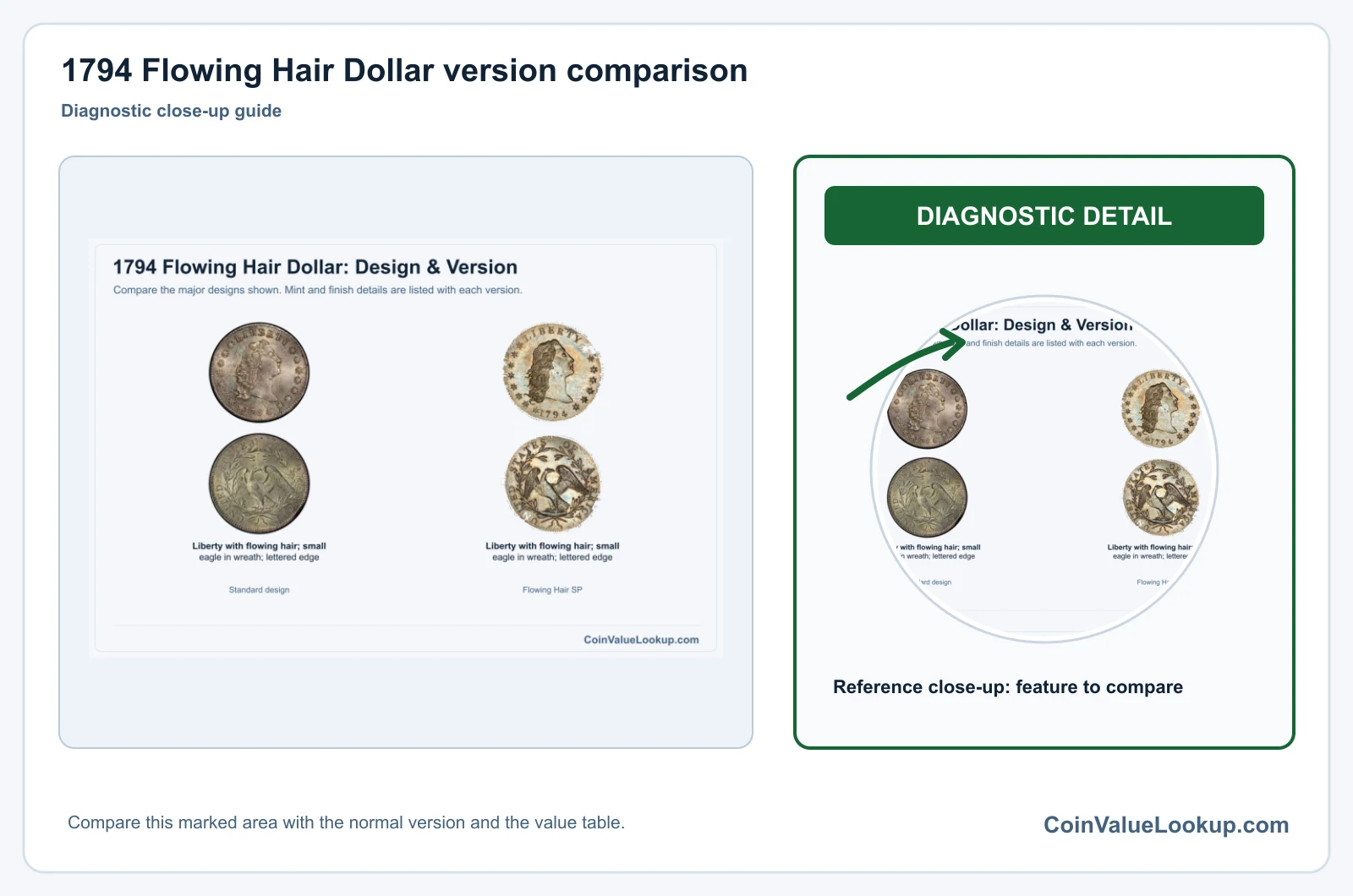
Every 1794 Flowing Hair Dollar was struck at Philadelphia; there are no mintmarks to hunt for. The coin is a silver-copper alloy with a nominal weight of 26.96 grams and features Liberty with flowing hair on the obverse and a small eagle within a wreath on the reverse.
The edge is lettered, not reeded, so check it carefully.
Two distinct versions exist for this year. The standard 1794 is a business strike.
The 1794 Flowing Hair SP is a Specimen strike, a special production method that typically yields sharper detail and superior surfaces compared to regular coinage.
Telling them apart requires evaluating the sharpness of the strike, surface quality, and overall eye appeal beyond what normal wear would explain. Authentication by a major grading service is essentially mandatory here — you are not going to settle this debate with a magnifying glass and a forum post.
Also watch for plugged planchets and adjustment marks, both of which are period-appropriate features on early dollars, not necessarily damage in the modern sense.
Step 2: Check Your 1794 Flowing Hair Dollar Grade
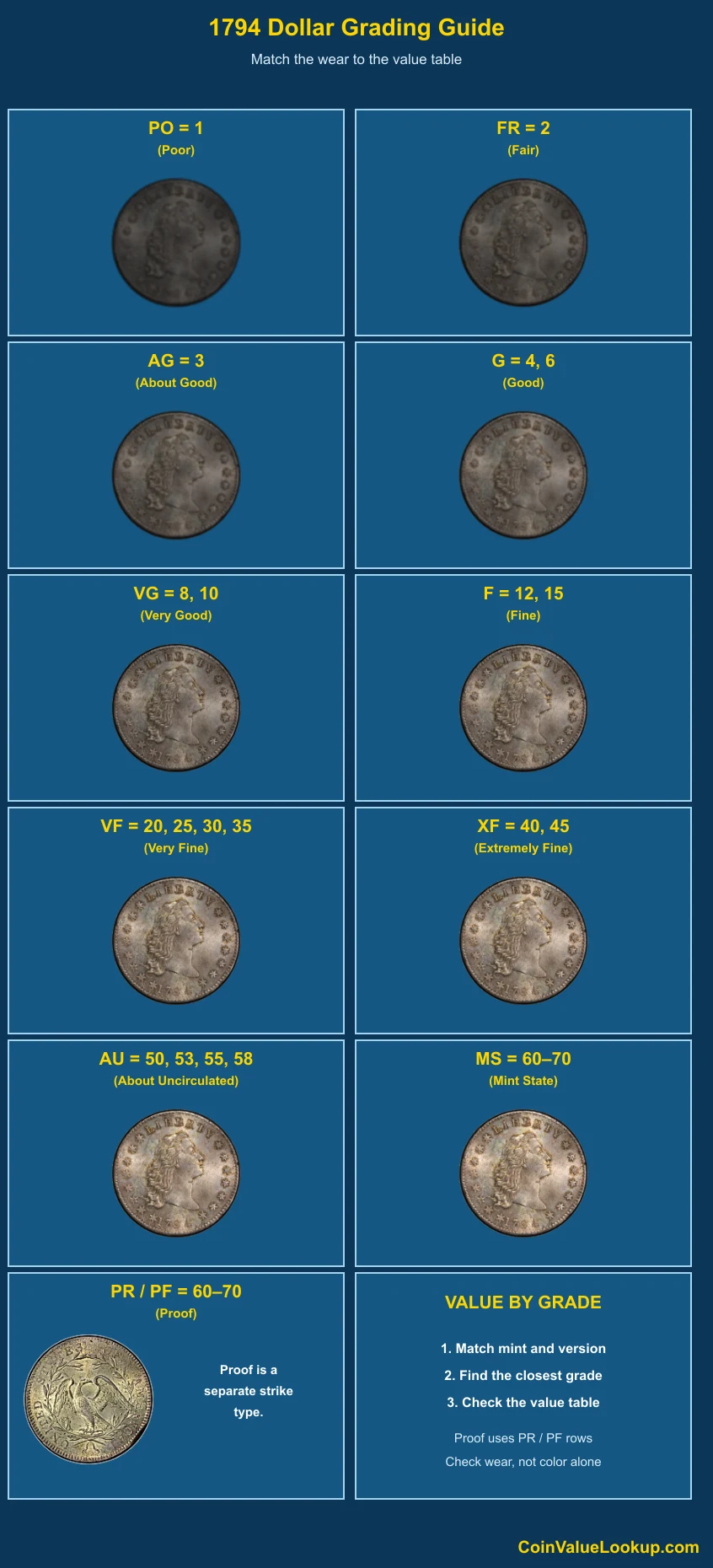
Focus on Liberty's hair detail, her cheek, and the eagle's breast feathers — these are the high points that wear first. Early dollars were often weakly struck to begin with, so a soft area does not automatically mean heavy wear.
You have to compare your coin against a genuine same-type example at a known grade.
Use the comparison image to see how a circulated piece differs from an AU (About Uncirculated) and a Mint State coin. On circulated examples, Liberty's hair strands merge and the eagle loses feather definition.
AU coins retain most luster with only light friction on the highest points.
Original surfaces matter a great deal. Polishing, cleaning, or tooling will reduce a coin's desirability and can result in a details-only grade, which sharply affects value.
For a coin at this price level, third-party professional grading is not optional — it is the baseline for any serious transaction.
Step 3: Check 1794 Flowing Hair Dollar Value by Mint and Version
1794 Flowing Hair Dollar
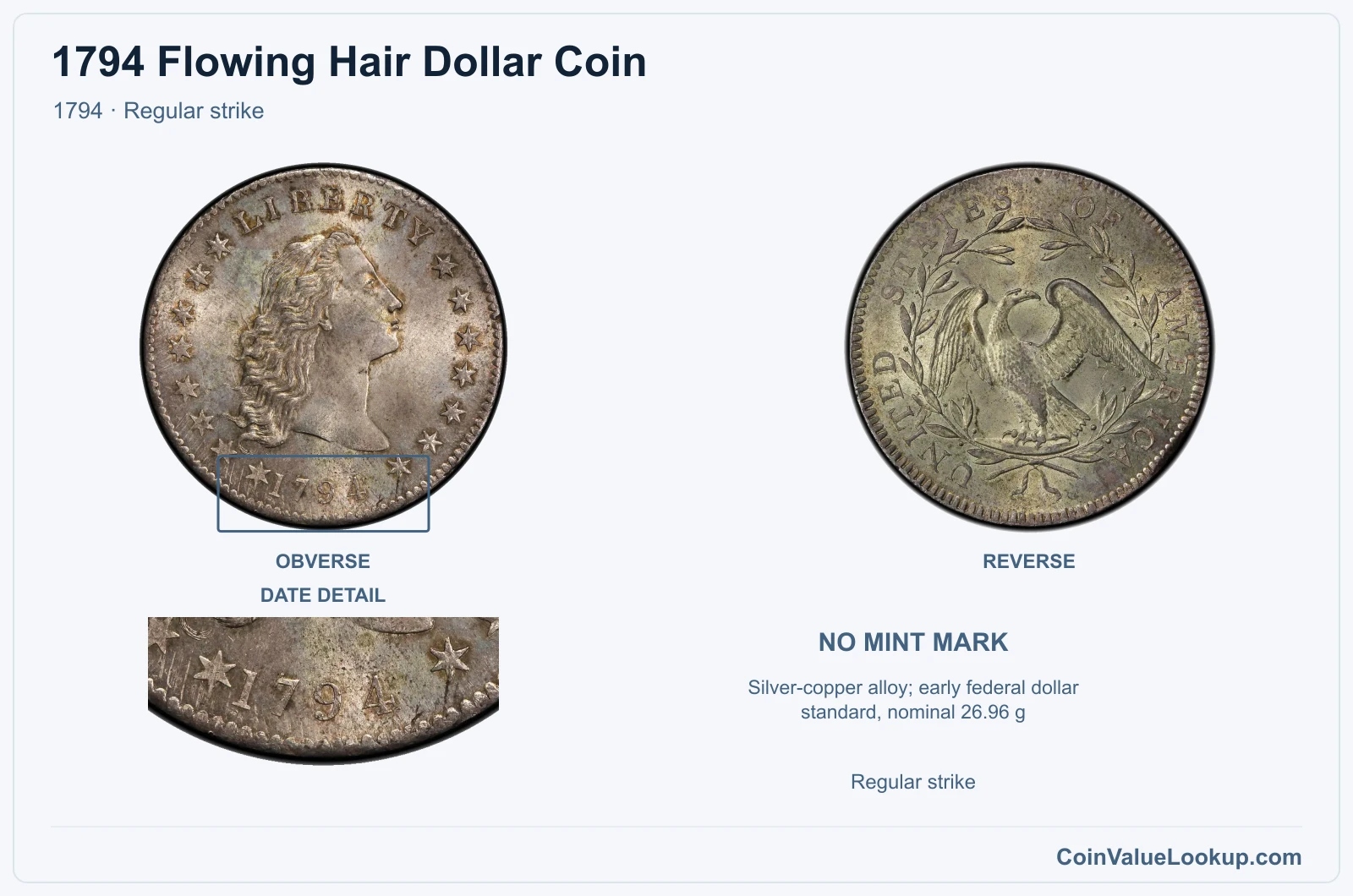
The standard 1794 Flowing Hair Dollar is the business-strike issue from Philadelphia. It features Liberty with flowing hair on the obverse and a small eagle in a wreath on the reverse, struck in a silver-copper alloy at a nominal 26.96 grams with a lettered edge.
USA Coin Book guide estimates place this version at $87,012.00 in G4 and $6,252,500.00 in MS65. Those are guide anchors at specific grades, not blanket offers for any coin in any state.
Original, unimpaired surfaces are critical at every grade level — a cleaned or polished example will not compare favorably to one with honest, undisturbed patina.
If you're exploring values for other early American coins, Coin Value Lookup is a good starting point for finding series-specific guides organized by year and denomination.
Range Grade
Price Auction Records Appraisal PO PO 1
—
Coin Identifier FR FR 2
—
Coin Identifier AG AG 3
Coin Identifier G G 4
—
Coin Identifier
G 6
—
Coin Identifier VG VG 8
—
Coin Identifier
VG 10
Coin Identifier F F 12
Coin Identifier
F 15
Coin Identifier VF VF 20
Coin Identifier
VF 25
Coin Identifier
VF 30
Coin Identifier
VF 35
Coin Identifier XF XF 40
Coin Identifier
XF 45
Coin Identifier AU AU 50
—
Coin Identifier
AU 53
—
Coin Identifier
AU 55
Coin Identifier
AU 58
Coin Identifier MS MS 60
—
Coin Identifier
MS 61
Coin Identifier
MS 62
Coin Identifier
MS 63
—
Coin Identifier
MS 64
Coin Identifier
MS 65
—
Coin Identifier
MS 66
—
Coin Identifier
MS 67
—
—
—
MS 68
—
—
—
MS 69
—
—
—
MS 70
—
—
—
1794 Flowing Hair Dollar — Flowing Hair SP
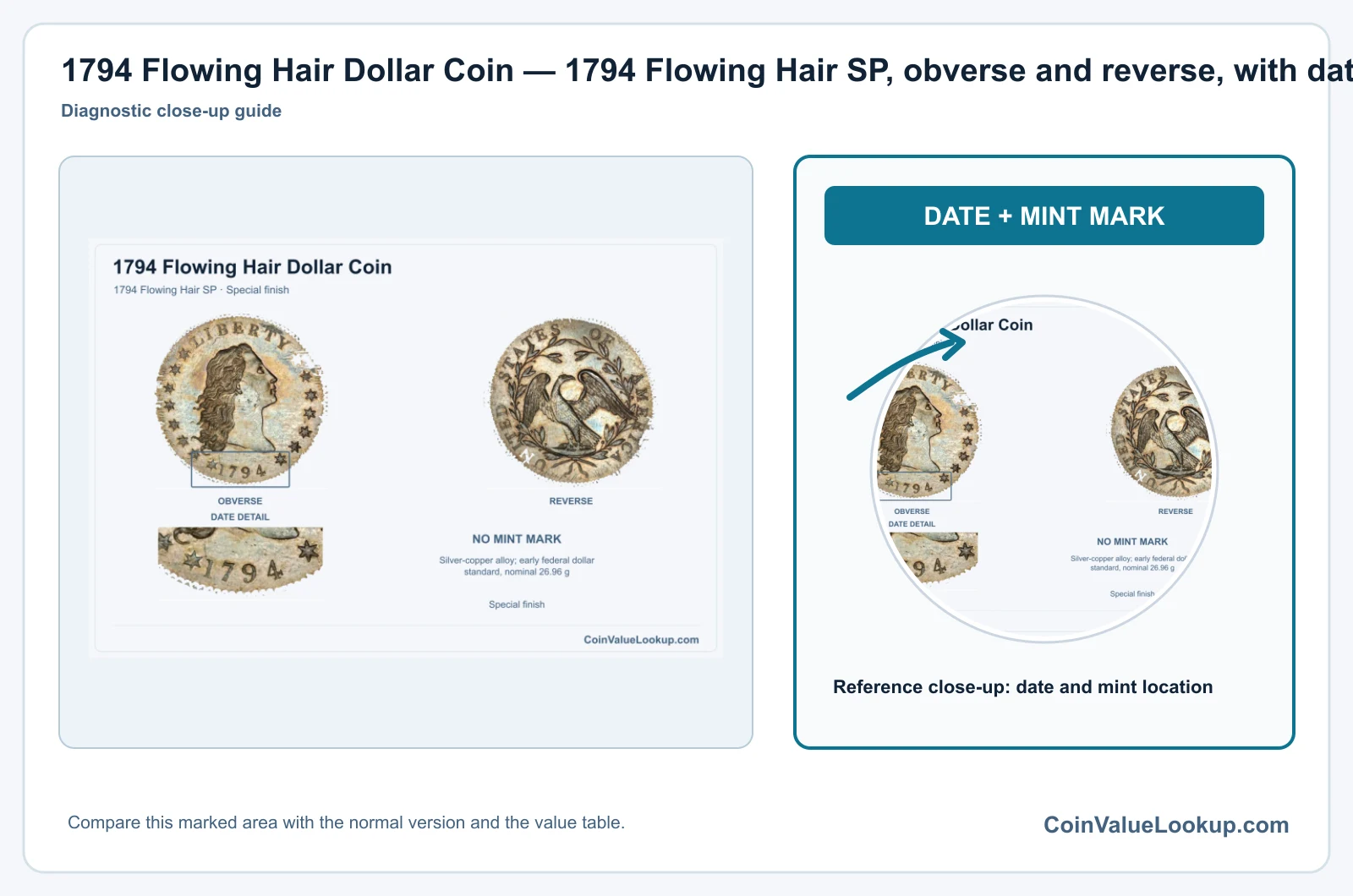
The 1794 Flowing Hair SP refers to coins struck as Specimen pieces — a special finish that predates the modern proof process. These share the same design, alloy, and weight as the business strike, but they were produced with extra care, resulting in noticeably sharper detail and more refined surfaces.
No numeric price range has been adopted for this version. Value depends entirely on authenticated identity, the coin's individual condition, and the severity of any impairments.
Given the rarity involved, professional grading and authentication are non-negotiable. A coin claimed to be a Specimen strike without third-party certification carries significant risk for both buyer and seller.
Specimen issue: The table below applies to the 1794 Silver Plug specimen issue, not ordinary circulation strikes.
Range Grade
Price Auction Records Appraisal SP SP 1
—
Coin Identifier
SP 2
—
Coin Identifier
SP 3
—
Coin Identifier
SP 4
—
Coin Identifier
SP 6
—
Coin Identifier
SP 8
—
Coin Identifier
SP 10
—
Coin Identifier
SP 12
—
Coin Identifier
SP 15
—
Coin Identifier
SP 20
—
Coin Identifier
SP 25
—
Coin Identifier
SP 30
—
Coin Identifier
SP 35
—
Coin Identifier
SP 40
—
Coin Identifier
SP 45
—
Coin Identifier
SP 50
—
Coin Identifier
SP 53
—
Coin Identifier
SP 55
—
Coin Identifier
SP 58
—
Coin Identifier
SP 60
—
Coin Identifier
SP 61
—
Coin Identifier
SP 62
—
Coin Identifier
SP 63
—
Coin Identifier
SP 64
—
Coin Identifier
SP 65
—
Coin Identifier
SP 66
Coin Identifier
SP 67
—
—
—
SP 68
—
—
—
SP 69
—
—
—
SP 70
—
—
—
1794 Flowing Hair Dollar Error List
1. 1794 Flowing Hair Dollar — Clashed Dies
A clashed-die variety has been reported for the 1794 Flowing Hair Dollar. Die clashes occur when the obverse and reverse dies strike each other without a planchet between them, transferring faint impressions of the opposite design onto each die.
On subsequent coins, you may see ghostly outlines — traces of the wreath on Liberty's side, or hints of her portrait near the eagle.
Look for these transferred design elements in the fields (flat areas) of the coin, aligned with where the opposing features would naturally fall. They should be consistent and symmetrical, not random.
Do not confuse clashed-die impressions with scratches, random raised lines, or brockage marks. Scratches tend to be irregular and directional, while clash marks follow the geometry of the opposing die.
No specific price data is available for this variety; value depends on condition, visibility of the clash, and authenticated confirmation of the feature.