1849 Braided Hair Cent Coin Value: How Much Is It Worth?
An 1849 Braided Hair Cent in well-worn condition can start around $30 at a G4 grade, while a nice mint-state example in MS63 territory reaches roughly $721 according to USA Coin Book guide estimates. That spread covers the ordinary business strike only.
Proofs, major errors, and problem-free original-surface coins each need individual evaluation, so pinning down the exact variety matters before you price anything.
Fast Way to Identify Your 1849 Braided Hair Cent
Want a quick read on what you have? Upload clear photos of the front and back of your 1849 cent.
That lets us run a preliminary identification against known types and point you toward the right variety. Sharp, well-lit images showing the full coin and edge details give the best results.
1849 Braided Hair Cent Value
Upload both sides of your 1849 Braided Hair Cent.
Front Obverse
Upload photo
Back Reverse
Upload photo
Which 1849 Braided Hair Cent Versions Are Worth Money?
- Business strikes range from about $30 in G4 to around $721 in MS63 per USA Coin Book; original surfaces and strong detail push value upward.
- Proof 1849 cents are cataloged but extremely rare; no standard guide price is adopted, so each one requires individual expert assessment.
- Coins with prominent mint errors such as die cracks, cuds, or off-center strikes deserve closer inspection and may carry premiums beyond the base date value.
- Problem-free examples with full hair detail and natural brown surfaces tend to outperform cleaned or corroded coins of the same technical grade.
Step 1: Identify Your 1849 Braided Hair Cent Mint Mark and Version
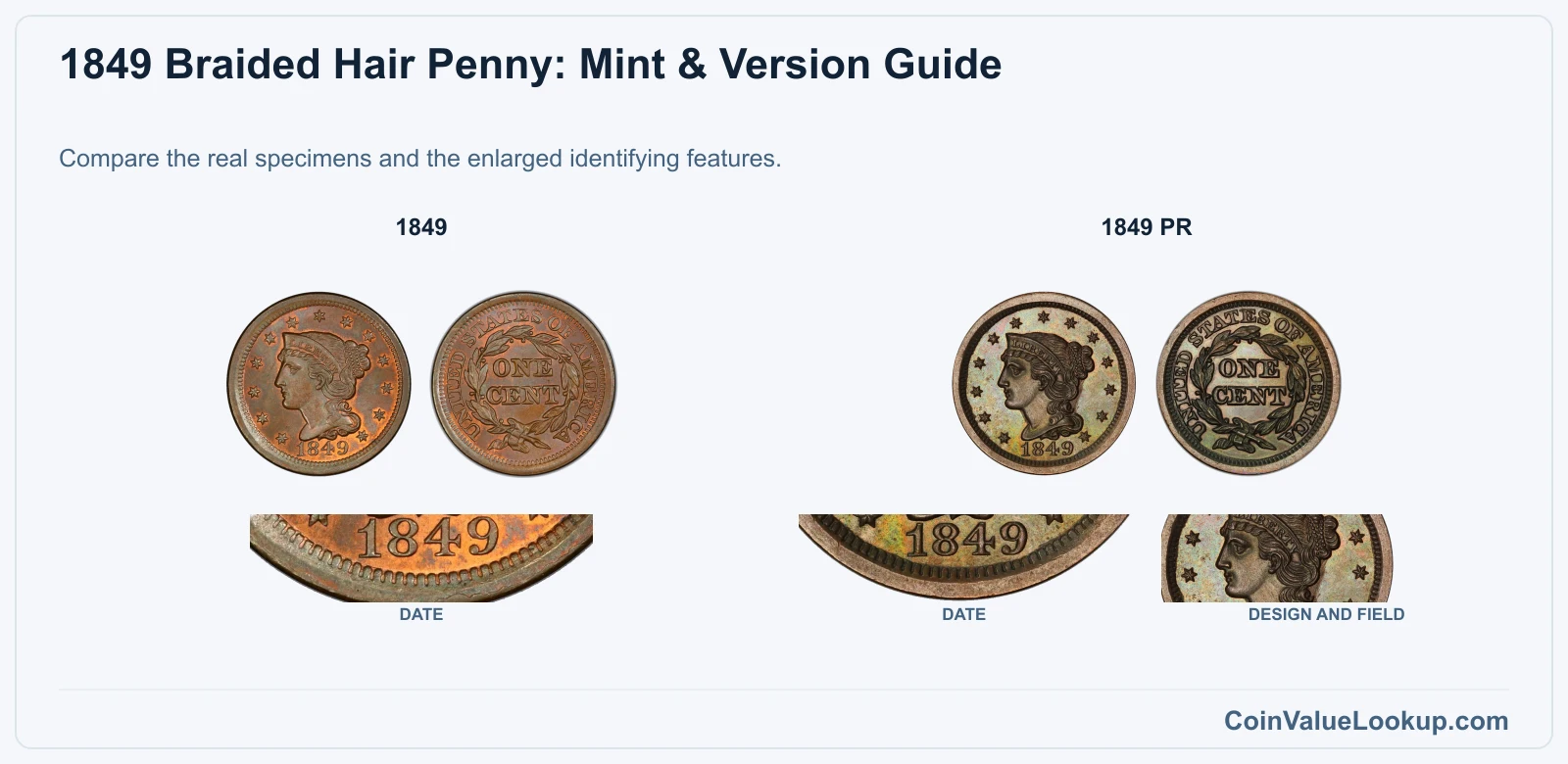
The 1849 Braided Hair Cent shows Liberty facing left with her hair in a braided bun, encircled by thirteen stars and the date below. The reverse displays the denomination ONE CENT inside a laurel wreath.
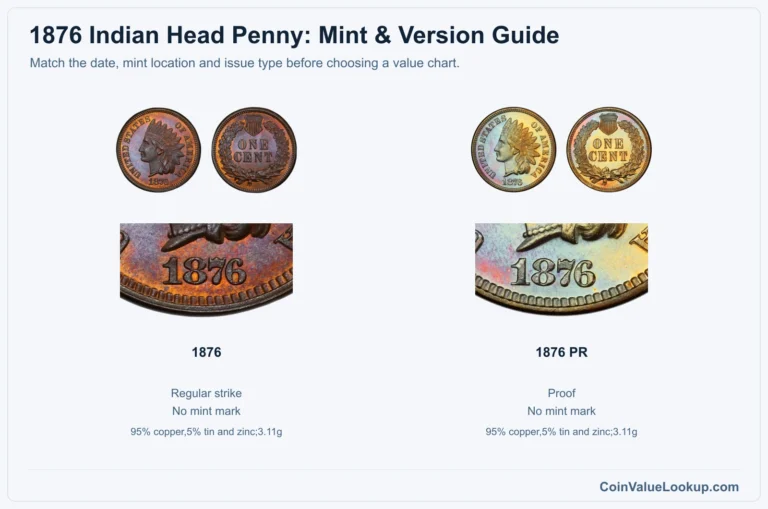
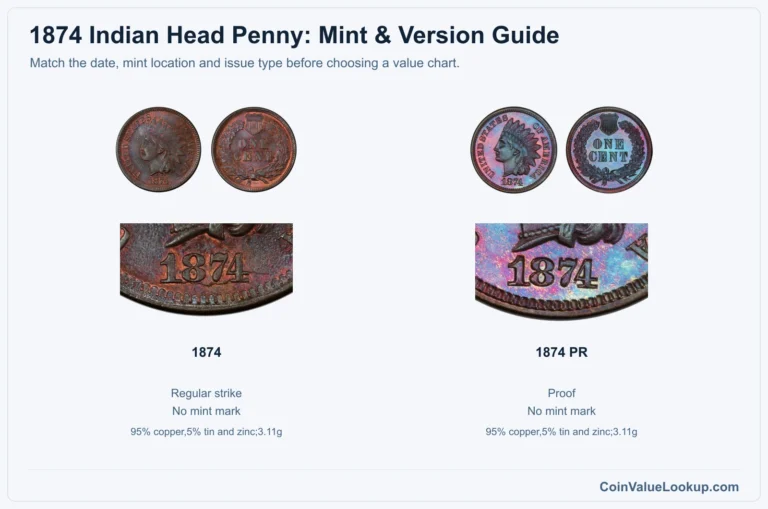
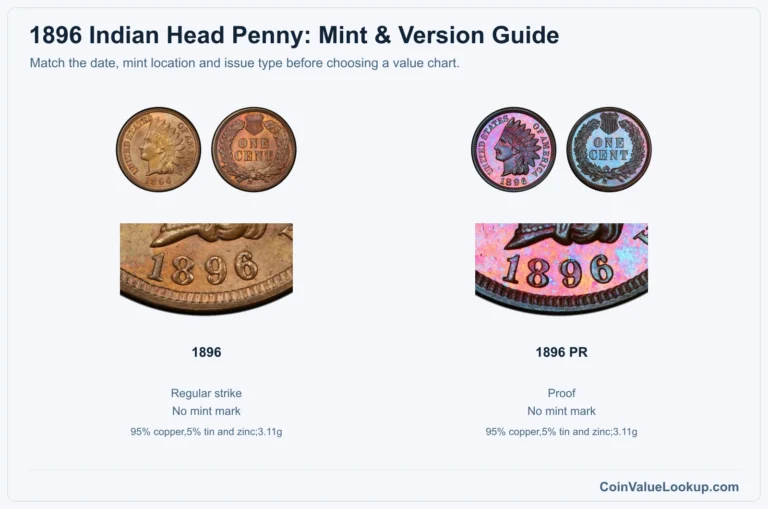
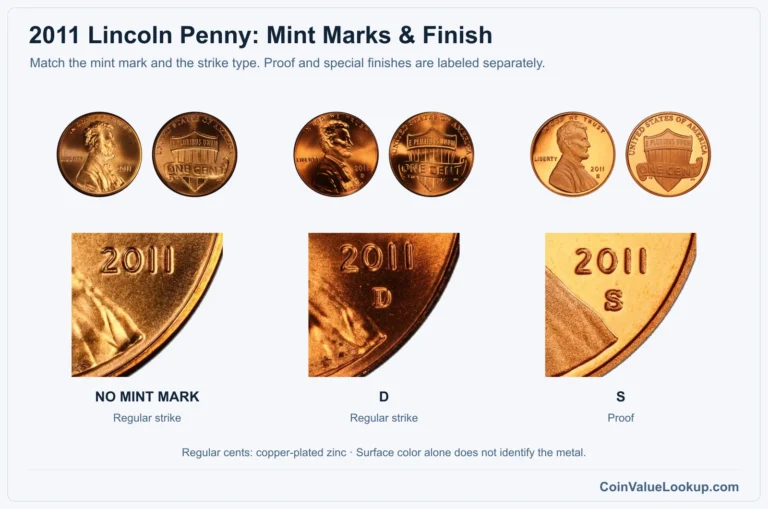
All were struck at Philadelphia, so there is no mintmark to hunt for.
To confirm the series, match both the portrait style and the wreath type. The Braided Hair design replaced the earlier Matron Head around 1839, and the two can look similar at first glance.
Check the hair above the ear and the shape of the coronet for the correct attribution.
Weight should be near the nominal 10.89 grams in copper, but wear, corrosion, and original production tolerances mean weight alone does not prove authenticity. Use it as supporting evidence alongside design and die characteristics.
Separate business strikes from proofs carefully. A proof is a specific manufacturing method involving polished dies and carefully prepared planchets, not simply a shiny coin.
Polishing a circulated cent does not turn it into a proof, and the distinction matters enormously for value.
Step 2: Check Your 1849 Braided Hair Cent Grade
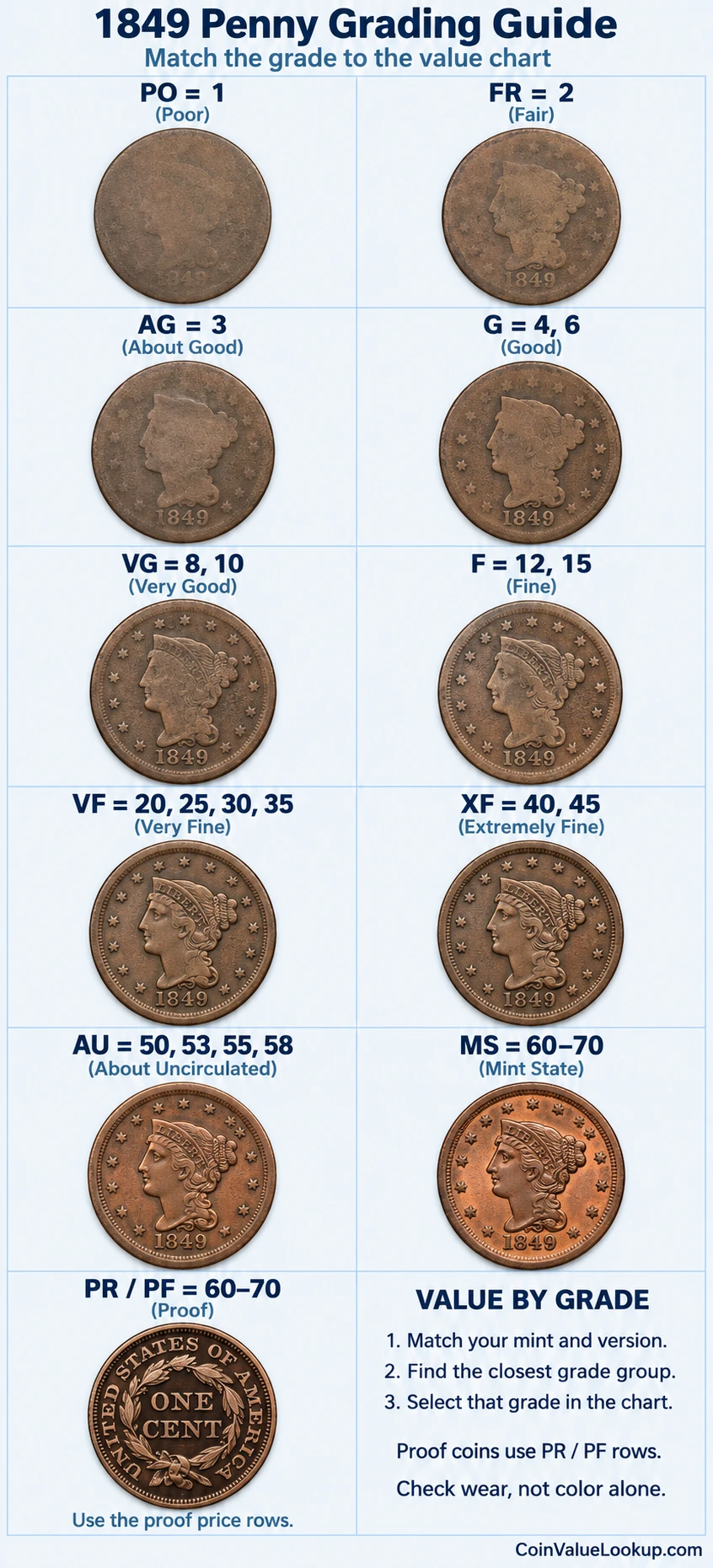
Focus on Liberty's hair detail first, especially the braids above the ear and the fine strands near the forehead. On a well-worn coin those braids merge into a flat mass, while on a higher-grade piece each strand stays individually visible.
The cheek should show smooth, original skin rather than flat wear spots.
Flip to the reverse and check the leaf tips in the wreath. Sharply defined leaf veins and full lettering indicate a coin that saw little actual use.
Use the comparison image to match your coin's wear pattern against known grade benchmarks. Keep in mind that a weak strike from the mint can mimic wear, so look at the overall coin, not just one soft area.
Copper coins carry color designations: BN (brown), RB (red-brown), and RD (red). These describe how much original mint color remains, not different metals.
Most surviving 1849 cents are fully brown, and that is perfectly normal for a 175-year-old copper coin.
Surface problems like corrosion, porosity, tooling marks, or old cleaning can drop the market value well below what a grade number alone would suggest. Original, undisturbed surfaces are what experienced buyers pay up for.
Step 3: Check 1849 Braided Hair Cent Value by Mint and Version
1849 Braided Hair Cent
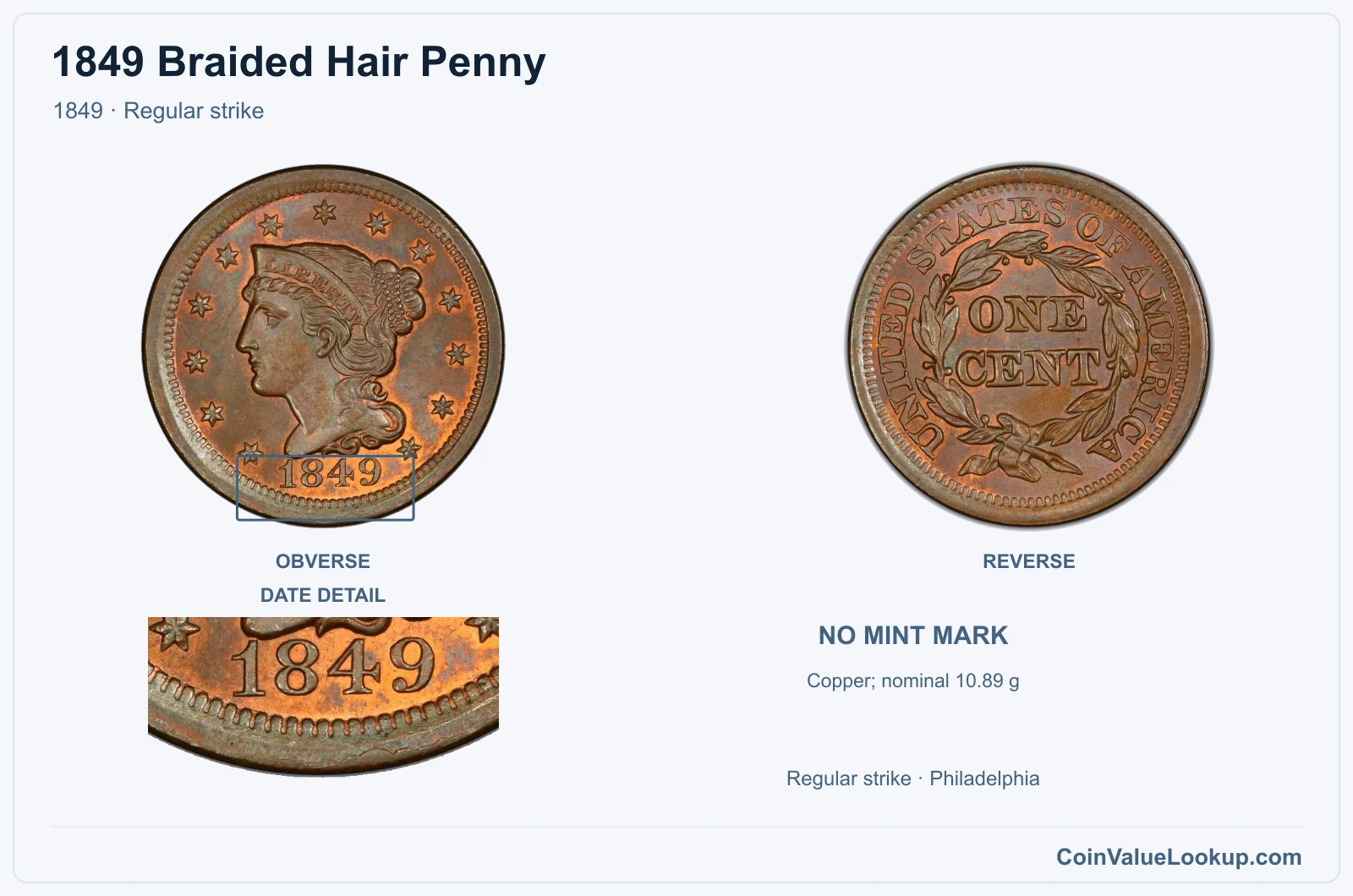
The standard 1849 Braided Hair Cent is a copper business strike from Philadelphia, weighing about 10.89 grams. No mintmark appears because Philadelphia was the only active mint for this denomination.
USA Coin Book guide estimates place it at roughly $30 in G4 and around $721 in MS63.
Look for the braided hair, thirteen obverse stars, and the ONE CENT denomination inside a wreath on the reverse. Original surfaces with honest wear are the goal.
Cleaned or corroded examples trade for less than these guide figures suggest, even if the remaining detail looks decent.
| Range | Grade | Price | Auction Records | Appraisal |
|---|---|---|---|---|
| PO | PO 1 | — | Coin Identifier | |
| FR | FR 2 | — | Coin Identifier | |
| AG | AG 3 | — | Coin Identifier | |
| G | G 4 | — | Coin Identifier | |
| G 6 | — | Coin Identifier | ||
| VG | VG 8 | — | Coin Identifier | |
| VG 10 | — | Coin Identifier | ||
| F | F 12 | — | Coin Identifier | |
| F 15 | Coin Identifier | |||
| VF | VF 20 | Coin Identifier | ||
| VF 25 | Coin Identifier | |||
| VF 30 | Coin Identifier | |||
| VF 35 | Coin Identifier | |||
| XF | XF 40 | Coin Identifier | ||
| XF 45 | Coin Identifier | |||
| AU | AU 50 | Coin Identifier | ||
| AU 53 | Coin Identifier | |||
| AU 55 | Coin Identifier | |||
| AU 58 | Coin Identifier | |||
| MS | MS 60 | — | Coin Identifier | |
| MS 61 | Coin Identifier | |||
| MS 62 | Coin Identifier | |||
| MS 63 | Coin Identifier | |||
| MS 64 | Coin Identifier | |||
| MS 65 | Coin Identifier | |||
| MS 66 | Coin Identifier | |||
| MS 67 | — | — | — | |
| MS 68 | — | — | — | |
| MS 69 | — | — | — | |
| MS 70 | — | — | — |
1849 Braided Hair Cent — PR
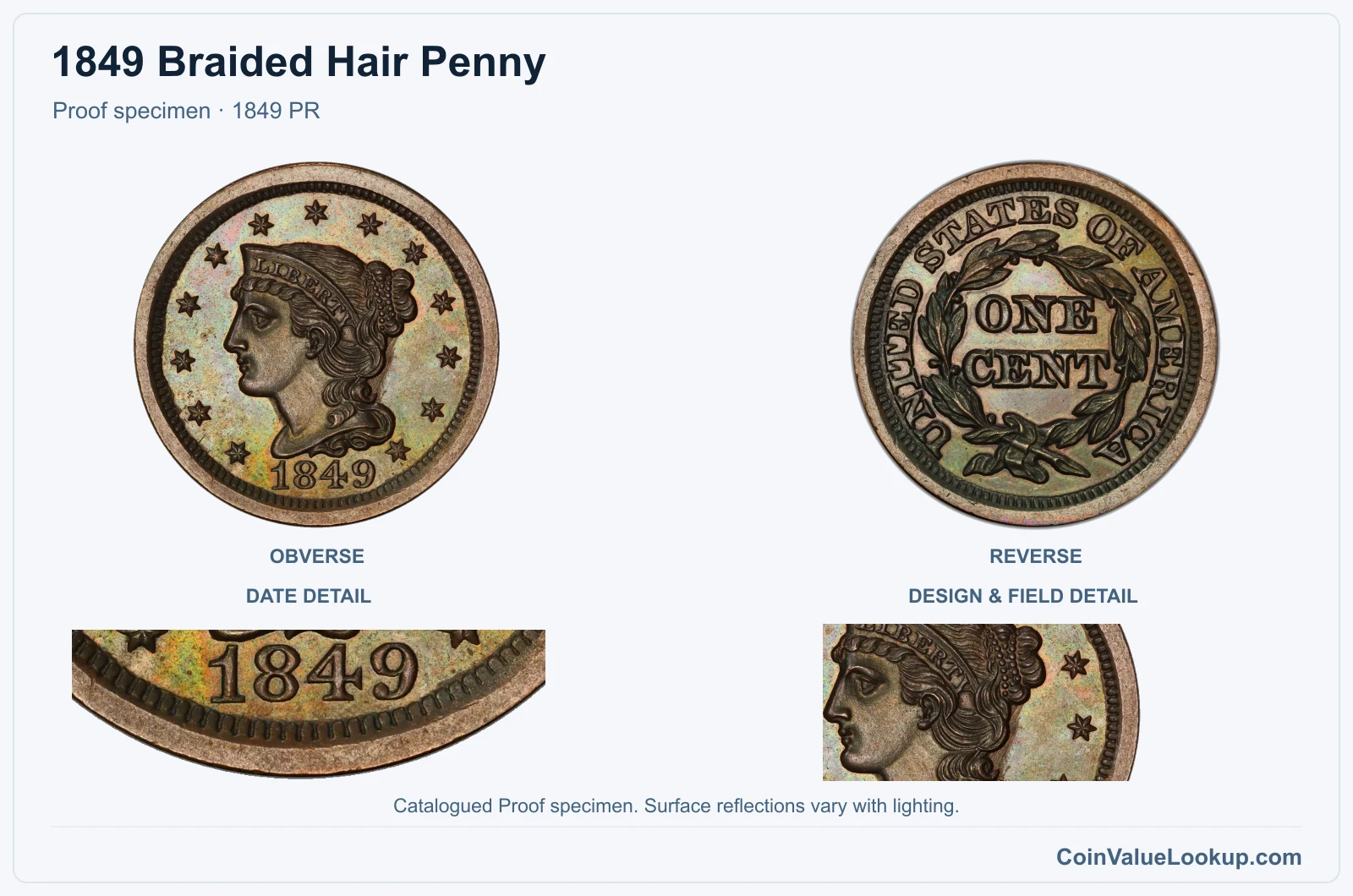
The 1849 Proof Braided Hair Cent is a cataloged variety, but surviving examples are exceptionally scarce. These were struck on polished planchets using specially prepared dies, producing sharp rims, full mirror fields, and crisp design details that business strikes rarely match.
No standard numeric price range is adopted for this proof issue. Each coin needs individual assessment based on authenticated identity, surface quality, and die characteristics.
Simply having a shiny 1849 cent does not make it a proof; third-party authentication is essential before assigning proof status.
Coin Value Lookup is a good starting point if you want to look up guides for other dates and denominations in this series. You can compare across years to understand where your coin fits in the broader Braided Hair lineup.
| Range | Grade | Price | Auction Records | Appraisal |
|---|---|---|---|---|
| PR | PR 1 | — | Coin Identifier | |
| PR 2 | — | Coin Identifier | ||
| PR 3 | — | Coin Identifier | ||
| PR 4 | — | Coin Identifier | ||
| PR 6 | — | Coin Identifier | ||
| PR 8 | — | Coin Identifier | ||
| PR 10 | — | Coin Identifier | ||
| PR 12 | — | Coin Identifier | ||
| PR 15 | — | Coin Identifier | ||
| PR 20 | — | Coin Identifier | ||
| PR 25 | — | Coin Identifier | ||
| PR 30 | — | Coin Identifier | ||
| PR 35 | — | Coin Identifier | ||
| PR 40 | — | Coin Identifier | ||
| PR 45 | — | Coin Identifier | ||
| PR 50 | — | Coin Identifier | ||
| PR 53 | — | Coin Identifier | ||
| PR 55 | — | Coin Identifier | ||
| PR 58 | — | Coin Identifier | ||
| PR 60 | — | Coin Identifier | ||
| PR 61 | — | Coin Identifier | ||
| PR 62 | — | Coin Identifier | ||
| PR 63 | Coin Identifier | |||
| PR 64 | Coin Identifier | |||
| PR 65 | — | Coin Identifier | ||
| PR 66 | — | — | — | |
| PR 67 | — | — | — | |
| PR 68 | — | — | — | |
| PR 69 | — | — | — | |
| PR 70 | — | — | — |
1849 Braided Hair Cent Error List
1. 1849 Braided Hair Cent — Die Crack
A die crack shows up as a thin raised line running across the coin's surface, sometimes crossing through design elements or connecting stars to the rim. These lines are raised because they correspond to a crack in the steel die, which fills with metal during striking.
To confirm a die crack on your 1849 cent, look closely in good light and trace the line with magnification. It should be raised above the surrounding field, not sunk into it.
An incuse scratch, corrosion channel, or tool mark will sit below the surface or have rough edges, which is the opposite of what a true die crack does.
No specific price premium is adopted for die cracks on this date. Value depends on the crack's size, location, and the coin's overall condition, so individual assessment is the way to go.
2. 1849 Braided Hair Cent — Die Chip
A die chip appears as a small, isolated raised blob on the coin's surface. It happens when a tiny piece of the die breaks away, leaving a void that fills with metal during the strike.
Common spots include inside letters, near stars, or on open field areas.
On an 1849 Braided Hair Cent, look for a localized lump that seems out of place against the surrounding normal design. Compare it to surface corrosion or an attached bit of foreign material, both of which tend to have irregular texture and lack the smooth, rounded profile of a genuine die chip.
No adopted price range exists for die chips on this date. The chip's size, position, and visual appeal all influence any premium, so each example needs its own evaluation.
3. 1849 Braided Hair Cent — Die Break / Cud
A cud is a specific type of die break that connects to the rim, creating a raised, featureless blob where part of the design should be. It forms when a section of the die edge breaks off entirely.
Smaller interior die breaks that do not reach the rim are just called retained die breaks.
On your 1849 cent, check the rim area carefully. A cud will show a smooth, raised mass with a distinct boundary against the normal design.
Do not confuse it with a rim dent, which is damage after striking and sits below the surface, or with heavy corrosion buildup near the edge.
No numeric price data is adopted for cuds on this issue. Large cuds on early copper tend to attract specialist interest, but value depends on size, location, and the coin's overall preservation.
4. 1849 Braided Hair Cent — Off-Center Strike
An off-center strike means the planchet was not properly seated between the dies, so part of the design is missing and a blank crescent of unstruck metal appears opposite the shift. The percentage of off-center displacement and whether the date remains visible are the two biggest factors collectors care about.
For an 1849 Braided Hair Cent, check that the blank area has a smooth, unstruck surface rather than signs of post-mint damage. A clipped planchet has a straight or curved missing section but the design is still centered.
One-sided die misalignment can look similar but affects only one face.
No adopted price premium exists for off-center 1849 cents specifically. Coins with visible dates and dramatic displacement generally attract the most collector attention.
5. 1849 Braided Hair Cent — Broadstrike
A broadstrike happens when the coin is struck without the collar die that normally confines the planchet and forms the rim. The result is a coin that spreads outward, appearing slightly larger than normal with a weak or missing raised rim.
The full design is still centered, which separates it from an off-center error.
On an 1849 cent, look for metal that has flowed outward past the normal diameter, with design elements that may appear slightly stretched near the edges. Compare this to a coin that was simply flattened after leaving the mint, which typically shows distorted surfaces and contact marks inconsistent with a single press strike.
No specific price data is adopted for broadstruck 1849 cents. Condition, visual drama, and authentication all factor into what a collector would pay.
6. 1849 Braided Hair Cent — Lamination / Split Planchet
A lamination error occurs when layers within the copper planchet separate, producing a visible flap, peel, or split in the metal. This usually traces back to impurities or gas pockets trapped during the planchet rolling process.
On early copper cents like the 1849, these can be quite dramatic.
Look for a section of metal that lifts away from the surface or a visible seam along the edge. Photograph both the affected face and the edge together to show the separation clearly.
The key distinction is that a lamination follows the metal's internal layers, while scraping, deliberate cutting, or corrosion damage tends to have rougher, more random patterns.
No numeric premium is adopted for lamination errors on this date. Each example needs evaluation based on the size of the affected area, whether the flap is retained, and the coin's overall grade.