1847 Braided Hair Cent Coin Value: How Much Is It Worth?
The 1847 Braided Hair Cent is a copper large cent struck at Philadelphia, and guide estimates range from about $30 in G4 to roughly $4,246 in MS63 depending on variety. That spread is not the entire market range.
Identifying your exact variety matters enormously, because a scarce overdate or a proof will price very differently from a normal-date coin.
Fast Way to Identify Your 1847 Braided Hair Cent
The quickest way to start is to upload clear photos of both the front and back of your coin. Good lighting and a straight-on angle help with preliminary identification.
Our identifier can check date style, surface condition, and overall type from your images, though final attribution and grading require hands-on professional evaluation.
1847 Braided Hair Cent Value
Upload both sides of your 1847 Braided Hair Cent.
Front Obverse
Upload photo
Back Reverse
Upload photo
Which 1847 Braided Hair Cent Versions Are Worth Money?
- The 1847/47 Large over Small 47 overdate starts around $91 in G4 and reaches roughly $4,246 in MS63 per USA Coin Book, well above the normal date at every grade level.
- A normal-date 1847 in circulated grades guides from about $30 (G4) to $929 (MS63), making high-grade examples the ones to watch.
- Proof 1847 Braided Hair Cents exist but require professional attribution of die characteristics, surfaces, and rims before any value can be assigned.
- Coins with recognized mint errors such as off-center strikes, die breaks, or repunched dates deserve individual assessment, especially when the date remains fully visible.
Step 1: Identify Your 1847 Braided Hair Cent Mint Mark and Version
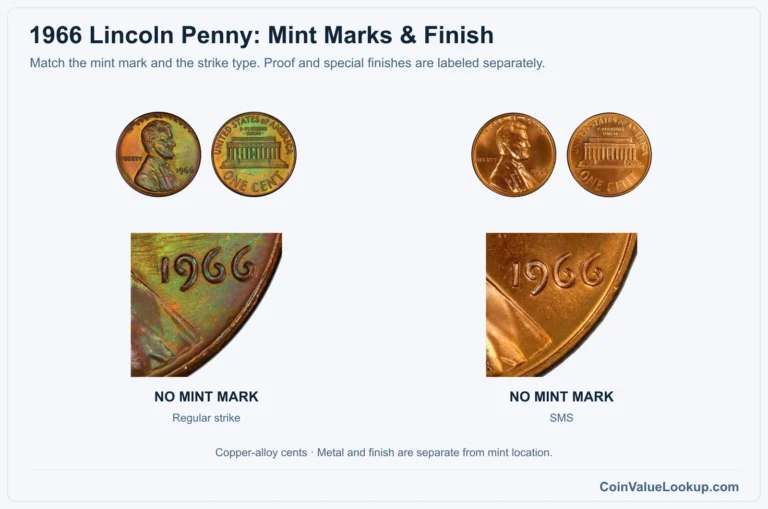
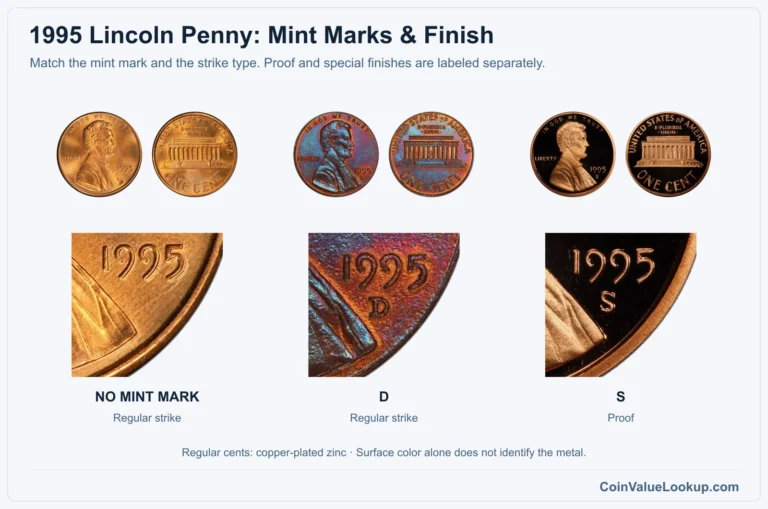
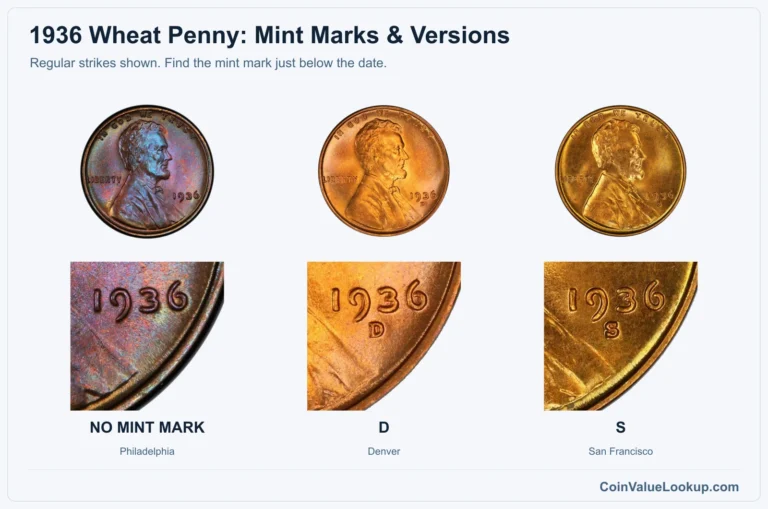
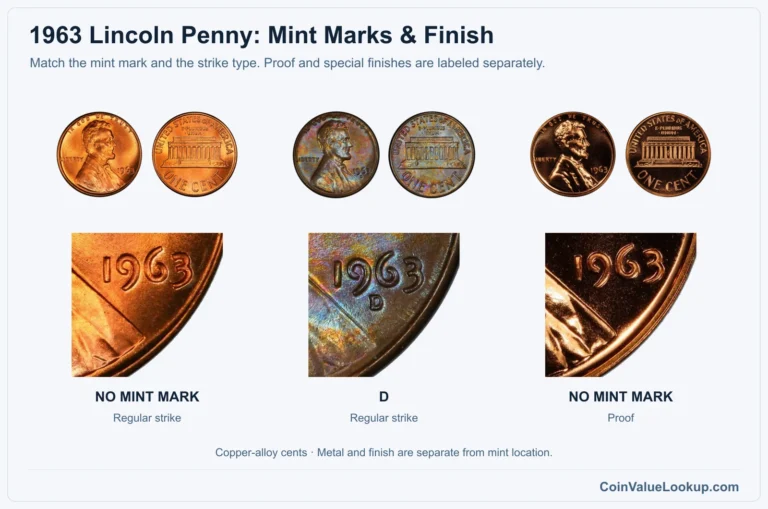
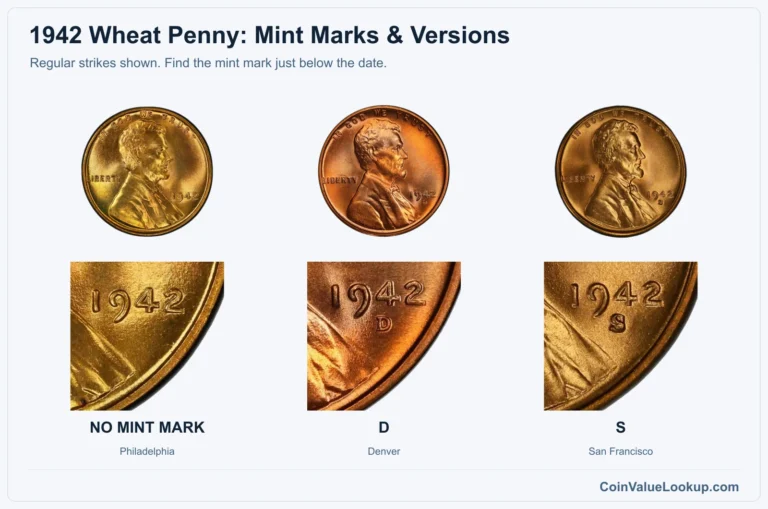
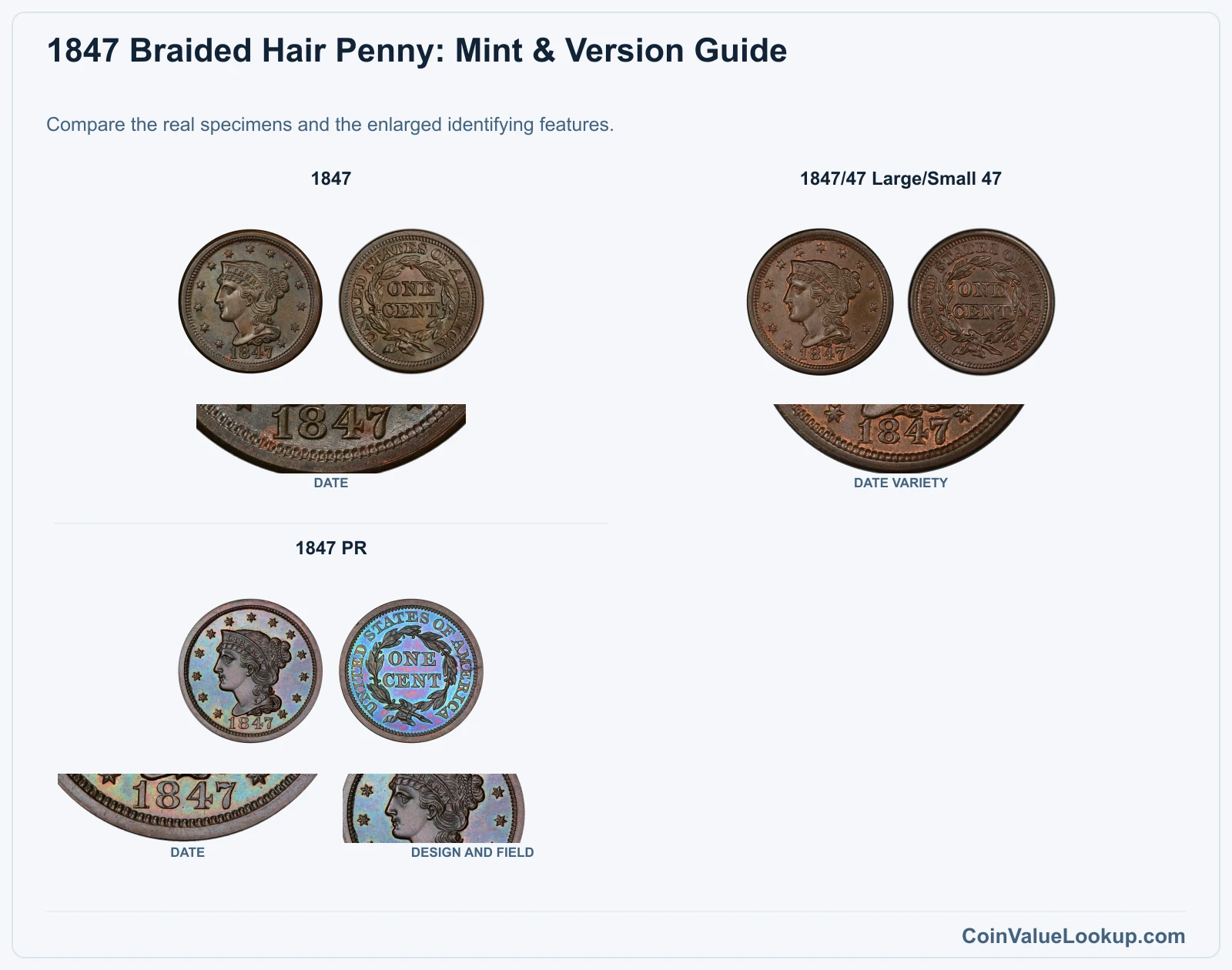
Every 1847 Braided Hair Cent was struck at Philadelphia, so there is no mintmark to look for. The key variety question is whether your coin is a Normal Date or the Large over Small 47 overdate.
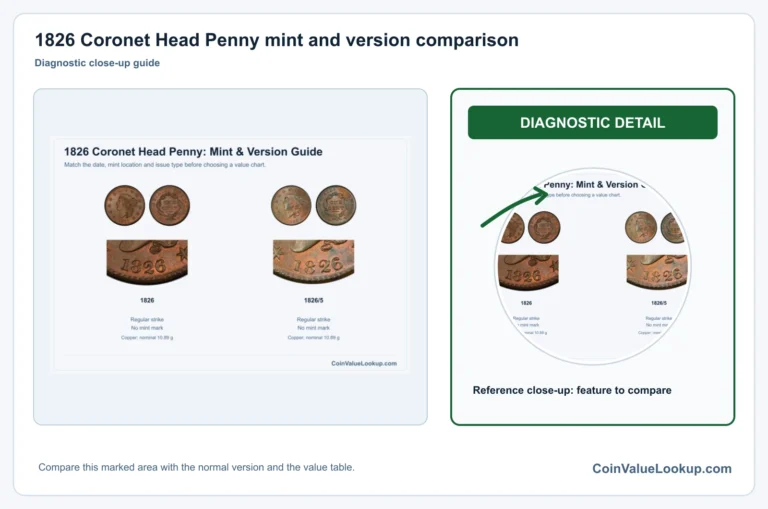
For the overdate, examine the digits closely under magnification. You are looking for traces of a smaller, earlier punch beneath the final "47" in the date.
Those remnants are most visible at the tops and bases of the numerals.
If no ghost image appears under the date, you likely have the ordinary 1847. The coin weighs nominally 10.89 grams in copper.
Weight alone will not prove authenticity because wear, corrosion, and period production tolerances all shift the number.
Check both faces and the edge carefully. Legend wording, wreath details, and the overall feel of the surfaces help separate a genuine coin from a cast copy or altered date.
Proof examples also exist for 1847, but a shiny surface does not make a proof; die characteristics, rim structure, and authenticated attribution are required.
Step 2: Check Your 1847 Braided Hair Cent Grade
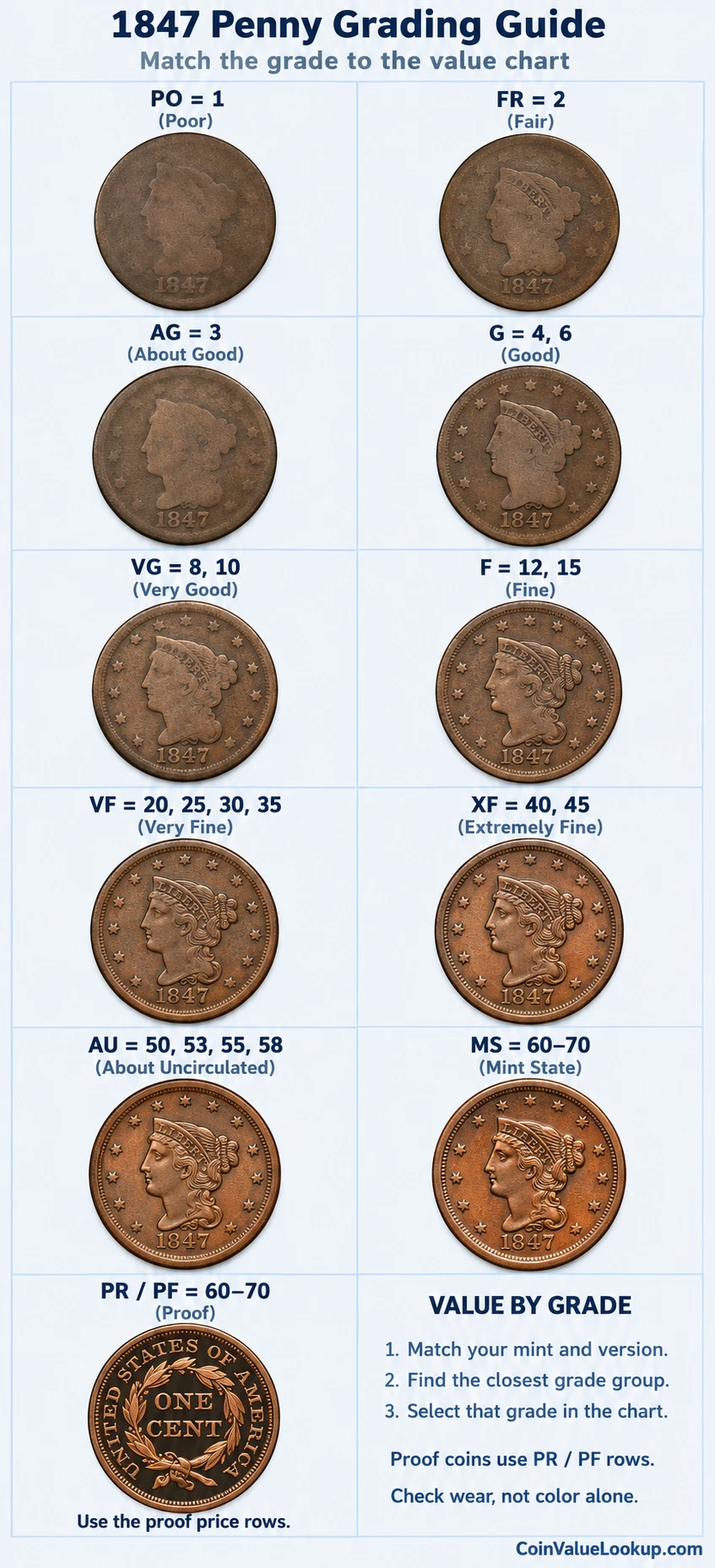
Start with Liberty's hair above the ear and the braid detail on the obverse. On a well-worn coin these flatten first, followed by the cheek and the headband lettering.
Flip to the reverse and check the individual leaf veins in the wreath. A coin grading around Good will show a full outline but little interior detail, while a mid-grade piece retains partial hair strands and visible leaf structure.
Do not confuse a weak strike with wear. Some 1847 cents left the press with soft spots, especially near the denticles.
Corrosion and porosity also eat away detail without the smooth, even loss you see from circulation.
Copper color designations like BN, RB, and RD describe remaining original red versus brown toning. They are color attributes, not separate alloys or automatic upgrades.
A coin with full red surfaces in high grade commands a premium, but any cleaning that produces an artificial color will hurt its appeal.
Use the comparison image to match your coin's detail against known grade benchmarks. Surface problems such as scratches, corrosion, or old cleaning can lower market value well below what the technical grade might suggest.
Step 3: Check 1847 Braided Hair Cent Value by Mint and Version
1847 Braided Hair Cent
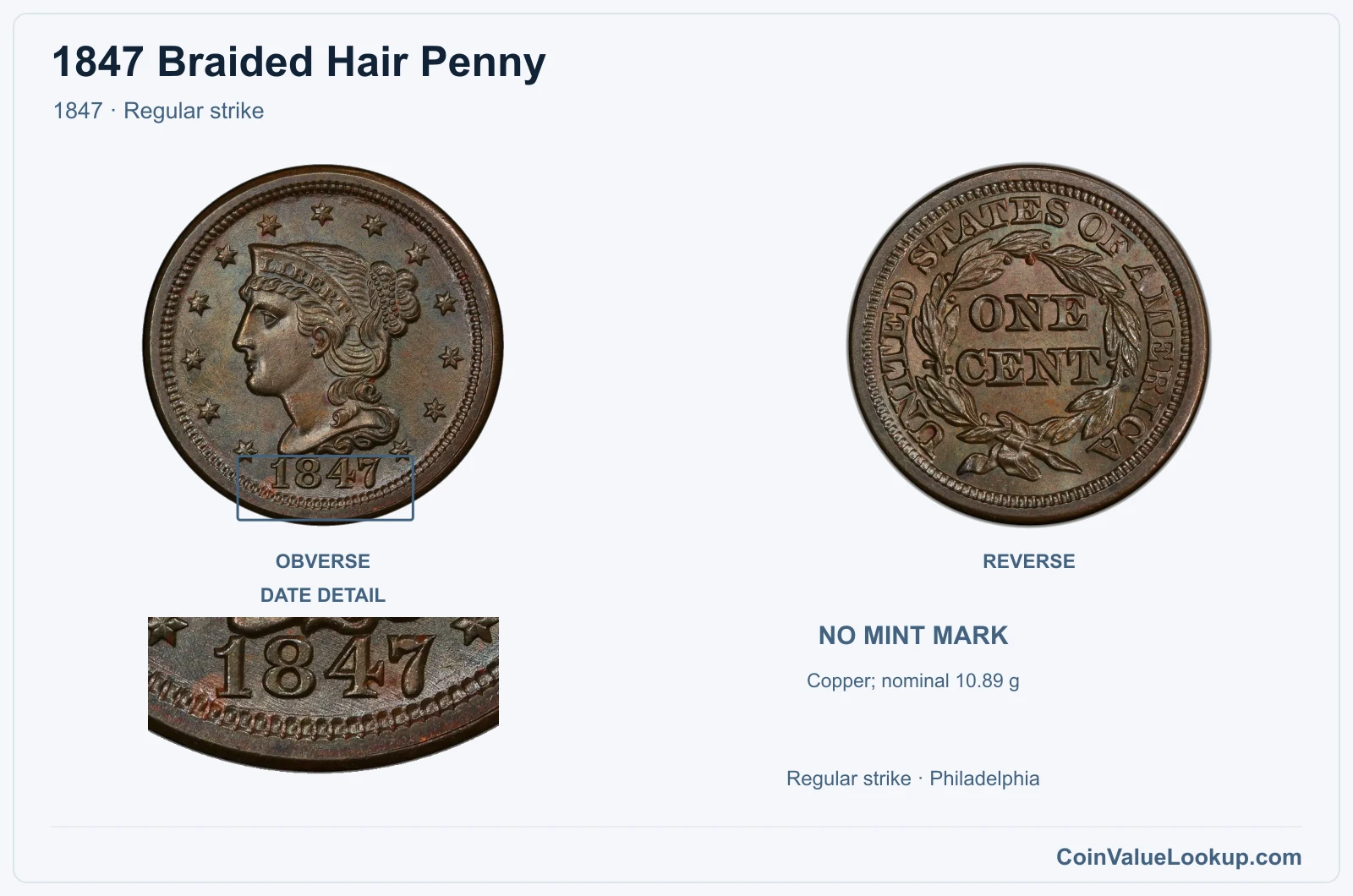
The normal-date 1847 Braided Hair Cent is the workhorse of this year. It was struck at Philadelphia in copper with no mintmark.
USA Coin Book guide estimates place it around $30 in G4 and approximately $929 in MS63.
Most surviving examples are well circulated, so anything above VF starts getting genuinely scarce. Look at the date digits carefully under magnification.
If you see no traces of an earlier, smaller punch beneath the "47," you have this variety. Cleaning and corrosion are common on copper this old, and both reduce collector appeal.
| Range | Grade | Price | Auction Records | Appraisal |
|---|---|---|---|---|
| PO | PO 1 | — | Coin Identifier | |
| FR | FR 2 | — | Coin Identifier | |
| AG | AG 3 | — | Coin Identifier | |
| G | G 4 | — | Coin Identifier | |
| G 6 | — | Coin Identifier | ||
| VG | VG 8 | — | Coin Identifier | |
| VG 10 | — | Coin Identifier | ||
| F | F 12 | — | Coin Identifier | |
| F 15 | Coin Identifier | |||
| VF | VF 20 | Coin Identifier | ||
| VF 25 | Coin Identifier | |||
| VF 30 | Coin Identifier | |||
| VF 35 | Coin Identifier | |||
| XF | XF 40 | Coin Identifier | ||
| XF 45 | Coin Identifier | |||
| AU | AU 50 | Coin Identifier | ||
| AU 53 | Coin Identifier | |||
| AU 55 | Coin Identifier | |||
| AU 58 | Coin Identifier | |||
| MS | MS 60 | Coin Identifier | ||
| MS 61 | Coin Identifier | |||
| MS 62 | Coin Identifier | |||
| MS 63 | Coin Identifier | |||
| MS 64 | Coin Identifier | |||
| MS 65 | Coin Identifier | |||
| MS 66 | Coin Identifier | |||
| MS 67 | — | — | — | |
| MS 68 | — | — | — | |
| MS 69 | — | — | — | |
| MS 70 | — | — | — |
1847 Braided Hair Cent — /47 Large/Small 47
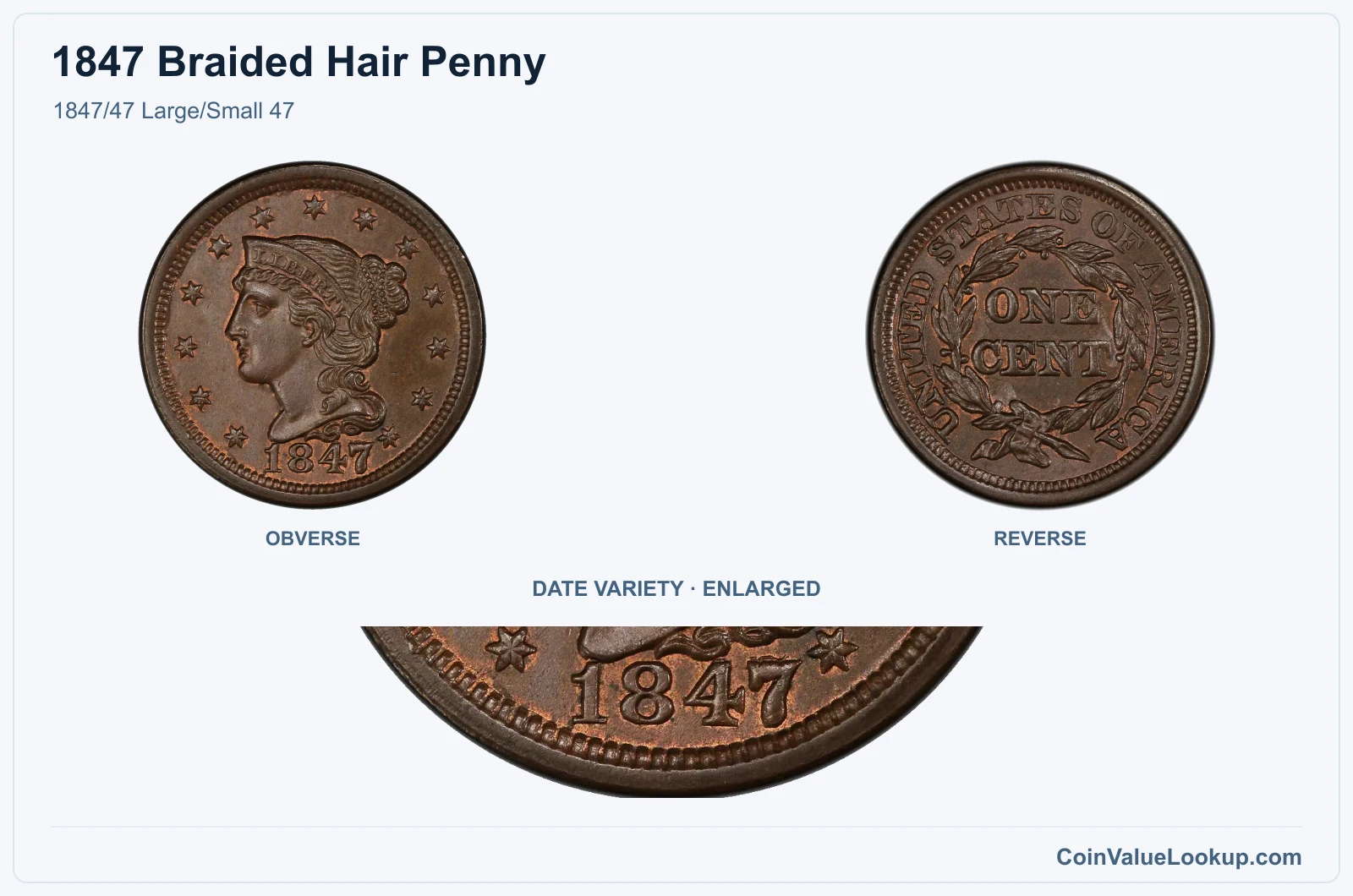
This is the overdate everyone checks for. The 1847/47 Large over Small 47 shows remnants of a smaller date punch beneath the final digits.
Under magnification, look for ghost outlines or serifs from the earlier, smaller "4" and "7" peeking out from under the larger final numerals.
USA Coin Book guides this variety from about $91 in G4 to roughly $4,246 in MS63, a significant jump over the normal date at every grade. The overdate traces can be hard to spot on heavily worn coins, so a loupe or USB microscope helps.
Do not confuse die cracks running through the date area with overdate remnants; the overdate shows a second, slightly offset numeral shape, not a random raised line.
Coin Value Lookup is a good starting point if you want to compare this variety's range against other Braided Hair dates before deciding whether to send your coin for professional attribution.
| Range | Grade | Price | Auction Records | Appraisal |
|---|---|---|---|---|
| PO | PO 1 | — | Coin Identifier | |
| FR | FR 2 | — | Coin Identifier | |
| AG | AG 3 | — | Coin Identifier | |
| G | G 4 | — | Coin Identifier | |
| G 6 | — | Coin Identifier | ||
| VG | VG 8 | — | Coin Identifier | |
| VG 10 | — | Coin Identifier | ||
| F | F 12 | — | Coin Identifier | |
| F 15 | — | Coin Identifier | ||
| VF | VF 20 | — | Coin Identifier | |
| VF 25 | — | Coin Identifier | ||
| VF 30 | Coin Identifier | |||
| VF 35 | Coin Identifier | |||
| XF | XF 40 | Coin Identifier | ||
| XF 45 | Coin Identifier | |||
| AU | AU 50 | Coin Identifier | ||
| AU 53 | Coin Identifier | |||
| AU 55 | Coin Identifier | |||
| AU 58 | Coin Identifier | |||
| MS | MS 60 | — | Coin Identifier | |
| MS 61 | Coin Identifier | |||
| MS 62 | Coin Identifier | |||
| MS 63 | Coin Identifier | |||
| MS 64 | Coin Identifier | |||
| MS 65 | Coin Identifier | |||
| MS 66 | — | — | — | |
| MS 67 | — | — | — | |
| MS 68 | — | — | — | |
| MS 69 | — | — | — | |
| MS 70 | — | — | — |
1847 Braided Hair Cent — PR
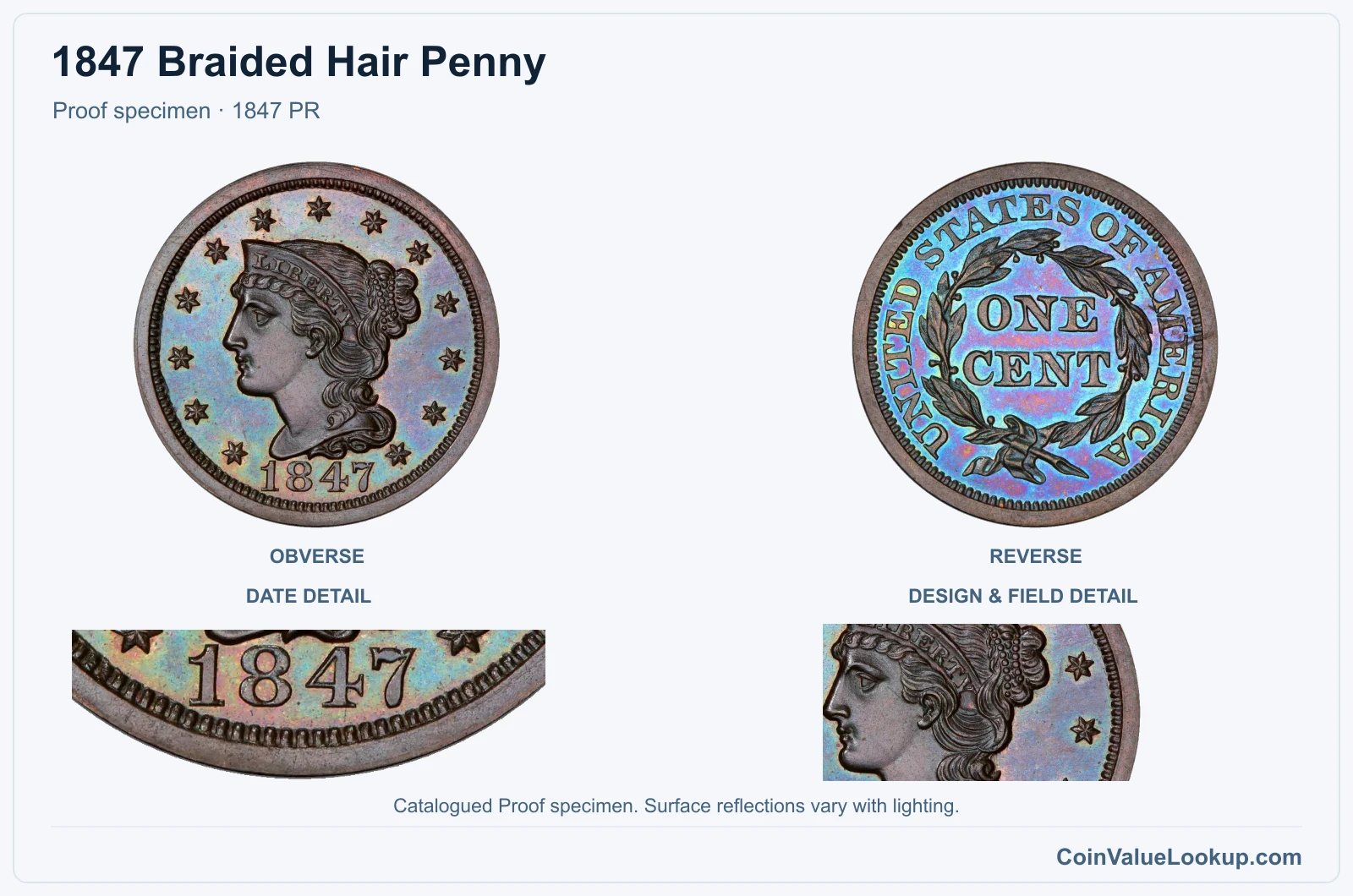
Proof 1847 Braided Hair Cents were made in very small numbers at Philadelphia. A genuine proof shows specific die characteristics: squared rims, a particular surface finish, and often identifiable die states that differ from business strikes.
Polishing a coin does not make it a proof. Attribution requires examination of rim structure, die diagnostics, and surface quality by someone experienced with the series.
No numeric guide price has been adopted here because proof examples need individual assessment based on authenticated identity, condition, and any errors present. If you suspect you have one, professional certification is the path forward.
| Range | Grade | Price | Auction Records | Appraisal |
|---|---|---|---|---|
| PR | PR 1 | — | Coin Identifier | |
| PR 2 | — | Coin Identifier | ||
| PR 3 | — | Coin Identifier | ||
| PR 4 | — | Coin Identifier | ||
| PR 6 | — | Coin Identifier | ||
| PR 8 | — | Coin Identifier | ||
| PR 10 | — | Coin Identifier | ||
| PR 12 | — | Coin Identifier | ||
| PR 15 | — | Coin Identifier | ||
| PR 20 | — | Coin Identifier | ||
| PR 25 | — | Coin Identifier | ||
| PR 30 | — | Coin Identifier | ||
| PR 35 | — | Coin Identifier | ||
| PR 40 | — | Coin Identifier | ||
| PR 45 | — | Coin Identifier | ||
| PR 50 | — | Coin Identifier | ||
| PR 53 | — | Coin Identifier | ||
| PR 55 | — | Coin Identifier | ||
| PR 58 | — | Coin Identifier | ||
| PR 60 | — | Coin Identifier | ||
| PR 61 | — | Coin Identifier | ||
| PR 62 | — | Coin Identifier | ||
| PR 63 | — | Coin Identifier | ||
| PR 64 | Coin Identifier | |||
| PR 65 | Coin Identifier | |||
| PR 66 | — | Coin Identifier | ||
| PR 67 | — | — | — | |
| PR 68 | — | — | — | |
| PR 69 | — | — | — | |
| PR 70 | — | — | — |
1847 Braided Hair Cent Error List
1. 1847 Braided Hair Cent — Off-Center Strike
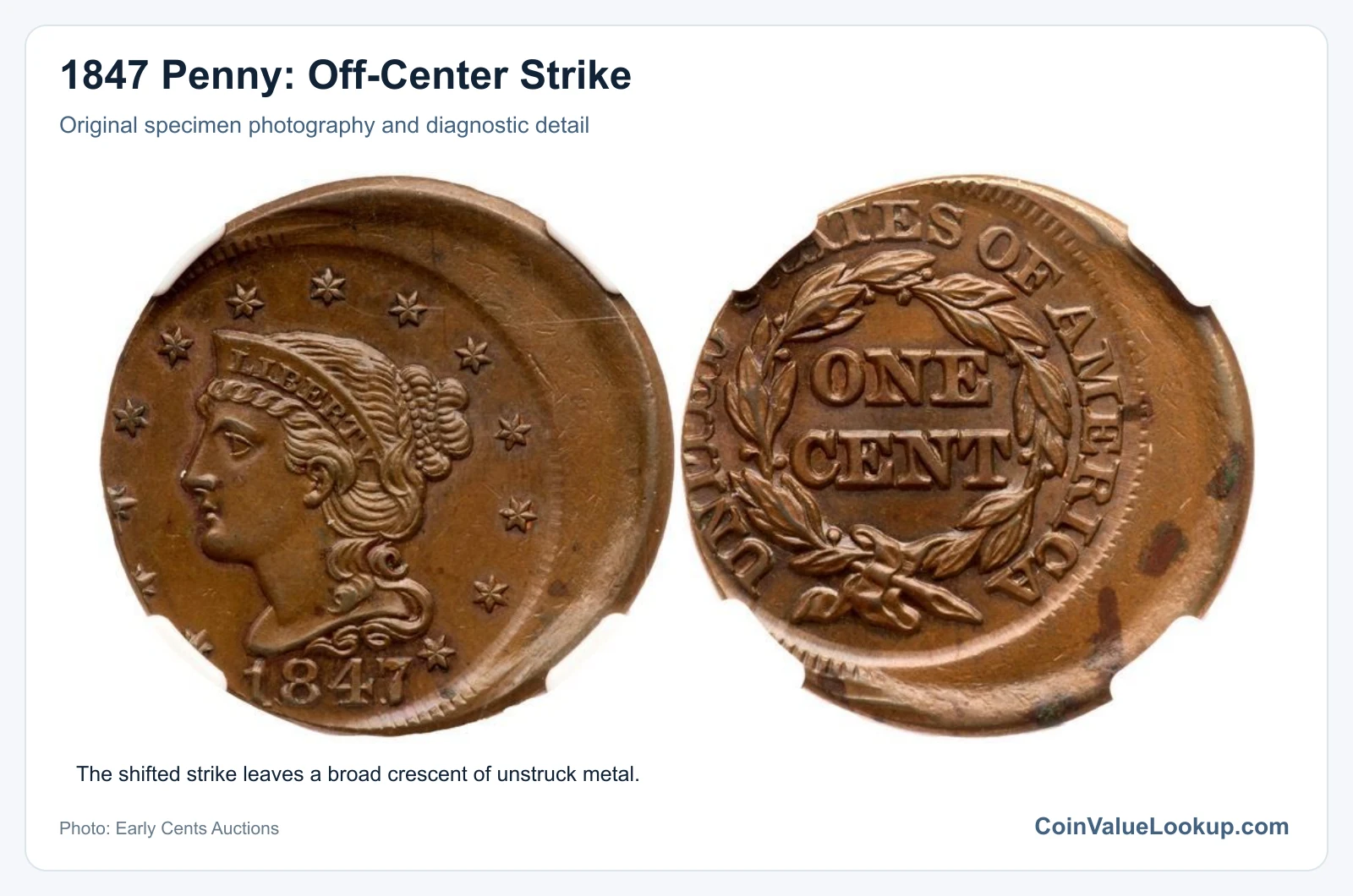
An off-center strike happens when the planchet is not seated properly between the dies. On an 1847 Braided Hair Cent, this produces a displaced design with an unstruck crescent along one side.
The most important thing for value is whether the full date remains visible. An off-center cent with the date intact is far more collectible than one missing key elements.
Look at the crescent area: it should show blank, undisturbed copper, not the flat shiny surface of a coin that was hammered or filed after leaving the mint.
Do not confuse a clipped planchet, a one-sided die misalignment, or post-mint flattening with a genuine off-center strike. Each error has a different market and different diagnostics.
No standard numeric price applies; these are assessed individually based on the degree of offset, date visibility, and overall condition.
2. 1847 Braided Hair Cent — Clipped Planchet
A clipped planchet occurs when the blank is cut incorrectly before striking, leaving a missing curved, straight, or ragged section. On an 1847 cent, look for a portion of the rim and adjacent design that simply is not there, combined with a characteristic weakness on the opposite side where metal could not fully flow into the die.
That opposite-side weakness is a useful diagnostic. It is hard to fake convincingly because it results from how metal distributes during the strike.
Compare the edge texture at the clip boundary to the rest of the coin; a genuine clip will show a different edge character than the struck rim.
Post-mint damage such as a filed notch, an edge cut, or heavy corrosion eating away the rim can look similar at first glance. Pricing depends on the clip type, size, and overall coin condition, assessed individually.
3. 1847 Braided Hair Cent — Lamination / Split Planchet
Lamination errors show up as peeling metal, a retained flap, or a visible separation within the copper. On an 1847 Braided Hair Cent, impurities or gas trapped during the rolling process can cause layers to split apart.
Photograph the edge and the affected face together. A genuine lamination will show a natural separation plane within the metal, often with a slightly different color or texture where the layers parted.
The flap, if still attached, bends naturally from the surface rather than looking like it was pried up.
The main lookalikes are scraping, corrosion pitting, and deliberately cut or peeled coins. Corrosion tends to be more random and pitted, while a lamination follows the plane of the metal.
Value depends on severity, location, and the coin's overall grade; no standard price applies.
4. 1847 Braided Hair Cent — Die Crack
Die cracks appear as raised lines crossing the fields or devices. They form when the steel die develops a fracture during use, and metal fills that fracture during striking.
The key word is raised. Run your fingernail across the suspected line.
A die crack sits above the surface, while a scratch or tool mark is incuse, meaning it digs into the metal. Corrosion lines are also typically recessed or rough, not cleanly raised.
On an 1847 cent, die cracks are not uncommon because copper large-cent dies saw hard use. Minor cracks add modest interest; dramatic cracks running across the portrait or through the date attract more attention.
Value depends on the crack's extent, location, and the coin's grade, assessed case by case.
5. 1847 Braided Hair Cent — Die Break / Cud
A cud is a specific type of die break where a piece of the die breaks away at the rim, leaving a raised, featureless blob of metal on the finished coin. It connects to the rim, which distinguishes it from an interior die chip that sits fully within the design.
On an 1847 Braided Hair Cent, look for a lump of raised metal along the edge that obliterates part of the design or legend. The boundary between the cud and the normal design should be abrupt.
Do not confuse a rim dent, corrosion buildup, or an interior die chip with a true cud. Rim damage is depressed, not raised.
Cuds are valued individually based on size, location, and how dramatically they displace the design. A large cud over a key part of the legend or date is more desirable.
6. 1847 Braided Hair Cent — Struck-Through Error
A struck-through error occurs when foreign material sits between the die and the planchet during striking. The result is a localized depression or an incomplete area of the design where the obstruction blocked the die's impression.
On an 1847 cent, grease fills are one common type, leaving a smooth, slightly recessed patch. A retained foreign object, such as a thread or metal fragment, can leave a more distinct impression.
Keep these descriptions separate because they represent different subcategories.
The main lookalikes are ordinary wear, cleaning, and weak strike areas. A struck-through depression typically has sharper boundaries than gradual wear and does not follow the high points the way circulation loss does.
Value is determined individually by the size of the affected area, clarity of the impression, and overall coin condition.
7. 1847 Braided Hair Cent — Repunched Date
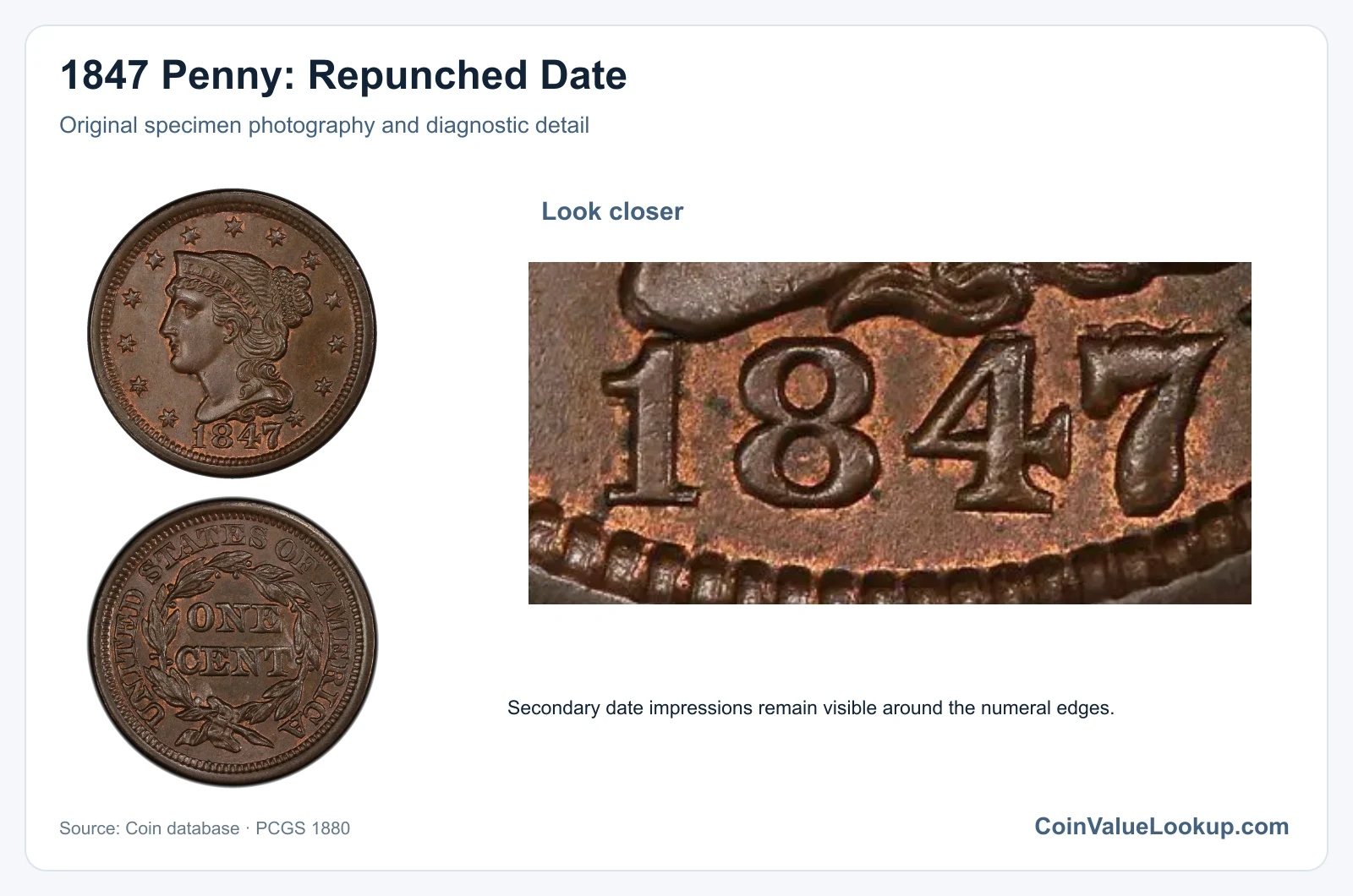
Before hub technology automated date placement, each die had its date punched in by hand. A repunched date on an 1847 cent shows remnants of an earlier punch position beside or beneath the final numerals.
This is distinct from the Large over Small 47 overdate, which involves two different-sized punches rather than the same punch applied twice in slightly different positions. It is also different from machine doubling, which affects the entire design and produces flat, shelf-like doubling rather than rounded secondary digits.
Look for shadowed outlines near individual date numerals, especially under magnification. A damaged or corroded date can mimic repunching, so examine whether the extra traces are raised and consistent with a second impression.
Pricing is assessed individually based on the clarity of the repunching and the coin's grade.