1963 Lincoln Penny Coin Value: How Much Is It Worth?
Most 1963 Lincoln pennies you pull from a jar are worth about what you'd expect — not much beyond face value. In uncirculated condition at MS65, guide estimates from USA Coin Book place either the Philadelphia or Denver issue around $1.24, while a PR65 proof runs about $1.88.
The real finds here are well-preserved original-color uncirculated coins, proof doubled die reverses, and the occasional wrong-planchet error.
Fast Way to Identify Your 1963 Lincoln Penny
Snap a clear photo of the front and back of your 1963 penny and upload both images using the identifier on this page. It can give you a preliminary identification of your coin's mint version and general condition based on what it sees.
This is not a substitute for professional authentication or grading, but it is a solid first step before you dig deeper.
1963 Penny Value
Upload both sides of your 1963 Lincoln Penny.
Front Obverse
Upload photo
Back Reverse
Upload photo
Which 1963 Lincoln Penny Versions Are Worth Money?
- Uncirculated coins with original Red copper color can carry a premium over toned examples, even at the same certified grade.
- Proof coins should be checked for mirror-field quality, hairlines, and copper spots — clean surfaces matter more than shine.
- A proof with a recognized doubled die reverse is a distinct collectible, with a PR67 Red example selling for $1,260 at Heritage in May 2023.
- A 1963-D cent struck on a silver dime planchet is a genuine wrong-planchet error; a PCGS MS62 sold for $990 in May 2022.
- Split-planchet strikes, ragged clips, and off-center strikes are error categories reported for 1963 cents and worth examining if your coin looks abnormal.
Step 1: Identify Your 1963 Lincoln Penny Mint Mark and Version
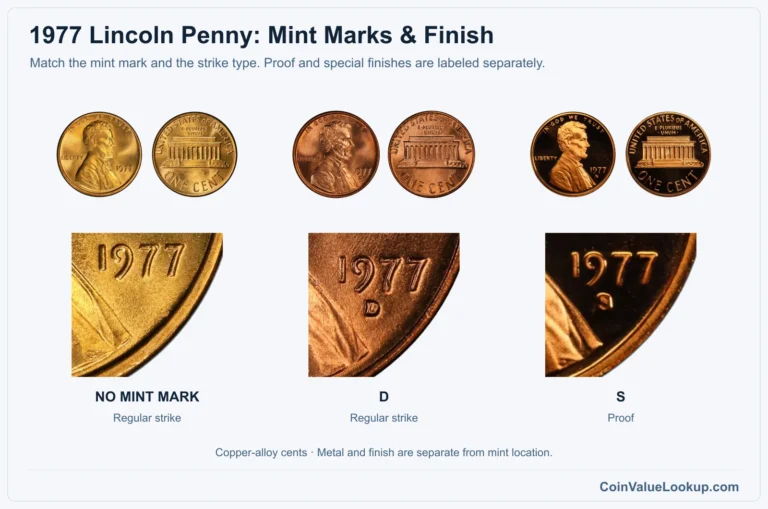
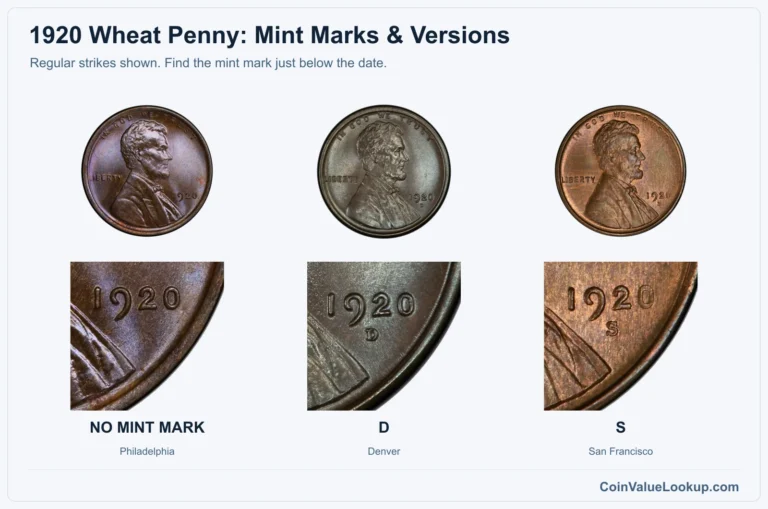
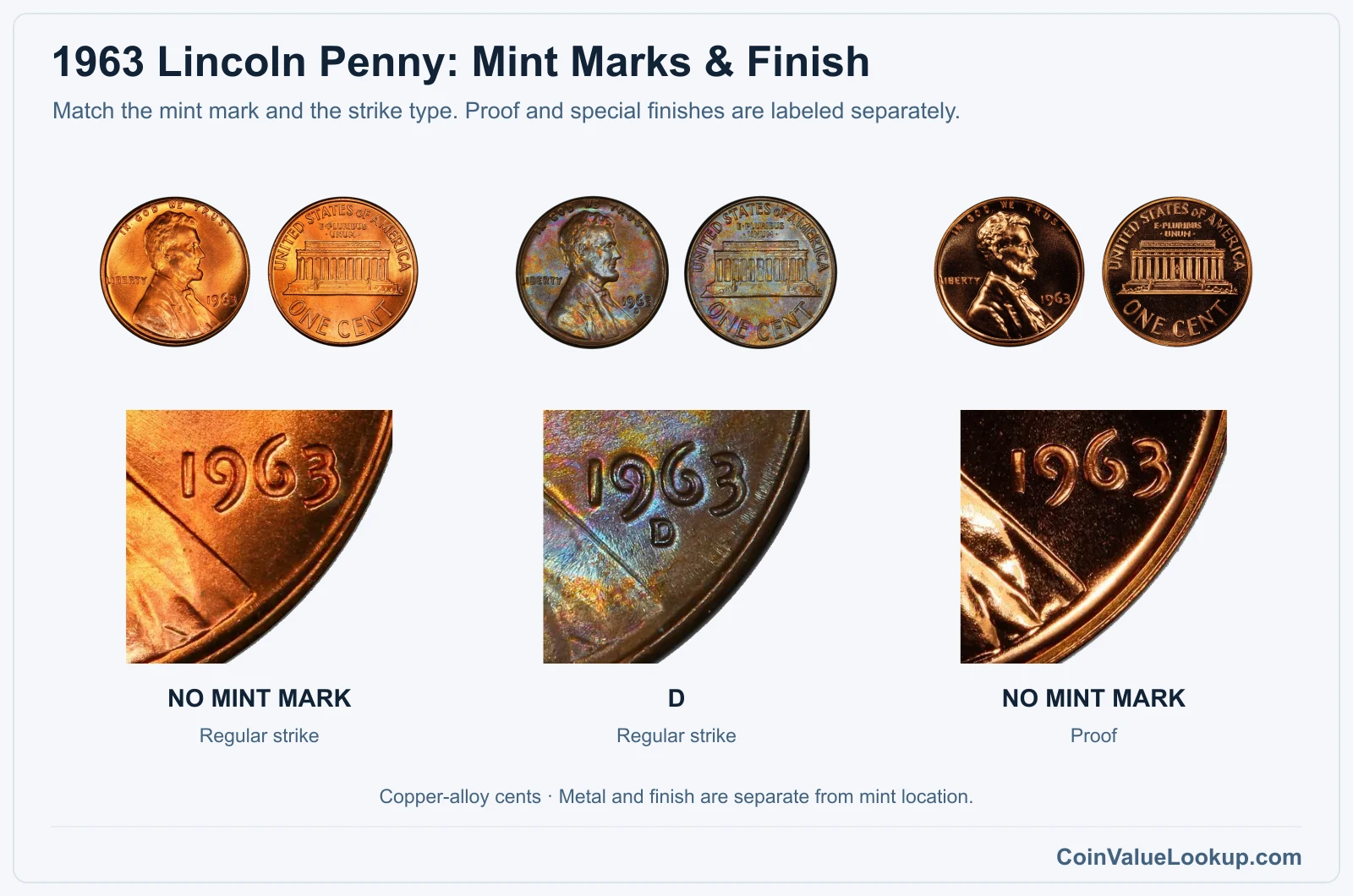
Look below the date on the obverse. No mint mark means Philadelphia.
A small D means Denver. There is no S-mint regular issue for 1963.
Every standard 1963 cent shows the Lincoln portrait on the front and the Lincoln Memorial on the back, with a plain edge. The alloy is 95% copper and 5% zinc — tin was removed from the cent composition in 1962, so these are technically brass, not bronze, though they look the same.
Do not confuse a shiny business strike with a proof. Proofs were struck at Philadelphia without a mint mark, so the mark alone will not separate them.
Proof coins have mirror-like fields and squared rims from the special striking process and were sold in collector sets, not released into circulation. A coin that simply looks shiny could just be lightly circulated or cleaned.
You may also see color designations: Red (RD), Red-Brown (RB), and Brown (BN). These describe how much original copper luster remains, not different metals.
A full Red coin held its original color; Brown has toned naturally over decades.
Step 2: Check Your 1963 Lincoln Penny Grade
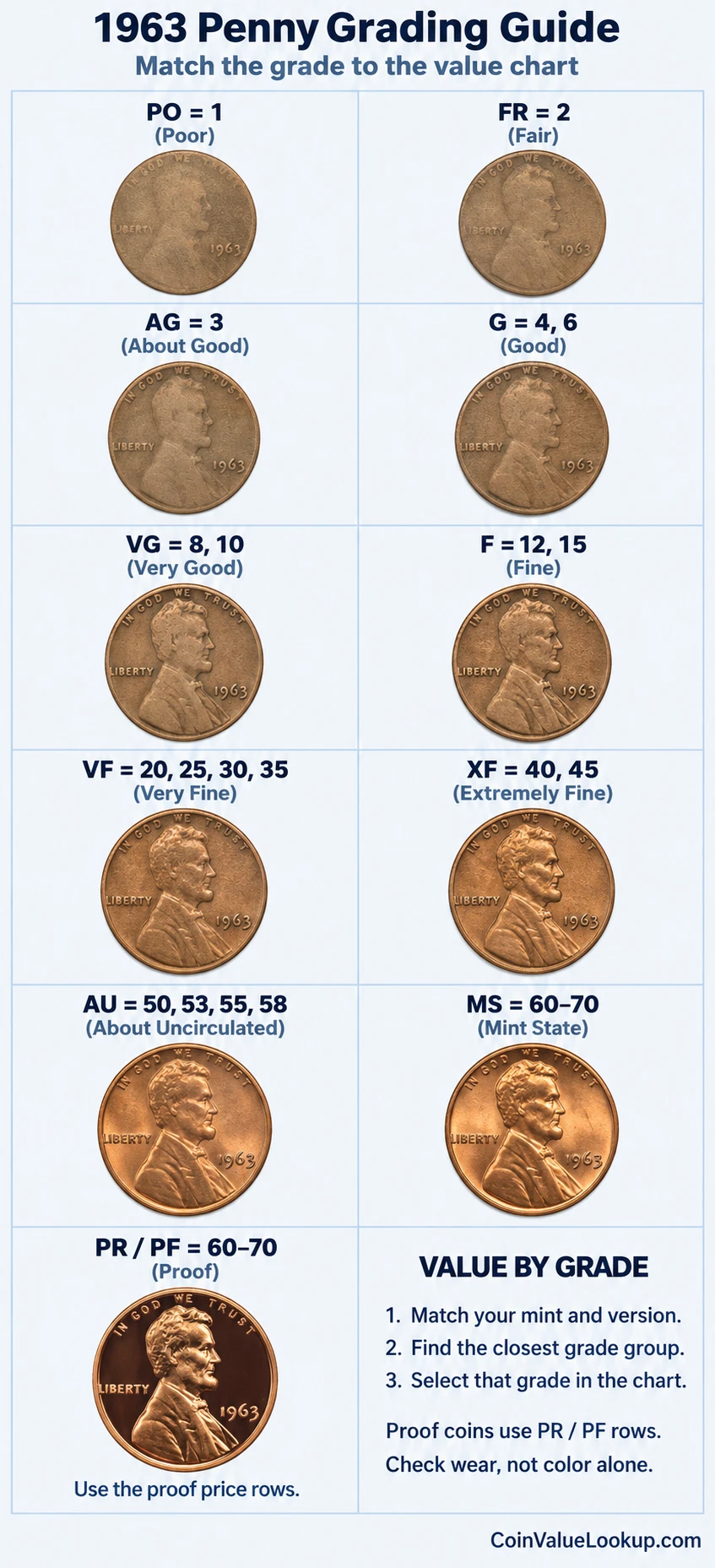
Start on the obverse. Lincoln's cheekbone and jawline show wear first, followed by the hair detail above his ear.
On the reverse, check the roof of the Memorial, the columns, and especially the tiny steps at the base — those steps vanish quickly with circulation.
Luster is your friend. A coin with unbroken cartwheel luster across the high points is Mint State, even if the copper has darkened to chocolate brown.
A bright, shiny coin with flat high points is more likely cleaned than uncirculated. Compare your coin to the reference image to gauge where it falls.
For proofs, look at the mirror fields under good light. Hairlines from mishandling and copper spots from improper storage both reduce the grade.
If a proof was spent or carried in a pocket, it is an impaired proof and should not be compared directly to guide prices for problem-free grades.
Color designations — RD, RB, BN — and cameo contrast on proofs are separate filters in pricing. A fully Red MS65 will generally bring more than a Brown MS65, though the guide anchors here do not break out every color tier.
Step 3: Check 1963 Lincoln Penny Value by Mint and Version
1963 Lincoln Penny — No Mint Mark — Business Strike
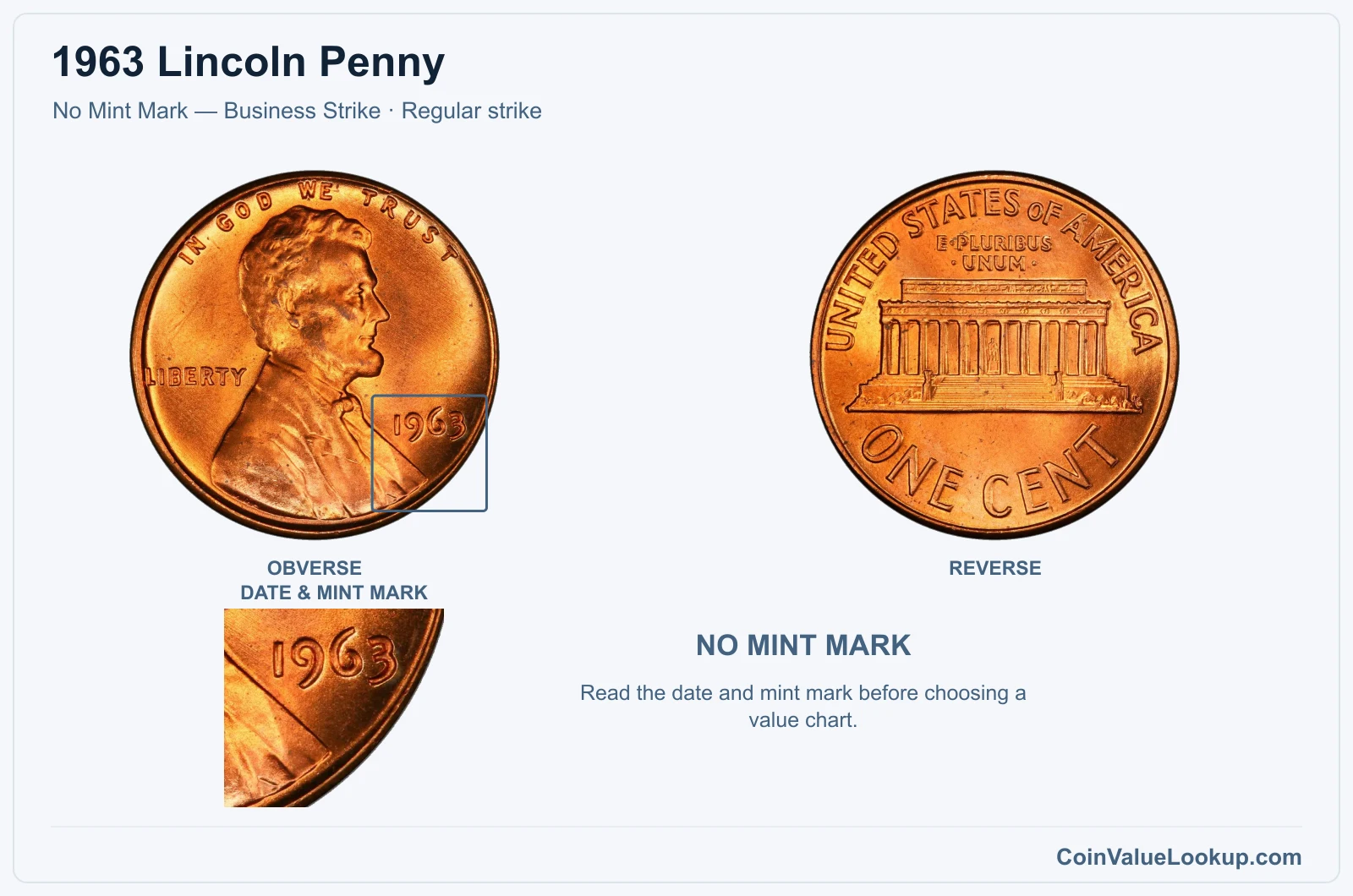
The Philadelphia 1963 cent carries no mint mark beneath the date. It is the most common version of the year, struck in the 95% copper / 5% zinc alloy adopted after tin was removed in 1962.
USA Coin Book guide estimates place this coin at roughly $0.18 in MS60 and $1.24 in MS65.
What separates a dollar coin from a few-cent coin here is preservation and original copper color. Look for full luster, no contact marks on Lincoln's cheek, and as much original reddish tone as possible.
A dark but untouched coin beats a bright but cleaned one every time.
Range Grade
Price1963 No Mint Mark — Business Strike (BN) Price1963 No Mint Mark — Business Strike (RB) Price1963 No Mint Mark — Business Strike (RD) Auction Records Appraisal PO PO 1
—
Coin Identifier FR FR 2
—
Coin Identifier AG AG 3
—
Coin Identifier G G 4
—
Coin Identifier
G 6
—
Coin Identifier VG VG 8
—
Coin Identifier
VG 10
—
Coin Identifier F F 12
—
Coin Identifier
F 15
—
Coin Identifier VF VF 20
—
Coin Identifier
VF 25
—
Coin Identifier
VF 30
—
Coin Identifier
VF 35
—
Coin Identifier XF XF 40
—
Coin Identifier
XF 45
—
Coin Identifier AU AU 50
—
Coin Identifier
AU 53
—
Coin Identifier
AU 55
—
Coin Identifier
AU 58
—
Coin Identifier MS MS 60
—
—
Coin Identifier
MS 61
—
—
Coin Identifier
MS 62
—
Coin Identifier
MS 63
—
Coin Identifier
MS 64
Coin Identifier
MS 65
Coin Identifier
MS 66
Coin Identifier
MS 67
—
Coin Identifier
MS 68
—
—
—
—
—
MS 69
—
—
—
—
—
MS 70
—
—
—
—
—
1963 Lincoln Penny — D — Business Strike
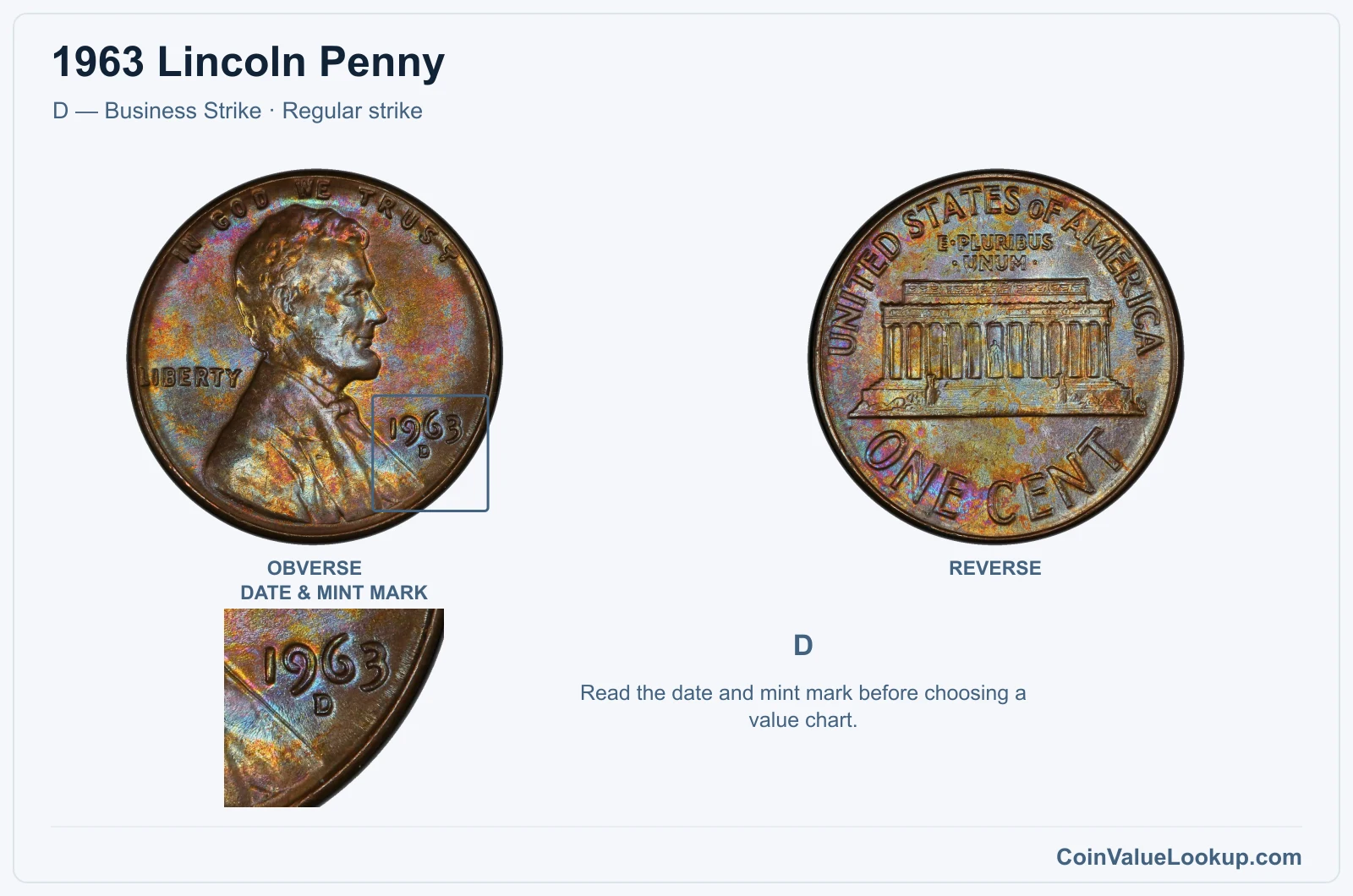
The Denver issue shows a small D below the date on the obverse. Same alloy, same design, same general availability as the Philadelphia coin.
Guide estimates from USA Coin Book are $0.18 at MS60 and $1.24 at MS65.
When examining your D-mint coin, take a close look at the mint mark itself. Repunched mint marks — where the D was stamped more than once in slightly different positions — are a known variety category for Lincoln cents of this era.
A loupe helps. If you see a shadow or second impression near the D, that is worth further research.
Range Grade
Price1963 D — Business Strike (BN) Price1963 D — Business Strike (RB) Price1963 D — Business Strike (RD) Auction Records Appraisal PO PO 1
—
Coin Identifier FR FR 2
—
Coin Identifier AG AG 3
—
Coin Identifier G G 4
—
Coin Identifier
G 6
—
Coin Identifier VG VG 8
—
Coin Identifier
VG 10
—
Coin Identifier F F 12
—
Coin Identifier
F 15
—
Coin Identifier VF VF 20
—
Coin Identifier
VF 25
—
Coin Identifier
VF 30
—
Coin Identifier
VF 35
—
Coin Identifier XF XF 40
—
Coin Identifier
XF 45
—
Coin Identifier AU AU 50
—
Coin Identifier
AU 53
—
Coin Identifier
AU 55
—
Coin Identifier
AU 58
—
Coin Identifier MS MS 60
—
Coin Identifier
MS 61
—
Coin Identifier
MS 62
—
Coin Identifier
MS 63
Coin Identifier
MS 64
Coin Identifier
MS 65
Coin Identifier
MS 66
Coin Identifier
MS 67
—
—
Coin Identifier
MS 68
—
—
—
—
—
MS 69
—
—
—
—
—
MS 70
—
—
—
—
—
1963 Lincoln Penny — No Mint Mark — Proof
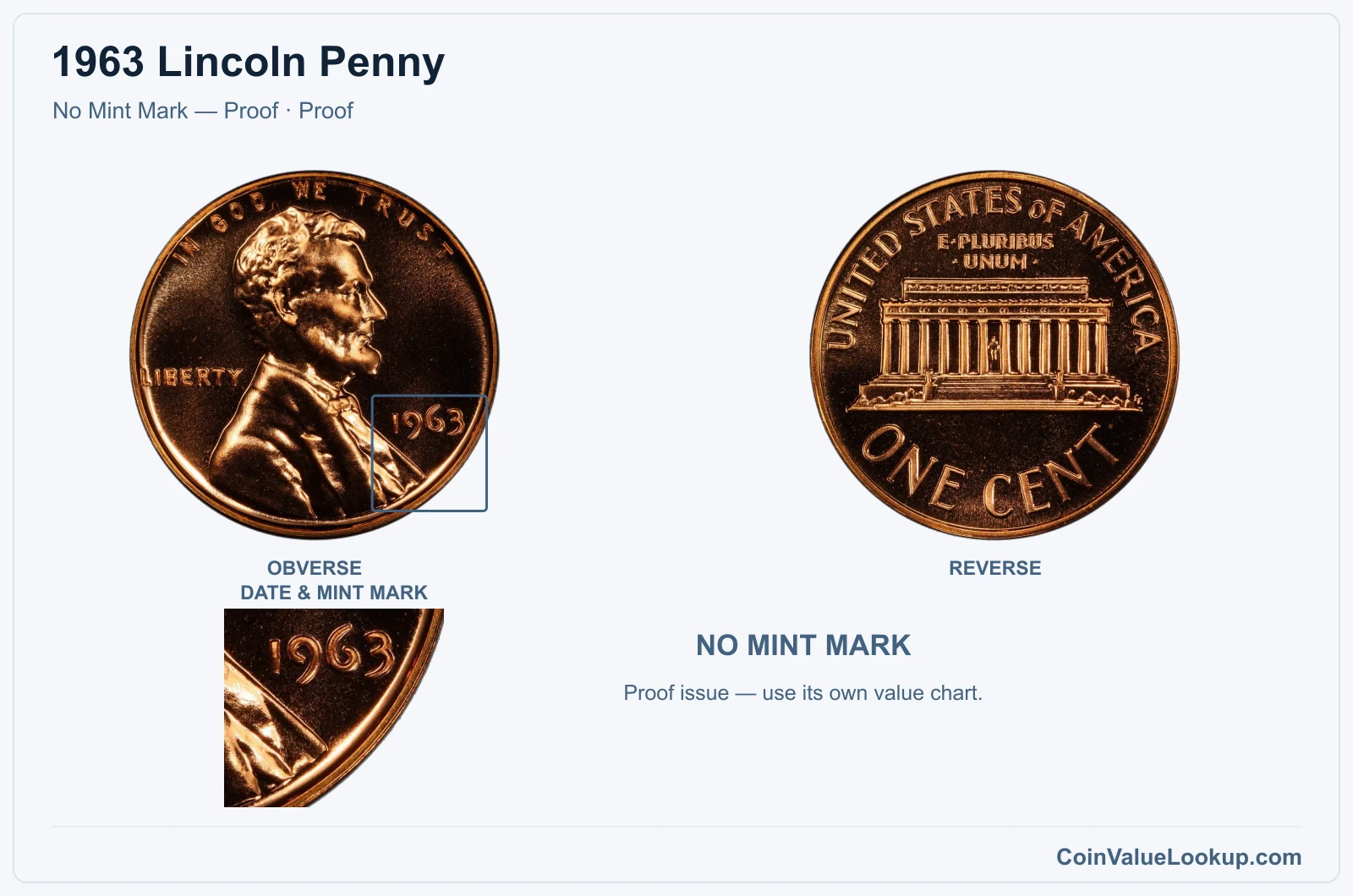
Philadelphia also struck proof cents for 1963 collector sets. These carry no mint mark, just like the business strikes, so identification depends on the coin's surfaces and provenance.
Genuine proofs have deeply mirrored fields, sharp squared rims, and were originally sold in sealed proof sets.
Coin Value Lookup is a good starting point if you want to compare your 1963 proof against other years or denominations. You can look up guides for the full Lincoln cent series and beyond.
USA Coin Book places the PR65 guide value at about $1.88. Cameo contrast — where Lincoln's portrait appears frosty against a mirror background — and full Red color are premium features within the proof category.
Do not compare a proof that has been removed from its holder and spent with these guide figures; impaired proofs are a different market entirely.
Range Grade
Price1963 No Mint Mark — Proof (CAM) Price1963 No Mint Mark — Proof (DCAM) Auction Records Appraisal PR PR 1
—
Coin Identifier
PR 2
—
Coin Identifier
PR 3
—
Coin Identifier
PR 4
—
Coin Identifier
PR 6
—
Coin Identifier
PR 8
—
Coin Identifier
PR 10
—
Coin Identifier
PR 12
—
Coin Identifier
PR 15
—
Coin Identifier
PR 20
—
Coin Identifier
PR 25
—
Coin Identifier
PR 30
—
Coin Identifier
PR 35
—
Coin Identifier
PR 40
—
Coin Identifier
PR 45
—
Coin Identifier
PR 50
—
Coin Identifier
PR 53
—
Coin Identifier
PR 55
—
Coin Identifier
PR 58
—
Coin Identifier
PR 60
—
Coin Identifier
PR 61
—
Coin Identifier
PR 62
—
Coin Identifier
PR 63
—
Coin Identifier
PR 64
—
Coin Identifier
PR 65
—
Coin Identifier
PR 66
Coin Identifier
PR 67
Coin Identifier
PR 68
Coin Identifier
PR 69
Coin Identifier
PR 70
—
—
—
—
1963 Lincoln Penny Error List
1. 1963 Lincoln Penny — Proof Doubled Die Reverse
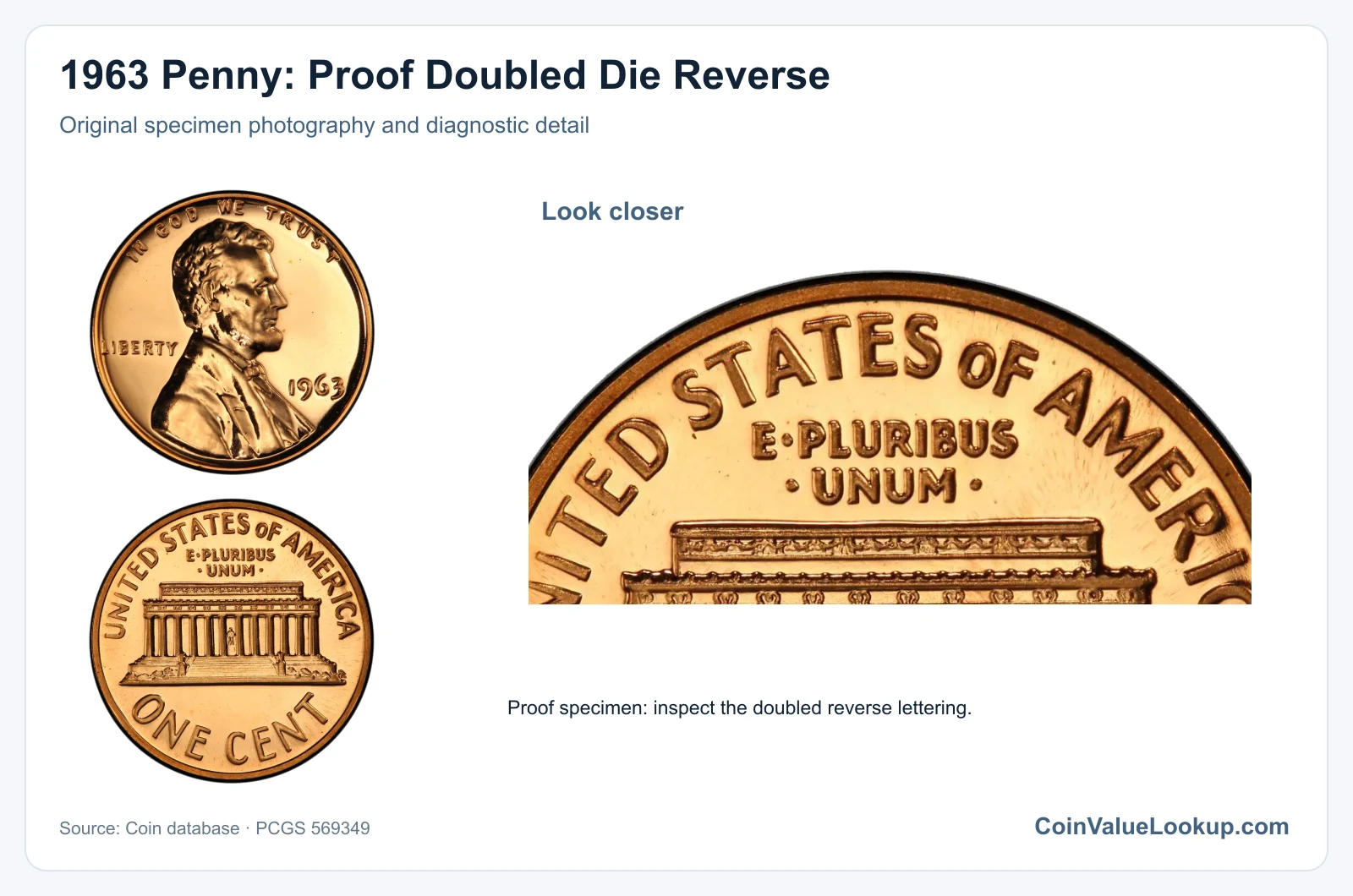
This is a 1963 proof cent with a recognized doubled die reverse. Under magnification, you can see raised secondary contours on the reverse lettering, particularly around the legends near the Memorial.
The doubling is consistent across multiple letters, which separates it from single-spot anomalies.
Do not confuse this with machine doubling, which tends to produce flat, shelf-like distortions rather than the rounded, raised secondary image of a true doubled die. Reflections off the proof's mirror surface can also trick the eye, so use steady directional light and a loupe.
A PCGS-graded PR67 Red example sold for $1,260 at Heritage Auctions in May 2023. That is a single recorded sale at a high grade and should not be read as a general market range for every proof DDR regardless of condition.
2. 1963 Lincoln Penny — Struck on a Silver Dime Planchet
A 1963-D cent struck on a silver dime planchet is a wrong-planchet error — the copper-cent dies struck a blank intended for a Roosevelt dime. The result is a silver-colored Lincoln cent that is slightly smaller and lighter than normal, with stretched or weak lettering near the rim and soft central details because the blank was the wrong size for the cent dies.
Not every silver-looking 1963 penny is this error. Plated pennies, chemically altered surfaces, and environmental damage can all make a copper cent look silvery.
Check the weight and diameter: a dime planchet weighs about 2.5 grams versus the cent's 3.11 grams, and it will be visibly smaller in diameter.
A PCGS MS62 example sold for $990 at auction in May 2022. That is one authenticated sale, not a price you should expect for an unverified coin.
3. 1963 Lincoln Penny — Struck on a Split Planchet
A split-planchet cent occurs when the metal blank separates into layers before the coin is struck. The result is a thin, underweight coin — roughly 1.6 grams instead of the standard 3.11 grams — that still shows the Lincoln cent design on both sides, though weakly impressed because the thinner blank could not fill the dies fully.
The texture of a genuine split planchet is distinctive. One side will look relatively normal while the other may show a rough, striated internal-metal surface.
Compare this to a cent that was ground down or acid-etched after minting, which produces smoother or pitted surfaces without the characteristic lamination texture.
Also distinguish pre-strike splits from post-strike splits. A coin that cracked apart after being struck will show full design detail on the intact face.
Value depends on the authenticated identity, condition, and severity of the error, so professional assessment is the way to go.
4. 1963 Lincoln Penny — Ragged Clipped Planchet
A ragged clipped planchet means the blank was torn or incompletely punched from the metal strip before striking, leaving an irregular chunk of missing metal along the edge. On a 1963 no-mint-mark cent, a reported example shows about a 4% ragged clip.
The key diagnostic is original mint-origin edge metal and evidence that the strike flowed around the missing area. You should see the design weakening or distorting near the clip, and the opposite side of the coin may show a slight weakness called the Blakesley effect.
Do not confuse this with post-mint damage. A coin that was cut, filed, or corroded after leaving the Mint will lack strike-flow evidence and often has tool marks or uneven edges.
Value for a genuine ragged clip depends on the authenticated identity, condition, and how dramatic the clip is, so individual assessment by a grading service is recommended.
5. 1963 Lincoln Penny — Doubled Die Obverse
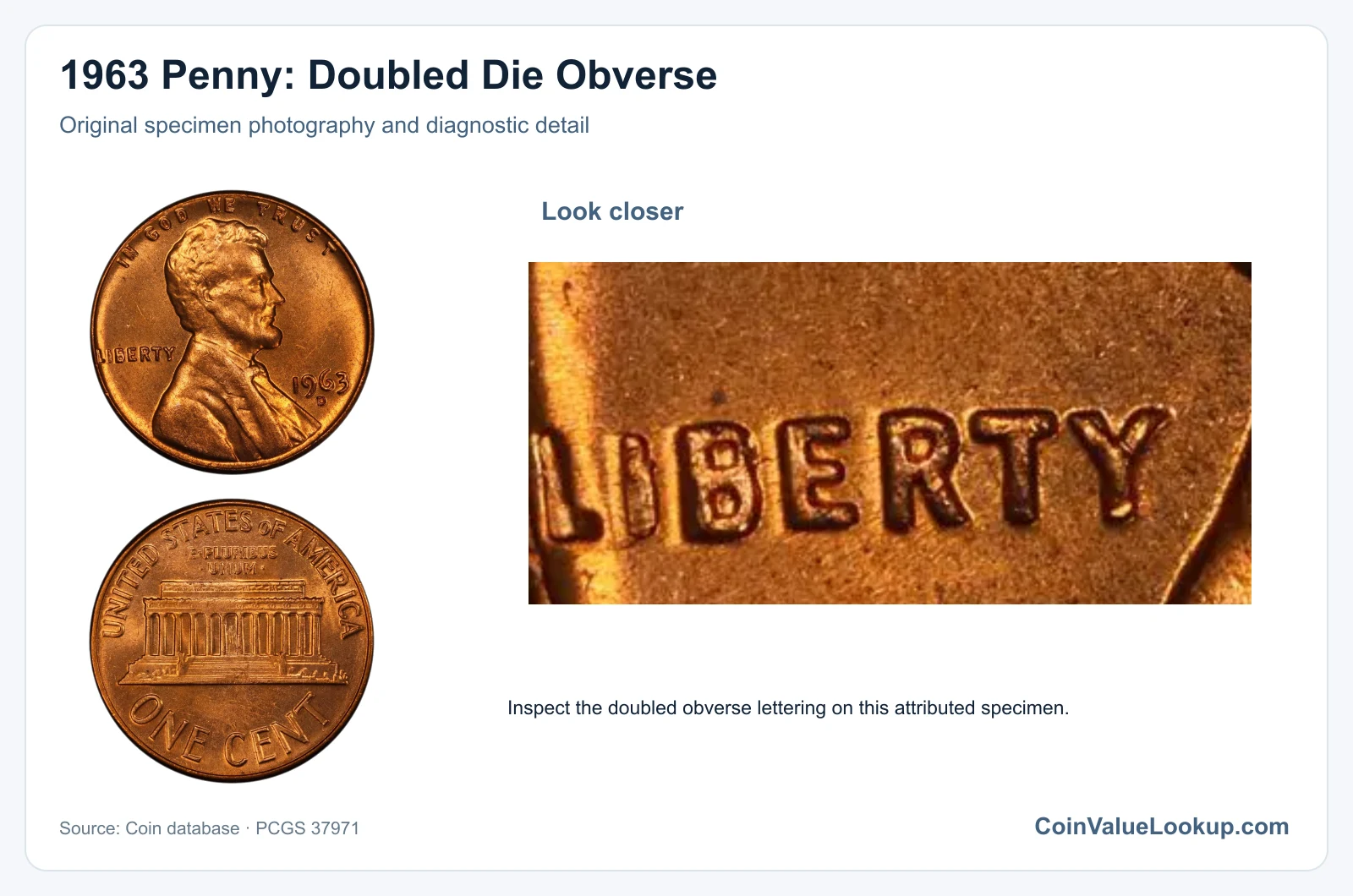
A doubled die obverse has been reported for the 1963-D cent. This variety shows consistent doubling on obverse design elements — look for separation or notching on the lettering or date when compared side by side with a normal 1963-D under identical lighting.
True doubled die doubling appears as a raised, rounded secondary image that repeats across multiple letters or design features in the same direction. Machine doubling, which is far more common and far less valuable, leaves a flat shelf on one side of the design elements.
The difference matters a lot to your wallet.
There is no adopted numerical price for this variety. Value depends on the specific doubled die, how visible the doubling is, and the coin's overall condition.
If you think you have one, comparison photos under magnification and professional authentication are the next steps.
6. 1963 Lincoln Penny — Off-Center Strike
An off-center strike happens when the blank is not properly seated between the dies, so part of the design is missing and a blank crescent of unstruck metal appears on one side. For a 1963 cent, the date needs to be fully visible for the coin to be attributable to this year — no date, no premium.
Do not confuse an off-center strike with a clipped planchet or a misaligned die. A clip removes metal from the blank itself, while a misaligned die shifts the entire design but still strikes the full planchet.
Post-mint flattening from damage can also mimic a mild off-center appearance.
No specific price is adopted for this error. The percentage of off-center displacement, date visibility, and overall condition all factor into what a given coin might bring.
More dramatic shifts with a full date tend to attract more collector interest.
7. 1963 Lincoln Penny — BIE Die Break
The BIE die break is a classic Lincoln cent variety. A small die crack between the letters B and E in LIBERTY creates a raised vertical line that looks like a capital I, spelling out what appears to be "BIIE" or similar.
It is caused by a crack in the die, not an engraving change.
On a 1963 cent, inspect the word LIBERTY carefully with a loupe. The raised bridge or blob should connect to the surrounding field and have a slightly irregular shape consistent with metal flowing into a die crack.
Dirt, scratches, or glued debris can mimic this, but those will not show the same integrated, raised-from-the-surface character.
No numerical price is adopted for this variety. BIE errors are popular with collectors who specialize in die varieties, and value depends on the clarity of the break and the coin's condition.
8. 1963 Lincoln Penny — Defective Planchet with a Blowhole
A defective planchet with a blowhole is a coin struck on a blank that contained a gas void or impurity within the metal. When the dies compress the blank, the void can open into a hole or pit on the coin's surface — that is the blowhole.
On a reported 1963 cent, the void appears behind Lincoln's head near LIBERTY.
The key is distinguishing a mint-caused void from post-mint damage. A genuine blowhole will have struck design detail flowing around and up to the edge of the void, and the surrounding metal should show no tool marks or corrosion.
A drilled hole has sharp, clean edges. Corrosion pits tend to be rough and affect the surrounding surface.
No specific price is adopted for this error. Value depends on the size and visibility of the blowhole, the coin's preservation, and whether it has been authenticated.
A certified example carries more weight than a raw coin with a suspicious hole.